Model Based Testing Market Size, Share, Growth and Forecast (2026 - 2036)

The Model Based Testing Market is segmented by Product (Model Based Test Design Platforms, Requirement Driven Testing Tools, Simulation Based Testing Platforms), End Use, and Region. Forecast for 2026 to 2036.

Model Based Testing Market Analysis and Forecast by Fact.MR

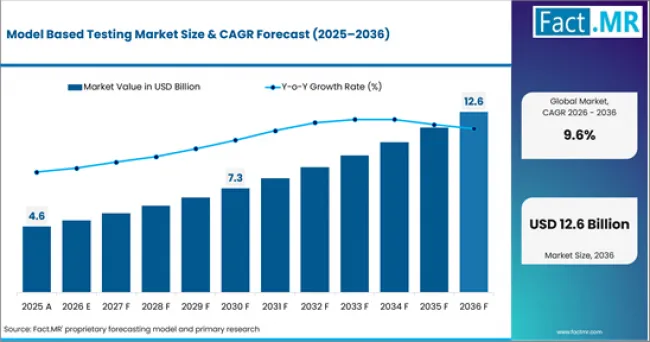
  • The Model Based Testing Market is expected to grow from USD 5.0 billion in 2026 to USD 12.6 billion by 2036, at a 9.6% CAGR.
  • Demand is driven by rising software architecture complexity, AI-augmented test generation, self-healing automation frameworks, and integration of model-based approaches into DevOps and continuous delivery pipelines.
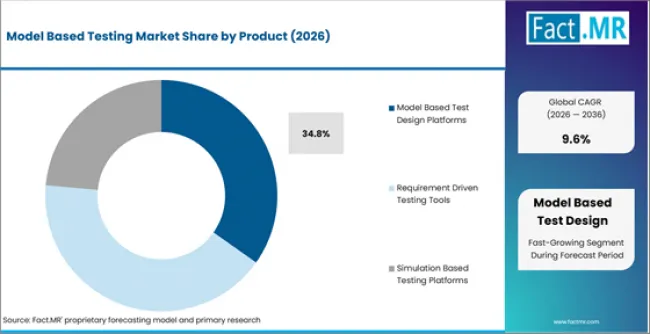
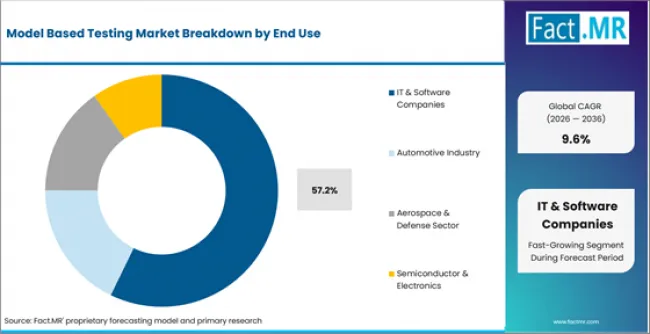
  • Model-based test design platforms account for 34.8% share, while IT and software companies contribute 57.2% end-use share as organizations prioritize test cycle compression, defect prevention, and engineering resource optimization.
Model Based Testing Market Value Analysis

Summary of the Model Based Testing Market

  • Market Snapshot
    • In 2025, the global Model Based Testing Market was valued at approximately USD 4.6 billion.
    • The market is estimated to reach USD 5.0 billion in 2026 and is projected to attain USD 12.6 billion by 2036.
    • The model based testing market is likely to expand at a CAGR of 9.6% during the forecast period.
    • The market is anticipated to create an absolute dollar opportunity of USD 7.6 billion between 2026 and 2036.
    • Model based test design platforms account for 34.8% of product segment share in 2026.
    • China (13.0%) and India (12.0%) are the key growth markets during the forecast period.
  • Demand and Growth Drivers
    • The growing complexity of enterprise software systems, microservices architectures, and multi-cloud deployments is increasing the cost and difficulty of manual test design, pushing organizations toward model-based approaches that generate test cases systematically from behavioral specifications.
    • DevOps and continuous delivery pipeline adoption is creating demand for testing tools that can produce, execute, and maintain test suites at deployment speed without proportional increases in QA engineering headcount.
    • AI-augmented test generation is extending MBT capabilities by using machine learning to identify high-risk code paths, predict defect-prone areas, and automatically create regression suites from production logs and natural-language requirements.
    • Regulatory compliance in automotive, aerospace, healthcare, and financial services is mandating traceable, requirements-linked testing that model-based frameworks deliver more consistently than ad-hoc manual approaches.
  • Product and Segment View
    • Model based test design platforms account for 34.8% of the product segment in 2026, supported by their ability to generate structured test cases from system behavior models across graph-based, state-machine, and UML-based approaches.
    • IT and software companies represent 57.2% of end-use demand in 2026, reflecting the primary adoption base among enterprise software firms, application development companies, and system integration providers managing large codebases.
    • Integrated modeling platforms lead the deployment model segment with 72.8% share in 2026, with cloud-based and SaaS delivery models gaining traction as distributed development teams require collaborative testing environments.
  • Key segmentation includes:
    • Product Type: Model-Based Test Design Platforms, Requirements-Driven Testing Tools, Simulation-Based Testing Platforms
    • End Use: IT & Software Companies, Automotive Industry, Aerospace & Defense Sector, Semiconductor & Electronics
    • Deployment Model: Integrated Modeling Platforms, Hybrid Testing Frameworks, API-Driven Testing Systems
    • These systems enable:
      • Systematic test case generation from behavioral models, reducing manual scripting effort while improving coverage of edge cases and state transitions.
      • Automated regression suite maintenance through model updates rather than individual script rewrites when application requirements change.
      • Traceability between requirements, test models, and executed test cases, supporting compliance documentation in regulated industries.
      • Geography and Competitive Outlook
      • North America leads adoption with strong demand from enterprise software firms, financial services, and automotive OEMs integrating MBT into continuous delivery pipelines across the United States and Canada.
      • Europe maintains steady growth, with Germany (11.0%) supported by automotive and industrial software testing requirements, and the United Kingdom benefiting from financial services compliance and digital government testing mandates.
      • Asia Pacific is the fastest-growing region, with China (13.0%) and India (12.0%) expanding through IT services companies scaling MBT across global delivery centers and domestic digital transformation programs.
      • IBM Corp, Accenture, Capgemini, Wipro, Tricentis, Cognizant Technology Solutions Corporation, Infosys, HCL Technologies, and OpenText Corporation are among the key companies shaping competitive dynamics.
  • Analyst Opinion
    • Shambhu Nath Jha, Principal Consultant at Fact.MR, says "The model based testing market is entering a structural growth phase as organizations recognize that manual test maintenance cannot scale alongside the velocity of modern software releases. The economics are straightforward: as applications grow more complex and release cycles compress, the cost of maintaining hand-written test suites rises faster than QA budgets. Model-based approaches address this by linking test generation directly to system specifications, so changes in one propagate automatically to the other. AI augmentation is accelerating this shift by enabling platforms to predict which tests matter most and generate them without waiting for human modeling effort."

Key Growth Drivers, Constraints, and Opportunities
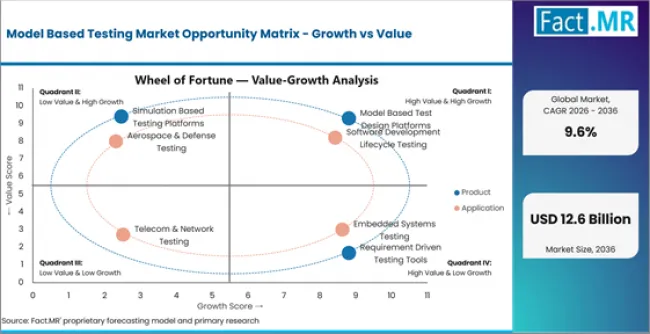
Model Based Testing Market Opportunity Matrix Growth Vs Value

Key Factors Driving Growth

  • Microservices decomposition of enterprise applications is generating exponential growth in required test coverage, as each service boundary, API contract, and integration point needs systematic validation that manual approaches cannot deliver at acceptable cost or speed.
  • Continuous delivery pipeline requirements are compressing testing windows from weeks to minutes, forcing QA teams to adopt model-based platforms that can generate, execute, and validate regression suites within automated deployment workflows.
  • Regulatory mandates in automotive software (ISO 26262), medical device software (IEC 62304), and financial services (SOX compliance) are requiring traceable, requirements-linked test documentation that model-based frameworks produce more reliably than manual scripting.

Key Market Constraints

  • Initial modeling effort and organizational learning curves slow adoption, as QA teams must invest time in creating behavioral specifications before model-based platforms can generate meaningful test suites.
  • Integration complexity with legacy test management tools and proprietary CI/CD environments limits deployment speed for organizations with entrenched testing infrastructure.
  • Shortage of engineers with combined domain expertise in behavioral modeling, formal methods, and practical QA operations constrains the speed at which organizations can scale model-based testing programs.

Key Opportunity Areas

  • AI-powered test generation that learns from production incident logs, user behavior data, and code commit patterns is enabling model-based platforms to create targeted test suites without requiring complete upfront behavioral modeling.
  • Growing adoption of digital twin and simulation-based testing in automotive, aerospace, and industrial IoT is creating demand for model-based approaches that can validate system behavior across virtual and physical environments simultaneously.
  • Cloud-native SaaS delivery models are lowering the entry barrier for mid-market organizations, enabling MBT adoption without large upfront infrastructure investments or specialized on-premise deployment.

Segment-wise Analysis of the Model Based Testing Market

  • Model based test design platforms hold 34.8% of the product segment in 2026, supported by their ability to generate test cases from structured system models across multiple modeling paradigms.
  • IT and software companies account for 57.2% of end-use demand in 2026, reflecting the concentration of large-scale testing requirements in enterprise software development and system integration environments.
  • Integrated modeling platforms lead the deployment model segment with 72.8% share, combining test design, execution, and reporting capabilities within unified environments that support collaborative model development.

The model-based testing market is segmented by product type, application, end use, technology, deployment model, distribution channel, and region. By product type, the market covers model-based test design platforms, graph-based and state-machine modeling systems, UML-based tools, and behavioral modeling systems. By end use, coverage includes IT and software companies, automotive and aerospace, BFSI, healthcare, and telecom. Model-based test design platforms lead by value due to their broad applicability across modeling paradigms and their integration with CI/CD toolchains.

Which Product Segment Dominates the Model Based Testing Market?
Model Based Testing Market Analysis By Product

Model based test design platforms account for 34.8% of the product segment in 2026. Their leadership reflects the broad applicability of structured test design tools across industries and testing maturity levels. These platforms support multiple modeling paradigms, including graph-based, state-machine, and behavioral specifications, enabling organizations to adopt model-based testing incrementally without committing to a single methodology. Integration with established CI/CD toolchains and test management platforms further supports adoption across enterprise environments.

Graph-based and state-machine modeling tools hold supporting positions, catering to organizations with specific modeling requirements in embedded systems, control software, and protocol testing. UML-based approaches remain relevant in regulated industries where formal specification documentation is a compliance requirement.

Which End-Use Segment Dominates the Model Based Testing Market?
Model Based Testing Market Analysis By End Use

IT and software companies are expected to lead the end-use segment with a 57.2% share in 2026. This dominance reflects the concentration of large-scale testing requirements in enterprise software firms, application development companies, system integration providers, and product engineering organizations managing complex, multi-platform codebases. The volume of test cases required to validate microservices architectures, API integrations, and multi-cloud deployments makes manual scripting increasingly impractical for these organizations.

Automotive and aerospace hold a growing share, driven by ISO 26262 and DO-178C compliance requirements that mandate structured, traceable testing for safety-critical software. Financial services and healthcare are also expanding adoption as digital transformation programs increase software complexity and regulatory scrutiny.

Which Technology Trend is Shaping the Next Phase of Growth in the Model Based Testing Market?

AI-augmented test generation is the most significant technology shift in the model-based testing market. Platforms are integrating machine learning to analyze production logs, code commit patterns, and user behavior data to identify high-risk areas and automatically generate targeted test cases. This reduces the upfront modeling effort that has historically slowed MBT adoption, allowing organizations to start generating meaningful test suites from existing system artifacts rather than building complete behavioral models from scratch.

Agentic AI frameworks that combine autonomous test creation with human oversight are gaining traction in enterprise environments. These systems can monitor CI/CD pipeline outputs, identify test gaps, suggest model refinements, and execute exploratory test scenarios without continuous manual direction. Early adopters report measurable reductions in test creation time and defect escape rates, creating a compelling business case for broader organizational rollout.

Regional Outlook Across Key Markets

  • China leads regional growth at 13.0%, supported by large-scale digital transformation programs across state-owned enterprises, rapid expansion of domestic software development capacity, and growing QA automation demand in fintech and e-commerce platforms.
  • India follows at 12.0%, driven by IT services companies scaling MBT capabilities across global delivery centers, domestic digital government testing programs, and automotive software development expansion under PLI manufacturing schemes.
  • North America maintains the largest market share, with demand concentrated in enterprise software, financial services, and automotive OEM testing programs across the United States and Canada.
  • Germany leads European growth at 11.0%, supported by automotive software testing requirements under ISO 26262, Industrie 4.0 digital twin validation, and financial services regulatory compliance.

Top Country Growth Comparison Model Based Testing Market Cagr (2026 2036)

CAGR Table

Country CAGR (%)
China 13.0%
India 12.0%
Germany 11.0%
UK 8.2%
USA 9.1%

Source: Fact MR analysis, based on proprietary forecasting model and primary research.
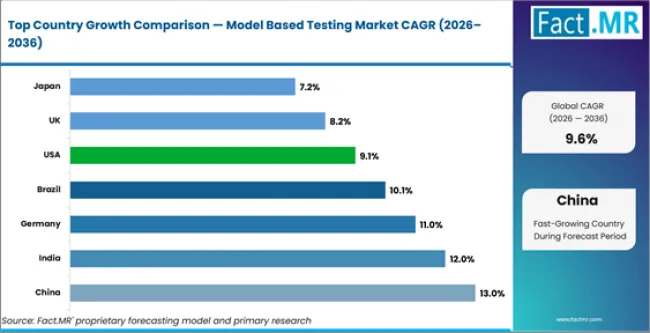
Model Based Testing Market Cagr Analysis By Country

Model Based Testing Demand Trends in the United States
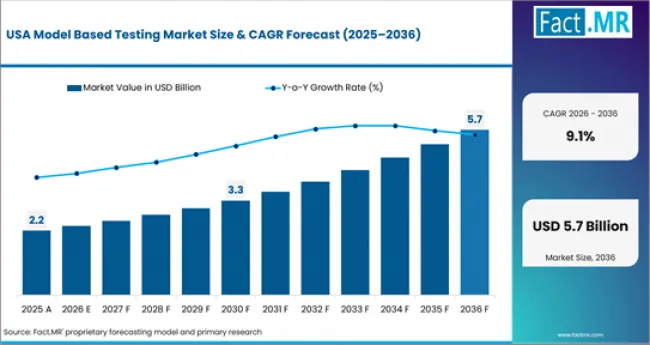
Model Based Testing Market Country Value Analysis

The USA model based testing market is projected to grow at 9.1% CAGR through 2036. The installed base of enterprise software testing infrastructure is mature, with growth shaped by replacement of legacy test automation tools with AI-augmented MBT platforms. CHIPS Act and IRA provisions supporting domestic semiconductor and technology manufacturing are also generating testing demand for embedded systems and automotive software validation programs.

  • Enterprise software firms and financial institutions are replacing legacy test automation with MBT platforms to compress testing cycles within accelerating CI/CD pipelines.
  • Automotive OEM testing programs for ADAS and autonomous driving software are creating specialized demand for model-based safety validation tools.

China Model Based Testing Growth Assessment

Government-backed digital transformation programs across state-owned enterprises and financial institutions are generating large-scale demand for structured testing platforms in China. Domestic software development capacity is expanding rapidly, and the volume of applications being built for e-commerce, fintech, and smart city infrastructure requires systematic test approaches that manual scripting cannot support at the required scale and speed.

  • Domestic fintech and e-commerce platform complexity is driving adoption of systematic model-based testing to manage growing API contract validation requirements.
  • State-owned enterprise digital transformation programs are creating institutional procurement pipelines for testing platform licenses and integration services.

India Model Based Testing Market Opportunity Outlook

IT services companies operating global delivery centers from India are scaling model-based testing capabilities to serve multinational clients with growing test automation requirements. PLI schemes supporting automotive and electronics manufacturing are also creating domestic demand for embedded software testing tools. The combination of global services delivery and local manufacturing expansion positions India as a dual-demand market for both testing platform licenses and implementation services.

  • Global capability centers operated by Wipro, Infosys, HCL, and Cognizant Technology Solutions Corporation are operationalizing MBT platforms at scale for international financial services and healthcare clients.
  • Automotive software testing demand under PLI manufacturing expansion is generating specialized procurement for safety-critical model-based validation tools.

Germany Model Based Testing Demand Analysis

Automotive software testing requirements under ISO 26262 and EU type-approval regulations are the primary structural drivers of MBT adoption in Germany. DIN-compliant testing documentation standards and Industrie 4.0 digital twin validation requirements create additional demand layers beyond automotive, extending into industrial automation, medical device, and aerospace software testing programs managed by German engineering organizations.

  • ISO 26262 compliance for ADAS and autonomous driving software mandates traceable, requirements-linked testing that model-based frameworks deliver more consistently than manual approaches.
  • Industrie 4.0 digital twin validation creates demand for simulation-integrated MBT platforms that can test system behavior across virtual and physical manufacturing environments.

Competitive Benchmarking and Company Positioning
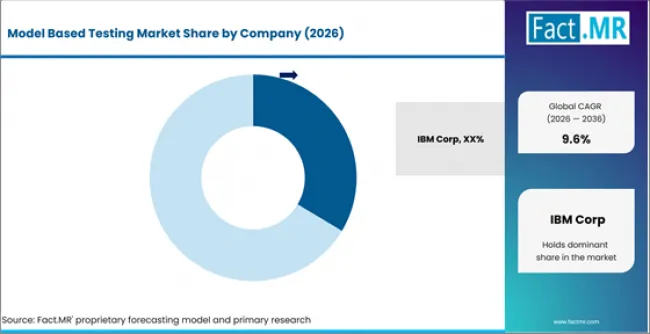
Model Based Testing Market Analysis By Company

Model Based Testing Market Analysis By Company

  • IBM Corp, and Tricentis hold strong positions through broad testing platform portfolios, deep enterprise integrations, and growing AI-augmented capabilities that extend model-based testing into automated defect prediction and agentic test generation workflows.
  • Accenture, Capgemini, Wipro, and Cognizant Technology Solutions Corporation compete through system integration and managed testing services that deploy MBT platforms within large-scale enterprise digital transformation programs across multiple industries and geographies.
  • Platform interoperability with established CI/CD toolchains, cloud-native deployment flexibility, and AI-driven test optimization capabilities are the primary competitive differentiators shaping vendor selection across enterprise accounts.

The competitive landscape combines pure-play testing platform vendors with large system integrators and IT services companies that embed MBT capabilities within broader digital transformation engagements. IBM Corp, Microsoft, and Tricentis compete through platform breadth, AI integration, and enterprise-grade orchestration capabilities. These vendors are investing in agentic AI frameworks, autonomous test creation, and cloud-native delivery to capture the next phase of market growth.

Below the platform tier, Accenture, Capgemini, Wipro, Cognizant Technology Solutions Corporation, Infosys, and HCL Technologies compete through implementation services, managed testing operations, and consulting that bridges the gap between MBT platform capability and organizational testing maturity. These firms serve as primary channels for enterprise MBT adoption, particularly in regulated industries where domain expertise and compliance documentation are critical procurement criteria.

Competition is also intensifying around AI-powered testing features. Vendors that can demonstrate measurable reductions in test creation time, defect escape rates, and maintenance effort are gaining procurement preference over platforms that rely primarily on traditional model-based approaches without AI augmentation.

Key Companies in the Model Based Testing Market

  • IBM Corp, Tricentis, and OpenText Corporation are among the leading platform vendors in the model based testing market, supported by comprehensive testing suites, enterprise-grade orchestration, and growing AI integration capabilities.
  • Accenture, Capgemini, Wipro, and Cognizant Technology Solutions Corporation hold strong positions as implementation and managed services providers, deploying MBT platforms at scale across global enterprise accounts.
  • Infosys, HCL Technologies, and specialist vendors including Conformiq and Smartesting compete through focused testing capabilities, domain expertise, and pricing flexibility across mid-market and specialized verticals.

Recent Industry Developments

  • Tricentis, Agentic Quality Engineering Platform Launch (March 2026)
    • Tricentis launched its Agentic Quality Engineering Platform in March 2026. The platform is powered by Tricentis AI Workspace and coordinates AI agents across testing, automation, performance, and quality intelligence workflows.
  • Tricentis, Agentic Test Automation and MCP Server Launch (June 2025)
    • Tricentis launched remote Model Context Protocol servers and Agentic Test Automation in June 2025. The launch enables AI agents to interact with enterprise testing tools including Tosca, NeoLoad, and qTest.
  • Sauce Labs, Sauce AI for Test Authoring Launch (March 2026)
    • Sauce Labs launched Sauce AI for Test Authoring in March 2026. The tool translates business intent into executable test suites for web, Android, and iOS applications.

Leading Companies Shaping the Model Based Testing Market

  • IBM Corp
  • Tricentis
  • Accenture Plc
  • Capgemini SE
  • Wipro Ltd.
  • Cognizant Technology Solutions Corporation
  • Infosys
  • HCL Technologies
  • OpenText Corporation

Sources and Research References

  • Tricentis. (2026, March 10). Tricentis introduces the first end-to-end enterprise agentic quality engineering platform, accelerating AI trust and time-to-value.
  • Tricentis. (2025, June 24). Tricentis leads new era of agentic AI to scale enterprise-grade autonomous software quality.
  • Sauce Labs. (2026, March 17). Sauce Labs CEO, Prince Kohli, says $1 trillion software quality industry has been “building wrong” for 20 years.

Key Questions This Report Addresses

  • What is the current and future size of the Model Based Testing Market?
  • How fast is the model based testing market expected to grow between 2026 and 2036?
  • Which product type is likely to lead the market by 2026?
  • Which end-use segment accounts for the highest demand in 2026?
  • What factors are driving adoption of model-based testing approaches?
  • How is AI augmentation influencing the model based testing market?
  • Why are China and India emerging as the fastest-growing markets?
  • How are DevOps and continuous delivery pipelines supporting demand?
  • Which countries are projected to show the fastest growth through 2036?
  • Who are the key companies active in the Model Based Testing Market?
  • How does Fact.MR estimate and validate the market forecast?

Model Based Testing Market Definition

The Model Based Testing Market covers software platforms, tools, and services that use formal behavioral models to systematically generate, execute, and maintain software test cases, serving IT organizations, system integrators, and regulated industries seeking structured, requirements-linked testing approaches.

Model Based Testing Market Inclusions

  • The scope covers global and regional market size and forecasts for 2026 to 2036 across product type, end use, deployment model, and region.
  • It includes model-based test design platforms, graph-based and state-machine modeling systems, UML-based tools, and behavioral modeling systems.
  • The report covers integration with CI/CD pipelines, AI-augmented test generation capabilities, and compliance-oriented testing frameworks.
  • It includes competitive landscape analysis with product portfolios, pricing strategies, and technology partnerships of leading vendors.

Model Based Testing Market Exclusions

  • The scope excludes general-purpose test automation tools that do not use behavioral models for test case generation, including record-and-playback tools and keyword-driven frameworks.
  • It excludes standalone code analysis tools, static testing platforms, and security vulnerability scanners sold independently of model-based testing capabilities.
  • The report excludes manual testing services, staffing-only QA outsourcing contracts, and project-based consulting engagements without platform license components.

Model Based Testing Market Research Methodology

  • The methodology combines secondary research, primary interviews, and forecast modelling.
  • It draws on 100+ secondary sources and benchmarks 50+ company product portfolios.
  • Market sizing covers 30+ countries through a demand-side model, supported by top-down validation.
  • Key inputs include enterprise software spending, DevOps adoption rates, QA headcount trends, and regulatory compliance requirements.
  • The model cross-checks demand with vendor revenue disclosures, pricing surveys, and technology adoption benchmarks.
  • Primary validation includes 25+ interviews across platform vendors, system integrators, enterprise QA leaders, and industry consultants.
  • Final estimates go through adoption-curve checks, spending-pattern reviews, and sensitivity testing.

Scope of Analysis
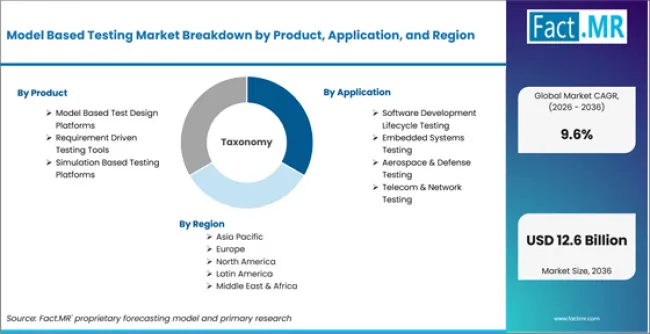
Model Based Testing Market Breakdown By Product, Application, And Region

Parameter Details
Quantitative Units USD 5.0 billion to USD 12.6 billion, at a CAGR of 9.6%
Market Definition The Model Based Testing Market covers software platforms, tools, and services that use formal behavioral models to generate, execute, and maintain software test cases across enterprise and embedded applications.
Regions Covered North America, Latin America, Europe, East Asia, South Asia and Pacific, Middle East and Africa
Countries Covered USA, Canada, UK, Germany, China, India, 30 plus countries
Key Companies IBM Corp, Tricentis, Accenture Plc, Capgemini SE, Wipro Ltd., Cognizant Technology Solutions Corporation, Infosys, HCL Technologies, OpenText Corporation
Forecast Period 2026 to 2036
Approach Hybrid demand-side and top-down methodology built on enterprise software spending analysis, QA headcount trends, DevOps adoption benchmarks, regulatory compliance requirements, and primary interviews across platform vendors, system integrators, and enterprise QA organizations.

Model Based Testing Market Segmentation

  • Model Based Testing Market Segmented by Product:

    • Model Based Test Design Platforms
      • Graph Based Modeling Systems
        • State Machine Modeling Tools
        • UML Based Test Modeling Tools
      • Behavioral Modeling Systems
        • Sequence Diagram Testing Tools
        • Activity Flow Test Models
    • Requirement Driven Testing Tools
      • Traceability Management Systems
        • Requirement Mapping Engines
        • Coverage Validation Platforms
      • Automated Test Generation Systems
        • Script Generation Engines
        • Scenario Based Test Generators
    • Simulation Based Testing Platforms
      • Digital Twin Testing Systems
        • System Simulation Environments
        • Virtual Test Bench Platforms
      • Model Execution Engines
        • Runtime Model Validators
        • Execution Path Testing Systems
  • Model Based Testing Market Segmented by Application:

    • Software Development Lifecycle Testing
      • Agile Development Testing
        • Sprint Based Test Validation
        • Continuous Integration Testing
      • DevOps Pipeline Testing
        • Automated Build Validation
        • Release Cycle Testing Systems
    • Embedded Systems Testing
      • Automotive Embedded Systems
        • ECU Software Validation
        • Infotainment System Testing
      • Industrial Embedded Systems
        • PLC Control Testing
        • IoT Device Validation
    • Aerospace & Defense Testing
      • Avionics Software Testing
        • Flight Control Software Validation
        • Navigation System Testing
      • Defense System Simulation
        • Mission Critical Software Testing
        • Radar System Validation
    • Telecom & Network Testing
      • Network Protocol Validation
        • 5G System Testing
        • Communication Stack Testing
      • Cloud Infrastructure Testing
        • Distributed System Validation
        • Virtualized Network Testing
  • Model Based Testing Market Segmented by End Use:

    • IT & Software Companies
      • Enterprise Software Firms
        • Application Development Companies
        • System Integration Firms
      • Product Engineering Companies
        • SaaS Platform Developers
        • Platform Engineering Teams
    • Automotive Industry
      • OEM Automotive Manufacturers
        • Vehicle Software Development Units
        • Autonomous Driving R&D Teams
      • Tier 1 Suppliers
        • Embedded Software Vendors
        • ECU System Developers
    • Aerospace & Defense Sector
      • Defense Software Contractors
        • Mission Critical System Developers
        • Avionics Software Vendors
      • Aerospace Manufacturers
        • Flight Control System Engineers
        • Space System Developers
    • Semiconductor & Electronics
      • Chip Design Companies
        • Hardware Simulation Teams
        • Embedded Firmware Developers
      • Electronics Manufacturers
        • Device Software Testing Teams
        • IoT Product Developers
  • Model Based Testing Market Segmented by Technology:

    • Model Driven Engineering Technology
      • UML Based Modeling Systems
        • Unified Modeling Language Engines
        • Diagram Based Test Systems
      • State Machine Modeling Systems
        • Finite State Test Engines
        • Event Driven Modeling Tools
    • Test Automation Engines
      • Script Generation Systems
        • Auto Code Test Generators
        • AI Based Test Creation Tools
      • Simulation Driven Testing
        • Virtual Environment Simulators
        • System Behavior Simulation Tools
    • Digital Twin Technology
    • AI Based Testing Technology
  • Model Based Testing Market Segmented by Formulation:

    • Integrated Modeling Platforms
      • Cloud Based Modeling Systems
        • SaaS Test Modeling Platforms
        • Remote Collaboration Systems
      • On Premise Modeling Tools
        • Enterprise Installed Solutions
        • Secure Testing Environments
    • Hybrid Testing Frameworks
      • Model + Script Hybrid Systems
        • Combined Manual Automated Testing
        • Adaptive Test Frameworks
      • Model + Simulation Integration
        • Virtual Execution Frameworks
        • System Level Simulation Engines
    • API Driven Testing Systems
      • Microservices Test Frameworks
        • Service Level Validation Systems
        • API Contract Testing Tools
      • Event Driven Testing Platforms
        • Real Time Event Simulation Systems
        • Trigger Based Test Execution Systems
  • Model Based Testing Market Segmented by Distribution Channel:

    • Direct Enterprise Sales
      • Software Vendor Sales
        • Enterprise Licensing Agreements
        • Annual Subscription Contracts
      • Consulting Led Sales
        • Testing Implementation Services
        • Enterprise Integration Consulting
    • Cloud Marketplaces
      • SaaS Distribution Platforms
        • Cloud Software Marketplaces
        • API Based Software Stores
      • DevOps Tool Platforms
        • CI/CD Marketplace Integrations
        • Developer Ecosystem Platforms
    • System Integrators
      • IT Service Providers
        • Enterprise Testing Consultants
        • Digital Transformation Partners
      • Engineering Service Firms
        • Product Lifecycle Service Providers
        • Software QA Outsourcing Firms
  • Model Based Testing Market by Region:

    • North America
      • USA
      • Canada
      • Mexico
    • Latin America
      • Brazil
      • Chile
      • Rest of Latin America
    • Western Europe
      • Germany
      • UK
      • Italy
      • Spain
      • France
      • Nordic
      • BENELUX
      • Rest of Western Europe
    • Eastern Europe
      • Russia
      • Poland
      • Hungary
      • Balkan & Baltic
      • Rest of Eastern Europe
    • East Asia
      • China
      • Japan
      • South Korea
    • South Asia and Pacific
      • India
      • ASEAN
      • Australia & New Zealand
      • Rest of South Asia and Pacific
    • Middle East & Africa
      • Kingdom of Saudi Arabia
      • Other GCC Countries
      • Turkiye
      • South Africa
      • Other African Union
      • Rest of Middle East & Africa

- Frequently Asked Questions -

How big is the model based testing market in 2026?

The global model based testing market is estimated to be valued at USD 5.0 billion in 2026.

What will be the size of the model-based testing market in 2036?

The market size for the model based testing market is projected to reach USD 12.6 billion by 2036.

How fast will the model-based testing market grow between 2026 and 2036?

The model based testing market is expected to grow at a 9.6% CAGR between 2026 and 2036.

What are the key products in the model based testing market?

The key products in the model based testing market are Model Based Test Design Platforms, Requirement Driven Testing Tools and Simulation Based Testing Platforms.

Which application segment is expected to contribute a significant share in the model-based testing market in 2026?

In terms of application, software development lifecycle testing segment is expected to command 61.5% share in the model based testing market in 2026.

Table of Content

  1. Key Takeaways
    • Market Size and CAGR
    • Top Growth Driver
    • Fastest Growing Segment
    • Leading Region
    • Key Companies
    • Emerging Opportunities
  2. Executive Summary
    • Global Market Outlook
    • Demand-side Trends
    • Supply-side Trends
    • Technology Roadmap Analysis
    • Analysis and Recommendations
    • Analyst Perspective (What is happening? Why now? What should investors know?)
    • Key Questions Answered
      • How large is the market?
      • What is the CAGR?
      • What are key trends?
      • Which region dominates?
      • Who are the leaders?
  3. Market Overview
    • Market Coverage / Taxonomy
    • Market Definition / Scope / Limitations
  4. Research Methodology
    • Chapter Orientation
    • Analytical Lens and Working Hypotheses
      • Market Structure, Signals, and Trend Drivers
      • Benchmarking and Cross-market Comparability
      • Market Sizing, Forecasting, and Opportunity Mapping
    • Research Design and Evidence Framework
      • Desk Research Programme (Secondary Evidence)
      • Expert Input and Fieldwork (Primary Evidence)
      • Tooling, Models, and Reference Databases
    • Data Engineering and Model Build
    • Quality Assurance and Audit Trail
  5. Market Background
    • Market Dynamics (Drivers, Restraints, Opportunity, Trends)
    • Scenario Forecast (Optimistic, Likely, Conservative)
    • Impact Analysis
      • AI Impact
      • Sustainability Impact
      • Regulatory Impact
      • Technology Impact
    • Consumer / Buyer Analysis
      • Purchase Drivers
      • Adoption Barriers
      • Buyer Journey
    • Opportunity Map Analysis
    • Product Life Cycle Analysis
    • Supply Chain Analysis
    • Investment Feasibility Matrix
    • Value Chain Analysis
    • PESTLE and Porter's Analysis
    • Regulatory Landscape
    • Regional Parent Market Outlook
    • Production and Consumption Statistics
    • Import and Export Statistics
  6. Global Market Analysis and Forecast, 2021 to 2036
    • Historical Market Size Value (USD Million) Analysis, 2021 to 2025
    • Current and Future Market Size Value (USD Million) Projections, 2026 to 2036
      • Y-o-Y Growth Trend Analysis
      • Absolute $ Opportunity Analysis
  7. Global Market Pricing Analysis, 2021 to 2036
  8. Global Market Analysis and Forecast, By Product, 2021 to 2036
    • Introduction / Key Findings
    • Historical Market Size Value (USD Million) Analysis By Product, 2021 to 2025
    • Current and Future Market Size Value (USD Million) Analysis and Forecast By Product, 2026 to 2036
      • Model Based Test Design Platforms
        • Graph Based Modeling Systems
        • Behavioral Modeling Systems
      • Requirement Driven Testing Tools
        • Traceability Management Systems
        • Automated Test Generation Systems
      • Simulation Based Testing Platforms
        • Digital Twin Testing Systems
        • Model Execution Engines
    • Y-o-Y Growth Trend Analysis By Product, 2021 to 2025
    • Absolute $ Opportunity Analysis By Product, 2026 to 2036
  9. Global Market Analysis and Forecast, By Application, 2021 to 2036
    • Introduction / Key Findings
    • Historical Market Size Value (USD Million) Analysis By Application, 2021 to 2025
    • Current and Future Market Size Value (USD Million) Analysis and Forecast By Application, 2026 to 2036
      • Software Development Lifecycle Testing
        • Agile Development Testing
        • DevOps Pipeline Testing
      • Embedded Systems Testing
        • Automotive Embedded Systems
        • Industrial Embedded Systems
      • Aerospace & Defense Testing
        • Avionics Software Testing
        • Defense System Simulation
      • Telecom & Network Testing
        • Network Protocol Validation
        • Cloud Infrastructure Testing
    • Y-o-Y Growth Trend Analysis By Application, 2021 to 2025
    • Absolute $ Opportunity Analysis By Application, 2026 to 2036
  10. Global Market Analysis and Forecast, By End Use, 2021 to 2036
    • Introduction / Key Findings
    • Historical Market Size Value (USD Million) Analysis By End Use, 2021 to 2025
    • Current and Future Market Size Value (USD Million) Analysis and Forecast By End Use, 2026 to 2036
      • IT & Software Companies
        • Enterprise Software Firms
        • Product Engineering Companies
      • Automotive Industry
        • OEM Automotive Manufacturers
        • Tier 1 Suppliers
      • Aerospace & Defense Sector
        • Defense Software Contractors
        • Aerospace Manufacturers
      • Semiconductor & Electronics
        • Chip Design Companies
        • Electronics Manufacturers
    • Y-o-Y Growth Trend Analysis By End Use, 2021 to 2025
    • Absolute $ Opportunity Analysis By End Use, 2026 to 2036
  11. Global Market Analysis and Forecast, By Technology, 2021 to 2036
    • Introduction / Key Findings
    • Historical Market Size Value (USD Million) Analysis By Technology, 2021 to 2025
    • Current and Future Market Size Value (USD Million) Analysis and Forecast By Technology, 2026 to 2036
      • Model Driven Engineering Technology
        • UML Based Modeling Systems
        • State Machine Modeling Systems
      • Test Automation Engines
        • Script Generation Systems
        • Simulation Driven Testing
      • Digital Twin Technology
      • AI Based Testing Technology
    • Y-o-Y Growth Trend Analysis By Technology, 2021 to 2025
    • Absolute $ Opportunity Analysis By Technology, 2026 to 2036
  12. Global Market Analysis and Forecast, By Formulation, 2021 to 2036
    • Introduction / Key Findings
    • Historical Market Size Value (USD Million) Analysis By Formulation, 2021 to 2025
    • Current and Future Market Size Value (USD Million) Analysis and Forecast By Formulation, 2026 to 2036
      • Integrated Modeling Platforms
        • Cloud Based Modeling Systems
        • On Premise Modeling Tools
      • Hybrid Testing Frameworks
        • Model + Script Hybrid Systems
        • Model + Simulation Integration
      • API Driven Testing Systems
        • Microservices Test Frameworks
        • Event Driven Testing Platforms
    • Y-o-Y Growth Trend Analysis By Formulation, 2021 to 2025
    • Absolute $ Opportunity Analysis By Formulation, 2026 to 2036
  13. Global Market Analysis and Forecast, By Distribution Channel
    • Introduction / Key Findings
    • Historical Market Size Value (USD Million) Analysis By Distribution Channel, 2021 to 2025
    • Current and Future Market Size Value (USD Million) Analysis and Forecast By Distribution Channel, 2026 to 2036
      • Direct Enterprise Sales
        • Software Vendor Sales
        • Consulting Led Sales
      • Cloud Marketplaces
        • SaaS Distribution Platforms
        • DevOps Tool Platforms
      • System Integrators
        • IT Service Providers
        • Engineering Service Firms
    • Y-o-Y Growth Trend Analysis By Distribution Channel, 2021 to 2025
    • Absolute $ Opportunity Analysis By Distribution Channel, 2026 to 2036
  14. Global Market Analysis and Forecast, By Region, 2021 to 2036
    • Introduction
    • Historical Market Size Value (USD Million) Analysis By Region, 2021 to 2025
    • Current Market Size Value (USD Million) Analysis and Forecast By Region, 2026 to 2036
      • North America
      • Latin America
      • Western Europe
      • Eastern Europe
      • East Asia
      • South Asia and Pacific
      • Middle East & Africa
    • Market Attractiveness Analysis By Region
  15. North America Market Analysis and Forecast, By Country, 2021 to 2036
    • Historical Market Size Value (USD Million) Trend Analysis By Market Taxonomy, 2021 to 2025
    • Market Size Value (USD Million) Forecast By Market Taxonomy, 2026 to 2036
      • By Country
        • USA
        • Canada
        • Mexico
      • By Product
      • By Application
      • By End Use
      • By Technology
      • By Formulation
      • By Distribution Channel
    • Market Attractiveness Analysis
      • By Country
      • By Product
      • By Application
      • By End Use
      • By Technology
      • By Formulation
      • By Distribution Channel
    • Key Takeaways
  16. Latin America Market Analysis and Forecast, By Country
    • Historical Market Size Value (USD Million) Trend Analysis By Market Taxonomy, 2021 to 2025
    • Market Size Value (USD Million) Forecast By Market Taxonomy, 2026 to 2036
      • By Country
        • Brazil
        • Chile
        • Rest of Latin America
      • By Product
      • By Application
      • By End Use
      • By Technology
      • By Formulation
      • By Distribution Channel
    • Market Attractiveness Analysis
      • By Country
      • By Product
      • By Application
      • By End Use
      • By Technology
      • By Formulation
      • By Distribution Channel
    • Key Takeaways
  17. Western Europe Market Analysis and Forecast, By Country
    • Historical Market Size Value (USD Million) Trend Analysis By Market Taxonomy, 2021 to 2025
    • Market Size Value (USD Million) Forecast By Market Taxonomy, 2026 to 2036
      • By Country
        • Germany
        • UK
        • Italy
        • Spain
        • France
        • Nordic
        • BENELUX
        • Rest of Western Europe
      • By Product
      • By Application
      • By End Use
      • By Technology
      • By Formulation
      • By Distribution Channel
    • Market Attractiveness Analysis
      • By Country
      • By Product
      • By Application
      • By End Use
      • By Technology
      • By Formulation
      • By Distribution Channel
    • Key Takeaways
  18. Eastern Europe Market Analysis and Forecast, By Country
    • Historical Market Size Value (USD Million) Trend Analysis By Market Taxonomy, 2021 to 2025
    • Market Size Value (USD Million) Forecast By Market Taxonomy, 2026 to 2036
      • By Country
        • Russia
        • Poland
        • Hungary
        • Balkan & Baltic
        • Rest of Eastern Europe
      • By Product
      • By Application
      • By End Use
      • By Technology
      • By Formulation
      • By Distribution Channel
    • Market Attractiveness Analysis
      • By Country
      • By Product
      • By Application
      • By End Use
      • By Technology
      • By Formulation
      • By Distribution Channel
    • Key Takeaways
  19. East Asia Market Analysis and Forecast, By Country
    • Historical Market Size Value (USD Million) Trend Analysis By Market Taxonomy, 2021 to 2025
    • Market Size Value (USD Million) Forecast By Market Taxonomy, 2026 to 2036
      • By Country
        • China
        • Japan
        • South Korea
      • By Product
      • By Application
      • By End Use
      • By Technology
      • By Formulation
      • By Distribution Channel
    • Market Attractiveness Analysis
      • By Country
      • By Product
      • By Application
      • By End Use
      • By Technology
      • By Formulation
      • By Distribution Channel
    • Key Takeaways
  20. South Asia and Pacific Market Analysis and Forecast, By Country
    • Historical Market Size Value (USD Million) Trend Analysis By Market Taxonomy, 2021 to 2025
    • Market Size Value (USD Million) Forecast By Market Taxonomy, 2026 to 2036
      • By Country
        • India
        • ASEAN
        • Australia & New Zealand
        • Rest of South Asia and Pacific
      • By Product
      • By Application
      • By End Use
      • By Technology
      • By Formulation
      • By Distribution Channel
    • Market Attractiveness Analysis
      • By Country
      • By Product
      • By Application
      • By End Use
      • By Technology
      • By Formulation
      • By Distribution Channel
    • Key Takeaways
  21. Middle East & Africa Market Analysis and Forecast, By Country
    • Historical Market Size Value (USD Million) Trend Analysis By Market Taxonomy, 2021 to 2025
    • Market Size Value (USD Million) Forecast By Market Taxonomy, 2026 to 2036
      • By Country
        • Kingdom of Saudi Arabia
        • Other GCC Countries
        • Turkiye
        • South Africa
        • Other African Union
        • Rest of Middle East & Africa
      • By Product
      • By Application
      • By End Use
      • By Technology
      • By Formulation
      • By Distribution Channel
    • Market Attractiveness Analysis
      • By Country
      • By Product
      • By Application
      • By End Use
      • By Technology
      • By Formulation
      • By Distribution Channel
    • Key Takeaways
  22. Key Countries Market Analysis
    • USA
      • Pricing Analysis
      • Market Share Analysis, 2025
        • By Product
        • By Application
        • By End Use
        • By Technology
        • By Formulation
        • By Distribution Channel
    • Canada
      • Pricing Analysis
      • Market Share Analysis, 2025
        • By Product
        • By Application
        • By End Use
        • By Technology
        • By Formulation
        • By Distribution Channel
    • Mexico
      • Pricing Analysis
      • Market Share Analysis, 2025
        • By Product
        • By Application
        • By End Use
        • By Technology
        • By Formulation
        • By Distribution Channel
    • Brazil
      • Pricing Analysis
      • Market Share Analysis, 2025
        • By Product
        • By Application
        • By End Use
        • By Technology
        • By Formulation
        • By Distribution Channel
    • Chile
      • Pricing Analysis
      • Market Share Analysis, 2025
        • By Product
        • By Application
        • By End Use
        • By Technology
        • By Formulation
        • By Distribution Channel
    • Germany
      • Pricing Analysis
      • Market Share Analysis, 2025
        • By Product
        • By Application
        • By End Use
        • By Technology
        • By Formulation
        • By Distribution Channel
    • UK
      • Pricing Analysis
      • Market Share Analysis, 2025
        • By Product
        • By Application
        • By End Use
        • By Technology
        • By Formulation
        • By Distribution Channel
    • Italy
      • Pricing Analysis
      • Market Share Analysis, 2025
        • By Product
        • By Application
        • By End Use
        • By Technology
        • By Formulation
        • By Distribution Channel
    • Spain
      • Pricing Analysis
      • Market Share Analysis, 2025
        • By Product
        • By Application
        • By End Use
        • By Technology
        • By Formulation
        • By Distribution Channel
    • France
      • Pricing Analysis
      • Market Share Analysis, 2025
        • By Product
        • By Application
        • By End Use
        • By Technology
        • By Formulation
        • By Distribution Channel
    • India
      • Pricing Analysis
      • Market Share Analysis, 2025
        • By Product
        • By Application
        • By End Use
        • By Technology
        • By Formulation
        • By Distribution Channel
    • ASEAN
      • Pricing Analysis
      • Market Share Analysis, 2025
        • By Product
        • By Application
        • By End Use
        • By Technology
        • By Formulation
        • By Distribution Channel
    • Australia & New Zealand
      • Pricing Analysis
      • Market Share Analysis, 2025
        • By Product
        • By Application
        • By End Use
        • By Technology
        • By Formulation
        • By Distribution Channel
    • China
      • Pricing Analysis
      • Market Share Analysis, 2025
        • By Product
        • By Application
        • By End Use
        • By Technology
        • By Formulation
        • By Distribution Channel
    • Japan
      • Pricing Analysis
      • Market Share Analysis, 2025
        • By Product
        • By Application
        • By End Use
        • By Technology
        • By Formulation
        • By Distribution Channel
    • South Korea
      • Pricing Analysis
      • Market Share Analysis, 2025
        • By Product
        • By Application
        • By End Use
        • By Technology
        • By Formulation
        • By Distribution Channel
    • Russia
      • Pricing Analysis
      • Market Share Analysis, 2025
        • By Product
        • By Application
        • By End Use
        • By Technology
        • By Formulation
        • By Distribution Channel
    • Poland
      • Pricing Analysis
      • Market Share Analysis, 2025
        • By Product
        • By Application
        • By End Use
        • By Technology
        • By Formulation
        • By Distribution Channel
    • Hungary
      • Pricing Analysis
      • Market Share Analysis, 2025
        • By Product
        • By Application
        • By End Use
        • By Technology
        • By Formulation
        • By Distribution Channel
    • Kingdom of Saudi Arabia
      • Pricing Analysis
      • Market Share Analysis, 2025
        • By Product
        • By Application
        • By End Use
        • By Technology
        • By Formulation
        • By Distribution Channel
    • Turkiye
      • Pricing Analysis
      • Market Share Analysis, 2025
        • By Product
        • By Application
        • By End Use
        • By Technology
        • By Formulation
        • By Distribution Channel
    • South Africa
      • Pricing Analysis
      • Market Share Analysis, 2025
        • By Product
        • By Application
        • By End Use
        • By Technology
        • By Formulation
        • By Distribution Channel
  23. Market Structure Analysis
    • Competition Dashboard
    • Competition Benchmarking
    • Market Share Analysis of Top Players
      • By Regional
      • By Product
      • By Application
      • By End Use
      • By Technology
      • By Formulation
      • By Distribution Channel
      • Emerging Startups
      • Innovation Benchmarking
    • Competition Analysis
      • Competition Deep Dive
        • IBM Corp
          • Overview
          • Product Portfolio
          • Profitability by Market Segments (Product/Age /Sales Channel/Region)
          • Sales Footprint
          • Strategy Overview
            • Marketing Strategy
            • Product Strategy
            • Channel Strategy
        • Accenture Plc
        • Capgemini SE
        • Wipro Ltd.
        • HCL Technologies Ltd.
        • Infosys Limited
        • Oracle Corporation
        • Cognizant Technology Solutions Corp.
        • Tata Consultancy Services Limited
    • Case Studies
    • Success Stories
    • Recent Developments
  24. Assumptions & Acronyms Used

List Of Table

  • Table 1: Global Market Value (USD Million) Forecast by Region, 2021 to 2036
  • Table 2: Global Market Value (USD Million) Forecast by Product, 2021 to 2036
  • Table 3: Global Market Value (USD Million) Forecast by Application, 2021 to 2036
  • Table 4: Global Market Value (USD Million) Forecast by End Use, 2021 to 2036
  • Table 5: Global Market Value (USD Million) Forecast by Technology, 2021 to 2036
  • Table 6: Global Market Value (USD Million) Forecast by Formulation, 2021 to 2036
  • Table 7: Global Market Value (USD Million) Forecast by Distribution Channel, 2021 to 2036
  • Table 8: Global Market rma_anu Forecast by rma_anu, 2021 to 2036
  • Table 9: North America Market Value (USD Million) Forecast by Country, 2021 to 2036
  • Table 10: North America Market Value (USD Million) Forecast by Product, 2021 to 2036
  • Table 11: North America Market Value (USD Million) Forecast by Application, 2021 to 2036
  • Table 12: North America Market Value (USD Million) Forecast by End Use, 2021 to 2036
  • Table 13: North America Market Value (USD Million) Forecast by Technology, 2021 to 2036
  • Table 14: North America Market Value (USD Million) Forecast by Formulation, 2021 to 2036
  • Table 15: North America Market Value (USD Million) Forecast by Distribution Channel, 2021 to 2036
  • Table 16: Latin America Market Value (USD Million) Forecast by Country, 2021 to 2036
  • Table 17: Latin America Market Value (USD Million) Forecast by Product, 2021 to 2036
  • Table 18: Latin America Market Value (USD Million) Forecast by Application, 2021 to 2036
  • Table 19: Latin America Market Value (USD Million) Forecast by End Use, 2021 to 2036
  • Table 20: Latin America Market Value (USD Million) Forecast by Technology, 2021 to 2036
  • Table 21: Latin America Market Value (USD Million) Forecast by Formulation, 2021 to 2036
  • Table 22: Latin America Market Value (USD Million) Forecast by Distribution Channel, 2021 to 2036
  • Table 23: Western Europe Market Value (USD Million) Forecast by Country, 2021 to 2036
  • Table 24: Western Europe Market Value (USD Million) Forecast by Product, 2021 to 2036
  • Table 25: Western Europe Market Value (USD Million) Forecast by Application, 2021 to 2036
  • Table 26: Western Europe Market Value (USD Million) Forecast by End Use, 2021 to 2036
  • Table 27: Western Europe Market Value (USD Million) Forecast by Technology, 2021 to 2036
  • Table 28: Western Europe Market Value (USD Million) Forecast by Formulation, 2021 to 2036
  • Table 29: Western Europe Market Value (USD Million) Forecast by Distribution Channel, 2021 to 2036
  • Table 30: Eastern Europe Market Value (USD Million) Forecast by Country, 2021 to 2036
  • Table 31: Eastern Europe Market Value (USD Million) Forecast by Product, 2021 to 2036
  • Table 32: Eastern Europe Market Value (USD Million) Forecast by Application, 2021 to 2036
  • Table 33: Eastern Europe Market Value (USD Million) Forecast by End Use, 2021 to 2036
  • Table 34: Eastern Europe Market Value (USD Million) Forecast by Technology, 2021 to 2036
  • Table 35: Eastern Europe Market Value (USD Million) Forecast by Formulation, 2021 to 2036
  • Table 36: Eastern Europe Market Value (USD Million) Forecast by Distribution Channel, 2021 to 2036
  • Table 37: East Asia Market Value (USD Million) Forecast by Country, 2021 to 2036
  • Table 38: East Asia Market Value (USD Million) Forecast by Product, 2021 to 2036
  • Table 39: East Asia Market Value (USD Million) Forecast by Application, 2021 to 2036
  • Table 40: East Asia Market Value (USD Million) Forecast by End Use, 2021 to 2036
  • Table 41: East Asia Market Value (USD Million) Forecast by Technology, 2021 to 2036
  • Table 42: East Asia Market Value (USD Million) Forecast by Formulation, 2021 to 2036
  • Table 43: East Asia Market Value (USD Million) Forecast by Distribution Channel, 2021 to 2036
  • Table 44: South Asia and Pacific Market Value (USD Million) Forecast by Country, 2021 to 2036
  • Table 45: South Asia and Pacific Market Value (USD Million) Forecast by Product, 2021 to 2036
  • Table 46: South Asia and Pacific Market Value (USD Million) Forecast by Application, 2021 to 2036
  • Table 47: South Asia and Pacific Market Value (USD Million) Forecast by End Use, 2021 to 2036
  • Table 48: South Asia and Pacific Market Value (USD Million) Forecast by Technology, 2021 to 2036
  • Table 49: South Asia and Pacific Market Value (USD Million) Forecast by Formulation, 2021 to 2036
  • Table 50: South Asia and Pacific Market Value (USD Million) Forecast by Distribution Channel, 2021 to 2036
  • Table 51: Middle East & Africa Market Value (USD Million) Forecast by Country, 2021 to 2036
  • Table 52: Middle East & Africa Market Value (USD Million) Forecast by Product, 2021 to 2036
  • Table 53: Middle East & Africa Market Value (USD Million) Forecast by Application, 2021 to 2036
  • Table 54: Middle East & Africa Market Value (USD Million) Forecast by End Use, 2021 to 2036
  • Table 55: Middle East & Africa Market Value (USD Million) Forecast by Technology, 2021 to 2036
  • Table 56: Middle East & Africa Market Value (USD Million) Forecast by Formulation, 2021 to 2036
  • Table 57: Middle East & Africa Market Value (USD Million) Forecast by Distribution Channel, 2021 to 2036

List Of Figures

  • Figure 1: Global Market Pricing Analysis
  • Figure 2: Global Market Value (USD Million) Forecast 2021 to 2036
  • Figure 3: Global Market Value Share and BPS Analysis by Product, 2026 and 2036
  • Figure 4: Global Market Y-o-Y Growth Comparison by Product, 2026 to 2036
  • Figure 5: Global Market Attractiveness Analysis by Product
  • Figure 6: Global Market Value Share and BPS Analysis by Application, 2026 and 2036
  • Figure 7: Global Market Y-o-Y Growth Comparison by Application, 2026 to 2036
  • Figure 8: Global Market Attractiveness Analysis by Application
  • Figure 9: Global Market Value Share and BPS Analysis by End Use, 2026 and 2036
  • Figure 10: Global Market Y-o-Y Growth Comparison by End Use, 2026 to 2036
  • Figure 11: Global Market Attractiveness Analysis by End Use
  • Figure 12: Global Market Value Share and BPS Analysis by Technology, 2026 and 2036
  • Figure 13: Global Market Y-o-Y Growth Comparison by Technology, 2026 to 2036
  • Figure 14: Global Market Attractiveness Analysis by Technology
  • Figure 15: Global Market Value Share and BPS Analysis by Formulation, 2026 and 2036
  • Figure 16: Global Market Y-o-Y Growth Comparison by Formulation, 2026 to 2036
  • Figure 17: Global Market Attractiveness Analysis by Formulation
  • Figure 18: Global Market Value Share and BPS Analysis by Distribution Channel, 2026 and 2036
  • Figure 19: Global Market Y-o-Y Growth Comparison by Distribution Channel, 2026 to 2036
  • Figure 20: Global Market Attractiveness Analysis by Distribution Channel
  • Figure 21: Global Market Value (USD Million) Share and BPS Analysis by Region, 2026 and 2036
  • Figure 22: Global Market Y-o-Y Growth Comparison by Region, 2026 to 2036
  • Figure 23: Global Market Attractiveness Analysis by Region
  • Figure 24: North America Market Incremental Dollar Opportunity, 2026 to 2036
  • Figure 25: Latin America Market Incremental Dollar Opportunity, 2026 to 2036
  • Figure 26: Western Europe Market Incremental Dollar Opportunity, 2026 to 2036
  • Figure 27: Eastern Europe Market Incremental Dollar Opportunity, 2026 to 2036
  • Figure 28: East Asia Market Incremental Dollar Opportunity, 2026 to 2036
  • Figure 29: South Asia and Pacific Market Incremental Dollar Opportunity, 2026 to 2036
  • Figure 30: Middle East & Africa Market Incremental Dollar Opportunity, 2026 to 2036
  • Figure 31: North America Market Value Share and BPS Analysis by Country, 2026 and 2036
  • Figure 32: North America Market Value Share and BPS Analysis by Product, 2026 and 2036
  • Figure 33: North America Market Y-o-Y Growth Comparison by Product, 2026 to 2036
  • Figure 34: North America Market Attractiveness Analysis by Product
  • Figure 35: North America Market Value Share and BPS Analysis by Application, 2026 and 2036
  • Figure 36: North America Market Y-o-Y Growth Comparison by Application, 2026 to 2036
  • Figure 37: North America Market Attractiveness Analysis by Application
  • Figure 38: North America Market Value Share and BPS Analysis by End Use, 2026 and 2036
  • Figure 39: North America Market Y-o-Y Growth Comparison by End Use, 2026 to 2036
  • Figure 40: North America Market Attractiveness Analysis by End Use
  • Figure 41: North America Market Value Share and BPS Analysis by Technology, 2026 and 2036
  • Figure 42: North America Market Y-o-Y Growth Comparison by Technology, 2026 to 2036
  • Figure 43: North America Market Attractiveness Analysis by Technology
  • Figure 44: North America Market Value Share and BPS Analysis by Formulation, 2026 and 2036
  • Figure 45: North America Market Y-o-Y Growth Comparison by Formulation, 2026 to 2036
  • Figure 46: North America Market Attractiveness Analysis by Formulation
  • Figure 47: North America Market Value Share and BPS Analysis by Distribution Channel, 2026 and 2036
  • Figure 48: North America Market Y-o-Y Growth Comparison by Distribution Channel, 2026 to 2036
  • Figure 49: North America Market Attractiveness Analysis by Distribution Channel
  • Figure 50: Latin America Market Value Share and BPS Analysis by Country, 2026 and 2036
  • Figure 51: Latin America Market Value Share and BPS Analysis by Product, 2026 and 2036
  • Figure 52: Latin America Market Y-o-Y Growth Comparison by Product, 2026 to 2036
  • Figure 53: Latin America Market Attractiveness Analysis by Product
  • Figure 54: Latin America Market Value Share and BPS Analysis by Application, 2026 and 2036
  • Figure 55: Latin America Market Y-o-Y Growth Comparison by Application, 2026 to 2036
  • Figure 56: Latin America Market Attractiveness Analysis by Application
  • Figure 57: Latin America Market Value Share and BPS Analysis by End Use, 2026 and 2036
  • Figure 58: Latin America Market Y-o-Y Growth Comparison by End Use, 2026 to 2036
  • Figure 59: Latin America Market Attractiveness Analysis by End Use
  • Figure 60: Latin America Market Value Share and BPS Analysis by Technology, 2026 and 2036
  • Figure 61: Latin America Market Y-o-Y Growth Comparison by Technology, 2026 to 2036
  • Figure 62: Latin America Market Attractiveness Analysis by Technology
  • Figure 63: Latin America Market Value Share and BPS Analysis by Formulation, 2026 and 2036
  • Figure 64: Latin America Market Y-o-Y Growth Comparison by Formulation, 2026 to 2036
  • Figure 65: Latin America Market Attractiveness Analysis by Formulation
  • Figure 66: Latin America Market Value Share and BPS Analysis by Distribution Channel, 2026 and 2036
  • Figure 67: Latin America Market Y-o-Y Growth Comparison by Distribution Channel, 2026 to 2036
  • Figure 68: Latin America Market Attractiveness Analysis by Distribution Channel
  • Figure 69: Western Europe Market Value Share and BPS Analysis by Country, 2026 and 2036
  • Figure 70: Western Europe Market Value Share and BPS Analysis by Product, 2026 and 2036
  • Figure 71: Western Europe Market Y-o-Y Growth Comparison by Product, 2026 to 2036
  • Figure 72: Western Europe Market Attractiveness Analysis by Product
  • Figure 73: Western Europe Market Value Share and BPS Analysis by Application, 2026 and 2036
  • Figure 74: Western Europe Market Y-o-Y Growth Comparison by Application, 2026 to 2036
  • Figure 75: Western Europe Market Attractiveness Analysis by Application
  • Figure 76: Western Europe Market Value Share and BPS Analysis by End Use, 2026 and 2036
  • Figure 77: Western Europe Market Y-o-Y Growth Comparison by End Use, 2026 to 2036
  • Figure 78: Western Europe Market Attractiveness Analysis by End Use
  • Figure 79: Western Europe Market Value Share and BPS Analysis by Technology, 2026 and 2036
  • Figure 80: Western Europe Market Y-o-Y Growth Comparison by Technology, 2026 to 2036
  • Figure 81: Western Europe Market Attractiveness Analysis by Technology
  • Figure 82: Western Europe Market Value Share and BPS Analysis by Formulation, 2026 and 2036
  • Figure 83: Western Europe Market Y-o-Y Growth Comparison by Formulation, 2026 to 2036
  • Figure 84: Western Europe Market Attractiveness Analysis by Formulation
  • Figure 85: Western Europe Market Value Share and BPS Analysis by Distribution Channel, 2026 and 2036
  • Figure 86: Western Europe Market Y-o-Y Growth Comparison by Distribution Channel, 2026 to 2036
  • Figure 87: Western Europe Market Attractiveness Analysis by Distribution Channel
  • Figure 88: Eastern Europe Market Value Share and BPS Analysis by Country, 2026 and 2036
  • Figure 89: Eastern Europe Market Value Share and BPS Analysis by Product, 2026 and 2036
  • Figure 90: Eastern Europe Market Y-o-Y Growth Comparison by Product, 2026 to 2036
  • Figure 91: Eastern Europe Market Attractiveness Analysis by Product
  • Figure 92: Eastern Europe Market Value Share and BPS Analysis by Application, 2026 and 2036
  • Figure 93: Eastern Europe Market Y-o-Y Growth Comparison by Application, 2026 to 2036
  • Figure 94: Eastern Europe Market Attractiveness Analysis by Application
  • Figure 95: Eastern Europe Market Value Share and BPS Analysis by End Use, 2026 and 2036
  • Figure 96: Eastern Europe Market Y-o-Y Growth Comparison by End Use, 2026 to 2036
  • Figure 97: Eastern Europe Market Attractiveness Analysis by End Use
  • Figure 98: Eastern Europe Market Value Share and BPS Analysis by Technology, 2026 and 2036
  • Figure 99: Eastern Europe Market Y-o-Y Growth Comparison by Technology, 2026 to 2036
  • Figure 100: Eastern Europe Market Attractiveness Analysis by Technology
  • Figure 101: Eastern Europe Market Value Share and BPS Analysis by Formulation, 2026 and 2036
  • Figure 102: Eastern Europe Market Y-o-Y Growth Comparison by Formulation, 2026 to 2036
  • Figure 103: Eastern Europe Market Attractiveness Analysis by Formulation
  • Figure 104: Eastern Europe Market Value Share and BPS Analysis by Distribution Channel, 2026 and 2036
  • Figure 105: Eastern Europe Market Y-o-Y Growth Comparison by Distribution Channel, 2026 to 2036
  • Figure 106: Eastern Europe Market Attractiveness Analysis by Distribution Channel
  • Figure 107: East Asia Market Value Share and BPS Analysis by Country, 2026 and 2036
  • Figure 108: East Asia Market Value Share and BPS Analysis by Product, 2026 and 2036
  • Figure 109: East Asia Market Y-o-Y Growth Comparison by Product, 2026 to 2036
  • Figure 110: East Asia Market Attractiveness Analysis by Product
  • Figure 111: East Asia Market Value Share and BPS Analysis by Application, 2026 and 2036
  • Figure 112: East Asia Market Y-o-Y Growth Comparison by Application, 2026 to 2036
  • Figure 113: East Asia Market Attractiveness Analysis by Application
  • Figure 114: East Asia Market Value Share and BPS Analysis by End Use, 2026 and 2036
  • Figure 115: East Asia Market Y-o-Y Growth Comparison by End Use, 2026 to 2036
  • Figure 116: East Asia Market Attractiveness Analysis by End Use
  • Figure 117: East Asia Market Value Share and BPS Analysis by Technology, 2026 and 2036
  • Figure 118: East Asia Market Y-o-Y Growth Comparison by Technology, 2026 to 2036
  • Figure 119: East Asia Market Attractiveness Analysis by Technology
  • Figure 120: East Asia Market Value Share and BPS Analysis by Formulation, 2026 and 2036
  • Figure 121: East Asia Market Y-o-Y Growth Comparison by Formulation, 2026 to 2036
  • Figure 122: East Asia Market Attractiveness Analysis by Formulation
  • Figure 123: East Asia Market Value Share and BPS Analysis by Distribution Channel, 2026 and 2036
  • Figure 124: East Asia Market Y-o-Y Growth Comparison by Distribution Channel, 2026 to 2036
  • Figure 125: East Asia Market Attractiveness Analysis by Distribution Channel
  • Figure 126: South Asia and Pacific Market Value Share and BPS Analysis by Country, 2026 and 2036
  • Figure 127: South Asia and Pacific Market Value Share and BPS Analysis by Product, 2026 and 2036
  • Figure 128: South Asia and Pacific Market Y-o-Y Growth Comparison by Product, 2026 to 2036
  • Figure 129: South Asia and Pacific Market Attractiveness Analysis by Product
  • Figure 130: South Asia and Pacific Market Value Share and BPS Analysis by Application, 2026 and 2036
  • Figure 131: South Asia and Pacific Market Y-o-Y Growth Comparison by Application, 2026 to 2036
  • Figure 132: South Asia and Pacific Market Attractiveness Analysis by Application
  • Figure 133: South Asia and Pacific Market Value Share and BPS Analysis by End Use, 2026 and 2036
  • Figure 134: South Asia and Pacific Market Y-o-Y Growth Comparison by End Use, 2026 to 2036
  • Figure 135: South Asia and Pacific Market Attractiveness Analysis by End Use
  • Figure 136: South Asia and Pacific Market Value Share and BPS Analysis by Technology, 2026 and 2036
  • Figure 137: South Asia and Pacific Market Y-o-Y Growth Comparison by Technology, 2026 to 2036
  • Figure 138: South Asia and Pacific Market Attractiveness Analysis by Technology
  • Figure 139: South Asia and Pacific Market Value Share and BPS Analysis by Formulation, 2026 and 2036
  • Figure 140: South Asia and Pacific Market Y-o-Y Growth Comparison by Formulation, 2026 to 2036
  • Figure 141: South Asia and Pacific Market Attractiveness Analysis by Formulation
  • Figure 142: South Asia and Pacific Market Value Share and BPS Analysis by Distribution Channel, 2026 and 2036
  • Figure 143: South Asia and Pacific Market Y-o-Y Growth Comparison by Distribution Channel, 2026 to 2036
  • Figure 144: South Asia and Pacific Market Attractiveness Analysis by Distribution Channel
  • Figure 145: Middle East & Africa Market Value Share and BPS Analysis by Country, 2026 and 2036
  • Figure 146: Middle East & Africa Market Value Share and BPS Analysis by Product, 2026 and 2036
  • Figure 147: Middle East & Africa Market Y-o-Y Growth Comparison by Product, 2026 to 2036
  • Figure 148: Middle East & Africa Market Attractiveness Analysis by Product
  • Figure 149: Middle East & Africa Market Value Share and BPS Analysis by Application, 2026 and 2036
  • Figure 150: Middle East & Africa Market Y-o-Y Growth Comparison by Application, 2026 to 2036
  • Figure 151: Middle East & Africa Market Attractiveness Analysis by Application
  • Figure 152: Middle East & Africa Market Value Share and BPS Analysis by End Use, 2026 and 2036
  • Figure 153: Middle East & Africa Market Y-o-Y Growth Comparison by End Use, 2026 to 2036
  • Figure 154: Middle East & Africa Market Attractiveness Analysis by End Use
  • Figure 155: Middle East & Africa Market Value Share and BPS Analysis by Technology, 2026 and 2036
  • Figure 156: Middle East & Africa Market Y-o-Y Growth Comparison by Technology, 2026 to 2036
  • Figure 157: Middle East & Africa Market Attractiveness Analysis by Technology
  • Figure 158: Middle East & Africa Market Value Share and BPS Analysis by Formulation, 2026 and 2036
  • Figure 159: Middle East & Africa Market Y-o-Y Growth Comparison by Formulation, 2026 to 2036
  • Figure 160: Middle East & Africa Market Attractiveness Analysis by Formulation
  • Figure 161: Middle East & Africa Market Value Share and BPS Analysis by Distribution Channel, 2026 and 2036
  • Figure 162: Middle East & Africa Market Y-o-Y Growth Comparison by Distribution Channel, 2026 to 2036
  • Figure 163: Middle East & Africa Market Attractiveness Analysis by Distribution Channel
  • Figure 164: Global Market - Tier Structure Analysis
  • Figure 165: Global Market - Company Share Analysis

Model Based Testing Market

About The Report

down arrow