- Market Value (2025): USD 3.0 Bn
- Estimated Value (2026): USD 3.2 Bn
- Forecast Value (2036): USD 5.9 Bn
- CAGR (2026-2036): 6.5%
What is the Industrial Strength Hand Wipes Market forecast to be worth by 2036?
USD 3.2 billion in 2026 to USD 5.9 billion by 2036 at a 6.5% CAGR.
- The plant Strength Hand Wipes Market reached USD 3.0 billion in 2025.
- Demand is expected to increase from USD 3.2 billion in 2026 to USD 5.9 billion by 2036.
- The market is forecast to record a 6.5% CAGR from 2026 to 2036. Factories. Workshops, construction crews, and facility teams standardize point-of-use wiping systems.
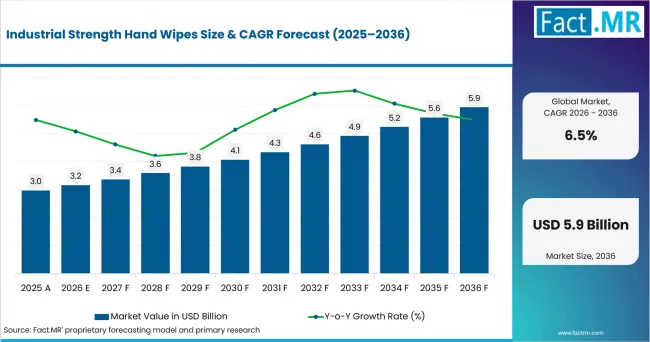
Industrial Strength Hand Wipes Value Analysis | Source: Fact.MR
What are the defining numbers behind Industrial Strength Hand Wipes Market growth?
An absolute opportunity of USD 2.7 billion is expected between 2026 and 2036.
- Demand Drivers in the Market
- Upkeep technicians need wipes that lift oil and grease while retaining strength during repeated passes. Durable web sheets are therefore expected to gain use around repair benches, machines, and vehicle-service bays.
- Plant hand cleaning more often moves closer to the task when crews work away from fixed sinks. Portable pre-moistened packs are expected to support faster cleanup across construction. Field upkeep, automotive service, and utility work.
- China’s National Bureau of Statistics reported in January 2026. Output value added reached 34,674.7 billion yuan in 2025. Increasing 6.1% from the previous year. That output scale supports recurring hand, tool, and machinery cleaning across factories.
- Facilities are expected to match wipe chemistry with the type of dirt and the surface being cleaned. Standard surfactants handle general grime. Stronger degreasers or antimicrobial wipes serve more specific cleaning tasks.
- Key Segments Analyzed
- By Substrate: Spunlace is expected to hold 36.0% share in 2026 because hydroentangled webs combine cloth-like handling with wet strength for repeated wiping passes.
- By Cleaning Chemistry: Solvent-free surfactant is projected to account for 31.0% share in 2026 as routine hand and surface cleaning favors formulas suited to common oils and grime.
- By Application: Industrial hands are anticipated to represent 29.0% share in 2026 owing to frequent contact with lubricants, adhesives, inks, grease, and workshop residue during maintenance work.
- By Format: Canister is estimated to capture 33.0% share in 2026 because sealed dispensing helps retain moisture and keeps wipes available near recurring work areas.
- Analyst Opinion at Fact.MR
- Shambhu Nath Jha, Principal Consultant at Fact.MR, states, “Industrial users judge a wipe by completed cleaning tasks rather than sheet count alone. A stronger substrate and task-matched chemistry are expected to carry more weight as teams compare cleaning speed and waste per job. Suppliers that pair credible performance data with practical dispensing formats are better aligned with plant and field use.”
- Strategic Implications
- Wipe makers should pair substrate strength with clearly defined upkeep tasks. A light-duty wipe and a heavy degreasing wipe have distinct results roles.
- Chemical formulators should separate general surfactant cleaning from stronger degreasing and antimicrobial systems. Clear use guidance helps plant teams select a chemistry that fits soil type and surface fit.
- Kimberly-Clark Professional introduced enhanced WypAll X70 Medium Duty and X80 Heavy Duty Cleaning Cloths in April 2025. The update added higher absorbency and sheets nearly 10% larger in selected Jumbo Roll and Pop-Up Box formats for plant and output environments.
- Japan’s Ministry of Economy, Trade and Industry reported on February 16. 2026. The original plant output index for December 2025 was 106.8 (2020=100), up 2.6% year on year. the seasonally adjusted index was 101.8. Active output supports recurring upkeep wiping around gear and work areas.
China is expected to post 7.2% CAGR through 2036 as plant work sustains frequent gear and hand-cleaning tasks. France is forecast at 7.1% supported by its plant base. The USA is expected to advance at 6.7% as construction and upkeep activity support portable formats. Germany is expected at 6.5% amid a mature plant base. Japan is expected at 5.6% as factories emphasize consistent process cleaning.
How does the Industrial Strength Hand Wipes Market break down by segment?
Spunlace leads Substrate at 36.0%. Canister leads Format at 33.0%.
Which Substrate dominates?
Spunlace is expected to hold 36.0% share in 2026.
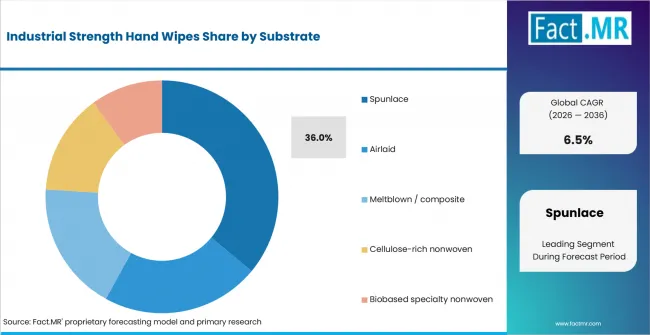
Industrial Strength Hand Wipes Analysis By Substrate | Source: Fact.MR
Spunlace is expected to lead because hydroentanglement creates a soft web with useful wet strength for hand and surface cleaning. Airlaid supports absorbent cellulose-rich formats, while meltblown and composite structures fit oil pickup and controlled-lint work. Cellulose-rich webs remain relevant where fiber content influences product selection. Biobased specialty webs are expected to draw interest where users want material changes without giving up tear resistance or liquid pickup. The wider material base can be compared with the web fabric category and adjacent specialty wipe substrates.
What leads the Cleaning Chemistry segment?
Solvent-free surfactant is expected to account for 31.0% share in 2026.
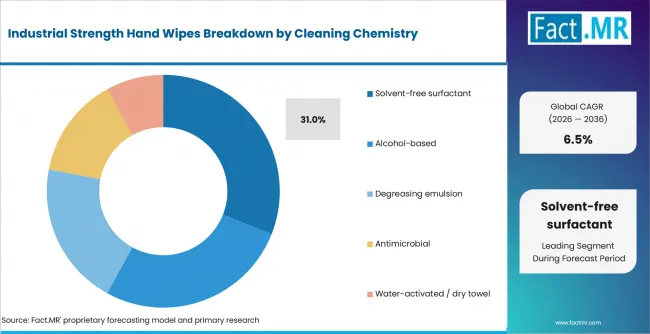
Industrial Strength Hand Wipes Analysis By Cleaning Chemistry | Source: Fact.MR
Solvent-free surfactant systems are expected to lead. Routine hand and surface soils often require wetting and emulsification more than aggressive solvent action. Alcohol-based wipes fit fast-drying tasks, while degreasing emulsions address heavier oils and shop residue. Antimicrobial products serve hygiene-sensitive work areas. Water-activated or dry towels suit facilities that prefer to apply a selected liquid at the point of use. The chemistry decision therefore depends on soil load, surface fit, drying behavior, and skin-contact expectations.
How does Application shape demand?
plant hands are expected to represent 29.0% share in 2026.
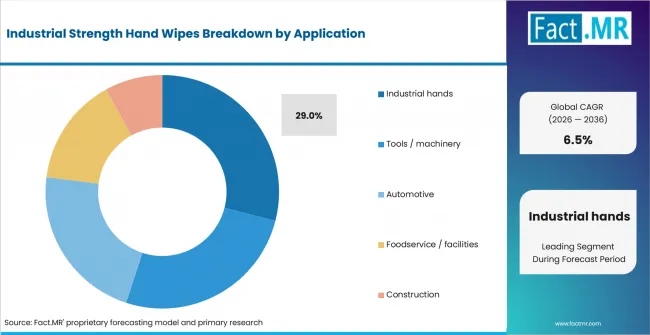
Industrial Strength Hand Wipes Analysis By Application | Source: Fact.MR
plant hand cleaning is expected to lead. Workers repeatedly contact grease. Lubricants, adhesives, inks, carbon soil, and machining residue. Tools and machinery form the next major use group. Technicians often wipe parts before inspection, assembly, or repair. INSEE reported in July 2026 that 3.811 million people were employed in French industry in 2025. That workforce illustrates the scale of recurring hand and workstation cleaning in an plant economy. Automotive users value a product that can move between hands and nearby surfaces. Construction crews favor portable packs that work from vans, toolboxes, and temporary job areas. Dreumex markets heavy-duty plant wipes for cleaning hands, tools and workbenches in automotive, construction and output settings.
What leads the Format segment?
Canister is expected to capture 33.0% share in 2026.
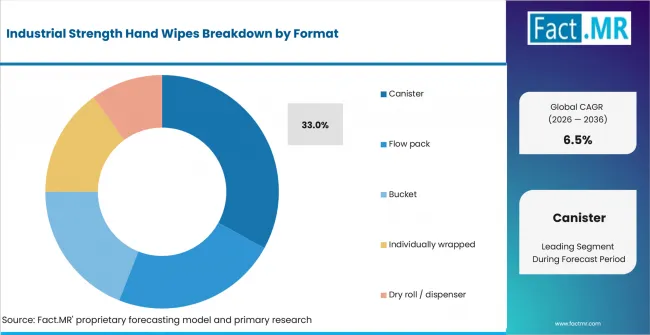
Industrial Strength Hand Wipes Analysis By Format | Source: Fact.MR
Canisters are expected to lead because they protect pre-moistened sheets and support repeat access near workshops and service areas. Flow packs suit mobile crews that need a lighter pack. Buckets serve higher-volume use where teams clean hands, tools, and parts throughout a shift. Individually wrapped wipes fit field kits and service vehicles. Dry rolls and dispensers remain useful when a facility wants to apply its own approved cleaner. ITW Pro Brands currently offers SCRUBS in-a-Bucket plant-strength cleaning towels in containers and refill packs. Showing how sealed dispensing and refillability can sit within the same product system.
What is accelerating Industrial Strength Hand Wipes Market adoption, and what is holding it back?
Point-of-use cleaning and faster upkeep support demand. Material costs and fit issues can limit wider use.
Drivers Impact Analysis
| DRIVER | (~) % IMPACT ON CAGR | GEOGRAPHIC RELEVANCE | IMPACT TIMELINE |
|---|---|---|---|
| Point-of-use cleaning in manufacturing and maintenance | +1.2% | Global | Short term (<= 2 years) |
| Replacement of mixed rags with task-specific wipes | +0.9% | North America, Europe, East Asia | Medium term (2-4 years) |
| Portable cleanup in construction and automotive service | +0.7% | Global | Medium term (2-4 years) |
| Controlled chemistry and dispenser use | +0.5% | North America, Europe | Long term (>= 4 years) |
Opportunity Impact Analysis
| OPPORTUNITY | (~) % IMPACT ON CAGR | GEOGRAPHIC RELEVANCE | IMPACT TIMELINE |
|---|---|---|---|
| Biobased and cellulose-rich wipe substrates | +0.6% | Europe, North America, Japan | Long term (>= 4 years) |
| Low-lint products for precision maintenance | +0.5% | Germany, Japan, USA | Medium term (2-4 years) |
| Refill and controlled-dispensing systems | +0.4% | Global | Medium term (2-4 years) |
Restraints Impact Analysis
| RESTRAINT | (~) % IMPACT ON CAGR | GEOGRAPHIC RELEVANCE | IMPACT TIMELINE |
|---|---|---|---|
| Disposable waste and material cost | -0.5% | Global | Medium term (2-4 years) |
| Chemical compatibility limits | -0.4% | Global | Short term (<= 2 years) |
| Reusable rag economics in low-specification tasks | -0.3% | Global | Long term (>= 4 years) |
Which countries are scaling the Industrial Strength Hand Wipes Market through 2036?
- The country comparison spans 1.6 percentage points across the forecast period.
- China remains 0.1 percentage point above France as plant work keeps gear and hand-cleaning needs broad.
- France remains 0.4 percentage point above the USA as output and construction support recurring professional wiping.
- The USA remains 0.2 percentage point above Germany as construction and upkeep crews sustain portable wipe use.
- Germany remains 0.9 percentage point above Japan as plant upkeep supports established wiping routines.
- Japan closes the displayed range as exact output keeps low-lint and controlled-use formats relevant.
Comparable CAGRs can create different entry conditions. Workforce size. Plant mix, jobsite mobility, pack preferences, and cleaning standards vary by country. Full report coverage includes North America, Latin America, Western Europe. Eastern Europe, East Asia, South Asia & Pacific, Middle East & Africa.
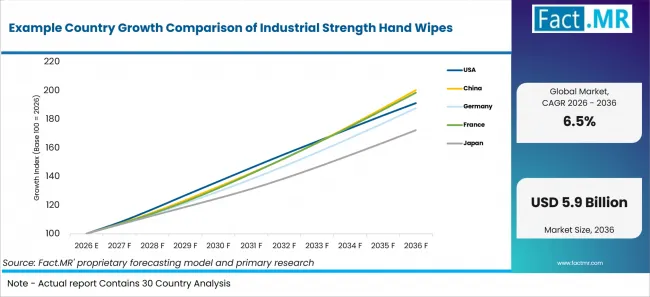
Example Country Growth Comparison Of Industrial Strength Hand Wipes | Source: Fact.MR
| Country | CAGR (2026-2036) |
|---|---|
| China | 7.2% |
| France | 7.1% |
| United States | 6.7% |
| Germany | 6.5% |
| Japan | 5.6% |
How is China developing demand?
7.2% CAGR, supported by plant work and gear-intensive output.
China’s large factory base is expected to keep plant wiping tied to upkeep. Assembly, machining, and gear care. Canisters and buckets are well suited to fixed work areas. Portable packs fit repair and field-service tasks across plant clusters.
What supports France growth?
7.1% CAGR, led by output output and professional upkeep activity.
French plant users are expected to favor wipes. Balance absorbency with predictable chemistry across factories, workshops, and facility operations. INSEE reported on July 21, 2026 that output output in value was EUR 981 billion in 2025. That output base creates recurring cleaning needs around hands, tools, parts, and work surfaces. Flow packs and canisters can serve different use patterns. Cellulose-rich and spunlace substrates give vendors room to address absorbency and handling preferences.
What supports USA adoption?
6.7% CAGR, backed by construction work and a large upkeep economy.
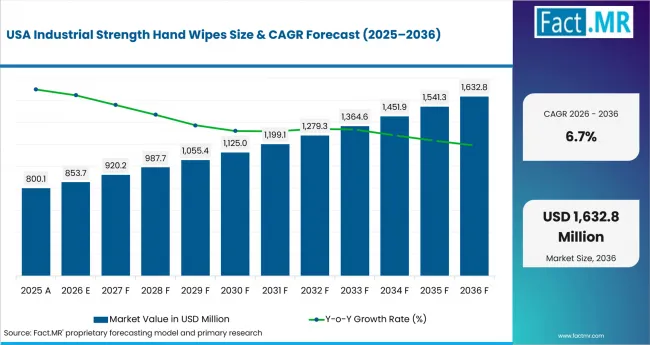
Industrial Strength Hand Wipes Country Value Analysis | Source: Fact.MR
U.S. demand is expected to benefit from mobile work where crews need hand and tool cleaning away from wash stations. The Bureau of Labor Statistics reported in May 2026. Construction and extraction occupations accounted for 6.4 million jobs in May 2025. Contractors, mechanics, and plant upkeep teams therefore form a large base for portable canisters. Wrapped wipes, and refill systems. vendors can compete through wipe durability, convenient dispensing, and chemistry suited to common oils and grime.
What is supporting Germany demand?
6.5% CAGR, driven by an established plant workforce and upkeep intensity.
Germany’s plant base is expected to support steady use of heavy-duty cleaning cloths where sheet strength and solvent fit influence product choice. Destatis reported in January 2026 that industry excluding construction employed 7.9 million people in 2025. That workforce keeps wiping demand connected to machinery, assembly, repair, and plant upkeep. Heavy-duty cloths and controlled dispensers are well suited to these settings. Users can standardize sheet access across repeated upkeep tasks.
How does Japan perform?
5.6% CAGR, led by exact upkeep and active construction programs.
Japan is expected to remain a specification-focused market where users value clean handling around tools, gear, and finished surfaces. The Ministry of Land, Infrastructure, Transport and Tourism reported in April 2026. Orders received by 50 major construction firms increased 12.0% in fiscal 2025. Field activity supports portable wipe use, while output uses favor low-lint materials and controlled liquid use. vendors therefore need clear positioning by soil type and work setting.
Who leads the Industrial Strength Hand Wipes Market?
Kimberly-Clark Professional serves plant users through WypAll cleaning cloths. Including the X70 and X80 lines. Received product enhancements in April 2025. ITW Pro Brands markets SCRUBS in-a-Bucket plant-strength cleaning towels for hands and surfaces. Sellars supplies market wipers under its Clean Task branding. Customers may continue to encounter selected TOOLBOX packaging during a phased brand transition extending into 2026. Dreumex offers Power Wipes and Expert Wipes for plant cleaning of hands, tools, and surfaces. Big Wipes provides heavy-duty plant cleaning wipes for professional tradespeople.
Suppliers compete on wipe strength, durability, chemistry compatibility, and moisture retention. Refill efficiency, dispensing, and cleaning performance also shape product selection. The competitive boundary can be viewed alongside the because facilities often combine manual wiping with broader industrial cleaning systems.industrial vacuum cleaner market
Which companies are the key providers?
Key companies include Kimberly-Clark Professional. ITW Pro Brands. Sellars. Dreumex. and Big Wipes.
- Kimberly-Clark Professional
- ITW Pro Brands
- Sellars
- Dreumex
- Big Wipes
Bibliography
- Techmer PM. (2025, May 14). Techmer PM unveils CoLab and Fibertech Connect at Dalton Fiber Center.
- Centers for Medicare & Medicaid Services. (2026, January 14). Historical. National Health Expenditure Data.
- Clariant. (2025, August 7). Clariant advances plastics stabilizer technology with expanded production and new applications.
- Czech Statistical Office. (2026, February 6). Industrial production increased by 1.5% in 2025 [Supplementary information to the news release on industry – December 2025].
- EDANA. (2026, April 7). 2025 nonwoven production in Greater Europe: European nonwovens industry remains strong amid challenging market conditions.
- Statistisches Bundesamt (Destatis). (2025, November 6). 2,0 % mehr stationäre Krankenhausbehandlungen im Jahr 2024 [2.0% more inpatient hospital treatments in 2024].
- Ministry of Economy, Trade and Industry. (2026, February 27). Indices of industrial production.
- Insee. (2026, July 2). Professions et secteurs d’activité [Occupations and sectors of activity].
- Statistics Korea. (2026, February 25). Vital statistics in December 2025.
This Report Answers
- The report explains where industrial strength hand wipes are used across substrate, cleaning chemistry, application, and format.
- Segment analysis identifies the leading subsegments and the operating reasons plant and field users select them.
- Country analysis compares the five profiled markets using 2026 to 2036 CAGRs and current official industrial evidence.
- Competitive analysis reviews finished-product providers with direct industrial hand, tool, or surface wiping portfolios.
- Application analysis covers hand cleaning, machinery wiping, automotive service, facilities work, and construction use.
What does the Industrial Strength Hand Wipes Market cover?
The Industrial Strength Hand Wipes Market covers durable wipes used by workers to remove grease, oil, dirt, adhesives, paint residue, sealants, and process soil from hands or nearby work surfaces. The scope includes pre-moistened and dry formats designed for industrial maintenance, automotive work, construction, facility cleaning, foodservice support, and related professional tasks where portability and controlled sheet use carry practical value.
Products can be disposable or designed for limited repeated use when the manufacturer positions the wipe for industrial cleaning. The market boundary focuses on professional wiping systems rather than household personal-care wipes. Substrate strength, liquid loading, chemistry choice, pack format, and dispensing method are treated as commercial variables because they influence how many sheets a team uses and how consistently the product performs during a task.
What is included in the scope?
The scope includes spunlace, airlaid, meltblown, composite, cellulose-rich, and biobased nonwovens.
Cleaning options include solvent-free surfactants, alcohol-based systems, degreasing emulsions, antimicrobial formulas, and water-activated or dry towels. Applications include hands, tools, machinery, automotive work, foodservice, facilities, and construction. Formats include canisters, flow packs, buckets, wrapped wipes, dry rolls, and dispensers.
What is excluded from the scope?
The scope excludes baby wipes, cosmetic wipes, household wipes, and medical disinfection products used only in clinical settings.
Loose rags and rental towel services are also excluded. Bulk liquid cleaners are treated as cleaning chemicals when they are sold without wipes. Gloves and other protective equipment are adjacent categories because their main role is protection rather than wiping.
How Was the Analysis Built?
The analysis draws on 120+ sources, 35+ company portfolios, 25+ countries, and more than 20 industry interviews.
- Primary Research: Primary research includes discussions with manufacturers, service providers, technology developers, distributors, end users, and subject-matter experts. These conversations examine purchasing priorities, product adoption, operational challenges, approval requirements, competitive positioning, and the factors that influence wider market acceptance.
- Desk Research: Desk research covers government statistics, regulatory publications, company filings, trade data, technical studies, industry associations, standards, public policy, and other authoritative sources. Every source used in the analysis is documented in the bibliography.
- Market Sizing and Forecasting: Market estimates combine historical performance, demand indicators, pricing and volume trends, segment shares, company participation, country-level growth, adoption patterns, investment activity, and barriers to market expansion.
- Data Validation and Update Cycle: Findings are validated by comparing primary interviews with public data, company activity, regulatory changes, trade patterns, and industry developments. Regular updates review new product launches, capacity changes, partnerships, approvals, and shifts in commercial adoption.
What is the report’s scope and coverage?
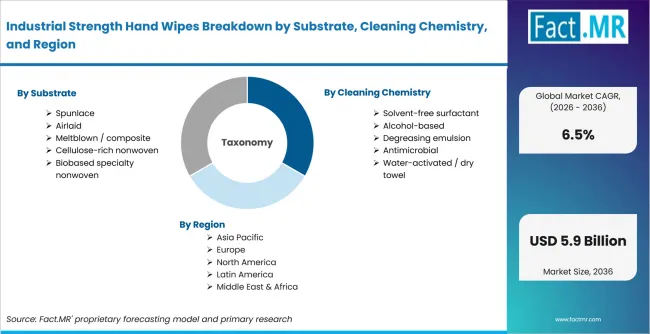
Industrial Strength Hand Wipes Breakdown By Substrate, Cleaning Chemistry, And Region | Source: Fact.MR
| Attribute | Details |
|---|---|
| Quantitative Units | USD billion |
| Market Definition | Industrial strength hand wipes are durable wiping products used for hand, tool, machinery, parts, and facility cleaning in industrial and professional work settings. |
| Substrate | Spunlace; Airlaid; Meltblown / composite; Cellulose-rich nonwoven; Biobased specialty nonwoven |
| Cleaning Chemistry | Solvent-free surfactant; Alcohol-based; Degreasing emulsion; Antimicrobial; Water-activated / dry towel |
| Application | Industrial hands; Tools / machinery; Automotive; Foodservice / facilities; Construction |
| Format | Canister; Flow pack; Bucket; Individually wrapped; Dry roll / dispenser |
| Regions Covered | North America; Latin America; Western Europe; Eastern Europe; East Asia; South Asia & Pacific; Middle East & Africa |
| Countries Covered | United States; China; Germany; France; Japan |
| Key Companies Profiled | Kimberly-Clark Professional; ITW Pro Brands; Sellars; Dreumex; Big Wipes |
| Forecast Period | 2026 to 2036 |
| Approach | Hybrid top-down and bottom-up approach using industrial activity, application intensity, substrate and chemistry mix, format use, country growth, and provider portfolio review. |
How is the market segmented?
-
By Substrate:
- Spunlace
- Airlaid
- Meltblown / composite
- Cellulose-rich nonwoven
- Biobased specialty nonwoven
-
By Cleaning Chemistry:
- Solvent-free surfactant
- Alcohol-based
- Degreasing emulsion
- Antimicrobial
- Water-activated / dry towel
-
By Application:
- Industrial hands
- Tools / machinery
- Automotive
- Foodservice / facilities
- Construction
-
By Format:
- Canister
- Flow pack
- Bucket
- Individually wrapped
- Dry roll / dispenser
-
By Region:
- North America
- Latin America
- Western Europe
- Eastern Europe
- East Asia
- South Asia & Pacific
- Middle East & Africa