Industrial Labels Market Size, Share, Growth and Forecast (2026 - 2036)

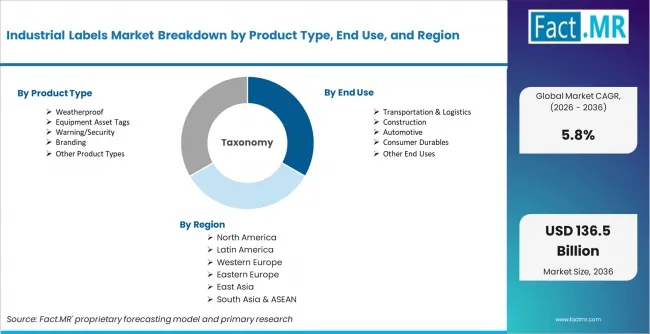
The Industrial Labels Market is segmented by Product Type (Warning/Security, Branding , Weatherproof , Equipment Asset Tags , Other Product Types). It is segmented by End Use (Transportation & Logistics, Construction, Automotive, Consumer Durables, Other End Uses). It is segmented by Material (Polymer, Metal). It is segmented by Printing Technology (Flexographic Printing, Digital Printing, Screen Printing, Thermal Transfer, Offset Printing). It is segmented by Adhesive Type (Pressure-Sensitive, Heat-Activated, Glue-Applied, Removable Adhesive). Forecast for 2026 to 2036.

Industrial Labels Market Size, Market Forecast and Outlook by Fact.MR

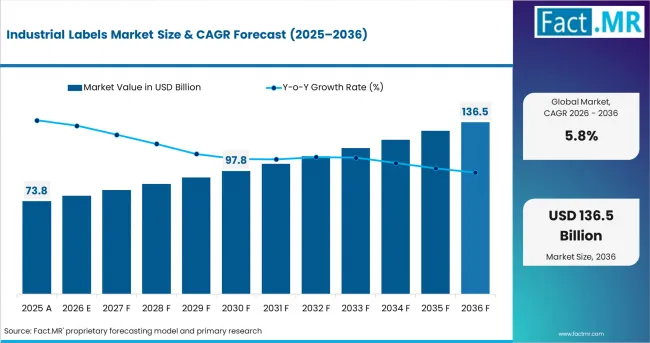
  • The industrial labels market valuation stood at USD 73.8 billion in 2025.
  • Demand is estimated to reach USD 77.7 billion in 2026 and is projected to rise to USD 136.5 billion by 2036.
  • The market is forecast to record 5.8% CAGR from 2026 to 2036. Packaging expansion and warehouse tracking needs are supporting demand for durable labels.
Industrial Labels Market Value Analysis

Metric Details
Industry Size (2026) USD 77.7 billion
Industry Value (2036) USD 136.5 billion
CAGR (2026 to 2036) 5.8%

Summary of Industrial Labels Market

  • Demand Drivers in the Market
    • Product Identification: Manufacturers need labels that keep product information readable across storage and transport. This supports traceability and safer handling.
    • Supply Chain Tracking: Logistics providers need barcodes and asset tags for parcel movement and inventory control. Faster shipment cycles increase label use.
    • Durable Label Demand: Industrial users need labels that resist heat and moisture. Harsh operating environments require stronger label materials.
  • Key Segments Analyzed
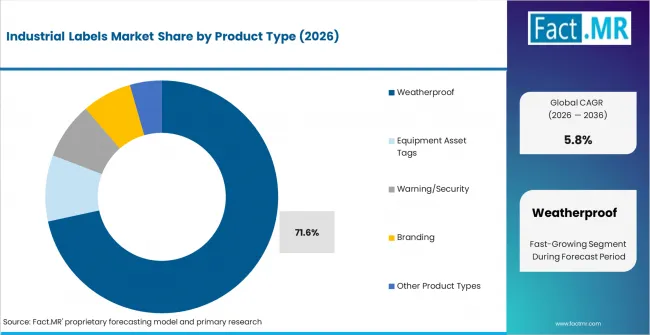
    • By Product Type: Weatherproof labels are projected to record 71.6% share in 2026 as industrial users need labels that resist moisture and temperature stress.
    • By End Use: Transportation & logistics lead because packages need tracking and route identification. The segment is estimated to hold 32.0% share in 2026.
    • By Material: Polymer labels are projected to account for 68.0% share in 2026 because plastic films support weatherproof and durable label use.
    • By Printing Technology: Flexographic printing leads as converters need cost-efficient output for repeat label runs. The technology is expected to hold 34.0% share in 2026.
    • By Adhesive Type: Pressure-sensitive labels are projected to account for 62.0% share in 2026 as they support fast application across packaging and equipment.
    • By Geography: India industrial labels demand is forecast to grow at 9.2% CAGR from 2026 to 2036 as packaged food and logistics activity expand.
  • Analyst Opinion at Fact.MR
    • Shambhu Nath Jha, Senior Analyst at Fact.MR, states, “Industrial label demand is becoming more performance-led. Manufacturers need labels that stay readable during storage and handling. Suppliers that combine durable materials with print quality can protect repeat demand.”
  • Strategic Implications
    • Durability Control: Label suppliers need materials matched to heat and moisture exposure. Weak labels can fail during storage or transport and raise relabeling cost.
    • Print Reliability: Converters need sharp barcodes and clear text for scanning and compliance. Poor print quality can delay shipments and disrupt traceability.
    • Adhesive Performance: Adhesives must hold during handling and temperature changes. Weak bonding can damage readability and create avoidable replacement work.

Industrial label demand rises as products need clear identification across production and distribution. Warning labels support workplace safety and product handling. Weatherproof labels protect information during heat and moisture exposure. Equipment asset tags help factories track machinery and service records.

Label suppliers are moving from basic printed stickers toward durable identification systems. Manufacturers need labels that resist heat and chemicals. Retail supply chains need barcodes and product information for tracking. Automotive producers need durable labels that stay readable across the service life of vehicles.

India is forecast to grow at 9.2% CAGR from 2026 to 2036 as packaged food output and logistics activity expand. China is projected to record 7.0% CAGR as manufacturing and e-commerce shipments increase label use. United States demand is set to rise at 5.8% CAGR through food labeling needs and industrial compliance. Canada may grow at 4.7% CAGR by 2036 as demand for eco-friendly labels improves. Germany follows at 5.2% CAGR through durable goods labeling and convenience food packaging. Japan is forecast to post 4.9% CAGR through electronics, automotive, and equipment label use.

Segmental Analysis

Industrial Labels Market Analysis by Product Type
Industrial Labels Market Analysis By Product Type

Weatherproof labels are projected to record 71.6% share in 2026 as industrial users need labels that stay readable in moisture and temperature changes. Warning and security labels support safety communication in factories. Equipment asset tags help companies to track tools and machinery. 3M states that its durable polyester label material offers moisture resistance and uses a high-performance acrylic adhesive for demanding environments. [1] Weatherproof labels lead because damaged labels can create traceability problems during handling.

  • Weatherproof Use: Weatherproof labels protect information through moisture and abrasion. This supports outdoor and warehouse use.
  • Warning Need: Warning labels communicate safety risks. OSHA’s updated hazard communication rule keeps label clarity important.
  • Asset Tags: Equipment asset tags support maintenance tracking. Facilities use them to identify tools and machinery.

Industrial Labels Market Analysis by End Use
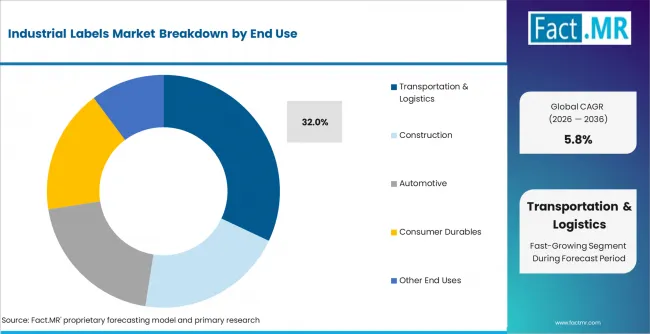
Industrial Labels Market Analysis By End Use

Transportation & logistics lead because goods need labels for tracking and shipment movement. Construction uses labels for safety and equipment identification. The transportation & logistics segment is estimated to hold 32.0% share in 2026 as route labels and barcodes support delivery accuracy. Transportation & logistics lead because packages need readable labels from pickup through final delivery.

  • Shipment Tracking: Logistics users need labels that scan correctly. Poor label quality can delay routing.
  • Construction Safety: Construction sites use labels for hazards and equipment. Durable labels help workers identify risks.
  • Automotive Use: Automotive labels need long service life. Labels must resist heat and chemicals.

Industrial Labels Market Analysis by Material
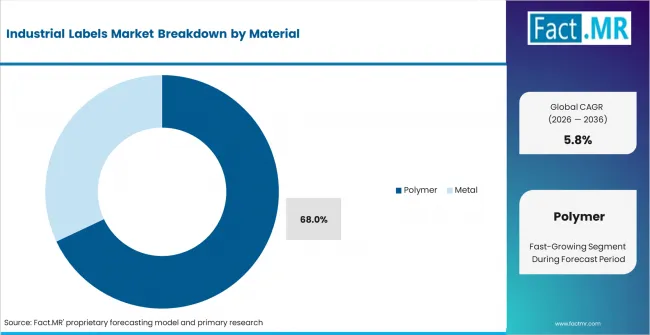
Industrial Labels Market Analysis By Material

Polymer labels are projected to account for 68.0% share in 2026 as film materials support durable and weatherproof label formats. Metal labels serve harsh industrial settings that need higher resistance. Polymer labels remain useful across packaging and equipment because they offer flexibility and clear print quality. Polymer labels lead as converters need materials that print well and resist handling stress.

  • Film Labels: Polymer films support durability and print clarity. They suit packaging and equipment identification.
  • Metal Labels: Metal labels serve demanding industrial settings. They support asset tags in severe operating areas.
  • Material Choice: Material selection depends on exposure risk. Heat and chemicals can damage weaker labels.

Industrial Labels Market Analysis by Printing Technology
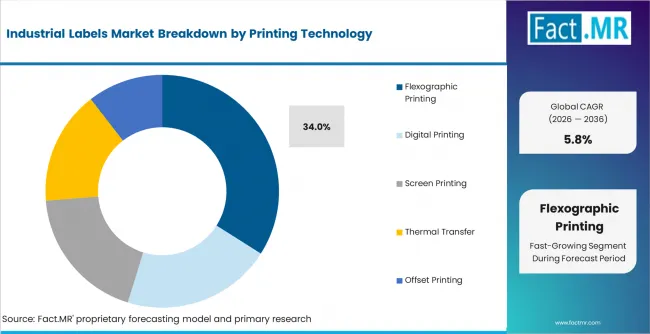
Industrial Labels Market Analysis By Printing Technology

Flexographic printing leads as converters need efficient output for repeat label runs. Digital printing supports short runs and variable data. Flexographic printing is expected to hold 34.0% share in 2026, packaged goods and logistics labels need repeat production at scale. Its lead is tied to consistent print quality across large label batches used in industrial and packaging applications.

  • Flexographic Runs: Flexographic printing supports large label batches. It helps converters serve repeat packaging demand.
  • Digital Output: Digital printing supports shorter runs and variable data. Brands use it for flexible label programs.
  • Thermal Transfer: Thermal transfer supports barcodes and asset tags. Industrial users value sharp variable information.

Industrial Labels Market Analysis by Adhesive Type
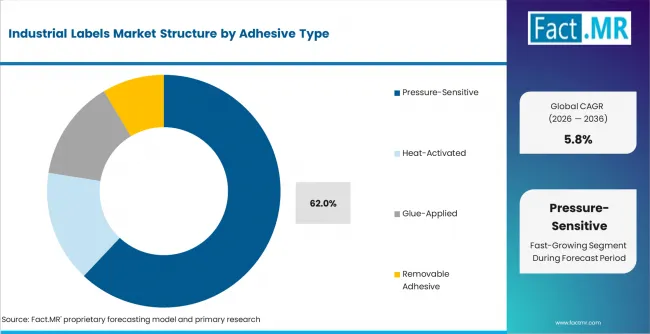
Industrial Labels Market Analysis By Adhesive Type

Pressure-sensitive labels are projected to account for 62.0% share in 2026 because they support fast application in packaging and equipment. Avery Dennison states that pressure-sensitive label materials are made from facestocks, adhesives, and release liners. [2] Heat-activated labels are used in higher-temperature applications. Glue-applied labels work for specific packaging lines. Pressure-sensitive labels lead because users can apply them quickly without separate curing steps.

  • Fast Application: Pressure-sensitive labels support quick placement. This helps packaging lines reduce handling time.
  • Heat-Activated Use: Heat-activated labels support severe applications. They are used when stronger bonding is needed.
  • Removable Labels: Removable adhesives support temporary identification. Warehouses use them for changing stock locations.

Industrial Labels Market Drivers, Restraints, and Opportunities

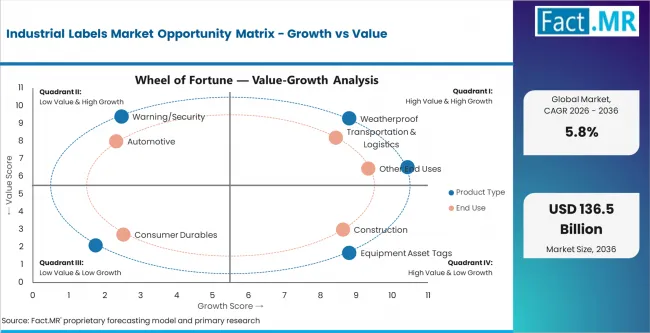
Industrial Labels Market Opportunity Matrix Growth Vs Value p>Product identification and supply chain tracking are the main growth drivers. Industrial labels help companies keep product data readable across storage and transport. Barcode labels support inventory control and delivery checks. Durable labels protect information during heat and moisture exposure.

Raw material and adhesive performance pressure is the main restraint. Films and adhesives must meet application-specific requirements. Label failure can create compliance risk and disrupt traceability. Price pressure can limit the use of premium materials in lower-margin applications.

Opportunities in the Industrial Labels Market

  • Compliance Labels: Chemical and workplace labels need clear hazard communication. Updated safety rules support better label and safety data sheet information for hazardous chemicals.
  • Durable Goods Labels: Industrial labels can expand in electronics and automotive applications. High-performance labels support parts tracking and identification during manufacturing.
  • Weatherproof Materials: Manufacturers need durable label materials for harsh operating conditions. Stronger label materials help keep warnings and product information readable through heat moisture and handling.

Regional Analysis

Based on regional analysis, the industrial labels market is segmented into North America, Latin America, Europe, East Asia, South Asia and Oceania, and Middle East and Africa.

Top Country Growth Comparison Industrial Labels Market Cagr (2026 2036)

Country CAGR (2026 to 2036)

Country CAGR
India 9.2%
China 7.0%
United States 5.8%
Germany 5.2%
Japan 4.9%
Canada 4.7%

Source: Fact.MR analysis based on adjusted forecast model and primary research.
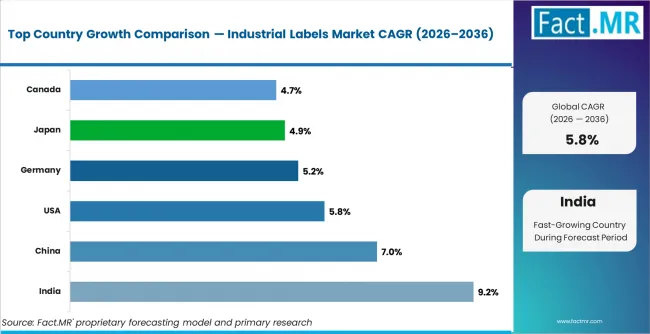
Industrial Labels Market Cagr Analysis By Country

South Asia and Oceania Industrial Labels Market Analysis

South Asia and Oceania demand is supported by packaged food and logistics activity. India leads through packaged goods growth and e-commerce shipping. Label use improves when products need clearer identity and traceability.

  • India: India industrial labels demand is forecast to grow at 9.2% CAGR from 2026 to 2036 as packaged food output and logistics activity expand. Food producers need labels for product information and shelf movement. Logistics operators need scannable labels for delivery accuracy. Growth is supported by packaging conversion and shipment tracking needs.

East Asia Industrial Labels Market Analysis

East Asia demand comes from manufacturing and consumer goods production. China leads through factory output and e-commerce shipments. Japan supports demand through electronics and automotive label use.

  • China: China demand is supported by manufacturing and export packaging. The country is projected to record 7.0% CAGR over the study period as product identification and logistics labeling expand. Domestic labels converters benefit as more products move through factories and warehouses. Growth is supported by manufacturing scale and shipment tracking needs.
  • Japan: Japan is forecast to post 4.9% CAGR through 2036 as electronics and automotive users require durable labels. Product quality expectations support careful label material selection. JAMA’s The Motor Industry of Japan 2025 shows Japan’s large automotive manufacturing base, which supports demand for durable product identification across vehicles and components. [3] Japan grows through precision packaging and durable goods labeling.

North America Industrial Labels Market Analysis
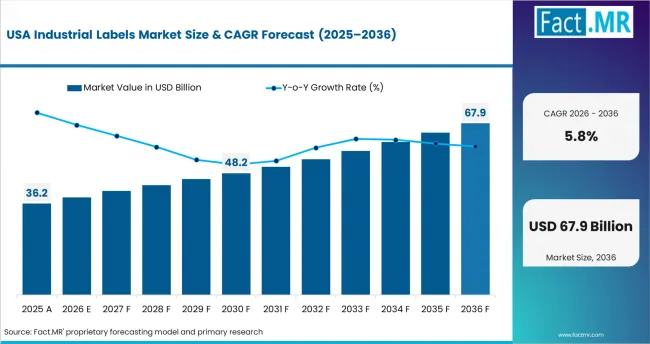
Industrial Labels Market Country Value Analysis

North America demand is supported by chemical labeling and packaged goods. The United States leads through industrial compliance and logistics systems. Canada supports demand through eco-friendly label use.

  • United States: United States demand is likely to rise at 5.8% CAGR from 2026 to 2036 as food and packaged product need clear product labels. FDA’s 2025 compliance program covers general food labeling requirements and labeling-related sample analysis for domestic and imported foods. [4] U.S. demand grows through packaged product information and compliance labeling needs.
  • Canada: Canada demand is forecast to grow at 4.7% CAGR over the forecast period through packaging and sustainability-led label use. Label suppliers need materials that support durability and recycling goals. Canada grows through eco-friendly packaging and industrial identification demand.

Europe Industrial Labels Market Analysis
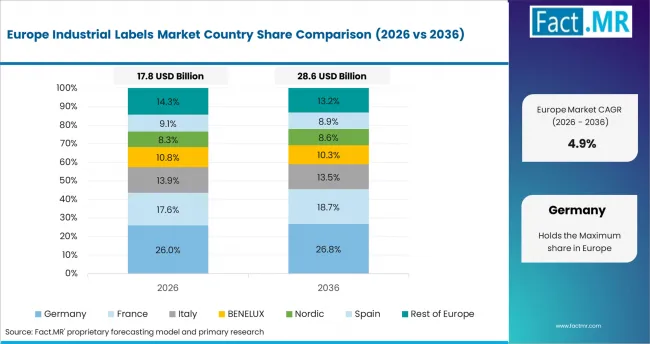
Industrial Labels Market Europe Country Market Share Analysis, 2026 & 2036

Europe demand is supported by durable goods and packaging rules. Germany leads through automotive and manufacturing activity.

  • Germany: Germany is forecast to post 5.2% CAGR by 2036 as durable goods and automotive applications support label demand. German manufacturers need labels that are readable through production and service life. Germany grows through manufacturing quality and industrial compliance needs.

Competitive Aligners for Market Players
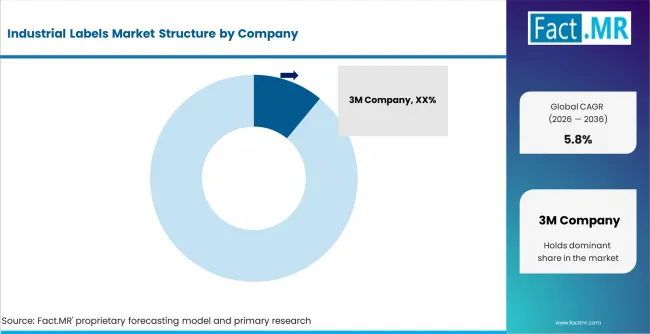
Industrial Labels Market Analysis By Company

The industrial labels market includes material suppliers and industrial identification companies. 3M competes through durable label materials for manufacturing use. Brady Corporation offers industrial labels and label printers. Avery Dennison supplies durable label materials for industrial products. CCL Industries serves automotive and electronics applications. Fuji Seal International supports packaging applications through pressure-sensitive and shrink sleeve labels.

Competition depends on label durability and print quality. Industrial users need labels that stay readable during heat, moisture, storage, and transport. Brady supports workplace identification through printers and label materials. CCL Design supplies engineered labels for electronics and automotive parts. Fuji Seal serves packaging lines through pressure-sensitive and shrink sleeve formats.

Supplier strength will depend on durability through 2036. Manufacturers need labels that resist heat and moisture. Logistics operators need scannable labels for tracking. Automotive users need labels that last through the service life of vehicles. Companies that combine durable materials with reliable print support can protect repeat demand.

Key Players in Industrial Labels Market

3M Company
Brady Corporation
Avery Dennison Corporation
CCL Industries Inc.
Fuji Seal International Inc.

Bibliography

  • [1] 3M. (2025, December). 3M™ Durable Label Material 7819: Technical data sheet. 3M.
  • [2] Avery Dennison. (2024). Product component guide: Sub-Saharan Africa 2025 (Q4 2024). Label and Packaging Materials.
  • [3] Japan Automobile Manufacturers Association. (2025, September). The motor industry of Japan 2025. Japan Automobile Manufacturers Association.
  • [4] U.S. Food and Drug Administration. (2025). CP 7321.005: General food labeling requirements and labeling-related sample analysis: Domestic and import compliance program. U.S. Department of Health and Human Services.

This Report Addresses

  • Strategic intelligence on industrial label demand across warning labels and weatherproof labels.
  • Growth opportunity mapping across India and China plus the United States and Germany.
  • Segment analysis by product type, end use, material, printing technology, and adhesive type.
  • Regional outlook covering product identification, supply chain tracking, durable goods labeling, and compliance demand.
  • Competitive analysis of 3M Company, Brady Corporation, Avery Dennison Corporation, CCL Industries Inc., and Fuji Seal International Inc.
  • Product assessment covering weatherproof labels, equipment asset tags, polymer labels, and pressure-sensitive labels.
  • Report delivered through PDF, Excel datasets, and presentation formats.
  • Primary interviews, supplier checks, and industrial label demand review support validation.

Industrial Labels Market Definition

The industrial labels market covers printed or converted labels used to identify products and equipment. These labels communicate safety details and operating instructions. They support tracking and brand information. The market covers durable labels used across factories and supply chains.

Industrial Labels Market Inclusions

The scope includes warning labels and security labels. Branding labels and weatherproof labels are included. Equipment asset tags are covered. Metal and polymer labels are counted. Pressure-sensitive labels and industrial printed labels are included.

Industrial Labels Market Exclusions

The scope excludes decorative stickers used without industrial function. Office stationery labels are outside scope. Plain packaging without printed label function is excluded. RFID hardware is not counted unless sold as part of an industrial label system.

Industrial Labels Market Research Methodology

  • Primary Research
    • Primary research includes interviews with label converters and packaging managers. Logistics operators were reviewed for tracking needs. Automotive suppliers were reviewed for durable identification demand. Supplier checks supported material and technology assumptions.
  • Desk Research
    • Desk research reviewed label material pages and safety labeling guidance. Company product pages supported supplier validation. Regulatory pages supported compliance-led demand logic.
  • Market-Sizing and Forecasting
    • Forecasting uses product type demand and end-use adoption. Material demand is linked to durability needs. Printing technology estimates reflect production scale and label specification.
  • Data Validation and Update Cycle
    • Forecasts are validated through converter checks. Packaging buyer interviews support demand validation. Regional assumptions are reviewed with packaging rules and manufacturing trends.

Scope of the Report

Industrial Labels Market Breakdown By Product Type, End Use, And Region

Attribute Details
Quantitative Units USD 77.7 billion in 2026 to USD 136.5 billion by 2036 at 5.8% CAGR
Market Definition Printed or converted labels used to identify products and equipment across industrial settings.
Product Type Warning/Security , Branding , Weatherproof , Equipment Asset Tags , Other Product Types
End Use Transportation & Logistics , Construction , Automotive , Consumer Durables , Other End Uses
Material Polymer , Metal
Printing Technology Flexographic Printing , Digital Printing , Screen Printing , Thermal Transfer , Offset Printing
Adhesive Type Pressure-Sensitive , Heat-Activated , Glue-Applied , Removable Adhesive
Regions Covered North America , Latin America , Europe , East Asia , South Asia and Oceania , Middle East and Africa
Countries Covered India , China , United States , Germany , Japan , Canada
Key Companies Profiled 3M Company , Brady Corporation , Avery Dennison Corporation , CCL Industries Inc. , Fuji Seal International Inc.
Forecast Period 2026 to 2036
Approach Hybrid top-down and bottom-up model using product type demand and end-use adoption. Material and technology demand were validated through supplier checks.

Industrial Labels Market Analysis by Segments

  • By Product Type:

    • Warning/Security
    • Branding
    • Weatherproof
    • Equipment Asset Tags
    • Other Product Types
  • By End Use:

    • Transportation & Logistics
    • Construction
    • Automotive
    • Consumer Durables
    • Other End Uses
  • By Material:

    • Polymer
    • Metal
  • By Printing Technology:

    • Flexographic Printing
    • Digital Printing
    • Screen Printing
    • Thermal Transfer
    • Offset Printing
  • By Adhesive Type:

    • Pressure-Sensitive
    • Heat-Activated
    • Glue-Applied
    • Removable Adhesive
  • Region:

    • North America
      • United States
      • Canada
    • Europe
      • Germany
      • United Kingdom
      • France
      • Italy
      • Spain
    • Asia Pacific
      • China
      • Japan
      • South Korea
      • Taiwan
      • Singapore
    • Latin America
      • Brazil
      • Mexico
      • Argentina
    • Middle East & Africa
      • GCC Countries
      • South Africa
      • Israel

- Frequently Asked Questions -

How large is the industrial labels market in 2025?

The industrial labels market was valued at USD 73.8 billion in 2025 based on the adjusted Fact.MR model.

What is the expected value of the industrial labels market in 2026?

The industrial labels market is estimated to reach USD 77.7 billion in 2026 after the forecast period adjustment.

What is the forecast value of the industrial labels market by 2036?

The industrial labels market is forecast to reach USD 136.5 billion by 2036 as durable label demand expands.

What CAGR is projected for the industrial labels market from 2026 to 2036?

Fact.MR’s is projected to forecast 5.8% CAGR for the industrial labels market from 2026 to 2036.

Which product type leads the industrial labels market?

Weatherproof labels lead with 71.6% share in 2026, industrial users need moisture-resistant labels.

Why do weatherproof labels lead demand?

Weatherproof labels lead, product information must stay readable during storage and transport.

Which end use leads the industrial labels market?

Transportation & logistics lead with 32.0% share in 2026 because shipments need tracking and route identification.

Which material leads the industrial labels market?

Polymer labels lead with 68.0% share in 2026 as films support durable and weatherproof label use.

Which printing technology leads the industrial labels market?

Flexographic printing leads with 34.0% share in 2026 because converters need efficient repeat output.

Which adhesive type leads the industrial labels market?

Pressure-sensitive labels lead with 62.0% share in 2026 because they support fast application.

Which country grows fastest in the industrial labels market?

India is forecast to grow fastest at 9.2% CAGR from 2026 to 2036.

Why is China important in the industrial labels market?

China is important because manufacturing and export packaging create steady label demand.

Why does the United States support industrial label demand?

The United States supports demand through chemical labeling and packaged food labeling needs.

Why does Germany support industrial label demand?

Germany supports demand through automotive and durable goods labeling.

What drives industrial labels market growth?

Product identification and supply chain tracking drive industrial label demand.

What restrains industrial labels market growth?

Raw material cost and adhesive performance pressure restrain growth.

How do industrial labels support logistics?

Industrial labels support logistics by carrying barcodes and route information.

How do industrial labels support manufacturing?

Industrial labels support manufacturing by identifying equipment and product batches.

Table of Content

  1. Executive Summary
    • Global Market Outlook
    • Demand to side Trends
    • Supply to side Trends
    • Technology Roadmap Analysis
    • Analysis and Recommendations
  2. Market Overview
    • Market Coverage / Taxonomy
    • Market Definition / Scope / Limitations
  3. Research Methodology
    • Chapter Orientation
    • Analytical Lens and Working Hypotheses
      • Market Structure, Signals, and Trend Drivers
      • Benchmarking and Cross-market Comparability
      • Market Sizing, Forecasting, and Opportunity Mapping
    • Research Design and Evidence Framework
      • Desk Research Programme (Secondary Evidence)
        • Company Annual and Sustainability Reports
        • Peer-reviewed Journals and Academic Literature
        • Corporate Websites, Product Literature, and Technical Notes
        • Earnings Decks and Investor Briefings
        • Statutory Filings and Regulatory Disclosures
        • Technical White Papers and Standards Notes
        • Trade Journals, Industry Magazines, and Analyst Briefs
        • Conference Proceedings, Webinars, and Seminar Materials
        • Government Statistics Portals and Public Data Releases
        • Press Releases and Reputable Media Coverage
        • Specialist Newsletters and Curated Briefings
        • Sector Databases and Reference Repositories
        • Fact.MR Internal Proprietary Databases and Historical Market Datasets
        • Subscription Datasets and Paid Sources
        • Social Channels, Communities, and Digital Listening Inputs
        • Additional Desk Sources
      • Expert Input and Fieldwork (Primary Evidence)
        • Primary Modes
          • Qualitative Interviews and Expert Elicitation
          • Quantitative Surveys and Structured Data Capture
          • Blended Approach
        • Why Primary Evidence is Used
        • Field Techniques
          • Interviews
          • Surveys
          • Focus Groups
          • Observational and In-context Research
          • Social and Community Interactions
        • Stakeholder Universe Engaged
          • C-suite Leaders
          • Board Members
          • Presidents and Vice Presidents
          • R&D and Innovation Heads
          • Technical Specialists
          • Domain Subject-matter Experts
          • Scientists
          • Physicians and Other Healthcare Professionals
        • Governance, Ethics, and Data Stewardship
          • Research Ethics
          • Data Integrity and Handling
      • Tooling, Models, and Reference Databases
    • Data Engineering and Model Build
      • Data Acquisition and Ingestion
      • Cleaning, Normalisation, and Verification
      • Synthesis, Triangulation, and Analysis
    • Quality Assurance and Audit Trail
  4. Market Background
    • Market Dynamics
      • Drivers
      • Restraints
      • Opportunity
      • Trends
    • Scenario Forecast
      • Demand in Optimistic Scenario
      • Demand in Likely Scenario
      • Demand in Conservative Scenario
    • Opportunity Map Analysis
    • Product Life Cycle Analysis
    • Supply Chain Analysis
    • Investment Feasibility Matrix
    • Value Chain Analysis
    • PESTLE and Porter’s Analysis
    • Regulatory Landscape
    • Regional Parent Market Outlook
    • Production and Consumption Statistics
    • Import and Export Statistics
  5. Global Market Analysis 2021 to 2025 and Forecast, 2026 to 2036
    • Historical Market Size Value (USD Million) Analysis, 2021 to 2025
    • Current and Future Market Size Value (USD Million) Projections, 2026 to 2036
      • Y to o to Y Growth Trend Analysis
      • Absolute $ Opportunity Analysis
  6. Global Market Pricing Analysis 2021 to 2025 and Forecast 2026 to 2036
  7. Global Market Analysis 2021 to 2025 and Forecast 2026 to 2036, By Grade Type
    • Introduction / Key Findings
    • Historical Market Size Value (USD Million) Analysis By Grade Type , 2021 to 2025
    • Current and Future Market Size Value (USD Million) Analysis and Forecast By Grade Type , 2026 to 2036
      • Industrial
      • Food
    • Y to o to Y Growth Trend Analysis By Grade Type , 2021 to 2025
    • Absolute $ Opportunity Analysis By Grade Type , 2026 to 2036
  8. Global Market Analysis 2021 to 2025 and Forecast 2026 to 2036, By Application
    • Introduction / Key Findings
    • Historical Market Size Value (USD Million) Analysis By Application, 2021 to 2025
    • Current and Future Market Size Value (USD Million) Analysis and Forecast By Application, 2026 to 2036
      • Oxidizing Agent
      • Dough Conditioner
      • Intermediary Chemicals
    • Y to o to Y Growth Trend Analysis By Application, 2021 to 2025
    • Absolute $ Opportunity Analysis By Application, 2026 to 2036
  9. Global Market Analysis 2021 to 2025 and Forecast 2026 to 2036, By End User
    • Introduction / Key Findings
    • Historical Market Size Value (USD Million) Analysis By End User, 2021 to 2025
    • Current and Future Market Size Value (USD Million) Analysis and Forecast By End User, 2026 to 2036
      • Agriculture
      • Mining
      • Pharmaceuticals
    • Y to o to Y Growth Trend Analysis By End User, 2021 to 2025
    • Absolute $ Opportunity Analysis By End User, 2026 to 2036
  10. Global Market Analysis 2021 to 2025 and Forecast 2026 to 2036, By Form
    • Introduction / Key Findings
    • Historical Market Size Value (USD Million) Analysis By Form, 2021 to 2025
    • Current and Future Market Size Value (USD Million) Analysis and Forecast By Form, 2026 to 2036
      • Powder
      • Granules
      • Tablets
    • Y to o to Y Growth Trend Analysis By Form, 2021 to 2025
    • Absolute $ Opportunity Analysis By Form, 2026 to 2036
  11. Global Market Analysis 2021 to 2025 and Forecast 2026 to 2036, By Distribution Channel
    • Introduction / Key Findings
    • Historical Market Size Value (USD Million) Analysis By Distribution Channel, 2021 to 2025
    • Current and Future Market Size Value (USD Million) Analysis and Forecast By Distribution Channel, 2026 to 2036
      • Direct Sales
      • Distributors & Wholesalers
      • Online Sales
    • Y to o to Y Growth Trend Analysis By Distribution Channel, 2021 to 2025
    • Absolute $ Opportunity Analysis By Distribution Channel, 2026 to 2036
  12. Global Market Analysis 2021 to 2025 and Forecast 2026 to 2036, By Region
    • Introduction
    • Historical Market Size Value (USD Million) Analysis By Region, 2021 to 2025
    • Current Market Size Value (USD Million) Analysis and Forecast By Region, 2026 to 2036
      • North America
      • Latin America
      • Western Europe
      • Eastern Europe
      • East Asia
      • South Asia and Pacific
      • Middle East & Africa
    • Market Attractiveness Analysis By Region
  13. North America Market Analysis 2021 to 2025 and Forecast 2026 to 2036, By Country
    • Historical Market Size Value (USD Million) Trend Analysis By Market Taxonomy, 2021 to 2025
    • Market Size Value (USD Million) Forecast By Market Taxonomy, 2026 to 2036
      • By Country
        • USA
        • Canada
        • Mexico
      • By Grade Type
      • By Application
      • By End User
      • By Form
      • By Distribution Channel
    • Market Attractiveness Analysis
      • By Country
      • By Grade Type
      • By Application
      • By End User
      • By Form
      • By Distribution Channel
    • Key Takeaways
  14. Latin America Market Analysis 2021 to 2025 and Forecast 2026 to 2036, By Country
    • Historical Market Size Value (USD Million) Trend Analysis By Market Taxonomy, 2021 to 2025
    • Market Size Value (USD Million) Forecast By Market Taxonomy, 2026 to 2036
      • By Country
        • Brazil
        • Chile
        • Rest of Latin America
      • By Grade Type
      • By Application
      • By End User
      • By Form
      • By Distribution Channel
    • Market Attractiveness Analysis
      • By Country
      • By Grade Type
      • By Application
      • By End User
      • By Form
      • By Distribution Channel
    • Key Takeaways
  15. Western Europe Market Analysis 2021 to 2025 and Forecast 2026 to 2036, By Country
    • Historical Market Size Value (USD Million) Trend Analysis By Market Taxonomy, 2021 to 2025
    • Market Size Value (USD Million) Forecast By Market Taxonomy, 2026 to 2036
      • By Country
        • Germany
        • UK
        • Italy
        • Spain
        • France
        • Nordic
        • BENELUX
        • Rest of Western Europe
      • By Grade Type
      • By Application
      • By End User
      • By Form
      • By Distribution Channel
    • Market Attractiveness Analysis
      • By Country
      • By Grade Type
      • By Application
      • By End User
      • By Form
      • By Distribution Channel
    • Key Takeaways
  16. Eastern Europe Market Analysis 2021 to 2025 and Forecast 2026 to 2036, By Country
    • Historical Market Size Value (USD Million) Trend Analysis By Market Taxonomy, 2021 to 2025
    • Market Size Value (USD Million) Forecast By Market Taxonomy, 2026 to 2036
      • By Country
        • Russia
        • Poland
        • Hungary
        • Balkan & Baltic
        • Rest of Eastern Europe
      • By Grade Type
      • By Application
      • By End User
      • By Form
      • By Distribution Channel
    • Market Attractiveness Analysis
      • By Country
      • By Grade Type
      • By Application
      • By End User
      • By Form
      • By Distribution Channel
    • Key Takeaways
  17. East Asia Market Analysis 2021 to 2025 and Forecast 2026 to 2036, By Country
    • Historical Market Size Value (USD Million) Trend Analysis By Market Taxonomy, 2021 to 2025
    • Market Size Value (USD Million) Forecast By Market Taxonomy, 2026 to 2036
      • By Country
        • China
        • Japan
        • South Korea
      • By Grade Type
      • By Application
      • By End User
      • By Form
      • By Distribution Channel
    • Market Attractiveness Analysis
      • By Country
      • By Grade Type
      • By Application
      • By End User
      • By Form
      • By Distribution Channel
    • Key Takeaways
  18. South Asia and Pacific Market Analysis 2021 to 2025 and Forecast 2026 to 2036, By Country
    • Historical Market Size Value (USD Million) Trend Analysis By Market Taxonomy, 2021 to 2025
    • Market Size Value (USD Million) Forecast By Market Taxonomy, 2026 to 2036
      • By Country
        • India
        • ASEAN
        • Australia & New Zealand
        • Rest of South Asia and Pacific
      • By Grade Type
      • By Application
      • By End User
      • By Form
      • By Distribution Channel
    • Market Attractiveness Analysis
      • By Country
      • By Grade Type
      • By Application
      • By End User
      • By Form
      • By Distribution Channel
    • Key Takeaways
  19. Middle East & Africa Market Analysis 2021 to 2025 and Forecast 2026 to 2036, By Country
    • Historical Market Size Value (USD Million) Trend Analysis By Market Taxonomy, 2021 to 2025
    • Market Size Value (USD Million) Forecast By Market Taxonomy, 2026 to 2036
      • By Country
        • Kingdom of Saudi Arabia
        • Other GCC Countries
        • Turkiye
        • South Africa
        • Other African Union
        • Rest of Middle East & Africa
      • By Grade Type
      • By Application
      • By End User
      • By Form
      • By Distribution Channel
    • Market Attractiveness Analysis
      • By Country
      • By Grade Type
      • By Application
      • By End User
      • By Form
      • By Distribution Channel
    • Key Takeaways
  20. Key Countries Market Analysis
    • USA
      • Pricing Analysis
      • Market Share Analysis, 2025
        • By Grade Type
        • By Application
        • By End User
        • By Form
        • By Distribution Channel
    • Canada
      • Pricing Analysis
      • Market Share Analysis, 2025
        • By Grade Type
        • By Application
        • By End User
        • By Form
        • By Distribution Channel
    • Mexico
      • Pricing Analysis
      • Market Share Analysis, 2025
        • By Grade Type
        • By Application
        • By End User
        • By Form
        • By Distribution Channel
    • Brazil
      • Pricing Analysis
      • Market Share Analysis, 2025
        • By Grade Type
        • By Application
        • By End User
        • By Form
        • By Distribution Channel
    • Chile
      • Pricing Analysis
      • Market Share Analysis, 2025
        • By Grade Type
        • By Application
        • By End User
        • By Form
        • By Distribution Channel
    • Germany
      • Pricing Analysis
      • Market Share Analysis, 2025
        • By Grade Type
        • By Application
        • By End User
        • By Form
        • By Distribution Channel
    • UK
      • Pricing Analysis
      • Market Share Analysis, 2025
        • By Grade Type
        • By Application
        • By End User
        • By Form
        • By Distribution Channel
    • Italy
      • Pricing Analysis
      • Market Share Analysis, 2025
        • By Grade Type
        • By Application
        • By End User
        • By Form
        • By Distribution Channel
    • Spain
      • Pricing Analysis
      • Market Share Analysis, 2025
        • By Grade Type
        • By Application
        • By End User
        • By Form
        • By Distribution Channel
    • France
      • Pricing Analysis
      • Market Share Analysis, 2025
        • By Grade Type
        • By Application
        • By End User
        • By Form
        • By Distribution Channel
    • India
      • Pricing Analysis
      • Market Share Analysis, 2025
        • By Grade Type
        • By Application
        • By End User
        • By Form
        • By Distribution Channel
    • ASEAN
      • Pricing Analysis
      • Market Share Analysis, 2025
        • By Grade Type
        • By Application
        • By End User
        • By Form
        • By Distribution Channel
    • Australia & New Zealand
      • Pricing Analysis
      • Market Share Analysis, 2025
        • By Grade Type
        • By Application
        • By End User
        • By Form
        • By Distribution Channel
    • China
      • Pricing Analysis
      • Market Share Analysis, 2025
        • By Grade Type
        • By Application
        • By End User
        • By Form
        • By Distribution Channel
    • Japan
      • Pricing Analysis
      • Market Share Analysis, 2025
        • By Grade Type
        • By Application
        • By End User
        • By Form
        • By Distribution Channel
    • South Korea
      • Pricing Analysis
      • Market Share Analysis, 2025
        • By Grade Type
        • By Application
        • By End User
        • By Form
        • By Distribution Channel
    • Russia
      • Pricing Analysis
      • Market Share Analysis, 2025
        • By Grade Type
        • By Application
        • By End User
        • By Form
        • By Distribution Channel
    • Poland
      • Pricing Analysis
      • Market Share Analysis, 2025
        • By Grade Type
        • By Application
        • By End User
        • By Form
        • By Distribution Channel
    • Hungary
      • Pricing Analysis
      • Market Share Analysis, 2025
        • By Grade Type
        • By Application
        • By End User
        • By Form
        • By Distribution Channel
    • Kingdom of Saudi Arabia
      • Pricing Analysis
      • Market Share Analysis, 2025
        • By Grade Type
        • By Application
        • By End User
        • By Form
        • By Distribution Channel
    • Turkiye
      • Pricing Analysis
      • Market Share Analysis, 2025
        • By Grade Type
        • By Application
        • By End User
        • By Form
        • By Distribution Channel
    • South Africa
      • Pricing Analysis
      • Market Share Analysis, 2025
        • By Grade Type
        • By Application
        • By End User
        • By Form
        • By Distribution Channel
  21. Market Structure Analysis
    • Competition Dashboard
    • Competition Benchmarking
    • Market Share Analysis of Top Players
      • By Regional
      • By Grade Type
      • By Application
      • By End User
      • By Form
      • By Distribution Channel
  22. Competition Analysis
    • Competition Deep Dive
      • Solvay SA
        • Overview
        • Product Portfolio
        • Profitability by Market Segments (Product/Age /Sales Channel/Region)
        • Sales Footprint
        • Strategy Overview
          • Marketing Strategy
          • Product Strategy
          • Channel Strategy
      • Chang Chun Petrochemical Co. Ltd.
      • Guangdong Zhongcheng Chemicals Inc. Ltd.
      • Evonik Industries AG
  23. Assumptions & Acronyms Used

List Of Table

  • Table 1: Global Market Value (USD Million) Forecast by Region, 2021 to 2036
  • Table 2: Global Market Value (USD Million) Forecast by Grade Type, 2021 to 2036
  • Table 3: Global Market Value (USD Million) Forecast by Application, 2021 to 2036
  • Table 4: Global Market Value (USD Million) Forecast by End User, 2021 to 2036
  • Table 5: Global Market Value (USD Million) Forecast by Form, 2021 to 2036
  • Table 6: Global Market Value (USD Million) Forecast by Distribution Channel, 2021 to 2036
  • Table 7: North America Market Value (USD Million) Forecast by Country, 2021 to 2036
  • Table 8: North America Market Value (USD Million) Forecast by Grade Type, 2021 to 2036
  • Table 9: North America Market Value (USD Million) Forecast by Application, 2021 to 2036
  • Table 10: North America Market Value (USD Million) Forecast by End User, 2021 to 2036
  • Table 11: North America Market Value (USD Million) Forecast by Form, 2021 to 2036
  • Table 12: North America Market Value (USD Million) Forecast by Distribution Channel, 2021 to 2036
  • Table 13: Latin America Market Value (USD Million) Forecast by Country, 2021 to 2036
  • Table 14: Latin America Market Value (USD Million) Forecast by Grade Type, 2021 to 2036
  • Table 15: Latin America Market Value (USD Million) Forecast by Application, 2021 to 2036
  • Table 16: Latin America Market Value (USD Million) Forecast by End User, 2021 to 2036
  • Table 17: Latin America Market Value (USD Million) Forecast by Form, 2021 to 2036
  • Table 18: Latin America Market Value (USD Million) Forecast by Distribution Channel, 2021 to 2036
  • Table 19: Western Europe Market Value (USD Million) Forecast by Country, 2021 to 2036
  • Table 20: Western Europe Market Value (USD Million) Forecast by Grade Type, 2021 to 2036
  • Table 21: Western Europe Market Value (USD Million) Forecast by Application, 2021 to 2036
  • Table 22: Western Europe Market Value (USD Million) Forecast by End User, 2021 to 2036
  • Table 23: Western Europe Market Value (USD Million) Forecast by Form, 2021 to 2036
  • Table 24: Western Europe Market Value (USD Million) Forecast by Distribution Channel, 2021 to 2036
  • Table 25: Eastern Europe Market Value (USD Million) Forecast by Country, 2021 to 2036
  • Table 26: Eastern Europe Market Value (USD Million) Forecast by Grade Type, 2021 to 2036
  • Table 27: Eastern Europe Market Value (USD Million) Forecast by Application, 2021 to 2036
  • Table 28: Eastern Europe Market Value (USD Million) Forecast by End User, 2021 to 2036
  • Table 29: Eastern Europe Market Value (USD Million) Forecast by Form, 2021 to 2036
  • Table 30: Eastern Europe Market Value (USD Million) Forecast by Distribution Channel, 2021 to 2036
  • Table 31: East Asia Market Value (USD Million) Forecast by Country, 2021 to 2036
  • Table 32: East Asia Market Value (USD Million) Forecast by Grade Type, 2021 to 2036
  • Table 33: East Asia Market Value (USD Million) Forecast by Application, 2021 to 2036
  • Table 34: East Asia Market Value (USD Million) Forecast by End User, 2021 to 2036
  • Table 35: East Asia Market Value (USD Million) Forecast by Form, 2021 to 2036
  • Table 36: East Asia Market Value (USD Million) Forecast by Distribution Channel, 2021 to 2036
  • Table 37: South Asia and Pacific Market Value (USD Million) Forecast by Country, 2021 to 2036
  • Table 38: South Asia and Pacific Market Value (USD Million) Forecast by Grade Type, 2021 to 2036
  • Table 39: South Asia and Pacific Market Value (USD Million) Forecast by Application, 2021 to 2036
  • Table 40: South Asia and Pacific Market Value (USD Million) Forecast by End User, 2021 to 2036
  • Table 41: South Asia and Pacific Market Value (USD Million) Forecast by Form, 2021 to 2036
  • Table 42: South Asia and Pacific Market Value (USD Million) Forecast by Distribution Channel, 2021 to 2036
  • Table 43: Middle East & Africa Market Value (USD Million) Forecast by Country, 2021 to 2036
  • Table 44: Middle East & Africa Market Value (USD Million) Forecast by Grade Type, 2021 to 2036
  • Table 45: Middle East & Africa Market Value (USD Million) Forecast by Application, 2021 to 2036
  • Table 46: Middle East & Africa Market Value (USD Million) Forecast by End User, 2021 to 2036
  • Table 47: Middle East & Africa Market Value (USD Million) Forecast by Form, 2021 to 2036
  • Table 48: Middle East & Africa Market Value (USD Million) Forecast by Distribution Channel, 2021 to 2036

List Of Figures

  • Figure 1: Global Market Pricing Analysis
  • Figure 2: Global Market Value (USD Million) Forecast 2021-2036
  • Figure 3: Global Market Value Share and BPS Analysis by Grade Type, 2026 and 2036
  • Figure 4: Global Market Y-o-Y Growth Comparison by Grade Type, 2026 to 2036
  • Figure 5: Global Market Attractiveness Analysis by Grade Type
  • Figure 6: Global Market Value Share and BPS Analysis by Application, 2026 and 2036
  • Figure 7: Global Market Y-o-Y Growth Comparison by Application, 2026 to 2036
  • Figure 8: Global Market Attractiveness Analysis by Application
  • Figure 9: Global Market Value Share and BPS Analysis by End User, 2026 and 2036
  • Figure 10: Global Market Y-o-Y Growth Comparison by End User, 2026 to 2036
  • Figure 11: Global Market Attractiveness Analysis by End User
  • Figure 12: Global Market Value Share and BPS Analysis by Form, 2026 and 2036
  • Figure 13: Global Market Y-o-Y Growth Comparison by Form, 2026 to 2036
  • Figure 14: Global Market Attractiveness Analysis by Form
  • Figure 15: Global Market Value Share and BPS Analysis by Distribution Channel, 2026 and 2036
  • Figure 16: Global Market Y-o-Y Growth Comparison by Distribution Channel, 2026 to 2036
  • Figure 17: Global Market Attractiveness Analysis by Distribution Channel
  • Figure 18: Global Market Value (USD Million) Share and BPS Analysis by Region, 2026 and 2036
  • Figure 19: Global Market Y-o-Y Growth Comparison by Region, 2026 to 2036
  • Figure 20: Global Market Attractiveness Analysis by Region
  • Figure 21: North America Market Incremental Dollar Opportunity, 2026 to 2036
  • Figure 22: Latin America Market Incremental Dollar Opportunity, 2026 to 2036
  • Figure 23: Western Europe Market Incremental Dollar Opportunity, 2026 to 2036
  • Figure 24: Eastern Europe Market Incremental Dollar Opportunity, 2026 to 2036
  • Figure 25: East Asia Market Incremental Dollar Opportunity, 2026 to 2036
  • Figure 26: South Asia and Pacific Market Incremental Dollar Opportunity, 2026 to 2036
  • Figure 27: Middle East & Africa Market Incremental Dollar Opportunity, 2026 to 2036
  • Figure 28: North America Market Value Share and BPS Analysis by Country, 2026 and 2036
  • Figure 29: North America Market Value Share and BPS Analysis by Grade Type, 2026 and 2036
  • Figure 30: North America Market Y-o-Y Growth Comparison by Grade Type, 2026 to 2036
  • Figure 31: North America Market Attractiveness Analysis by Grade Type
  • Figure 32: North America Market Value Share and BPS Analysis by Application, 2026 and 2036
  • Figure 33: North America Market Y-o-Y Growth Comparison by Application, 2026 to 2036
  • Figure 34: North America Market Attractiveness Analysis by Application
  • Figure 35: North America Market Value Share and BPS Analysis by End User, 2026 and 2036
  • Figure 36: North America Market Y-o-Y Growth Comparison by End User, 2026 to 2036
  • Figure 37: North America Market Attractiveness Analysis by End User
  • Figure 38: North America Market Value Share and BPS Analysis by Form, 2026 and 2036
  • Figure 39: North America Market Y-o-Y Growth Comparison by Form, 2026 to 2036
  • Figure 40: North America Market Attractiveness Analysis by Form
  • Figure 41: North America Market Value Share and BPS Analysis by Distribution Channel, 2026 and 2036
  • Figure 42: North America Market Y-o-Y Growth Comparison by Distribution Channel, 2026 to 2036
  • Figure 43: North America Market Attractiveness Analysis by Distribution Channel
  • Figure 44: Latin America Market Value Share and BPS Analysis by Country, 2026 and 2036
  • Figure 45: Latin America Market Value Share and BPS Analysis by Grade Type, 2026 and 2036
  • Figure 46: Latin America Market Y-o-Y Growth Comparison by Grade Type, 2026 to 2036
  • Figure 47: Latin America Market Attractiveness Analysis by Grade Type
  • Figure 48: Latin America Market Value Share and BPS Analysis by Application, 2026 and 2036
  • Figure 49: Latin America Market Y-o-Y Growth Comparison by Application, 2026 to 2036
  • Figure 50: Latin America Market Attractiveness Analysis by Application
  • Figure 51: Latin America Market Value Share and BPS Analysis by End User, 2026 and 2036
  • Figure 52: Latin America Market Y-o-Y Growth Comparison by End User, 2026 to 2036
  • Figure 53: Latin America Market Attractiveness Analysis by End User
  • Figure 54: Latin America Market Value Share and BPS Analysis by Form, 2026 and 2036
  • Figure 55: Latin America Market Y-o-Y Growth Comparison by Form, 2026 to 2036
  • Figure 56: Latin America Market Attractiveness Analysis by Form
  • Figure 57: Latin America Market Value Share and BPS Analysis by Distribution Channel, 2026 and 2036
  • Figure 58: Latin America Market Y-o-Y Growth Comparison by Distribution Channel, 2026 to 2036
  • Figure 59: Latin America Market Attractiveness Analysis by Distribution Channel
  • Figure 60: Western Europe Market Value Share and BPS Analysis by Country, 2026 and 2036
  • Figure 61: Western Europe Market Value Share and BPS Analysis by Grade Type, 2026 and 2036
  • Figure 62: Western Europe Market Y-o-Y Growth Comparison by Grade Type, 2026 to 2036
  • Figure 63: Western Europe Market Attractiveness Analysis by Grade Type
  • Figure 64: Western Europe Market Value Share and BPS Analysis by Application, 2026 and 2036
  • Figure 65: Western Europe Market Y-o-Y Growth Comparison by Application, 2026 to 2036
  • Figure 66: Western Europe Market Attractiveness Analysis by Application
  • Figure 67: Western Europe Market Value Share and BPS Analysis by End User, 2026 and 2036
  • Figure 68: Western Europe Market Y-o-Y Growth Comparison by End User, 2026 to 2036
  • Figure 69: Western Europe Market Attractiveness Analysis by End User
  • Figure 70: Western Europe Market Value Share and BPS Analysis by Form, 2026 and 2036
  • Figure 71: Western Europe Market Y-o-Y Growth Comparison by Form, 2026 to 2036
  • Figure 72: Western Europe Market Attractiveness Analysis by Form
  • Figure 73: Western Europe Market Value Share and BPS Analysis by Distribution Channel, 2026 and 2036
  • Figure 74: Western Europe Market Y-o-Y Growth Comparison by Distribution Channel, 2026 to 2036
  • Figure 75: Western Europe Market Attractiveness Analysis by Distribution Channel
  • Figure 76: Eastern Europe Market Value Share and BPS Analysis by Country, 2026 and 2036
  • Figure 77: Eastern Europe Market Value Share and BPS Analysis by Grade Type, 2026 and 2036
  • Figure 78: Eastern Europe Market Y-o-Y Growth Comparison by Grade Type, 2026 to 2036
  • Figure 79: Eastern Europe Market Attractiveness Analysis by Grade Type
  • Figure 80: Eastern Europe Market Value Share and BPS Analysis by Application, 2026 and 2036
  • Figure 81: Eastern Europe Market Y-o-Y Growth Comparison by Application, 2026 to 2036
  • Figure 82: Eastern Europe Market Attractiveness Analysis by Application
  • Figure 83: Eastern Europe Market Value Share and BPS Analysis by End User, 2026 and 2036
  • Figure 84: Eastern Europe Market Y-o-Y Growth Comparison by End User, 2026 to 2036
  • Figure 85: Eastern Europe Market Attractiveness Analysis by End User
  • Figure 86: Eastern Europe Market Value Share and BPS Analysis by Form, 2026 and 2036
  • Figure 87: Eastern Europe Market Y-o-Y Growth Comparison by Form, 2026 to 2036
  • Figure 88: Eastern Europe Market Attractiveness Analysis by Form
  • Figure 89: Eastern Europe Market Value Share and BPS Analysis by Distribution Channel, 2026 and 2036
  • Figure 90: Eastern Europe Market Y-o-Y Growth Comparison by Distribution Channel, 2026 to 2036
  • Figure 91: Eastern Europe Market Attractiveness Analysis by Distribution Channel
  • Figure 92: East Asia Market Value Share and BPS Analysis by Country, 2026 and 2036
  • Figure 93: East Asia Market Value Share and BPS Analysis by Grade Type, 2026 and 2036
  • Figure 94: East Asia Market Y-o-Y Growth Comparison by Grade Type, 2026 to 2036
  • Figure 95: East Asia Market Attractiveness Analysis by Grade Type
  • Figure 96: East Asia Market Value Share and BPS Analysis by Application, 2026 and 2036
  • Figure 97: East Asia Market Y-o-Y Growth Comparison by Application, 2026 to 2036
  • Figure 98: East Asia Market Attractiveness Analysis by Application
  • Figure 99: East Asia Market Value Share and BPS Analysis by End User, 2026 and 2036
  • Figure 100: East Asia Market Y-o-Y Growth Comparison by End User, 2026 to 2036
  • Figure 101: East Asia Market Attractiveness Analysis by End User
  • Figure 102: East Asia Market Value Share and BPS Analysis by Form, 2026 and 2036
  • Figure 103: East Asia Market Y-o-Y Growth Comparison by Form, 2026 to 2036
  • Figure 104: East Asia Market Attractiveness Analysis by Form
  • Figure 105: East Asia Market Value Share and BPS Analysis by Distribution Channel, 2026 and 2036
  • Figure 106: East Asia Market Y-o-Y Growth Comparison by Distribution Channel, 2026 to 2036
  • Figure 107: East Asia Market Attractiveness Analysis by Distribution Channel
  • Figure 108: South Asia and Pacific Market Value Share and BPS Analysis by Country, 2026 and 2036
  • Figure 109: South Asia and Pacific Market Value Share and BPS Analysis by Grade Type, 2026 and 2036
  • Figure 110: South Asia and Pacific Market Y-o-Y Growth Comparison by Grade Type, 2026 to 2036
  • Figure 111: South Asia and Pacific Market Attractiveness Analysis by Grade Type
  • Figure 112: South Asia and Pacific Market Value Share and BPS Analysis by Application, 2026 and 2036
  • Figure 113: South Asia and Pacific Market Y-o-Y Growth Comparison by Application, 2026 to 2036
  • Figure 114: South Asia and Pacific Market Attractiveness Analysis by Application
  • Figure 115: South Asia and Pacific Market Value Share and BPS Analysis by End User, 2026 and 2036
  • Figure 116: South Asia and Pacific Market Y-o-Y Growth Comparison by End User, 2026 to 2036
  • Figure 117: South Asia and Pacific Market Attractiveness Analysis by End User
  • Figure 118: South Asia and Pacific Market Value Share and BPS Analysis by Form, 2026 and 2036
  • Figure 119: South Asia and Pacific Market Y-o-Y Growth Comparison by Form, 2026 to 2036
  • Figure 120: South Asia and Pacific Market Attractiveness Analysis by Form
  • Figure 121: South Asia and Pacific Market Value Share and BPS Analysis by Distribution Channel, 2026 and 2036
  • Figure 122: South Asia and Pacific Market Y-o-Y Growth Comparison by Distribution Channel, 2026 to 2036
  • Figure 123: South Asia and Pacific Market Attractiveness Analysis by Distribution Channel
  • Figure 124: Middle East & Africa Market Value Share and BPS Analysis by Country, 2026 and 2036
  • Figure 125: Middle East & Africa Market Value Share and BPS Analysis by Grade Type, 2026 and 2036
  • Figure 126: Middle East & Africa Market Y-o-Y Growth Comparison by Grade Type, 2026 to 2036
  • Figure 127: Middle East & Africa Market Attractiveness Analysis by Grade Type
  • Figure 128: Middle East & Africa Market Value Share and BPS Analysis by Application, 2026 and 2036
  • Figure 129: Middle East & Africa Market Y-o-Y Growth Comparison by Application, 2026 to 2036
  • Figure 130: Middle East & Africa Market Attractiveness Analysis by Application
  • Figure 131: Middle East & Africa Market Value Share and BPS Analysis by End User, 2026 and 2036
  • Figure 132: Middle East & Africa Market Y-o-Y Growth Comparison by End User, 2026 to 2036
  • Figure 133: Middle East & Africa Market Attractiveness Analysis by End User
  • Figure 134: Middle East & Africa Market Value Share and BPS Analysis by Form, 2026 and 2036
  • Figure 135: Middle East & Africa Market Y-o-Y Growth Comparison by Form, 2026 to 2036
  • Figure 136: Middle East & Africa Market Attractiveness Analysis by Form
  • Figure 137: Middle East & Africa Market Value Share and BPS Analysis by Distribution Channel, 2026 and 2036
  • Figure 138: Middle East & Africa Market Y-o-Y Growth Comparison by Distribution Channel, 2026 to 2036
  • Figure 139: Middle East & Africa Market Attractiveness Analysis by Distribution Channel
  • Figure 140: Global Market - Tier Structure Analysis
  • Figure 141: Global Market - Company Share Analysis

Industrial Labels Market

Buy Report Now