- Base Value(2025): 76.1 Bn
- Estimated Value(2026): 79.4 Bn
- Forecast Value (2036): 119.8 Bn
- CAGR (2026 - 2036): 4.2%
Industrial Packaging Market Size, Market Forecast and Outlook by Fact.MR
- The industrial packaging market valuation stood at USD 76.1 billion in 2025.
- Demand is estimated to reach USD 79.4 billion in 2026 and is projected to rise to USD 119.8 billion by 2036.
- The market is forecast to record 4.2% CAGR from 2026 to 2036 as bulk material movement and industrial trade support demand.
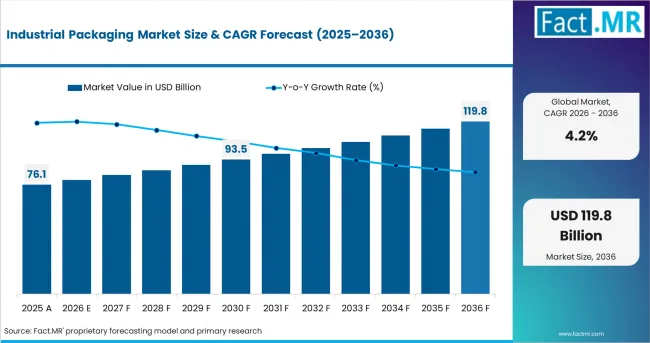
Industrial Packaging Market Value Analysis | Source: Fact.MR
Summary of industrial packaging market
- Demand Drivers in the Market
- Bulk Goods Movement: Manufacturers need packaging that protects products during storage and transport. This supports demand for IBCs, drums and corrugated boxes.
- Industrial Trade: Exporters need packaging that can handle long routes and repeated handling. Durable formats reduce product damage and claims.
- Sustainability Pressure: Packaging suppliers need recyclable and reusable solutions. EU packaging rules are increasing pressure to reduce waste.
- Key Segments Analyzed
- By Type: IBCs are projected to hold 34.0% share in 2026 as bulk liquids and chemicals need stackable storage and transport containers.
- By Application: Food & beverages lead because bulk ingredients and processed goods need safe movement. The application is modeled to hold 30.0% share in 2026.
- By Material: Plastic is anticipated to account for 46.0% share in 2026 because drums, pails and IBC liners need lighter weight and chemical resistance.
- By Packaging Format: Rigid packaging leads because industrial goods need shape stability during storage and transport. The format is expected to hold 58.0% share in 2026.
- By Packaging Function: Transportation is anticipated to capture 41.0% share in 2026 because industrial packaging must protect goods during movement across warehouses and trade routes.
- By Geography: India industrial packaging demand is forecast to grow at 5.6% CAGR from 2026 to 2036 as manufacturing and packaged goods movement expand.
- Analyst Opinion at Fact.MR
- Shambhu Nath Jha, Senior Analyst at Fact.MR, states, “Industrial packaging demand is becoming more performance-led. Manufacturers need packaging that can protect bulk goods and support safer logistics. Suppliers that combine durability with recyclable or reusable formats will gain stronger repeat demand.”
- Strategic Implications
- Material Planning: Packaging suppliers need better raw material control. Price changes in paper and metal can affect packaging margins quickly.
- Handling Safety: Industrial users should match packaging type with product weight and hazard level. Wrong packaging can increase leakage and handling risk.
- Reuse Readiness: Producers need reusable and recyclable formats. Sustainability rules can reduce demand for single-use designs over time.
| Metric | Details |
|---|---|
| Industry Size (2026) | USD 79.4 billion |
| Industry Value (2036) | USD 119.8 billion |
| CAGR (2026 to 2036) | 4.2% |
Source: Fact.MR analysis. Updated Jun 2, 2026
Industrial packaging demand is rising because products need safe storage and secure transport. IBCs lead because liquid and semi-liquid goods need stackable bulk containers. Corrugated boxes support transport and e-commerce-related industrial shipments. Drums and pails remain important for chemicals and lubricants because packaging must match product safety and handling needs.
India is forecast to record 5.6% CAGR from 2026 to 2036 as manufacturing and packaged goods movement expand. China is expected to post 5.1% CAGR as export packaging and industrial output rise. The United States is predicted to reach 4.2% CAGR by 2036 due to trade flows and food-grade industrial packaging demand. Canada is forecast to grow at 3.5% CAGR as bulk packaging and reusable container use improve. Germany follows at 3.2% CAGR from 2026 to 2036 as industrial goods and pharmaceutical packaging use support demand.
Segmental Analysis
Industrial Packaging Market Analysis by Type
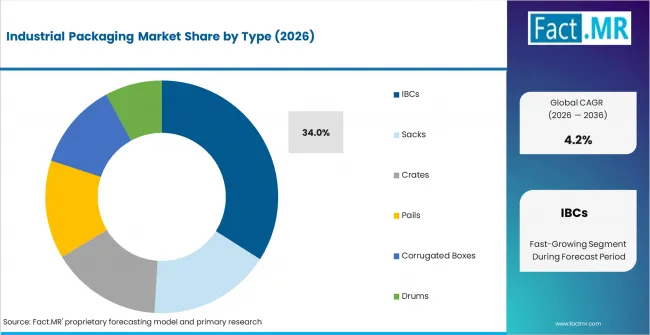
Industrial Packaging Market Analysis By Type | Source: Fact.MR
IBCs are projected to hold 34.0% share in 2026 because bulk liquids and semi-liquid goods need stackable transport and storage. Corrugated boxes support dry goods and e-commerce-linked shipments. Drums serve chemicals and lubricants that need stronger containment. Greif states that its GCUBE IBC is suited for transporting and storing bulk liquids, with a common 275-gallon or 1,040-liter size. IBCs lead because they combine handling efficiency with bulk storage strength.
- IBC Use: IBCs support bulk liquids and semi-liquid goods. They help industrial users reduce small-container handling.
- Corrugated Reach: Corrugated boxes serve dry goods and industrial parts. They protect products during warehousing and shipment.
- Drum Strength: Drums support chemicals and lubricants. They remain important when liquid containment and compatibility matter.
Industrial Packaging Market Analysis by Application
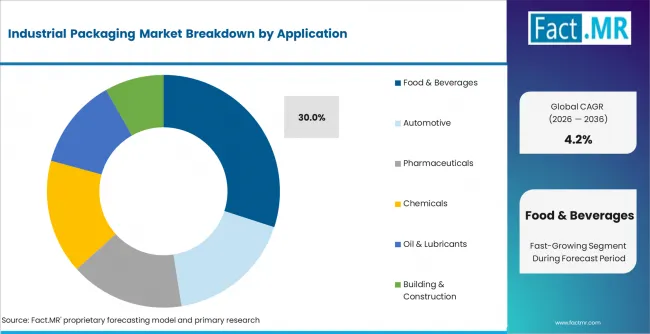
Industrial Packaging Market Analysis By Application | Source: Fact.MR
Food & beverages lead because bulk ingredients and processed goods need safe packaging during movement between suppliers and processors. Chemicals remain important because drums and IBCs must manage compatibility and leakage risk. The food & beverages application is anticipated to hold 30.0% share in 2026 as industrial packaging supports storage and transport safety. Food and beverage demand leads because packaging failure can affect product quality and compliance.
- Food Movement: Food and beverage producers need packaging that protects ingredients during storage and transport. Safe materials help reduce contamination risk.
- Chemical Handling: Chemical producers need compatible drums and IBCs. Poor packaging choice can increase leakage and safety risks.
- Pharma Use: Pharmaceutical applications need clean and controlled packaging. Supplier documentation remains important for regulated products.
Industrial Packaging Market Analysis by Material
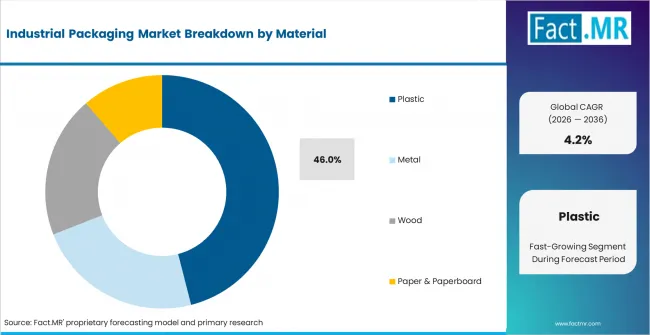
Industrial Packaging Market Analysis By Material | Source: Fact.MR
Plastic packaging is projected to account for 46.0% share in 2026 because industrial users need lightweight containers with chemical resistance. Paper and paperboard remain important through corrugated boxes and industrial paper bags. Metal serves drums and pails that need higher strength. Mondi states that its industrial paper bags are optimized for high-speed filling lines and suitable for food contact. Plastic leads because IBCs and selected drums need durability with easier handling.
- Plastic Strength: Plastic supports pails, IBC components and selected drums. It helps reduce handling weight across logistics operations.
- Paperboard Use: Paper and paperboard support corrugated boxes and sacks. They remain important for dry goods and recyclable packaging demand.
- Metal Durability: Metal packaging serves demanding industrial liquids. It offers strength when impact and compatibility risks are higher.
Industrial Packaging Market Analysis by Packaging Format
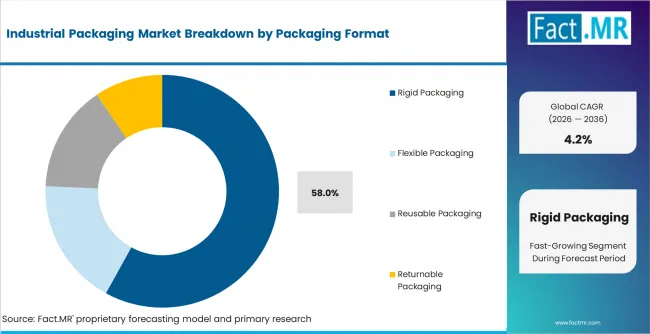
Industrial Packaging Market Analysis By Packaging Format | Source: Fact.MR
Rigid packaging leads because industrial goods need stable containers for storage and transport. Flexible packaging serves sacks and bags used in powdered or granular goods. Rigid packaging is expected to hold 58.0% share in 2026 because IBCs and crates carry heavy or bulk products. Rigid packaging suppliers will face higher recycling and reuse expectations.
- Rigid Protection: Rigid packaging protects liquids and heavy goods during movement. It helps reduce product loss in industrial supply chains.
- Flexible Reach: Flexible sacks and bags serve powders and dry bulk goods. They support easier handling in selected industrial applications.
- Reuse Value: Returnable formats can reduce packaging waste. Industrial users adopt them when reverse logistics are practical.
Industrial Packaging Market Analysis by Packaging Function
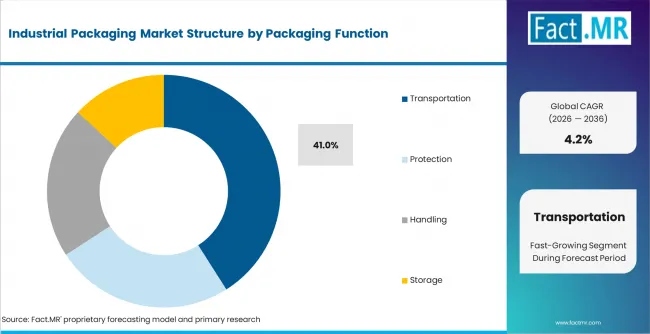
Industrial Packaging Market Analysis By Packaging Function | Source: Fact.MR
Transportation is anticipated to grow at 41.0% share in 2026 because industrial packaging must protect goods during warehouse movement and trade routes. Storage remains important for bulk liquids and dry materials. Protection needs increases when products face vibration, moisture or repeated handling. Transportation leads because damaged products can raise replacement cost and delay deliveries.
- Transport Safety: Industrial packaging protects products during shipment. Strong formats reduce damage during handling and long routes.
- Storage Role: Bulk goods need packaging that can hold shape and protect contents. IBCs and drums support longer storage cycles.
- Handling Control: Packaging must support lifting, stacking and movement. Poor handling design can increase workplace and product risks.
Industrial Packaging Market Drivers, Restraints, and Opportunities
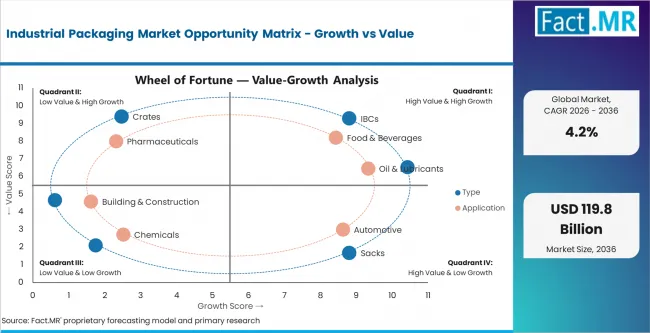
Industrial Packaging Market Opportunity Matrix Growth Vs Value | Source: Fact.MR
Industrial trade and bulk goods movement are the main demand drivers. Manufacturers need packaging that protects raw materials and food ingredients during storage and transport. IBCs and drums reduce small-container handling. Corrugated packaging supports dry goods and industrial shipments. Recyclable and reusable formats are shaping packaging choice.
Raw material cost and sustainability compliance remain the main restraints. Paper and metal price changes can pressure packaging margins. Regulations may require redesign and reuse planning. Smaller suppliers can face higher costs for compliance and material testing.
Opportunities in the Industrial Packaging Market
- Reusable IBCs: Industrial users can reduce handling waste through reusable IBC systems. Strong cleaning and reconditioning networks will support adoption.
- Corrugated Bulk Packaging: Corrugated boxes and sheets can serve transport and heavy-duty packaging needs. Recyclability supports wider acceptance.
- Food-grade Industrial Packaging: Food processors need safe packaging for ingredients and liquids. Suppliers with clear documentation can gain stronger repeat demand.
Regional Analysis
.webp "Top Country Growth Comparison Industrial Packaging Market Cagr (2026 2036)")
Top Country Growth Comparison Industrial Packaging Market Cagr (2026 2036) | Source: Fact.MR
Based on regional analysis, the industrial packaging market is segmented into North America, Latin America, Europe, East Asia, South Asia and Oceania, and Middle East and Africa.
| Country | CAGR |
|---|---|
| India | 5.6% |
| China | 5.1% |
| United States | 4.2% |
| Canada | 3.5% |
| Germany | 3.2% |
Source: Fact.MR analysis. Updated Jun 2, 2026
Source: Fact.MR analysis based on forecast model and primary research.
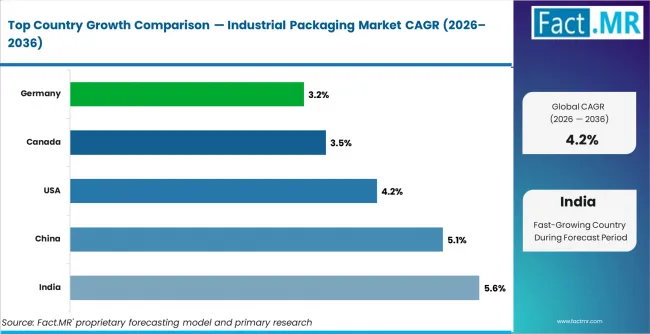
Industrial Packaging Market Cagr Analysis By Country | Source: Fact.MR
South Asia and Oceania Industrial Packaging Market Analysis
South Asia and Oceania demand is supported by manufacturing growth and packaged goods movement. India leads because factories and export activity need durable industrial packaging. Packaging suppliers can gain from corrugated boxes and drums as industrial output expands.
- India: India is projected to grow at 5.6% CAGR from 2026 to 2036 as manufacturing and packaged goods movement expand. Food processors need industrial packaging for bulk ingredients and finished products. Chemical suppliers need drums and IBCs for safe transport. Local packaging converters can gain as industrial corridors and logistics networks expand. Price discipline will stay important because many users compare packaging cost with handling savings.
East Asia Industrial Packaging Market Analysis
East Asia demand is tied to manufacturing scale and export packaging. China leads through large industrial output and broad packaging conversion capacity. Japan supports demand through high-quality manufacturing and lifestyle product packaging. Regional demand favors suppliers that offer durable products with controlled cost. Sustainability rules in export markets will push suppliers toward recyclable and reusable packaging options.
- China: Manufacturing and export shipments support industrial packaging demand in China. The country is projected to record 5.1% by 2036 as bulk goods and industrial materials move through domestic and global supply chains. Corrugated boxes and drums remain important for factories and exporters. Local producers benefit from scale, but quality expectations rise for goods entering regulated markets. Recyclable packaging options can support export-facing customers.
North America Industrial Packaging Market Analysis
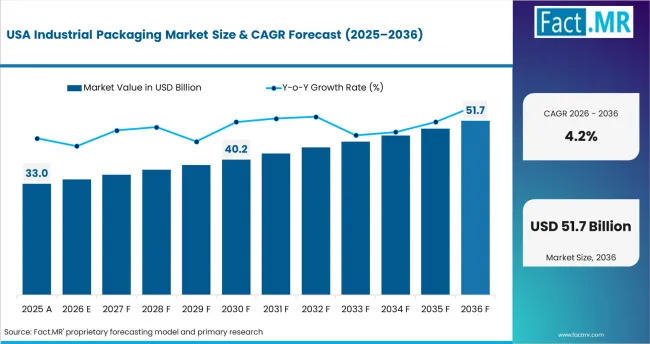
Industrial Packaging Market Country Value Analysis | Source: Fact.MR
North America demand is supported by trade activity and mature industrial supply chains. The United States leads because manufacturers and food processors need packaging for bulk movement. Canada supports demand through reusable container and industrial goods movement.
- United States: The United States is anticipated to grow at 4.2% CAGR through 2036 as trade flows and industrial goods movement support demand. Food and beverage producers need corrugated boxes and bulk packaging for distribution. Chemical producers need compatible containers and safer handling. Industrial packaging suppliers can gain through reliable products and local service support. Reusable packaging programs can support long-term retention.
- Canada: Canada is expected to grow at 3.5% over the forecast period as industrial users improve bulk packaging and reusable container use. Food and chemical movement support demand for drums and corrugated packaging. Packaging suppliers need products that support durability and environmental goals. Reconditioned containers can gain attention as users seek lower waste and controlled cost. Regional demand should stay steady across manufacturing and resource-linked sectors.
Europe Industrial Packaging Market Analysis
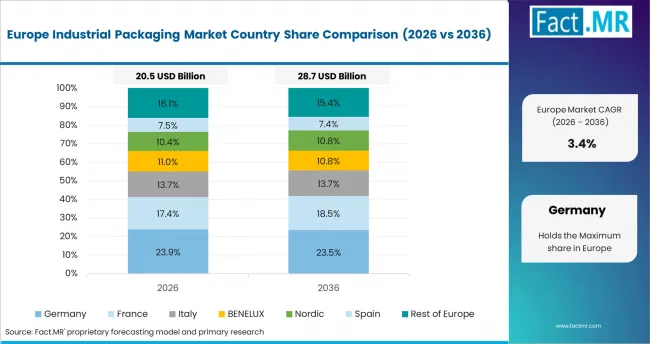
Industrial Packaging Market Europe Country Market Share Analysis, 2026 & 2036 | Source: Fact.MR
Europe demand comes from sustainability rules and industrial goods movement. Germany leads through manufacturing and chemical production. EU packaging waste rules increase pressure on recyclability and reuse.
- Germany: Industrial goods and pharmaceutical packaging are likely to support steady demand in Germany. The market is projected to record 3.2% CAGR by 2036. Manufacturers need packaging that protects products during storage and shipment. Chemical and machinery users need durable drums and corrugated formats for safer handling. Material quality and compliance documents remain key selection factors. Recyclability should gain more weight as EU packaging rules move into application.
Competitive Aligners for Market Players
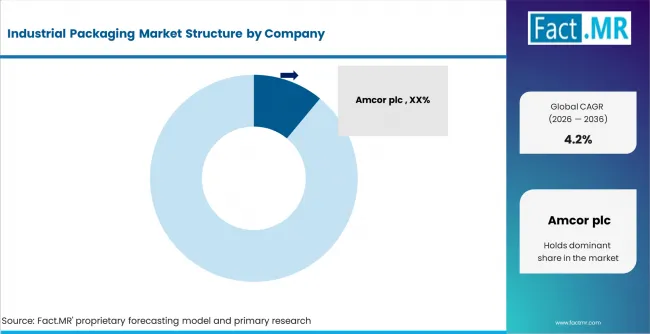
Industrial Packaging Market Analysis By Company | Source: Fact.MR
The industrial packaging market includes paper packaging suppliers and rigid or flexible packaging producers. Amcor plc supports demand through flexible and rigid packaging formats. Greif, Inc. supplies drums, IBCs and reconditioned packaging for bulk handling. International Paper Company provides corrugated packaging and supply-chain protection solutions. Smurfit Westrock plc supports demand through corrugated packaging and paper-based systems. Mondi plc serves industrial packaging needs through paper bags and flexible packaging.
Competitive position depends on durability and material coverage. Industrial users need packaging that protects goods during storage and shipment. Chemical producers need compatibility and safety documents. Food processors need safe materials and clean handling. Companies with broad product coverage and regional service can protect repeat demand.
Supplier strength through 2036 will depend on sustainability and handling performance. Industrial packaging producers need recyclable and reusable options. EU packaging rules will increase pressure on design and waste recovery. Suppliers with proven materials, reconditioning networks and customer support can defend long-term contracts.
Key Players in Industrial Packaging Market
- Amcor plc
- Greif, Inc.
- International Paper Company
- Smurfit Westrock plc
- Mondi plc
Bibliography
- Greif, Inc. (2024, March 26). Greif completes acquisition of Ipackchem.
- Mondi. (2025, April 1). Mondi expands packaging portfolio and capacity by completing acquisition of Schumacher Packaging’s Western Europe operations.
- Smurfit Westrock plc. (2024, July 8). Smurfit Westrock makes its debut in New York and London. WestRock Co.
- Amcor plc. (2025, April 30). Amcor completes combination with Berry Global.
- Sonoco Products Company. (2024, December 4). Sonoco completes acquisition of Eviosys.
This Report Addresses
- Strategic intelligence on industrial packaging demand across IBCs, drums and corrugated boxes.
- Growth opportunity mapping across India and China plus the United States and Germany.
- Segment analysis by type, application, material, packaging format and packaging function.
- Regional outlook covering industrial trade, food-grade packaging, reusable containers and EU packaging rules.
- Competitive analysis of Amcor plc, Greif, Inc., International Paper Company, Smurfit Westrock plc, Mondi plc.
- Product assessment covering IBCs, drums, corrugated boxes, sacks and reusable industrial packaging.
- Market forecast built from Fact.MR’s baseline model with a revised 2026 to 2036 CAGR.
- Primary interviews, supplier checks and official source review support validation.
Industrial Packaging Market Definition
The industrial packaging market covers containers and protective packaging used to store, ship and handle goods across industrial settings. The scope includes corrugated boxes, drums, IBCs, sacks, crates and pails. The market differs from retail packaging because it focuses on protection, bulk movement and operational handling. International Paper states that corrugated packaging protects products throughout the supply chain.
Industrial Packaging Market Inclusions
The scope includes industrial packaging used for food, chemicals, automotive parts, pharmaceuticals, lubricants and construction materials. Paper-based, plastic, metal and wood packaging are counted. Reusable drums and IBCs are included when they support bulk movement. RIPA states that its members produce new and reconditioned steel, plastic and fiber drums, as well as intermediate bulk containers.
Industrial Packaging Market Exclusions
The scope excludes decorative consumer packs without industrial handling function. Small retail pouches are outside scope unless used for industrial supply. Primary food packaging sold for shelf branding alone is excluded. Labels and RFID hardware are excluded unless sold as part of an industrial packaging system.
Industrial Packaging Market Research Methodology
- Primary Research
- Primary research includes interviews with industrial packaging converters and supply chain managers. Chemical packaging heads were reviewed for drum and IBC demand. Food and beverage packaging managers were checked for storage, safety and transport requirements.
- Desk Research
- Desk research reviewed official company product pages and packaging regulation sources. Corrugated packaging and IBC supplier pages supported product validation. Sustainability and packaging waste rules helped review recyclable and reusable packaging demand.
- Market-Sizing and Forecasting
- Forecasting uses type demand and application movement. Material estimates reflect paperboard and wood adoption. Packaging function demand is linked to storage and handling.
- Data Validation and Update Cycle
- Forecasts were validated through supplier checks and official packaging sources. Regional assumptions were reviewed with industrial output and export movement. Company evidence supported competitive positioning and product scope.
Segmentation
Scope of the Report
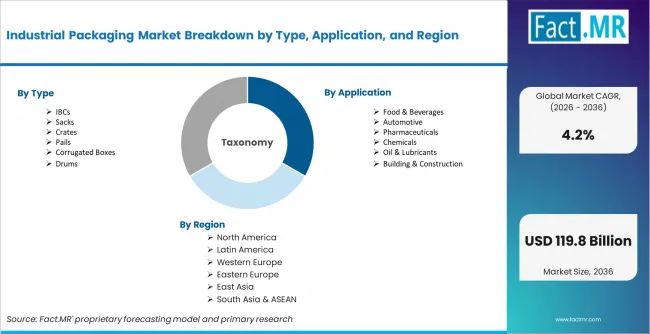
Industrial Packaging Market Breakdown By Type, Application, And Region | Source: Fact.MR
| Attribute | Details |
|---|---|
| Quantitative Units | USD 79.4 billion in 2026 to USD 119.8 billion by 2036 at 4.2% CAGR |
| Market Definition | Packaging used to store, protect, handle and transport goods across industrial settings. |
| Type | Corrugated Boxes, Drums, IBCs, Sacks, Crates, Pails |
| Application | Food & Beverages, Automotive, Pharmaceuticals, Chemicals, Oil & Lubricants, Building & Construction, Other Applications |
| Material | Paper & Paperboard, Plastic, Metal, Wood |
| Packaging Format | Rigid Packaging, Flexible Packaging, Reusable Packaging, Returnable Packaging |
| Packaging Function | Storage, Transportation, Protection, Handling |
| Regions Covered | North America, Latin America, Europe, East Asia, South Asia and Oceania, Middle East and Africa |
| Countries Covered | India, China, United States, Canada, Germany, Japan |
| Key Companies Profiled | Amcor plc, Greif, Inc., International Paper Company, Smurfit Westrock plc, Mondi plc |
| Forecast Period | 2026 to 2036 |
| Approach | Hybrid top-down and bottom-up model using type demand, application movement, material adoption and supplier validation. |
Source: Fact.MR analysis. Updated Jun 2, 2026
Industrial Packaging Market Analysis by Segments
-
By Type:
- Corrugated Boxes
- Drums
- IBCs
- Sacks
- Crates
- Pails
-
By Application:
- Food & Beverages
- Automotive
- Pharmaceuticals
- Chemicals
- Oil & Lubricants
- Building & Construction
- Other Applications
-
By Material:
- Paper & Paperboard
- Plastic
- Metal
- Wood
-
By Packaging Format:
- Rigid Packaging
- Flexible Packaging
- Reusable Packaging
- Returnable Packaging
-
By Packaging Function:
- Storage
- Transportation
- Protection
- Handling
-
Region:
- North America
- United States
- Canada
- Europe
- Germany
- United Kingdom
- France
- Italy
- Spain
- Asia Pacific
- China
- Japan
- South Korea
- Taiwan
- Singapore
- Latin America
- Brazil
- Mexico
- Argentina
- Middle East & Africa
- GCC Countries
- South Africa
- Israel
- North America
Frequently Asked Questions
How large is the industrial packaging market in 2025?
What is the expected value of the industrial packaging market in 2026?
What is the forecast value of the industrial packaging market by 2036?
What CAGR is projected for the industrial packaging market from 2026 to 2036?
Which type leads the industrial packaging market?
Why do IBCs lead type demand?
Which application leads the industrial packaging market?
Which material leads the industrial packaging market?
Which packaging format leads the industrial packaging market?Rigid packaging leads with modeled 58.0% share in 2026 because industrial goods need shape stability during storage and transport.
Which packaging function leads demand?
Which country grows fastest in the industrial packaging market?
Why is China important in the industrial packaging market?
Why does the United States support industrial packaging demand?
Why does Canada support industrial packaging demand?
Why does Germany support industrial packaging demand?
Why does Japan support industrial packaging demand?
What drives industrial packaging market demand?
What restrains industrial packaging market demand?
How do IBCs support industrial packaging demand?
How does corrugated packaging support industrial users?
What is included in the industrial packaging market scope?
What is excluded from the industrial packaging market scope?
How does Fact.MR forecast industrial packaging demand?
Who worked on this report


Preview the report firsthand - request a free sample
Free SampleGet the brochure for pricing and purchase details
Download PDF