Industrial Water Treatment Chemicals Market
Industrial Water Treatment Chemicals Market Size and Share Forecast Outlook 2026 to 2036
Industrial water treatment chemicals market is projected to grow from USD 18.2 billion in 2026 to USD 31.6 billion by 2036, at a CAGR of 5.7%. Cooling & Boilers will dominate with a 47.5% market share, while food & beverage will lead the end-use segment with a 19.3% share.
Industrial Water Treatment Chemicals Market Forecast and Outlook 2026 to 2036
The global industrial water treatment chemicals market is projected to reach USD 31.6 billion by 2036. The market is valued at USD 18.2 billion in 2026 and is set to rise at a CAGR of 5.7% during the assessment period.
Quick Stats for Industrial Water Treatment Chemicals Market
- Industrial Water Treatment Chemicals Market Value (2026): USD 18.2 billion
- Industrial Water Treatment Chemicals Market Forecast Value (2036): USD 31.6 billion
- Industrial Water Treatment Chemicals Market Forecast CAGR: 5.7%
- Leading Application in Industrial Water Treatment Chemicals Market: Cooling & Boilers (47.5%)
- Key Growth Regions in Industrial Water Treatment Chemicals Market: Asia Pacific, North America, and Europe
- Top Players in Industrial Water Treatment Chemicals Market: Ecolab Inc., BASF, Solenis, Kemira, SNF Group, SUEZ, Dow, Clariant, Italmatch Chemicals, Akzo Nobel N.V.
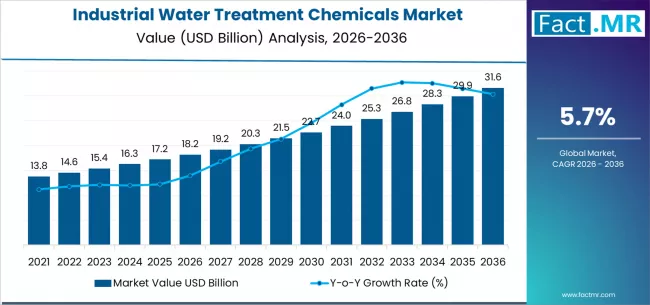
The market is expected to grow by 1.7 times during the same period, supported by increasing demand from cooling and boiler treatment applications and expanding utilization in water desalination operations across both developed and emerging industrial markets.
Growing application diversity in effluent water treatment systems, raw water purification processes, and specialized industrial water management creates expanding opportunities for chemical treatment innovations and specialized formulation developments.
Rising industrial output in Asia Pacific nations, coupled with expanding water treatment infrastructure through advanced chemical dosing facilities and modern monitoring systems, further accelerate market penetration across diverse industrial segments.
The growing global emphasis on water conservation and environmental compliance, particularly in manufacturing and processing facilities, generates sustained requirements for effective water treatment solutions and discharge quality management systems.
Industrial Water Treatment Chemicals Market Key Takeaways
| Metric | Value |
|---|---|
| Market Value (2026) | USD 18.2 billion |
| Market Forecast Value (2036) | USD 31.6 billion |
| Forecast CAGR (2026-2036) | 5.7% |
Segmental Analysis
What makes Cooling & Boilers the Dominant Application Segment in the Industrial Water Treatment Chemicals Market?
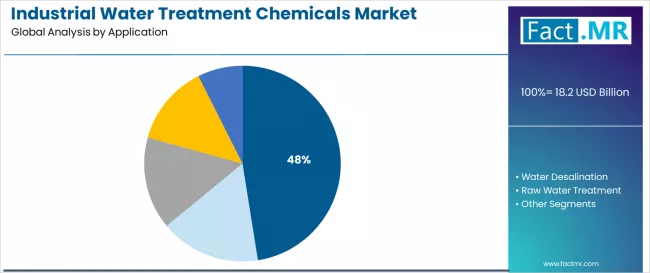
The cooling & boilers segment represents the dominant force in the industrial water treatment chemicals market, capturing approximately 47.5% of total market share in 2026. This category encompasses solutions featuring critical scale inhibition functionality for cooling towers, boiler feed water treatment, and closed-loop systems, including antiscalants and oxygen scavengers that enable improved heat transfer efficiency, reduced equipment corrosion, and enhanced system reliability across all industrial cooling and steam generation applications.
Which End-use Category Leads Market Consumption in the Industrial Water Treatment Chemicals Market?
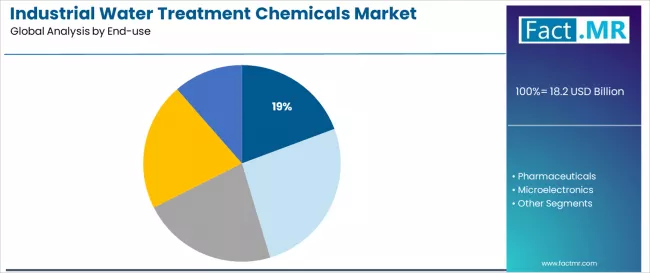
The food & beverage segment represents the leading end-use category in the industrial water treatment chemicals market, capturing approximately 19.3% of total market share in 2026. This end-use encompasses water treatment requirements for beverage processing operations, dairy manufacturing facilities, and general food production applications requiring stringent water quality standards and regulatory compliance.
The food & beverage segment's market leadership stems from strict quality control requirements, comprehensive sanitation protocols, and continuous production operations demanding reliable water treatment performance.
What are the Drivers, Restraints, and Key Trends of the Industrial Water Treatment Chemicals Market?
The industrial water treatment chemicals market is driven by rising water scarcity and stricter conservation mandates, increasing demand for chemical solutions that support water recycling and reuse across industrial operations. Expansion of desalination capacity for freshwater and industrial supply is further boosting demand for specialized treatment chemicals. Advances in chemical formulation and smart dosing technologies are also improving treatment efficiency, reducing chemical consumption, and enhancing water quality outcomes.
Market restraints include volatility in raw material prices, which can raise operating costs and limit adoption of comprehensive treatment programs. Increasing regulatory scrutiny of chemical discharge toxicity and environmental persistence is prompting reformulation requirements and higher compliance costs. Competition from non-chemical alternatives, such as membrane filtration, UV disinfection, and electrochemical treatment, is also challenging traditional chemical-based approaches.
Key trends include growing adoption of green and biodegradable chemistry formulations, particularly in North America and Europe. Automated chemical dosing systems integrated with real-time monitoring and predictive analytics are gaining traction, enabling optimized usage, lower waste generation, and reduced operational costs, though advances in non-chemical technologies may influence long-term demand dynamics.
Analysis of the Industrial Water Treatment Chemicals Market by Key Countries
| Country | CAGR (2026-2036) |
|---|---|
| India | 7.4% |
| China | 6.9% |
| UAE | 6.5% |
| Brazil | 6.0% |
| USA | 5.6% |
| Germany | 4.9% |
| Japan | 4.4% |
How are Environmental Mandates Powering India’s Industrial Water Treatment Chemicals Demand?
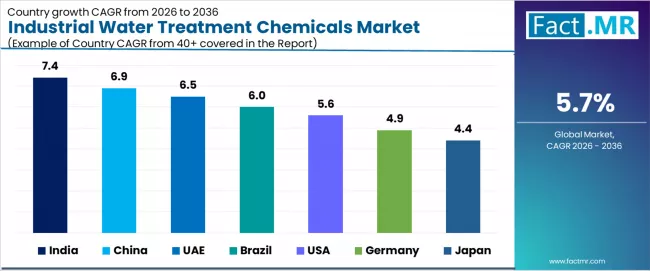
India’s industrial water treatment chemicals market is projected to grow at a CAGR of 7.4% through 2036, driven by stringent zero liquid discharge regulations and expanding pharmaceutical and textile manufacturing. Industrial clusters across western and southern states are increasing chemical consumption to meet effluent discharge limits and operational efficiency requirements. Regulatory enforcement and rising environmental compliance costs continue to support sustained demand across industrial facilities.
Why does China Function as a High-Volume Industrial Water Treatment Market?
China is expected to register a CAGR of 6.9%, supported by strict wastewater discharge regulations and extensive industrial activity across major manufacturing provinces. Facilities are adopting advanced treatment chemicals and real-time monitoring systems to meet environmental compliance targets. Government-led water conservation and pollution control initiatives continue to reinforce steady chemical demand across industrial processing sectors.
How is Desalination Infrastructure Shaping Water Treatment Demand in the UAE?
The UAE market is forecast to grow at a CAGR of 6.5%, driven by large-scale desalination capacity expansion and industrial development across economic zones. Water treatment chemical demand is concentrated in membrane protection, fouling control, and pretreatment applications. Ongoing investment in desalination and industrial infrastructure supports sustained consumption of specialized chemical formulations.
Why do Mining and Pulp Industries Anchor Brazil’s Market Growth?
Brazil’s industrial water treatment chemicals market is projected to expand at a CAGR of 6.0%, supported by mining operations and pulp and paper manufacturing. Water reuse mandates and environmental compliance requirements are increasing chemical usage for effluent treatment and recycling. Demand remains concentrated in major industrial regions where water conservation initiatives are intensifying.
How does Regulatory Enforcement Sustain Market Stability in the USA?
The USA’s market is expected to grow at a CAGR of 5.6%, driven by EPA enforcement, industrial water recycling initiatives, and tightening effluent standards. Manufacturing and power generation facilities are implementing consistent chemical treatment programs to maintain compliance and optimize operational performance. A mature regulatory framework ensures steady demand for reliable treatment solutions.
How is Compliance-Driven Innovation Supporting Germany’s Market Position?
Germany is projected to record a CAGR of 4.9%. This growth is supported by REACH compliance requirements and advanced wastewater treatment integration. Industrial facilities are prioritizing environmentally compliant and biodegradable chemical formulations. Strong regulatory oversight and sustainability initiatives continue to guide adoption across chemical processing and manufacturing operations.
Why do High-Purity Requirements Define Japan’s Market Structure?
Japan’s market is forecast to grow at a CAGR of 4.4%, driven by ultrapure water requirements in semiconductor and electronics manufacturing. Treatment chemical demand focuses on precision purification and contamination control. Strong quality standards and technology partnerships support continued adoption of premium formulations in high-specification industrial applications.
Competitive Landscape of the Industrial Water Treatment Chemicals Market
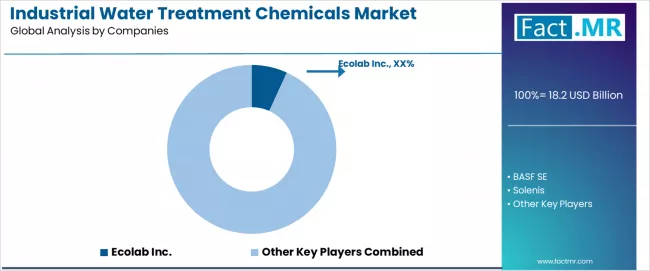
The industrial water treatment chemicals market is moderately concentrated, with around 40-50 meaningful participants operating across industrial and municipal water management segments. Competitive intensity is shaped by formulation performance, technical service capability, regulatory compliance expertise, and long-term customer relationships rather than price-based competition.
Ecolab Inc., BASF, and Solenis hold leading positions, supported by broad water treatment chemical portfolios, global manufacturing scale, and strong application engineering capabilities. These companies differentiate through integrated service models, performance monitoring, and continuous innovation in specialty and sustainable treatment chemistries. Their global technical networks enable consistent service delivery across power generation, manufacturing, and processing industries.
Challengers such as Kemira, SNF Group, and SUEZ compete through focused product offerings and strong regional penetration in key industrial markets. Specialty suppliers including Dow, Clariant, Italmatch Chemicals, and Akzo Nobel N.V. emphasize customized formulations, niche chemistries, and application-specific technical support.
Regional and emerging players intensify competition in high-growth markets, particularly China and India, by leveraging local manufacturing and proximity-based service advantages. Overall competitiveness favors suppliers combining innovative chemistry platforms with robust technical support and sustainability-aligned solutions.
Key Players in the Industrial Water Treatment Chemicals Market
- Ecolab Inc.
- BASF SE
- Solenis
- Kemira Oyj
- SNF Group
- SUEZ
- Dow Inc.
- Clariant AG
- Italmatch Chemicals
- Akzo Nobel N.V.
Scope of the Report
| Items | Values |
|---|---|
| Quantitative Units | USD 18.2 Billion |
| Application | Cooling & Boilers, Water Desalination, Raw Water Treatment, Effluent Water Treatment, Other Applications |
| End-use | Food & Beverage, Pharmaceuticals, Microelectronics, Commercial & Institutional, Other Industrial |
| Regions Covered | Asia Pacific, North America, Europe, Latin America, Middle East & Africa |
| Country Covered | India, China, UAE, Brazil, USA, Germany, Japan, and 40+ countries |
| Key Companies Profiled | Ecolab Inc., BASF, Solenis, Kemira, SNF Group, SUEZ, Dow, Clariant, Italmatch Chemicals, Akzo Nobel N.V. |
| Additional Attributes | Dollar sales by application and end-use categories, regional treatment trends across Asia Pacific, North America, and Europe, competitive landscape with specialty chemical producers and water treatment service companies, chemical specifications and performance requirements, integration with industrial cooling systems and desalination facilities. |
Industrial Water Treatment Chemicals Market by Segments
-
Application :
- Cooling & Boilers
- Water Desalination
- Raw Water Treatment
- Effluent Water Treatment
- Other Applications
-
End-use :
- Food & Beverage
- Pharmaceuticals
- Microelectronics
- Commercial & Institutional
- Other Industrial
-
Region :
- Asia Pacific
- China
- Japan
- South Korea
- India
- Australia & New Zealand
- ASEAN
- Rest of Asia Pacific
- North America
- USA
- Canada
- Mexico
- Europe
- Germany
- France
- UK
- Italy
- Spain
- Rest of Europe
- Latin America
- Brazil
- Rest of Latin America
- Middle East & Africa
- Kingdom of Saudi Arabia
- Other GCC Countries
- Turkey
- South Africa
- Rest of Middle East & Africa
- Asia Pacific
Table of Content
- Executive Summary
- Global Market Outlook
- Demand to side Trends
- Supply to side Trends
- Technology Roadmap Analysis
- Analysis and Recommendations
- Market Overview
- Market Coverage / Taxonomy
- Market Definition / Scope / Limitations
- Market Background
- Market Dynamics
- Drivers
- Restraints
- Opportunity
- Trends
- Scenario Forecast
- Demand in Optimistic Scenario
- Demand in Likely Scenario
- Demand in Conservative Scenario
- Opportunity Map Analysis
- Product Life Cycle Analysis
- Supply Chain Analysis
- Investment Feasibility Matrix
- Value Chain Analysis
- PESTLE and Porter’s Analysis
- Regulatory Landscape
- Regional Parent Market Outlook
- Production and Consumption Statistics
- Import and Export Statistics
- Market Dynamics
- Global Market Analysis 2021 to 2025 and Forecast, 2026 to 2036
- Historical Market Size Value (USD Million) Analysis, 2021 to 2025
- Current and Future Market Size Value (USD Million) Projections, 2026 to 2036
- Y to o to Y Growth Trend Analysis
- Absolute $ Opportunity Analysis
- Global Market Pricing Analysis 2021 to 2025 and Forecast 2026 to 2036
- Global Market Analysis 2021 to 2025 and Forecast 2026 to 2036, By Application
- Introduction / Key Findings
- Historical Market Size Value (USD Million) Analysis By Application, 2021 to 2025
- Current and Future Market Size Value (USD Million) Analysis and Forecast By Application, 2026 to 2036
- Cooling & Boilers
- Water Desalination
- Raw Water Treatment
- Effluent Water Treatment
- Other Applications
- Cooling & Boilers
- Y to o to Y Growth Trend Analysis By Application, 2021 to 2025
- Absolute $ Opportunity Analysis By Application, 2026 to 2036
- Global Market Analysis 2021 to 2025 and Forecast 2026 to 2036, By End-use
- Introduction / Key Findings
- Historical Market Size Value (USD Million) Analysis By End-use, 2021 to 2025
- Current and Future Market Size Value (USD Million) Analysis and Forecast By End-use, 2026 to 2036
- Food & Beverage
- Pharmaceuticals
- Microelectronics
- Commercial & Institutional
- Other Industrial
- Food & Beverage
- Y to o to Y Growth Trend Analysis By End-use, 2021 to 2025
- Absolute $ Opportunity Analysis By End-use, 2026 to 2036
- Global Market Analysis 2021 to 2025 and Forecast 2026 to 2036, By Region
- Introduction
- Historical Market Size Value (USD Million) Analysis By Region, 2021 to 2025
- Current Market Size Value (USD Million) Analysis and Forecast By Region, 2026 to 2036
- North America
- Latin America
- Western Europe
- Eastern Europe
- East Asia
- South Asia and Pacific
- Middle East & Africa
- Market Attractiveness Analysis By Region
- North America Market Analysis 2021 to 2025 and Forecast 2026 to 2036, By Country
- Historical Market Size Value (USD Million) Trend Analysis By Market Taxonomy, 2021 to 2025
- Market Size Value (USD Million) Forecast By Market Taxonomy, 2026 to 2036
- By Country
- USA
- Canada
- Mexico
- By Application
- By End-use
- By Country
- Market Attractiveness Analysis
- By Country
- By Application
- By End-use
- Key Takeaways
- Latin America Market Analysis 2021 to 2025 and Forecast 2026 to 2036, By Country
- Historical Market Size Value (USD Million) Trend Analysis By Market Taxonomy, 2021 to 2025
- Market Size Value (USD Million) Forecast By Market Taxonomy, 2026 to 2036
- By Country
- Brazil
- Chile
- Rest of Latin America
- By Application
- By End-use
- By Country
- Market Attractiveness Analysis
- By Country
- By Application
- By End-use
- Key Takeaways
- Western Europe Market Analysis 2021 to 2025 and Forecast 2026 to 2036, By Country
- Historical Market Size Value (USD Million) Trend Analysis By Market Taxonomy, 2021 to 2025
- Market Size Value (USD Million) Forecast By Market Taxonomy, 2026 to 2036
- By Country
- Germany
- UK
- Italy
- Spain
- France
- Nordic
- BENELUX
- Rest of Western Europe
- By Application
- By End-use
- By Country
- Market Attractiveness Analysis
- By Country
- By Application
- By End-use
- Key Takeaways
- Eastern Europe Market Analysis 2021 to 2025 and Forecast 2026 to 2036, By Country
- Historical Market Size Value (USD Million) Trend Analysis By Market Taxonomy, 2021 to 2025
- Market Size Value (USD Million) Forecast By Market Taxonomy, 2026 to 2036
- By Country
- Russia
- Poland
- Hungary
- Balkan & Baltic
- Rest of Eastern Europe
- By Application
- By End-use
- By Country
- Market Attractiveness Analysis
- By Country
- By Application
- By End-use
- Key Takeaways
- East Asia Market Analysis 2021 to 2025 and Forecast 2026 to 2036, By Country
- Historical Market Size Value (USD Million) Trend Analysis By Market Taxonomy, 2021 to 2025
- Market Size Value (USD Million) Forecast By Market Taxonomy, 2026 to 2036
- By Country
- China
- Japan
- South Korea
- By Application
- By End-use
- By Country
- Market Attractiveness Analysis
- By Country
- By Application
- By End-use
- Key Takeaways
- South Asia and Pacific Market Analysis 2021 to 2025 and Forecast 2026 to 2036, By Country
- Historical Market Size Value (USD Million) Trend Analysis By Market Taxonomy, 2021 to 2025
- Market Size Value (USD Million) Forecast By Market Taxonomy, 2026 to 2036
- By Country
- India
- ASEAN
- Australia & New Zealand
- Rest of South Asia and Pacific
- By Application
- By End-use
- By Country
- Market Attractiveness Analysis
- By Country
- By Application
- By End-use
- Key Takeaways
- Middle East & Africa Market Analysis 2021 to 2025 and Forecast 2026 to 2036, By Country
- Historical Market Size Value (USD Million) Trend Analysis By Market Taxonomy, 2021 to 2025
- Market Size Value (USD Million) Forecast By Market Taxonomy, 2026 to 2036
- By Country
- Kingdom of Saudi Arabia
- Other GCC Countries
- Turkiye
- South Africa
- Other African Union
- Rest of Middle East & Africa
- By Application
- By End-use
- By Country
- Market Attractiveness Analysis
- By Country
- By Application
- By End-use
- Key Takeaways
- Key Countries Market Analysis
- USA
- Pricing Analysis
- Market Share Analysis, 2025
- By Application
- By End-use
- Canada
- Pricing Analysis
- Market Share Analysis, 2025
- By Application
- By End-use
- Mexico
- Pricing Analysis
- Market Share Analysis, 2025
- By Application
- By End-use
- Brazil
- Pricing Analysis
- Market Share Analysis, 2025
- By Application
- By End-use
- Chile
- Pricing Analysis
- Market Share Analysis, 2025
- By Application
- By End-use
- Germany
- Pricing Analysis
- Market Share Analysis, 2025
- By Application
- By End-use
- UK
- Pricing Analysis
- Market Share Analysis, 2025
- By Application
- By End-use
- Italy
- Pricing Analysis
- Market Share Analysis, 2025
- By Application
- By End-use
- Spain
- Pricing Analysis
- Market Share Analysis, 2025
- By Application
- By End-use
- France
- Pricing Analysis
- Market Share Analysis, 2025
- By Application
- By End-use
- India
- Pricing Analysis
- Market Share Analysis, 2025
- By Application
- By End-use
- ASEAN
- Pricing Analysis
- Market Share Analysis, 2025
- By Application
- By End-use
- Australia & New Zealand
- Pricing Analysis
- Market Share Analysis, 2025
- By Application
- By End-use
- China
- Pricing Analysis
- Market Share Analysis, 2025
- By Application
- By End-use
- Japan
- Pricing Analysis
- Market Share Analysis, 2025
- By Application
- By End-use
- South Korea
- Pricing Analysis
- Market Share Analysis, 2025
- By Application
- By End-use
- Russia
- Pricing Analysis
- Market Share Analysis, 2025
- By Application
- By End-use
- Poland
- Pricing Analysis
- Market Share Analysis, 2025
- By Application
- By End-use
- Hungary
- Pricing Analysis
- Market Share Analysis, 2025
- By Application
- By End-use
- Kingdom of Saudi Arabia
- Pricing Analysis
- Market Share Analysis, 2025
- By Application
- By End-use
- Turkiye
- Pricing Analysis
- Market Share Analysis, 2025
- By Application
- By End-use
- South Africa
- Pricing Analysis
- Market Share Analysis, 2025
- By Application
- By End-use
- USA
- Market Structure Analysis
- Competition Dashboard
- Competition Benchmarking
- Market Share Analysis of Top Players
- By Regional
- By Application
- By End-use
- Competition Analysis
- Competition Deep Dive
- Ecolab Inc.
- Overview
- Product Portfolio
- Profitability by Market Segments (Product/Age /Sales Channel/Region)
- Sales Footprint
- Strategy Overview
- Marketing Strategy
- Product Strategy
- Channel Strategy
- BASF SE
- Solenis
- Kemira Oyj
- SNF Group
- SUEZ
- Dow Inc.
- Clariant AG
- Italmatch Chemicals
- Akzo Nobel N.V.
- Ecolab Inc.
- Competition Deep Dive
- Assumptions & Acronyms Used
- Research Methodology
List Of Table
- Table 1: Global Market Value (USD Million) Forecast by Region, 2021 to 2036
- Table 2: Global Market Value (USD Million) Forecast by Application, 2021 to 2036
- Table 3: Global Market Value (USD Million) Forecast by End-use, 2021 to 2036
- Table 4: North America Market Value (USD Million) Forecast by Country, 2021 to 2036
- Table 5: North America Market Value (USD Million) Forecast by Application, 2021 to 2036
- Table 6: North America Market Value (USD Million) Forecast by End-use, 2021 to 2036
- Table 7: Latin America Market Value (USD Million) Forecast by Country, 2021 to 2036
- Table 8: Latin America Market Value (USD Million) Forecast by Application, 2021 to 2036
- Table 9: Latin America Market Value (USD Million) Forecast by End-use, 2021 to 2036
- Table 10: Western Europe Market Value (USD Million) Forecast by Country, 2021 to 2036
- Table 11: Western Europe Market Value (USD Million) Forecast by Application, 2021 to 2036
- Table 12: Western Europe Market Value (USD Million) Forecast by End-use, 2021 to 2036
- Table 13: Eastern Europe Market Value (USD Million) Forecast by Country, 2021 to 2036
- Table 14: Eastern Europe Market Value (USD Million) Forecast by Application, 2021 to 2036
- Table 15: Eastern Europe Market Value (USD Million) Forecast by End-use, 2021 to 2036
- Table 16: East Asia Market Value (USD Million) Forecast by Country, 2021 to 2036
- Table 17: East Asia Market Value (USD Million) Forecast by Application, 2021 to 2036
- Table 18: East Asia Market Value (USD Million) Forecast by End-use, 2021 to 2036
- Table 19: South Asia and Pacific Market Value (USD Million) Forecast by Country, 2021 to 2036
- Table 20: South Asia and Pacific Market Value (USD Million) Forecast by Application, 2021 to 2036
- Table 21: South Asia and Pacific Market Value (USD Million) Forecast by End-use, 2021 to 2036
- Table 22: Middle East & Africa Market Value (USD Million) Forecast by Country, 2021 to 2036
- Table 23: Middle East & Africa Market Value (USD Million) Forecast by Application, 2021 to 2036
- Table 24: Middle East & Africa Market Value (USD Million) Forecast by End-use, 2021 to 2036
List Of Figures
- Figure 1: Global Market Pricing Analysis
- Figure 2: Global Market Value (USD Million) Forecast 2021 to 2036
- Figure 3: Global Market Value Share and BPS Analysis by Application, 2026 and 2036
- Figure 4: Global Market Y to o to Y Growth Comparison by Application, 2026 to 2036
- Figure 5: Global Market Attractiveness Analysis by Application
- Figure 6: Global Market Value Share and BPS Analysis by End-use, 2026 and 2036
- Figure 7: Global Market Y to o to Y Growth Comparison by End-use, 2026 to 2036
- Figure 8: Global Market Attractiveness Analysis by End-use
- Figure 9: Global Market Value (USD Million) Share and BPS Analysis by Region, 2026 and 2036
- Figure 10: Global Market Y to o to Y Growth Comparison by Region, 2026 to 2036
- Figure 11: Global Market Attractiveness Analysis by Region
- Figure 12: North America Market Incremental Dollar Opportunity, 2026 to 2036
- Figure 13: Latin America Market Incremental Dollar Opportunity, 2026 to 2036
- Figure 14: Western Europe Market Incremental Dollar Opportunity, 2026 to 2036
- Figure 15: Eastern Europe Market Incremental Dollar Opportunity, 2026 to 2036
- Figure 16: East Asia Market Incremental Dollar Opportunity, 2026 to 2036
- Figure 17: South Asia and Pacific Market Incremental Dollar Opportunity, 2026 to 2036
- Figure 18: Middle East & Africa Market Incremental Dollar Opportunity, 2026 to 2036
- Figure 19: North America Market Value Share and BPS Analysis by Country, 2026 and 2036
- Figure 20: North America Market Value Share and BPS Analysis by Application, 2026 and 2036
- Figure 21: North America Market Y to o to Y Growth Comparison by Application, 2026 to 2036
- Figure 22: North America Market Attractiveness Analysis by Application
- Figure 23: North America Market Value Share and BPS Analysis by End-use, 2026 and 2036
- Figure 24: North America Market Y to o to Y Growth Comparison by End-use, 2026 to 2036
- Figure 25: North America Market Attractiveness Analysis by End-use
- Figure 26: Latin America Market Value Share and BPS Analysis by Country, 2026 and 2036
- Figure 27: Latin America Market Value Share and BPS Analysis by Application, 2026 and 2036
- Figure 28: Latin America Market Y to o to Y Growth Comparison by Application, 2026 to 2036
- Figure 29: Latin America Market Attractiveness Analysis by Application
- Figure 30: Latin America Market Value Share and BPS Analysis by End-use, 2026 and 2036
- Figure 31: Latin America Market Y to o to Y Growth Comparison by End-use, 2026 to 2036
- Figure 32: Latin America Market Attractiveness Analysis by End-use
- Figure 33: Western Europe Market Value Share and BPS Analysis by Country, 2026 and 2036
- Figure 34: Western Europe Market Value Share and BPS Analysis by Application, 2026 and 2036
- Figure 35: Western Europe Market Y to o to Y Growth Comparison by Application, 2026 to 2036
- Figure 36: Western Europe Market Attractiveness Analysis by Application
- Figure 37: Western Europe Market Value Share and BPS Analysis by End-use, 2026 and 2036
- Figure 38: Western Europe Market Y to o to Y Growth Comparison by End-use, 2026 to 2036
- Figure 39: Western Europe Market Attractiveness Analysis by End-use
- Figure 40: Eastern Europe Market Value Share and BPS Analysis by Country, 2026 and 2036
- Figure 41: Eastern Europe Market Value Share and BPS Analysis by Application, 2026 and 2036
- Figure 42: Eastern Europe Market Y to o to Y Growth Comparison by Application, 2026 to 2036
- Figure 43: Eastern Europe Market Attractiveness Analysis by Application
- Figure 44: Eastern Europe Market Value Share and BPS Analysis by End-use, 2026 and 2036
- Figure 45: Eastern Europe Market Y to o to Y Growth Comparison by End-use, 2026 to 2036
- Figure 46: Eastern Europe Market Attractiveness Analysis by End-use
- Figure 47: East Asia Market Value Share and BPS Analysis by Country, 2026 and 2036
- Figure 48: East Asia Market Value Share and BPS Analysis by Application, 2026 and 2036
- Figure 49: East Asia Market Y to o to Y Growth Comparison by Application, 2026 to 2036
- Figure 50: East Asia Market Attractiveness Analysis by Application
- Figure 51: East Asia Market Value Share and BPS Analysis by End-use, 2026 and 2036
- Figure 52: East Asia Market Y to o to Y Growth Comparison by End-use, 2026 to 2036
- Figure 53: East Asia Market Attractiveness Analysis by End-use
- Figure 54: South Asia and Pacific Market Value Share and BPS Analysis by Country, 2026 and 2036
- Figure 55: South Asia and Pacific Market Value Share and BPS Analysis by Application, 2026 and 2036
- Figure 56: South Asia and Pacific Market Y to o to Y Growth Comparison by Application, 2026 to 2036
- Figure 57: South Asia and Pacific Market Attractiveness Analysis by Application
- Figure 58: South Asia and Pacific Market Value Share and BPS Analysis by End-use, 2026 and 2036
- Figure 59: South Asia and Pacific Market Y to o to Y Growth Comparison by End-use, 2026 to 2036
- Figure 60: South Asia and Pacific Market Attractiveness Analysis by End-use
- Figure 61: Middle East & Africa Market Value Share and BPS Analysis by Country, 2026 and 2036
- Figure 62: Middle East & Africa Market Value Share and BPS Analysis by Application, 2026 and 2036
- Figure 63: Middle East & Africa Market Y to o to Y Growth Comparison by Application, 2026 to 2036
- Figure 64: Middle East & Africa Market Attractiveness Analysis by Application
- Figure 65: Middle East & Africa Market Value Share and BPS Analysis by End-use, 2026 and 2036
- Figure 66: Middle East & Africa Market Y to o to Y Growth Comparison by End-use, 2026 to 2036
- Figure 67: Middle East & Africa Market Attractiveness Analysis by End-use
- Figure 68: Global Market - Tier Structure Analysis
- Figure 69: Global Market - Company Share Analysis
- FAQs -
How big is the industrial water treatment chemicals market in 2026?
The global industrial water treatment chemicals market is estimated to be valued at USD 18.2 billion in 2026.
What will be the size of industrial water treatment chemicals market in 2036?
The market size for the industrial water treatment chemicals market is projected to reach USD 31.6 billion by 2036.
How much will be the industrial water treatment chemicals market growth between 2026 and 2036?
The industrial water treatment chemicals market is expected to grow at a 5.7% CAGR between 2026 and 2036.
What are the key product types in the industrial water treatment chemicals market?
The key product types in industrial water treatment chemicals market are cooling & boilers, water desalination, raw water treatment, effluent water treatment and other applications.
Which end-use segment to contribute significant share in the industrial water treatment chemicals market in 2026?
In terms of end-use, food & beverage segment to command 19.3% share in the industrial water treatment chemicals market in 2026.