Knowledge Management Market Size, Share, Growth and Forecast (2026 - 2036)

The Knowledge Management Market is segmented by Type (Systems, Mechanisms and Technologies, Processes, Infrastructure), Organization Size (Large Enterprises, Small and Medium Enterprises), Deployment (Cloud, On Premise, Hybrid), Function (Knowledge Capture, Knowledge Sharing, Customer Support, Decision Support, Compliance Learning), End Use (IT and Telecom, BFSI, Healthcare, Manufacturing, Government, Education), Sales Channel (Direct Subscriptions, Channel Partners, System Integrators, App Stores), and Region. Forecast for 2026 to 2036.

Fact.MR states that knowledge management demand is shifting toward AI-aided search and cloud-based employee support. Large enterprises are expected to lead by organization size as large staff bases need shared answer control. Cloud deployment is expected to lead as distributed teams need faster access to approved knowledge.

Knowledge Management Market Size, Market Forecast and Outlook by Fact.MR

  • The knowledge management market crossed a valuation of USD 901.2 billion in 2025.
  • Demand is forecast at USD 1049.9 billion in 2026.
  • The market is set to grow at 16.5% CAGR from 2026 to 2036.
  • AI search and cloud content control are forecast to lift the market to USD 4835.5 billion by 2036.
  • Enterprises are shifting from static document stores toward answer systems that guide service agents and staff.
  • Log management adds audit trails as firms need content history with reduced manual checks.
  • The same need supports approved search and role based content control across regulated functions.
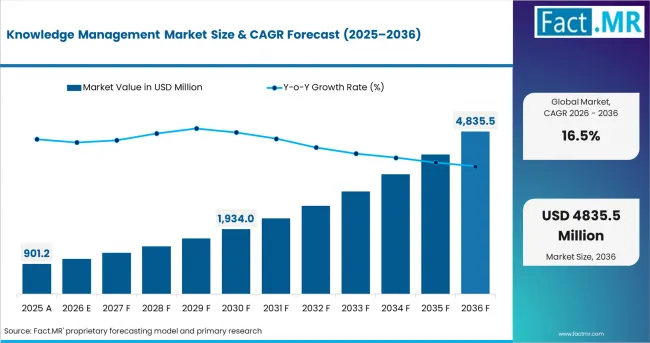
Knowledge Management Market Market Value Analysis

Summary of knowledge management market

  • Market Definition
    • The knowledge management market covers software and service systems that capture, organize, search, and share approved business knowledge for employee support, customer service, decision support, compliance learning, and enterprise content control.
  • Demand Drivers in the Market
    •  AI workplace adoption raises knowledge management demand as enterprises need approved content stores for employee search and customer support answers.
    •  Cloud software use supports knowledge management platform adoption across distributed workforces that need direct access to shared business knowledge.
    •  Customer service and staff learning requirements raise demand for knowledge management systems that reduce repeated queries and improve answer consistency.
  • Key Segments Analyzed
    •  By Type: Systems account for 40.0% share in 2026. Core knowledge platforms support enterprise search and approved answer control. Content access helps service agents work with consistent information.
    •  By Organization Size: Large enterprises account for 60.0% share in 2026. Large staff bases and multi unit service operations require shared knowledge control across departments.
    •  By Deployment: Cloud holds 58.0% share in 2026. Distributed workforces and multi office operations support cloud based knowledge access and timely content updates.
    •  By Function: Customer support accounts for 34.0% share in 2026. Service agents use approved answers to reduce repeated queries and improve response consistency.
    •  By End Use: IT and telecom account for 28.0% share in 2026. High ticket volumes and frequent technical updates raise knowledge management adoption across service operations.
    •  By Geography: South Korea leads at 17.3% CAGR from 2026 to 2036. Enterprise software use and digital skill development support knowledge management demand.
  • Analyst Opinion at Fact.MR
    • S. N. Jha of Fact.MR states, “Knowledge management is moving from a document library role into a daily decision support role. I see the best demand in teams that must answer customers quickly and train staff with approved content. AI improves speed. It also raises the need for clean content ownership. Suppliers will gain if search quality comes with permissions and clear answer review.”
  • Strategic Implications
    • Knowledge management software suppliers should pair AI aided search with content approval controls to build enterprise trust across customer support and employee guidance workflows.
    • Large enterprises create long term opportunities for knowledge management platforms as staff scale and service desk volume rise. Regulated content control needs add further demand.
    • South Korea and the United States attract knowledge management adoption through enterprise software use and cloud workplace expansion. India adds demand through AI ready content governance needs.
  • Methodology
    • Market sizing uses Fact.MR valuation data and knowledge management software demand. AI adoption statistics and cloud service use support validation. Enterprise software spending patterns are reviewed separately.
    • The study uses Eurostat AI use data and Organization for Economic Co-operation and Development cloud adoption indicators. Federal Reserve AI adoption analysis and national digital economy sources are reviewed separately.
    • Forecast analysis uses enterprise software adoption trends and cloud deployment growth. Primary interviews with technology sourcing heads and customer service leaders support the forecast model.
Metric Details
Industry Size (2026) USD 1049.9 billion
Industry Value (2036) USD 4835.5 billion
CAGR (2026 to 2036) 16.5% CAGR

Knowledge work supports customer service and staff learning. AI based answers reduce repeated support work. Content owners keep approved text in one place. Euro stat reported in December 2025 that 20.0% of EU enterprises with ten or more employees used AI technologies in 2025. [1] This supports demand for knowledge tools that can govern AI-ready content.

South Korea is projected to record 17.3% CAGR through 2036 as enterprise software use and digital skill needs rise together. The United States is expected to expand at 17.0% CAGR through 2036 as cloud software depth and AI workplace pilots raise tool use. India is forecast to grow at 16.8% CAGR through 2036 as IT service firms use KM platforms for client support. China is expected to advance at 16.6% CAGR through 2036 as data creation and AI tools expand inside large companies. Germany is projected to rise at 16.2% CAGR through 2036 as industrial firms link KM with quality records. The UK is forecast at 15.8% CAGR through 2036 as service firms test AI tools for staff support. Japan is expected to post 15.6% CAGR through 2036 as older firms protect expert know-how.

Segmental Analysis

Knowledge Management Market Analysis by Type
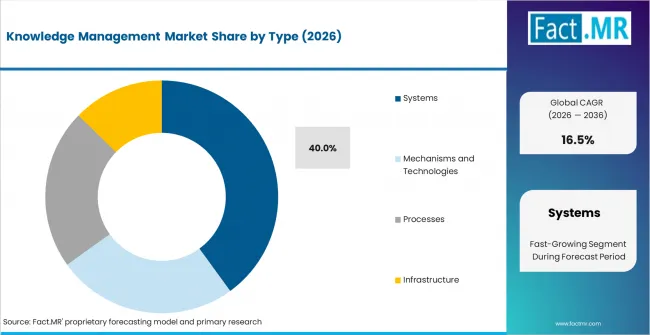
Knowledge Management Market Analysis By Type

Systems account for 40.0% share by type in 2026 as firms adopt knowledge management through core platforms. Supporting technologies improve tagging and search. Processes guide content review and answer updates. Infrastructure supports secure access and data storage.

  • Platform Control: Systems lead because enterprises want a single search base that connects approved answers and user access. Key management as a service demand reflects the same need for secure access control.
  • Content Flow: Processes gain share as content owners need clear responsibility for answer review and update cycles. Reviewed information improves agent and staff guidance.
  • Data Base: Infrastructure demand comes from cloud storage and secure data access. Systems hold the leading adoption position because they guide daily knowledge management use.

Knowledge Management Market Analysis by Organization Size
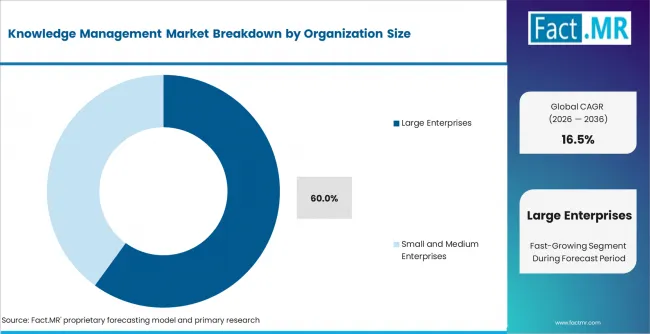
Knowledge Management Market Analysis By Organization Size

Large enterprises are projected to account for 60.0% share by organization size in 2026 as large staff bases need shared answer control. SMEs adopt KM through lower-cost cloud packages and lighter service plans. Large firms spend more as content volume and support teams scale faster.

  • Large Account Need: Large enterprises use KM to standardize answers across business units and service desks. This reduces duplicate content and support variation.
  • SME Adoption Path: SMEs tend to prefer ready‑made cloud packages with low setup work, and OECD reports indicate that cloud computing adoption has become widespread across OECD member countries, with strong uptake by 2024 [2]
  • Budget Pressure: Smaller firms face cost pressure from content cleanup and staff training. This slows premium AI KM uptake despite clear service benefits.

Knowledge Management Market Analysis by Deployment
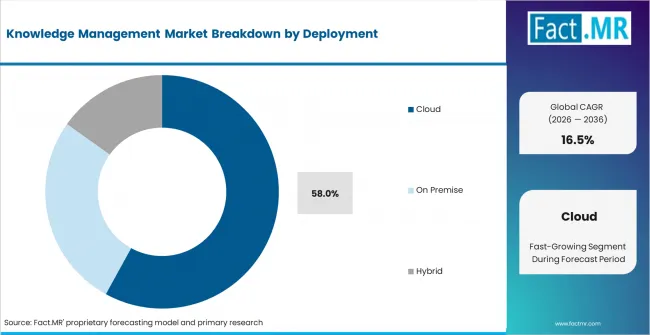
Knowledge Management Market Analysis By Deployment

Cloud represents 58.0% share by deployment in 2026 as subscription access supports multi office workforces and timely updates. On premise tools serve firms with strict data control rules. Hybrid setups serve departments that manage sensitive content with cloud search.

  • Cloud Access: Cloud leads as firms want shared answer tools with central updates. Remote workforces and customer service desks need the same access.
  • Regional Readiness: Eurostat reported in February 2026 that 53% of EU enterprises used paid cloud computing services in 2025. [3] This shows a mature base for cloud KM buying.
  • Data Control: On premise systems keep a role in regulated teams that limit external hosting. Hybrid setup helps firms separate sensitive records from general staff content.

Knowledge Management Market Analysis by Function
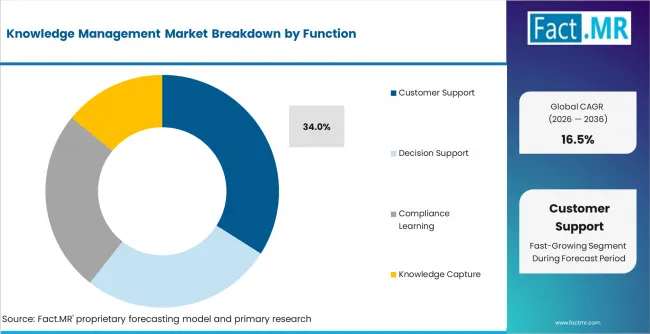
Knowledge Management Market Analysis By Function

Customer support accounts for 34.0% share by function in 2026 as service agents need approved answers during live cases. Knowledge sharing grows as staff training and internal search needs expand. Decision support rises as AI tools need verified content inputs.

  • Service Desk Use: Customer support leads as agents need timely answers that match policy and product records. Customer relationship management links improve knowledge management use during live service calls.
  • Answer Quality: Decision support works best when content owners approve source text before AI search use. Review tools and permission controls support this process.
  • Learning Support: Compliance learning uses knowledge management to keep approved process notes easy to find. Regulated departments train staff with reduced file conflict.

Knowledge Management Market Analysis by End Use
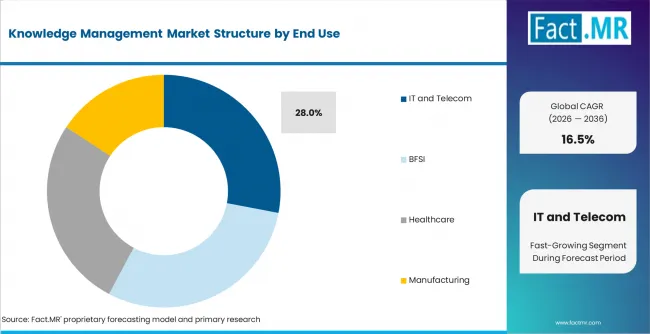
Knowledge Management Market Analysis By End Use

IT and telecom account for 28.0% share by end use in 2026 as service desks handle high ticket volumes and frequent technical updates. BFSI demand rises as regulated departments need controlled answers. Healthcare and government departments adopt knowledge management for case support and staff guidance.

  • Service Volume: IT and telecom service desks rely on knowledge management as product changes and support tickets create frequent content turnover. Ticket notes and fix histories raise the need for approved search.
  • Regulated Use: BFSI and healthcare departments use knowledge management with contract lifecycle management and policy records. This supports audit ready answers in client and staff channels.
  • Public Sector Role: Government departments use knowledge management for citizen service and staff training. Simple search and access control carry priority over advanced features.

Knowledge Management Market Analysis by Sales Channel
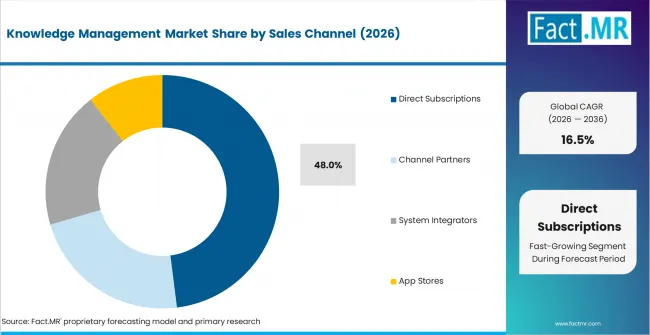
Knowledge Management Market Analysis By Sales Channel

Direct subscriptions account for 48.0% share by sales channel in 2026 as large accounts need vendor support and account control. Channel partners serve mid sized firms that need setup help. System integrators support complex links with service platforms.

  • Direct Account Control: Direct subscriptions lead as large accounts need service terms and account support from the platform seller. Renewals and feature planning depend on this support.
  • Partner Role: Channel partners help mid sized firms connect knowledge management with marketing operations management and service tools. Setup help is important for firms with limited IT support.
  • Integrator Need: System integrators serve complex accounts that need knowledge management linked with customer relationship management and service portals. These projects often need data cleanup before launch.

Knowledge Management Market Drivers, Restraints and Opportunities
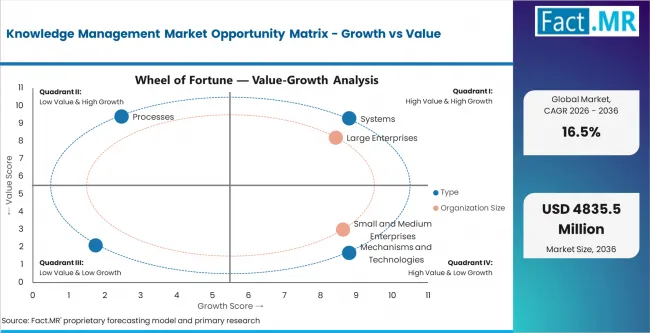
Knowledge Management Market Opportunity Matrix Growth Vs Value

AI-aided search forms the main demand base for knowledge management. Customer service teams need fast answers that use approved content. Staff learning teams use the same systems to share process updates. The Federal Reserve noted in April 2026 that Census Bureau survey data showed about 18% of United States firms had adopted AI by year end 2025. [4] This raises the value of clean knowledge stores that can feed safe answer tools.

Cost and content cleanup form the main restraints. KM projects can slow as older files need review before AI search tools are trusted. Smaller firms can delay premium tools as data cleanup and staff training raise total cost. Permission setup adds another barrier as firms must control access to approved answers.

Opportunities in the Knowledge Management Market

• AI Answer Control: Suppliers can expand through knowledge management tools that review answers before staff use them in client or internal work.

• Service Desk Content: Support desks need searchable product and policy notes that reduce repeated questions across client cases.

• Enterprise Process Records: Supplier management and audit workflows can use knowledge management to keep vendor instructions and review notes consistent.

Regional Analysis

Top Country Growth Comparison Knowledge Management Market Cagr (2026 2036)

Based on regional analysis, the knowledge management market is segmented into North America, Latin America, Western Europe, Eastern Europe, East Asia, South Asia and Pacific, and Middle East and Africa across 30 plus countries.

Country CAGR (2026 to 2036)
South Korea 17.3%
United States 17.0%
India 16.8%
China 16.6%
Germany 16.2%
UK 15.8%
Japan 15.6%

Source: Fact.MR analysis, based on proprietary forecasting model and primary research.

North America Knowledge Management Market Analysis
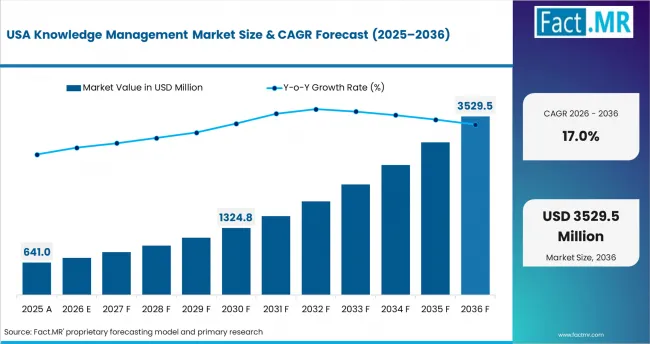
Knowledge Management Market Country Value Analysis

North America shows deep software use across service desks and enterprise learning teams. The United States is the main country opportunity in the region. Knowledge management supports customer support and internal search. It also supports policy records and staff training. Larger software budgets help vendors sell AI search with permission control.

  • United States: United States knowledge management demand is expected to expand at 17.0% CAGR through 2036 as cloud software depth and AI workplace pilots raise tool use. The Census Bureau reported in September 2025 that only 3.8% of businesses used AI to produce goods and services. [5] The gap between pilot interest and full use supports KM tools that make approved content ready for AI answers.

East Asia Knowledge Management Market Analysis
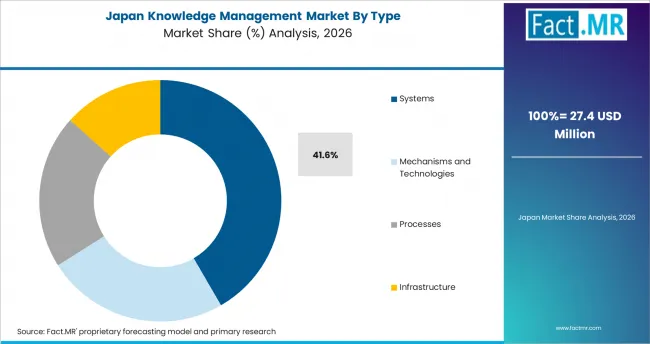
Knowledge Management Market Japan Market Share Analysis By Type

East Asia demand is backed by large technology firms and high data creation. South Korea is the fastest country in this report. China has a large enterprise data base that supports KM demand. Japan has steady demand from firms that need to retain expert knowledge as older staff retire.

  • South Korea: South Korea is projected to record 17.3% CAGR through 2036 as enterprise software use and digital skill needs rise together. OECD reported in October 2025 that 31% of Korean SMEs used AI. [6]
  • China: China is expected to advance at 16.6% CAGR through 2036 as data creation and AI tools expand inside large companies. China produced 52.26 zettabytes of data in 2025. [7] The scale of enterprise data creation supports structured content search and controlled knowledge sharing.
  • Japan: Japan is expected to post 15.6% CAGR through 2036 as older firms protect expert know-how and service process records. Enterprises prefer tools that simplify staff search and keep approved content simple to review.

South Asia and Pacific Knowledge Management Market Analysis

South Asia and Pacific benefits from IT services and shared service centers. India is the key growth country as software service firms handle large client knowledge bases. Knowledge management demand rises as firms need repeatable answers and training content across large teams.

  • India: India is forecast to grow at 16.8% CAGR through 2036 as IT service firms use KM platforms for client support and project records. Press Information Bureau reported in October 2025 that 87% of Indian enterprises were actively using AI solutions. [8] This supports KM demand tied to AI-ready content and workforce training.

Western Europe Knowledge Management Market Analysis

Western Europe demand comes from regulated service firms and industrial companies. Germany leads through enterprise software depth and process discipline. The UK supports demand through service firms that use AI tools for support and internal guidance.

  • Germany: Germany is projected to rise at 16.2% CAGR through 2036 as industrial firms link KM with quality records and staff learning. The country benefits from enterprise systems that already document procedures and service notes.
  • UK: The UK is forecast at 15.8% CAGR through 2036 as service firms test AI tools for staff support. The Office for National Statistics reported in January 2026 that 15% of UK businesses planned to adopt AI within three months. [9] That near-term intent supports KM tools that organize source content before AI use expands.

Latin America Knowledge Management Market Analysis

Latin America demand comes from service modernization and customer support platforms. Brazil leads regional demand as banks and telecom firms need better answer control. Cost sensitivity can slow premium AI KM use. Local partner support influences repeat sales in mid-sized firms.

  • Brazil: Brazil knowledge management demand is expected to rise as banks and telecom firms expand asset performance management style software discipline into service teams. Vendors with simple setup and local support can win mid-sized accounts.

Competitive Aligners for Market Players
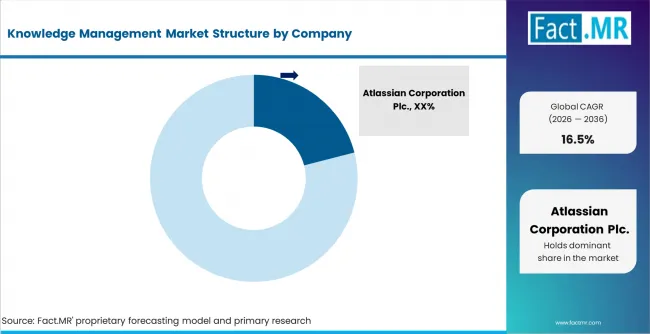
Knowledge Management Market Analysis By Company

The knowledge management market includes enterprise software vendors and customer support platform suppliers. Atlassian and Freshworks compete through search quality and answer governance. ComAround, Bloomfire, IBM, eGain, and eXo Platform support the same competitive base. Enterprises evaluate tools through content control and integration depth. Service support and setup effort influence vendor selection.

Competition depends on pairing AI search with content ownership. Suppliers with clear permissions and simple review tools can protect position from 2026 to 2036. Service desks need reliable answers and timely updates. Large accounts need vendor support during rollout and renewal.

Portfolio depth supports enterprises shifting from basic document search to repeat service guidance. Premium accounts prefer tools that reduce repeated questions and support audit checks. Adjacent systems such as inspection management software and laboratory information management systems show how controlled records guide software selection in specialized operations.

Key Players in Knowledge Management Market

  • Atlassian Corporation Plc.
  • Freshworks Inc.
  • ComAround Inc.
  • Bloomfire
  • Ernst & Young Global Limited
  • Igloo Software
  • eXo Platform
  • IBM
  • Bitrix Inc.
  • eGain Corporation

Bibliography

  • [1]. Eurostat. (2025, December 11). 20% of EU enterprises use AI technologies. European Commission. [2]. Organisation for Economic Co-operation and Development. (2025, December 9). AI adoption by small and medium-sized enterprises. OECD Publishing.
  • [3]. Eurostat. (2026, February 3). 53% of EU enterprises used paid cloud services in 2025. European Commission.
  • [4]. Allen, J. S. (2026, April 3). Monitoring AI adoption in the US economy. Board of Governors of the Federal Reserve System.
  • [5]. U.S. Census Bureau. (2025, September 17). How AI and other technology impacted businesses and workers.
  • [6]. Organisation for Economic Co-operation and Development and Korea Labor Institute. (2025, October 27). Artificial intelligence and the labour market in Korea. OECD Publishing.
  • [7]. The State Council of the People's Republic of China. (2026, April 29). China's 2025 data production hits 52.26 zettabytes.
  • [8]. Press Information Bureau. (2025, October 12). Transforming India with AI. Government of India. [9]. Office for National Statistics. (2026, January 8). Business insights and impact on the UK economy: 8 January 2026.

This Report Addresses

  • Strategic intelligence on knowledge management demand across enterprise search and customer support globally.
  • Growth opportunity mapping across United States AI readiness and South Korea enterprise software use.
  • Segment analysis by type, organization size, deployment, function, end use, and sales channel.
  • Regional outlook covering North America cloud software depth and East Asia data creation.
  • Competitive analysis of Atlassian, Freshworks, ComAround, Bloomfire, IBM, and eGain.
  • Product assessment covering KM systems and cloud-based KM tools.
  • Report delivered through PDF, Excel datasets, and presentation formats.
  • Primary interviews, public digital statistics, and supplier portfolio analysis support validation.

Knowledge Management Market Definition

The knowledge management market covers software and service systems used to capture approved business knowledge. It includes enterprise search and content databases for service teams. The market differs from general file storage as search quality and answer control shape product choice.

Knowledge Management Market Inclusions

The scope includes KM systems and KM infrastructure. It covers cloud tools and on premise tools with AI search. It covers large enterprise rollouts and SME packages sold through direct or partner channels.

Knowledge Management Market Exclusions

The scope excludes general email software and simple file backup. It excludes consumer note apps and standalone training courses not tied to a KM platform.

Knowledge Management Market Research Methodology

  • Primary Research
    • Primary research includes interviews with technology buyers and customer service heads. Enterprise software sellers and channel partners provide supplier-level inputs for buying criteria.
  • Desk Research
    • Desk research reviews the Fact.MR source page and public digital economy data. Company product pages and cloud adoption sources support supplier checks.
  • Market-Sizing and Forecasting
    • Market sizing uses a hybrid top-down and bottom-up model. The model draws on knowledge management software revenues by deployment type, enterprise user volumes by organization size, subscription pricing by sales channel, and digital workplace spending benchmarks across IT, BFSI, healthcare, manufacturing, and government sectors.
  • Data Validation and Update Cycle
    • Forecasts are checked against AI workplace use and cloud adoption data. Company portfolios and regional software use patterns support final validation.

Scope of the Report

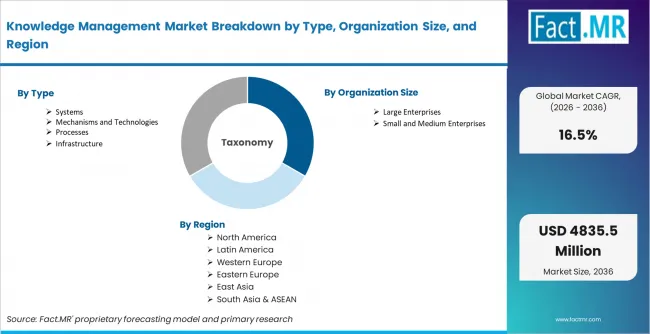
Knowledge Management Market Breakdown By Type, Organization Size, And Region

Attribute Details
Quantitative Units USD 1049.9 billion in 2026 to USD 4835.5 billion by 2036, at 16.5% CAGR
Market Definition Software and service systems used to capture and organize approved business knowledge for shared search.
Type Systems, Mechanisms and Technologies, Processes, Infrastructure
Organization Size Large Enterprises, Small and Medium Enterprises
Deployment Cloud, On Premise, Hybrid
Function Knowledge Capture, Knowledge Sharing, Customer Support, Decision Support, Compliance Learning
End Use IT and Telecom, BFSI, Healthcare, Manufacturing, Government, Education
Sales Channel Direct Subscriptions, Channel Partners, System Integrators, App Stores
Regions Covered North America, Latin America, Western Europe, Eastern Europe, East Asia, South Asia and Pacific, Middle East and Africa
Countries Covered South Korea, United States, India, China, Germany, UK, Japan, 30 plus countries
Key Companies Profiled Atlassian Corporation Plc., Freshworks Inc., ComAround Inc., Bloomfire, Ernst & Young Global Limited, Igloo Software, eXo Platform, IBM, Bitrix Inc., eGain Corporation
Forecast Period 2026 to 2036
Approach Hybrid top-down and bottom-up model using software demand, AI readiness, cloud use, and primary interviews with software buyers.

Knowledge Management Market Analysis by Segments

  • By Type:

    • Systems
    • Mechanisms and Technologies
    • Processes
    • Infrastructure
  • By Sales Channel:

    • Direct Subscriptions
    • Channel Partners
    • System Integrators
    • App Stores
  • By End Use:

    • IT and Telecom
    • BFSI
    • Healthcare
    • Manufacturing
    • Government
    • Education
    • Knowledge Capture
    • Knowledge Sharing
    • Customer Support
    • Decision Support
    • Compliance Learning
  • By Deployment:

    • Cloud
    • On Premise
    • Hybrid
  • By Organization Size:

    • Large Enterprises
    • Small and Medium Enterprises
  • Region:

  • North America
    • United States
    • Canada
  • Latin America
    • Brazil
    • Mexico
  • Western Europe
    • Germany
    • United Kingdom
    • France
    • Italy
    • Spain
  • East Asia
    • China
    • Japan
    • South Korea
  • South Asia and Pacific
    • India
    • ASEAN
    • Australia and New Zealand
  • Middle East and Africa
    • GCC Countries
    • South Africa

- Frequently Asked Questions -

How large is the knowledge management market in 2025?

The knowledge management market was valued at USD 901.2 billion in 2025 after extending the 2024 source value by one year.

What is the expected value in 2026?

Demand is estimated to reach USD 1049.9 billion in 2026 as cloud KM and AI search spending increase.

What is the forecast value by 2036?

The knowledge management market is forecast to reach USD 4835.5 billion by 2036 across enterprise and service use cases.

What CAGR is projected for 2026 to 2036?

Fact.MR projects 16.5% CAGR for knowledge management demand from 2026 to 2036.

Which organization size accounts for the highest share?

Large enterprises are expected to account for 60.0% share in 2026 as large staff bases need shared knowledge control.

Which deployment leads the knowledge management market?

Cloud is estimated to hold 58.0% share in 2026 as subscription access supports multi-office and remote teams.

Which type leads knowledge management demand?

Systems are projected to hold 40.0% share in 2026 as firms still buy KM through core platforms first.

Which function accounts for the highest share?

Customer support is estimated to hold 34.0% share in 2026 as agents need approved answers during live cases.

Which end use accounts for the highest share?

IT and telecom is estimated to account for 28.0% share in 2026 as service teams manage frequent technical updates.

Which sales channel leads demand?

Direct subscriptions are estimated to hold 48.0% share in 2026 as large accounts need vendor support and account control.

Which country shows the fastest growth?

South Korea is projected to record 17.3% CAGR through 2036 as enterprise software use and digital skill needs rise together.

What supports demand in the United States?

Cloud software depth and AI workplace pilots support 17.0% CAGR in the United States through 2036.

What supports demand in India?

IT service firms and client support knowledge bases support 16.8% CAGR in India through 2036.

What supports demand in China?

Large enterprise data creation and AI tools support 16.6% CAGR in China through 2036.

Why do large enterprises lead demand?

Large enterprises lead as large staff bases need shared answers, content permissions, and service desk consistency.

Why does cloud lead deployment?

Cloud leads as subscription access reduces update work and supports staff across many offices.

What is the main restraint in this market?

The main restraint is content cleanup cost before AI search tools can be trusted by staff.

What defines competition in this market?

Competition is based on search accuracy and permission control. Integration depth and support quality influence vendor choice.

Who are the leading companies?

Leading companies include Atlassian, Freshworks, ComAround, Bloomfire, IBM, eXo Platform, Bitrix, and eGain.

Why is data governance important for KM?

Data governance is important as AI answers need approved source content and clear ownership before enterprise use.

Table of Content

  1. Executive Summary
    • Global Market Outlook
    • Demand to side Trends
    • Supply to side Trends
    • Technology Roadmap Analysis
    • Analysis and Recommendations
  2. Market Overview
    • Market Coverage / Taxonomy
    • Market Definition / Scope / Limitations
  3. Research Methodology
    • Chapter Orientation
    • Analytical Lens and Working Hypotheses
      • Market Structure, Signals, and Trend Drivers
      • Benchmarking and Cross-market Comparability
      • Market Sizing, Forecasting, and Opportunity Mapping
    • Research Design and Evidence Framework
      • Desk Research Programme (Secondary Evidence)
        • Company Annual and Sustainability Reports
        • Peer-reviewed Journals and Academic Literature
        • Corporate Websites, Product Literature, and Technical Notes
        • Earnings Decks and Investor Briefings
        • Statutory Filings and Regulatory Disclosures
        • Technical White Papers and Standards Notes
        • Trade Journals, Industry Magazines, and Analyst Briefs
        • Conference Proceedings, Webinars, and Seminar Materials
        • Government Statistics Portals and Public Data Releases
        • Press Releases and Reputable Media Coverage
        • Specialist Newsletters and Curated Briefings
        • Sector Databases and Reference Repositories
        • Fact.MR Internal Proprietary Databases and Historical Market Datasets
        • Subscription Datasets and Paid Sources
        • Social Channels, Communities, and Digital Listening Inputs
        • Additional Desk Sources
      • Expert Input and Fieldwork (Primary Evidence)
        • Primary Modes
          • Qualitative Interviews and Expert Elicitation
          • Quantitative Surveys and Structured Data Capture
          • Blended Approach
        • Why Primary Evidence is Used
        • Field Techniques
          • Interviews
          • Surveys
          • Focus Groups
          • Observational and In-context Research
          • Social and Community Interactions
        • Stakeholder Universe Engaged
          • C-suite Leaders
          • Board Members
          • Presidents and Vice Presidents
          • R&D and Innovation Heads
          • Technical Specialists
          • Domain Subject-matter Experts
          • Scientists
          • Physicians and Other Healthcare Professionals
        • Governance, Ethics, and Data Stewardship
          • Research Ethics
          • Data Integrity and Handling
      • Tooling, Models, and Reference Databases
    • Data Engineering and Model Build
      • Data Acquisition and Ingestion
      • Cleaning, Normalisation, and Verification
      • Synthesis, Triangulation, and Analysis
    • Quality Assurance and Audit Trail
  4. Market Background
    • Market Dynamics
      • Drivers
      • Restraints
      • Opportunity
      • Trends
    • Scenario Forecast
      • Demand in Optimistic Scenario
      • Demand in Likely Scenario
      • Demand in Conservative Scenario
    • Opportunity Map Analysis
    • Product Life Cycle Analysis
    • Supply Chain Analysis
    • Investment Feasibility Matrix
    • Value Chain Analysis
    • PESTLE and Porter’s Analysis
    • Regulatory Landscape
    • Regional Parent Market Outlook
    • Production and Consumption Statistics
    • Import and Export Statistics
  5. Global Market Analysis 2021 to 2025 and Forecast, 2026 to 2036
    • Historical Market Size Value (USD Million) Analysis, 2021 to 2025
    • Current and Future Market Size Value (USD Million) Projections, 2026 to 2036
      • Y to o to Y Growth Trend Analysis
      • Absolute $ Opportunity Analysis
  6. Global Market Pricing Analysis 2021 to 2025 and Forecast 2026 to 2036
  7. Global Market Analysis 2021 to 2025 and Forecast 2026 to 2036, By Type
    • Introduction / Key Findings
    • Historical Market Size Value (USD Million) Analysis By Type , 2021 to 2025
    • Current and Future Market Size Value (USD Million) Analysis and Forecast By Type , 2026 to 2036
      • Systems
      • Mechanisms and Technologies
      • Processes
      • Infrastructure
    • Y to o to Y Growth Trend Analysis By Type , 2021 to 2025
    • Absolute $ Opportunity Analysis By Type , 2026 to 2036
  8. Global Market Analysis 2021 to 2025 and Forecast 2026 to 2036, By Organization Size
    • Introduction / Key Findings
    • Historical Market Size Value (USD Million) Analysis By Organization Size, 2021 to 2025
    • Current and Future Market Size Value (USD Million) Analysis and Forecast By Organization Size, 2026 to 2036
      • Large Enterprises
      • Small and Medium Enterprises
    • Y to o to Y Growth Trend Analysis By Organization Size, 2021 to 2025
    • Absolute $ Opportunity Analysis By Organization Size, 2026 to 2036
  9. Global Market Analysis 2021 to 2025 and Forecast 2026 to 2036, By Deployment
    • Introduction / Key Findings
    • Historical Market Size Value (USD Million) Analysis By Deployment, 2021 to 2025
    • Current and Future Market Size Value (USD Million) Analysis and Forecast By Deployment, 2026 to 2036
      • Cloud
      • On Premise
      • Hybrid
    • Y to o to Y Growth Trend Analysis By Deployment, 2021 to 2025
    • Absolute $ Opportunity Analysis By Deployment, 2026 to 2036
  10. Global Market Analysis 2021 to 2025 and Forecast 2026 to 2036, By Function
    • Introduction / Key Findings
    • Historical Market Size Value (USD Million) Analysis By Function, 2021 to 2025
    • Current and Future Market Size Value (USD Million) Analysis and Forecast By Function, 2026 to 2036
      • Customer Support
      • Decision Support
      • Compliance Learning
      • Knowledge Capture
      • Knowledge Sharing
    • Y to o to Y Growth Trend Analysis By Function, 2021 to 2025
    • Absolute $ Opportunity Analysis By Function, 2026 to 2036
  11. Global Market Analysis 2021 to 2025 and Forecast 2026 to 2036, By End Use
    • Introduction / Key Findings
    • Historical Market Size Value (USD Million) Analysis By End Use, 2021 to 2025
    • Current and Future Market Size Value (USD Million) Analysis and Forecast By End Use, 2026 to 2036
      • IT and Telecom
      • BFSI
      • Healthcare
      • Manufacturing
      • Government
      • Education
    • Y to o to Y Growth Trend Analysis By End Use, 2021 to 2025
    • Absolute $ Opportunity Analysis By End Use, 2026 to 2036
  12. Global Market Analysis 2021 to 2025 and Forecast 2026 to 2036, By Sales Channel
    • Introduction / Key Findings
    • Historical Market Size Value (USD Million) Analysis By Sales Channel, 2021 to 2025
    • Current and Future Market Size Value (USD Million) Analysis and Forecast By Sales Channel, 2026 to 2036
      • Direct Subscriptions
      • Channel Partners
      • System Integrators
      • App Stores
    • Y to o to Y Growth Trend Analysis By Sales Channel, 2021 to 2025
    • Absolute $ Opportunity Analysis By Sales Channel, 2026 to 2036
  13. Global Market Analysis 2021 to 2025 and Forecast 2026 to 2036, By Region
    • Introduction
    • Historical Market Size Value (USD Million) Analysis By Region, 2021 to 2025
    • Current Market Size Value (USD Million) Analysis and Forecast By Region, 2026 to 2036
      • North America
      • Latin America
      • Western Europe
      • Eastern Europe
      • East Asia
      • South Asia and Pacific
      • Middle East & Africa
    • Market Attractiveness Analysis By Region
  14. North America Market Analysis 2021 to 2025 and Forecast 2026 to 2036, By Country
    • Historical Market Size Value (USD Million) Trend Analysis By Market Taxonomy, 2021 to 2025
    • Market Size Value (USD Million) Forecast By Market Taxonomy, 2026 to 2036
      • By Country
        • USA
        • Canada
        • Mexico
      • By Type
      • By Organization Size
      • By Deployment
      • By Function
      • By End Use
      • By Sales Channel
    • Market Attractiveness Analysis
      • By Country
      • By Type
      • By Organization Size
      • By Deployment
      • By Function
      • By End Use
      • By Sales Channel
    • Key Takeaways
  15. Latin America Market Analysis 2021 to 2025 and Forecast 2026 to 2036, By Country
    • Historical Market Size Value (USD Million) Trend Analysis By Market Taxonomy, 2021 to 2025
    • Market Size Value (USD Million) Forecast By Market Taxonomy, 2026 to 2036
      • By Country
        • Brazil
        • Chile
        • Rest of Latin America
      • By Type
      • By Organization Size
      • By Deployment
      • By Function
      • By End Use
      • By Sales Channel
    • Market Attractiveness Analysis
      • By Country
      • By Type
      • By Organization Size
      • By Deployment
      • By Function
      • By End Use
      • By Sales Channel
    • Key Takeaways
  16. Western Europe Market Analysis 2021 to 2025 and Forecast 2026 to 2036, By Country
    • Historical Market Size Value (USD Million) Trend Analysis By Market Taxonomy, 2021 to 2025
    • Market Size Value (USD Million) Forecast By Market Taxonomy, 2026 to 2036
      • By Country
        • Germany
        • UK
        • Italy
        • Spain
        • France
        • Nordic
        • BENELUX
        • Rest of Western Europe
      • By Type
      • By Organization Size
      • By Deployment
      • By Function
      • By End Use
      • By Sales Channel
    • Market Attractiveness Analysis
      • By Country
      • By Type
      • By Organization Size
      • By Deployment
      • By Function
      • By End Use
      • By Sales Channel
    • Key Takeaways
  17. Eastern Europe Market Analysis 2021 to 2025 and Forecast 2026 to 2036, By Country
    • Historical Market Size Value (USD Million) Trend Analysis By Market Taxonomy, 2021 to 2025
    • Market Size Value (USD Million) Forecast By Market Taxonomy, 2026 to 2036
      • By Country
        • Russia
        • Poland
        • Hungary
        • Balkan & Baltic
        • Rest of Eastern Europe
      • By Type
      • By Organization Size
      • By Deployment
      • By Function
      • By End Use
      • By Sales Channel
    • Market Attractiveness Analysis
      • By Country
      • By Type
      • By Organization Size
      • By Deployment
      • By Function
      • By End Use
      • By Sales Channel
    • Key Takeaways
  18. East Asia Market Analysis 2021 to 2025 and Forecast 2026 to 2036, By Country
    • Historical Market Size Value (USD Million) Trend Analysis By Market Taxonomy, 2021 to 2025
    • Market Size Value (USD Million) Forecast By Market Taxonomy, 2026 to 2036
      • By Country
        • China
        • Japan
        • South Korea
      • By Type
      • By Organization Size
      • By Deployment
      • By Function
      • By End Use
      • By Sales Channel
    • Market Attractiveness Analysis
      • By Country
      • By Type
      • By Organization Size
      • By Deployment
      • By Function
      • By End Use
      • By Sales Channel
    • Key Takeaways
  19. South Asia and Pacific Market Analysis 2021 to 2025 and Forecast 2026 to 2036, By Country
    • Historical Market Size Value (USD Million) Trend Analysis By Market Taxonomy, 2021 to 2025
    • Market Size Value (USD Million) Forecast By Market Taxonomy, 2026 to 2036
      • By Country
        • India
        • ASEAN
        • Australia & New Zealand
        • Rest of South Asia and Pacific
      • By Type
      • By Organization Size
      • By Deployment
      • By Function
      • By End Use
      • By Sales Channel
    • Market Attractiveness Analysis
      • By Country
      • By Type
      • By Organization Size
      • By Deployment
      • By Function
      • By End Use
      • By Sales Channel
    • Key Takeaways
  20. Middle East & Africa Market Analysis 2021 to 2025 and Forecast 2026 to 2036, By Country
    • Historical Market Size Value (USD Million) Trend Analysis By Market Taxonomy, 2021 to 2025
    • Market Size Value (USD Million) Forecast By Market Taxonomy, 2026 to 2036
      • By Country
        • Kingdom of Saudi Arabia
        • Other GCC Countries
        • Turkiye
        • South Africa
        • Other African Union
        • Rest of Middle East & Africa
      • By Type
      • By Organization Size
      • By Deployment
      • By Function
      • By End Use
      • By Sales Channel
    • Market Attractiveness Analysis
      • By Country
      • By Type
      • By Organization Size
      • By Deployment
      • By Function
      • By End Use
      • By Sales Channel
    • Key Takeaways
  21. Key Countries Market Analysis
    • USA
      • Pricing Analysis
      • Market Share Analysis, 2025
        • By Type
        • By Organization Size
        • By Deployment
        • By Function
        • By End Use
        • By Sales Channel
    • Canada
      • Pricing Analysis
      • Market Share Analysis, 2025
        • By Type
        • By Organization Size
        • By Deployment
        • By Function
        • By End Use
        • By Sales Channel
    • Mexico
      • Pricing Analysis
      • Market Share Analysis, 2025
        • By Type
        • By Organization Size
        • By Deployment
        • By Function
        • By End Use
        • By Sales Channel
    • Brazil
      • Pricing Analysis
      • Market Share Analysis, 2025
        • By Type
        • By Organization Size
        • By Deployment
        • By Function
        • By End Use
        • By Sales Channel
    • Chile
      • Pricing Analysis
      • Market Share Analysis, 2025
        • By Type
        • By Organization Size
        • By Deployment
        • By Function
        • By End Use
        • By Sales Channel
    • Germany
      • Pricing Analysis
      • Market Share Analysis, 2025
        • By Type
        • By Organization Size
        • By Deployment
        • By Function
        • By End Use
        • By Sales Channel
    • UK
      • Pricing Analysis
      • Market Share Analysis, 2025
        • By Type
        • By Organization Size
        • By Deployment
        • By Function
        • By End Use
        • By Sales Channel
    • Italy
      • Pricing Analysis
      • Market Share Analysis, 2025
        • By Type
        • By Organization Size
        • By Deployment
        • By Function
        • By End Use
        • By Sales Channel
    • Spain
      • Pricing Analysis
      • Market Share Analysis, 2025
        • By Type
        • By Organization Size
        • By Deployment
        • By Function
        • By End Use
        • By Sales Channel
    • France
      • Pricing Analysis
      • Market Share Analysis, 2025
        • By Type
        • By Organization Size
        • By Deployment
        • By Function
        • By End Use
        • By Sales Channel
    • India
      • Pricing Analysis
      • Market Share Analysis, 2025
        • By Type
        • By Organization Size
        • By Deployment
        • By Function
        • By End Use
        • By Sales Channel
    • ASEAN
      • Pricing Analysis
      • Market Share Analysis, 2025
        • By Type
        • By Organization Size
        • By Deployment
        • By Function
        • By End Use
        • By Sales Channel
    • Australia & New Zealand
      • Pricing Analysis
      • Market Share Analysis, 2025
        • By Type
        • By Organization Size
        • By Deployment
        • By Function
        • By End Use
        • By Sales Channel
    • China
      • Pricing Analysis
      • Market Share Analysis, 2025
        • By Type
        • By Organization Size
        • By Deployment
        • By Function
        • By End Use
        • By Sales Channel
    • Japan
      • Pricing Analysis
      • Market Share Analysis, 2025
        • By Type
        • By Organization Size
        • By Deployment
        • By Function
        • By End Use
        • By Sales Channel
    • South Korea
      • Pricing Analysis
      • Market Share Analysis, 2025
        • By Type
        • By Organization Size
        • By Deployment
        • By Function
        • By End Use
        • By Sales Channel
    • Russia
      • Pricing Analysis
      • Market Share Analysis, 2025
        • By Type
        • By Organization Size
        • By Deployment
        • By Function
        • By End Use
        • By Sales Channel
    • Poland
      • Pricing Analysis
      • Market Share Analysis, 2025
        • By Type
        • By Organization Size
        • By Deployment
        • By Function
        • By End Use
        • By Sales Channel
    • Hungary
      • Pricing Analysis
      • Market Share Analysis, 2025
        • By Type
        • By Organization Size
        • By Deployment
        • By Function
        • By End Use
        • By Sales Channel
    • Kingdom of Saudi Arabia
      • Pricing Analysis
      • Market Share Analysis, 2025
        • By Type
        • By Organization Size
        • By Deployment
        • By Function
        • By End Use
        • By Sales Channel
    • Turkiye
      • Pricing Analysis
      • Market Share Analysis, 2025
        • By Type
        • By Organization Size
        • By Deployment
        • By Function
        • By End Use
        • By Sales Channel
    • South Africa
      • Pricing Analysis
      • Market Share Analysis, 2025
        • By Type
        • By Organization Size
        • By Deployment
        • By Function
        • By End Use
        • By Sales Channel
  22. Market Structure Analysis
    • Competition Dashboard
    • Competition Benchmarking
    • Market Share Analysis of Top Players
      • By Regional
      • By Type
      • By Organization Size
      • By Deployment
      • By Function
      • By End Use
      • By Sales Channel
  23. Competition Analysis
    • Competition Deep Dive
      • Atlassian Corporation Plc.
        • Overview
        • Product Portfolio
        • Profitability by Market Segments (Product/Age /Sales Channel/Region)
        • Sales Footprint
        • Strategy Overview
          • Marketing Strategy
          • Product Strategy
          • Channel Strategy
      • Freshworks Inc.
      • ComAround Inc.
      • Bloomfire
      • Ernst & Young Global Limited
      • Igloo Software
      • eXo Platform
      • IBM
      • Bitrix Inc.
      • eGain Corporation
  24. Assumptions & Acronyms Used

List Of Table

  • Table 1: Global Market Value (USD Million) Forecast by Region, 2021 to 2036
  • Table 2: Global Market Value (USD Million) Forecast by Type , 2021 to 2036
  • Table 3: Global Market Value (USD Million) Forecast by Organization Size, 2021 to 2036
  • Table 4: Global Market Value (USD Million) Forecast by Deployment, 2021 to 2036
  • Table 5: Global Market Value (USD Million) Forecast by Function, 2021 to 2036
  • Table 6: Global Market Value (USD Million) Forecast by End Use, 2021 to 2036
  • Table 7: Global Market Value (USD Million) Forecast by Sales Channel, 2021 to 2036
  • Table 8: North America Market Value (USD Million) Forecast by Country, 2021 to 2036
  • Table 9: North America Market Value (USD Million) Forecast by Type , 2021 to 2036
  • Table 10: North America Market Value (USD Million) Forecast by Organization Size, 2021 to 2036
  • Table 11: North America Market Value (USD Million) Forecast by Deployment, 2021 to 2036
  • Table 12: North America Market Value (USD Million) Forecast by Function, 2021 to 2036
  • Table 13: North America Market Value (USD Million) Forecast by End Use, 2021 to 2036
  • Table 14: North America Market Value (USD Million) Forecast by Sales Channel, 2021 to 2036
  • Table 15: Latin America Market Value (USD Million) Forecast by Country, 2021 to 2036
  • Table 16: Latin America Market Value (USD Million) Forecast by Type , 2021 to 2036
  • Table 17: Latin America Market Value (USD Million) Forecast by Organization Size, 2021 to 2036
  • Table 18: Latin America Market Value (USD Million) Forecast by Deployment, 2021 to 2036
  • Table 19: Latin America Market Value (USD Million) Forecast by Function, 2021 to 2036
  • Table 20: Latin America Market Value (USD Million) Forecast by End Use, 2021 to 2036
  • Table 21: Latin America Market Value (USD Million) Forecast by Sales Channel, 2021 to 2036
  • Table 22: Western Europe Market Value (USD Million) Forecast by Country, 2021 to 2036
  • Table 23: Western Europe Market Value (USD Million) Forecast by Type , 2021 to 2036
  • Table 24: Western Europe Market Value (USD Million) Forecast by Organization Size, 2021 to 2036
  • Table 25: Western Europe Market Value (USD Million) Forecast by Deployment, 2021 to 2036
  • Table 26: Western Europe Market Value (USD Million) Forecast by Function, 2021 to 2036
  • Table 27: Western Europe Market Value (USD Million) Forecast by End Use, 2021 to 2036
  • Table 28: Western Europe Market Value (USD Million) Forecast by Sales Channel, 2021 to 2036
  • Table 29: Eastern Europe Market Value (USD Million) Forecast by Country, 2021 to 2036
  • Table 30: Eastern Europe Market Value (USD Million) Forecast by Type , 2021 to 2036
  • Table 31: Eastern Europe Market Value (USD Million) Forecast by Organization Size, 2021 to 2036
  • Table 32: Eastern Europe Market Value (USD Million) Forecast by Deployment, 2021 to 2036
  • Table 33: Eastern Europe Market Value (USD Million) Forecast by Function, 2021 to 2036
  • Table 34: Eastern Europe Market Value (USD Million) Forecast by End Use, 2021 to 2036
  • Table 35: Eastern Europe Market Value (USD Million) Forecast by Sales Channel, 2021 to 2036
  • Table 36: East Asia Market Value (USD Million) Forecast by Country, 2021 to 2036
  • Table 37: East Asia Market Value (USD Million) Forecast by Type , 2021 to 2036
  • Table 38: East Asia Market Value (USD Million) Forecast by Organization Size, 2021 to 2036
  • Table 39: East Asia Market Value (USD Million) Forecast by Deployment, 2021 to 2036
  • Table 40: East Asia Market Value (USD Million) Forecast by Function, 2021 to 2036
  • Table 41: East Asia Market Value (USD Million) Forecast by End Use, 2021 to 2036
  • Table 42: East Asia Market Value (USD Million) Forecast by Sales Channel, 2021 to 2036
  • Table 43: South Asia and Pacific Market Value (USD Million) Forecast by Country, 2021 to 2036
  • Table 44: South Asia and Pacific Market Value (USD Million) Forecast by Type , 2021 to 2036
  • Table 45: South Asia and Pacific Market Value (USD Million) Forecast by Organization Size, 2021 to 2036
  • Table 46: South Asia and Pacific Market Value (USD Million) Forecast by Deployment, 2021 to 2036
  • Table 47: South Asia and Pacific Market Value (USD Million) Forecast by Function, 2021 to 2036
  • Table 48: South Asia and Pacific Market Value (USD Million) Forecast by End Use, 2021 to 2036
  • Table 49: South Asia and Pacific Market Value (USD Million) Forecast by Sales Channel, 2021 to 2036
  • Table 50: Middle East & Africa Market Value (USD Million) Forecast by Country, 2021 to 2036
  • Table 51: Middle East & Africa Market Value (USD Million) Forecast by Type , 2021 to 2036
  • Table 52: Middle East & Africa Market Value (USD Million) Forecast by Organization Size, 2021 to 2036
  • Table 53: Middle East & Africa Market Value (USD Million) Forecast by Deployment, 2021 to 2036
  • Table 54: Middle East & Africa Market Value (USD Million) Forecast by Function, 2021 to 2036
  • Table 55: Middle East & Africa Market Value (USD Million) Forecast by End Use, 2021 to 2036
  • Table 56: Middle East & Africa Market Value (USD Million) Forecast by Sales Channel, 2021 to 2036

List Of Figures

  • Figure 1: Global Market Pricing Analysis
  • Figure 2: Global Market Value (USD Million) Forecast 2021-2036
  • Figure 3: Global Market Value Share and BPS Analysis by Type , 2026 and 2036
  • Figure 4: Global Market Y-o-Y Growth Comparison by Type , 2026-2036
  • Figure 5: Global Market Attractiveness Analysis by Type
  • Figure 6: Global Market Value Share and BPS Analysis by Organization Size, 2026 and 2036
  • Figure 7: Global Market Y-o-Y Growth Comparison by Organization Size, 2026-2036
  • Figure 8: Global Market Attractiveness Analysis by Organization Size
  • Figure 9: Global Market Value Share and BPS Analysis by Deployment, 2026 and 2036
  • Figure 10: Global Market Y-o-Y Growth Comparison by Deployment, 2026-2036
  • Figure 11: Global Market Attractiveness Analysis by Deployment
  • Figure 12: Global Market Value Share and BPS Analysis by Function, 2026 and 2036
  • Figure 13: Global Market Y-o-Y Growth Comparison by Function, 2026-2036
  • Figure 14: Global Market Attractiveness Analysis by Function
  • Figure 15: Global Market Value Share and BPS Analysis by End Use, 2026 and 2036
  • Figure 16: Global Market Y-o-Y Growth Comparison by End Use, 2026-2036
  • Figure 17: Global Market Attractiveness Analysis by End Use
  • Figure 18: Global Market Value Share and BPS Analysis by Sales Channel, 2026 and 2036
  • Figure 19: Global Market Y-o-Y Growth Comparison by Sales Channel, 2026-2036
  • Figure 20: Global Market Attractiveness Analysis by Sales Channel
  • Figure 21: Global Market Value (USD Million) Share and BPS Analysis by Region, 2026 and 2036
  • Figure 22: Global Market Y-o-Y Growth Comparison by Region, 2026-2036
  • Figure 23: Global Market Attractiveness Analysis by Region
  • Figure 24: North America Market Incremental Dollar Opportunity, 2026-2036
  • Figure 25: Latin America Market Incremental Dollar Opportunity, 2026-2036
  • Figure 26: Western Europe Market Incremental Dollar Opportunity, 2026-2036
  • Figure 27: Eastern Europe Market Incremental Dollar Opportunity, 2026-2036
  • Figure 28: East Asia Market Incremental Dollar Opportunity, 2026-2036
  • Figure 29: South Asia and Pacific Market Incremental Dollar Opportunity, 2026-2036
  • Figure 30: Middle East & Africa Market Incremental Dollar Opportunity, 2026-2036
  • Figure 31: North America Market Value Share and BPS Analysis by Country, 2026 and 2036
  • Figure 32: North America Market Value Share and BPS Analysis by Type , 2026 and 2036
  • Figure 33: North America Market Y-o-Y Growth Comparison by Type , 2026-2036
  • Figure 34: North America Market Attractiveness Analysis by Type
  • Figure 35: North America Market Value Share and BPS Analysis by Organization Size, 2026 and 2036
  • Figure 36: North America Market Y-o-Y Growth Comparison by Organization Size, 2026-2036
  • Figure 37: North America Market Attractiveness Analysis by Organization Size
  • Figure 38: North America Market Value Share and BPS Analysis by Deployment, 2026 and 2036
  • Figure 39: North America Market Y-o-Y Growth Comparison by Deployment, 2026-2036
  • Figure 40: North America Market Attractiveness Analysis by Deployment
  • Figure 41: North America Market Value Share and BPS Analysis by Function, 2026 and 2036
  • Figure 42: North America Market Y-o-Y Growth Comparison by Function, 2026-2036
  • Figure 43: North America Market Attractiveness Analysis by Function
  • Figure 44: North America Market Value Share and BPS Analysis by End Use, 2026 and 2036
  • Figure 45: North America Market Y-o-Y Growth Comparison by End Use, 2026-2036
  • Figure 46: North America Market Attractiveness Analysis by End Use
  • Figure 47: North America Market Value Share and BPS Analysis by Sales Channel, 2026 and 2036
  • Figure 48: North America Market Y-o-Y Growth Comparison by Sales Channel, 2026-2036
  • Figure 49: North America Market Attractiveness Analysis by Sales Channel
  • Figure 50: Latin America Market Value Share and BPS Analysis by Country, 2026 and 2036
  • Figure 51: Latin America Market Value Share and BPS Analysis by Type , 2026 and 2036
  • Figure 52: Latin America Market Y-o-Y Growth Comparison by Type , 2026-2036
  • Figure 53: Latin America Market Attractiveness Analysis by Type
  • Figure 54: Latin America Market Value Share and BPS Analysis by Organization Size, 2026 and 2036
  • Figure 55: Latin America Market Y-o-Y Growth Comparison by Organization Size, 2026-2036
  • Figure 56: Latin America Market Attractiveness Analysis by Organization Size
  • Figure 57: Latin America Market Value Share and BPS Analysis by Deployment, 2026 and 2036
  • Figure 58: Latin America Market Y-o-Y Growth Comparison by Deployment, 2026-2036
  • Figure 59: Latin America Market Attractiveness Analysis by Deployment
  • Figure 60: Latin America Market Value Share and BPS Analysis by Function, 2026 and 2036
  • Figure 61: Latin America Market Y-o-Y Growth Comparison by Function, 2026-2036
  • Figure 62: Latin America Market Attractiveness Analysis by Function
  • Figure 63: Latin America Market Value Share and BPS Analysis by End Use, 2026 and 2036
  • Figure 64: Latin America Market Y-o-Y Growth Comparison by End Use, 2026-2036
  • Figure 65: Latin America Market Attractiveness Analysis by End Use
  • Figure 66: Latin America Market Value Share and BPS Analysis by Sales Channel, 2026 and 2036
  • Figure 67: Latin America Market Y-o-Y Growth Comparison by Sales Channel, 2026-2036
  • Figure 68: Latin America Market Attractiveness Analysis by Sales Channel
  • Figure 69: Western Europe Market Value Share and BPS Analysis by Country, 2026 and 2036
  • Figure 70: Western Europe Market Value Share and BPS Analysis by Type , 2026 and 2036
  • Figure 71: Western Europe Market Y-o-Y Growth Comparison by Type , 2026-2036
  • Figure 72: Western Europe Market Attractiveness Analysis by Type
  • Figure 73: Western Europe Market Value Share and BPS Analysis by Organization Size, 2026 and 2036
  • Figure 74: Western Europe Market Y-o-Y Growth Comparison by Organization Size, 2026-2036
  • Figure 75: Western Europe Market Attractiveness Analysis by Organization Size
  • Figure 76: Western Europe Market Value Share and BPS Analysis by Deployment, 2026 and 2036
  • Figure 77: Western Europe Market Y-o-Y Growth Comparison by Deployment, 2026-2036
  • Figure 78: Western Europe Market Attractiveness Analysis by Deployment
  • Figure 79: Western Europe Market Value Share and BPS Analysis by Function, 2026 and 2036
  • Figure 80: Western Europe Market Y-o-Y Growth Comparison by Function, 2026-2036
  • Figure 81: Western Europe Market Attractiveness Analysis by Function
  • Figure 82: Western Europe Market Value Share and BPS Analysis by End Use, 2026 and 2036
  • Figure 83: Western Europe Market Y-o-Y Growth Comparison by End Use, 2026-2036
  • Figure 84: Western Europe Market Attractiveness Analysis by End Use
  • Figure 85: Western Europe Market Value Share and BPS Analysis by Sales Channel, 2026 and 2036
  • Figure 86: Western Europe Market Y-o-Y Growth Comparison by Sales Channel, 2026-2036
  • Figure 87: Western Europe Market Attractiveness Analysis by Sales Channel
  • Figure 88: Eastern Europe Market Value Share and BPS Analysis by Country, 2026 and 2036
  • Figure 89: Eastern Europe Market Value Share and BPS Analysis by Type , 2026 and 2036
  • Figure 90: Eastern Europe Market Y-o-Y Growth Comparison by Type , 2026-2036
  • Figure 91: Eastern Europe Market Attractiveness Analysis by Type
  • Figure 92: Eastern Europe Market Value Share and BPS Analysis by Organization Size, 2026 and 2036
  • Figure 93: Eastern Europe Market Y-o-Y Growth Comparison by Organization Size, 2026-2036
  • Figure 94: Eastern Europe Market Attractiveness Analysis by Organization Size
  • Figure 95: Eastern Europe Market Value Share and BPS Analysis by Deployment, 2026 and 2036
  • Figure 96: Eastern Europe Market Y-o-Y Growth Comparison by Deployment, 2026-2036
  • Figure 97: Eastern Europe Market Attractiveness Analysis by Deployment
  • Figure 98: Eastern Europe Market Value Share and BPS Analysis by Function, 2026 and 2036
  • Figure 99: Eastern Europe Market Y-o-Y Growth Comparison by Function, 2026-2036
  • Figure 100: Eastern Europe Market Attractiveness Analysis by Function
  • Figure 101: Eastern Europe Market Value Share and BPS Analysis by End Use, 2026 and 2036
  • Figure 102: Eastern Europe Market Y-o-Y Growth Comparison by End Use, 2026-2036
  • Figure 103: Eastern Europe Market Attractiveness Analysis by End Use
  • Figure 104: Eastern Europe Market Value Share and BPS Analysis by Sales Channel, 2026 and 2036
  • Figure 105: Eastern Europe Market Y-o-Y Growth Comparison by Sales Channel, 2026-2036
  • Figure 106: Eastern Europe Market Attractiveness Analysis by Sales Channel
  • Figure 107: East Asia Market Value Share and BPS Analysis by Country, 2026 and 2036
  • Figure 108: East Asia Market Value Share and BPS Analysis by Type , 2026 and 2036
  • Figure 109: East Asia Market Y-o-Y Growth Comparison by Type , 2026-2036
  • Figure 110: East Asia Market Attractiveness Analysis by Type
  • Figure 111: East Asia Market Value Share and BPS Analysis by Organization Size, 2026 and 2036
  • Figure 112: East Asia Market Y-o-Y Growth Comparison by Organization Size, 2026-2036
  • Figure 113: East Asia Market Attractiveness Analysis by Organization Size
  • Figure 114: East Asia Market Value Share and BPS Analysis by Deployment, 2026 and 2036
  • Figure 115: East Asia Market Y-o-Y Growth Comparison by Deployment, 2026-2036
  • Figure 116: East Asia Market Attractiveness Analysis by Deployment
  • Figure 117: East Asia Market Value Share and BPS Analysis by Function, 2026 and 2036
  • Figure 118: East Asia Market Y-o-Y Growth Comparison by Function, 2026-2036
  • Figure 119: East Asia Market Attractiveness Analysis by Function
  • Figure 120: East Asia Market Value Share and BPS Analysis by End Use, 2026 and 2036
  • Figure 121: East Asia Market Y-o-Y Growth Comparison by End Use, 2026-2036
  • Figure 122: East Asia Market Attractiveness Analysis by End Use
  • Figure 123: East Asia Market Value Share and BPS Analysis by Sales Channel, 2026 and 2036
  • Figure 124: East Asia Market Y-o-Y Growth Comparison by Sales Channel, 2026-2036
  • Figure 125: East Asia Market Attractiveness Analysis by Sales Channel
  • Figure 126: South Asia and Pacific Market Value Share and BPS Analysis by Country, 2026 and 2036
  • Figure 127: South Asia and Pacific Market Value Share and BPS Analysis by Type , 2026 and 2036
  • Figure 128: South Asia and Pacific Market Y-o-Y Growth Comparison by Type , 2026-2036
  • Figure 129: South Asia and Pacific Market Attractiveness Analysis by Type
  • Figure 130: South Asia and Pacific Market Value Share and BPS Analysis by Organization Size, 2026 and 2036
  • Figure 131: South Asia and Pacific Market Y-o-Y Growth Comparison by Organization Size, 2026-2036
  • Figure 132: South Asia and Pacific Market Attractiveness Analysis by Organization Size
  • Figure 133: South Asia and Pacific Market Value Share and BPS Analysis by Deployment, 2026 and 2036
  • Figure 134: South Asia and Pacific Market Y-o-Y Growth Comparison by Deployment, 2026-2036
  • Figure 135: South Asia and Pacific Market Attractiveness Analysis by Deployment
  • Figure 136: South Asia and Pacific Market Value Share and BPS Analysis by Function, 2026 and 2036
  • Figure 137: South Asia and Pacific Market Y-o-Y Growth Comparison by Function, 2026-2036
  • Figure 138: South Asia and Pacific Market Attractiveness Analysis by Function
  • Figure 139: South Asia and Pacific Market Value Share and BPS Analysis by End Use, 2026 and 2036
  • Figure 140: South Asia and Pacific Market Y-o-Y Growth Comparison by End Use, 2026-2036
  • Figure 141: South Asia and Pacific Market Attractiveness Analysis by End Use
  • Figure 142: South Asia and Pacific Market Value Share and BPS Analysis by Sales Channel, 2026 and 2036
  • Figure 143: South Asia and Pacific Market Y-o-Y Growth Comparison by Sales Channel, 2026-2036
  • Figure 144: South Asia and Pacific Market Attractiveness Analysis by Sales Channel
  • Figure 145: Middle East & Africa Market Value Share and BPS Analysis by Country, 2026 and 2036
  • Figure 146: Middle East & Africa Market Value Share and BPS Analysis by Type , 2026 and 2036
  • Figure 147: Middle East & Africa Market Y-o-Y Growth Comparison by Type , 2026-2036
  • Figure 148: Middle East & Africa Market Attractiveness Analysis by Type
  • Figure 149: Middle East & Africa Market Value Share and BPS Analysis by Organization Size, 2026 and 2036
  • Figure 150: Middle East & Africa Market Y-o-Y Growth Comparison by Organization Size, 2026-2036
  • Figure 151: Middle East & Africa Market Attractiveness Analysis by Organization Size
  • Figure 152: Middle East & Africa Market Value Share and BPS Analysis by Deployment, 2026 and 2036
  • Figure 153: Middle East & Africa Market Y-o-Y Growth Comparison by Deployment, 2026-2036
  • Figure 154: Middle East & Africa Market Attractiveness Analysis by Deployment
  • Figure 155: Middle East & Africa Market Value Share and BPS Analysis by Function, 2026 and 2036
  • Figure 156: Middle East & Africa Market Y-o-Y Growth Comparison by Function, 2026-2036
  • Figure 157: Middle East & Africa Market Attractiveness Analysis by Function
  • Figure 158: Middle East & Africa Market Value Share and BPS Analysis by End Use, 2026 and 2036
  • Figure 159: Middle East & Africa Market Y-o-Y Growth Comparison by End Use, 2026-2036
  • Figure 160: Middle East & Africa Market Attractiveness Analysis by End Use
  • Figure 161: Middle East & Africa Market Value Share and BPS Analysis by Sales Channel, 2026 and 2036
  • Figure 162: Middle East & Africa Market Y-o-Y Growth Comparison by Sales Channel, 2026-2036
  • Figure 163: Middle East & Africa Market Attractiveness Analysis by Sales Channel
  • Figure 164: Global Market - Tier Structure Analysis
  • Figure 165: Global Market - Company Share Analysis

Knowledge Management Market