- Market Value (2025): USD 65.1 Mn
- Estimated Value (2026): USD 70.0 Mn
- Forecast Value (2036): USD 144.3 Mn
- CAGR (2026-2036): 7.5%
What is the Laryngeal Stents Market forecast to be worth by 2036?
USD 70.0 million in 2026 to USD 144.3 million by 2036 at a 7.5% CAGR.
- The Laryngeal Stents Market reached approximately USD 65.1 million in 2025.
- Demand is projected to increase from USD 70.0 million in 2026 to USD 144.3 million by 2036.
- The market is forecast to expand at a 7.5% CAGR from 2026 to 2036.
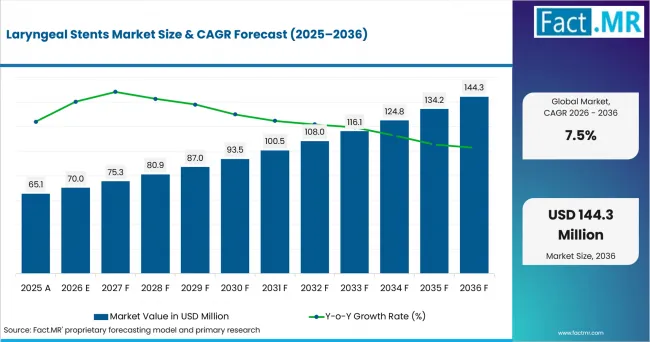
Laryngeal Stents Market Value Analysis | Source: Fact.MR
What are the defining numbers behind Laryngeal Stents Market growth?
An absolute opportunity of USD 74.3 million is expected between 2026 and 2036.
- Demand Drivers in the Market
- Laryngotracheal stenosis creates direct demand for devices that keep a narrowed or reconstructed airway open. NICE identifies stent insertion among the endoscopic options used for severe established subglottic or tracheal stenosis, while reconstructive surgery can use a graft or stent to enlarge and stabilize the affected segment.
- Pediatric airway reconstruction supports demand for smaller and more adaptable devices. A 2025 Frontiers in Pediatrics review notes that acquired pediatric subglottic stenosis is commonly associated with prolonged endotracheal intubation and that intralaryngeal stents may be used after selected double-stage reconstruction procedures to support healing and limit restenosis.
- Endoscopic placement gives specialists a route to position selected stents under direct visualization and to combine stenting with dilation or scar treatment when clinically appropriate. This links demand to specialist ENT programs and the wider endoscopy devices category.
- Patient-specific design addresses the fit problems created by irregular airway anatomy. Research on customized airway stents describes additive manufacturing as a route to better anatomical matching, increasing the relevance of 3D printing for complex airway reconstruction.
- Postoperative stabilization, laryngeal trauma and oncologic reconstruction remain established use cases. These procedures are concentrated in specialist centres that also procure broader ENT devices for laryngoscopy, airway surgery and follow-up care.
- Key Segments Analyzed
- Self-expandable Stents account for 36.8% of Product in 2026. Continuous radial support and endoscopic delivery make the format useful where clinicians need a device that can conform to a narrowed airway segment.
- Hospitals represent 44.1% of End Use in 2026, reflecting the need for anesthesia, bronchoscopy, airway-rescue capability and multidisciplinary postoperative care during complex stenting procedures.
- Child accounts for 55.2% of Application in 2026. Pediatric laryngotracheal reconstruction can require temporary stenting to support grafts and maintain the reconstructed airway during healing.
- Endoscopic Stent Placement Technology holds 55.6% of Technology in 2026 because direct laryngoscopic or bronchoscopic visualization supports placement, inspection and removal without a separate open exposure in selected cases.
- Analyst Opinion at Fact.MR
- Shambhu Nath Jha, Principal Consultant, Fact.MR
- “Laryngeal stent demand is concentrated in complex airway cases where fit, removability and postoperative control matter as much as initial airway support. Pediatric sizing, dependable endoscopic placement and designs that limit migration or tissue reaction are central to purchasing decisions at specialist ENT centres.”
- Strategic Implications
- Manufacturers should build size ranges around airway diameter and indication, with separate design attention for pediatric reconstruction and adult stenosis.
- Placement and removal guidance should be developed alongside the device because clinicians evaluate the complete procedural pathway rather than the implant alone.
- Material and geometry development should address migration resistance, mucosal tolerance and removability. Surface engineering and device coatings can also influence tissue interaction where a device remains in contact with the airway for an extended period.
- Commercial coverage should prioritize tertiary ENT and airway centres that can manage difficult stenosis and repeat bronchoscopy. Follow-up pathways increasingly sit alongside connected monitoring and other respiratory devices used in specialist respiratory care.
How does the Laryngeal Stents Market break down by segment?
The market is segmented by Product, End Use, Application and Technology.
Why do Self-expandable Stents lead Product?
Self-expandable Stents account for a 36.8% share of Product in 2026.
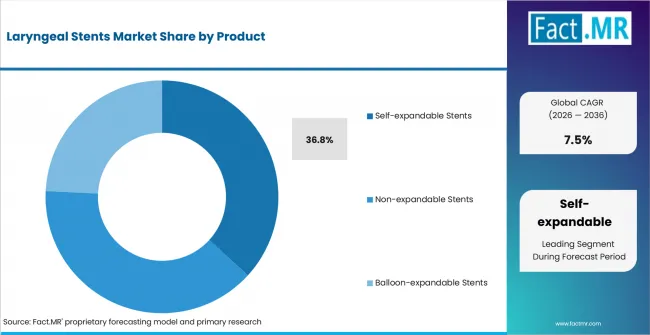
Laryngeal Stents Market Analysis By Product | Source: Fact.MR
Self-expanding designs can provide continuous radial support while adapting to changes in airway diameter. This operating characteristic is useful when clinicians need endoscopic delivery followed by controlled expansion within a stenotic segment.
Airway-stent literature emphasizes that expansion force must be considered together with removability, covering, migration risk and expected dwell time. Buyers therefore evaluate the complete stent behavior rather than diameter alone.
Why do Hospitals lead End Use?
Hospitals account for a 44.1% share of End Use in 2026.
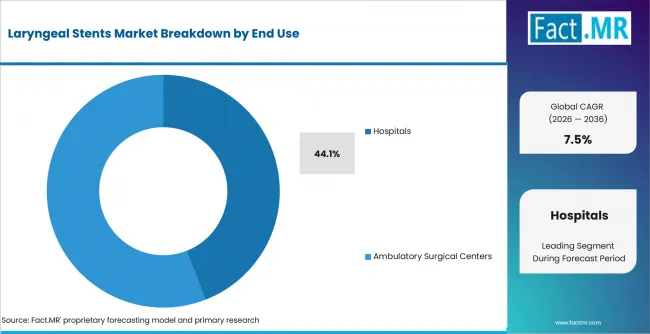
Laryngeal Stents Market Analysis By End Use | Source: Fact.MR
Laryngeal stenting can require rigid or flexible endoscopy, general anesthesia and immediate management of bleeding or obstruction. Complex patients may also need postoperative intensive care and repeat endoscopic assessment.
Pediatric laryngotracheal stenosis care often involves otolaryngology, pulmonology, anesthesiology and intensive-care teams. The concentration of these specialists and airway equipment makes hospitals the principal purchasing setting for stents used in reconstruction and severe stenosis.
Why does Child lead Application?
Child accounts for a 55.2% share of Application in 2026.
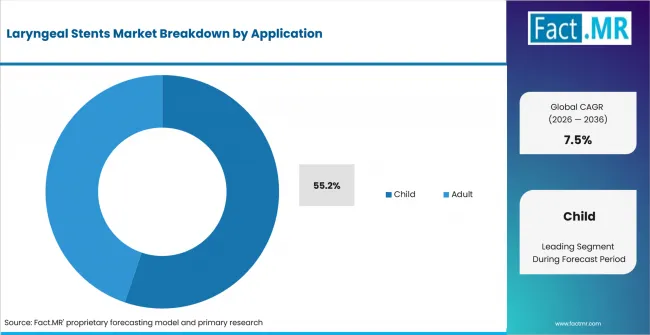
Laryngeal Stents Market Analysis By Application | Source: Fact.MR
Pediatric laryngotracheal stenosis can follow prolonged intubation and may require staged reconstruction. A temporary intralaryngeal stent can support a graft or reconstructed segment while healing occurs, particularly in selected double-stage procedures.
Device fit is especially important in smaller and more dynamic airways. The limited availability of purpose-sized pediatric stents increases the value of dedicated size ranges and patient-specific approaches at pediatric airway centres.
Why does Endoscopic Stent Placement Technology lead Technology?
Endoscopic Stent Placement Technology accounts for a 55.6% share of Technology in 2026.
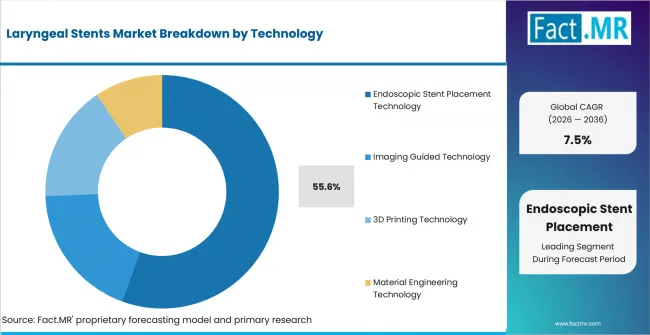
Laryngeal Stents Market Analysis By Technology | Source: Fact.MR
Direct visualization allows the physician to identify the stenotic segment, position the device and preserve access for later inspection or removal. The same session can incorporate dilation, scar treatment or other airway interventions when clinically appropriate.
NICE describes endoscopic treatment of subglottic or tracheal stenosis under direct laryngoscopic or bronchoscopic visualization. Airway-stent reviews similarly describe rigid and flexible bronchoscopy as established placement routes, supporting devices designed for endoscopic delivery and follow-up.
What is accelerating Laryngeal Stents Market adoption, and what is holding it back?
Reconstructive airway surgery, endoscopic management of stenosis and patient-specific design support adoption. Growth is constrained by migration, granulation tissue, mucus retention and the need for specialized placement, removal and surveillance.
Drivers Impact Analysis
| Factor | (~) % Impact on CAGR | Geographic Relevance | Impact Timeline |
|---|---|---|---|
| Use in reconstructive airway surgery | +1.6% | Global | Short term (<= 2 years) |
| Endoscopic management of airway stenosis | +1.4% | USA, Germany and UK | Short term (<= 2 years) |
| Pediatric airway reconstruction demand | +1.1% | Global | Medium term (2-4 years) |
| Patient-specific sizing and design | +0.9% | USA, UK and Japan | Medium term (2-4 years) |
| Specialist ENT and airway-centre capacity | +0.6% | Global | Long term (>= 4 years) |
Source: Fact.MR analysis. Updated Sep 3, 2026
Opportunity Impact Analysis
| Factor | (~) % Impact on CAGR | Geographic Relevance | Impact Timeline |
|---|---|---|---|
| 3D-printed patient-specific stents | +1.0% | Global | Medium term (2-4 years) |
| Removable and biocompatible stent designs | +0.8% | USA, UK and Germany | Medium term (2-4 years) |
| Pediatric size-range expansion | +0.7% | Global | Long term (>= 4 years) |
| Imaging-guided placement workflows | +0.5% | USA, Germany and Japan | Long term (>= 4 years) |
Source: Fact.MR analysis. Updated Sep 3, 2026
Restraints Impact Analysis
| Factor | (~) % Impact on CAGR | Geographic Relevance | Impact Timeline |
|---|---|---|---|
| Migration, granulation and mucus plugging | -1.1% | Global | Short term (<= 2 years) |
| Complex sizing, placement and removal | -0.9% | USA, UK and Germany | Short term (<= 2 years) |
| Substitution by dilation or open reconstruction | -0.7% | Developed hospital markets | Medium term (2-4 years) |
| Limited pediatric sizing and specialist availability | -0.5% | Global | Long term (>= 4 years) |
Source: Fact.MR analysis. Updated Sep 3, 2026
Which countries are scaling the Laryngeal Stents Market through 2036?
- Germany combines specialist head-and-neck oncology with reconstructive airway surgery. A continuing laryngeal cancer caseload supports procedures that can require airway stabilization or repeated management of laryngotracheal narrowing.
- Brazil has recurring oncology demand within public referral hospitals. Complex laryngeal cancer treatment can create cases requiring temporary airway support after reconstruction or during stenosis management.
- USA demand is supported by a broad tertiary-care network for benign and malignant airway disease, together with clinical research on customized stents for difficult anatomy.
- U.K. clinical guidance recognizes stent insertion among treatment options for severe established subglottic or tracheal stenosis, providing a defined route for selected cases.
- Japan combines a continuing laryngeal cancer treatment population with advanced endoscopic practice, supporting specialist procedures where stenting can be used for selected stenosis or reconstructive cases.
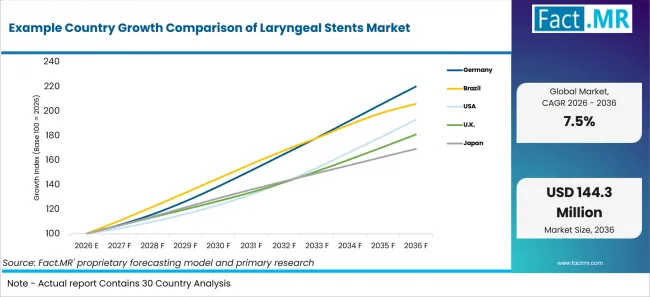
Example Country Growth Comparison Of Laryngeal Stents Market | Source: Fact.MR
| Country | CAGR, 2026-2036 |
|---|---|
| Germany | 8.2% |
| Brazil | 7.5% |
| USA | 6.8% |
| U.K. | 6.1% |
| Japan | 5.4% |
Source: Fact.MR analysis. Updated Sep 3, 2026
What is driving Germany's growth through 2036?
Germany is forecast to expand at an 8.2% CAGR from 2026 to 2036.
Germany combines specialist ENT capability with a measurable head-and-neck oncology caseload. The Robert Koch Institute recorded 3,067 new laryngeal cancer cases in 2022. Complex cancer surgery and post-treatment airway management can create requirements for reconstruction, temporary stenting or repeated endoscopic intervention.
Purchasing is concentrated in tertiary hospitals because stents must be selected around lesion level, airway diameter and expected dwell time. This favors suppliers that can support procedure planning, sizing and follow-up rather than relying on commodity distribution.
What is driving Brazil's growth through 2036?
Brazil is forecast to expand at a 7.5% CAGR from 2026 to 2036.
Brazil has a continuing laryngeal cancer treatment burden across public oncology services. INCA estimates 8,510 new laryngeal cancer cases for each year from 2026 to 2028. Complex cases can create demand for airway stabilization following tumor treatment, reconstruction or stenosis management.
Demand is concentrated in referral hospitals with ENT surgery, anesthesia and endoscopic capability. Devices offered in practical airway size ranges and supported by clear placement and removal guidance fit this centralized care model.
What is driving USA's growth through 2036?
The USA is forecast to expand at a 6.8% CAGR from 2026 to 2036.
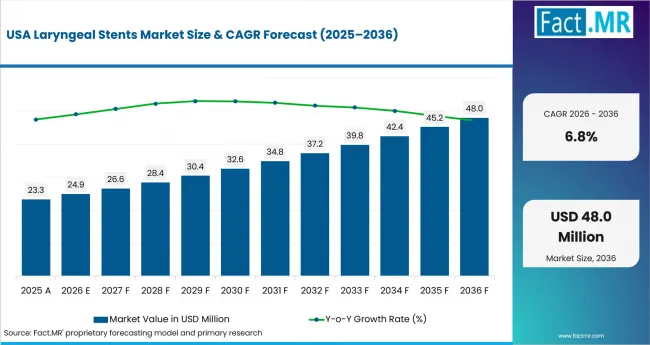
Laryngeal Stents Market Country Value Analysis | Source: Fact.MR
The National Cancer Institute estimates 12,290 new laryngeal cancer cases in 2026. Tertiary airway programs also manage benign post-intubation stenosis, trauma and recurrent narrowing after reconstruction, creating several clinical pathways in which temporary stenting may be considered.
U.S. clinical centres also contribute to patient-specific airway-stent development. Published work on 3D printing and customized stent design addresses complex anatomy and the complications that can follow poor device fit.
What is driving the U.K.'s growth through 2036?
The U.K. is forecast to expand at a 6.1% CAGR from 2026 to 2036.
NICE provides a defined role for endoscopic intervention in severe airway narrowing, identifying stent insertion, laser ablation and open reconstruction among treatment options according to anatomy and severity.
Cancer Research UK reports around 2,300 laryngeal cancer diagnoses each year. This contributes to the specialist ENT caseload in which surgeons may require postoperative airway support or treatment of scar-related narrowing.
What is driving Japan's growth through 2036?
Japan is forecast to expand at a 5.4% CAGR from 2026 to 2036.
Japan recorded 4,648 laryngeal cancer diagnoses in 2023 according to the National Cancer Center. The continuing treatment population supports specialist laryngeal surgery and postoperative airway management at referral centres.
Advanced endoscopic practice and precision-device capability are relevant where placement accuracy and airway fit determine whether a stent remains stable without excessive mucosal injury or repeat intervention
Who Leads the Laryngeal Stents Market?
Key players in the Laryngeal Stents Market include Boston Medical Products, Inc. and Zimmer Biomet through Biomet Microfixation/Walter Lorenz Surgical.
Competition is shaped by airway-specific sizing, material behavior, removability and procedural compatibility. Hospitals compare whether a device can maintain the reconstructed airway while limiting migration, mucosal trauma, granulation and the need for repeat intervention.
Boston Medical Products supplies the Montgomery Laryngeal Stent, Rutter Supra-Stomal Stent and related laryngeal keels in pediatric and adult sizes. U.S. device records identify these products as polymeric laryngeal stents in commercial distribution. Zimmer Biomet also maintains active laryngeal-stent registrations through Biomet Microfixation/Walter Lorenz Surgical, supporting a second established specialist product route.
Which companies are the key providers?
Key providers include Boston Medical Products, Inc. and Zimmer Biomet through Biomet Microfixation/Walter Lorenz Surgical.
- Boston Medical Products, Inc.
- Zimmer Biomet
- Biomet Microfixation/Walter Lorenz Surgical
Bibliography
- National Institute for Health and Care Excellence. (2022). Endoscopic balloon dilation for subglottic or tracheal stenosis. NICE.
- Frontiers in Pediatrics. (2025). Contemporary surgical strategies for pediatric laryngotracheal stenosis: a comprehensive review. Frontiers Media.
- Journal of Thoracic Disease. (2017). Stents for airway strictures: selection and results. AME Publishing Company.
- Annals of Translational Medicine. (2023). Patient-specific airway stent using three-dimensional printing: a review. AME Publishing Company.
- National Cancer Institute. (2026). Laryngeal Cancer - Cancer Stat Facts. U.S. National Institutes of Health.
- Robert Koch Institute. (2024). Laryngeal Cancer (ICD-10 C32). Centre for Cancer Registry Data, Germany.
- Instituto Nacional de Cancer. (2026). Estimativa de incidencia: neoplasia maligna da laringe. Ministry of Health, Brazil.
- Cancer Research UK. (2024). What is laryngeal cancer? Cancer Research UK.
- National Cancer Center Japan. (2026). Larynx: Cancer Statistics. Cancer Information Service.
- Boston Medical Products, Inc. (2026). Montgomery Laryngeal Stent. Boston Medical Products, Inc.
- Boston Medical Products, Inc. (2026). Rutter Supra-Stomal Stent. Boston Medical Products, Inc.
- U.S. Food and Drug Administration. (2026). Global Unique Device Identification Database: Polymeric Laryngeal Stents. FDA.
- Therapeutic Goods Administration. (2015). Zimmer Biomet Pty Ltd - Laryngeal stent. Australian Government.
This Report Answers
- Which laryngeal stent designs are used across self-expandable, non-expandable and balloon-expandable categories?
- Why are hospitals the principal purchasing environment for laryngeal stents?
- How do pediatric airway requirements influence product sizing and material selection?
- How are endoscopic, imaging-guided and 3D-printing technologies changing placement and design?
- Which clinical and device-related factors shape country demand through 2036?
What does the Laryngeal Stents Market cover?
The Laryngeal Stents Market covers implantable stents designed to maintain or stabilize the laryngeal and laryngotracheal airway. Revenue relates to the stent device and integrated delivery configuration when sold as part of the stenting system.
What is included in the scope?
The scope includes self-expandable, non-expandable and balloon-expandable laryngeal stents used in child and adult airway applications. Devices used in hospitals and ambulatory surgical centres for airway management, respiratory care and ENT procedures are included.
Technology coverage includes endoscopic placement, imaging-guided placement, 3D-printed patient-specific design and material-engineering approaches. Geographic analysis includes Germany, Brazil, USA, U.K. and Japan within the global regional framework.
What is excluded from the scope?
Coronary, peripheral vascular and other intravascular stents are excluded even when they use similar self-expanding or balloon-expandable engineering. Tracheal or bronchial stents used entirely outside the laryngeal or laryngotracheal treatment area are also outside the market unless they form part of a qualifying laryngeal application.
Routine tracheostomy tubes without a laryngeal stenting function, standalone balloon dilators, lasers, imaging systems and open surgical graft materials are excluded when sold separately. Procedure fees and hospital services are not counted as device revenue.
How Was the Analysis Built?
The analysis draws on more than 120 sources, over 35 company portfolios and more than 20 industry interviews across at least 25 countries.
- Primary Research: Interviews with ENT surgeons, pediatric airway specialists, interventional pulmonologists, hospital procurement teams, device engineers and specialist distributors examine stent selection, sizing, placement, removal and follow-up requirements.
- Desk Research: The review covers airway-stenosis guidance, laryngeal and head-and-neck cancer registries, peer-reviewed airway-stent studies, regulatory device records, company disclosures and procedural literature.
- Market Sizing and Forecasting: Estimates combine laryngotracheal procedure activity, stent utilization per case, average selling prices, pediatric and adult application mix, hospital and ambulatory demand, and country-level growth.
- Data Validation and Update Cycle: Findings are cross-checked against clinical evidence, device registrations, product availability and interview feedback. Updates account for changes in stent design, endoscopic practice, patient-specific manufacturing and reconstructive airway procedures.
Segmentation
What is the report's scope and coverage?
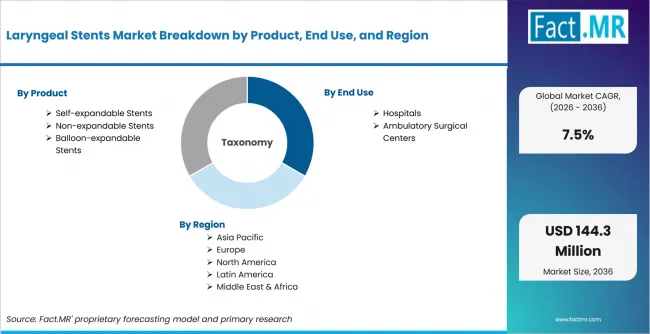
Laryngeal Stents Market Breakdown By Product, End Use, And Region | Source: Fact.MR
| Attribute | Details |
|---|---|
| Quantitative Units | USD million |
| Market Definition | Laryngeal and laryngotracheal stent devices sold to maintain airway patency or support stabilization after reconstruction, trauma or stenotic disease |
| Segments Covered | Product; End Use; Application; Technology |
| Regions Covered | North America; Latin America; Europe; East Asia; South Asia and Pacific; Middle East and Africa |
| Countries Covered | Germany; Brazil; USA; U.K.; Japan |
| Key Companies Profiled | Boston Medical Products, Inc.; Zimmer Biomet through Biomet Microfixation/Walter Lorenz Surgical |
| Forecast Period | 2026 to 2036 |
| Base Year | 2026 |
| Market Value, 2026 | USD 70.0 million |
| Market Value, 2036 | USD 144.3 million |
| CAGR, 2026-2036 | 7.5% |
| Absolute Opportunity | USD 74.3 million |
| Approach | Hybrid top-down and bottom-up approach using laryngotracheal procedure activity, stent utilization, product mix, end-use demand, pricing and country growth |
Source: Fact.MR analysis. Updated Sep 3, 2026
How is the market segmented?
-
By Product:
- Self-expandable Stents
- Metal Self-expandable Stents
- Silicone Self-expandable Stents
- Hybrid Self-expandable Stents
- Non-expandable Stents
- Rigid Non-expandable Stents
- Silicone Non-expandable Stents
- Polymeric Non-expandable Stents
- Balloon-expandable Stents
- High Pressure Expandable Stents
- Metal Balloon-expandable Stents
- Polymer Balloon-expandable Stents
- Self-expandable Stents
-
By End Use:
- Hospitals
- General Hospitals
- Specialty Hospitals
- Tertiary Care Centers
- Ambulatory Surgical Centers
- Day Care Surgical Centers
- Specialized Surgical Clinics
- Independent Surgical Centers
- Hospitals
-
By Application:
- Child
- Pediatric Airway Management
- Pediatric Respiratory Care
- Pediatric ENT Applications
- Adult
- Adult Airway Management
- Adult Respiratory Care
- Adult ENT Applications
- Child
-
By Technology:
- Endoscopic Stent Placement Technology
- Rigid Endoscopic Systems
- Flexible Endoscopic Systems
- Imaging Guided Technology
- Fluoroscopy Guided Placement
- CT Guided Systems
- 3D Printing Technology
- Patient Specific Stent Design
- Rapid Prototyping Systems
- Material Engineering Technology
- Biocompatible Polymer Engineering
- Shape Memory Alloys
- Endoscopic Stent Placement Technology
-
By Region:
- North America
- Latin America
- Western Europe
- Eastern Europe
- East Asia
- South Asia and Pacific
- Middle East & Africa
Frequently Asked Questions
What is the Laryngeal Stents Market value in 2026?
At what CAGR is the market projected to grow?
What is the projected market value by 2036?
Which Product leads the market?
Which End Use leads the market?
Which Application leads the market?
Which Technology leads the market?
What CAGR is forecast for Germany?
Which companies are active in the Laryngeal Stents Market?
What is the primary driver in this market?
What is the main restraint?
Who worked on this report


Preview the report firsthand - request a free sample
Free SampleGet the brochure for pricing and purchase details
Download PDF