- Market Value (2025): USD 417.8 Bn
- Estimated Value (2026): USD 445.0 Bn
- Forecast Value (2036): USD 1,150 Bn
- CAGR (2026-2036): 10.0%
What is the Light-Blocking PET Sleeves Market forecast to be worth by 2036?
USD 3.1 billion in 2026 to USD 6.1 billion by 2036 at a 7.1% CAGR.
- The Light-Blocking PET Sleeves Market was valued at USD 2.9 billion in 2025.
- Demand is projected to increase from USD 3.1 billion in 2026 to USD 6.1 billion by 2036.
- The market is forecast to record 7.1% CAGR from 2026 to 2036 as brand owners balance product protection with bottle recovery checks.
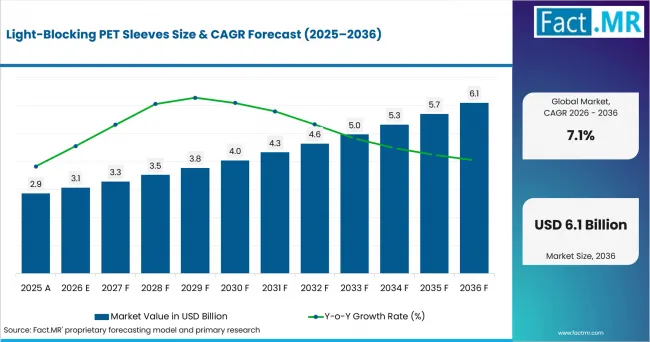
Light Blocking Pet Sleeves Value Analysis | Source: Fact.MR
What are the defining numbers behind Light-Blocking PET Sleeves Market growth?
An absolute opportunity of USD 3.0 billion is expected between 2026 and 2036.
- Demand Drivers in the Market
- Beverage brands need full-body opacity when clear PET bottles carry juices, dairy drinks and fortified beverages exposed to shelf light.
- USDA Economic Research Service reported on June 11, 2026 that inflation-adjusted U.S. food spending reached USD 2.51 trillion in 2025, expressed in 2025 dollars.
- Brand teams in China and East Asia use full-height sleeves where shelf graphics and light shielding need to work on the same bottle surface.
- European packaging rules are set to increase the emphasis on recyclability and effective waste sorting. The European Commission stated in August 2026 that all packaging must be recyclable by 2030, while harmonized packaging labels will apply from 2028 to facilitate waste sorting.
- Dairy processors use sleeve opacity when PET bottle shapes need to stay compatible with filling lines and chilled display cases.
- Key Segments Analyzed
- By Sleeve Material: Crystallizable PET is expected to hold 34.0% share in 2026 because it aligns better with PET bottle recovery than conventional PETG sleeves.
- By Optical Function: Full block-out is projected to account for 37.0% share in 2026 as opaque sleeves protect dairy drinks, juices and fortified beverages.
- By Container: Beverage PET is anticipated to capture 33.0% share in 2026 since bottles remain the main format for light-sensitive drinks and shelf graphics.
- By Printing: Gravure is estimated to represent 36.0% share in 2026 owing to dense opacity and repeatable print quality in high-volume sleeves.
- Analyst Opinion at Fact.MR
- Shambhu Nath Jha, Principal Consultant at Fact.MR, states, “Decoration alone is no longer enough. Brands want sleeves that block light while still passing PET recovery checks. Demand is expected to concentrate around films, inks and perforation designs that protect products and keep bottles easier to recover.”
- Strategic Implications
- Film suppliers should document shrink behavior and PET stream compatibility so brand trials move faster across beverage and dairy bottles.
- Label converters should align ink, seam and perforation choices with bottle recovery rules before commercial sleeve approval.
- California beverage manufacturers subject to the state’s plastic minimum-content requirements should map recycled-content exposure early. CalRecycle states that penalties for beverage manufacturers failing to meet California’s minimum recycled plastic content requirements are calculated at USD 0.20 per pound based on the recycled-content shortfall.
- European packaging teams should test sleeve separation and print bleed before PPWR recyclability grades become a design gate.
China is projected to post 7.6% CAGR through 2036 due to packaged beverage throughput and local film-converting scale. The USA is expected to record 7.1% CAGR as beverage packaging and PCR rules guide sleeve choices. Japan is forecast to reach 7.1% CAGR through PET bottle collection systems and sleeve recycling work. Germany is anticipated to advance at 6.9% CAGR because recyclability reviews shape full-body sleeve approvals. France is estimated to post 6.4% CAGR as dairy packaging and plastic bottle collection policy influence adoption.
How does the Light-Blocking PET Sleeves Market break down by segment?
Crystallizable PET leads Sleeve Material at 34.0%; Full block-out leads Optical Function at 37.0%.
Which Sleeve Material dominates?
Crystallizable PET is expected to hold 34.0% share in 2026.
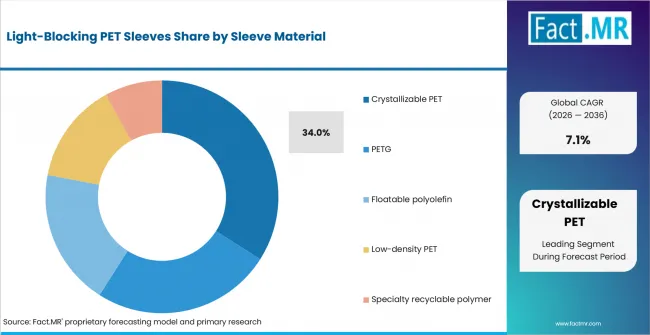
Light Blocking Pet Sleeves Analysis By Sleeve Material | Source: Fact.MR
Crystallizable PET leads because it keeps the sleeve closer to the bottle polymer family. Reclaimers assess whether printed sleeves wash, separate or process with PET flake. That assessment links sleeve selection with bottle-to-bottle quality requirements.
Bonset America describes Bonpet Renew as a clear crystallizable PETG heat-shrink film designed for shrink labels to be reclaimed with PET bottle flake in the PET mechanical recycling process. The product illustrates the importance of material compatibility when selecting shrink-sleeve films for PET recycling applications.
What leads the Optical Function segment?
Full block-out is projected to account for 37.0% share in 2026.
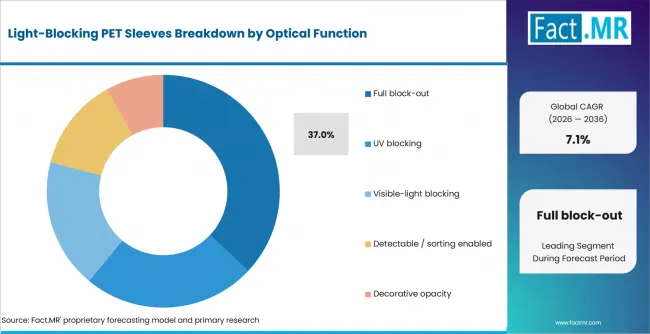
Light Blocking Pet Sleeves Analysis By Optical Function | Source: Fact.MR
Full block-out demand comes from products where light affects color, flavor or nutrient quality. Beverage and dairy brands need shelf graphics and protection in one label layer.
Klöckner Pentaplast states that Pentalabel® eklipse® has a light transmission rate of less than 1% and is designed to protect light-sensitive ingredients in dairy, juice, fortified beverages and isotonic products. Its light-blocking performance provides a measurable packaging characteristic and can reduce the need for multi-layer or opaque primary containers.
How does Container demand develop?
Beverage PET is anticipated to capture 33.0% share in 2026.
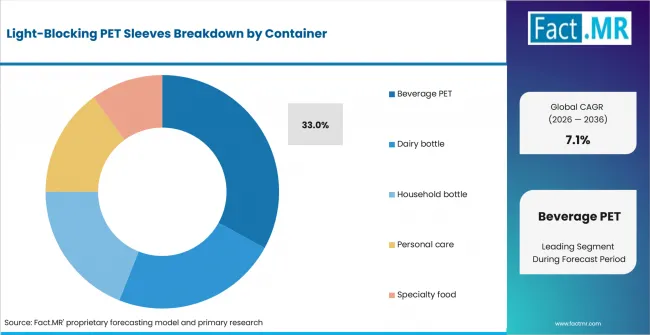
Light Blocking Pet Sleeves Analysis By Container | Source: Fact.MR
Beverage PET leads because drink brands want bottle clarity, low weight and filling-line speed. A sleeve lets brands add light protection at the decoration stage.
Domestic converting scale helps sleeve buyers obtain films, labels and printed decoration without changing bottle platforms. Beverage PET also benefits when brand owners need light protection without changing filling infrastructure.
What supports Gravure within Printing?
Gravure is estimated to represent 36.0% share in 2026.
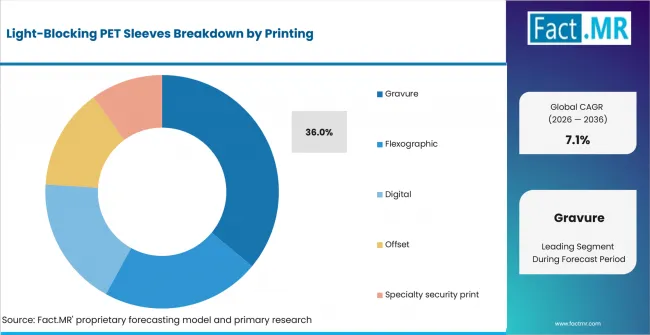
Light Blocking Pet Sleeves Analysis By Printing | Source: Fact.MR
Gravure is favored in large sleeve runs because it delivers dense opacity and repeatable graphics. It suits bottles where color coverage must stay consistent after shrinking.
Klöckner Pentaplast lists roll sleeve films as suitable for gravure, flexographic and rotary offset printing. The printing base also overlaps with PETG printing grade label film where sleeve print quality and shrink behavior are buying criteria.
What is accelerating Light-Blocking PET Sleeves Market adoption, and what is holding it back?
Demand is expected to rise through light protection, PET bottle conversion and recyclability design; adoption is constrained by sorting compatibility, sleeve removal and print cost.
Driver Impact Analysis
| DRIVER | (~) % IMPACT ON CAGR | GEOGRAPHIC RELEVANCE | IMPACT TIMELINE |
|---|---|---|---|
| Shift from opaque containers to sleeved PET bottles | +1.5% | North America, Europe, East Asia | Medium term (2-4 years) |
| Brand need for full-body light protection and graphics | +1.2% | Global | Short term (<= 2 years) |
| Recyclable sleeve and ink system development | +0.9% | North America, Europe, Japan | Medium term (2-4 years) |
| High-volume gravure and flexographic sleeve converting | +0.7% | China, USA, Germany | Long term (>= 4 years) |
Opportunity Impact Analysis
| OPPORTUNITY | (~) % IMPACT ON CAGR | GEOGRAPHIC RELEVANCE | IMPACT TIMELINE |
|---|---|---|---|
| Detectable and sorting-enabled sleeve systems | +1.1% | Europe, Japan, North America | Medium term (2-4 years) |
| Light-barrier sleeves for dairy and functional beverages | +0.9% | USA, France, Japan | Short term (<= 2 years) |
| Crystallizable PET sleeve films for bottle recovery | +0.8% | Global | Long term (>= 4 years) |
Restraint Impact Analysis
| RESTRAINT | (~) % IMPACT ON CAGR | GEOGRAPHIC RELEVANCE | IMPACT TIMELINE |
|---|---|---|---|
| Sorting disruption from full-body sleeves | -0.6% | Europe, Japan, North America | Short term (<= 2 years) |
| Higher cost of dense opacity and specialty films | -0.5% | Global | Medium term (2-4 years) |
| Qualification time across filling and shrink tunnels | -0.4% | Global | Medium term (2-4 years) |
Which countries are scaling the Light-Blocking PET Sleeves Market through 2036?
- The country comparison spans 1.2 percentage points and forms three practical growth bands across the forecast period.
- China remains 0.5 percentage point above the USA through packaged retail scale and local sleeve converting capacity.
- The USA and Japan remain tied at 7.1% CAGR, but each market follows a different adoption route.
- Germany remains 0.2 percentage point below the USA because recyclability checks weigh heavily on full-body sleeve formats.
- France closes the displayed range as bottle collection policy and dairy packaging needs shape sleeve approval cycles.
- Comparable CAGRs create different entry conditions due to PET recovery rules, dairy bottle habits and brand qualification cycles.
Full report coverage includes North America, Latin America, Western Europe, Eastern Europe, East Asia, South Asia & Pacific, Middle East & Africa. The displayed country set focuses on markets where bottle recovery rules, packaged beverage volume and local converter capability shape sleeve demand.
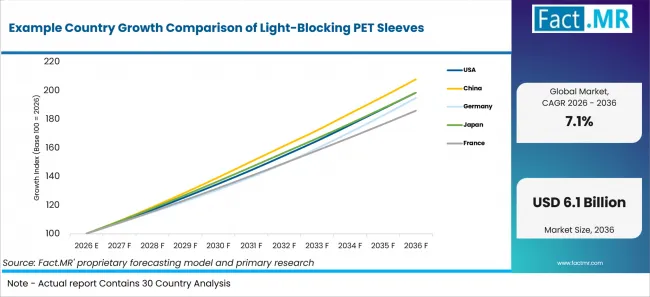
Example Country Growth Comparison Of Light Blocking Pet Sleeves | Source: Fact.MR
| Country | CAGR (2026-2036) |
|---|---|
| China | 7.6% |
| USA | 7.1% |
| Japan | 7.1% |
| Germany | 6.9% |
| France | 6.4% |
What supports China adoption?
7.6% CAGR, supported by packaged retail scale and PET-compatible sleeve conversion.
China’s beverage and household product brands use full-body sleeves when clear containers need shelf impact and product protection. The National Bureau of Statistics of China reported in February 2026 that retail sales of beverages by enterprises above the designated size increased 1.0% in 2025. Local gravure and flexographic converters help brands test opacity, shrink fit and bottle recovery requirements within shorter launch cycles.
What supports USA adoption?
7.1% CAGR, driven by beverage packaging scale and recycled-content pressure.
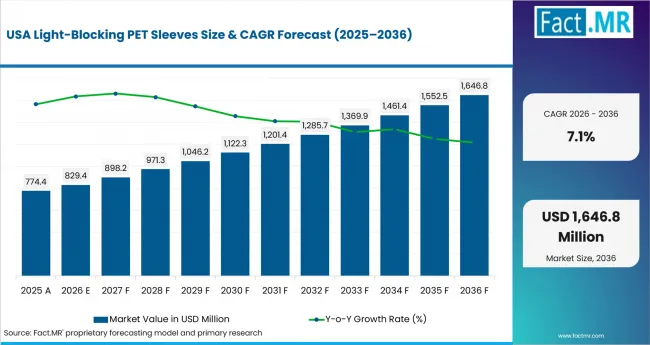
Light Blocking Pet Sleeves Country Value Analysis | Source: Fact.MR
U.S. demand is shaped by high packaged food and drink spending, together with state rules that make bottle recovery documentation more visible. The U.S. Census Bureau reported on March 18, 2026 that seasonally adjusted manufacturers’ shipments of beverages totaled USD 12.075 billion in January 2026. Beverage and nutraceutical brands use block-out sleeves when PET bottles need light protection and full-height graphics.
How is Japan scaling demand?
7.1% CAGR, supported by PET bottle collection systems and sleeve recycling work.
Japan has a mature PET bottle recovery base that makes sleeve compatibility part of packaging approval. The Ministry of the Environment reported in March 2026 that municipalities separately collected 360,498 tonnes of PET bottles in FY2024. Fuji Seal’s recycling initiatives illustrate the importance of sleeve design in PET recovery: RecShrink uses washable ink and a highly recyclable film designed to be recycled with PET bottles, while its wider shrink-sleeve portfolio incorporates perforation to support label separation. The company is also developing Label-to-Label recycling to turn recovered shrink sleeves into new labels.
What is supporting Germany’s adoption?
6.9% CAGR, backed by recyclability rules and premium packaged food applications.
Germany’s demand is shaped by recyclability review before full-body sleeves move onto deposit-sensitive bottle lines. UBA and ZSVR reported in January 2026 that around 5.5 million tonnes of packaging waste collected by the dual systems were recycled in 2024. Ready meals, dairy drinks and specialty beverages create use cases where low-transmission sleeves must satisfy both shelf and recovery needs.
How does France perform?
6.4% CAGR, led by dairy packaging demand and recycling-target pressure.
France combines a large food manufacturing base with policy pressure around plastic beverage bottle collection. INSEE reported in July 2026 that the production value of food, beverage and tobacco manufacturing in France reached EUR 207 billion in 2025, based on provisional data. Dairy, juice and personal care brands use light-shielding sleeves where opacity improves shelf display and helps clear PET containers carry sensitive contents.
Who leads the Light-Blocking PET Sleeves Market?
CCL Industries participates through CCL Label and Innovia Films, while the acquired application-equipment business retains the Sleever name. The acquired operations cover shrink sleeve labels, extruded films and application equipment for consumer packaged goods and healthcare customers.
Fuji Seal International remains relevant through shrink sleeve labels for beverage, food, home and personal care products. Its circular-economy work addresses PET bottle recycling through washable ink, high-recycle-applicability film and perforation design.
Klöckner Pentaplast supplies Pentalabel eklipse shrink sleeve film for light-sensitive applications, combining light-blocking performance with printability. Bonset America offers PETG and crystallizable PETG heat-shrink films for shrink labels, including a crystallizable grade designed to be reclaimed with PET bottle flake.
Which companies are the key providers?
Key companies include CCL Industries Inc. (including the acquired Sleever operations); Fuji Seal International, Inc.; Klöckner Pentaplast Group; Bonset America Corporation.
- CCL Industries Inc.
- Fuji Seal International, Inc.
- Klöckner Pentaplast Group
- Bonset America Corporation
Bibliography
- Touati-Houari, N. (2026, June 12). Lait. Avril 2026 : la collecte de lait toujours en hausse sur un an (Conjoncture – Infos Rapides No. 2026-73). Agreste.
- CCL Industries Inc. (2026, June 1). CCL Industries closing of Sleever International acquisition.
- Directorate-General for Communication. (2026, August 12). New packaging rules for less waste and easier recycling. European Commission.
- Institut national de la statistique et des études économiques. (2026, July 21). Indicateurs macroéconomiques de l’industrie manufacturière : Données annuelles de 2010 à 2025.
- National Bureau of Statistics of China. (2026, February 28). Statistical communiqué of the People's Republic of China on the 2025 national economic and social development.
- German Environment Agency, & Central Agency Packaging Register. (2026, January 27). Facts against myths: Packaging waste recycling in Germany is working.
- U.S. Census Bureau. (2026, March 18). Monthly full report on manufacturers’ shipments, inventories and orders: January 2026 (Release No. CB 26-38 M3-2 (26)-01).
- Zeballos, E., & Sinclair, W. (2026, June 11). Total U.S. food spending reached $2.51 trillion in 2025. U.S. Department of Agriculture, Economic Research Service.
This Report Answers
- The report explains where light-blocking PET sleeves are used across sleeve material, optical function, container and printing method.
- Segment analysis identifies the leading subsegments and the operational reasons brand owners prioritize them.
- Country analysis examines the listed markets and the recycling, dairy and beverage mechanisms supporting sleeve deployment.
- Competitive analysis reviews current providers across shrink sleeve films, label converting, application equipment and recovery-compatible design.
- Application analysis assesses how light protection, shrink fit, print coverage and PET recovery influence purchase decisions.
What does the Light-Blocking PET Sleeves Market cover?
The Light-Blocking PET Sleeves Market covers heat-shrink and roll sleeve films that reduce light exposure on plastic bottles and containers. It includes formats where brands need opacity, product information and full-height display on bottled water packaging, dairy drinks and specialty beverages.
The assessment covers full block-out, UV blocking and visible-light blocking sleeves across beverage PET, dairy bottles and personal care containers. It considers films, seams, washable inks and wash-off bottle adhesives used to protect recovery quality.
What is included in the scope?
The scope includes crystallizable PET, PETG, floatable polyolefin and specialty recyclable polymer sleeves for light-sensitive products. It includes dairy drinks, functional beverages, bottled water and specialty food containers.
It includes gravure, flexographic, digital, offset and security-print programs where light blocking is part of the package function. Sleeve systems with detectable or sorting-enabled features are included when they support PET bottle recovery.
What is excluded from the scope?
The scope excludes clear decorative sleeves outside light-blocking, UV-blocking or sorting-enabled functions. It excludes tamper evident labels sold only as safety bands.
Pressure-sensitive labels, paper wrap labels, in-mold labels and plain tamper bands are outside scope unless used as part of a light-blocking PET sleeve. General rigid plastic packaging sold without sleeve films is outside scope.
How Was the Analysis Built?
The analysis draws on 120+ references, 35+ company portfolios, 25+ countries and more than 20 interviews.
- Primary Research: Primary research includes discussions with manufacturers, technology developers, distributors, brand owners and subject-matter experts. These conversations examine purchasing priorities, product adoption, operational barriers, approval requirements, competitive positioning and the factors that influence wider market acceptance.
- Desk Research: Desk research covers government statistics, regulatory publications, company filings, trade data, technical studies, industry associations, standards and public policy. Evidence used in the analysis is documented in the bibliography.
- Market Sizing and Forecasting: Market estimates combine historical performance, demand indicators, pricing and volume trends, segment shares, company participation, country growth, adoption patterns, investment activity and barriers to market expansion.
- Data Validation and Update Cycle: Findings are checked against public data, company activity, regulatory changes, trade patterns and industry developments. Regular updates review new product launches, capacity changes, approvals and shifts in commercial adoption.
What is the report’s scope and coverage?
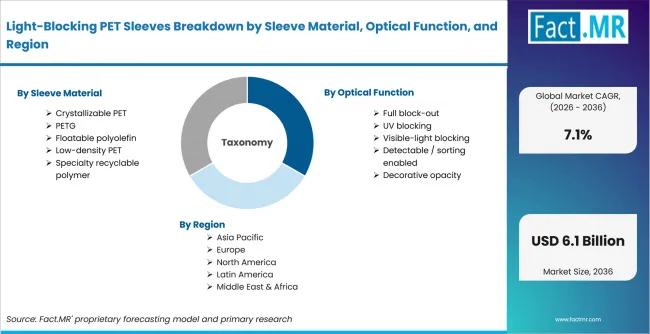
Light Blocking Pet Sleeves Breakdown By Sleeve Material, Optical Function, And Region | Source: Fact.MR
| Attribute | Details |
|---|---|
| Quantitative Units | USD billion |
| Market Definition | Light-blocking PET sleeves are heat-shrink or roll sleeve label films used on PET and related containers to reduce visible light or UV exposure while carrying printed graphics, product information and sorting features. |
| Sleeve Material | Crystallizable PET; PETG; Floatable polyolefin; Low-density PET; Specialty recyclable polymer |
| Optical Function | Full block-out; UV blocking; Visible-light blocking; Detectable or sorting enabled; Decorative opacity |
| Container | Beverage PET; Dairy bottle; Household bottle; Personal care; Specialty food |
| Printing | Gravure; Flexographic; Digital; Offset; Specialty security print |
| Regions Covered | North America; Latin America; Western Europe; Eastern Europe; East Asia; South Asia & Pacific; Middle East & Africa |
| Countries Covered | China; USA; Japan; Germany; France |
| Key Companies Profiled | CCL Industries Inc. (including the acquired Sleever operations); Fuji Seal International, Inc.; Klöckner Pentaplast Group; Bonset America Corporation |
| Forecast Period | 2026 to 2036 |
| Approach | Hybrid top-down and bottom-up approach using packaged beverage indicators; sleeve material portfolios; PET bottle recovery rules; converter capability; segment shares; country growth; and provider portfolio review. |
How is the market segmented?
-
By Sleeve Material
- Crystallizable PET
- PETG
- Floatable polyolefin
- Low-density PET
- Specialty recyclable polymer
-
By Optical Function
- Full block-out
- UV blocking
- Visible-light blocking
- Detectable or sorting enabled
- Decorative opacity
-
By Container
- Beverage PET
- Dairy bottle
- Household bottle
- Personal care
- Specialty food
-
By Printing
- Gravure
- Flexographic
- Digital
- Offset
- Specialty security print
-
By Region
- North America
- Latin America
- Western Europe
- Eastern Europe
- East Asia
- South Asia & Pacific
- Middle East & Africa