- Base Value(2025): 353.4 Mn
- Forecast Value (2035): 1178.6 Mn
- CAGR (2035): 12.8%
Pet GPS Tracker Market Size and Share Forecast Outlook 2025 to 2035
The global pet GPS tracker market is forecast to reach USD 1,178.6 million by 2035, up from USD 353.4 million in 2025. During the forecast period, the industry is projected to register at a CAGR of 12.8%. Demand for pet GPS trackers is seeing steady recovery in the short term, with a positive growth outlook for the long term.
The introduction of compact chips and improvements in the global telecommunications network will drive demand for pet GPS tracking devices during the forecast period. Technological improvements and the ability to track pet locations worldwide are boosting the need for pet GPS trackers.
Quick Stats on Pet GPS Tracker Market
- Pet GPS Tracker Market Size (2025): USD 353.4 million.
- Projected Pet GPS Tracker Market Size (2035): USD 1,178.6 million
- Forecast CAGR of Pet GPS Tracker Market (2025 to 2035): 12.8%
- Leading Technology Segment of Pet GPS Tracker Market: Cellular Pet GPS Tracker
- Leading Offering Segment of Pet GPS Tracker Market: Hardware Device
- Key Growth Regions of Pet GPS Tracker Market: United States, China, Japan
- Prominent Players in the Pet GPS Tracker Market: Whistle GO, Jiobits, Fi, Tractive, Pawscout, Wagtag, Shenzhen Motto Electronics Co. Ltd., Others
2025-to-2035.webp "Us Pet Gps Tracker Market Value(usd Million)2025 To 2035")
Us Pet Gps Tracker Market Value(usd Million)2025 To 2035 | Source: Fact.MR
| Metric | Value |
|---|---|
| Industry Size (2025E) | USD 353.4 million |
| Industry Size (2035F) | USD 1,178.6 million |
| CAGR (2025-2035) | 12.8% |
Source: Fact.MR analysis. Updated Aug 20, 2025
The pet GPS tracker market is expected to expand from USD 353.4 million in 2025 to USD 1,178.6 million by 2035, registering a CAGR of 12.8%. This translates to a strong year-on-year growth trajectory, with annual revenues compounding steadily and crossing USD 500 million by 2029 and USD 900 million by 2033 before approaching the forecasted value in 2035.
From 2025 to 2029, growth will be driven primarily by consumer-side factors. Rising pet adoption, coupled with heightened awareness about pet safety, is creating consistent uptake of GPS-enabled collars and wearables. Owners are increasingly treating pets as family members, which supports higher spending on tracking technologies.
Growing integration of these devices with smartphones and mobile apps also boosts adoption, as users seek seamless real-time monitoring. Retailers and online platforms are expanding their distribution footprint, making trackers more accessible at both premium and affordable price tiers.
From 2030 to 2035, supply-side enablers are expected to accelerate momentum. Advancements in battery efficiency, miniaturization of chips, and enhanced connectivity through 5G and IoT ecosystems will make devices more reliable and accurate. Manufacturers are likely to leverage AI-driven geofencing, predictive alerts, and health monitoring features, positioning trackers as multifunctional devices.
Partnerships between telecom providers, veterinary clinics, and pet insurance firms will expand bundled offerings. Pricing pressure from new entrants will make trackers more affordable, thereby expanding adoption in emerging markets.
Key Pet GPS Tracker Market Dynamics
The pet GPS tracker industry is evolving into a vital segment of the pet care ecosystem, supported by both consumer-driven adoption and supply-side innovations. While rapid growth is projected, the balance between drivers and challenges will determine how widely these solutions penetrate different regions and demographics. Examining both dimensions highlights how demand-side enthusiasm intersects with technological, regulatory, and economic constraints.
Rising Pet Adoption and Humanization of Pets
The global surge in pet ownership is creating a strong base of demand for tracking devices. Owners now view pets as family members, which encourages spending on advanced care products. GPS trackers have become essential tools to provide peace of mind and minimize risks of pet loss. This emotional connection is strengthening adoption rates across urban households.
In developed economies, pet parents actively seek premium solutions that combine GPS with wellness monitoring. In emerging economies, increasing adoption of companion animals is creating new opportunities for cost-effective trackers. This broadening base highlights the role of cultural and psychological shifts in driving industry expansion.
Technological Advancements in IoT and Connectivity
Integration of cellular, Wi-Fi, and Bluetooth technologies has enhanced product reliability and broadened usability. Lightweight, durable designs powered by improved chipsets are ensuring trackers remain efficient across indoor and outdoor environments. These improvements are helping overcome the early skepticism about device accuracy.
Smartphone integration has been equally influential. Real-time notifications, location history, and geofencing capabilities have turned trackers into lifestyle products. This convergence of IoT and app-based ecosystems ensures deeper user engagement and long-term subscription-driven revenue streams.
Growing Focus on Pet Safety and Health Monitoring
Beyond location tracking, GPS devices now offer advanced health features, such as step counting, sleep monitoring, and calorie tracking. Owners are increasingly using trackers to ensure pets maintain active and healthy lifestyles. This diversification of features is transforming trackers into holistic wellness tools.
Geofencing technology is another significant enabler. Pet parents gain reassurance by receiving alerts when pets leave designated safe zones. These functions, coupled with increasing consumer education around preventive pet health, make GPS trackers indispensable in modern pet care.
High Cost and Subscription Barriers May Limit Purchase of GPS Trackers
Pricing remains a major constraint in both developed and developing markets. Beyond the upfront cost of devices, recurring subscription fees for cellular services deter cost-conscious consumers. This challenge has slowed mass-market adoption despite rising interest in pet technology.
Manufacturers are attempting to mitigate this through freemium models or bundled services with insurance and veterinary care. However, for price-sensitive demographics, affordability remains a decisive factor in adoption, particularly in Asia-Pacific and rural economies.
Battery Limitations and Durability Issues
One of the most cited pain points is limited battery life. Active pets require trackers that can sustain long outdoor sessions without frequent recharging. Weaknesses in this area reduce user satisfaction and trust in the technology.
Durability also plays a key role. Trackers exposed to water, chewing, or rough environments often face performance issues. Improving ruggedness without compromising compactness continues to be a central challenge for manufacturers seeking long-term adoption.
Connectivity and Privacy Concerns
While urban areas enjoy reliable GPS coverage, rural and remote regions face connectivity gaps. Interrupted signals lead to delayed tracking, reducing the device’s value. This is a major hurdle for users living outside dense networks or in developing countries.
Data privacy concerns are equally pressing. Owners remain cautious about security breaches and unauthorized access to location data. Without stronger assurances of cybersecurity and compliance, adoption may remain limited among tech-conscious consumers.
Regional Trends of the Pet GPS Tracker Market
North America leads global adoption, supported by high pet ownership, tech affinity, and integration of GPS devices into wellness programs. Insurance providers and veterinarians actively promote adoption, while e-commerce platforms boost accessibility.
Europe is expanding rapidly, with strong welfare legislation and consumer demand for traceability driving adoption in Germany, France, and the UK. Eco-conscious consumers also show interest in trackers made with sustainable materials and enhanced accuracy.
Asia-Pacific is the fastest-growing region, with China, Japan, South Korea, and India witnessing rising middle-class ownership of pets. E-commerce platforms and local manufacturers offering affordable devices are accelerating penetration across both urban and semi-urban markets.
Country-Wise Outlook
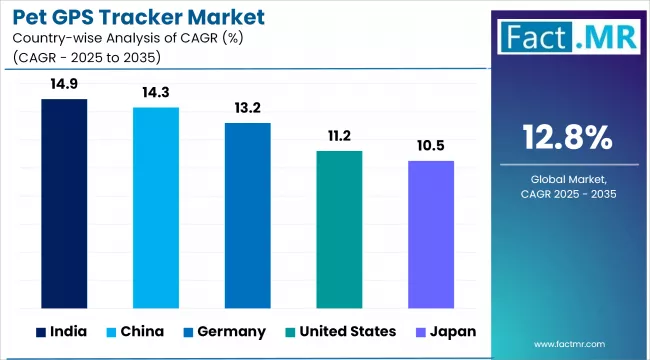
Pet Gps Tracker Market By Country | Source: Fact.MR
| Countries | CAGR (2025-2035) |
|---|---|
| United States | 11.2% |
| China | 14.3% |
| Japan | 10.5% |
Source: Fact.MR analysis. Updated Aug 20, 2025
United States Pet GPS Tracker Market Rides the Wave of Tech Affinity, Pet Wellness, and Suburban Expansion
2025-to-2035.webp "Us Pet Gps Tracker Market Country Value(usd Million)2025 To 2035")
Us Pet Gps Tracker Market Country Value(usd Million)2025 To 2035 | Source: Fact.MR
The U.S. pet GPS tracker market is growing due to a cultural shift toward treating pets like family. More households now see pets as children, which increases the demand for devices that improve health, safety, and lifestyle. GPS wearables are now essential for modern pet care.
Americans quickly adopt pet technology. Linking GPS devices with mobile apps, fitness tracking, and geofencing meets their demand for smart home tools. This smooth technology integration helps the market develop in both urban and suburban areas.
Suburban growth and increased pet mobility also play a role. With bigger yards and more off-leash spaces, there is a higher need for real-time pet tracking. Devices that offer longer range and support multiple pets are becoming more popular among households with several animals.
Retailers like Chewy, Amazon, and PetSmart are making products easier to buy. Meanwhile, veterinarians and insurance companies promote proactive tracking. There's potential to bundle GPS devices with extra services, such as lost pet recovery programs or wellness plan.
- Strong cultural trend of treating pets as family boosts GPS tracker adoption
- Integration with apps, geofencing, and fitness tracking supports suburban and urban growth
- Suburban expansion and veterinary/insurance bundling expand long-term adoption potential
China Pet GPS Tracker Market Accelerates on the Back of Industrialization, Export Growth, and Policy-Backed Expansion
China is experiencing rapid growth in the pet GPS tracker market. This surge is driven by fast urbanization and increasing disposable incomes. As more people live in apartments, pet owners in China are looking for smarter ways to track their pets' activities both indoors and outdoors.
Innovation in technology is a key factor in this growth. Local brands are providing affordable GPS options that feature AI tracking, voice command capabilities, and apps in Mandarin. These brands benefit from being compatible with popular Chinese mobile platforms.
Government programs that support local pet tech manufacturing are also boosting the market. Policies that are friendly to exports allow Chinese brands to expand internationally while improving their products for local customers.
Great potential exists in tier-2 and tier-3 cities, where pet adoption rates are rising but awareness of smart pet technology is still developing. Education, influencer marketing, and partnerships with pet communities can create significant demand in these unexplored areas.
- Rapid urban growth and rising incomes drive high adoption in apartments and cities
- Local brands offer affordable AI-enabled and app-compatible trackers, boosting demand
- Government support for local manufacturing and export-friendly policies fuel expansion
Japan Pet GPS Tracker Market Evolves with Aging Society, Miniature Breeds, and High-Tech Expectations
Japan's market is unique, influenced by cultural precision, high technology standards, and a quickly aging population. Small pets are common in homes, and there is strong demand for GPS trackers made for miniature breeds. The aging population is resulting in more single-person households with pets, which increases the emotional bond and the need for safety. GPS trackers are not just for location; they also provide peace of mind, especially for older pet owners.
Japan's passion for advanced, compact gadgets boosts interest in discreet and lightweight GPS wearables. Consumers want more than just basic tracking; they also expect features like temperature alerts, step counting, and behavior analysis. Retailers are working with tech developers to create hybrid pet wellness subscriptions. The market opportunity lies in offering high-quality, compact devices that serve multiple purposes, aligning with Japan's minimalist design style.
- Aging society and small pet breeds create strong need for compact, lightweight trackers
- Emotional bond in single-person households increases reliance on safety devices
- Demand centers on multifunctional, high-tech devices with wellness and activity features
Analyzing Global Pet GPS Tracker Market by Key Category
The pet GPS tracker industry is no longer limited to basic hardware. Evolving technology, diversified business models, and shifting consumer expectations have transformed the market into a multi-layered ecosystem. Each category, from technology type, offering, or sales channel, plays a crucial role in shaping adoption trends and growth opportunities.
Cellular Pet GPS Tracker Dominates Due to Real-Time Accuracy and Wider Coverage
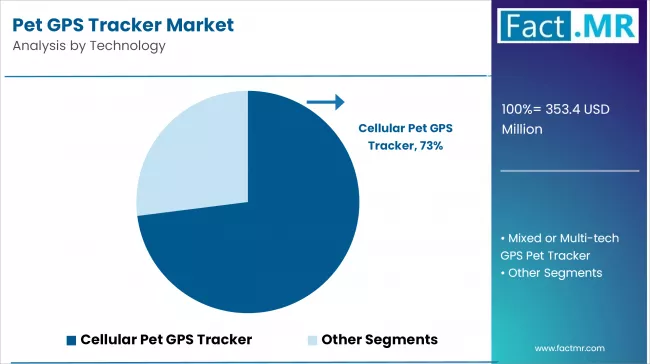
Pet Gps Tracker Market By Technology | Source: Fact.MR
Cellular GPS trackers remain the main technology in the pet tracker market. They provide real-time tracking, long-range coverage, and easy syncing with smartphone apps, making them the top choice for pet owners. These devices work over 2G and 4G networks, ensuring higher reliability in crowded or remote areas.
Features like live location sharing, geofencing, and escape alerts work well with cellular technology. Their effectiveness in preventing pet loss has confirmed their role as the preferred solution in cities and suburbs.
The mixed or multi-tech GPS tracker segment is growing quickly and becoming the fastest-growing technology. These trackers combine GPS with Bluetooth, Wi-Fi, and cellular to improve accuracy and battery life. Pet owners appreciate their ability to switch smoothly between different tracking modes based on the environment and distance.
This innovation offers better indoor tracking, lowers data costs, and extends battery life, making it a great choice for home and outdoor use. As tech-savvy consumers look for more integrated and dependable solutions, multi-tech trackers are quickly changing the competitive landscape.
- Cellular GPS trackers dominate with real-time accuracy, long range, and reliability.
- Multi-tech trackers combining GPS, Wi-Fi, and Bluetooth improve indoor/outdoor performance.
- Demand is shifting toward hybrid trackers that balance accuracy and battery efficiency.
Hardware Devices Lead the Pack with Wearable Innovation and Smart Design
Hardware devices lead the pet GPS tracker market because of their practical use and changing designs. Collars, tags, and clip-on devices have become smarter, smaller, and more durable, which encourages widespread use.
Features like waterproofing, long battery life, and tough designs make these trackers suitable for both indoor pets and active outdoor breeds. Pet parents value reliability and real-time monitoring, so hardware is often the first choice. The physical nature of these devices builds trust and provides immediate value, solidifying their position across all customer segments.
Software and related services are growing quickly, changing GPS trackers into complete pet management tools. Users want app-based features like health monitoring, location history, geofencing, and behavior analysis. Subscription models that offer premium features, cloud storage, and vet integration are becoming more popular.
The move towards data-driven pet care is changing market dynamics and making GPS tracking an ongoing service experience. As competition heats up, companies are using AI and user data to provide smarter, more personalized insights, which boosts recurring revenue and customer loyalty.
- Hardware devices (collars, tags, clip-ons) lead due to durability and trusted reliability.
- Software services add recurring value through health monitoring and premium app features.
- Subscription models transform trackers into full-service wellness and safety solutions.
Online Channel Emerges as the Dominant Distribution Force in Pet Tech
Online channels have become the main way people buy pet GPS trackers. This shift is driven by convenience, competitive pricing, and a wide selection of products. E-commerce platforms like Amazon, Chewy, and brand-owned websites give consumers direct access to products, along with detailed reviews and comparisons.
Tech-savvy pet owners prefer shopping online so they can explore features, track deliveries, and find bundled subscription offers. The growth of influencer marketing and digital ads has also increased visibility. Today, online sales clearly outpace traditional retail formats in this category.
Specialty stores are quickly becoming the fastest-growing channel. They offer personalized guidance and curated product selections. Pet owners appreciate expert advice from staff, especially for high-involvement tech products like GPS trackers. These stores also provide live demonstrations, product trials, and loyalty programs that improve the customer experience.
As pet humanization trends rise, shoppers are returning to physical stores to find trustworthy, brand-authorized retailers. Specialty stores connect premium hardware with after-sales service, making them more popular in urban areas with a high awareness of pet technology.
- Online channels dominate sales with convenience, wide product range, and reviews
- Specialty stores gain traction for demonstrations, expert advice, and loyalty programs
- E-commerce bundling with insurance and subscription offers boosts visibility and uptake
Competitive Analysis
The pet GPS tracker market is somewhat consolidated. It includes established consumer electronics brands, niche pet tech companies, and new IoT startups. The competition centers on device design, accuracy, battery life, and integration with mobile systems. Companies that provide seamless tracking, reliable connectivity, and quick performance are securing strong positions in the market.
Competition is heating up over product differentiation. This includes design (collars, tags, clip-ons), durability (waterproofing, chew-proofing), and usability (app design and data visualization). Companies that offer a complete pet-care solution, combining GPS with health tracking and geofencing, are gaining an edge by tapping into the larger trend of pet wellness.
Price is a major factor, especially in cost-sensitive markets. Companies fall into premium, mid-range, and budget categories. The premium segment aims at feature-rich devices and bundled software services. Budget models usually offer fewer features but attract first-time users, especially in emerging markets.
Subscription models are changing the value chain. Relying solely on hardware no longer guarantees loyalty. Recurring software services and exclusive app content are now crucial for keeping customers and maximizing value. Brands with scalable cloud platforms, multilingual support, and AI-based tracking are outperforming traditional device-only competitors.
Distribution strategy is another important factor. Online-first brands use SEO, influencer partnerships, and social media to dominate the digital space. Others expand through specialty retailers, veterinary clinics, and pet expos.
Key Players in the Market
- Whistle GO
- Jiobits
- Fi
- Tractive
- Pawscout
- Wagtag
- Shenzhen Motto Electronics Co. Ltd.
- Jupin Group Co. Ltd.
- Dongguan ShuangXin Industry Co. Ltd
- Kippy, Weenect Inc.
- Trackimo
- Yepzon
- Dynotag
- Pitpatpet Ltd.
Recent Developments
- In July 2025, Fetch Pet Insurance, the most complete pet insurance in North America, today announced a partnership with pet-tech pioneer SATELLAI to offer smart collars for dogs. This is a major step toward the future of personalized pet health. SATELLAI’s advanced collar provides unique insights into a pet’s behavior, energy levels, and rest patterns through real-time GPS tracking and activity monitoring.
- In June 2025, two major companies in the European pet health market are partnering: Tractive, the top provider of smart trackers for pets, has teamed up with Mammaly, the premium dog supplement brand and the fastest growing digital pet health start-up in Europe. The aim of this partnership is to measure the health impacts of dietary supplements for dogs on a large scale for the first time, using objective vital signs data.
Segmentation
Segmentation of Pet GPS Tracker Market
-
By Technology :
- Cellular Pet GPS Tracker
- Mixed or Multi-tech GPS Pet Tracker
-
By Offerings :
- Hardware Device
- Software and Associated Services
-
By Sales Channel :
- Modern Trade
- Franchised Outlets
- Specialty Store
- Online Channel
-
By Region :
- North America
- Latin America
- Western Europe
- Eastern Europe
- East Asia
- South Asia & Pacific
- Middle East & Africa
Frequently Asked Questions
What is the Global Pet GPS Tracker Market size in 2025?
Who are the Major Players Operating in the Pet GPS Tracker Market?
What is the Estimated Valuation of the Pet GPS Tracker Market by 2035?
At what CAGR is the Pet GPS Tracker Market slated to grow during the study period?
Who worked on this report


Preview the report firsthand - request a free sample
Free SampleGet the brochure for pricing and purchase details
Download PDF