- Market Value (2025): USD 332.8 Mn
- Estimated Value (2026): USD 360.0 Mn
- Forecast Value (2036): USD 790.0 Mn
- CAGR (2026-2036): 8.2%
What is the Wash-Off Bottle Adhesives Market forecast to be worth by 2036?
USD 360.0 million in 2026 to USD 790.0 million by 2036, at a CAGR of 8.2%.
- The wash-off bottle adhesives market reached USD 332.8 million in 2025, supported by wider testing across recyclable and returnable bottle formats.
- Demand is projected to increase from USD 360.0 million in 2026 to USD 790.0 million by 2036, driven by greater use in PET bottles, reusable packaging, and bottle recycling programs.
- The market is forecast to record an 8.2% CAGR. Companies want adhesives that wash off cleanly, perform well on filling lines, and meet recycling requirements.
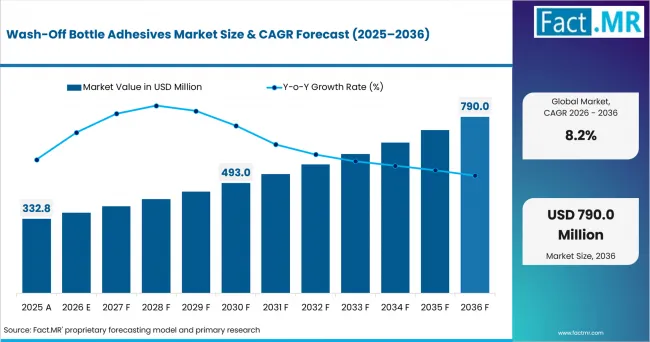
Wash Off Bottle Adhesives Market Market Value Analysis | Source: Fact.MR
What are the defining numbers behind Wash-Off Bottle Adhesives Market growth?
USD 430.0 million absolute opportunity through 2036.
- Demand Drivers in the Market
- PET bottle companies approve adhesives more quickly when they reduce rework, pass recycling tests, and help produce cleaner recycled flakes.
- Alkali-soluble adhesives are used when label residue or mixed materials make recycling harder.
- Demand grows when companies need clear proof that the label, adhesive, and bottle work well together during recycling.
- Beverage bottles receive more testing because they are produced in large volumes and have a direct effect on recycling results.
- Brand owners prefer adhesives that separate cleanly during washing without raising processing costs.
- Key Segments Analyzed
- By Bottle Material: PET is expected to hold 43% share in 2026, supported by its wide use in bottle recycling and the need to maintain clean recycled flakes.
- By Adhesive System: Alkali-soluble is projected to account for 31% share in 2026 due to clean label removal during washing and compatibility with existing recycling lines.
- By Application: Labels are anticipatedto capture 29% share in 2026, driven by their common use on beverage and packaging bottles.
- By End Use: Beverage is estimated to represent 29% share in 2026, influenced by high bottle volumes, PET recycling goals, and packaging commitments.
- By Recycling Need: PET flake purity is forecast to account for 35% share in 2026, owing to the need for cleaner recycled material without major changes to bottles or filling lines.
- Analyst Opinion at Fact.MR
- Shambhu Nath Jha, Senior Analyst at Fact.MR, states, “Wash-off bottle adhesives must perform well during real recycling tests. Companies prefer products that are easy to test, come with clear records, and give the same result each time. Adhesive manufacturers that offer steady product quality and practical support are more likely to gain repeat orders.”
- Strategic Implications
- Adhesive manufacturers need to test their products under the same washing and recycling conditions used by customers. Broad product claims are not enough.
- Packaging companies should compare products before changing an approved adhesive. Even a small change can affect label hold, residue, and recycling results.
- Distributors should keep safety and technical documents ready because companies often ask for them early in the approval process.
- China is expected to record an 11.0% CAGR, supported by large-scale manufacturing, strong packaging demand, and quick local product support.
Germany is anticipated to expand at a 9.4% CAGR through 2036. Brazil is forecast to register an 8.6% CAGR over the same period. The United States is expected to post a 7.8% CAGR by 2036.
How does the Wash-Off Bottle Adhesives Market break down by segment?
PET leads Bottle Material with43% share in 2026, while alkali-soluble systems lead Adhesive System with31% share.
What supports Bottle Material adoption?
PET holds43% share in 2026.
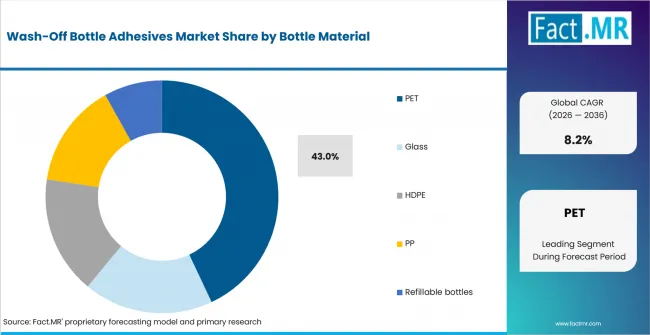
Wash Off Bottle Adhesives Market Analysis By Bottle Material | Source: Fact.MR
PET is widely used for beverage bottles and has a strong recycling base. Companies choose adhesives that let labels come off cleanly during washing and leave little residue on the plastic flakes. Glass, HDPE, PP, and refillable bottles also use wash-off adhesives, but each material hasdifferent needs. PET leads because poor label removal can lower the quality and value of recycled plastic.
Which Adhesive System dominates?
Alkali-solubleaccounts for31% share in 2026.
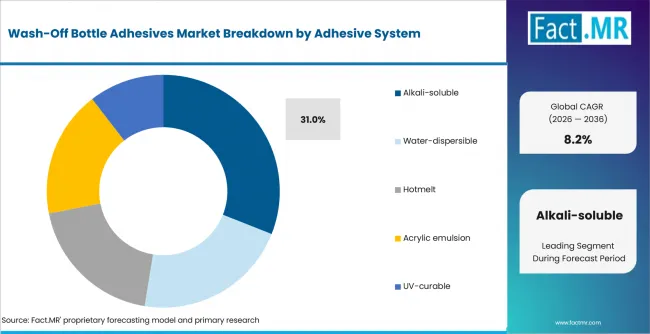
Wash Off Bottle Adhesives Market Analysis By Adhesive System | Source: Fact.MR
Alkali-soluble adhesives lead because many bottle-washing and recycling lines already use alkaline water. This makes the adhesive easier to test under normal working conditions. The label must stay in place during storage, transport, filling, and use, then come off cleanly during washing.
Water-dispersible,hotmelt, acrylic emulsion, and UV-curable adhesives are also used, but each works differently with coating speed, label material, and bottle type. Alkali-soluble products gain wider use when tests show clean label removal, little residue, and steady results after storage and exposure to moisture.
What leads the Application segment?
Labels hold 29% share in 2026.
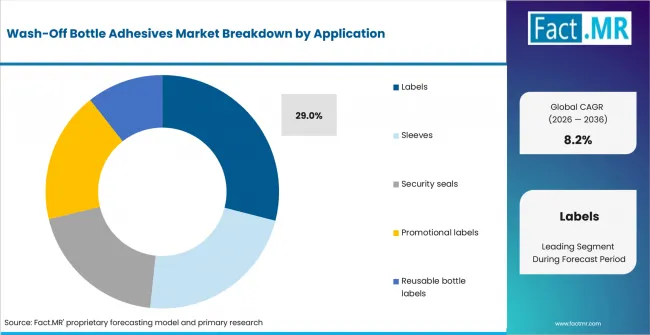
Wash Off Bottle Adhesives Market Analysis By Application | Source: Fact.MR
Labels lead the application category because they are used on most bottle sand their performance is easy to check during recycling. Companies look beyond how well the label sticks and also check whether it comes off cleanly during washing, leaves little residue, and helps keep recycled plastic clean.
Sleeves, security seals, promotional labels, and reusable bottle labelsremainimportant because each serves a different packaging need. The right choice depends on the bottle material, label design, washing process, and recycling method. Labels are more likely to be approved when recycling tests show clean removal without affecting bottle appearance or production line performance.
How does End Use shape demand?
Beverageleads with29% share in 2026.
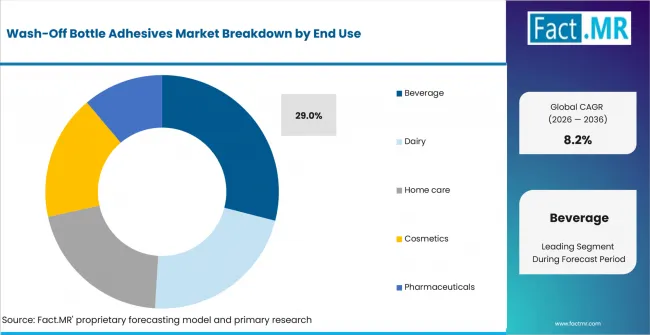
Wash Off Bottle Adhesives Market Analysis By End Use | Source: Fact.MR
Beverage applicationsremainahead because bottles in this segment are collected and processed in very large quantities. Adhesive performance has a direct effect on how easily labels are removed and how smoothly bottles move through recycling steps.
Dairy, home care, cosmetics, and pharmaceutical packaging also use bottle adhesives, but their containers often have different design and handling needs. Beverage packaging sees faster adoption when wash-off adhesives helpmaintainbottle quality and avoid issues during recycling operations.
Where is Recycling Need demand strongest?
PET flake purity holds 35% share in 2026.
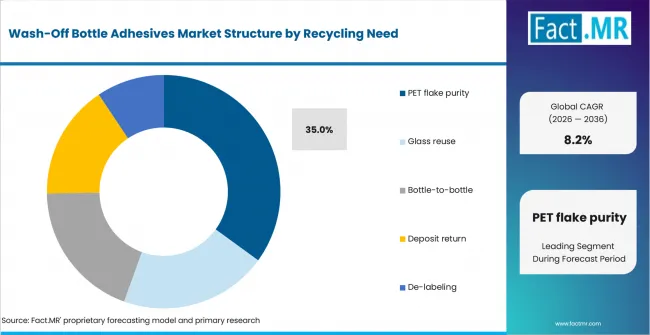
Wash Off Bottle Adhesives Market Analysis By Recycling Need | Source: Fact.MR
PET flake purity receives strong attention because recycled PET quality depends on clean separation during washing and processing. Adhesive residue, leftover label material, and ink transfer can lower the quality of recycled plastic and reduce its reuse potential.
Glass reuse, deposit return programs, and other recycling methods also support demand. However, PET recycling receives more focus due to the need for consistent flake quality in new packaging and other applications.
What is accelerating Wash-Off Bottle Adhesives Market adoption, and what is holding it back?
Flake quality improvement isanticipatedto drive market growth, while qualification cost and process changes restrain adoption.
Drivers Impact Analysis
| DRIVER | (~) % IMPACT ON CAGR | GEOGRAPHIC RELEVANCE | IMPACT TIMELINE |
|---|---|---|---|
| Flake quality control in PET | +0.8% | China and export suppliers | Medium term (2-4 years) |
| Label release testing | +0.6% | Europe and North America | Short term (<= 2 years) |
| PET bottle applications approval programs | +0.5% | Asia Pacific | Medium term (2-4 years) |
| Local support near label converters | +0.4% | Global | Long term (>= 4 years) |
Source: Fact.MR analysis. Updated Jul 15, 2026
- PET flake quality control:Cleaner recycled PET helps companies reduce material loss and improve the value of recycled plastic. Adhesives that separate well during washing make it easier tomaintainbetter flake quality.
- Label removal testing:Testing helps companies understand whether an adhesive works properly during recycling. Clear results can reduce trial failures and make it easier to approve new adhesive options.
- PET bottle recycling approval programs:Recycling checks help companies compare adhesive performance before making packaging changes. Once a product passes testing, the same results can support use across similar bottle formats.
- Local support near label converters:Quick technical help allows companies to solve problems related to labels, bottles, washing conditions, and production lines. Better support can reduce delays during product testing and approval.
Opportunity Impact Analysis
| OPPORTUNITY | (~) % IMPACT ON CAGR | GEOGRAPHIC RELEVANCE | IMPACT TIMELINE |
|---|---|---|---|
| Grades tuned for PET bottle applications | +0.5% | Global | Medium term (2-4 years) |
| Application labs for Alkali-soluble | +0.4% | Asia Pacific and Europe | Short term (<= 2 years) |
| Rule-ready documentation | +0.4% | Europe and United Kingdom | Medium term (2-4 years) |
| Local trials with bottle washers | +0.3% | India and Brazil | Long term (>= 4 years) |
Source: Fact.MR analysis. Updated Jul 15, 2026
- PET bottle application grades:Demand grows when companies can test and confirm adhesive performance on their own. Products that keep labels secure during use and remove cleanly during washing have a stronger chance of adoption.
- Testing support for alkali-soluble adhesives:Simple testing methods help companies compare adhesives before approval. Tests covering label age, washing conditions, label materials, and residue help reduce uncertainty.
- Clear product documents:Adoption improves when technical and safety details are easy to review. Companies need clear information on product use, recycling performance, and handling before selecting an adhesive.
- Local testing with bottle recycling plants:Market opportunities increase when adhesives perform well under actual recycling conditions. This is important in regions such as India and Brazil, where bottle production and recycling activity continue to expand.
Restraints Impact Analysis
| RESTRAINT | (~) % IMPACT ON CAGR | GEOGRAPHIC RELEVANCE | IMPACT TIMELINE |
|---|---|---|---|
| Qualification cost | -0.4% | Global processors | Medium term (2-4 years) |
| Fit limits in Alkali-soluble | -0.3% | Global | Short term (<= 2 years) |
| Documentation burden | -0.3% | Europe and North America | Medium term (2-4 years) |
| Scale-up risk | -0.2% | High-volume plants | Long term (>= 4 years) |
Source: Fact.MR analysis. Updated Jul 15, 2026
- Qualification cost:Changing an adhesive can affect labeling, storage, bottle washing, and recycling results. Companies often delay switching until the benefits are clear enough to cover testing costs.
- Limits of alkali-soluble adhesives:These adhesives mustremovecleanly during washing while keeping labels fixed during filling, transport, cooling, and shelf time. Finding the right balance canslowadoption.
- Documentation requirements:New adhesives need clear safety details, test results, and performance records before companies approve them. This review process can take time and delay wider use.
- Scale-up challenges:A product that works in small tests may need more checks before use in large production. Companies must confirm performance across coating lines, bottle designs, label materials, and recycling processes.
Which countries are scaling Wash-Off Bottle Adhesives Market fastest?
Germany at 9.4%, Brazil at 8.6%, and the United States at 7.8%.
Regional analysis covers North America, Europe, Asia Pacific,LatinAmerica, and the Middle East and Africa.
.webp "Top Country Growth Comparison Wash Off Bottle Adhesives Market Cagr (2026 2036)")
Top Country Growth Comparison Wash Off Bottle Adhesives Market Cagr (2026 2036) | Source: Fact.MR
| COUNTRY | CAGR |
|---|---|
| Germany | 9.4% |
| Brazil | 8.6% |
| United States | 7.8% |
Source: Fact.MR analysis. Updated Jul 15, 2026
How is Germany scaling demand?
9.4% CAGR, shaped by strong recycling practices, strict packaging rules, and demand for better label removal solutions.
Companies in Germany check adhesive performance carefully before making changes because many packaging systems are already well established. Clear test results and product details help speed up the approval process.
Demand is supported by bottle return programs, recycling targets, and the need for adhesives that remove cleanly, leave less residue, and work well with PET and reusable bottles.
What supports the Brazil outlook?
8.6% CAGR, with beverage packaging demand and recycling activity shaping market expansion.
Bottle producers, label converters, and recycling companies are testing wash-off adhesives to understand how they perform under local conditions. Companies prefer options that improve recycling without requiring major changes to existing production setups.
Different bottle formats, transport conditions, and washing methods influence adhesives election across the country. Products with reliable performance and strong technical support have a better chance of moving from early trials to regular use.
How is United States developing demand?
7.8% CAGR, supported by high PET bottle use, recycling activity, and demand for easy-to-remove labels.
Companies in the United States test wash-off adhesives before using them widely. They check whether labels stay in place during normal use and come off properly during recycling.
Demand grows for adhesives that work well with existing bottle lines, support recycling needs, and reduce problems during packaging and recycling.
Who leads the Wash-Off Bottle Adhesives Market?
Avery Dennison and UPM Raflatac lead the named provider set, with Henkel, H.B. Fuller,Bostikcompleting the group. Product performance, label compatibility, testing support, and response speed during customer trials influence competitive standing.
Competition depends on how well companies help customers move through adhesive testing and approval. Companies need support with label materials, bottle types, washing conditions, residue checks, and recycling requirements. A provider gains an advantage when its adhesive performs consistently across real packaging trials and helps customers move from testing to regular use.
Which companies are the key providers?
Avery Dennison and UPMRaflatacare key providers. Henkel and H.B. Fuller are also profiled.Bostikcompletes thecompanyset.
- Avery Dennison
- UPM Raflatac
- Henkel
- H.B. Fuller
- Bostik
Bibliography
- Association of Plastic Recyclers. (2025).APR Design® Guide for Plastics Recyclability. Association of Plastic Recyclers.
- European Parliament & Council of the European Union. (2025, January 22).Regulation (EU) 2025/40 on packaging and packaging waste. EUR-Lex.
- European Commission. (2025).Packaging waste. Directorate-General for Environment.
- RecyClass. (2025).Design for Recycling Guidelines.RecyClass.
- U.S. Environmental Protection Agency. (2025).Containers and packaging: Product-specific data. United States Environmental Protection Agency.
- U.S. Environmental Protection Agency. (2025).Safer Choice criteria for chemicals. United States Environmental Protection Agency.
This Report Addresses
- The report provides strategic intelligence on Wash-Off Bottle Adhesives Market across bottle material and adhesive system choices.
- Regional outlook evaluates US, Germany, France, UK and 30+ countries.
- Competitive analysis profiles Avery Dennison and UPMRaflatacfollowed by the remaining named providers.
- Use-case assessment covers PET bottle applications and adjacent applications in bottle label adhesives and wash-off labels.
What does the Wash-Off Bottle Adhesives Market cover?
The market covers PET, alkali-soluble systems, and PET bottle applications used in defined commercial applications. It focuses on products sold for a specific function inside bottle label adhesives and wash-off labels.
The category covers adhesives that need to perform through normal packaging use and then let go during washing or recycling. Value here comes from solving a defined use problem, not from selling a broad chemical family.
The market stays separate from broad chemical supply because the buying reason is narrow and specific. A commodity adhesivedoesn'tcount unlessit's sold, tested, and approved for wash-off bottle labeling or sleeve-release use.
What is included in the scope?
The scope includes adhesives for labels and sleeves that detach in bottle washing or recycling lines without contaminating flakes. Coverage spans PET, alkali-soluble systems, and PET bottle applications wherever customers are buying that same function.
Included sales cover approved grades, application support, repeat supply into customer routes, and technical service tied to label converters, bottle producers, recyclers, brand owners, and distributors. The scope also takes in adhesives used in recyclable label constructions wherever wash-off performance is a central buying requirement.
What is excluded from the scope?
The boundary excludescommodity parent grades that lack the named function. Equipment on its own sits outside this market, and general packaging adhesives are excluded when they aren't sold specifically for wash-off bottlelabelor sleeve applications.
Commodity materials stay out unlessthey'resold as part of this market for a named application. Broad chemical resins, unrelated label materials, recycling machinery, bottle-washing equipment, inks, closures, and packaging films fall outside the scope unless the adhesive itself is the revenue item under review.
How was the analysis built?
120+ sources, 35+ company portfolios, 25+ countries, and 20+ industry interviews.
- Primary Research:Primary researchincludes discussions with adhesive producers, label converters, packaging companies, recycling specialists, distributors, and technical staff involved in bottle labeling and wash-off adhesive applications.
- Desk Research:Desk research examines government publications, recycling guidelines, packaging regulations, technical documents, industry standards, and company information to understand material choices, recycling needs, and packaging trends.
- Market-Sizingand Forecasting:Forecasting combines market value trends, growth rates, segment performance, company activity, regional demand, PET bottle usage, label requirements, adhesive selection factors, and recycling-related adoption drivers.
- Data Validation and Update Cycle:Forecast checks review company activity, product availability, technical performance, packaging changes, approval requirements, and market conditions. Regular updates help confirm whether demand patterns match real adoption across bottle and label applications.
Segmentation
What is the report's scope and coverage?
| Attribute | Details |
|---|---|
| Quantitative Units | USD Million in 2026 to USD Million by 2036 at CAGR |
| Market Definition | Adhesives for labels and sleeves that detach in bottle washing or recycling lines without contaminating flakes. |
| Bottle Material | PET, Glass, HDPE, PP, Refillable bottles |
| Adhesive System | Alkali-soluble, Water-dispersible,Hotmelt, Acrylic emulsion, UV-curable |
| Application | Labels, Sleeves, Security seals, Promotional labels, Reusable bottle labels |
| End Use | Beverage, Dairy, Home care, Cosmetics, Pharmaceuticals |
| Recycling Need | PET flake purity, Glass reuse, Bottle-to-bottle, Deposit return, De-labeling |
| Regions Covered | North America, Europe, Asia Pacific, Central and South America, Middle Eastand Africa |
| Countries Covered | Germany, Brazil, United States |
| Key Companies Profiled | Avery Dennison, UPMRaflatac, Henkel, H.B. Fuller,Bostik |
| Forecast Period | 2026 to 2036 |
| Approach | Hybrid top-down and bottom-up approach using Bottle Label Adhesives / Wash-Off Labels, segment shares, country growth, supplier mapping, and technical validation |
Source: Fact.MR analysis. Updated Jul 15, 2026
How is the market segmented?
-
By Bottle Material
- PET
- Glass
- HDPE
- PP
- Refillable bottles
-
By Adhesive System
- Alkali-soluble
- Water-dispersible
- Hotmelt
- Acrylic emulsion
- UV-curable
-
By Application
- Labels
- Sleeves
- Security seals
- Promotional labels
- Reusable bottle labels
-
By End Use
- Beverage
- Dairy
- Home care
- Cosmetics
- Pharmaceuticals
-
By Recycling Need
- PET flake purity
- Glass reuse
- Bottle-to-bottle
- Deposit return
- De-labeling
-
By Region
- North America
- United States
- Canada
- Europe
- Germany
- United Kingdom
- France
- Italy
- Spain
- Asia Pacific
- India
- China
- Japan
- South Korea
- Australia
- LatinAmerica
- Brazil
- Argentina
- Mexico
- Chile
- Middle East & Africa
- UAE
- Saudi Arabia
- South Africa
- North America
Frequently Asked Questions
Which Bottle Material leads the Wash-Off Bottle Adhesives Market?
Which Adhesive System leads the Wash-Off Bottle Adhesives Market?
Which Application leads the Wash-Off Bottle Adhesives Market?
What is the primary driver in the Wash-Off Bottle Adhesives Market?
What is the main restraint in the Wash-Off Bottle Adhesives Market?
Why do companies continue testing Wash-Off Bottle Adhesives Market?
Who worked on this report


Preview the report firsthand - request a free sample
Free SampleGet the brochure for pricing and purchase details
Download PDF