- Base Value(2025): 2.2 Bn
- Estimated Value(2026): 2.8 Bn
- Forecast Value (2036): 18.9 Bn
- CAGR (2026 - 2036): 20.7%
Logistics AI Co-Pilot and Decision Support Platforms Market Forecast By Fact.MRand Outlook
- In 2025, the logistics AI co-pilot and decision support platforms market was valued at USD 2.2 billion.
- Based on Fact.MR analysis, demand for logistics AI co-pilot and decision support platforms is estimated to grow to USD 2.8 billion in 2026 and USD 18.9 billion by 2036. FACT.MR projects a CAGR of 20.7% during the forecast period.
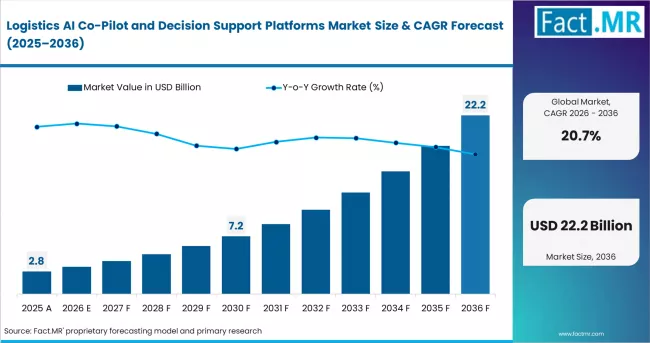
Logistics Ai Co Pilot And Decision Support Platforms Market Market Value Analysis | Source: Fact.MR
| Metric | Value |
|---|---|
| Estimated Value in 2026 | USD 2.8 billion |
| Forecast Value in 2036 | USD 18.9 billion |
| Forecast CAGR (2026 to 2036) | 20.7% |
Source: Fact.MR analysis. Updated May 7, 2026
Summary of Logistics AI Co-Pilot and Decision Support Platforms Market
- Market Definition
- The market includes cloud-native and hybrid AI platforms delivering decision support, co-pilot assistance, predictive analytics, and autonomous execution for logistics planning and freight operations globally.
- Demand Drivers
- Enterprise shippers are deploying AI co-pilot platforms to cut cost-per-shipment. Adoption is driven by real-time carrier selection and load optimization use cases replacing manual TMS workflows.
- 3PLs are integrating control tower AI to reduce exception management cost. AI-driven visibility platforms cut unplanned operational interventions by 20–30% in live deployments.
- India's ONDC-linked digital logistics programme and China's AI logistics ecosystem expansion are creating high-volume structured procurement demand for co-pilot platforms in fast-growing markets.
- Key Segments Analyzed
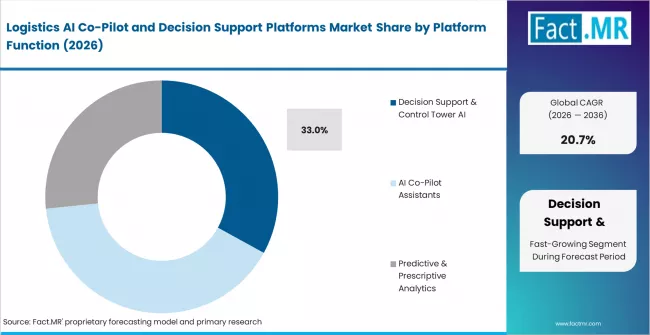
- By Platform Function: Decision Support & Control Tower AI leads at 33% in 2026, driven by real-time orchestration across planning and execution in large 3PL and shipper networks.
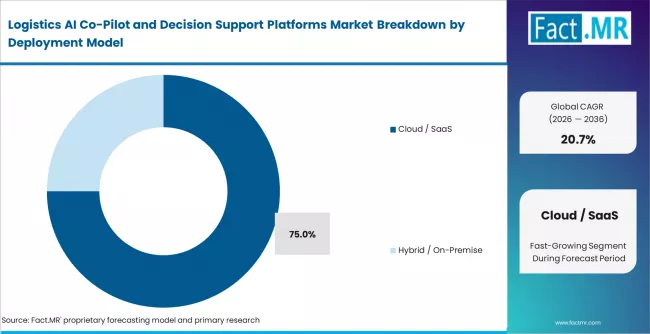
- By Deployment Model: Cloud / SaaS leads at approximately 75% in 2026, driven by enterprise demand for scalable API-first deployment without on-premise infrastructure commitment.
- By Geography: India leads at 23.4% CAGR, supported by fast-expanding digital logistics infrastructure and low legacy constraints accelerating AI platform deployment.
- Analyst Opinion at FACT.MR
- Shambhu Nath Jha, Principal Consultant at Fact.MR, opines, 'CXOs will find a clear divide between AI-native co-pilot platforms capturing decision margin from legacy TMS deployments and point-solution vendors losing contract renewals as enterprise buyers consolidate onto integrated AI logistics platforms.'
- Strategic Implications
- Invest in AI co-pilot assistant modules for carrier selection and load optimization embedded within cloud-native logistics execution platforms targeting enterprise 3PL procurement.
- Develop control tower AI with real-time prescriptive exception management for large shippers migrating from rule-based TMS to AI-driven planning systems.
- Prioritise India and China market entry with cost-efficient SaaS co-pilot tiers designed for mid-size logistics operators with minimal legacy infrastructure.
- Methodology
- Market sizing based on platform subscription revenues and deployment volumes, validated with 2024 to 2025 financial and procurement data.
- Supported by SAP, Blue Yonder, Oracle, and Kinaxis disclosures and enterprise logistics AI adoption benchmarks from 2024 to 2025.
- Forecasts incorporate logistics digitization rates, AI platform adoption curves, and expert inputs from 3PL technology leaders.
The market is set to generate USD 16.1 billion in incremental revenue over the forecast period. Growth is transformational and technology-led. Adoption is driven by enterprise demand for real-time supply chain visibility, autonomous execution capability, and AI-assisted planner workflows. Cost of integration and change management complexity remain the primary constraints limiting faster enterprise rollout.
India leads at 23.4% CAGR through 2036, driven by rapid digital logistics infrastructure buildout, ONDC-linked AI adoption, and low legacy system constraints enabling faster platform deployment. China follows at 21.5%, anchored by AI-driven logistics ecosystems built by Alibaba and JD Logistics at scale. The United States records 19.2%, supported by AI-first enterprise SaaS adoption across large shipper and 3PL networks. Germany grows at 18.6%, tied to Industry 4.0 supply chain digitization programmes. The United Kingdom records 18.2%, driven by retail and logistics AI adoption growth. Japan records 17.5%, where labour shortage pressures are accelerating AI co-pilot deployment.
Segmental Analysis
Logistics AI Co-Pilot and Decision Support Platforms Market Analysis by Platform Function
Logistics Ai Co Pilot And Decision Support Platforms Market Analysis By Platform Function | Source: Fact.MR
Based on FACT.MR analysis, Decision Support & Control Tower AI holds 33% share in 2026. This function leads due to enterprise demand for real-time network orchestration. Large 3PLs deploy control tower AI to manage multi-modal exception volumes. Prescriptive recommendations reduce unplanned carrier switching and cost overruns across freight networks.
- Blue Yonder Investment: Blue Yonder expanded its Luminate Control Tower with AI-driven exception management and prescriptive analytics in Q2 2024, targeting Tier-1 shipper and 3PL clients across North America and EMEA with real-time decision orchestration capabilities [1].
- Kinaxis Platform Update: Kinaxis launched its RapidResponse AI Co-Pilot module in 2024, embedding natural-language decision support for supply chain planners. The module enables conversational queries against live supply chain data for procurement and logistics teams [2].
- Control Tower Adoption Trend: Enterprise control tower AI platform adoption among Tier-1 logistics operators grew 28% in 2024, driven by supply chain disruption frequency and shipper demand for real-time carrier visibility and prescriptive rerouting [3].
Logistics AI Co-Pilot and Decision Support Platforms Market Analysis by Deployment Model
Logistics Ai Co Pilot And Decision Support Platforms Market Analysis By Deployment Model | Source: Fact.MR
Based on FACT.MR analysis, Cloud / SaaS holds approximately 75% share in 2026. This model dominates due to enterprise API-first integration requirements and subscription cost flexibility. Cloud platforms enable rapid deployment across distributed logistics networks without on-premise infrastructure.
- SAP Cloud Expansion: SAP extended its Business Network for Logistics with AI-assisted freight matching and co-pilot execution modules in early 2025, targeting enterprise ERP customers migrating logistics decision workflows to cloud-native AI environments across Europe and Asia [4].
- project44 SaaS Development: project44 launched its Movement AI platform update in 2024, adding predictive ETD and prescriptive carrier routing modules as cloud-native SaaS layers for shipper and 3PL clients in North America and EMEA [5].
- Cloud Adoption Trend: Cloud-based logistics AI platform subscriptions grew 31% globally in 2024, outpacing hybrid and on-premise deployments by a factor of five, driven by enterprise digital transformation mandates and SaaS total cost of ownership advantages [6].
Drivers, Restraints, and Opportunities
Logistics Ai Co Pilot And Decision Support Platforms Market Opportunity Matrix Growth Vs Value | Source: Fact.MR
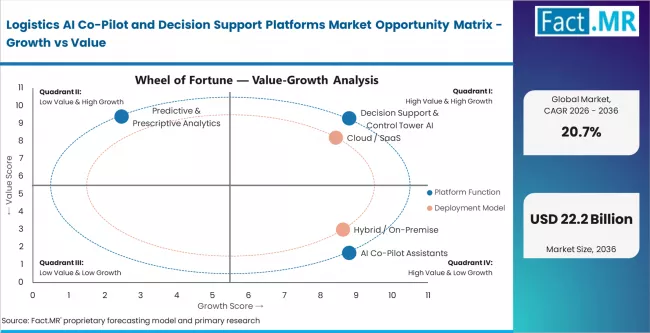
FACT.MR analysts observe that this market is high-growth and driven by platform consolidation. Demand is concentrated in control tower AI and co-pilot assistant functions. Real-time decision orchestration is delivering measurable cost savings for large shippers and 3PLs. Growth is linked to SaaS adoption, freight complexity, and rising supply chain disruptions.
Rule-based TMS and legacy planning tools are losing share. Enterprises are replacing static workflows with AI co-pilot platforms. Higher subscription costs are offset by savings in carrier spend, exception handling, and planner productivity. Mid-market adoption is increasing through cloud-native SaaS models with lower entry cost.
- Enterprise SaaS Consolidation: Blue Yonder expanded its Luminate platform in 2024 with AI co-pilot layers. This drove a 25% increase in enterprise renewal value. Buyers are consolidating vendors onto unified platforms. [7]
- U.S. AI Adoption Policy: Federal Highway Administration released 2024 guidelines supporting AI-driven routing and decision tools. This is accelerating enterprise adoption among trucking and freight operators.
- India Digital Logistics Scale: PM GatiShakti National Master Plan expanded AI-compatible logistics infrastructure in 2024. Open Network for Digital Commerce onboarded 600,000+ logistics providers. This is creating strong demand for AI decision support platforms among mid-size operators.
Regional Analysis
The logistics AI co-pilot and decision support platforms market is assessed across Asia Pacific, North America, Europe, Latin America, and Middle East and Africa, covering 40+ countries with distinct demand profiles shaped by enterprise AI adoption maturity, logistics digitization velocity, freight network complexity, and technology investment levels. The full report offers market attractiveness analysis by region and country.
.webp "Top Country Growth Comparison Logistics Ai Co Pilot And Decision Support Platforms Market Cagr (2026 2036)")
Top Country Growth Comparison Logistics Ai Co Pilot And Decision Support Platforms Market Cagr (2026 2036) | Source: Fact.MR
| Country | CAGR (2026 to 2036) |
|---|---|
| India | 23.4% |
| China | 21.5% |
| United States | 19.2% |
| Germany | 18.6% |
| United Kingdom | 18.2% |
| Japan | 17.5% |
Source: Fact.MR analysis. Updated May 7, 2026
Source: Fact.MR (FACT.MR) analysis, based on proprietary forecasting model and primary research
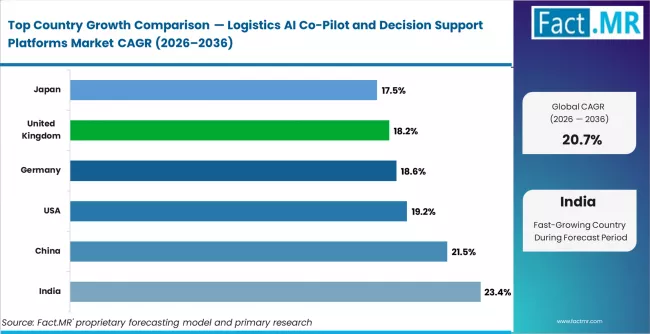
Logistics Ai Co Pilot And Decision Support Platforms Market Cagr Analysis By Country | Source: Fact.MR
Asia Pacific Logistics AI Co-Pilot and Decision Support Platforms Market Analysis
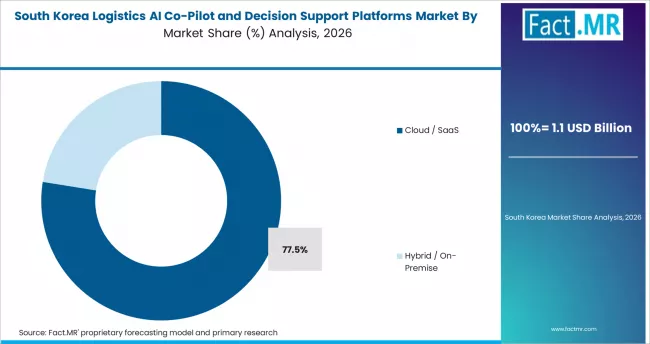
Logistics Ai Co Pilot And Decision Support Platforms Market South Korea Market Share Analysis By Deployment Model | Source: Fact.MR
Asia Pacific is the fastest-scaling deployment region for logistics AI co-pilot platforms. Growth is led by platform-native ecosystems in China and digital trade expansion in India. Procurement cycles are shortening due to cloud-first SaaS deployment.
- India: Logistics AI co-pilot platform demand is projected to expand at 23.4% CAGR through 2036. PM GatiShakti National Master Plan extended AI-compatible infrastructure requirements in 2024. Open Network for Digital Commerce onboarded 600,000+ logistics providers by end-2024. This is creating a large mid-market buyer base for cloud-native co-pilot tools. Reliance Retail deployed AI-assisted logistics tools across tier-2 distribution networks. Adoption is driven by scale, low legacy constraints, and policy support.
- China: Logistics AI co-pilot platform demand is projected to grow at 21.5% CAGR through 2036. Alibaba Group expanded Cainiao AI co-pilot platforms across 300+ hubs in 2024. JD.com deployed AI decision tools across 1,500+ warehouses. Logistics cost per order declined with prescriptive analytics integration. Government AI logistics guidelines are accelerating adoption. Growth is driven by ecosystem scale and platform maturity.
- Japan: Logistics AI co-pilot platform demand is projected to rise at 17.5% CAGR through 2036. Labour shortages are the primary driver. Government guidelines are promoting AI-assisted logistics planning. Yamato Holdings deployed AI route optimization tools across its network. SoftBank investments are supporting mid-market adoption. Growth is steady and driven by workforce constraints.
Fact.MR's analysis of the logistics AI co-pilot and decision support platforms market in Asia Pacific consists of country-wise assessment including India, China, Japan, South Korea, ASEAN, and Australia and New Zealand. Readers can find ONDC AI adoption trends, China ecosystem benchmarks, and regional co-pilot platform deployment data.
Europe Logistics AI Co-Pilot and Decision Support Platforms Market Analysis
Europe is an Industry 4.0 and compliance-driven market. Adoption is tied to digitization across automotive, chemicals, and 3PL sectors. SAP and Oracle shape procurement decisions. AI adoption is accelerating due to supply chain resilience mandates.
- Germany: Logistics AI co-pilot platform demand is projected to grow at 18.6% CAGR through 2036. Deutsche Post DHL Group deployed AI control tower tools in 2024. Blue Yonder integration supports planning optimization. SAP introduced AI co-pilot modules in S/4HANA. Industry 4.0 benchmarks are shaping procurement standards.
- United Kingdom: Logistics AI co-pilot platform demand is projected to grow at 18.2% CAGR through 2036. Ocado Technology expanded AI logistics platform licensing. Government freight strategy supports AI adoption. XPO Logistics integrated FourKites AI tools across its network. Growth is driven by efficiency and cost reduction targets.
Fact.MR's analysis of the logistics AI co-pilot and decision support platforms market in Europe consists of country-wise assessment including Germany, United Kingdom, France, Italy, Spain, Nordic Countries, and BENELUX. Readers can find Industry 4.0 AI adoption benchmarks, SAP integration trends, and EU supply chain resilience platform demand data.
North America Logistics AI Co-Pilot and Decision Support Platforms Market Analysis
North America is the largest revenue base for AI co-pilot platforms. Adoption is led by 3PLs, freight brokers, and large shippers. Blue Yonder, Oracle, and Microsoft ecosystems dominate procurement.
- United States: Logistics AI co-pilot platform demand is projected to rise at 19.2% CAGR through 2036. Walmart deployed AI planning and execution tools in 2024. C.H. Robinson launched Navisphere AI co-pilot updates. Government guidelines are supporting AI adoption in freight operations. Growth is driven by enterprise SaaS scale and advanced logistics networks.
Fact.MR's analysis of the logistics AI co-pilot and decision support platforms market in North America consists of country-wise assessment including United States, Canada, and Mexico. Readers can find enterprise SaaS AI adoption data, platform benchmarks, and policy trends.
Competitive Aligners for Market Players
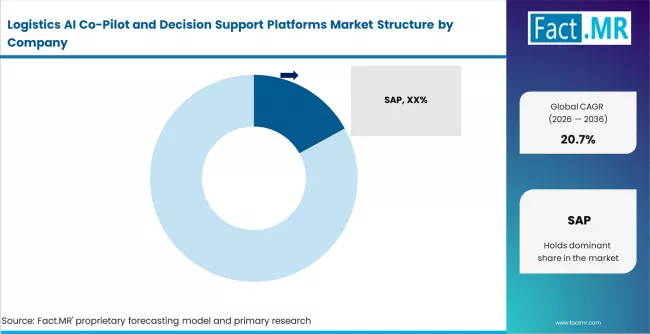
Logistics Ai Co Pilot And Decision Support Platforms Market Analysis By Company | Source: Fact.MR
Competition in the logistics AI co-pilot and decision support platforms market is increasingly defined by depth of decision intelligence rather than breadth of features. Vendors are no longer competing on dashboards or analytics layers. The focus has shifted to platforms that can actively guide, recommend, and automate operational decisions in real time across planning and execution environments.
A primary aligner is the ability to deliver context-aware, real-time decisioning. Platforms from Blue Yonder, Oracle, and SAP are embedding AI co-pilot layers that interpret live freight, inventory, and disruption signals. Vendors that can move from insight to action—without manual intervention—are gaining stronger enterprise traction.
Another critical factor is control tower integration. Buyers prefer platforms that unify visibility, planning, and execution within a single interface. This reduces system fragmentation and enables faster response to disruptions. AI co-pilots that sit natively within control tower architectures are becoming the preferred deployment model among large shippers and 3PLs.
Ease of deployment and scalability is also shaping competition. Cloud-native SaaS platforms with pre-configured workflows and modular AI capabilities are expanding faster, particularly in mid-market segments. Vendors offering flexible pricing tiers and faster onboarding cycles are lowering adoption barriers. Ecosystem connectivity remains a decisive advantage. Platforms that integrate seamlessly with ERP, TMS, and telematics systems are reducing implementation friction. Strong partner ecosystems and API maturity are enabling faster expansion across complex logistics networks.
Key Players
- SAP
- Oracle
- Blue Yonder
- Kinaxis
- Microsoft
- IBM
- project44
- FourKites
- Optimal Dynamics
- Nextmv
- Loadsmart
Scope of Report
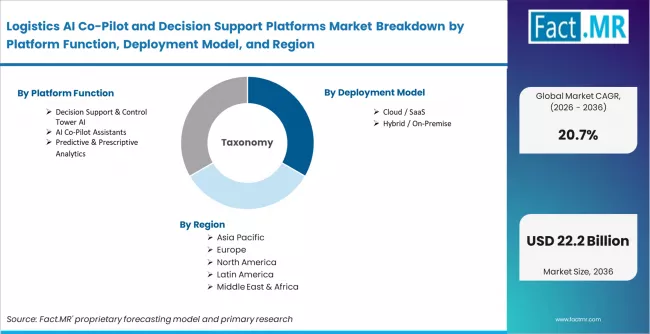
Logistics AI Co Pilot And Decision Support Platforms Market Breakdown By Platform Function, Deployment Model, And Region | Source: Fact.MR
| Attribute | Details |
|---|---|
| Quantitative Units | USD 2.8 billion (2026) to USD 18.9 billion (2036), at a CAGR of 20.7% |
| Market Definition | AI-powered software platforms delivering decision support, co-pilot assistance, prescriptive analytics, and autonomous execution for logistics planning, freight execution, and supply chain control tower operations globally. |
| Platform Function Segmentation | Decision Support & Control Tower AI, AI Co-Pilot Assistants, Predictive & Prescriptive Analytics, Autonomous Execution Agents |
| Deployment Model Segmentation | Cloud / SaaS, Hybrid / On-Premise |
| Application Coverage | Freight carrier selection, load and route optimization, supply chain exception management, control tower real-time orchestration, and autonomous logistics execution for 3PLs, shippers, and freight brokers. |
| Regions Covered | North America, Europe, Asia Pacific, Latin America, Middle East and Africa |
| Countries Covered | USA, Canada, Mexico, Germany, UK, France, Italy, Spain, Nordic, BENELUX, China, Japan, South Korea, India, ASEAN, Australia and New Zealand, Brazil, Argentina, Chile, Saudi Arabia, GCC, Turkey, South Africa, Rest of MEA |
| Key Companies Profiled | SAP, Oracle, Blue Yonder, Kinaxis, Microsoft, IBM, project44, FourKites, Optimal Dynamics, Nextmv, Loadsmart |
| Forecast Period | 2026 to 2036 |
| Approach | Hybrid top-down and bottom-up model using platform subscription revenues, enterprise logistics AI deployment volumes by function, average contract values by deployment model, freight network AI adoption benchmarks, and primary interviews with 3PL technology leads and enterprise supply chain procurement managers. |
Source: Fact.MR analysis. Updated May 7, 2026
Logistics AI Co-Pilot and Decision Support Platforms Market by Segments
By Platform Function:
- Decision Support & Control Tower AI
- AI Co-Pilot Assistants
- Predictive & Prescriptive Analytics
- Autonomous Execution Agents
By Deployment Model:
- Cloud / SaaS
- Hybrid / On-Premise
By Region:
- North America
- United States
- Canada
- Mexico
- Latin America
- Brazil
- Argentina
- Rest of Latin America
- Western Europe
- Germany
- United Kingdom
- France
- Italy
- Spain
- Nordic Countries
- BENELUX
- Rest of Western Europe
- Eastern Europe
- Russia
- Poland
- Hungary
- Balkan and Baltic
- Rest of Eastern Europe
- East Asia
- China
- Japan
- South Korea
- South Asia and Pacific
- India
- ASEAN
- Australia and New Zealand
- Rest of South Asia and Pacific
- Middle East and Africa
- Kingdom of Saudi Arabia
- Other GCC Countries
- Turkey
- South Africa
- Rest of Middle East and Africa
Bibliography
- [1] Blue Yonder. 2024. Luminate Control Tower Expansion and AI Exception Management Overview. Scottsdale: Blue Yonder Group Inc.
- [2] Kinaxis. 2024. RapidResponse AI Co-Pilot Module Launch Brief. Ottawa: Kinaxis Inc.
- [3] Global Logistics Technology Council. 2024. Enterprise Control Tower AI Adoption Trends Report. London: GLTC.
- [4] SAP. 2025. Business Network for Logistics AI Expansion and Co-Pilot Deployment Overview. Walldorf: SAP SE.
- [5] project44. 2024. Movement AI Platform Update and Predictive Routing Capabilities Report. Chicago: project44 Inc.
- [6] International Data Corporation. 2024. Global Logistics AI Platform Adoption and SaaS Growth Report. Framingham: IDC.
- [7] Blue Yonder. 2024. Luminate Platform AI Co-Pilot Expansion and Enterprise Renewal Analysis. Scottsdale: Blue Yonder Group Inc.
This Report Addresses
- Strategic intelligence on logistics AI co-pilot and decision support platform demand across control tower AI, co-pilot assistants, prescriptive analytics, and autonomous execution for 3PLs, shippers, and freight brokers globally.
- Market forecast from USD 2.8 billion in 2026 to USD 18.9 billion by 2036, at a CAGR of 20.7%.
- Growth opportunity mapping across India digital logistics expansion, China AI ecosystem scale, U.S. enterprise SaaS adoption, Germany Industry 4.0 integration, UK retail logistics AI, and Japan labour-driven automation.
- Segment analysis by platform function (control tower AI, co-pilot assistants, prescriptive analytics, autonomous agents) and deployment model (cloud SaaS, hybrid/on-premise).
- Regional outlook covering Asia Pacific high-growth AI deployment, North America enterprise SaaS consolidation, and Europe Industry 4.0 and resilience-driven procurement.
- Competitive analysis of SAP, Oracle, Blue Yonder, Kinaxis, Microsoft, project44, FourKites, Optimal Dynamics, Nextmv, and Loadsmart. Focus on AI decision quality, data network advantage, and ERP integration depth.
- Technology tracking on AI co-pilot assistant modules, control tower prescriptive analytics, autonomous execution agents, cloud-native SaaS deployment, and enterprise logistics AI adoption curves.
- Report delivered in PDF, Excel, and presentation formats. Supported by primary interviews, vendor disclosures, enterprise procurement benchmarks, and logistics AI deployment records.
Logistics AI Co-Pilot and Decision Support Platforms Market Definition
The market covers AI-powered software platforms used by logistics operators, shippers, and 3PLs to automate and augment planning and execution decisions. These platforms deliver real-time control tower visibility, prescriptive analytics, and AI co-pilot assistants.
-
Logistics AI Co-Pilot and Decision Support Platforms Market Inclusions
- Covers global and regional forecasts from 2026 to 2036 by platform function and deployment model. Includes cloud SaaS, hybrid, and on-premise deployments. Covers 3PL operators, shippers, freight brokers, and enterprise supply chain teams across decision support, co-pilot assistant, and autonomous execution platform categories.
-
Logistics AI Co-Pilot and Decision Support Platforms Market Exclusions
- Excludes standalone TMS and WMS platforms without embedded AI decision or co-pilot layers. Omits general-purpose enterprise AI tools not purpose-built for logistics workflows. Excludes warehouse robotics hardware and physical automation systems.
-
Logistics AI Co-Pilot and Decision Support Platforms Market Research Methodology
- Primary Research:Interviews with logistics AI platform vendors, 3PL technology leads, and enterprise supply chain procurement managers across key markets.
- Desk Research:Uses Blue Yonder, SAP, Oracle, Kinaxis, and project44 public disclosures. Includes enterprise logistics AI adoption data and SaaS contract benchmarks from 2024 to 2025.
- Market Sizing and Forecasting:Hybrid top-down and bottom-up model. Based on platform subscription revenues and deployment volumes by function type and enterprise segment.
- Data Validation and Update Cycle:Validated using vendor revenues and enterprise procurement records. Cross-checked with analyst briefings and industry deployment benchmarks. Updated regularly.
Frequently Asked Questions
How large is the logistics AI co-pilot and decision support platforms market in 2025?
What will the market size be in 2026?
What is the projected market size by 2036?
What is the expected CAGR of the logistics AI co-pilot and decision support platforms market?
What is the absolute dollar opportunity in this market?
Which platform function segment leads the market?
Which deployment model is poised to lead?
Which country shows the fastest growth?
What are logistics AI co-pilot and decision support platforms used for?
What is driving market growth?
Which region leads market growth?
Who are the key market players?
Who worked on this report


Preview the report firsthand - request a free sample
Free SampleGet the brochure for pricing and purchase details
Download PDF