Marketplaces Seller Fulfillment and Logistics Orchestration Platforms Market
The Marketplaces Seller Fulfillment and Logistics Orchestration Platforms Market is analyzed by platform function, including seller fulfillment orchestration and logistics orchestration, forecast 2026 to 2036.
By Fact.MR Consumer Goods DeskLead analyst:
Ayush RajPublished :
13 min read
Fact-checked under the Fact.MR editorial process
Marketplaces Seller Fulfillment and Logistics Orchestration Platforms Market Forecast and Outlook By Fact.MR
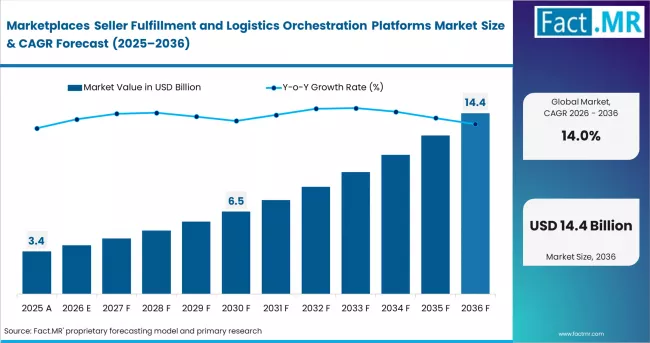
In 2025, the marketplaces seller fulfillment and logistics orchestration platforms market was valued at USD 3.4 billion.
Based on Fact.MR analysis, demand for seller fulfillment and logistics orchestration platforms is estimated to grow to USD 3.8 billion in 2026 and USD 12.6 billion by 2036.
FACT.MR projects a CAGR of 14.0% during the forecast period.
Marketplaces Seller Fulfillment And Logistics Orchestration Platforms Market Market Value Analysis | Source: Fact.MR
Metric
Value
Estimated Value in 2026
USD 3.8 billion
Forecast Value in 2036
USD 12.6 billion
Forecast CAGR (2026 to 2036)
14.0%
Source: Fact.MR analysis. Updated May 7, 2026
Summary of Marketplaces Seller Fulfillment and Logistics Orchestration Platforms Market
Market Definition
The market covers cloud and on-premise platforms used by marketplace sellers and logistics aggregators to orchestrate order fulfillment, carrier selection, inventory sync, and returns across multi-channel, multi-node ecosystems.
Demand Drivers
Amazon Fulfilled by Merchant and Multi-Channel Fulfillment programs are increasing reliance on third-party orchestration platforms across the United States and Europe.
Open Network for Digital Commerce in India is driving adoption of standardized orchestration software through interoperability mandates.
Seller aggregators in the United States and United Kingdom are consolidating brands, increasing demand for centralized fulfillment orchestration.
Key Segments Analyzed
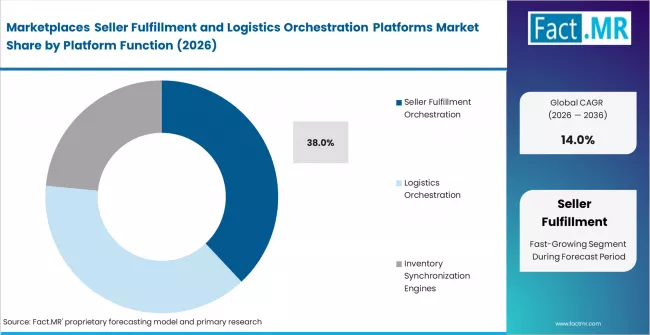
By Platform Function: Seller Fulfillment Orchestration leads with 38% share in 2026, driven by multi-node routing and marketplace complexity.
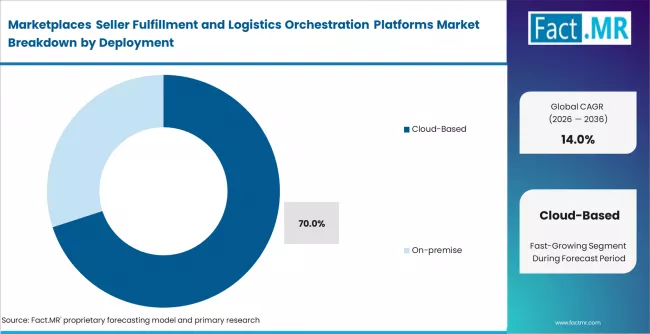
By Deployment: Cloud-based platforms dominate with ~70% share in 2026, supported by API-first integration and faster onboarding.
By Seller Type: Large sellers and aggregators lead with 45% share in 2026 due to scale and enterprise investment capacity.
By Geography: India leads with 17.2% CAGR through 2036, driven by ONDC-led digitization and logistics expansion.
Analyst Opinion at FACT.MR
Shambhu Nath Jha, Principal Consultant at Fact.MR, “CXOs will find platform consolidation to be the key commercial imperative. Vendors offering unified orchestration across routing, carrier selection, inventory sync, and returns within a single API-native platform will capture disproportionate enterprise and aggregator share through 2036.”
Strategic Implications
Invest in API-native platforms with connectors for Amazon, Walmart, eBay, Shopify, and regional marketplaces to reduce onboarding friction.
Expand in India and Southeast Asia through ONDC-compatible modules and logistics partnerships.
Build returns orchestration as a key capability to address rising return rates and compliance needs in the US and Europe.
Methodology
Market sizing is based on active seller counts, platform attach rates, and contract values by seller tier, validated with 2024–2025 data.
Uses marketplace filings, earnings disclosures, ONDC documents, and logistics investment data for validation.
Forecasts incorporate seller growth, platform consolidation, ONDC mandates, and carrier API adoption trends.
The market is projected to generate USD 9.2 billion in absolute opportunity between 2026 and 2036. Growth is structurally anchored in seller ecosystem expansion on major marketplaces. Rising order complexity and multi-channel demand are compelling sellers to adopt unified orchestration platforms, while integration costs and legacy OMS dependencies moderate adoption pace among SMB sellers.
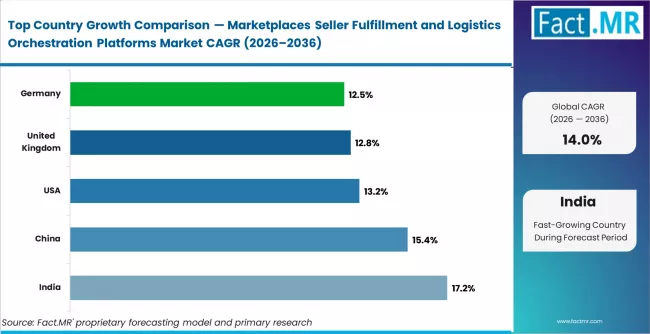
India leads with a projected CAGR of 17.2% through 2036, driven by rapid seller digitization, ONDC marketplace expansion, and government logistics infrastructure investment. China follows at 15.4%, supported by deeply integrated Alibaba and JD.com fulfillment ecosystems. The United States records 13.2%, anchored by Amazon-led seller ecosystem maturity and advanced OMS adoption. The United Kingdom records 12.8%, supported by strong omnichannel retail growth and cross-border marketplace sellers. Germany records 12.5%, driven by logistics automation and EU marketplace expansion. Mature Western European markets face higher integration compliance costs and slower seller onboarding cycles as structural limits.
Segmental Analysis
Marketplaces Seller Fulfillment and Logistics Orchestration Platforms Market Analysis by Platform Function
Marketplaces Seller Fulfillment And Logistics Orchestration Platforms Market Analysis By Platform Function | Source: Fact.MR
Based on FACT.MR, Seller Fulfillment Orchestration holds 38% share in 2026. It leads due to complexity of multi-node routing across FBA and FBM seller workflows. Real-time inventory visibility and order splitting drive platform adoption. Logistics Orchestration and Returns Orchestration are secondary but fast-growing functions.
ShipBob Platform Expansion: Launched multi-node fulfillment orchestration update in Q2 2024. Added FBA/FBM sync and automated routing rules for U.S. and EU sellers. Integrated with Amazon, Walmart, and Shopify. [1]
Fluent Commerce Development: Released Order Management System v4 in 2024. Added real-time multi-node inventory visibility and marketplace carrier API connectors. Targeted enterprise brands and aggregators. [2]
Returns Orchestration Trend: Happy Returns reported 35% year-on-year growth in returns orchestration volume in 2024. Marketplace sellers are increasingly requiring integrated returns platforms as Amazon expands its returnless refund policies. [3]
Marketplaces Seller Fulfillment and Logistics Orchestration Platforms Market Analysis by Deployment
Marketplaces Seller Fulfillment And Logistics Orchestration Platforms Market Analysis By Deployment | Source: Fact.MR
Based on FACT.MR, cloud-based platforms hold approximately 70% share in 2026. API-native architecture and subscription pricing are primary adoption drivers. On-premise deployments remain in large enterprise and regulated logistics environments requiring data sovereignty.
EasyPost Cloud Expansion: Expanded cloud carrier API platform in 2024. Added 50 new carrier integrations and real-time rate shopping for U.S. and cross-border sellers. Processed over 1 billion shipments annually. [4]
Blue Yonder SaaS Migration: Released cloud-native Luminate Commerce platform in 2024. Transitioned major retail logistics clients from on-premise OMS to SaaS-based fulfillment orchestration. [5]
Cloud Adoption Trend: Salesforce 2024 Connected Commerce Report found 68% of marketplace sellers planned to migrate fulfillment orchestration to cloud-native platforms within 12 months due to carrier API flexibility and cost. [6]
Regional Analysis
The marketplaces seller fulfillment and logistics orchestration platforms market is assessed across Asia Pacific, North America, Europe, Latin America, and Middle East and Africa, covering 40+ countries with distinct demand profiles shaped by marketplace penetration, seller digitization, logistics infrastructure, and regulatory frameworks. The full report provides market attractiveness analysis by region and country.
Top Country Growth Comparison Marketplaces Seller Fulfillment And Logistics Orchestration Platforms Market Cagr (2026 2036) | Source: Fact.MR
Country
CAGR (2026 to 2036)
India
17.2%
China
15.4%
United States
13.2%
United Kingdom
12.8%
Germany
12.5%
Source: Fact.MR analysis. Updated May 7, 2026
Source: Fact.MR (FACT.MR) analysis, based on proprietary forecasting model and primary research
Marketplaces Seller Fulfillment And Logistics Orchestration Platforms Market Cagr Analysis By Country | Source: Fact.MR
Asia Pacific Marketplaces Seller Fulfillment and Logistics Orchestration Platforms Market Analysis
Asia Pacific is the highest-growth region and an emerging platform innovation epicenter. India and China drive seller ecosystem expansion. Alibaba Group, JD.com, and Flipkart are deepening fulfillment orchestration integration across their seller bases. Open Network for Digital Commerce in India and national logistics infrastructure investments across the region are accelerating platform adoption.
India: Seller digitization and ONDC mandates support 17.2% CAGR through 2036, the fastest among tracked markets. Department for Promotion of Industry and Internal Trade issued ONDC seller interoperability compliance guidelines in Q1 2024. Logistics service providers onboarded under ONDC expanded to 120+ cities by Q3 2024. Meesho and Flipkart onboarded 400,000 new sellers requiring fulfillment orchestration tools in 2024. Shiprocket secured USD 100 million in logistics platform investment in Q2 2024 to expand orchestration capabilities. National Logistics Policy 2024 allocated USD 500 million to digital logistics infrastructure. Growth is mandate-driven and volume-led across both public marketplace and private seller ecosystems.
China: Alibaba Group and JD.com ecosystem integration supports 15.4% CAGR through 2036. National Development and Reform Commission released e-commerce logistics infrastructure guidelines in Q2 2024. Cainiao Network expanded smart fulfillment orchestration coverage to 300+ cities in 2024. JD Logistics launched open fulfillment API for third-party sellers in Q1 2025. Cross-border seller volumes on Alibaba's AliExpress platform grew 28% in 2024, increasing demand for multi-node routing tools.
Fact.MR's analysis covers India, China, Japan, South Korea, ASEAN, and Australia and New Zealand. It includes seller ecosystem trends, platform adoption rates, and logistics infrastructure investment impacts.
North America Marketplaces Seller Fulfillment and Logistics Orchestration Platforms Market Analysis
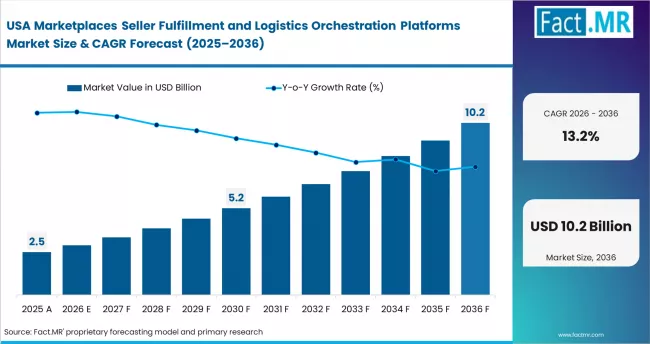
Marketplaces Seller Fulfillment And Logistics Orchestration Platforms Market Country Value Analysis | Source: Fact.MR
North America is the leading market by platform revenue and the standard-setter for enterprise OMS adoption. Amazon-led seller ecosystem mandates and advanced logistics APIs define platform requirements. ShipBob, ShipStation, and EasyPost lead institutional seller fulfillment supply.
United States: Amazon-led seller ecosystem and OMS maturity support 13.2% CAGR through 2036. Amazon updated Fulfilled by Merchant performance metrics in Q1 2024, compelling sellers to adopt automated routing platforms. FTC issued marketplace seller compliance guidance in Q2 2024 covering fulfillment accuracy standards. Walmart expanded its Walmart Fulfillment Services to 12,000 additional sellers in 2024. ShipBob processed over 10 million orders monthly in 2024 across U.S. multi-node fulfillment centers.
Fact.MR's analysis covers United States, Canada, and Mexico. It includes Amazon policy timelines, Walmart seller programme updates, and OMS platform procurement trends.
Europe Marketplaces Seller Fulfillment and Logistics Orchestration Platforms Market Analysis
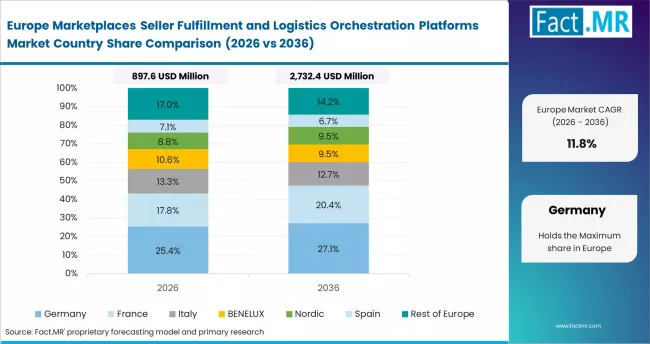
Marketplaces Seller Fulfillment And Logistics Orchestration Platforms Market Europe Country Market Share Analysis, 2026 & 2036 | Source: Fact.MR
Europe is a regulatory-driven market. EU Digital Services Act seller compliance mandates and cross-border marketplace expansion are reshaping platform requirements. Manhattan Associates and Blue Yonder lead enterprise fulfillment orchestration supply in the region.
United Kingdom: Omnichannel retail depth and cross-border marketplace growth support 12.8% CAGR through 2036. UK Competition and Markets Authority issued online marketplace seller fairness guidelines in Q2 2024. Royal Mail and Evri updated carrier API frameworks for third-party OMS integrations in Q3 2024. ASOS onboarded 2,000 new marketplace sellers requiring fulfillment orchestration in 2024. Shopify UK expanded Fulfillment Network partnerships with three new UK 3PL providers in Q1 2025. Growth is driven by cross-border seller volume and omnichannel logistics integration.
Germany: Logistics automation leadership and EU marketplace expansion support 12.5% CAGR through 2036. German Federal Network Agency updated e-commerce logistics data reporting requirements in Q1 2024. Otto Group expanded marketplace platform to 50,000 active sellers requiring integrated OMS tools in 2024. DHL Supply Chain launched API-native fulfillment orchestration service for SMB marketplace sellers in Q2 2024.
Fact.MR's analysis covers Germany, France, United Kingdom, Italy, Spain, and Rest of Europe. It includes EU DSA compliance timelines, carrier API frameworks, and omnichannel platform adoption trends.
Competitive Aligners for Market Players
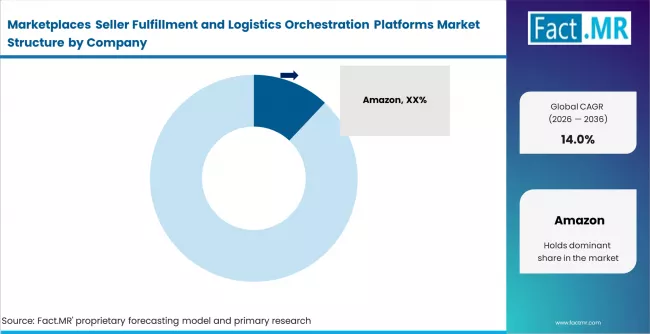
Marketplaces Seller Fulfillment And Logistics Orchestration Platforms Market Analysis By Company | Source: Fact.MR
The competitive landscape is consolidating around full-stack orchestration platforms rather than fragmented tools. Vendors are competing on their ability to unify order routing, inventory visibility, carrier integration, and returns within a single system. Platforms that act as a central operating layer for multi-channel commerce are gaining clear advantage.
Large enterprise software providers such as SAP, Oracle, and Blue Yonder dominate the upper tier. These players offer deep integration across ERP, WMS, and transportation systems, making them preferred by large retailers and global sellers. Their strength lies in handling high-volume, multi-region operations with complex routing and inventory logic.
Mid-market and API-first platforms are rapidly gaining share. Companies like Fluent Commerce, Linnworks, and Zoho Inventory are focusing on flexibility, faster deployment, and integration across marketplaces like Amazon and Shopify. These platforms are positioning themselves as scalable orchestration layers for aggregators and fast-growing sellers.
Logistics-tech players such as ShipBob, ShipStation, and EasyPost compete by embedding orchestration into fulfillment services. Their differentiation lies in combining software with execution capability, enabling sellers to manage multi-node logistics without building infrastructure. Competitive differentiation is increasingly defined by real-time decisioning. Vendors that provide AI-driven routing, inventory synchronization, and predictive fulfillment are gaining traction. The shift toward multi-node commerce and rising order complexity is reinforcing demand for intelligent orchestration engines. Thus, the market is moving toward consolidation. Vendors offering unified, API-native platforms are capturing enterprise and aggregator demand, while standalone tools with limited integration are gradually losing relevance.
[2] Fluent Commerce. 2024. Order Management System v4 Release Overview. Sydney: Fluent Commerce Pty Ltd.
[3] Happy Returns (a PayPal company). 2024. Returns Orchestration Growth Report. Santa Monica: Happy Returns LLC.
[4] EasyPost. 2024. Carrier API Platform Expansion and Shipment Volume Report. San Francisco: EasyPost Inc.
[5] Blue Yonder. 2024. Luminate Commerce Platform SaaS Migration Brief. Scottsdale: Blue Yonder Group Inc.
[6] Salesforce. 2024. Connected Commerce Report. San Francisco: Salesforce Inc.
This Report Addresses
Strategic intelligence on seller fulfillment and logistics orchestration platform demand across seller fulfillment, logistics orchestration, inventory synchronization, and returns orchestration function types for marketplace and D2C seller applications globally.
Market forecast from USD 3.8 billion in 2026 to USD 12.6 billion by 2036 at a CAGR of 14.0%.
Growth opportunity mapping across India ONDC seller digitization, China Alibaba and JD ecosystem scale, United States Amazon-led OMS adoption, UK omnichannel marketplace expansion, and Germany logistics automation and EU DSA compliance.
Segment analysis by platform function (fulfillment orchestration, logistics orchestration, inventory sync, returns orchestration), deployment (cloud-based, on-premise), and seller type (large sellers/aggregators, SMB sellers, D2C brands).
Regional outlook covering Asia Pacific high-growth seller digitization, North America enterprise OMS penetration, and Europe EU DSA compliance and omnichannel marketplace-driven platform procurement.
Competitive analysis of Amazon, Alibaba Group, eBay, Walmart, Manhattan Associates, Blue Yonder, Fluent Commerce, Shopify, ShipBob, ShipStation, and EasyPost. Focus on marketplace API coverage, carrier network breadth, and orchestration depth.
Regulatory impact analysis covering ONDC seller interoperability mandates in India, Amazon MCF policy updates in the United States, EU Digital Services Act fulfillment reporting requirements, and cross-border e-commerce logistics compliance across covered markets.
Report delivered in PDF, Excel datasets, and presentation formats. Supported by primary interviews, marketplace seller surveys, platform earnings disclosures, logistics policy filings, and government e-commerce infrastructure investment records.
Marketplaces Seller Fulfillment and Logistics Orchestration Platforms MarketDefinition
The market covers software platforms used by marketplace sellers to orchestrate order fulfillment, carrier selection, inventory synchronization, and reverse logistics across multi-channel and multi-node commerce environments.
Marketplaces Seller Fulfillment and Logistics Orchestration Platforms Market Inclusions
Covers global and regional forecasts from 2026 to 2036. Includes platform function, deployment, and seller type segments. Covers cloud-based and on-premise orchestration platforms. Includes seller fulfillment routing, carrier management, inventory sync, and returns orchestration across marketplace and D2C seller environments.
Marketplaces Seller Fulfillment and Logistics Orchestration Platforms Market Exclusions
Excludes standalone warehouse management systems not integrated with marketplace APIs. Omits pure transportation management platforms unless serving marketplace seller orchestration. Excludes last-mile carrier networks and fleet operations. Focus remains on software orchestration layers and their immediate seller fulfillment applications.
Marketplaces Seller Fulfillment and Logistics Orchestration Platforms Market Research Methodology
Primary Research: Interviews with marketplace seller operations heads, logistics platform product managers, e-commerce fulfillment directors, and OMS architects at key companies across the United States, China, India, Germany, and the United Kingdom.
Desk Research: Uses marketplace seller policy disclosures, logistics platform investor filings, company earnings transcripts, and government e-commerce logistics programme data from 2024 to 2025.
Market-Sizing and Forecasting: Hybrid model using active marketplace seller counts by tier, platform attach rates by deployment type, and average contract values by seller segment across all covered geographies and platform function types.
Data Validation and Update Cycle: Validated using platform revenue disclosures, marketplace seller surveys, and logistics policy filings. Cross-checked with industry expert interviews. Updated annually.
Market Breakdown
Segmentation
Scope of Report
Attribute
Details
Quantitative Units
USD 3.8 billion (2026) to USD 12.6 billion (2036), at a CAGR of 14.0%
Market Definition
Cloud-based and on-premise software platforms used by marketplace sellers, logistics aggregators, and D2C brands to orchestrate order fulfillment, carrier selection, inventory synchronization, and returns across multi-channel marketplace environments globally.
Large Marketplace Sellers/Aggregators, SMB Sellers, D2C Brands Using Marketplaces
Application Coverage
Multi-node order routing for FBA/FBM sync, carrier and last-mile selection, inventory synchronization across marketplace storefronts, and reverse logistics orchestration for returns compliance across Amazon, Walmart, eBay, Shopify, and regional marketplace platforms.
Regions Covered
North America, Europe, Asia Pacific, Latin America, Middle East and Africa
Countries Covered
USA, Canada, Mexico, Germany, UK, France, Italy, Spain, Nordic, BENELUX, China, Japan, South Korea, India, ASEAN, Australia and New Zealand, Brazil, Argentina, Chile, Saudi Arabia, GCC, Turkey, South Africa, Rest of MEA
Hybrid top-down and bottom-up model using active marketplace seller counts by tier, platform attach rates by deployment type, average contract values by seller segment, marketplace policy timelines, and primary interviews with seller operations and logistics platform executives.
Source: Fact.MR analysis. Updated May 7, 2026
Marketplaces Seller Fulfillment and Logistics Orchestration Platforms Market by Segments
By Platform Function:
Seller Fulfillment Orchestration
Logistics Orchestration
Inventory Synchronization Engines
Returns and Reverse Logistics Orchestration
By Deployment:
Cloud-based
On-premise
By Seller Type:
Large Marketplace Sellers/Aggregators
SMB Sellers
D2C Brands Using Marketplaces
By Region:
North America
United States
Canada
Mexico
Latin America
Brazil
Mexico
Argentina
Chile
Rest of Latin America
Western Europe
Germany
United Kingdom
France
Italy
Spain
Nordic Countries
BENELUX
Rest of Western Europe
Eastern Europe
Russia
Poland
Hungary
Balkan and Baltic
Rest of Eastern Europe
East Asia
China
Japan
South Korea
South Asia and Pacific
India
ASEAN
Australia and New Zealand
Rest of South Asia and Pacific
Middle East and Africa
Kingdom of Saudi Arabia
Other GCC Countries
Turkey
South Africa
Rest of Middle East and Africa
Questions Answered
Frequently Asked Questions
How large is the global marketplaces seller fulfillment and logistics orchestration platforms market in 2025?
The global marketplaces seller fulfillment and logistics orchestration platforms market was valued at USD 3.4 billion in 2025.
What will the market size be in 2026?
Based on Fact.MR analysis, demand for seller fulfillment and logistics orchestration platforms is estimated to grow to USD 3.8 billion in 2026.
What is the projected market size by 2036?
The market is projected to reach USD 12.6 billion by 2036, generating USD 9.2 billion in absolute dollar opportunity over the forecast period.
What is the expected CAGR from 2026 to 2036?
FACT.MR projects a CAGR of 14.0% for the global marketplaces seller fulfillment and logistics orchestration platforms market during the 2026 to 2036 forecast period.
Which platform function segment is poised to lead the market?
Seller Fulfillment Orchestration leads with approximately 38% share in 2026.
Which deployment model dominates the market?
Cloud-based platforms dominate with approximately 70% share in 2026.
Which seller type holds the largest share?
Large marketplace sellers and aggregators lead with approximately 45% share in 2026.
Which country shows the fastest growth?
India leads at 17.2% CAGR through 2036, driven by ONDC seller interoperability mandates, rapid marketplace seller digitization, and national logistics infrastructure investment under the National Logistics Policy.
What is driving demand for seller fulfillment and logistics orchestration platforms?
Demand is driven by expanding marketplace seller ecosystems, multi-channel selling complexity, ONDC mandates in India, Amazon MCF policy updates in the United States, and EU Digital Services Act fulfillment reporting requirements across Europe.
.webp "Top Country Growth Comparison Marketplaces Seller Fulfillment And Logistics Orchestration Platforms Market Cagr (2026 2036)")