- Base Value(2025): 1.9 Bn
- Estimated Value(2026): 2.2 Bn
- Forecast Value (2036): 9.6 Bn
- CAGR (2026 - 2036): 15.9%
Long-Range Radar Sensor Components for Highway ADAS Market Forecast and Outlook (2026 to 2036)
- The market was valued at USD 1.9 billion in 2025 and is estimated to reach USD 2.2 billion in 2026.
- It is projected to expand to USD 9.6 billion by 2036, registering a CAGR of 15.9% over the forecast period.
- Growth reflects rapid adoption of radar-based sensing systems across vehicle safety applications, where detection accuracy and reliability are critical.
- The market is set to generate USD 7.4 billion in incremental opportunity between 2026 and 2036, supported by increasing integration of ADAS features across vehicle platforms.
< Image (2) | Source: Fact.MR.webp "Image (2)")
| Metric | Value |
|---|---|
| Estimated Value in 2026 | USD 2.2 billion |
| Forecast Value in 2036 | USD 9.6 billion |
| Forecast CAGR (2026 to 2036) | 15.9% |
Source: Fact.MR analysis. Updated May 7, 2026
Summary of Long-Range Radar Sensor Components for Highway ADAS Market
- Market Definition
- Long-range radar components enable highway ADAS by detecting vehicles and obstacles at extended distances using radio-frequency sensing.
- Demand Drivers
- Euro NCAP safety requirements are increasing mandatory adoption of radar-based ADAS systems.
- Chinese OEMs are expanding radar deployment in mid-range vehicles to meet domestic safety standards.
- U.S. fleet operators are adopting collision avoidance systems to improve operational safety.
- Key Segments Analyzed
- By Frequency Band: 77 GHz is expected to account for 69.0% share in 2026.
- By Vehicle Type: Passenger cars are projected to represent 76.0% share in 2026.
- By Geography: China leads with 17.4% CAGR through the forecast period.
- Analyst Opinion at FACT.MR
- Shambhu Nath Jha, Senior Analyst at Fact.MR, states that radar systems are moving into standard vehicle safety configurations across passenger cars. OEMs are aligning hardware deployment with regulatory requirements, as safety mandates increasingly require reliable sensing systems. Radar technologies support functions such as collision detection, blind spot monitoring, and adaptive assistance, making them central to ADAS architectures. As integration expands across vehicle segments, radar systems are becoming a core component of vehicle design, influencing platform development and long-term safety strategies.
- Strategic Implications
- Expand production of 77 GHz radar systems to meet rising regulatory demand, as higher-frequency radar supports improved detection accuracy, resolution, and compliance with evolving safety standards across vehicle platforms. Increased production capacity also helps support large-scale OEM integration.
- Strengthen OEM partnerships to support integrated ADAS deployment, ensuring radar systems align with vehicle architecture, software platforms, and safety requirements. Close collaboration improves system compatibility and supports long-term supply agreements.
- Focus on cost optimization for mid-segment vehicle adoption, balancing performance and affordability to expand radar integration beyond premium vehicles and support wider market penetration.
- Methodology
- Market sizing uses vehicle production data and ADAS penetration rates to estimate demand across different vehicle segments and regions, reflecting how radar integration scales with overall automotive output and safety feature adoption.
- Analysis incorporates regulatory frameworks and OEM strategies, highlighting how safety mandates, compliance requirements, and platform-level integration decisions influence radar system deployment across global markets.
- Forecasts reflect the transition toward high-frequency radar technologies, showing how improved detection capability, regulatory alignment, and performance requirements are shaping long-term demand and technology adoption trends.
Regulatory mandates are a primary driver, as governments require safety systems such as collision avoidance, blind spot detection, and adaptive assistance functions. Increasing ADAS penetration across passenger vehicles is accelerating demand for radar sensors, particularly as these systems move from optional features to standard fitment. The transition toward high-frequency radar systems is further strengthening demand, as these technologies offer improved resolution, better object detection, and more reliable performance in complex driving environments.
China is projected to grow at 17.4% CAGR through 2036, supported by large-scale vehicle production and strong regulatory enforcement. South Korea is expected to expand at 16.2%, driven by advanced automotive technology integration. The United States is likely to grow at 15.6%, followed by Germany at 14.9% and Japan at 14.2%, where adoption is supported by safety standards and continued advancement in vehicle technologies.
Drivers, Restraints, and Opportunities
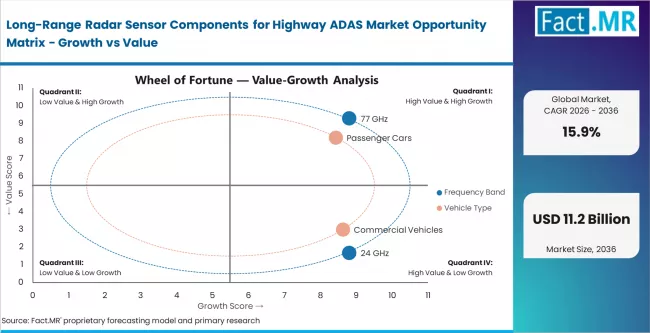
Long Range Radar Sensor Components For Highway Adas Market Opportunity Matrix Growth Vs Value | Source: Fact.MR
The market is in a rapid growth phase, supported by regulatory enforcement and increasing integration of ADAS features across vehicle platforms. Demand is closely linked to highway driving applications, where radar systems provide reliable detection under varying environmental conditions such as low visibility, rain, and traffic density. As safety features become part of standard vehicle configurations, radar sensing is moving from optional deployment to baseline integration. The current market size reflects this shift, with OEMs embedding radar systems during production to meet safety requirements and ensure consistent performance across models.
A transition is underway from 24 GHz to 77 GHz radar systems, driven by the need for higher detection accuracy and improved system performance. Higher-frequency radar enables better object resolution and range, though it comes with higher initial costs. OEMs are managing this transition by adopting phased deployment strategies, where premium and mid-range vehicles integrate advanced systems first, followed by gradual expansion into cost-sensitive segments as technology matures and costs stabilize.
- Safety regulation push: UNECE Regulation No. 152 mandates advanced emergency braking systems, increasing radar adoption across Europe and influencing global safety standards.
- Technology migration: The shift toward 77 GHz radar improves detection range and accuracy, while semiconductor integration is reducing system complexity and supporting cost optimization over time.
- Asia production expansion: China and South Korea are increasing radar component manufacturing capacity, supporting domestic OEM demand and strengthening export-oriented supply chains.
Segmental Analysis
Long-Range Radar Sensor Components Market Analysis by Frequency Band
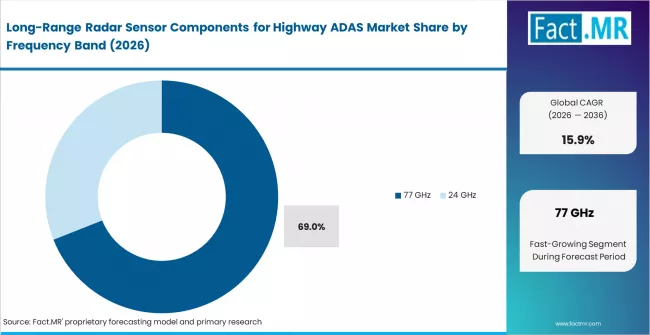
Long Range Radar Sensor Components For Highway Adas Market Analysis By Frequency Band | Source: Fact.MR
77 GHz radar is estimated to account for 69.0% share of the long-range radar sensor components market in 2026, driven by its ability to deliver higher resolution, longer detection range, and improved object recognition. These capabilities are critical for highway driving scenarios, where vehicles operate at higher speeds and require accurate detection of distant objects. Compared to lower-frequency systems, 77 GHz radar provides better performance in complex traffic environments and supports advanced ADAS functions such as adaptive cruise control and collision avoidance. As safety requirements increase, OEMs are standardizing this frequency band across vehicle platforms to ensure consistent performance and regulatory compliance. The shift toward 77 GHz is also supported by improvements in semiconductor design, which are helping reduce system size and improve integration efficiency.
- Infineon expansion: Infineon Technologies expanded automotive radar chipset production capacity in 2024 to meet growing OEM demand for high-frequency radar systems [1]
- NXP innovation: NXP Semiconductors introduced next-generation radar processors in 2025, supporting higher resolution sensing and improved processing capability [2]
- Industry shift: OEMs are standardizing 77 GHz platforms across vehicle models to simplify integration, improve scalability, and align with regulatory expectations
Long-Range Radar Sensor Components Market Analysis by Vehicle Type
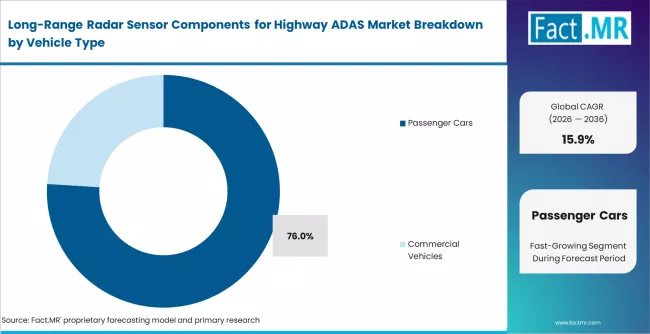
Long Range Radar Sensor Components For Highway Adas Market Analysis By Vehicle Type | Source: Fact.MR
Passenger cars are expected to represent 76.0% share of the market in 2026, supported by high production volumes and increasing adoption of ADAS features. Radar systems are being integrated across multiple vehicle segments, moving from premium models into mid-range and entry-level variants. This shift is driven by regulatory requirements and growing consumer demand for safety features. OEMs are embedding radar sensors during vehicle production to ensure system compatibility and consistent performance across models. As safety ratings and compliance standards become more important, radar integration is becoming a baseline requirement rather than an optional feature.
- Bosch capacity expansion: Robert Bosch GmbH increased radar sensor production capacity in 2024 to support rising OEM demand and large-scale deployment across passenger vehicles [3]
- Continental integration: Continental AG launched compact radar modules for mid-range vehicles in 2025, supporting wider adoption across cost-sensitive segments
- Adoption trend: OEMs are integrating radar systems into base variants to meet safety ratings, regulatory requirements, and consumer expectations
Long-Range Radar Sensor Components Market Analysis by Application
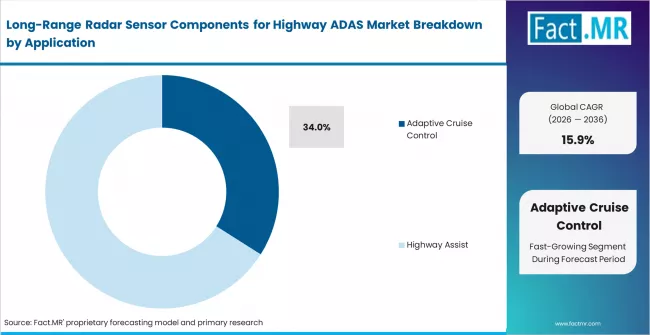
Long Range Radar Sensor Components For Highway Adas Market Analysis By Application | Source: Fact.MR
Adaptive cruise control and highway assist systems are projected to account for 34.0% share of the market in 2026, as these applications rely heavily on long-range radar for accurate distance and speed measurement. These systems enable vehicles to maintain safe following distances, adjust speed automatically, and support semi-autonomous driving functions. As highway driving assistance becomes more common, demand for reliable long-range radar systems continues to increase. Integration with other sensors such as cameras further enhances system performance, supporting improved detection and response capabilities.
- ZF deployment: ZF Friedrichshafen AG expanded ADAS system integration across European vehicle platforms in 2024, supporting wider deployment of radar-based applications [4]
- Valeo development: Valeo introduced advanced radar-based highway assist solutions, improving system accuracy and response in real-world driving conditions
- Fleet demand: Commercial fleets are adopting radar systems to meet safety compliance requirements, improve driver assistance functions, and enhance operational efficiency
Regional Analysis
The market spans North America, Europe, Asia Pacific, Latin America, and Middle East & Africa. Regional demand is shaped by vehicle production, ADAS regulations, and technology adoption levels. The report provides detailed market attractiveness analysis.
.webp "Top Country Growth Comparison Long Range Radar Sensor Components For Highway Adas Market Cagr (2026 2036)")
Top Country Growth Comparison Long Range Radar Sensor Components For Highway Adas Market Cagr (2026 2036) | Source: Fact.MR
| Country | CAGR (2026–2036) |
|---|---|
| China | 17.4% |
| South Korea | 16.2% |
| United States | 15.6% |
| Germany | 14.9% |
| Japan | 14.2% |
Source: Fact.MR analysis. Updated May 7, 2026
Source: Fact.MR (FACTMR) analysis, based on proprietary forecasting model and primary research
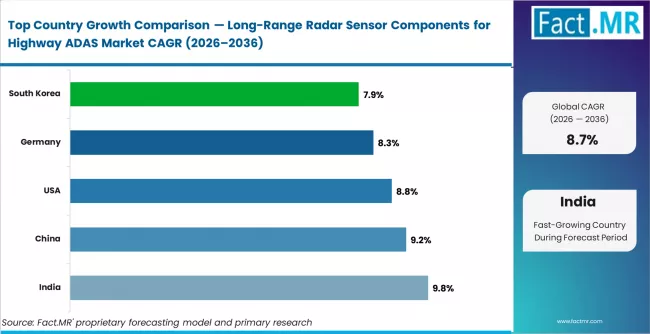
Long Range Radar Sensor Components For Highway Adas Market Cagr Analysis By Country | Source: Fact.MR
Asia Pacific
Asia Pacific functions as the primary production and demand hub for radar-based ADAS systems, supported by large-scale automotive manufacturing and increasing safety regulation alignment. The region benefits from strong domestic OEM ecosystems and expanding semiconductor capabilities, which help accelerate both production and adoption.
- China: China leads the regional landscape, driven by its position as the largest automotive manufacturing base and rapid expansion of ADAS-equipped vehicles. The market is projected to grow at a 17.4% CAGR, reflecting aggressive integration of radar systems across vehicle segments. Regulatory support has strengthened adoption, particularly with safety guidelines introduced in 2024 that encourage radar-based technologies. Domestic automakers are scaling production of vehicles equipped with ADAS features, making radar systems a core component of modern vehicle platforms. Suppliers that align with local OEM production cycles and cost structures can benefit from high-volume opportunities. [5]
- South Korea: South Korea follows closely, supported by advanced automotive manufacturing and strong technology integration capabilities. The market is expected to expand at a 16.2% CAGR, reflecting steady growth driven by both domestic demand and export-oriented production. Automotive manufacturers are expanding ADAS deployment across vehicle lineups, supported by government initiatives promoting safety technologies. Strong semiconductor and electronics capabilities further strengthen supply chain efficiency, allowing local players to maintain competitive advantage.
- Japan: Japan adds a precision-driven dimension to the regional market, where adoption is shaped by engineering standards and gradual technology integration. The market is expected to reach 14.2% CAGR, reflecting steady expansion rather than rapid scale-up. Automotive manufacturers focus on reliability, system accuracy, and seamless integration of radar systems into existing vehicle platforms. Demand is supported by the country’s strong domestic automotive industry and emphasis on safety innovation. Suppliers that align with Japan’s quality expectations and long-term product performance standards can maintain stable growth in this market.
Regional demand across Asia Pacific continues to expand as safety awareness increases and regulatory frameworks evolve. Unlike mature markets, growth here is driven by both new adoption and production scale, creating long-term opportunities for radar system suppliers.
North America
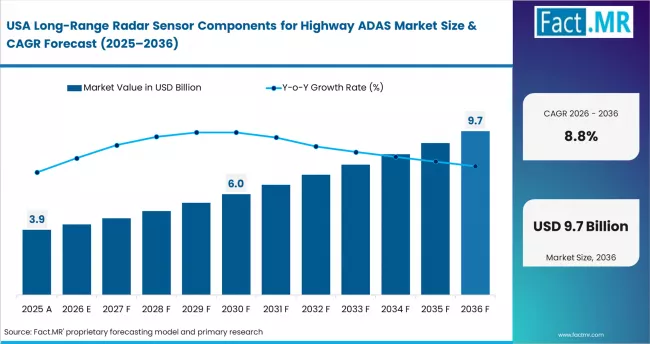
Long Range Radar Sensor Components For Highway Adas Market Country Value Analysis | Source: Fact.MR
North America represents a technology-driven market where regulatory influence and consumer expectations for safety features support radar system adoption. Automotive manufacturers are actively integrating ADAS technologies to enhance vehicle safety and align with evolving regulatory standards.
- U.S.: The United States leads regional demand, supported by strong automotive production and early adoption of advanced safety technologies. The market is anticipated to expand at a CAGR of 15.6%, reflecting significant expansion in radar system integration across both passenger and commercial vehicles. Safety guidelines introduced in 2024 have reinforced the adoption of collision avoidance and driver assistance systems. Automakers are increasing the use of radar sensors to improve vehicle safety performance and meet regulatory requirements. Fleet operators are also adopting these systems to enhance compliance and reduce operational risks.
Demand in North America is further supported by a mature automotive ecosystem and strong OEM-supplier relationships. Suppliers that offer high-performance radar systems with seamless integration into vehicle platforms can maintain a competitive edge in this market.
Europe
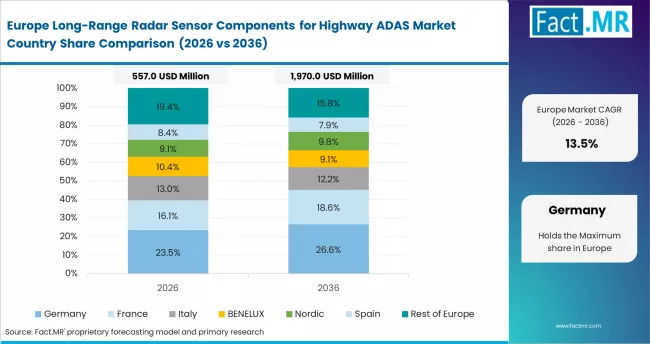
Long Range Radar Sensor Components For Highway Adas Market Europe Country Market Share Analysis, 2026 & 2036 | Source: Fact.MR
Europe operates as a compliance-driven market where regulatory enforcement plays a central role in shaping radar system adoption. The region has implemented stringent safety protocols, making ADAS technologies a requirement rather than an optional feature.
- Germany: Germany remains a key market, supported by its strong automotive manufacturing base and emphasis on engineering precision. The market is expected to record a 14.9% CAGR, reflecting steady demand driven by regulatory compliance. Stricter Euro NCAP protocols introduced in 2024 have accelerated the integration of radar systems across vehicle platforms. Automakers are prioritizing compliance with safety standards, leading to widespread adoption of radar-based ADAS features.
Across Europe, demand is closely tied to regulatory frameworks rather than consumer-driven adoption alone. This creates a stable market environment where suppliers must meet strict technical and compliance standards to remain competitive.
Competitive Aligners for Market Players
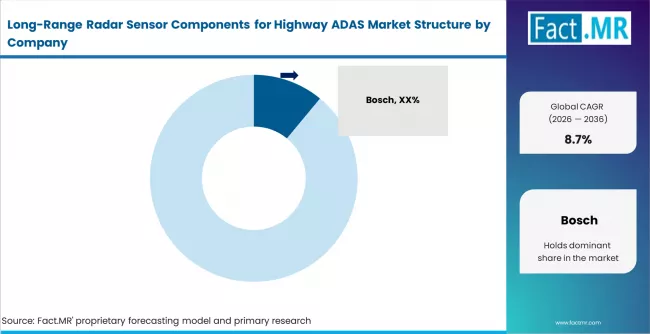
Long Range Radar Sensor Components For Highway Adas Market Analysis By Company | Source: Fact.MR
The market remains moderately concentrated, with leading Tier-1 suppliers accounting for a significant share of radar sensor system demand across automotive platforms. Competition is shaped by technology capability, system reliability, and the ability to integrate radar components within broader ADAS architectures. Suppliers must meet strict validation standards and deliver consistent performance across varying driving conditions, which limits entry for new participants and strengthens the position of established players.
Companies such as Robert Bosch GmbH, Continental AG, and Denso Corporation benefit from long-standing OEM relationships and advanced radar and semiconductor capabilities. Their experience in system-level integration and large-scale production supports consistent delivery across multiple vehicle programs. These companies also maintain strong global supply networks, allowing them to respond to OEM requirements with greater flexibility and reliability.
Vertical integration provides additional advantages by improving control over semiconductor design, module assembly, and system integration. This structure supports cost management, reduces dependency on external suppliers, and allows better alignment between hardware and software components. As radar systems become more complex, integration capability becomes a key differentiator in supplier selection.
OEMs maintain diversified supplier networks to reduce dependency risks and ensure continuity of supply. Long qualification cycles and integration complexity limit rapid supplier switching, as replacing a supplier requires extensive validation and system adjustments. These structural factors help established players retain strong positioning, while newer entrants face challenges in scaling without proven performance and integration capability.
Key Players
- Robert Bosch GmbH
- Continental AG
- ZF Friedrichshafen AG
- Aptiv PLC
- Valeo SA
- DENSO Corporation
- FORVIA HELLA
- NXP Semiconductors
- Infineon Technologies AG
- Onsemi
Long-Range Radar Sensor Components Market by Segments
-
By Frequency Band
- 24 GHz
- 77 GHz
-
By Vehicle Type
- Passenger Cars
- Commercial Vehicles
-
By Application
- Adaptive Cruise Control
- Highway Assist
- Collision Avoidance
-
By Region
-
North America
- United States
- Canada
- Europe
- Germany
- United Kingdom
- France
- Italy
- Spain
- Asia Pacific
- ` China
- Japan
- South Korea
- Taiwan
- Singapore
- Latin America
- Brazil
- Mexico
- Argentina
- Middle East & Africa
- GCC Countries
- South Africa
- Israel
-
Bibliography
- [1] Infineon Technologies. Automotive Radar Chipset Production Expansion. 2024. infineon.com
- [2] NXP Semiconductors. Radar Processor Product Launch Announcement. 2025. nxp.com
- [3] Robert Bosch GmbH. Automotive Radar Production Expansion Update. 2024. bosch.com
- [4] ZF Friedrichshafen AG. ADAS System Integration Report. 2024. zf.com
- [5] Ministry of Industry and Information Technology (China). Automotive Safety and ADAS Policy Update. 2024. miit.gov.cn
This Report Addresses
- Strategic intelligence on long-range radar sensor component demand across highway ADAS applications including adaptive cruise control, collision avoidance, and lane-keeping systems.
- Market forecast from USD 2.2 billion in 2026 to USD 9.6 billion by 2036 at a CAGR of 15.9%.
- Growth opportunity mapping across high-speed ADAS deployment in China, South Korea, the United States, and Germany driven by safety regulations and OEM integration.
- Segment analysis by frequency band (77 GHz), vehicle type (passenger cars), and application (adaptive cruise control / highway assist systems).
- Regional outlook covering Asia Pacific manufacturing expansion, North America ADAS adoption trends, and Europe’s regulatory-driven safety system deployment.
- Competitive analysis of leading players including Bosch, Continental, ZF, Aptiv, Valeo, and semiconductor suppliers such as NXP and Infineon.
- Regulatory impact analysis covering Euro NCAP safety ratings, U.S. NHTSA guidelines, and China’s intelligent vehicle roadmap influencing radar adoption.
- Report delivery in PDF, Excel datasets, and presentation formats supported by primary interviews, OEM sourcing data, and semiconductor supply chain analysis.
Long-Range Radar Sensor Components for Highway ADAS Market Definition
Long-range radar sensor components are electronic systems that use radio-frequency signals to detect vehicles, obstacles, and movement at extended distances, typically beyond 150 meters. These sensors measure distance, speed, and direction to support highway driving functions. Their primary role is to enable features such as adaptive cruise control, forward collision warning, and automated highway driving. These components are integrated into passenger and commercial vehicles as part of advanced driver assistance systems, where consistent detection performance across weather and lighting conditions is essential for safe operation.
Long-Range Radar Sensor Components for Highway ADAS Market Inclusions
The report covers global and regional market size estimates and forecasts from 2026 to 2036. It includes segmentation by frequency band, vehicle type, and application. The study evaluates OEM installation trends, pricing structures, and supply chain dynamics. It also incorporates regulatory frameworks influencing ADAS deployment and analyzes technology transitions across regions.
Long-Range Radar Sensor Components for Highway ADAS Market Exclusions
The scope excludes short-range radar, ultrasonic sensors, and camera-only systems unless integrated within long-range radar modules. It omits full ADAS software platforms and autonomous driving stacks. The analysis focuses strictly on radar hardware components and associated electronic modules used in highway driving applications.
Long-Range Radar Sensor Components for Highway ADAS Market Research Methodology
- Primary Research:Interviews with automotive OEMs, Tier-1 suppliers, semiconductor manufacturers, and ADAS system integrators.
- Desk Research:Data sources include UNECE safety regulations, Euro NCAP protocols, NHTSA guidelines, and company reports from Bosch, Continental, and Infineon.
- Market-Sizing and Forecasting:Hybrid model combining vehicle production volumes, ADAS penetration rates, and radar component pricing.
- Data Validation and Update Cycle:Validated through OEM production data, supplier shipment volumes, and regulatory compliance tracking
Segmentation
Scope of the Report
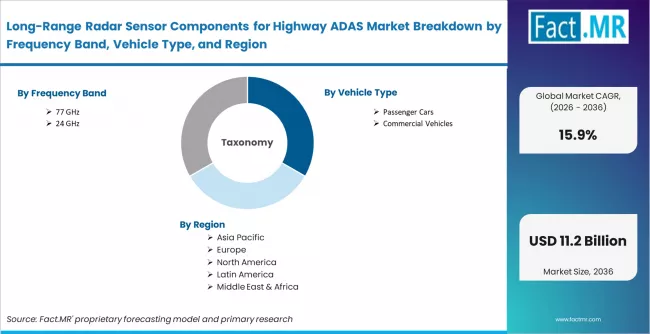
Long Range Radar Sensor Components For Highway Adas Market Breakdown By Frequency Band, Vehicle Type, And Region | Source: Fact.MR
| Attribute | Value |
|---|---|
| Quantitative Units | USD 2.2 billion (2026) to USD 9.6 billion (2036), at a CAGR of 15.9% |
| Market Definition | Long-range radar components used in ADAS for highway driving applications |
| Frequency Band Segmentation | 24 GHz, 77 GHz |
| Vehicle Type Segmentation | Passenger Cars, Commercial Vehicles |
| Application Segmentation | Adaptive Cruise Control, Highway Assist, Collision Avoidance |
| Regions Covered | North America, Europe, Asia Pacific, Latin America, Middle East & Africa |
| Countries Covered | USA, Canada, Germany, UK, France, Italy, Spain, China, Japan, South Korea, Taiwan, Singapore, Brazil, Mexico, Argentina, GCC, South Africa, Israel |
| Key Companies Profiled | Bosch, Continental, ZF, Aptiv, Valeo, DENSO, FORVIA HELLA, NXP, Infineon, onsemi |
| Forecast Period | 2026 to 2036 |
| Approach | Hybrid model using vehicle production, ADAS penetration, and radar pricing |
Source: Fact.MR analysis. Updated May 7, 2026
Frequently Asked Questions
How large is the long-range radar sensor components market in 2025?
What will the market size be in 2026?
What is the projected market size by 2036?
What is the expected CAGR from 2026 to 2036?
Which frequency band segment is poised to lead the market?
Which vehicle type dominates demand?
Which application segment holds the largest share?
Which country shows the fastest growth?
What is driving demand for long-range radar sensors?
What is the key challenge in this market?
Why is 77 GHz radar technology preferred?
How are regulations influencing market growth?
What role do semiconductor suppliers play in this market?
How is OEM fitment impacting demand?
What industries benefit most from this market?
Who worked on this report


Preview the report firsthand - request a free sample
Free SampleGet the brochure for pricing and purchase details
Download PDF