- Base Value(2026): 7.9 Bn
- Estimated Value(2026): 7.9 Bn
- Forecast Value (2036): 30.9 Bn
- CAGR (2026 - 2036): 14.6%
Automotive Radar Sensors Market Forecast and Outlook 2026 to 2036
In 2025, the automotive radar sensors market surpassed a valuation of USD 7.0 billion. Based on Fact.MR analysis, demand for automotive radar sensors is estimated to grow to USD 7.9 billion in 2026 and USD 30.9 billion by 2036. Fact.MR projects a CAGR of 14.6% during the forecast period.
Between 2026 and 2036, the automotive radar sensors market is projected to generate an absolute dollar opportunity of USD 23.0 billion a near-fourfold expansion driven by mandatory ADAS fitment regulation, multi-radar sensor stacking per vehicle, and rising radar content in economy and mid-sized passenger car segments previously underserved by premium-priced LiDAR alternatives. Growth is moderated by semiconductor supply chain concentration and per-unit radar chipset price erosion as volumes scale.
Prof. Amnon Shashua, President and CEO of Mobileye said. "The selection of our imaging radar by this new customer validates the groundbreaking work we undertook to develop our imaging radar. After recognizing how important this sensing modality would be to autonomous driving, we built what we believe is the industry's standard for imaging radar that can deliver the safety and accuracy self-driving systems require."
Country growth reflects ADAS regulation timelines, vehicle production scale, and OEM adoption curves. China leads at 20.1% CAGR, driven by GB/T ADAS standards and NEV platform radar integration. India follows at 19.5% under AIS-190 AEB mandate timelines. Germany posts 18.4% as Euro NCAP 2026 and UN Regulation No. 152 drive OEM radar fitment across all segments. Brazil registers 17.2% as CONTRAN Resolution 996 introduces phased ADAS requirements. The United States posts 14.4% anchored by NHTSA AEB final rule expanding mandatory fitment. The United Kingdom advances at 11.4%, constrained by post-Brexit regulatory alignment timelines but supported by NCAP compliance investment.
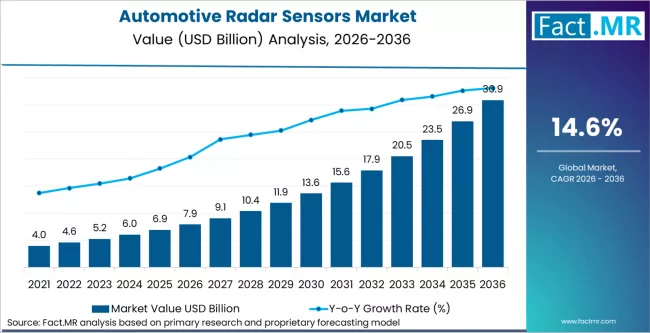
Automotive Radar Sensors Market Market Value Analysis | Source: Fact.MR
| Metric | Value |
|---|---|
| Estimated Value in 2026 | USD 7.9 billion |
| Forecast Value in 2036 | USD 30.9 billion |
| Forecast CAGR (2026 to 2036) | 14.6% |
Source: Fact.MR analysis. Updated Mar 3, 2026
Market Definition
The automotive radar sensors market covers radio detection and ranging systems integrated into passenger cars and commercial vehicles for ADAS applications. These sensors operate primarily at 77 GHz and 79 GHz, enabling functions including adaptive cruise control, autonomous emergency braking, blind spot detection, lane change assist, and parking assistance. Products span short-range, medium-range, and long-range radar modules supplied to OEMs and Tier 1 integrators.
Market Inclusions
Global and regional revenue forecasts (2026-2036) across application type, radar range, and vehicle type. Covers OEM radar supply to passenger cars (economy, mid-size, luxury) and commercial vehicles. Includes chipset-level pricing dynamics, regulatory compliance adoption timelines, and multi-radar fusion system trends by region.
Market Exclusions
Excludes LiDAR sensors, camera-based ADAS systems, ultrasonic parking sensors, and standalone GPS or V2X communication modules not integrated with radar. Also excludes radar used in non-automotive applications such as aerospace, maritime, and industrial robotics. Aftermarket radar retrofit kits for legacy vehicles are excluded from OEM-focused scope.
Research Methodology
- Primary Research: Interviews were conducted with automotive Tier 1 radar engineers, OEM ADAS procurement managers, semiconductor chipset suppliers, and regulatory compliance consultants across Europe, Asia Pacific, and North America.
- Desk Research: Sources included UN Regulation No. 152 texts, Euro NCAP 2026 assessment protocols, NHTSA AEB final rule documentation, national vehicle production statistics, and OEM investor presentations and annual reports.
- Market Sizing and Forecasting: A hybrid model combined top-down vehicle production forecasts by segment with bottom-up average radar sensor content per vehicle, incorporating regulatory mandate timelines and ADAS adoption curves from primary interviews with Tier 1 suppliers and OEM procurement teams.
- Data Validation and Update Cycle: Outputs were validated against OEM radar fitment disclosures, Tier 1 supplier revenue filings, regulatory implementation records, and IHS Markit vehicle production data. Forecasts are reviewed annually to reflect regulation enforcement updates and OEM platform decisions.
Summary
- Market Definition
- Automotive radar sensors are 77/79 GHz radio frequency modules embedded in vehicles to enable real-time detection of surrounding objects, supporting ADAS safety functions from emergency braking to highway pilot across economy, mid-size, luxury, and commercial vehicle platforms.
- Demand Drivers
- UN Regulation No. 152 mandating AEB with pedestrian and cyclist detection across new passenger car type approvals in the EU from 2024 is forcing OEMs to fit radar sensors as standard components on every new platform, not as optional add-ons.
- Euro NCAP's 2026 safety assessment protocol requires multi-radar sensor stacking for maximum star ratings, compelling OEMs to increase per-vehicle radar content beyond single-sensor configurations to protect model commercial positioning.
- China's GB/T ADAS standards and NEV subsidy programme tie radar fitment to qualification criteria for electric vehicle model subsidies, driving high-volume radar integration across domestic and foreign OEM NEV platforms produced in China.
- Key Segments Analyzed
- By Application: Adaptive Cruise Control (ACC) leads with 31.2% share, as highway ADAS adoption across mid-size and luxury passenger car segments makes ACC the highest-volume single-function radar application globally.
- By Range: Medium Range holds 40.4% share, balancing detection distance and processing cost for blind spot detection, lane change assist, and cross-traffic alert functions that now span economy to luxury vehicle tiers.
- By Vehicle Type: Passenger Cars dominate radar sensor demand, with the mid-sized PC sub-segment showing the fastest fitment growth as OEM ADAS regulation compliance pushes radar adoption below the luxury tier into mainstream volumes.
- Analyst Opinion at FACT.MR
- Shambhu Nath Jha, Principal Consultant at Fact.MR, opines, 'CXOs will find this report essential for navigating the shift from premium-differentiation to compliance-driven mass-market radar procurement, where cost-optimised 77 GHz chipsets and multi-function sensor fusion platforms will define supplier wins across OEM programmes through 2036.'
- Strategic Implications
- Radar sensor manufacturers should invest in cost-reduced 77 GHz chipset platforms targeting economy and mid-sized passenger car OEM programmes. Regulatory mandate timelines are pulling radar fitment into the highest-volume vehicle segments where per-unit cost, not feature richness, determines supplier selection.
- Tier 1 integrators should develop multi-radar fusion software stacks that combine short, medium, and long-range inputs for NCAP 2026 compliance. OEMs increasingly prefer integrated software-plus-hardware sensor solutions over discrete hardware-only supply relationships.
- Suppliers targeting India and China should localise manufacturing and certification to meet domestic content preferences and government subsidy programme qualification requirements that increasingly favour in-country sensor production.
- Methodology
- Market sizing combined vehicle production volume forecasts by segment and region with average radar sensor count per vehicle, validated through Tier 1 supplier revenue disclosures and OEM ADAS fitment rate announcements.
- Regulatory adoption timelines were benchmarked against UN Regulation No. 152 implementation schedules, Euro NCAP 2026 protocol publications, NHTSA AEB final rule enforcement dates, and India AIS-190 mandate timelines.
- Regional forecasts incorporated national vehicle production statistics, OEM ADAS specification upgrade announcements, NEV subsidy programme radar fitment criteria, and primary interviews with semiconductor and Tier 1 radar suppliers.
Segmental Analysis
Automotive Radar Sensors Market Analysis by Application
Automotive Radar Sensors Market Analysis By Application | Source: Fact.MR
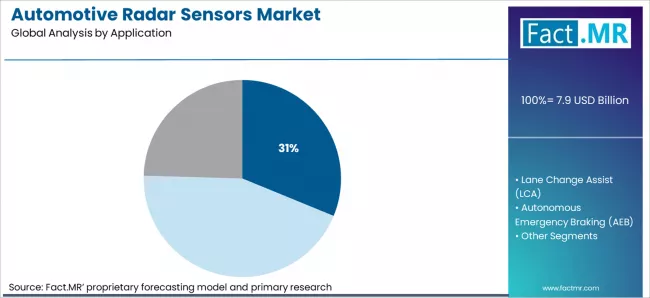
Based on FACT.MR's automotive radar sensors market report, Adaptive Cruise Control (ACC) is estimated to hold 31.2% share in 2026. ACC dominates because it is the gateway ADAS feature for long-range radar adoption across mid-sized and luxury passenger cars globally, and because regulatory frameworks such as UN Regulation No. 152 and Euro NCAP 2026 reward multi-function radar stacks where ACC serves as the base layer for higher-complexity AEB and highway pilot functions.
- Continental AG Radar Chipset Expansion: In March 2025, Continental AG disclosed in its FY2024 results presentation that its Advanced Driver Assistance Systems division expanded long-range radar module production at its Bangalore facility to support ACC and AEB integration across Indian and Southeast Asian OEM programmes ahead of AIS-190 mandate timelines. Continental confirmed new multi-year radar supply agreements with three major Asian OEMs. [2]
- Bosch Next-Gen ARS6xx Launch: In January 2025, Robert Bosch GmbH announced commercial availability of its ARS6xx-series 4D imaging radar platform, combining long-range and medium-range detection in a single module for ACC, AEB, and BSD stacking on a single hardware unit. The launch targets Euro NCAP 2026 compliance requirements that favour integrated multi-function sensor architectures. [3]
- AEB Mandate Driving BSD and FCWS Co-Fitment: In 2024, Euro NCAP published its updated 2026 assessment framework confirming that maximum star ratings require simultaneous AEB, blind spot detection, and forward collision warning capability, creating structural co-fitment demand that raises average radar sensor count per vehicle from 1.8 to 3.2 units among compliant OEM platforms. [4]
Automotive Radar Sensors Market Analysis by Range
Automotive Radar Sensors Market Analysis By Range | Source: Fact.MR
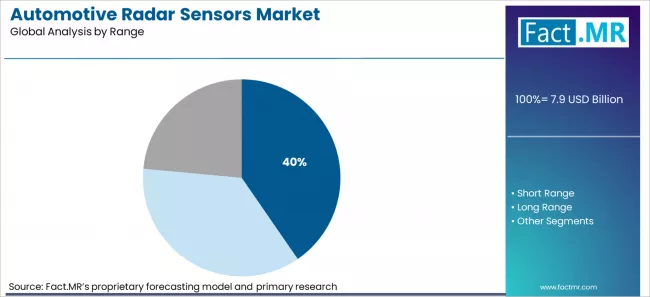
Based on FACT.MR's automotive radar sensors market report, Medium Range radar is estimated to hold 40.4% share in 2026. Medium-range sensors dominate because they serve the widest range of ADAS functions, blind spot detection, lane change assist, rear cross-traffic alert, and short-highway cut-in warning that are now mandated or NCAP-rewarded across volume passenger car segments. Their lower unit cost relative to long-range sensors makes them the preferred fitment for economy and mid-sized platforms entering regulatory compliance.
- NXP S32R Radar Processor Deployment: In 2024, NXP Semiconductors N.V. announced volume production of its S32R45 radar processor, specifically designed for medium and short-range ADAS radar modules targeting cost-optimised economy vehicle platforms. NXP confirmed design wins at multiple Tier 1 suppliers serving European and Asian OEMs pursuing NCAP 2026 compliance at mainstream price points. [5]
- Infineon BGT60 Series for Multi-Range Fusion: In February 2025, Infineon Technologies AG launched its BGT60UTR11AIP single-chip 60 GHz radar sensor enabling short-range cabin and blind spot detection, complementing its 77 GHz medium-range BGT77 family in multi-sensor vehicle architectures. Infineon cited growing OEM demand for disaggregated short and medium-range radar stacks replacing single long-range units. [6]
- Economy Segment Medium-Range Uptake: In 2024, Maruti Suzuki India disclosed fitment of medium-range radar-based BSD and RCTA systems on its Fronx and Jimny models ahead of India's AIS-190 Phase 1 implementation, marking the first mass-market radar deployment in India's economy passenger car segment and confirming medium-range as the entry-level ADAS fitment standard. [7]
Drivers, Restraints, and Opportunities
FACT.MR analysts observe that the automotive radar sensors market has expanded from a niche premium-vehicle feature in the early 2010s to a USD 7.0 billion foundational ADAS component in 2025, driven by a decade of progressive NCAP scoring reforms that linked radar-enabled functions to star ratings. The structural reality is a market transitioning from optional equipment to regulated standard equipment across all vehicle segments, with the key growth mechanism shifting from consumer preference to regulatory mandate enforcement.
The core tension is cost versus compliance. OEMs must integrate radar across economy platforms where per-vehicle sensor budgets are far tighter than in luxury segments, pressuring chipset suppliers to deliver regulatory-grade performance at consumer-electronics cost curves. Long-range LiDAR and camera fusion remain premium complements rather than radar substitutes across the 2026-2036 horizon because radar's performance in adverse weather conditions like rain, fog, and dust cannot be replicated at equivalent cost by camera or LiDAR alone.
- UN Regulation No. 152 and Euro NCAP 2026 as Mandatory Fitment Engines: UN Regulation No. 152, fully in force for new EU passenger car type approvals since July 2024, mandates AEB with pedestrian and cyclist detection functions that require forward-facing radar. Euro NCAP's 2026 protocol raises minimum radar sensor count requirements for five-star ratings, locking in a multi-sensor standard across mainstream OEM programmes globally. [4][8]
- China NEV Radar Integration Driving Volume: China's NEV dual-credit system and MIIT ADAS guidelines require L2 ADAS capability on qualifying NEV models, tying radar sensor integration to subsidy eligibility for the world's largest EV market. In 2024, China's NEV sales exceeded 10 million units, with the majority of new models launched by BYD, SAIC, and Geely incorporating multi-radar ADAS suites as standard. [9]
- NHTSA AEB Final Rule Expanding U.S. Mandate: The NHTSA finalised its AEB rule in April 2024, requiring AEB fitment on all new light vehicles sold in the United States by September 2029, with phased manufacturer compliance starting earlier. This creates a structured multi-year radar demand pipeline across U.S.-market OEM programmes and compels non-compliant manufacturers to accelerate Tier 1 radar supply sourcing. [10]
Regional Analysis
The automotive radar sensors market is analysed across Asia Pacific, Europe, North America, Latin America, and Middle East and Africa, covering over 30 countries with individual ADAS regulation, vehicle production, and OEM adoption profiles. The full report also offers market attractiveness analysis based on regulation enforcement timelines, vehicle production scale, and radar content-per-vehicle trajectories by region.
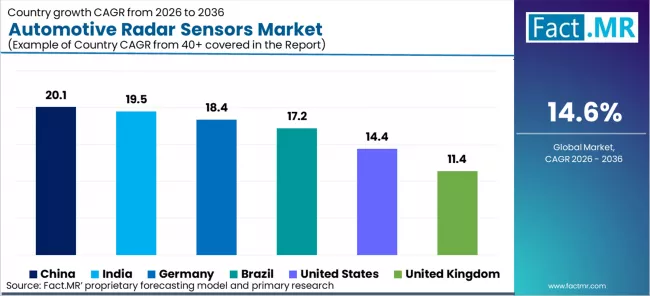
Automotive Radar Sensors Market Cagr Analysis By Country | Source: Fact.MR
| Country | CAGR (2026-2036) |
|---|---|
| China | 20.1% |
| India | 19.5% |
| Germany | 18.4% |
| Brazil | 17.2% |
| United States | 14.4% |
| United Kingdom | 11.4% |
Source: Fact.MR analysis. Updated Mar 3, 2026
Source: Fact.MR (FACT.MR) analysis, based on proprietary forecasting model and primary research
Asia Pacific Automotive Radar Sensors Market Analysis
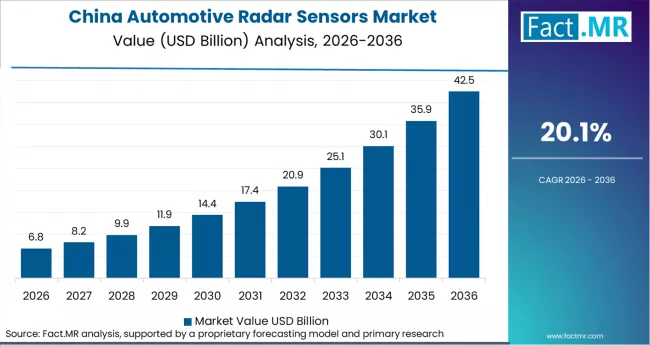
Automotive Radar Sensors Market Country Value Analysis | Source: Fact.MR
Asia Pacific is the volume production epicenter for automotive radar sensors, led by China's NEV-driven radar integration scale and India's rapidly accelerating AIS-190 mandate implementation. The region combines the world's largest automotive manufacturing base with the fastest-moving regulatory ADAS adoption agenda. Continental AG, Bosch, and Denso Corporation maintain strong regional positions, while domestic Chinese ADAS suppliers such as Huawei Smart Car and Hesai are gaining specification share in local OEM programmes.
- China: China is set to remain the fastest growing automotive radar sensors market, expanding at a 20.1% CAGR through 2036. MIIT’s 2024 ADAS guidelines mandate L2 features including AEB and ACC on qualifying NEVs. In January 2025, BYD confirmed four radar ADAS suites on Seal and Han EV models for MIIT and Euro NCAP compliance. Calterah Semiconductor reported 77 GHz radar chip output of 5 million units annually in 2024, highlighting domestic supply chain maturity.
- India: India’s automotive radar sensors market is forecast to grow at a 19.5% CAGR through 2036. AIS 190 mandates phased AEB adoption from 2025, driving structural demand. In October 2024, Maruti Suzuki added radar based ADAS to Fronx and Baleno, marking economy segment adoption. Continental AG confirmed radar module supply from its Bangalore plant under AIS 190 linked contracts.
FACT.MR's Asia Pacific analysis of the automotive radar sensors market covers China, Japan, South Korea, India, Australia and New Zealand, ASEAN, and Rest of Asia Pacific. Readers can find AIS-190 and MIIT regulation adoption timelines, NEV radar integration trends, domestic chipset supply chain analysis, and country-level CAGR projections by application.
Europe Automotive Radar Sensors Market Analysis
Europe is the global regulatory laboratory for automotive radar mandates, where UN Regulation No. 152 and Euro NCAP 2026 assessment reforms are establishing the global benchmark for mandatory radar sensor content per vehicle. German OEMs and their Tier 1 suppliers led by Robert Bosch GmbH, Continental AG, and Hella KGaA, dominate premium radar system integration, while semiconductor suppliers Infineon and NXP provide the chipset foundations for cost-optimised mainstream implementations.
- Germany: Demand for automotive radar sensors in Germany is expected to advance at a compound annual growth rate of 18.4% through 2036. UN Regulation No. 152 type approval requirements, fully enforced for new EU passenger car approvals from July 2024, mandate AEB with vulnerable road user detection across all new platform launches by Volkswagen Group, BMW Group, and Mercedes-Benz Group. In September 2024, Volkswagen Group disclosed that its MEB+ electric platform integrates a six radar sensor suite as standard, compared to two radars on previous generation MQB platforms, directly reflecting NCAP 2026 compliance requirements.
- United Kingdom: The UK automotive radar sensors market is set to witness sustained growth over the forecast period, with demand projected to record an 11.4% CAGR through 2036. The UK's post-Brexit vehicle type approval framework adopted UN Regulation No. 152 equivalent requirements through the UK UNECE alignment programme in 2024, sustaining mandatory AEB radar fitment across new UK-market passenger car type approvals. In early 2025, Jaguar Land Rover disclosed upgraded ADAS radar specifications on its new Range Rover Sport platform, citing NCAP 2026 five-star compliance requirements as the primary driver of sensor content increase.
FACT.MR's European analysis covers Germany, France, the United Kingdom, Italy, Spain, the Netherlands, the Nordics, and Rest of Europe. Readers can find UN Regulation No. 152 enforcement timelines, NCAP 2026 compliance impact on radar content per vehicle, OEM platform radar specification trends, and country-level CAGR projections by application.
North America Automotive Radar Sensors Market Analysis
North America is a large, maturing automotive radar market where NHTSA's finalised AEB mandate is transforming radar from a feature common in premium and mid-sized vehicles to a regulatory requirement across all light vehicle categories by 2029. The United States generates the majority of regional demand, with domestic production by Ford, GM, and Stellantis supplemented by Japanese transplant volumes from Toyota and Honda, all subject to AEB mandate compliance timelines.
- United States: U.S. market is projected to rise at a 14.4% CAGR through 2036. NHTSA's AEB final rule, published in April 2024, mandates AEB fitment on all new light vehicles by September 2029, with phased compliance for larger manufacturers beginning in 2027. In November 2024, General Motors disclosed that its next-generation Ultifi platform integrates radar-based AEB and ACC as standard across all U.S.-market Chevrolet, GMC, and Cadillac models from model year 2026.
FACT.MR's North American analysis covers the United States, Canada, and Mexico. Readers can find NHTSA AEB mandate implementation timelines, OEM platform radar fitment disclosures, Tier 1 supplier capacity expansion announcements, and country-level CAGR projections by application and vehicle type.
Latin America Automotive Radar Sensors Market Analysis
Latin America is an emerging growth region for automotive radar sensors, led by Brazil's phased ADAS mandate under CONTRAN Resolution 996. Brazil's large domestic vehicle production base including plants operated by Volkswagen, Stellantis, GM, and Toyota positions it as the primary Latin American radar demand driver as OEMs align new platform launches with regulatory compliance timelines.
- Brazil: Demand for automotive radar sensors in Brazil is projected to rise at a 17.2% CAGR through 2036. CONTRAN Resolution 996, phasing in mandatory AEB and electronic stability control across new passenger car type approvals from 2026 onwards, requires radar integration on new OEM platform launches in the Brazilian market. In 2024, Volkswagen do Brasil disclosed that its updated Polo and Virtus platforms, manufactured locally, will integrate radar-based AEB from model year 2026 to meet CONTRAN 996 requirements.
FACT.MR's Latin American analysis covers Brazil, Chile, Ecuador, and Rest of Latin America. Readers can find CONTRAN Resolution 996 phased implementation timelines, OEM compliance investment profiles, radar fitment rate forecasts by vehicle segment, and country-level CAGR projections.
Competitive Aligners for Market Players
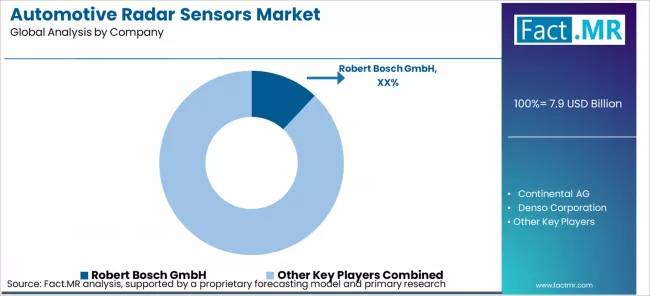
Automotive Radar Sensors Market Analysis By Company | Source: Fact.MR
The global automotive radar sensors market is moderately concentrated at the Tier 1 system integration level, with Robert Bosch GmbH, Continental AG, and Denso Corporation collectively holding the majority of OEM radar supply revenue. The primary competitive variable is the ability to deliver regulatory-grade radar performance at the cost points required by economy and mid-sized OEM programme procurement targets, which are far below the cost structures that sustained radar as a premium feature. Semiconductor suppliers Infineon, NXP, and Texas Instruments compete for chipset design wins at Tier 1 integrators, creating a two-layer competitive structure where chipset specification advantage translates into Tier 1 system win share.
Structural advantages belong to suppliers with vertically integrated radar module and chipset development capability, established OEM type-approval track records under UN Regulation No. 152, and co-development relationships that lock in radar specifications during early vehicle platform architecture phases. Bosch's ARS6xx 4D imaging radar platform exemplifies this advantage: by combining long-range and medium-range functions in a single module, Bosch reduces OEM sensor count and integration cost while maintaining compliance performance, creating specification lock-in that competitors cannot displace mid-platform. Aptiv PLC and Veoneer Inc. maintain positions through software-defined sensor fusion platforms that differentiate on ADAS system integration capability rather than hardware alone.
OEM buyer behaviour in radar procurement is shaped by four-to-six-year vehicle platform lifecycles during which supplier switching is technically prohibitive once radar modules are integrated into the vehicle architecture. Large OEM customers manage this dependency through dual-sourcing strategies across primary and secondary Tier 1 suppliers, but qualification cycles of 18-24 months constrain rapid substitution. Economy-segment OEMs in India and China exert higher pricing leverage than premium OEMs due to volume scale and domestic supplier competition, compressing margins on mainstream radar modules while sustaining premium pricing for high-performance 4D imaging and long-range variants.
Recent Developments
- In January 2025, Robert Bosch GmbH announced commercial availability of its ARS6xx 4D imaging radar platform, supporting simultaneous long-range ACC and medium-range BSD/AEB functions in a single module targeting Euro NCAP 2026 compliance across European OEM programmes.
- In March 2025, Continental AG disclosed expansion of its radar sensor manufacturing capacity at its Bangalore, India facility, confirming new multi-year supply agreements with Indian OEMs ahead of AIS-190 Phase 1 ADAS mandate enforcement.
Key Players
- Robert Bosch GmbH
- Continental AG
- Denso Corporation
- Aptiv PLC
- Infineon Technologies AG
- NXP Semiconductors N.V.
- Texas Instruments Incorporated
- Analog Devices, Inc.
- Hella KGaA Hueck & Co.
- Veoneer Inc.
Bibliography
- [1] Robert Bosch GmbH. (2025). FY2024 Annual Report: Mobility Solutions Division Driver Assistance Systems Revenue and Radar Capacity Investment. Bosch Investor Relations. March 2025.
- [2] Continental AG. (2025). FY2024 Results Presentation: Advanced Driver Assistance Systems Division Radar Module Expansion, Bangalore. Continental Investor Relations. February 2025.
- [3] Robert Bosch GmbH. (2025). Press Release: ARS6xx 4D Imaging Radar Platform Commercial Launch. Bosch Media. January 2025.
- [4] Euro NCAP. (2024). Euro NCAP 2026 Assessment Protocol v1.0: Safety Assist and Vulnerable Road User Protection Requirements. Euro NCAP Technical Publications. October 2024.
- [5] NXP Semiconductors N.V. (2024). Press Release: S32R45 Radar Processor Volume Production and ADAS Design Win Announcement. NXP Media Relations. September 2024.
- [6] Infineon Technologies AG. (2025). Press Release: BGT60UTR11AIP Single-Chip 60 GHz Radar Sensor Launch for Cabin and Blind Spot Detection. Infineon Media. February 2025.
- [7] Maruti Suzuki India Limited. (2024). Annual Report FY2024: ADAS Radar Integration on Fronx and Baleno Platforms Ahead of AIS-190 Implementation. Maruti Suzuki Investor Relations. August 2024.
- [8] United Nations Economic Commission for Europe. (2024). UN Regulation No. 152: Uniform Provisions for Motor Vehicles Regarding Advanced Emergency Braking Systems Enforcement Status July 2024. UNECE Transport Division.
This Report Addresses
- Strategic market intelligence on UN Regulation No. 152 AEB mandates, Euro NCAP 2026 multi-radar requirements, NHTSA AEB final rule, India AIS-190 timelines, and China NEV ADAS subsidy qualification criteria.
- Market size and forecast: valued at USD 7.9 billion in 2026, projected to reach USD 30.9 billion by 2036 at a 14.6% CAGR, segmented by application, range, vehicle type, and region.
- Growth opportunity mapping across economy-segment mandatory radar fitment programmes, multi-radar NCAP 2026 sensor stacking, 4D imaging radar adoption, and India and China volume expansion.
- Segment and regional outlook with country-level CAGR for China (20.1%), India (19.5%), Germany (18.4%), Brazil (17.2%), United States (14.4%), and United Kingdom (11.4%).
- Competitive strategy analysis of Bosch, Continental, Denso, Aptiv, Infineon, NXP, and Texas Instruments covering OEM specification positioning, chipset design win share, multi-function radar platform differentiation, and cost-reduction roadmaps.
- Technology tracking: 4D imaging radar, 77/79 GHz chipset cost reduction, medium-range multi-function sensor fusion, short-range in-cabin radar, and software-defined ADAS integration platforms.
- Regulatory coverage: UN Regulation No. 152, Euro NCAP 2026, NHTSA AEB final rule (April 2024), India AIS-190, China MIIT ADAS guidelines, CONTRAN Resolution 996 (Brazil).
- Report delivered in Excel datasets, PowerPoint summary, and detailed PDF supported by verified regulatory records, OEM disclosures, and Tier 1 supplier filings.
Segmentation
Scope of Report
| Items | Values |
|---|---|
| Quantitative Units | USD 7.9 billion (2026) to USD 30.9 billion (2036), at a CAGR of 14.6% |
| Market Definition | Automotive radar sensors are 77/79 GHz radio frequency detection modules integrated into passenger cars and commercial vehicles to enable ADAS safety functions including adaptive cruise control, autonomous emergency braking, blind spot detection, lane change assist, forward collision warning, rear cross traffic assist, and parking assistance, supplied as OEM-integrated short, medium, and long-range radar modules. |
| Application Segmentation | Adaptive Cruise Control (ACC), Lane Change Assist (LCA), Autonomous Emergency Braking (AEB), Blind Spot Detection (BSD), Forward Collision Warning System (FCWS), Rear Cross Traffic Assist (RCTA), Intelligent Parking Assistance (IPA), Others (Exit Assist, Rear Collision Warning) |
| Range Segmentation | Medium Range (40.4%), Short Range, Long Range |
| Vehicle Type Segmentation | Passenger Car (Economic PC, Mid-Sized PC, Luxury PC), Commercial Vehicles |
| Application Coverage | OEM passenger car ADAS compliance fitment, commercial vehicle ADAS integration, economy segment mandatory radar fitment, luxury platform multi-radar sensor stacking, NEV radar integration for subsidy qualification, aftermarket ADAS upgrade radar modules |
| Regions Covered | Asia Pacific, Europe, North America, Latin America, Middle East and Africa |
| Countries Covered | China, Japan, South Korea, India, Australia and New Zealand, ASEAN, Rest of Asia Pacific, Germany, United Kingdom, France, Italy, Spain, Netherlands, Nordics, Rest of Europe, United States, Canada, Mexico, Brazil, Chile, Ecuador, Rest of Latin America, Kingdom of Saudi Arabia, United Arab Emirates, South Africa, Turkey, Rest of Middle East and Africa |
| Key Companies Profiled | Robert Bosch GmbH, Continental AG, Denso Corporation, Aptiv PLC, Infineon Technologies AG, NXP Semiconductors N.V., Texas Instruments Incorporated, Analog Devices Inc., Hella KGaA Hueck & Co., Veoneer Inc. |
| Forecast Period | 2026 to 2036 |
| Approach | A hybrid top-down and bottom-up model was used. Top-down inputs included IHS vehicle production forecasts, national ADAS regulation enforcement timelines, and radar fitment rate projections by vehicle segment. Bottom-up inputs incorporated average radar sensor ASPs by range type, units per vehicle by ADAS compliance tier, Tier 1 supplier capacity disclosures, and OEM platform radar specification data from primary interviews. |
Source: Fact.MR analysis. Updated Mar 3, 2026
Automotive Radar Sensors Market by Segment
-
By Application
- Adaptive Cruise Control (ACC)
- Lane Change Assist (LCA)
- Autonomous Emergency Braking (AEB)
- Blind Spot Detection (BSD)
- Forward Collision Warning System (FCWS)
- Rear Cross Traffic Assist (RCTA)
- Intelligent Parking Assistance (IPA)
- Others (Exit Assist, Rear Collision Warning)
-
By Range
- Medium Range
- Short Range
- Long Range
-
By Vehicle Type
- Passenger Car
- Economic PC
- Mid-Sized PC
- Luxury PC
- Commercial Vehicles
-
By Region
- North America
- United States
- Canada
- Mexico
- Europe
- Germany
- United Kingdom
- France
- Italy
- Spain
- Netherlands
- Nordics
- Rest of Europe
- Asia Pacific
- China
- Japan
- South Korea
- India
- Australia and New Zealand
- ASEAN
- Rest of Asia Pacific
- Latin America
- Brazil
- Chile
- Ecuador
- Rest of Latin America
- Middle East and Africa
- Kingdom of Saudi Arabia
- United Arab Emirates
- South Africa
- Turkey
- Rest of Middle East and Africa
- North America
Frequently Asked Questions
How large is the automotive radar sensors market in 2025?
What will the market size be in 2026?
What is the projected market size by 2036?
What is the expected CAGR for the forecast period 2026 to 2036?
Which application segment holds the leading share?
Which range segment commands the largest share?
Which country is projected to grow the fastest?
What is the expected growth rate for Germany?
What is the forecast CAGR for the United States automotive radar sensors market?
How is India's automotive radar sensors market expected to grow?
Who worked on this report


Preview the report firsthand - request a free sample
Free SampleGet the brochure for pricing and purchase details
Download PDF