- Base Value(2026): 2.1 Bn
- Estimated Value(2026): 2.1 Bn
- Forecast Value (2036): 14.6 Bn
- CAGR (2026 - 2036): 21.5%
Low-Altitude Airspace Management Software for Drones Market Forecast and Outlook By FACT.MR
Valuation of the low-altitude airspace management software for drones market stood at USD 1.7 billion in 2025. According to Fact MR, demand for software platforms enabling coordinated management of low-altitude drone airspace is expected to reach USD 2.1 billion in 2026 and USD 14.6 billion by 2036. A CAGR of 21.5% is projected for the forecast timeline.
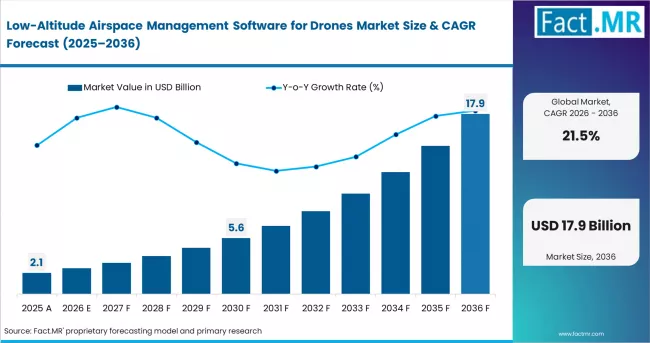
Low Altitude Airspace Management Software For Drones Market Market Value Analysis | Source: Fact.MR
Low-Altitude Airspace Management Software for Drones Market
| Metric | Details |
|---|---|
| Industry Size (2026E) | USD 2.1 billion |
| Industry Value (2036F) | USD 14.6 billion |
| CAGR (2026 to 2036) | 21.5% |
Source: Fact.MR analysis. Updated Apr 24, 2026
Summary of the Low-Altitude Airspace Management Software for Drones Market
- Market Definition
- The market comprises digital platforms that coordinate unmanned aerial vehicle operations within low-altitude airspace, typically below 400 feet, enabling routing, authorization, geofencing enforcement, collision avoidance, and multi-operator traffic synchronization across commercial drone ecosystems. These platforms form the core software layer of unmanned traffic management architectures supporting integration of drones into shared aviation environments.
- Demand Drivers
- Increasing deployment of commercial drone applications across logistics, infrastructure inspection, agriculture monitoring, and emergency response operations.
- Rising requirement for automated airspace authorization systems supporting beyond visual line of sight flight operations.
- Growing need for geofencing compliance tools ensuring adherence to restricted zone regulations.
- Expansion of unmanned traffic management frameworks enabling coordination of multi-operator drone activity.
- Increasing regulatory standardization supporting digital authorization protocols for low-altitude aviation environments.
- Rising requirement for real-time flight monitoring systems supporting safe scaling of drone density in urban airspace corridors.
- Key Segments Analyzed
- Component: Software platforms account for 49% share due to requirement for digital flight coordination infrastructure.
- Deployment: Cloud deployment holds 53% share supported by need for real-time data synchronization across distributed airspace networks.
- Application Role: Flight routing, collision avoidance, and geofencing compliance represent primary operational functions.
- Technology Function: Airspace orchestration platforms integrate telemetry, mapping data, and regulatory constraints enabling controlled drone navigation.
- Geography: Asia Pacific, Europe, and North America demonstrate adoption aligned with expansion of commercial drone traffic management frameworks.
- Analyst Opinion at Fact MR
- Shambhu Nath Jha, Principal Consultant, Fact MR, opines, 'In this updated edition of the Low-Altitude Airspace Management Software for Drones Market report, unmanned traffic management architectures increasingly function as foundational infrastructure enabling safe scaling of commercial drone operations through 2036.'
- Strategic Implications or Executive Takeaways
- Invest in cloud-based traffic coordination software supporting scalable management of multi-operator drone activity.
- Strengthen geospatial analytics capability supporting accurate enforcement of geofencing constraints across regulated airspace.
- Expand integration capability supporting interoperability with aviation authority authorization platforms.
- Improve collision avoidance algorithm functionality supporting dynamic route conflict resolution.
- Focus on regulatory compliance architecture supporting alignment with unmanned traffic management frameworks.
- Enhance collaboration with aviation regulators supporting development of standardized low-altitude digital airspace infrastructure.
- Methodology
- Primary interviews conducted with aviation software developers, drone traffic management providers, and regulatory technology specialists.
- Benchmarked against unmanned aircraft system deployment indicators influencing adoption of airspace orchestration platforms.
- Evaluated flight routing and authorization system functionality supporting coordinated drone operations.
- Hybrid modeling applied combining top down drone ecosystem demand assessment with bottom up software deployment benchmarking.
- Validation conducted using supplier level unmanned traffic management platform adoption indicators.
- Peer review applied using Fact MR analytical frameworks linking drone density growth patterns with airspace coordination software demand.
A CAGR of 21.5% indicates transformational expansion as drone traffic coordination becomes essential for logistics, inspection, and urban air mobility operations. Growth is supported by airspace digitization requirements, while constraints persist from fragmented aviation regulations, interoperability standards development, and integration complexity with existing air traffic management infrastructure.
China leads with a projected CAGR of 23.8%, supported by expansion of unmanned aerial vehicle traffic coordination platforms across commercial drone logistics operations. India follows with a CAGR of 23.1%, driven by increasing deployment of digital airspace management frameworks across urban drone mobility ecosystems. The United Kingdom records a CAGR of 22.6%, reflecting steady adoption of drone traffic orchestration software across regulated low-altitude aviation environments. Germany shows a CAGR of 22.2%, supported by consistent integration of digital flight corridor management tools across commercial drone applications. The United States records the slowest growth at 21.5%, reflecting an emerging aviation software ecosystem tied to gradual adoption cycles within unmanned airspace regulatory infrastructures.
Segmental Analysis
Low-Altitude Airspace Management Software for Drones Market Analysis by Deployment
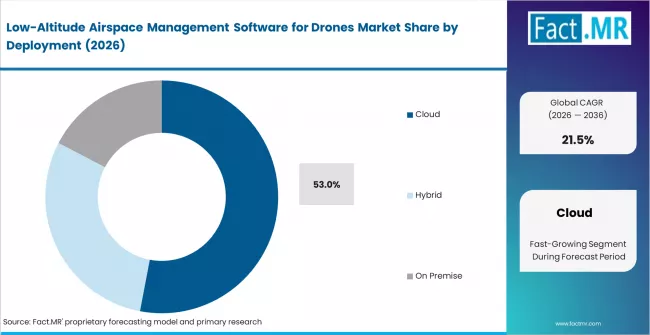
Low Altitude Airspace Management Software For Drones Market Analysis By Deployment | Source: Fact.MR
- Market Overview: Based on Fact MR assessment, cloud deployment is projected to account for 53% share of the low altitude airspace management software for drones market in 2026. Cloud based traffic coordination platforms enable monitoring of unmanned aerial vehicle flight paths across shared airspace corridors requiring real time data exchange between operators, regulators, and navigation systems. Software infrastructure supports geofencing control, flight authorization validation, and route conflict detection enabling structured management of drone traffic movement across urban and industrial operating environments. Deployment architecture supports continuous synchronization of positional data enabling coordination of multiple drone operations requiring stable communication performance across distributed airspace networks.
- Demand Drivers:
- Traffic Coordination Requirements: Cloud platforms support centralized management of drone flight paths enabling prevention of route conflicts across shared airspace corridors.
- Data Processing Parameters: Real time positional data processing supports identification of flight trajectory deviations requiring continuous monitoring performance.
- Scalability Needs: Cloud deployment supports expansion of drone traffic management networks requiring adaptable computational capacity across distributed aviation infrastructure.
Low-Altitude Airspace Management Software for Drones Market Analysis by Component
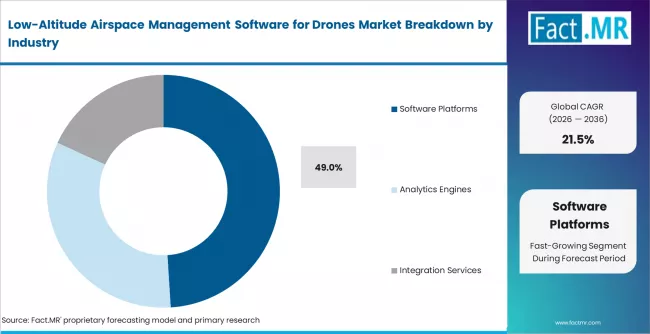
Low Altitude Airspace Management Software For Drones Market Analysis By Component | Source: Fact.MR
- Market Overview: Software platforms are estimated to hold 49% share of the low altitude airspace management software for drones market in 2026, supported by requirement for digital traffic management tools enabling coordination of unmanned aircraft operations across regulated airspace environments. Platform architecture supports integration of mapping data, flight telemetry, and regulatory constraints enabling structured control of drone operations across commercial delivery, inspection, and surveillance activities. Software functionality supports monitoring of altitude limits, restricted zones, and flight permissions enabling consistent operational oversight across expanding drone ecosystem infrastructure.
- Demand Drivers:
- Flight Monitoring Requirements: Software platforms support tracking of drone position enabling controlled management of flight path compliance across regulated airspace environments.
- Regulatory Integration Parameters: Digital airspace management tools support enforcement of flight restrictions enabling adherence to defined operational rules.
Operational Coordination Needs: Software architecture supports communication between drone operators and traffic management systems enabling synchronized drone deployment across shared airspace networks.
Key Dynamics
Low-Altitude Airspace Management Software for Drones Market Drivers, Restraints, and Opportunities
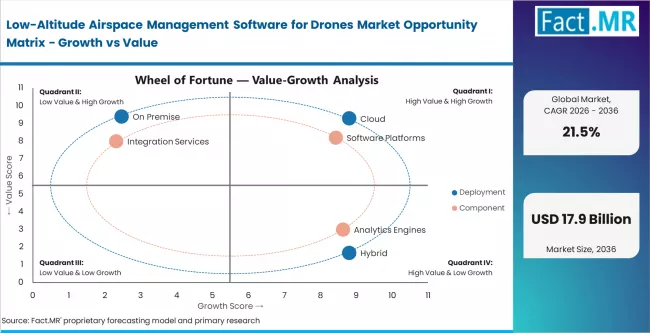
Low Altitude Airspace Management Software For Drones Market Opportunity Matrix Growth Vs Value | Source: Fact.MR
FMR analysts observe that historical drone deployment operated under fragmented flight authorization and manual coordination frameworks that limited scalability of commercial unmanned aerial operations. The current market size reflects a structural transition toward Unmanned Aircraft System Traffic Management architectures that digitally coordinate flight planning, authorization, geofencing, and conflict detection across shared low-altitude airspace. Structural reality indicates a growth-phase infrastructure software market because increasing drone density in logistics, inspection, agriculture, and emergency response requires automated coordination layers capable of managing beyond visual line of sight operations without relying on traditional air traffic control systems. UTM frameworks enable real-time surveillance, flight approval, and deconfliction services supporting safe drone integration into national airspace systems.
The present structural shift reflects declining reliance on isolated drone fleet management tools as regulators require interoperable digital airspace coordination platforms capable of managing multiple operators simultaneously. Software costs increase due to integration with communication, navigation, and surveillance data streams, yet scalable airspace utilization improves operational viability for drone delivery and advanced air mobility services despite relatively low flight volumes. Value growth is linked to regulatory enablement of commercial drone corridors rather than hardware unit expansion alone.
- UTM Infrastructure Layer: UAS Traffic Management platforms provide digital flight authorization, tracking, and conflict resolution functions enabling safe scaling of commercial drone operations.
- Airspace Regulation Framework: EU U-space Regulation 2021/664 and FAA LAANC authorization systems establish standardized requirements for automated approval and geo-awareness services.
- Urban Drone Corridors: United States, Europe, and China support pilot deployment of low-altitude traffic systems to manage delivery drones and advanced air mobility operations.
Regional Analysis
The Low-Altitude Airspace Management Software for Drones Market is assessed across North America, Europe, and Asia Pacific, segmented by country-level demand in unmanned traffic management platforms, flight path optimization software, geofencing analytics systems, and real-time drone airspace coordination tools. Regional demand reflects expansion of commercial drone operations and adoption of digital airspace monitoring technologies. The full report offers market attractiveness analysis.
.webp "Top Country Growth Comparison Low Altitude Airspace Management Software For Drones Market Cagr (2026 2036)")
Top Country Growth Comparison Low Altitude Airspace Management Software For Drones Market Cagr (2026 2036) | Source: Fact.MR
CAGR Table of Low-Altitude Airspace Management Software for Drones Market
| Country | CAGR (2026–2036) |
|---|---|
| China | 23.8% |
| India | 23.1% |
| United Kingdom | 22.6% |
| Germany | 22.2% |
| United States | 21.5% |
Source: Fact.MR analysis. Updated Apr 24, 2026
Source: Fact MR analysis, based on proprietary forecasting model and primary research
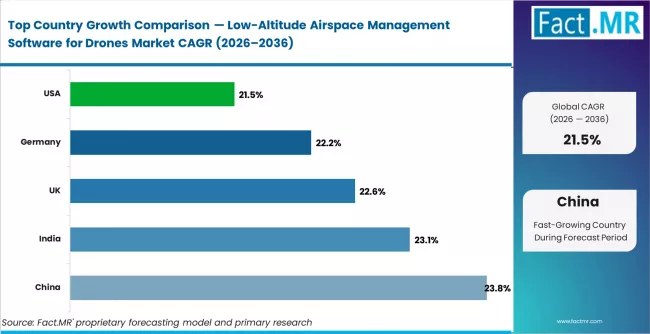
Low Altitude Airspace Management Software For Drones Market Cagr Analysis By Country | Source: Fact.MR
Asia Pacific
Asia Pacific functions as the unmanned traffic management deployment hub, supported by expansion of commercial drone operations and integration of digital airspace coordination platforms. DJI Technology Co., Ltd. strengthens drone flight data integration capability. Thales Group expands unmanned traffic management software platforms. ANRA Technologies Pvt. Ltd. supports airspace analytics system development.
- China: China is projected to record 23.8% CAGR in low-altitude airspace management software for drones through 2036. Civil Aviation Administration low-altitude economy development framework update (March 2024) supports digital airspace coordination platform deployment. DJI Technology Co., Ltd. expanded flight management software capability (June 2023).
- India: Adoption of low-altitude airspace management software for drones in India is forecast to grow at 23.1% CAGR through 2036. Digital Sky airspace authorization platform expansion update (Ministry of Civil Aviation, January 2024) supports drone traffic management software integration. ANRA Technologies Pvt. Ltd. expanded unmanned traffic management analytics capability (May 2023).
Europe
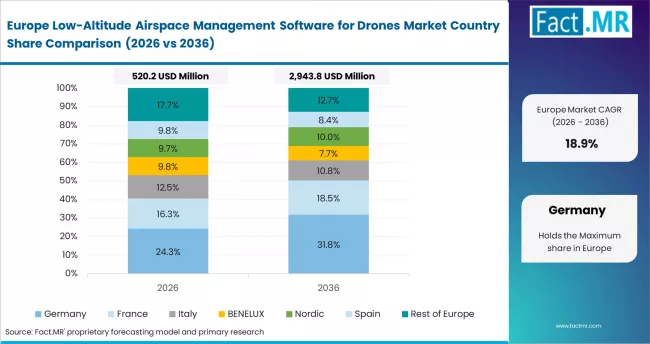
Low Altitude Airspace Management Software For Drones Market Europe Country Market Share Analysis, 2026 & 2036 | Source: Fact.MR
Europe operates as the structured drone airspace coordination compliance center, supported by harmonized unmanned aircraft system regulations and increasing deployment of digital flight management platforms. Thales Group strengthens unmanned traffic control software capability. Airbus SE expands drone airspace analytics platforms. Frequentis AG supports aviation data management integration technologies.
- United Kingdom: Deployment of low-altitude airspace management software for drones in United Kingdom is expected to expand at 22.6% CAGR through 2036. UK Future Flight Challenge airspace modernization update (Department for Transport, February 2024) supports drone traffic coordination software deployment. Frequentis AG expanded airspace data integration capability (July 2023).
- Germany: Germany is anticipated to observe 22.2% CAGR in low-altitude airspace management software for drones through 2036. U Space regulatory framework implementation update (Federal Ministry for Digital and Transport, October 2023) supports digital drone traffic management platform adoption. Airbus SE expanded unmanned traffic analytics capability (April 2023).
North America
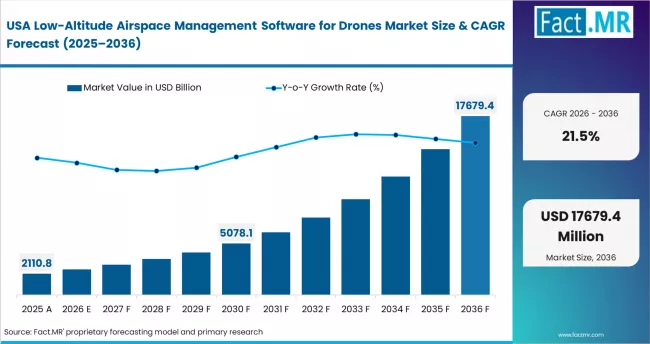
Low Altitude Airspace Management Software For Drones Market Country Value Analysis | Source: Fact.MR
North America represents the commercial drone traffic coordination software environment, supported by expansion of autonomous aerial operations and integration of real-time airspace monitoring platforms. Lockheed Martin Corporation strengthens unmanned traffic management analytics capability. AirMap Inc. expands drone navigation data platforms. Skyward IO Inc. supports aviation data integration technologies.
- United States: The United States is forecast to witness 21.5% CAGR in low-altitude airspace management software for drones through 2036. FAA UTM integration pilot programme update (April 2024) supports automated drone traffic management software deployment. Lockheed Martin Corporation expanded airspace analytics platform capability (August 2023).
Fact MR's analysis of low-altitude airspace management software for drones market in global regions consists of country-wise assessment that includes China, India, United Kingdom, Germany, and United States. Readers can find unmanned traffic management trends, drone airspace analytics developments, regulatory signals, and competitive positioning across key markets.
Competitive Landscape
Competitive Structure and Buyer Dynamics in the Low-Altitude Airspace Management Software for Drones Market
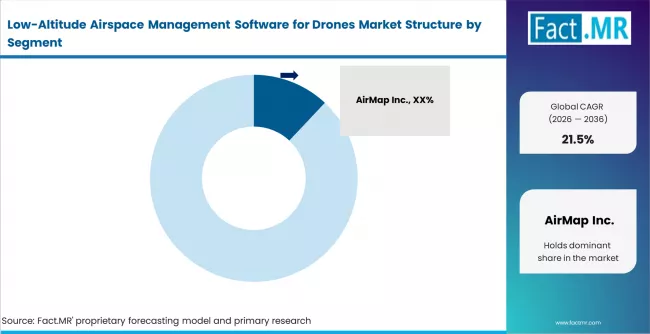
Low Altitude Airspace Management Software For Drones Market Analysis By Company | Source: Fact.MR
The competitive structure of the Low-Altitude Airspace Management Software for Drones Market is moderately concentrated, with aviation technology providers and air traffic management software developers controlling a significant share of unmanned traffic management platform deployments. Companies such as Thales Group, Leonardo S.p.A., Frequentis AG, AirMap Inc., Unifly NV, Altitude Angel Ltd., SkyGrid LLC, ANRA Technologies LLC, Airmatrix Inc., and OneSky Systems Inc. maintain strong positions through expertise in aviation communication systems and digital airspace coordination platforms. Competition is primarily influenced by airspace mapping accuracy, real time flight authorization capability, system interoperability with aviation authorities, and scalability of drone traffic coordination algorithms.
Several companies maintain structural advantages through established relationships with aviation regulators and air navigation service providers requiring certified traffic management solutions. Firms such as Thales Group, Leonardo S.p.A., and Frequentis AG benefit from long experience in air traffic control infrastructure supporting regulatory alignment. Altitude Angel Ltd., Unifly NV, and ANRA Technologies LLC maintain advantages through specialized unmanned traffic management platforms designed for commercial drone operations. Drone operators often evaluate multiple software providers to reduce dependence on a single airspace coordination platform and maintain operational flexibility. Procurement decisions assess suppliers based on regulatory compatibility, data reliability, and long term platform scalability, moderating supplier pricing leverage across drone traffic management systems.
Key Players of the Low-Altitude Airspace Management Software for Drones Market
- AirMap Inc.
- Unifly NV
- Altitude Angel Ltd.
- Thales Group
- Leonardo S.p.A.
- SkyGrid LLC
- Frequentis AG
- Airmatrix Inc.
- ANRA Technologies LLC
- OneSky Systems Inc
Bibliographies
- [1] Federal Aviation Administration. (2024, April). UTM integration pilot programme update. Federal Aviation Administration.
- [2] Ministry of Civil Aviation. (2024, January). Digital Sky airspace authorization platform expansion update. Government of India.
- [3] Civil Aviation Administration of China. (2024, March). Low altitude economy development framework update. Government of China.
- [4] Department for Transport. (2024, February). UK future flight challenge airspace modernization update. UK Government.
- [5] Federal Ministry for Digital and Transport. (2023, October). U space regulatory framework implementation update. Government of Germany.
- [6] DJI Technology Co Ltd. (2023, June). Flight management software capability expansion. DJI Technology Co Ltd.
- [7] ANRA Technologies Pvt Ltd. (2023, May). Unmanned traffic management analytics capability expansion. ANRA Technologies Pvt Ltd.
- [8] Frequentis AG. (2023, July). Airspace data integration capability expansion. Frequentis AG.
- [9] Lockheed Martin Corporation. (2023, August). Airspace analytics platform capability expansion. Lockheed Martin Corporation.
- [10] Thales Group. (2023). Unmanned traffic management software platform capability expansion. Thales Group.
This Report Addresses
- Market size forecasts for 2026 to 2036 based on adoption of unmanned traffic management platforms supporting coordination of drone operations in controlled low-altitude airspace.
- Opportunity mapping across software platforms, analytics engines, and integration services enabling flight routing optimization, collision avoidance logic, and geofencing compliance workflows.
- Segment and regional forecasts covering airspace authorization systems, fleet coordination tools, and digital flight path management applications across commercial unmanned aerial operations.
- Competition benchmarking based on airspace mapping precision, real-time traffic synchronization capability, interoperability with aviation regulatory systems, and scalability of drone coordination algorithms.
- Standards assessment covering U-space Regulation 2021/664, FAA LAANC authorization frameworks, and emerging unmanned traffic management interoperability protocols influencing digital airspace governance.
- Report delivery in PDF, Excel, PPT, and dashboard formats supporting drone fleet operators, aviation software developers, air navigation service providers, and regulatory technology integrators.
- Technology risk evaluation covering fragmented regulatory harmonization, integration complexity with legacy air traffic systems, communication latency sensitivity, and evolving certification requirements for unmanned airspace coordination platforms.
Market Definition
The Low-Altitude Airspace Management Software for Drones Market includes digital platforms that plan, monitor, and control drone operations in airspace typically below 400 feet, enabling flight authorization, traffic coordination, geofencing, and collision avoidance to ensure safe integration of unmanned aerial vehicles into shared airspace.
Low-Altitude Airspace Management Software for Drones Market Inclusions
The report includes global and regional market size estimates, forecast analysis, and segmentation by software architecture, airspace coordination capability, communication protocol, application area, end use industry, pricing structure, and integration with unmanned traffic management and drone fleet control platforms.
Low-Altitude Airspace Management Software for Drones Market Exclusions
The scope excludes drone hardware, standalone flight planning apps without airspace coordination capability, traditional air traffic management systems for manned aviation, and geospatial software not specifically designed for drone traffic orchestration in low altitude environments.
Low-Altitude Airspace Management Software for Drones Market Research Methodology
- Primary Research: Interviews were conducted with drone software providers, aviation regulators, airspace service companies, and unmanned traffic management technology developers.
- Desk Research: Public sources included aviation regulatory frameworks, technical documentation on unmanned traffic management, company product materials, and research publications on drone airspace coordination systems.
- Market-Sizing and Forecasting: A hybrid model combining top-down drone ecosystem demand evaluation and bottom-up analysis of airspace management software deployment across commercial UAV operations was applied.
- Data Validation and Update Cycle: Outputs were validated through cross comparison of regulatory developments, expert consultation, and periodic monitoring of drone traffic management technology adoption trends.
Segmentation
Report Scope
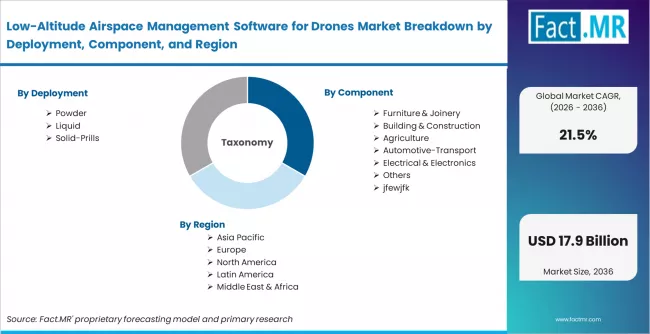
Low Altitude Airspace Management Software For Drones Market Breakdown By Deployment, Component, And Region | Source: Fact.MR
| Metric | Value |
|---|---|
| Quantitative Units | USD 2.1 billion (2026) to USD 14.6 billion (2036), at a CAGR of 21.5% |
| Market Definition | The low-altitude airspace management software for drones market includes digital traffic management platforms that coordinate unmanned aerial vehicle operations, enable safe routing, ensure regulatory compliance, and manage airspace access across commercial drone ecosystems. |
| Component Segmentation | Software platforms, Analytics engines, Integration services |
| Application Segmentation | Flight routing, Collision avoidance, Airspace authorization, Fleet coordination, Geofencing compliance |
| Deployment Segmentation | Cloud, Hybrid, On premise |
| Regions Covered | North America, Latin America, Europe, East Asia, South Asia, Oceania, Middle East and Africa |
| Countries Covered | United States, Canada, United Kingdom, France, Germany, Netherlands, Sweden, China, Japan, South Korea, India, Singapore, Australia, Brazil, Mexico, United Arab Emirates, Saudi Arabia, South Africa, and 40+ countries |
| Key Companies Profiled | AirMap Inc., Unifly NV, Altitude Angel Ltd., Thales Group, Leonardo S.p.A., SkyGrid LLC, Frequentis AG, Airmatrix Inc., ANRA Technologies LLC, OneSky Systems Inc. |
| Forecast Period | 2026 to 2036 |
| Approach | Hybrid top-down and bottom-up market estimation based on commercial drone deployment growth benchmarking, unmanned traffic management software adoption trends, aviation regulatory framework development analysis, airspace digitization demand patterns, and validation through primary interviews with drone software providers, aviation technology companies, and regulatory solution developers. |
Source: Fact.MR analysis. Updated Apr 24, 2026
Low Altitude Airspace Management Software for Drones Market Key Segments
-
Component:
- Software Platforms
- Analytics Engines
- Integration Services
-
Application:
- Flight Routing
- Collision Avoidance
- Airspace Authorization
- Fleet Coordination
- Geofencing Compliance
-
Deployment:
- Cloud
- Hybrid
- On Premise
-
Region:
- North America
- USA
- Canada
- Mexico
- Europe
- Germany
- UK
- France
- Italy
- Spain
- Nordic Countries
- BENELUX
- Rest of Europe
- Asia Pacific
- China
- Japan
- South Korea
- India
- Australia
- Rest of Asia Pacific
- Latin America
- Brazil
- Argentina
- Rest of Latin America
- Middle East and Africa
- Kingdom of Saudi Arabia
- United Arab Emirates
- South Africa
- Rest of Middle East and Africa
- Other Regions
- Oceania
- Central Asia
- Other Markets
- North America
Frequently Asked Questions
How large is the demand for Low-Altitude Airspace Management Software for Drones in the global market in 2026?
What will be the market size of Low-Altitude Airspace Management Software for Drones in the global market by 2036?
What is the expected demand growth for Low-Altitude Airspace Management Software for Drones in the global market between 2026 and 2036?
Which company is identified as a leading provider in the Low-Altitude Airspace Management Software for Drones market?
Which deployment segment is projected to dominate airspace management software adoption by 2026?
Why are cloud-based airspace management platforms widely used in drone traffic coordination systems?
What is driving demand for drone airspace management software in China?
What is the growth outlook for the Low-Altitude Airspace Management Software for Drones market in China?
Why is India an important market for drone airspace coordination platforms?
What is the growth outlook for the Low-Altitude Airspace Management Software for Drones market in India?
How is demand for drone airspace software evolving in the United Kingdom aviation technology sector?
What is the growth outlook for the Low-Altitude Airspace Management Software for Drones market in the United Kingdom?
What is the growth outlook for the Low-Altitude Airspace Management Software for Drones market in Germany?
How is the United States positioned in the Low-Altitude Airspace Management Software for Drones market?
What is the growth outlook for the Low-Altitude Airspace Management Software for Drones market in the United States?
What is low-altitude airspace management software for drones and what is it mainly used for?
What does the Low-Altitude Airspace Management Software for Drones market include in this report?
What applications are included in the scope of the Low-Altitude Airspace Management Software for Drones market?
What is excluded from the scope of the Low-Altitude Airspace Management Software for Drones market report?
What does market forecast mean in the Low-Altitude Airspace Management Software for Drones market report?
How is the Low-Altitude Airspace Management Software for Drones market forecast developed in this report?
What does primary validation indicate in the Low-Altitude Airspace Management Software for Drones market analysis?
Who worked on this report


Preview the report firsthand - request a free sample
Free SampleGet the brochure for pricing and purchase details
Download PDF