Loyal Wingman Ghost Bat Drones Market

Loyal Wingman Ghost Bat Drones Market Size and Share Forecast Outlook 2026 to 2036

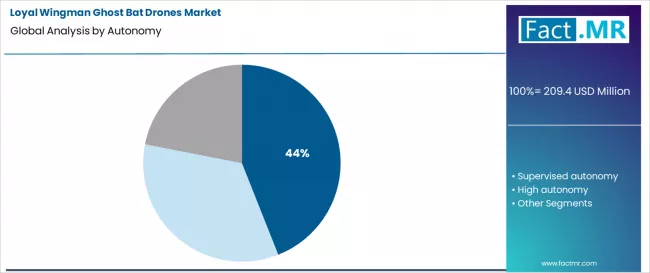
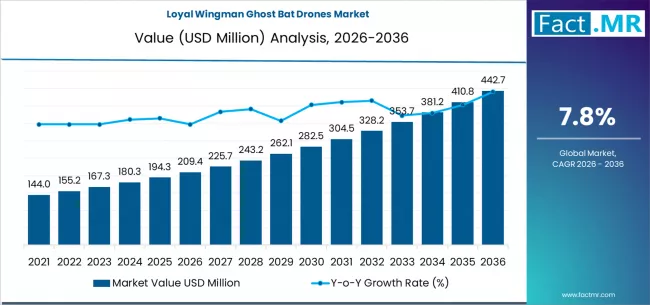
Loyal wingman ghost bat drones market is projected to grow from USD 209.4 million in 2026 to USD 442.7 million by 2036, at a CAGR of 7.8%. ISR escort will dominate with a 26.0% market share, while human-on-loop will lead the autonomy segment with a 44.0% share.

Loyal Wingman Ghost Bat Drones Market Forecast and Outlook 2026 to 2036

The global market for loyal wingman or ghost bat-type drones is projected to experience significant growth, expanding from USD 209.40 million in 2026 to USD 442.74 million by 2036, which reflects a CAGR of 7.8%. This growth trajectory is fundamentally fueled by a transformative shift in modern air combat doctrine, moving decisively towards collaborative combat aircraft and manned-unmanned teaming concepts.

Key Takeaways from the Loyal Wingman Ghost Bat Drones Market

  • Market Value for 2026: USD 209.40 Million
  • Market Value for 2036: USD 442.74 Million
  • Forecast CAGR (2026-2036): 7.8%
  • Leading Mission Role Segment (2026): ISR Escort (26%)
  • Leading Autonomy Segment (2026): Human-on-loop (44%)
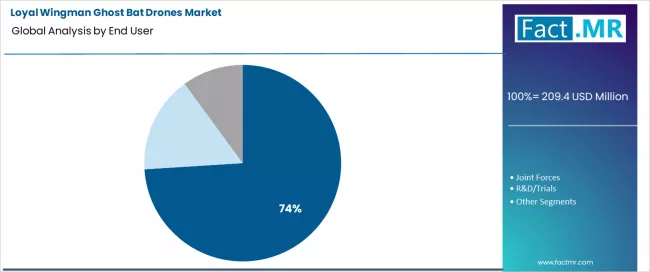
  • Leading End User Segment (2026): Air Force (74%)
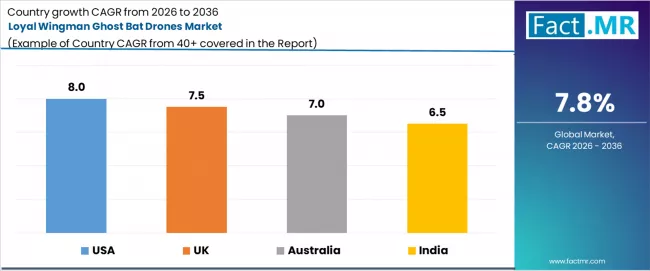
  • Key Growth Countries: USA (8.00% CAGR), UK (7.50% CAGR), Australia (7.00% CAGR), India (6.50% CAGR)
  • Key Players in the Market: Boeing Defence, Kratos Defense, General Atomics, Northrop Grumman, Airbus Defence, Turkish Aerospace Industries

Loyal Wingman Ghost Bat Drones Market Market Value Analysis

These autonomous, attritable drones are engineered to operate as integrated companions to crewed fighter jets, such as the F-35 or F/A-18, forming a cohesive aerial team. They are designed to perform high-risk missions that would be too dangerous for manned platforms, thereby dramatically enhancing overall mission survivability and effectiveness.

The development and accelerated procurement of these systems are driven by several pressing strategic needs. Primarily, they are a direct response to the proliferation of advanced, integrated air defense systems, offering a way to project power in heavily contested and denied environments. They address the twin pressures of soaring costs associated with next-generation manned fighters and growing personnel limitations within air forces.

By deploying more affordable, attritable loyal wingmen, militaries can increase their tactical mass and capability without a proportional increase in budget or pilot training pipelines. Consequently, this market sits at the forefront of aerial combat innovation, representing the critical convergence of advanced artificial intelligence for autonomous decision-making, modular mission payloads for role flexibility, and entirely new concepts of operations that redefine human-machine collaboration in warfare.

Metric

Metric Value
Market Value (2026) USD 209.40 Million
Market Forecast Value (2036) USD 442.74 Million
Forecast CAGR (2026-2036) 7.8%

Category

Category Segments
Mission Role ISR Escort, Strike Support, EW/Decoy, Air Defense Penetration, Training Platforms
Autonomy Human-on-loop, Supervised Autonomy, High Autonomy
End User Air Force, Joint Forces, R&D/Trials
Region North America, Latin America, Western Europe, Eastern Europe, East Asia, South Asia & Pacific, MEA

Segmental Analysis

By Mission Role, Which Function is the Initial Priority?

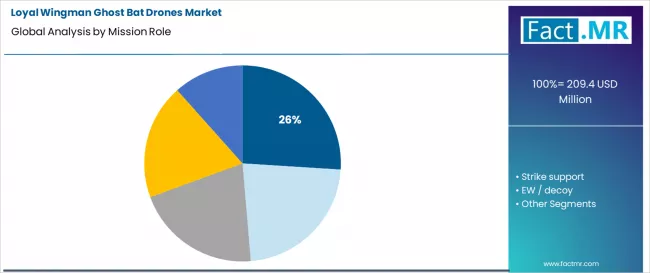
Loyal Wingman Ghost Bat Drones Market Analysis By Mission Role

Intelligence, surveillance, and reconnaissance (ISR) escort leads the mission role segment with a 26% share. This reflects the initial operational concept for loyal wingmen: to act as forward-deployed sensor nodes, extending the situational awareness of a manned aircraft while keeping it at a safer distance from threats.

Carrying advanced radars, electro-optical sensors, and electronic support measures, these drones are seen as a force multiplier for information dominance, making this the foundational and most readily integrated role in early MUM-T deployments.

By Autonomy, What Level of Human Control is Prevailing?

Loyal Wingman Ghost Bat Drones Market Analysis By Autonomy

Human-on-loop autonomy is the dominant segment at 44%. This indicates that despite advances in AI, current doctrine and technology prioritize a high degree of human operator oversight for weapon release and complex engagement decisions.

The pilot in the manned aircraft acts as a mission commander, delegating tasks to drones while retaining ultimate authority, balancing the benefits of automation with the need for human judgment in the battlespace, especially under rules of engagement.

By End User, Which Service is Driving Procurement?

Loyal Wingman Ghost Bat Drones Market Analysis By End User

The air force is the overwhelming end user, commanding a 74% share. This dominance is logical as loyal wingman concepts are primarily designed to integrate with existing air force fighter and bomber fleets.

Air forces worldwide are leading the development of new CCA tactics and requirements to maintain air superiority. Their substantial procurement budgets and operational need to penetrate denied airspace make them the primary funders and consumers of these advanced unmanned systems.

What are the Drivers, Restraints, Opportunities, & Challenges Shaping the Loyal Wingman Market?

Aspect Key Factors
Drivers Strategic shift to counter A2-AD threats, requiring attritable, lower-cost platforms to absorb risk.
  Rapid maturation of AI-ML enabling reliable autonomous navigation and target identification.
Restraints Extremely high development costs and integration complexity with legacy command and control networks.
  Evolving and uncertain regulatory frameworks for autonomous weapons systems and airspace integration.
Opportunities Growing export potential for allied nations seeking to interoperate with US-led or NATO CCA ecosystems.
  Development of modular, multi-role platforms that can be reconfigured for different mission sets.
Trends Focus on open-architecture systems and government-owned autonomy core to ensure interoperability and flexibility.
  Progression towards advanced swarm tactics where multiple loyal wingmen operate collaboratively.

Analysis of the Loyal Wingman Ghost Bat Drones Market by Key Countries

Loyal Wingman Ghost Bat Drones Market Cagr Analysis By Country

Country CAGR (2026-2036)
USA 8.00%
UK 7.50%
Australia 7.00%
India 6.50%

How does the USA's Next-Generation Air Dominance Program Drive the Market?

Loyal Wingman Ghost Bat Drones Market Country Value Analysis

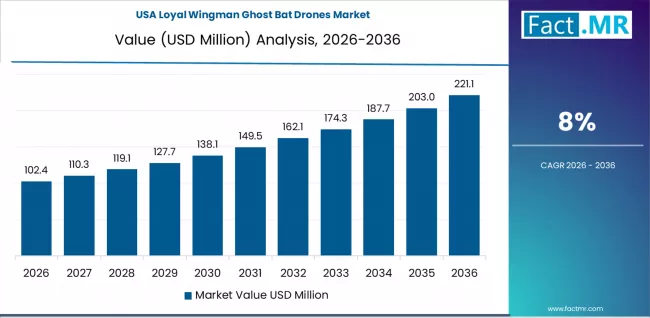
The USA's 8.00% CAGR is anchored in its NGAD (Next Generation Air Dominance) and CCA programs, which are defining the future of aerial warfare. Massive R&D and prototyping investments by the U.S. Air Force and Navy, involving prime contractors and newer entrants, set the global technological standard. The U.S. market is driven by the need to operationalize these systems at scale to maintain qualitative overmatch against peer competitors.

What is the Basis for the UK's Involvement in Autonomous Combat Air?

The UK's 7.50% growth is driven by its Future Combat Air System (FCAS) initiatives, particularly the Tempest program and associated loyal wingman projects like Mosquito. The UK aims to develop sovereign expertise in autonomous systems and ensure interoperability with key allies. Government-backed technology demonstrators sustain growth and a strong industrial base focused on systems integration and AI.

How does Australia's Ghost Bat Program Position It as a Pioneer?

Australia's 7.00% CAGR is directly tied to the Boeing-led MQ-28A Ghost Bat program, a world-leading loyal wingman development. This initiative demonstrates a mid-sized power's ability to drive innovation in autonomous systems tailored for its strategic environment. The program fuels local industry, informs allied development, and creates export opportunities for a proven system.

What Factors Underpin India's Strategic Interest in This Technology?

India's 6.50% growth stems from its strategic imperatives to counter regional threats and develop indigenous advanced aerial systems. While currently focused on R&D and trials, India's involvement in programs like the CATS Warrior concept reflects a long-term ambition to integrate autonomous systems with its Sukhoi and Rafale fleets, reducing reliance on foreign platforms for high-risk missions.

Competitive Landscape of the Loyal Wingman Ghost Bat Drones Market

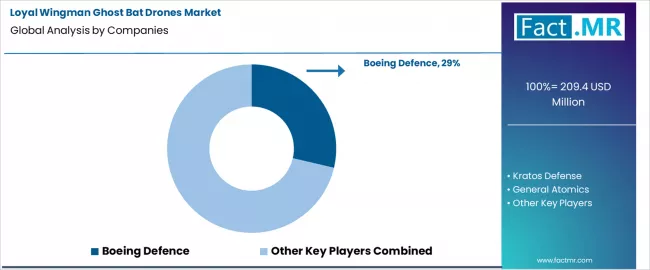
Loyal Wingman Ghost Bat Drones Market Analysis By Company

Established defense primes and specialized unmanned system providers define the competitive landscape. Competition revolves around demonstrating credible, flight-proven autonomy stacks, air vehicle performance, and the ability to seamlessly integrate with existing manned platforms like the F-35 or Eurofighter.

Success depends on securing anchor contracts from leading air forces for development and production, and on establishing common standards that allow for multi-vendor interoperability. Strategic partnerships between airframe manufacturers and AI software firms are becoming critical.

Key Players in the Loyal Wingman Ghost Bat Drones Market

  • Boeing Defence
  • Kratos Defense
  • General Atomics
  • Northrop Grumman
  • Airbus Defence
  • Turkish Aerospace Industries

Scope of Report

Items Values
Quantitative Units USD Million
Mission Role ISR Escort, Strike Support, EW/Decoy, Air Defense Penetration, Training Platforms
Autonomy Human-on-loop, Supervised Autonomy, High Autonomy
End User Air Force, Joint Forces, R&D/Trials
Key Countries USA, UK, Australia, India
Key Companies Boeing Defence, Kratos Defense, General Atomics, Northrop Grumman, Airbus Defence, Turkish Aerospace Industries
Additional Analysis Technical analysis of AI/ML decision-making latency and reliability; cost-benefit analysis vs. traditional manned aircraft; study of datalink security and resilience in contested EW environments; assessment of training requirements for pilots managing drone teams; regulatory analysis for flight certification in shared airspace.

Market by Segments

  • Mission Role :

    • ISR Escort
    • Strike Support
    • EW/Decoy
    • Air Defense Penetration
    • Training Platforms
  • Autonomy :

    • Human-on-loop
    • Supervised Autonomy
    • High Autonomy
  • End User :

    • Air Force
    • Joint Forces
    • R&D/Trials
  • Region :

    • North America

      • USA
      • Canada
    • Latin America

      • Brazil
      • Mexico
      • Argentina
      • Rest of Latin America
    • Western Europe

      • Germany
      • France
      • Italy
      • Spain
      • UK
      • BENELUX
      • Rest of Western Europe
    • Eastern Europe

      • Russia
      • Poland
      • Czech Republic
      • Rest of Eastern Europe
    • East Asia

      • China
      • Japan
      • South Korea
      • Rest of East Asia
    • South Asia & Pacific

      • India
      • ASEAN
      • Australia
      • Rest of South Asia & Pacific
    • MEA

      • GCC Countries
      • South Africa
      • Turkiye
      • Rest of MEA

References

  • Department of the Air Force. (2024). Collaborative Combat Aircraft (CCA) Concept of Operations. U.S. Air Force.
  • Defence Science and Technology Agency. (2024). Roadmap for Autonomous Systems in Air Combat. Australian Government.
  • Michel, A. H. (2023). Swarm Troopers: How drones will conquer the world and change warfare. Fast Company Press.
  • Royal Air Force. (2024). Future Combat Air Strategy: The Role of Autonomous Systems. UK Ministry of Defence.
  • Tirpak, J. A. (2023). The Rise of the Loyal Wingman: Manned-Unmanned Teaming in Modern Air Warfare. Air & Space Forces Magazine.
  • Valavanis, K. P., & Vachtsevanos, G. J. (2023). Handbook of Unmanned Aerial Vehicles: Combat and Support Applications. Springer.

Table of Content

  1. Executive Summary
    • Global Market Outlook
    • Demand to side Trends
    • Supply to side Trends
    • Technology Roadmap Analysis
    • Analysis and Recommendations
  2. Market Overview
    • Market Coverage / Taxonomy
    • Market Definition / Scope / Limitations
  3. Market Background
    • Market Dynamics
      • Drivers
      • Restraints
      • Opportunity
      • Trends
    • Scenario Forecast
      • Demand in Optimistic Scenario
      • Demand in Likely Scenario
      • Demand in Conservative Scenario
    • Opportunity Map Analysis
    • Product Life Cycle Analysis
    • Supply Chain Analysis
    • Investment Feasibility Matrix
    • Value Chain Analysis
    • PESTLE and Porter’s Analysis
    • Regulatory Landscape
    • Regional Parent Market Outlook
    • Production and Consumption Statistics
    • Import and Export Statistics
  4. Global Market Analysis 2021 to 2025 and Forecast, 2026 to 2036
    • Historical Market Size Value (USD Million) Analysis, 2021 to 2025
    • Current and Future Market Size Value (USD Million) Projections, 2026 to 2036
      • Y to o to Y Growth Trend Analysis
      • Absolute $ Opportunity Analysis
  5. Global Market Pricing Analysis 2021 to 2025 and Forecast 2026 to 2036
  6. Global Market Analysis 2021 to 2025 and Forecast 2026 to 2036, By Mission Role
    • Introduction / Key Findings
    • Historical Market Size Value (USD Million) Analysis By Mission Role, 2021 to 2025
    • Current and Future Market Size Value (USD Million) Analysis and Forecast By Mission Role, 2026 to 2036
      • ISR escort
      • Strike support
      • EW / decoy
      • Air defense penetration
      • Training platforms
    • Y to o to Y Growth Trend Analysis By Mission Role, 2021 to 2025
    • Absolute $ Opportunity Analysis By Mission Role, 2026 to 2036
  7. Global Market Analysis 2021 to 2025 and Forecast 2026 to 2036, By Autonomy
    • Introduction / Key Findings
    • Historical Market Size Value (USD Million) Analysis By Autonomy, 2021 to 2025
    • Current and Future Market Size Value (USD Million) Analysis and Forecast By Autonomy, 2026 to 2036
      • Human-on-loop
      • Supervised autonomy
      • High autonomy
    • Y to o to Y Growth Trend Analysis By Autonomy, 2021 to 2025
    • Absolute $ Opportunity Analysis By Autonomy, 2026 to 2036
  8. Global Market Analysis 2021 to 2025 and Forecast 2026 to 2036, By End User
    • Introduction / Key Findings
    • Historical Market Size Value (USD Million) Analysis By End User, 2021 to 2025
    • Current and Future Market Size Value (USD Million) Analysis and Forecast By End User, 2026 to 2036
      • Air Force
      • Joint Forces
      • R&D/Trials
    • Y to o to Y Growth Trend Analysis By End User, 2021 to 2025
    • Absolute $ Opportunity Analysis By End User, 2026 to 2036
  9. Global Market Analysis 2021 to 2025 and Forecast 2026 to 2036, By Region
    • Introduction
    • Historical Market Size Value (USD Million) Analysis By Region, 2021 to 2025
    • Current Market Size Value (USD Million) Analysis and Forecast By Region, 2026 to 2036
      • North America
      • Latin America
      • Western Europe
      • Eastern Europe
      • East Asia
      • South Asia and Pacific
      • Middle East & Africa
    • Market Attractiveness Analysis By Region
  10. North America Market Analysis 2021 to 2025 and Forecast 2026 to 2036, By Country
    • Historical Market Size Value (USD Million) Trend Analysis By Market Taxonomy, 2021 to 2025
    • Market Size Value (USD Million) Forecast By Market Taxonomy, 2026 to 2036
      • By Country
        • USA
        • Canada
        • Mexico
      • By Mission Role
      • By Autonomy
      • By End User
    • Market Attractiveness Analysis
      • By Country
      • By Mission Role
      • By Autonomy
      • By End User
    • Key Takeaways
  11. Latin America Market Analysis 2021 to 2025 and Forecast 2026 to 2036, By Country
    • Historical Market Size Value (USD Million) Trend Analysis By Market Taxonomy, 2021 to 2025
    • Market Size Value (USD Million) Forecast By Market Taxonomy, 2026 to 2036
      • By Country
        • Brazil
        • Chile
        • Rest of Latin America
      • By Mission Role
      • By Autonomy
      • By End User
    • Market Attractiveness Analysis
      • By Country
      • By Mission Role
      • By Autonomy
      • By End User
    • Key Takeaways
  12. Western Europe Market Analysis 2021 to 2025 and Forecast 2026 to 2036, By Country
    • Historical Market Size Value (USD Million) Trend Analysis By Market Taxonomy, 2021 to 2025
    • Market Size Value (USD Million) Forecast By Market Taxonomy, 2026 to 2036
      • By Country
        • Germany
        • UK
        • Italy
        • Spain
        • France
        • Nordic
        • BENELUX
        • Rest of Western Europe
      • By Mission Role
      • By Autonomy
      • By End User
    • Market Attractiveness Analysis
      • By Country
      • By Mission Role
      • By Autonomy
      • By End User
    • Key Takeaways
  13. Eastern Europe Market Analysis 2021 to 2025 and Forecast 2026 to 2036, By Country
    • Historical Market Size Value (USD Million) Trend Analysis By Market Taxonomy, 2021 to 2025
    • Market Size Value (USD Million) Forecast By Market Taxonomy, 2026 to 2036
      • By Country
        • Russia
        • Poland
        • Hungary
        • Balkan & Baltic
        • Rest of Eastern Europe
      • By Mission Role
      • By Autonomy
      • By End User
    • Market Attractiveness Analysis
      • By Country
      • By Mission Role
      • By Autonomy
      • By End User
    • Key Takeaways
  14. East Asia Market Analysis 2021 to 2025 and Forecast 2026 to 2036, By Country
    • Historical Market Size Value (USD Million) Trend Analysis By Market Taxonomy, 2021 to 2025
    • Market Size Value (USD Million) Forecast By Market Taxonomy, 2026 to 2036
      • By Country
        • China
        • Japan
        • South Korea
      • By Mission Role
      • By Autonomy
      • By End User
    • Market Attractiveness Analysis
      • By Country
      • By Mission Role
      • By Autonomy
      • By End User
    • Key Takeaways
  15. South Asia and Pacific Market Analysis 2021 to 2025 and Forecast 2026 to 2036, By Country
    • Historical Market Size Value (USD Million) Trend Analysis By Market Taxonomy, 2021 to 2025
    • Market Size Value (USD Million) Forecast By Market Taxonomy, 2026 to 2036
      • By Country
        • India
        • ASEAN
        • Australia & New Zealand
        • Rest of South Asia and Pacific
      • By Mission Role
      • By Autonomy
      • By End User
    • Market Attractiveness Analysis
      • By Country
      • By Mission Role
      • By Autonomy
      • By End User
    • Key Takeaways
  16. Middle East & Africa Market Analysis 2021 to 2025 and Forecast 2026 to 2036, By Country
    • Historical Market Size Value (USD Million) Trend Analysis By Market Taxonomy, 2021 to 2025
    • Market Size Value (USD Million) Forecast By Market Taxonomy, 2026 to 2036
      • By Country
        • Kingdom of Saudi Arabia
        • Other GCC Countries
        • Turkiye
        • South Africa
        • Other African Union
        • Rest of Middle East & Africa
      • By Mission Role
      • By Autonomy
      • By End User
    • Market Attractiveness Analysis
      • By Country
      • By Mission Role
      • By Autonomy
      • By End User
    • Key Takeaways
  17. Key Countries Market Analysis
    • USA
      • Pricing Analysis
      • Market Share Analysis, 2025
        • By Mission Role
        • By Autonomy
        • By End User
    • Canada
      • Pricing Analysis
      • Market Share Analysis, 2025
        • By Mission Role
        • By Autonomy
        • By End User
    • Mexico
      • Pricing Analysis
      • Market Share Analysis, 2025
        • By Mission Role
        • By Autonomy
        • By End User
    • Brazil
      • Pricing Analysis
      • Market Share Analysis, 2025
        • By Mission Role
        • By Autonomy
        • By End User
    • Chile
      • Pricing Analysis
      • Market Share Analysis, 2025
        • By Mission Role
        • By Autonomy
        • By End User
    • Germany
      • Pricing Analysis
      • Market Share Analysis, 2025
        • By Mission Role
        • By Autonomy
        • By End User
    • UK
      • Pricing Analysis
      • Market Share Analysis, 2025
        • By Mission Role
        • By Autonomy
        • By End User
    • Italy
      • Pricing Analysis
      • Market Share Analysis, 2025
        • By Mission Role
        • By Autonomy
        • By End User
    • Spain
      • Pricing Analysis
      • Market Share Analysis, 2025
        • By Mission Role
        • By Autonomy
        • By End User
    • France
      • Pricing Analysis
      • Market Share Analysis, 2025
        • By Mission Role
        • By Autonomy
        • By End User
    • India
      • Pricing Analysis
      • Market Share Analysis, 2025
        • By Mission Role
        • By Autonomy
        • By End User
    • ASEAN
      • Pricing Analysis
      • Market Share Analysis, 2025
        • By Mission Role
        • By Autonomy
        • By End User
    • Australia & New Zealand
      • Pricing Analysis
      • Market Share Analysis, 2025
        • By Mission Role
        • By Autonomy
        • By End User
    • China
      • Pricing Analysis
      • Market Share Analysis, 2025
        • By Mission Role
        • By Autonomy
        • By End User
    • Japan
      • Pricing Analysis
      • Market Share Analysis, 2025
        • By Mission Role
        • By Autonomy
        • By End User
    • South Korea
      • Pricing Analysis
      • Market Share Analysis, 2025
        • By Mission Role
        • By Autonomy
        • By End User
    • Russia
      • Pricing Analysis
      • Market Share Analysis, 2025
        • By Mission Role
        • By Autonomy
        • By End User
    • Poland
      • Pricing Analysis
      • Market Share Analysis, 2025
        • By Mission Role
        • By Autonomy
        • By End User
    • Hungary
      • Pricing Analysis
      • Market Share Analysis, 2025
        • By Mission Role
        • By Autonomy
        • By End User
    • Kingdom of Saudi Arabia
      • Pricing Analysis
      • Market Share Analysis, 2025
        • By Mission Role
        • By Autonomy
        • By End User
    • Turkiye
      • Pricing Analysis
      • Market Share Analysis, 2025
        • By Mission Role
        • By Autonomy
        • By End User
    • South Africa
      • Pricing Analysis
      • Market Share Analysis, 2025
        • By Mission Role
        • By Autonomy
        • By End User
  18. Market Structure Analysis
    • Competition Dashboard
    • Competition Benchmarking
    • Market Share Analysis of Top Players
      • By Regional
      • By Mission Role
      • By Autonomy
      • By End User
  19. Competition Analysis
    • Competition Deep Dive
      • Boeing Defence
        • Overview
        • Product Portfolio
        • Profitability by Market Segments (Product/Age /Sales Channel/Region)
        • Sales Footprint
        • Strategy Overview
          • Marketing Strategy
          • Product Strategy
          • Channel Strategy
      • Kratos Defense
      • General Atomics
      • Northrop Grumman
      • Airbus Defence
      • Turkish Aerospace Industries
  20. Assumptions & Acronyms Used
  21. Research Methodology

List Of Table

  • Table 1: Global Market Value (USD Million) Forecast by Region, 2021 to 2036
  • Table 2: Global Market Value (USD Million) Forecast by Mission Role, 2021 to 2036
  • Table 3: Global Market Value (USD Million) Forecast by Autonomy, 2021 to 2036
  • Table 4: Global Market Value (USD Million) Forecast by End User, 2021 to 2036
  • Table 5: North America Market Value (USD Million) Forecast by Country, 2021 to 2036
  • Table 6: North America Market Value (USD Million) Forecast by Mission Role, 2021 to 2036
  • Table 7: North America Market Value (USD Million) Forecast by Autonomy, 2021 to 2036
  • Table 8: North America Market Value (USD Million) Forecast by End User, 2021 to 2036
  • Table 9: Latin America Market Value (USD Million) Forecast by Country, 2021 to 2036
  • Table 10: Latin America Market Value (USD Million) Forecast by Mission Role, 2021 to 2036
  • Table 11: Latin America Market Value (USD Million) Forecast by Autonomy, 2021 to 2036
  • Table 12: Latin America Market Value (USD Million) Forecast by End User, 2021 to 2036
  • Table 13: Western Europe Market Value (USD Million) Forecast by Country, 2021 to 2036
  • Table 14: Western Europe Market Value (USD Million) Forecast by Mission Role, 2021 to 2036
  • Table 15: Western Europe Market Value (USD Million) Forecast by Autonomy, 2021 to 2036
  • Table 16: Western Europe Market Value (USD Million) Forecast by End User, 2021 to 2036
  • Table 17: Eastern Europe Market Value (USD Million) Forecast by Country, 2021 to 2036
  • Table 18: Eastern Europe Market Value (USD Million) Forecast by Mission Role, 2021 to 2036
  • Table 19: Eastern Europe Market Value (USD Million) Forecast by Autonomy, 2021 to 2036
  • Table 20: Eastern Europe Market Value (USD Million) Forecast by End User, 2021 to 2036
  • Table 21: East Asia Market Value (USD Million) Forecast by Country, 2021 to 2036
  • Table 22: East Asia Market Value (USD Million) Forecast by Mission Role, 2021 to 2036
  • Table 23: East Asia Market Value (USD Million) Forecast by Autonomy, 2021 to 2036
  • Table 24: East Asia Market Value (USD Million) Forecast by End User, 2021 to 2036
  • Table 25: South Asia and Pacific Market Value (USD Million) Forecast by Country, 2021 to 2036
  • Table 26: South Asia and Pacific Market Value (USD Million) Forecast by Mission Role, 2021 to 2036
  • Table 27: South Asia and Pacific Market Value (USD Million) Forecast by Autonomy, 2021 to 2036
  • Table 28: South Asia and Pacific Market Value (USD Million) Forecast by End User, 2021 to 2036
  • Table 29: Middle East & Africa Market Value (USD Million) Forecast by Country, 2021 to 2036
  • Table 30: Middle East & Africa Market Value (USD Million) Forecast by Mission Role, 2021 to 2036
  • Table 31: Middle East & Africa Market Value (USD Million) Forecast by Autonomy, 2021 to 2036
  • Table 32: Middle East & Africa Market Value (USD Million) Forecast by End User, 2021 to 2036

List Of Figures

  • Figure 1: Global Market Pricing Analysis
  • Figure 2: Global Market Value (USD Million) Forecast 2021 to 2036
  • Figure 3: Global Market Value Share and BPS Analysis by Mission Role, 2026 and 2036
  • Figure 4: Global Market Y to o to Y Growth Comparison by Mission Role, 2026 to 2036
  • Figure 5: Global Market Attractiveness Analysis by Mission Role
  • Figure 6: Global Market Value Share and BPS Analysis by Autonomy, 2026 and 2036
  • Figure 7: Global Market Y to o to Y Growth Comparison by Autonomy, 2026 to 2036
  • Figure 8: Global Market Attractiveness Analysis by Autonomy
  • Figure 9: Global Market Value Share and BPS Analysis by End User, 2026 and 2036
  • Figure 10: Global Market Y to o to Y Growth Comparison by End User, 2026 to 2036
  • Figure 11: Global Market Attractiveness Analysis by End User
  • Figure 12: Global Market Value (USD Million) Share and BPS Analysis by Region, 2026 and 2036
  • Figure 13: Global Market Y to o to Y Growth Comparison by Region, 2026 to 2036
  • Figure 14: Global Market Attractiveness Analysis by Region
  • Figure 15: North America Market Incremental Dollar Opportunity, 2026 to 2036
  • Figure 16: Latin America Market Incremental Dollar Opportunity, 2026 to 2036
  • Figure 17: Western Europe Market Incremental Dollar Opportunity, 2026 to 2036
  • Figure 18: Eastern Europe Market Incremental Dollar Opportunity, 2026 to 2036
  • Figure 19: East Asia Market Incremental Dollar Opportunity, 2026 to 2036
  • Figure 20: South Asia and Pacific Market Incremental Dollar Opportunity, 2026 to 2036
  • Figure 21: Middle East & Africa Market Incremental Dollar Opportunity, 2026 to 2036
  • Figure 22: North America Market Value Share and BPS Analysis by Country, 2026 and 2036
  • Figure 23: North America Market Value Share and BPS Analysis by Mission Role, 2026 and 2036
  • Figure 24: North America Market Y to o to Y Growth Comparison by Mission Role, 2026 to 2036
  • Figure 25: North America Market Attractiveness Analysis by Mission Role
  • Figure 26: North America Market Value Share and BPS Analysis by Autonomy, 2026 and 2036
  • Figure 27: North America Market Y to o to Y Growth Comparison by Autonomy, 2026 to 2036
  • Figure 28: North America Market Attractiveness Analysis by Autonomy
  • Figure 29: North America Market Value Share and BPS Analysis by End User, 2026 and 2036
  • Figure 30: North America Market Y to o to Y Growth Comparison by End User, 2026 to 2036
  • Figure 31: North America Market Attractiveness Analysis by End User
  • Figure 32: Latin America Market Value Share and BPS Analysis by Country, 2026 and 2036
  • Figure 33: Latin America Market Value Share and BPS Analysis by Mission Role, 2026 and 2036
  • Figure 34: Latin America Market Y to o to Y Growth Comparison by Mission Role, 2026 to 2036
  • Figure 35: Latin America Market Attractiveness Analysis by Mission Role
  • Figure 36: Latin America Market Value Share and BPS Analysis by Autonomy, 2026 and 2036
  • Figure 37: Latin America Market Y to o to Y Growth Comparison by Autonomy, 2026 to 2036
  • Figure 38: Latin America Market Attractiveness Analysis by Autonomy
  • Figure 39: Latin America Market Value Share and BPS Analysis by End User, 2026 and 2036
  • Figure 40: Latin America Market Y to o to Y Growth Comparison by End User, 2026 to 2036
  • Figure 41: Latin America Market Attractiveness Analysis by End User
  • Figure 42: Western Europe Market Value Share and BPS Analysis by Country, 2026 and 2036
  • Figure 43: Western Europe Market Value Share and BPS Analysis by Mission Role, 2026 and 2036
  • Figure 44: Western Europe Market Y to o to Y Growth Comparison by Mission Role, 2026 to 2036
  • Figure 45: Western Europe Market Attractiveness Analysis by Mission Role
  • Figure 46: Western Europe Market Value Share and BPS Analysis by Autonomy, 2026 and 2036
  • Figure 47: Western Europe Market Y to o to Y Growth Comparison by Autonomy, 2026 to 2036
  • Figure 48: Western Europe Market Attractiveness Analysis by Autonomy
  • Figure 49: Western Europe Market Value Share and BPS Analysis by End User, 2026 and 2036
  • Figure 50: Western Europe Market Y to o to Y Growth Comparison by End User, 2026 to 2036
  • Figure 51: Western Europe Market Attractiveness Analysis by End User
  • Figure 52: Eastern Europe Market Value Share and BPS Analysis by Country, 2026 and 2036
  • Figure 53: Eastern Europe Market Value Share and BPS Analysis by Mission Role, 2026 and 2036
  • Figure 54: Eastern Europe Market Y to o to Y Growth Comparison by Mission Role, 2026 to 2036
  • Figure 55: Eastern Europe Market Attractiveness Analysis by Mission Role
  • Figure 56: Eastern Europe Market Value Share and BPS Analysis by Autonomy, 2026 and 2036
  • Figure 57: Eastern Europe Market Y to o to Y Growth Comparison by Autonomy, 2026 to 2036
  • Figure 58: Eastern Europe Market Attractiveness Analysis by Autonomy
  • Figure 59: Eastern Europe Market Value Share and BPS Analysis by End User, 2026 and 2036
  • Figure 60: Eastern Europe Market Y to o to Y Growth Comparison by End User, 2026 to 2036
  • Figure 61: Eastern Europe Market Attractiveness Analysis by End User
  • Figure 62: East Asia Market Value Share and BPS Analysis by Country, 2026 and 2036
  • Figure 63: East Asia Market Value Share and BPS Analysis by Mission Role, 2026 and 2036
  • Figure 64: East Asia Market Y to o to Y Growth Comparison by Mission Role, 2026 to 2036
  • Figure 65: East Asia Market Attractiveness Analysis by Mission Role
  • Figure 66: East Asia Market Value Share and BPS Analysis by Autonomy, 2026 and 2036
  • Figure 67: East Asia Market Y to o to Y Growth Comparison by Autonomy, 2026 to 2036
  • Figure 68: East Asia Market Attractiveness Analysis by Autonomy
  • Figure 69: East Asia Market Value Share and BPS Analysis by End User, 2026 and 2036
  • Figure 70: East Asia Market Y to o to Y Growth Comparison by End User, 2026 to 2036
  • Figure 71: East Asia Market Attractiveness Analysis by End User
  • Figure 72: South Asia and Pacific Market Value Share and BPS Analysis by Country, 2026 and 2036
  • Figure 73: South Asia and Pacific Market Value Share and BPS Analysis by Mission Role, 2026 and 2036
  • Figure 74: South Asia and Pacific Market Y to o to Y Growth Comparison by Mission Role, 2026 to 2036
  • Figure 75: South Asia and Pacific Market Attractiveness Analysis by Mission Role
  • Figure 76: South Asia and Pacific Market Value Share and BPS Analysis by Autonomy, 2026 and 2036
  • Figure 77: South Asia and Pacific Market Y to o to Y Growth Comparison by Autonomy, 2026 to 2036
  • Figure 78: South Asia and Pacific Market Attractiveness Analysis by Autonomy
  • Figure 79: South Asia and Pacific Market Value Share and BPS Analysis by End User, 2026 and 2036
  • Figure 80: South Asia and Pacific Market Y to o to Y Growth Comparison by End User, 2026 to 2036
  • Figure 81: South Asia and Pacific Market Attractiveness Analysis by End User
  • Figure 82: Middle East & Africa Market Value Share and BPS Analysis by Country, 2026 and 2036
  • Figure 83: Middle East & Africa Market Value Share and BPS Analysis by Mission Role, 2026 and 2036
  • Figure 84: Middle East & Africa Market Y to o to Y Growth Comparison by Mission Role, 2026 to 2036
  • Figure 85: Middle East & Africa Market Attractiveness Analysis by Mission Role
  • Figure 86: Middle East & Africa Market Value Share and BPS Analysis by Autonomy, 2026 and 2036
  • Figure 87: Middle East & Africa Market Y to o to Y Growth Comparison by Autonomy, 2026 to 2036
  • Figure 88: Middle East & Africa Market Attractiveness Analysis by Autonomy
  • Figure 89: Middle East & Africa Market Value Share and BPS Analysis by End User, 2026 and 2036
  • Figure 90: Middle East & Africa Market Y to o to Y Growth Comparison by End User, 2026 to 2036
  • Figure 91: Middle East & Africa Market Attractiveness Analysis by End User
  • Figure 92: Global Market - Tier Structure Analysis
  • Figure 93: Global Market - Company Share Analysis

- FAQs -

How big is the loyal wingman ghost bat drones market in 2026?

The global loyal wingman ghost bat drones market is estimated to be valued at USD 209.4 million in 2026.

What will be the size of loyal wingman ghost bat drones market in 2036?

The market size for the loyal wingman ghost bat drones market is projected to reach USD 442.7 million by 2036.

How much will be the loyal wingman ghost bat drones market growth between 2026 and 2036?

The loyal wingman ghost bat drones market is expected to grow at a 7.8% CAGR between 2026 and 2036.

What are the key product types in the loyal wingman ghost bat drones market?

The key product types in loyal wingman ghost bat drones market are isr escort, strike support, ew / decoy, air defense penetration and training platforms.

Which autonomy segment to contribute significant share in the loyal wingman ghost bat drones market in 2026?

In terms of autonomy, human-on-loop segment to command 44.0% share in the loyal wingman ghost bat drones market in 2026.
Loyal Wingman Ghost Bat Drones Market