- Market Value (2025): USD 2.1 Bn
- Estimated Value (2026): USD 2.3 Bn
- Forecast Value (2036): USD 4.1 Bn
- CAGR (2026-2036): 6.1%
What is the Low-Hydroxy Acrylic Emulsions Market forecast to be worth by 2036?
USD 2.3 billion in 2026 to USD 4.1 billion by 2036, at 6.1% CAGR.
- The Low-Hydroxy Acrylic Emulsions Market crossed a valuation of USD 2.1 billion in 2025.
- Demand is projected to increase from USD 2.3 billion in 2026 to USD 4.1 billion by 2036.
- The market is forecast to record a 6.1% CAGR from 2026 to 2036, supported by architectural coatings and industrial finishes that need reactive waterborne binders.
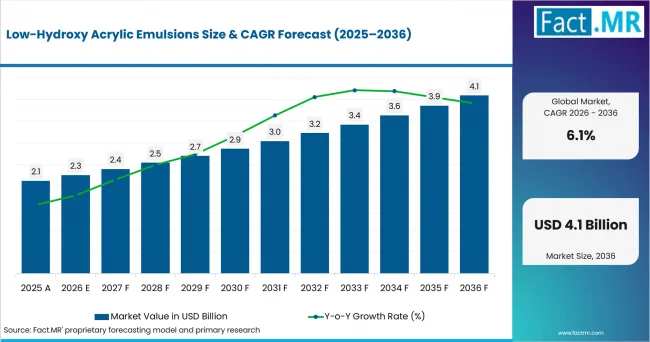
Low Hydroxy Acrylic Emulsions Value Analysis | Source: Fact.MR
What are the defining numbers behind Low-Hydroxy Acrylic Emulsions Market growth?
USD 1.8 billion absolute opportunity by 2036, led by <1% OH emulsions, pure acrylic chemistry and architectural coatings.
- Demand Drivers in the Market
- Architectural paint formulators need low-hydroxyl binders because façade coatings must balance scrub resistance, viscosity and low odor.
- Industrial coating teams need controlled crosslink density, supported by waterborne systems that resist blocking at lower solvent levels.
- Wood coating producers need acrylic-urethane hybrids owing to clear-film demand on joinery and furniture surfaces.
- Adhesive and sealant manufacturers need stable reactive emulsions, driven by label films and construction joints that require better water resistance.
- Key Segments Analyzed
- By Hydroxyl Content: <1% OH is expected to hold 36.0% share in 2026 because it gives crosslinking headroom at workable viscosity.
- By Emulsion Type: Pure acrylic is projected to account for 38.0% share in 2026 owing to exterior durability and UV resistance.
- By Application: Architectural coatings are anticipated to capture 31.0% share in 2026, supported by masonry and repainting use.
- By Crosslinking Route: Ambient self-crosslinking is estimated to represent 33.0% share in 2026 due to room-temperature curing needs.
- Analyst Opinion at Fact.MR
- Shambhu Nath Jha, Principal Consultant at Fact.MR, states, “Hydroxyl control changes pot life, hardness and water resistance. Demand is expected to rise where waterborne coatings must pass exterior tests. Suppliers should pair resin design with crosslinker guidance and VOC documentation.”
- Strategic Implications
- Resin producers should publish formulation windows for <1% OH and 1-2% OH grades so paint teams compare cure response clearly.
- Crosslinker suppliers should provide compatibility guidance for carbodiimide, melamine and isocyanate routes used with low-OH acrylic emulsions.
- Paint brands should test early water resistance and scrub performance before changing exterior masonry binder packages.
- Distributors should separate technical support by application since wood, architectural and metal coatings need different cure profiles.
South Korea is projected to post 7.5% CAGR through 2036, led by vehicle coatings and construction contracts. The UK is anticipated at 7.2% CAGR through renovation work. The USA is forecast at 6.4% CAGR owing to its coatings output base. Germany is expected to hold 6.1% CAGR, shaped by building approvals. France is estimated to record 4.4% CAGR due to housing starts.
How does the Low-Hydroxy Acrylic Emulsions Market break down by segment?
<1% OH leads at 36.0%; pure acrylic leads at 38.0%.
Which Hydroxyl Content dominates?
<1% OH holds 36.0% share in 2026.
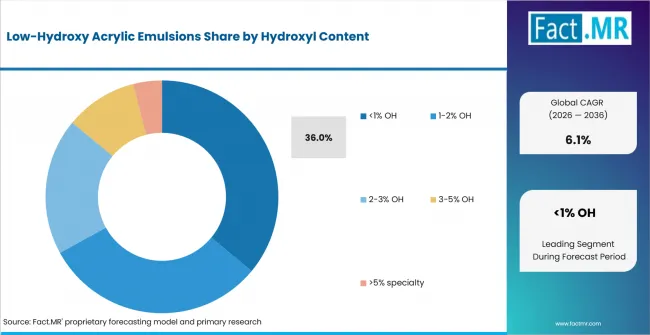
Low Hydroxy Acrylic Emulsions Analysis By Hydroxyl Content | Source: Fact.MR
<1% OH is expected to hold 36.0% share in 2026 because formulators want light reactivity at manageable viscosity. 1-2% OH grades have higher hydroxyl functionality than <1% OH grades. Dow’s 2025 annual report lists acrylic binders for architectural paints and coatings, industrial coatings and paper, and separately identifies adhesives among the applications served by its Coatings & Performance Monomers business.
What leads the Emulsion Type segment?
Pure acrylic leads with 38.0% share in 2026.
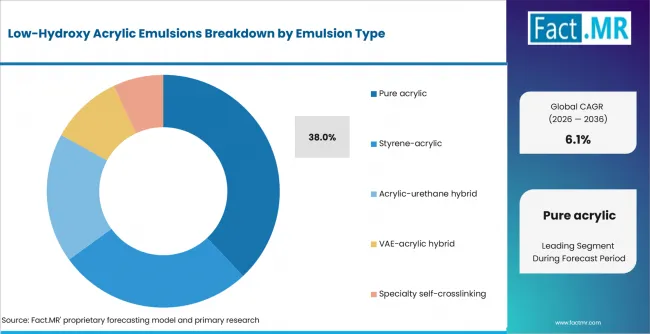
Low Hydroxy Acrylic Emulsions Analysis By Emulsion Type | Source: Fact.MR
Pure acrylic is projected to account for 38.0% share in 2026, supported by strong exterior durability, UV resistance and weatherability. These properties make it suitable for façade and architectural coatings, while styrene-acrylic grades remain more attractive in cost-sensitive paints where performance requirements are less demanding.
How does Application shape demand?
Architectural coatings capture 31.0% share in 2026.
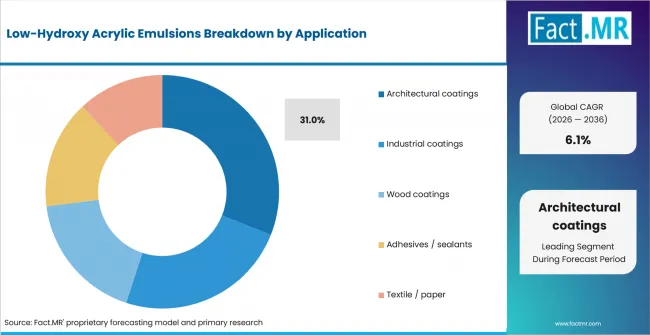
Low Hydroxy Acrylic Emulsions Analysis By Application | Source: Fact.MR
Architectural coatings are anticipated to capture 31.0% share in 2026, driven by masonry and repainting. Industrial coatings use low-OH emulsions for lower-solvent protection. EPA’s March 2026 architectural coatings page states that manufacturers and importers are required to limit the VOC content of architectural coatings.
What supports Crosslinking Route adoption?
Ambient self-crosslinking represents 33.0% share in 2026.
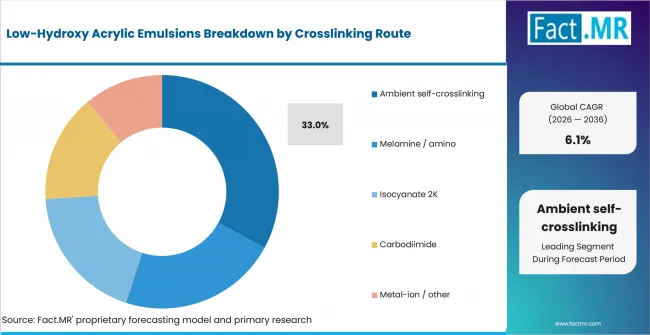
Low Hydroxy Acrylic Emulsions Analysis By Crosslinking Route | Source: Fact.MR
Ambient self-crosslinking is estimated to represent 33.0% share in 2026 because many building coatings cure at room temperature. Melamine routes fit heated factory lines. Isocyanate 2K routes improve hardness while requiring tighter handling.
What is accelerating Low-Hydroxy Acrylic Emulsions Market adoption, and what is holding it back?
VOC-compliant waterborne coating demand drives it; crosslinking complexity restrains it.
Drivers Impact Analysis
| DRIVER | (~) % IMPACT ON CAGR | GEOGRAPHIC RELEVANCE | IMPACT TIMELINE |
|---|---|---|---|
| Low-VOC architectural coating reformulation | +1.4% | North America, Europe | Short term (<= 2 years) |
| Exterior durability needs in pure acrylic systems | +1.1% | Global | Medium term (2-4 years) |
| Industrial shift to waterborne metal coatings | +0.9% | USA, Germany, South Korea | Medium term (2-4 years) |
| Wood coating demand for clear hard films | +0.6% | Western Europe, North America | Long term (>= 4 years) |
| Adhesives and sealants moving to reactive emulsions | +0.4% | Global | Long term (>= 4 years) |
- Low-VOC architectural coating reformulation: Architectural paint manufacturers are shifting toward acrylic emulsions to reduce solvent content while maintaining washability and application performance. Low-hydroxyl formulations support waterborne wall paints that balance regulatory requirements with contractor-friendly handling and durable finishes.
- Exterior durability needs in pure acrylic systems: Pure acrylic emulsions remain important for exterior coatings exposed to moisture, ultraviolet radiation, and dirt pickup. Their weatherability and film durability make them suitable for façade and architectural applications where long-term appearance and protection are important.
- Industrial shift to waterborne metal coatings: Metal-coating manufacturers are adopting waterborne systems to reduce solvent emissions while maintaining corrosion resistance and finish quality. Hydroxyl-functional acrylic emulsions support crosslinking with melamine and isocyanate systems, expanding their use in industrial topcoats.
- Wood coating demand for clear hard films: Furniture and joinery coatings require clarity, hardness, stain resistance, and lower solvent content. Acrylic-urethane hybrid systems allow formulators to balance flexibility, scratch resistance, and surface appearance across visible wood-finishing applications.
- Adhesives and sealants moving to reactive emulsions: Reactive acrylic emulsions can improve film strength and water resistance in labels, construction joints, and specialty paper applications. Adoption is expanding where wash-off performance, adhesion durability, and resistance to moisture influence product approval.
Opportunity Impact Analysis
| OPPORTUNITY | (~) % IMPACT ON CAGR | GEOGRAPHIC RELEVANCE | IMPACT TIMELINE |
|---|---|---|---|
| Self-crosslinking architectural grades | +1.0% | USA, UK, Germany | Short term (<= 2 years) |
| Acrylic-urethane hybrids for wood coatings | +0.8% | Europe, North America | Medium term (2-4 years) |
| Carbodiimide packages for low-temperature cure | +0.6% | Global | Medium term (2-4 years) |
| Bio-attributed waterborne acrylic resins | +0.4% | Europe | Long term (>= 4 years) |
- Self-crosslinking architectural grades: Room-temperature curing gives paint manufacturers a simpler route for masonry, trim, and other architectural coatings. These grades can reduce separate crosslinker handling while supporting low-VOC formulations, weather resistance, and contractor-friendly application.
- Acrylic-urethane hybrids for wood coatings: Hybrid acrylic-urethane chemistry supports tougher, more durable films than conventional latex systems. Furniture and joinery producers can use these formulations to improve block resistance, water resistance, clarity, and surface durability in low-VOC clear and pigmented finishes.
- Carbodiimide packages for low-temperature cure: Carbodiimide crosslinking can improve water resistance without requiring high curing temperatures. This makes the chemistry suitable for construction coatings and adhesives applied to large or heat-sensitive substrates, although formulation stability and crosslinker dosage remain important selection factors.
- Bio-attributed waterborne acrylic resins: Bio-attributed acrylic resins create an opportunity for coating producers seeking lower-impact waterborne formulations without changing established application processes. These materials can support sustainability targets while retaining the performance characteristics required in architectural and industrial coating systems.
Restraints Impact Analysis
| RESTRAINT | (~) % IMPACT ON CAGR | GEOGRAPHIC RELEVANCE | IMPACT TIMELINE |
|---|---|---|---|
| Crosslinker handling and pot-life limits | -0.7% | Global | Short term (<= 2 years) |
| Acrylic monomer price pressure | -0.5% | North America, Europe | Medium term (2-4 years) |
| Performance validation delays | -0.4% | USA, Germany, South Korea | Medium term (2-4 years) |
| Competition from lower-cost styrene-acrylics | -0.3% | Global | Long term (>= 4 years) |
- Crosslinker handling and pot-life limits: Reactive coating systems require tighter mixing and application control than conventional latex binders. Two-component crosslinking can introduce pot-life constraints, encouraging smaller applicators to favor one-pack self-crosslinking grades that simplify handling and reduce formulation complexity.
- Acrylic monomer price pressure: Changes in acrylic acid and ester costs can quickly affect binder pricing. Paint and coating manufacturers may delay reformulation when higher raw-material expenses are not matched by sufficient gains in durability, curing performance, or application efficiency.
- Performance validation delays: Coating producers typically require weathering, scrub, adhesion, storage, and application testing before changing binder chemistry. Low-hydroxyl acrylic emulsions therefore face longer qualification periods where customers need to confirm performance under specific end-use conditions.
- Competition from lower-cost styrene-acrylics: Styrene-acrylic binders remain attractive in value-oriented paints and basic sealants because of their lower cost. Low-hydroxyl acrylic emulsions gain stronger acceptance where superior exterior durability, water resistance, or low-temperature curing justifies a premium.
Which countries are scaling the Low-Hydroxy Acrylic Emulsions Market through 2036?
- The country comparison spans 3.1 percentage points and forms three practical growth bands across the forecast period.
- South Korea remains 0.3 percentage point above the UK through vehicle coatings and domestic construction contracts.
- The UK remains 0.8 percentage point above the USA as renovation painting and industrial sales support low-OH binder use.
- The USA remains 0.3 percentage point above Germany through coatings output scale and VOC documentation requirements.
- Germany remains 1.7 percentage points above France through building approvals and technical coating standards.
- France closes the displayed range through housing starts and refinish coating demand.
Comparable CAGRs create different entry conditions due to construction cycles, coating qualification timelines and automotive refinish demand. Full report coverage includes North America, Latin America, Western Europe, Eastern Europe, East Asia, South Asia & Pacific, Middle East & Africa.
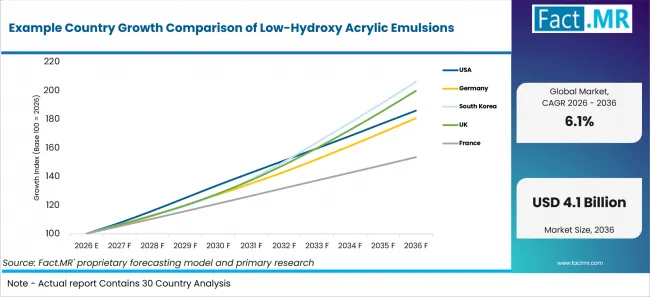
Example Country Growth Comparison Of Low Hydroxy Acrylic Emulsions | Source: Fact.MR
| Country | CAGR |
|---|---|
| South Korea | 7.5% |
| UK | 7.2% |
| USA | 6.4% |
| Germany | 6.1% |
| France | 4.4% |
What supports South Korea adoption?
7.5% CAGR through 2036, driven by export-oriented vehicle coatings and construction contracts.
South Korea is expected to use low-hydroxy acrylic emulsions across vehicle coatings and industrial finishes. The Ministry of Trade, Industry and Resources reported in January 2026 that domestic automobile production totaled 4.1 million units in 2025. Demand is projected to post 7.5% CAGR through 2036.
How is the UK scaling low-hydroxy acrylic emulsion demand?
7.2% CAGR through 2036, supported by renovation coatings and industrial sales.
The UK is anticipated to expand through repair work, repainting and industrial coating demand. The Office for National Statistics reported in February 2026 that annual construction output increased 1.8% in 2025 compared with 2024. Low-OH acrylic emulsions fit contractor-applied coatings needing low odor and scrub resistance.
What supports the USA outlook?
6.4% CAGR through 2036, shaped by paint manufacturing scale and VOC compliance.
The USA has a broad paint, coating and adhesive manufacturing base. FRED data updated June 29, 2026 and sourced from the U.S. Bureau of Labor Statistics show 2025 sectoral output of USD 52.406 billion for U.S. paint, coating, and adhesive manufacturing (NAICS 3255). The country is forecast to advance at 6.4% CAGR through 2036.
What supports Germany's growth?
6.1% CAGR through 2036, driven by building approvals and technical coating standards.
Germany favors technically documented coatings that meet performance and emissions expectations. Destatis reported in February 2026, based on preliminary results, that 238,500 dwellings were approved in Germany in 2025. The country is expected to hold 6.1% CAGR through 2036 as formulators qualify low-OH acrylic systems.
How does France perform?
4.4% CAGR through 2036, supported by façade repainting and refinish coating demand.
France shows a steadier adoption path in housing starts and renovation coatings. INSEE published July 2026 data showing 264.8 thousand dwellings started in 2025 across France excluding Mayotte. The market is estimated to record 4.4% CAGR through 2036.
Who leads the Low-Hydroxy Acrylic Emulsions Market?
Dow is an active provider through its acrylic binder portfolio serving architectural paints, industrial coatings, paper, adhesives and related formulation uses. Its position is relevant where waterborne binders must balance film hardness, adhesion, water resistance and crosslinking behavior across multiple coating applications.
Arkema participates through waterborne acrylic resin capabilities and sustainability-oriented resin development. Its ISCC PLUS-certified waterborne acrylic resin operations support bio-attributed formulation routes, giving coating producers options for lower-impact architectural and industrial waterborne systems. BASF also remains relevant through its dispersion-production capabilities serving coatings demand.
Covestro, Allnex and Alberdingk Boley are included among the key providers reviewed in the market. The available report evidence supports their inclusion in the competitive landscape, although it provides less product-specific detail for low-hydroxyl acrylic emulsions than for Dow and Arkema.
Competition therefore centers on hydroxyl-function control, crosslinker compatibility, low-VOC formulation support and exterior durability. Suppliers also differentiate through self-crosslinking chemistry, acrylic-urethane hybrid capability, technical formulation guidance and support for waterborne coating qualification.
Which companies are the key providers?
Key companies include Dow, BASF, Arkema, Covestro, Allnex and Alberdingk Boley.
- Dow
- BASF
- Arkema
- Covestro
- Allnex
- Alberdingk Boley
Bibliography
- Arkema. (2025, October 23). Arkema adds Boretto, Italy site to global list of ISCC PLUS certified waterborne resins facilities.
- BASF. (2025, July 9). BASF is investing in its dispersion production sites to meet growing customer demand in EMEA.
- Dow Inc. (2026, February 3). Annual report for the fiscal year ended December 31, 2025 [Form 10-K].
- Institut national de la statistique et des études économiques. (2026, July 9). Logements mis en chantier.
- Ministry of Trade, Industry and Resources. (2026, January 15). Automobile exports hit record high of $72 billion in 2025.
- Office for National Statistics. (2026, February 12). Construction output in Great Britain: December 2025, new orders and Construction Output Price Indices, October to December 2025.
- Service des données et études statistiques. (2026, February 11). Données 2025 sur les immatriculations des véhicules.
- Statistisches Bundesamt (Destatis). (2026, February 18). 10,8 % mehr Baugenehmigungen für Wohnungen im Jahr 2025.
- U.S. Environmental Protection Agency. (2026, March 4). Architectural Coatings: National Volatile Organic Compounds Emission Standards.
This Report Answers
- The report explains where low-hydroxy acrylic emulsions are used across hydroxyl content and emulsion type.
- Segment analysis identifies <1% OH and pure acrylic chemistry as the two main share leaders in 2026.
- Country analysis examines South Korea, UK, USA, Germany and France with local construction and coating indicators.
- Competitive analysis reviews Dow, BASF, Arkema, Covestro, Allnex and Alberdingk Boley through capability-focused company analysis.
- Application analysis covers architectural coatings, industrial coatings, wood coatings, adhesives / sealants and textile / paper uses.
- Crosslinking analysis compares ambient self-crosslinking, melamine / amino, isocyanate 2K, carbodiimide and metal-ion routes.
- Official data review combines government statistics, company portfolio checks and post-2024 development verification.
What does the Low-Hydroxy Acrylic Emulsions Market cover?
<1% OH, 1-2% OH, pure acrylic and hybrid emulsions used for reactive waterborne formulation.
The Low-Hydroxy Acrylic Emulsions Market covers waterborne acrylic dispersions with controlled hydroxyl functionality. These materials help formulators tune hardness, adhesion, water resistance and cure behavior.
The assessment focuses on low-hydroxyl acrylic emulsions and hybrid systems where hydroxyl functionality shapes crosslinking performance. Standard latex binders fall outside the boundary when reactive hydroxyl function is absent from the formulation decision.
What is included in the scope?
Low-hydroxy acrylic emulsion systems used in coatings, adhesives, sealants, textile and paper applications.
The scope includes <1% OH, 1-2% OH, 2-3% OH, 3-5% OH and >5% specialty emulsions where hydroxyl functionality changes film performance. It aligns with adjacent coverage of waterborne acrylic resins, coating binders and architectural coatings when reactive acrylic emulsion chemistry is central. Application coverage includes wood coatings, adhesives and sealants, textile and paper formulations.
What is excluded from the scope?
Standard latex binders and solventborne acrylic resins are outside the scope.
The scope excludes commodity vinyl acetate emulsions, styrene-butadiene latex and solventborne acrylic resins sold outside a low-hydroxyl emulsion function. General paints and coatings belong outside the boundary unless the formulation uses low-hydroxy acrylic emulsions as a reactive binder.
How Was the Analysis Built?
The analysis draws on 120+ sources, 35+ company portfolios, 25+ countries, and more than 20 industry interviews.
- Primary Research: Primary research includes discussions with manufacturers, service providers, technology developers, distributors, end users, and subject-matter experts. These conversations examine purchasing priorities, product adoption, operational challenges, approval requirements, competitive positioning, and the factors that influence wider market acceptance.
- Desk Research: Desk research covers government statistics, regulatory publications, company filings, trade data, technical studies, industry associations, standards, public policy, and other authoritative sources. Every source used in the analysis is documented in the bibliography.
- Market Sizing and Forecasting: Market estimates combine historical performance, demand indicators, pricing and volume trends, segment shares, company participation, country-level growth, adoption patterns, investment activity, and barriers to market expansion.
- Data Validation and Update Cycle: Findings are validated by comparing primary interviews with public data, company activity, regulatory changes, trade patterns, and industry developments. Regular updates review new product launches, capacity changes, partnerships, approvals, and shifts in commercial adoption.
What is the report’s scope and coverage?
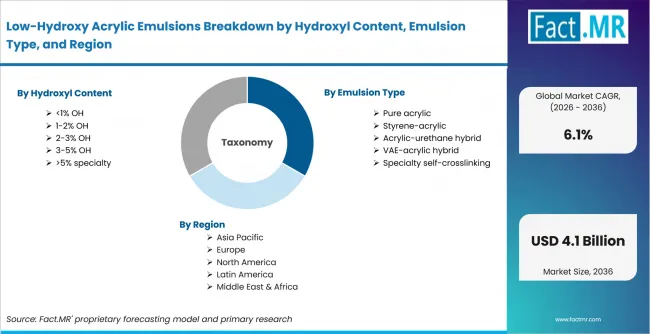
Low Hydroxy Acrylic Emulsions Breakdown By Hydroxyl Content, Emulsion Type, And Region | Source: Fact.MR
| Attribute | Details |
|---|---|
| Quantitative Units | USD billion |
| Market Definition | Waterborne acrylic emulsions with controlled low hydroxyl functionality used to tune crosslinking, film hardness, adhesion, water resistance and cure behavior in coating, adhesive, sealant, textile and paper formulations. |
| Hydroxyl Content | <1% OH; 1-2% OH; 2-3% OH; 3-5% OH; >5% specialty |
| Emulsion Type | Pure acrylic; Styrene-acrylic; Acrylic-urethane hybrid; VAE-acrylic hybrid; Specialty self-crosslinking |
| Application | Architectural coatings; Industrial coatings; Wood coatings; Adhesives / sealants; Textile / paper |
| Crosslinking Route | Ambient self-crosslinking; Melamine / amino; Isocyanate 2K; Carbodiimide; Metal-ion / other |
| Regions Covered | North America; Latin America; Western Europe; Eastern Europe; East Asia; South Asia & Pacific; Middle East & Africa |
| Countries Covered | USA; Germany; South Korea; UK; France |
| Key Companies Profiled | Dow; BASF; Arkema; Covestro; Allnex; Alberdingk Boley |
| Forecast Period | 2026 to 2036 |
| Approach | Hybrid top-down and bottom-up approach using coating output indicators; emulsion-type mapping; application mix; country adoption; and provider portfolio review. |
How is the market segmented?
-
By Hydroxyl Content
- <1% OH
- 1-2% OH
- 2-3% OH
- 3-5% OH
- >5% specialty
-
By Emulsion Type
- Pure acrylic
- Styrene-acrylic
- Acrylic-urethane hybrid
- VAE-acrylic hybrid
- Specialty self-crosslinking
-
By Application
- Architectural coatings
- Industrial coatings
- Wood coatings
- Adhesives / sealants
- Textile / paper
-
By Crosslinking Route
- Ambient self-crosslinking
- Melamine / amino
- Isocyanate 2K
- Carbodiimide
- Metal-ion / other
-
By Region
- North America
- Latin America
- Western Europe
- Eastern Europe
- East Asia
- South Asia & Pacific
- Middle East & Africa