- Market Value (2025): USD 110.8 Mn
- Estimated Value (2026): USD 116 Mn
- Forecast Value (2036): USD 184 Mn
- CAGR (2026-2036): 4.7%
What is the Low-Viscosity Ink Pigments Market forecast to be worth by 2036?
USD 116 million in 2026 to USD 184 million by 2036, at 4.7% CAGR.
- The low-viscosity ink pigments market was valued at USD 110.8 million in 2025, with demand led by gravure and flexographic formulations.
- Revenue is projected to increase from USD 116 million in 2026 to USD 184 million by 2036 as printers and ink producers seek faster dispersion at useful pigment loading.
- The market is forecast to record a 4.7% CAGR from 2026 to 2036. Growth is supported by flexible-packaging ink use and predispersed forms.
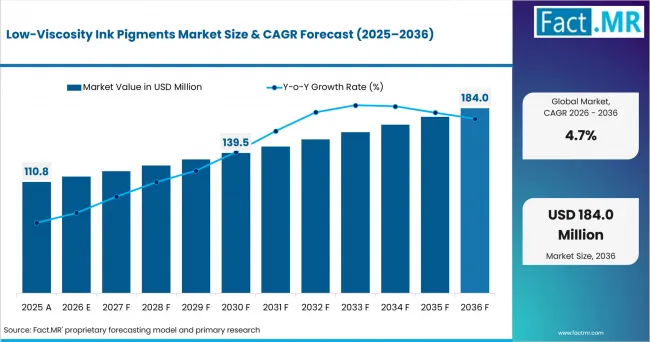
Low Viscosity Ink Pigments Market Value Analysis | Source: Fact.MR
What are the defining numbers behind Low-Viscosity Ink Pigments Market growth?
USD 68 million absolute opportunity by 2036, led by Solvent gravure inks and Azo pigments within their respective segments.
- Demand Drivers in the Market
- Gravure and flexographic ink makers look for strong color in inks that flow smoothly through fast printing machines.
- Flexible-packaging inks must mix quickly without bleeding or spreading into nearby materials. They also have to resist heat, sticking, and strong solvents during use.
- Ready-made chips and liquid color mixes help cut milling time and reduce batch differences when they work well with the chosen resin.
- Digital and special inks depend on very small, even pigment particles. This helps prevent blockages, clumps, and changes in ink flow during storage.
- Key Segments Analyzed
- By Ink System: Solvent gravure inks are projected to hold 27.0% share in 2026 supported by strong color development and fast flow at low working viscosity.
- By Pigment Chemistry: Azo pigments are expected to account for 31.0% share in 2026 owing to broad coverage across key yellow and red color spaces with practical strength and cost.
- By Performance Need: Low millbase viscosity is estimated to capture 34.0% share in 2026 because it allows useful pigment loading without reducing processability during ink production.
- By End Packaging: Flexible packaging is anticipated to represent 39.0% share in 2026 driven by high gravure and flexographic ink consumption across printed films.
- By Supply Form: Dry powder is forecast to hold 36.0% share in 2026 due to greater formulation freedom and control over carrier selection.
- Analyst Opinion at Fact.MR
- Shambhu Nath Jha, Senior Analyst at Fact.MR, states, " A low millbase reading is only the first step. The pigment must still flow well after the ink is adjusted to reach the required shade and color strength. Final results also depend on the printing method and the material being printed."
- Strategic Implications
- Pigment companies are better placed to support plant trials when they provide flow and color results at the same pigment level and mixing effort. The test details also have to name the binder and solvent so ink makers can compare grades fairly.
- Ink companies get a clearer picture by checking how the viscosity benefit holds up during real printing conditions. Storage time and temperature changes also matter before a laboratory result is accepted.
- Early work between packaging companies, ink makers, and pigment producers becomes important when food-contact rules or migration limits reduce the number of suitable materials.
- Distributors add practical value by offering dry powder and presscake along with chips and liquid dispersions that match the customer’s milling setup.
The United States is projected to grow at a 4.7% CAGR from 2026 to 2036, supported by demand for packaging and label inks. The United Kingdom is expected to expand at 4.6% as label and flexible-packaging production increases. Germany is anticipated to record a 4.5% CAGR, helped by careful product testing and strict packaging rules. Italy is estimated to advance at 4.4% through gravure and label printing. Japan is forecast to grow at 4.3%, supported by accurate printing and stable pigment mixes.
How does the Low-Viscosity Ink Pigments Market break down by segment?
Solvent gravure inks are projected to lead with 27.0% share by Ink System, while Azo pigments are expected to lead with 31.0% share by Pigment Chemistry in 2026.
Which Ink System dominates?
Solvent Gravure Inks hold 27.0% share in 2026.
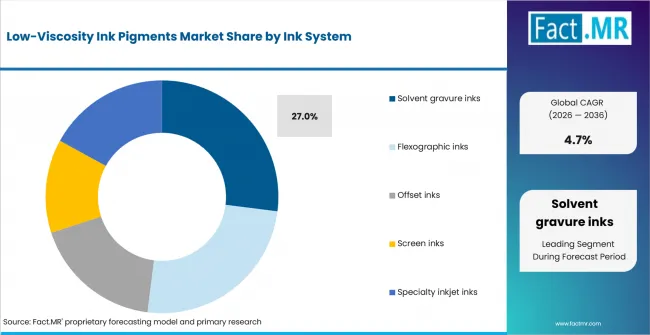
Low Viscosity Ink Pigments Market Analysis By Ink System | Source: Fact.MR
Solvent gravure inks are projected to hold 27.0% share in 2026, supported by the need for strong color development at low working viscosity. High-speed presses require pigments that disperse evenly, move through the ink system without disruption, and retain shade consistency during long runs. Their close fit with film-printing operations places solvent gravure formulations ahead within the ink-system segment.
What leads the Pigment Chemistry segment?
Azo Pigments account for 31.0% share in 2026.
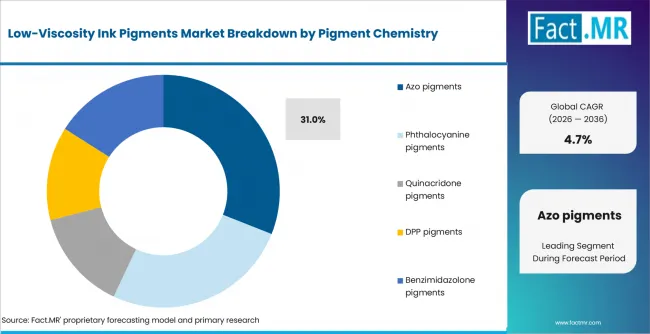
Low Viscosity Ink Pigments Market Analysis By Pigment Chemistry | Source: Fact.MR
Azo pigments are expected to account for 31.0% share in 2026, reflecting their wide coverage across yellow, orange, and red shades. Ink makers value the balance between color strength, formulation flexibility, and practical cost. Their broad shade range also helps producers serve process and spot-color requirements without relying on higher-cost pigment chemistries for every packaging design.
Which Performance Need holds the largest share?
Low Millbase Viscosity captures 34.0% share in 2026.
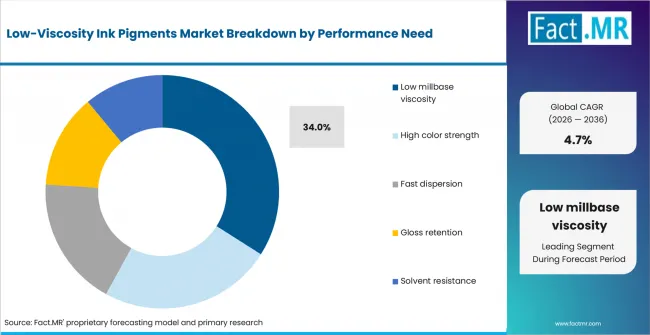
Low Viscosity Ink Pigments Market Analysis By Performance Need | Source: Fact.MR
Low millbase viscosity is estimated to capture 34.0% share in 2026, owing to its direct influence on milling speed, pumpability, pigment loading, and press adjustment. Ink makers need sufficient color strength without producing a mixture that becomes difficult to process. This requirement shapes pigment approval during early formulation work and places viscosity control at the centre of production efficiency.
What leads the End Packaging segment?
Flexible Packaging represents 39.0% share in 2026.
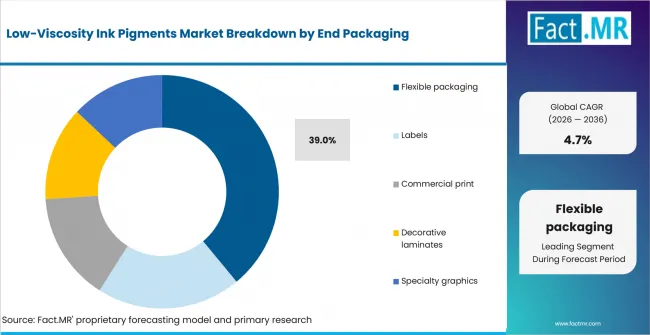
Low Viscosity Ink Pigments Market Analysis By End Packaging | Source: Fact.MR
Flexible packaging is anticipated to represent 39.0% share in 2026, driven by heavy use of gravure and flexographic inks across printed films. These applications require smooth flow, strong color, resistance, and dependable performance at high press speeds. Large production volumes across food, household, and personal-care packs keep flexible formats ahead of other end-packaging categories.
Which Supply Form dominates?
Dry Powder holds 36.0% share in 2026.
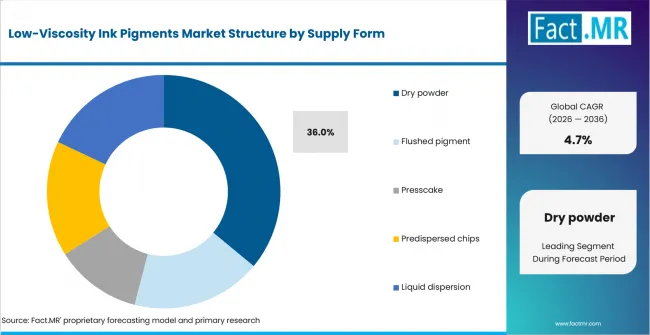
Low Viscosity Ink Pigments Market Analysis By Supply Form | Source: Fact.MR
Dry powder is forecast to hold 36.0% share in 2026, with ink makers retaining direct control over resin, solvent, carrier, and pigment concentration. Plants equipped for milling and dust management can adapt one pigment grade across several formulations. This flexibility supports custom ink development and avoids dependence on a predispersed product that may not match the final vehicle.
What is accelerating Low-Viscosity Ink Pigments Market adoption, and what is holding it back?
Faster dispersion and stable high-speed press flow are expected to be the main adoption engines. The restraint is that low viscosity has to be tested alongside pigment loading and vehicle compatibility. Storage behavior and print quality keep qualification formulation-specific. Packaging compliance adds another review layer.
Drivers Impact Analysis
| DRIVER | (~) % IMPACT ON CAGR | GEOGRAPHIC RELEVANCE | IMPACT TIMELINE |
|---|---|---|---|
| High-speed liquid printing | +0.7% | Asia Pacific and North America | Short term (<= 2 years) |
| Flexible-packaging demand | +0.6% | United States and Europe | Medium term (2-4 years) |
| Faster ink manufacture | +0.5% | Global ink-production hubs | Medium term (2-4 years) |
| Digital print expansion | +0.4% | Japan, Germany, and United States | Long term (>= 4 years) |
| Packaging-ink governance | +0.3% | European Union | Long term (>= 4 years) |
Source: Fact.MR analysis. Updated Jul 17, 2026
- High-speed liquid printing: Gravure and flexographic presses need inks that meter and transfer consistently at production speed. A pigment that develops strength without pushing viscosity upward is expected to give formulators more operating room.
- Flexible-packaging demand: Flexible packaging is projected to remain the largest end segment at 39.0%. Film substrates and laminated structures keep pigment selection technically active, especially where compliance expectations are tight.
- Faster ink manufacture: Fast-dispersing pigments are expected to reduce mill passes and energy use when the process is properly optimized. The benefit is strongest when color development remains consistent between scales.
Opportunity Impact Analysis
| OPPORTUNITY | (~) % IMPACT ON CAGR | GEOGRAPHIC RELEVANCE | IMPACT TIMELINE |
|---|---|---|---|
| Low-rheology pigment variants | +0.4% | Global | Medium term (2-4 years) |
| Resin-compatible chips | +0.3% | Europe, Japan, and United States | Short term (<= 2 years) |
| Food-packaging data support | +0.3% | European Union and North America | Long term (>= 4 years) |
| Inkjet dispersion platforms | +0.2% | Japan and Germany | Long term (>= 4 years) |
Source: Fact.MR analysis. Updated Jul 17, 2026
- Low-rheology pigment variants: Particle engineering and surface treatment are expected to reduce millbase viscosity in selected vehicles. A chemistry family offered in standard and low-rheology versions lets ink makers compare value without changing hue abruptly.
- Resin-compatible chips: Predispersed chips are anticipated to reduce dust and milling effort when the carrier dissolves cleanly in the customer's resin system. Producers need to state resin compatibility and effective pigment content precisely.
- Food-packaging data support: Packaging-ink formulators need raw-material disclosure and risk information to support finished-article compliance work. Pigment producers compete through traceability and impurity control. Timely notification of material changes adds further value.
Restraints Impact Analysis
| RESTRAINT | (~) % IMPACT ON CAGR | GEOGRAPHIC RELEVANCE | IMPACT TIMELINE |
|---|---|---|---|
| Vehicle-specific rheology | -0.3% | Global formulation markets | Short term (<= 2 years) |
| Strength-viscosity tradeoff | -0.3% | Gravure and flexographic ink plants | Medium term (2-4 years) |
| Storage instability | -0.2% | Global distribution channels | Long term (>= 4 years) |
| Compliance-driven exclusions | -0.2% | Food-contact packaging markets | Long term (>= 4 years) |
Source: Fact.MR analysis. Updated Jul 17, 2026
- Vehicle-specific rheology: A pigment that is fluid in one resin-solvent combination sometimes thickens in another. Broad low-viscosity claims therefore require careful qualification boundaries.
- Strength-viscosity tradeoff: Reducing pigment content lowers viscosity but weakens color. Higher loading is expected to erase the rheology benefit, so formulators need to compare color at equal strength.
- Storage instability: Settling or flocculation sometimes appears after the laboratory batch has passed. Viscosity drift during long transport and warehouse temperature changes creates commercial risk for predispersed forms.
Which countries shape low-viscosity ink pigment demand?
United States 4.7%, United Kingdom 4.6%, Germany 4.5%, Italy 4.4%, Japan 4.3%
The report reviews North America, Europe, and Asia Pacific. The country section gives closer attention to the United States, the United Kingdom, Germany, Italy, and Japan. The full study covers more than 30+ countries.
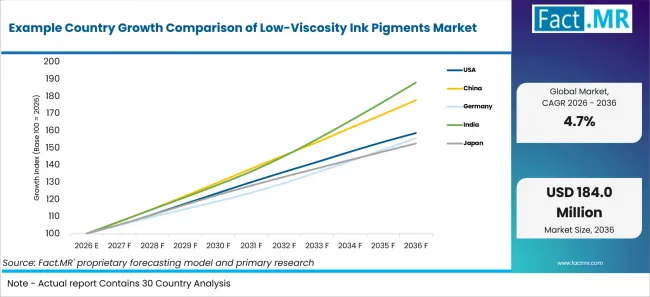
Example Country Growth Comparison Of Low Viscosity Ink Pigments Market | Source: Fact.MR
| COUNTRY | CAGR |
|---|---|
| United States | 4.7% |
| United Kingdom | 4.6% |
| Germany | 4.5% |
| Italy | 4.4% |
| Japan | 4.3% |
Source: Fact.MR analysis. Updated Jul 17, 2026
What supports the United States outlook?
4.7% CAGR, supported by packaging inks, labels, and specialized inkjet applications.
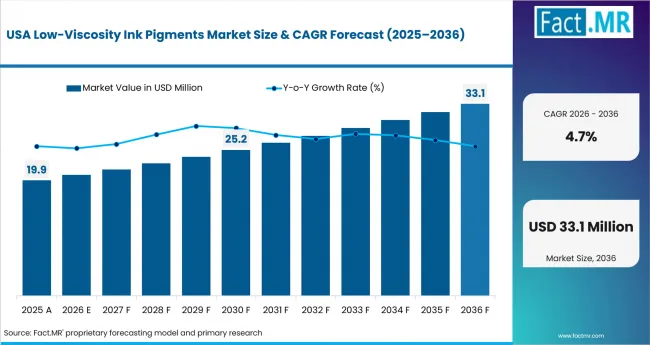
Low Viscosity Ink Pigments Market Country Value Analysis | Source: Fact.MR
Demand in the United States comes mainly from packaging inks, labels, and selected inkjet uses. Ink makers also examine food-contact records and pigment dispersion before approving a grade. The market is expected to record a 4.7% CAGR through 2036, with stronger interest in pigments that reduce milling time while preserving color strength, storage stability, and final print performance.
How is the United Kingdom sustaining ink pigment demand?
4.6% CAGR, driven by label production, flexible packaging, and short print runs.
United Kingdom demand is closely tied to labels, flexible packs, and frequent short-run printing. Ink plants often work with smaller batches and regular shade changes, making fast and even pigment mixing commercially useful. The market is projected to expand at a 4.6% CAGR from 2026 to 2036 as processors seek grades that reach target color with fewer production steps and lower changeover losses.
What shapes Germany’s technical opportunity?
4.5% CAGR, backed by detailed qualification and strict formulation control.
German ink companies usually require clear evidence of flow behavior, chemical resistance, product history, and resin compatibility before approving a pigment. This favors producers that test grades in realistic ink systems and explain their performance limits clearly. Germany is anticipated to record a 4.5% CAGR from 2026 to 2036 as documentation quality becomes closely linked with technical acceptance.
Why does Italy remain an important ink pigment market?
4.4% CAGR, supported by packaging gravure and appearance-led print applications.
Italy combines high-volume gravure printing with packaging work where shade quality and visual finish carry strong commercial value. Food, beverage, fashion, and premium packs all require clean color and steady press behavior. The market is estimated to advance at a 4.4% CAGR through 2036 as low-viscosity pigments help maintain color strength during long runs while supporting accurate shade control.
What keeps Japan relevant for high-performance pigment demand?
4.3% CAGR, driven by precision printing and consistent pigment dispersion.
Japanese ink makers place close attention on particle-size control, storage stability, and limited variation between batches. These factors are especially important in digital printing, where small differences can affect ink flow and final appearance. Japan is forecast to grow at a 4.3% CAGR through 2036 as formulators continue to favor pigment dispersions that deliver stable and repeatable performance.
Who leads the Low-Viscosity Ink Pigments Market?
Sudarshan Chemical Industries Limited and DIC Corporation lead through organic pigment depth.
Sudarshan Chemical Industries Limited strengthened its pigment position after completing the acquisition of Heubach Group in March 2025. The combined platform brings broader organic pigment technology and production reach across Europe and the Americas.
DIC Corporation combines organic pigment chemistry with printing inks and synthetic resins, giving the group a close view of pigment and vehicle interaction. Its January 2025 expansion of nitrocellulose-alternative ink solutions shows how changing resin systems influence pigment approval. Competition through 2036 is expected to focus on dispersion quality, low millbase viscosity, shade consistency, and application support.
Which companies are the key providers?
The company set includes artience Co., Ltd.; Dainichiseika Color & Chemicals Mfg. Co., Ltd.; DIC; and Sudarshan Chemical.
- Artience Co.Ltd.
- Dainichiseika Color & Chemicals Mfg. Co. Ltd.
- DIC
- Sudarshan Chemical
Bibliography
- DIC Corporation. (2025). DIC report 2025.
- European Printing Ink Association. (2025). Fifth version of EuPIA GMP published.
- Sudarshan Chemical Industries Limited. (2025, March 3). Sudarshan Chemical completes acquisition of Heubach Group.
- U.S. Environmental Protection Agency. (2025, September 22). EPA releases proposal to increase efficiency, better protect health and the environment in chemical reviews under TSCA.
This Report Addresses
- It quantifies the 2025 base and the market grow from 2026 to 2036.
- Country coverage concentrates on the United States and the United Kingdom. Germany and Italy are also covered along with Japan from a study base of more than 30 countries.
- It evaluates Dainichiseika Color & Chemicals Mfg. Co., Ltd.; DIC; artience Co., Ltd.; and Sudarshan Chemical against pigment coverage and ink-system fit.
- It contrasts azo and phthalocyanine pigment choices with quinacridone chemistry. DPP and benzimidazolone chemistry are also reviewed.
- It maps gravure and flexographic use into packaging demand. Offset and screen systems are also covered alongside specialty inkjet applications.
- It tests forecast reasoning against millbase rheology and color strength. Dispersion speed and gloss are included. Solvent resistance, storage stability and compliance requirements are also reviewed.
What does the Low-Viscosity Ink Pigments Market cover?
The report isolates pigment value where low-viscosity processing or end-use flow is a defined part of the ink-grade proposition.
Coverage combines ink system and chemistry with performance need. End packaging and supply form coverage are included. Country and competitor coverage are also part of the scope.
Technical analysis considers particle and surface design with vehicle compatibility. Milling and let-down behavior are reviewed. Storage and press transfer are included. Resistance and raw-material governance are also assessed.
What is included in the scope?
A pigment is included when it is marketed or qualified for low-rheology ink formulation within the covered ink systems and applications.
Dry and wet forms are counted on a pigment-value basis after adjustment for carrier or water content. Flushed forms and chipped forms follow the same boundary alongside liquid forms.
Both conventional printing and specialty inkjet applications remain in scope when the relevant low-viscosity performance is isolated.
What is excluded from the scope?
Finished ink and the surrounding print-production value chain are outside the pigment boundary.
The study removes resin and solvent value from the pigment boundary. Additives and varnish value are outside the count. Finished ink and substrate value are also excluded. Press, plate and printed-package value are removed from the count.
Colorants not covered by the five source chemistries are excluded. Products sold only into non-ink uses and services without pigment revenue are also outside the scope.
How Was the Analysis Built?
The analysis draws on 120+ sources, 35+ company portfolios, 25+ countries, and more than 20 industry interviews.
- Primary Research: Primary research includes discussions with manufacturers, service providers, technology developers, distributors, end users, procurement teams, and subject-matter experts. These conversations examine purchasing priorities, product adoption, operational challenges, approval requirements, competitive positioning, and the factors that influence wider market acceptance.
- Desk Research: Desk research covers government statistics, regulatory publications, company filings, trade data, technical studies, industry associations, standards, public policy, and other authoritative sources. Every source used in the analysis is documented in the bibliography.
- Market Sizing and Forecasting: Market estimates combine historical performance, demand indicators, pricing and volume trends, segment shares, company participation, country-level growth, adoption patterns, investment activity, and barriers to market expansion.
- Data Validation and Update Cycle: Findings are validated by comparing primary interviews with public data, company activity, regulatory changes, trade patterns, and industry developments. Regular updates review new product launches, capacity changes, partnerships, approvals, procurement trends, and shifts in commercial adoption.
Segmentation
What is the report's scope and coverage?
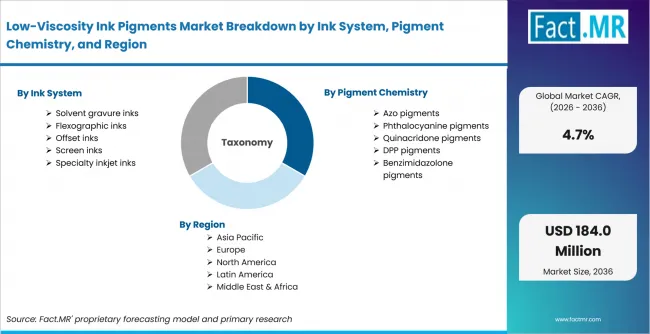
Low Viscosity Ink Pigments Market Breakdown By Ink System, Pigment Chemistry, And Region | Source: Fact.MR
| ATTRIBUTE | DETAILS |
|---|---|
| Quantitative Units | USD million in 2026 to USD million by 2036 at a CAGR |
| Market Definition | Low-viscosity ink pigments are organic pigment powders, presscakes, flushed products, chips, and dispersions sold for ink formulations in which controlled rheology and efficient color development are specified purchasing attributes. |
| Ink System | Solvent gravure inks; Flexographic inks; Offset inks; Screen inks; Specialty inkjet inks |
| Pigment Chemistry | Azo pigments; Phthalocyanine pigments; Quinacridone pigments; DPP pigments; Benzimidazolone pigments |
| Performance Need | Low millbase viscosity; High color strength; Fast dispersion; Gloss retention; Solvent resistance |
| End Packaging | Flexible packaging; Labels; Commercial print; Decorative laminates; Specialty graphics |
| Supply Form | Dry powder; Flushed pigment; Presscake; Predispersed chips; Liquid dispersion |
| Regions Covered | North America; Europe; Asia Pacific; Latin America; Middle East and Africa |
| Countries Covered | United States; United Kingdom; Germany; Italy; Japan and 30+ countries |
| Key Companies Profiled | Artience Co. Ltd.; Dainichiseika Color & Chemicals Mfg. Co. Ltd.; DIC; Sudarshan Chemical |
| Forecast Period | 2026 to 2036 |
| Approach | Sizing reconciles ink output and pigment loading by process with the share requiring low-viscosity performance, chemistry mix, supply-form solids, and realized pigment price. |
Source: Fact.MR analysis. Updated Jul 17, 2026
How is the market segmented?
-
By Ink System
- Solvent gravure inks
- Flexographic inks
- Offset inks
- Screen inks
- Specialty inkjet inks
-
By Pigment Chemistry
- Azo pigments
- Phthalocyanine pigments
- Quinacridone pigments
- DPP pigments
- Benzimidazolone pigments
-
By Performance Need
- Low millbase viscosity
- High color strength
- Fast dispersion
- Gloss retention
- Solvent resistance
-
By End Packaging
- Flexible packaging
- Labels
- Commercial print
- Decorative laminates
- Specialty graphics
-
By Supply Form
- Dry powder
- Flushed pigment
- Presscake
- Predispersed chips
- Liquid dispersion
-
By Region
- North America
- United States
- Europe
- United Kingdom
- Germany
- Italy
- Asia Pacific
- Japan
Frequently Asked Questions
Which Ink System leads the Low-Viscosity Ink Pigments Market?
Which Pigment Chemistry leads the Low-Viscosity Ink Pigments Market?
Which Performance Need leads the Low-Viscosity Ink Pigments Market?
Which End Packaging segment leads the Low-Viscosity Ink Pigments Market?
Which Supply Form leads the Low-Viscosity Ink Pigments Market?
Which country records the highest CAGR in the Low-Viscosity Ink Pigments Market?
How does the United Kingdom perform in the Low-Viscosity Ink Pigments Market?
How does Germany perform in the Low-Viscosity Ink Pigments Market?
How does Italy perform in the Low-Viscosity Ink Pigments Market?
How does Japan perform in the Low-Viscosity Ink Pigments Market?
What is the primary driver in the Low-Viscosity Ink Pigments Market?
What is the main restraint in the Low-Viscosity Ink Pigments Market?
Why is Low Millbase Viscosity important?
Why do flexible-packaging applications dominate demand?
Who worked on this report


Preview the report firsthand - request a free sample
Free SampleGet the brochure for pricing and purchase details
Download PDF