- Base Value(2025): 1.81 Bn
- Estimated Value(2026): 1.90 Bn
- Forecast Value (2036): 3.00 Bn
- CAGR (2026 - 2036): 4.8%
Non Shrink Grouts Market Forecast and Outlook 2026 to 2036
In 2025, the non-shrink grouts market was valued at USD 1.81 billion. Based on Fact.MR analysis, demand for non-shrink grouts is estimated to grow to USD 1.90 billion in 2026 and USD 3.00 billion by 2036. Fact.MR projects a CAGR of 4.8% during the forecast period. Growth reflects steady uptake across infrastructure anchoring, industrial equipment installation, and transport asset refurbishment governed by structural performance standards.
The market adds approximately USD 1.19 billion in value over the decade, indicating measured compounding rather than rapid acceleration. Demand follows capital spending on foundations, machinery installation, and asset reinforcement, while pricing reflects compliance with ASTM C1107 and EN 1504 6 performance criteria. Value growth is supported by wider use of engineered grout systems in load bearing and alignment sensitive applications, even where overall construction activity fluctuates.
As Benoît Bazin, Chairman and Chief Executive Officer of Saint-Gobain, stated in the 2024 Universal Registration Document following the acquisition of Fosroc, “Saint-Gobain has changed radically and greatly expanded its geographic presence in high growth areas. We are also continuing to increase our presence in construction chemicals, an essential lever for the decarbonization of the sector.” [1] The statement reflects Saint-Gobain strategy to scale specialty construction chemicals, including non-shrink grouts, through portfolio expansion rather than standalone product growth, as per Fact.MR assessment.
India records the fastest growth at 5.9% CAGR, supported by infrastructure and metro rail construction standards. Vietnam follows at 5.7% due to industrial foundation and port development activity, while Indonesia grows at 5.6% through national project execution. China posts 5.0% as equipment installation and urban rail projects continue. Saudi Arabia grows at 4.8% driven by industrial and energy asset reinforcement. Mature markets including the United States at 3.1%, Germany at 2.6%, and Japan at 2.2% remain replacement led, constrained by long maintenance cycles and strict engineering approval processes.
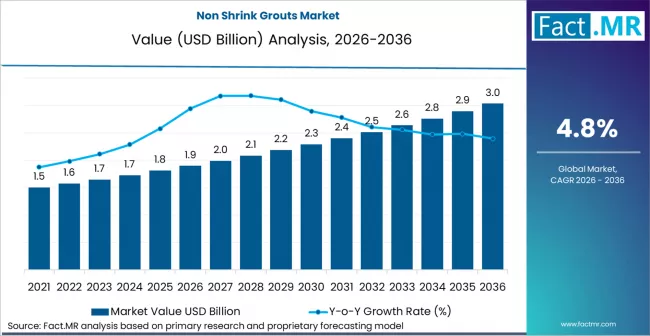
Non Shrink Grouts Market Market Value Analysis | Source: Fact.MR
Non Shrink Grouts Market Definition
The non-shrink grouts market covers cement based and resin based grouting materials formulated to harden without measurable volume loss after placement, as defined in ASTM [2]. These materials fill gaps between structural elements and transfer loads from equipment bases to concrete foundations. They are supplied in dry or pre mixed forms and placed under machinery, columns, anchor bolts, and precast joints. Typical users include construction contractors, industrial maintenance teams, and infrastructure owners responsible for alignment, anchoring, and load bearing repairs.
Non Shrink Grouts Market Inclusions
The report covers global and regional market size estimates in volume and value terms with a forecast period from 2026 to 2036. Segmentation includes grout type, cementitious and resin based, application areas such as equipment foundations and structural anchoring, and end use sectors including construction, industrial plants, and transport infrastructure. The scope also includes regional demand patterns and pricing benchmarks.
Non Shrink Grouts Market Exclusions
The scope excludes shrink compensated mortars and general repair concretes that do not meet non shrink performance criteria under ASTM C1107. Finished structural components, precast elements, and turnkey foundation systems are not included. Decorative floor toppings, consumer grade repair products, laboratory scale formulations, and experimental grouts without documented use in construction or industrial anchoring applications are also excluded worldwide markets.
Non Shrink Grouts Market Research Methodology
- Primary Research: Primary research involved interviews with grout manufacturers, construction contractors, equipment installers, and civil engineers engaged in foundation and anchoring works.
- Desk Research: Desk research used ASTM C1107 specifications, EN 1504-6 anchoring standards issued by CEN, government infrastructure manuals, and company annual reports and technical datasheets filed with securities regulators.
- Market Sizing and Forecasting: Market sizing applied a hybrid top down and bottom up model using construction spending data from national statistical offices, equipment installation rates, and grout consumption norms referenced in EN 1504-6.
Data Validation and Update Cycle
Outputs were validated through cross checks against procurement tenders, trade statistics for cement and resin materials, and public capital expenditure disclosures, with updates applied when verified source data is revised.
Summary of non-shrink grouts market
Market definition
- The non-shrink grouts market covers cement based and resin based grouting materials engineered to harden without measurable volume loss after placement, ensuring load transfer and dimensional stability in anchoring and foundation applications, as defined under ASTM C1107
Demand drivers
- Infrastructure owners and industrial operators specify non shrink grouts for machinery bases, rail assets, and bridge bearings where controlled expansion and compressive strength are mandated under structural performance standards, based on Fact.MR analysis.
- Transport, energy, and industrial projects continue to procure non shrink grouts as part of installation and refurbishment cycles governed by anchoring and load transfer requirements under EN 1504-6
- Growth in metro rail systems, industrial foundations, and wind and energy installations across Asia Pacific is increasing specification of engineered grout systems over generic mortars, as per Fact.MR.
Key segments analyzed
- Product type: Cementitious non shrink grouts lead with an estimated 55% share in 2026 due to cost control, ease of onsite handling, and compliance with ASTM C1107 expansion criteria, based on Fact.MR
- Application: Machinery baseplates account for about 26% of demand, reflecting continuous installation and realignment of industrial equipment across power, cement, metals, and processing plants, according to Fact.MR.
- Geography: Asia Pacific records the fastest growth led by India, Vietnam, and Indonesia, while North America and Europe remain replacement-driven markets constrained by long maintenance cycles, based on Fact.MR analysis.
Analyst opinion at Fact.MR
- Shambhu Nath Jha, Principal Consultant at Fact.MR, opines, ‘CXOs will find that non shrink grout demand is anchored in specification-led applications where controlled expansion, compressive strength, and anchoring performance matter more than general construction volume.’
Strategic implications and executive takeaways
- Fact.MR is of the opinion that suppliers should align growth strategies with performance-critical applications such as machinery installation, rail anchoring, and structural rehabilitation.
- Fact.MR opines that expanding high-performance and hybrid grout portfolios can improve participation in projects governed by ASTM and EN anchoring standards.
- Fact.MR analysts recommend strengthening technical approvals and site support capabilities to secure repeat inclusion in infrastructure and industrial tenders.
Methodology
- Based on Fact.MR’s report, estimates draw on primary interviews with grout manufacturers, contractors, equipment installers, and civil engineers.
- Fact.MR analysis integrates ASTM C1107 specifications and EN 1504-6 anchoring standards with public infrastructure and industrial project documentation
- Outputs were validated through cross-checks against procurement tenders, trade data for cement and resin materials, and public capital expenditure disclosures.
Segmental Analysis
Non shrink grouts market analysis by product type
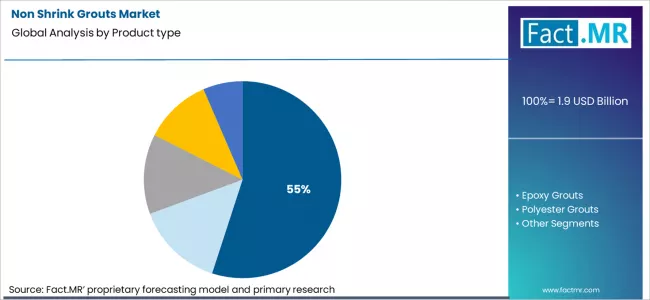
Non Shrink Grouts Market Analysis By Product Type | Source: Fact.MR
Based on FACT.MR's non shrink grouts market report, consumption of cementitious non shrink grouts is estimated to hold 55% share in 2026. FACT.MR analysts link this dominance to cost control, ease of onsite mixing, and compatibility with standard construction practices across industrial and infrastructure projects. As per FACT.MR, cementitious systems solve buyer requirements for volume stability and compressive strength without the handling constraints associated with resin based grouts.
- Manufacturing investment: Sika expanded cementitious mortar and grout production capacity through new and upgraded plants to support infrastructure and industrial construction demand, as disclosed in its annual report and regional investment announcements [3]
- Product formulation: Fosroc publishes technical data for Conbextra GP and Conbextra HS, cement based non shrink grouts with specified flow and strength performance for baseplate and structural applications .
Specification pattern: Fact.MRanalysis references public infrastructure tender documents that continue to specify cementitious non shrink grouts for anchor bolts and equipment foundations due to local availability and standard compliance.
Non shrink grouts market analysis by application
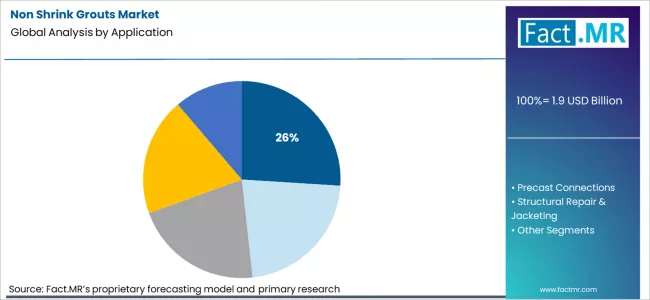
Non Shrink Grouts Market Analysis By Application | Source: Fact.MR
Based on FACT.MR's non shrink grouts market report, consumption in machinery baseplate applications is estimated to hold 26% share in 2026. FACT.MR is of the opinion that this segment leads due to continuous installation and replacement of rotating and static equipment across power, cement, metals, and processing plants. As per FACT.MR, machinery grouting solves alignment stability and vibration transfer issues by providing uniform load distribution between equipment and concrete foundations.
- Industrial demand: ABB specifies non shrink cementitious grouts for motor, generator, and drive installations in its publicly available installation manuals
- Application guidance: American Concrete Institute ACI 351.1R identifies non shrink grouts as standard materials for machinery baseplates to maintain load transfer and dimensional stability
- Maintenance cycle: FACT.MR analysts note that plant shutdown and overhaul schedules create recurring demand for baseplate grouting during equipment realignment and replacement cycles, supporting repeat consumption in this application segment.
Non shrink grouts market drivers, restraints, and opportunities
Fact.MRanalysis indicates that the non-shrink grouts market exists as a value-added segment within construction materials, used where grout volume stability is required for structural bearing, anchoring, and load-transfer applications. As per FACT.MR, non-shrink grout formulations are specified because they maintain or slightly expand in confined spaces after curing, preventing gap formation at baseplates, rail support, and bridge bearing pads an outcome verified by standard test methods such as ASTM C1107, which sets performance requirements for packaged grouts with controlled expansion [4]. This structural reality supports consistent demand from infrastructure projects, industrial facilities, and heavy civil construction, where grout performance directly influences asset safety and service life.
FACT.MR is of the opinion that the market is undergoing a shift toward high-performance and specialty formulations driven by engineering requirements and project specifications that measure compressive strength, expansion limits, and flow characteristics. Based on FACT.MR’s report, generic cement-based mortars that lack controlled expansion are being replaced in critical load-bearing applications with engineered non shrink grouts, even though these advanced products typically carry higher formulation and quality assurance costs. This pricing gap means that total value for non-shrink grouts can grow even where bulk volume growth is moderate, reflecting value contribution from performance attributes that matter in structural applications.
- ASTM performance specifications: FACT.MR analysts note that ASTM C1107 performance criteria for expansion, compressive strength, and flow influence procurement specifications, leading engineers and owners to require tested non shrink grout products rather than generic binders
- Infrastructure and heavy construction demand: Based on FACT.MR’s report, sustained investment in bridges, rail systems, power plants, and industrial facilities in North America and Europe supports consistent use of non-shrink grouts because controlled expansion and strength retention are prerequisites for structural bearing and load transfer.
- Asia Pacific construction activity: FACT.MR opines that rapid expansion of reinforced concrete and specialized industrial projects in China, India, and Southeast Asia increases specification of engineered non shrink grouts, as project owners seek materials that align with international performance benchmarks referenced by structural engineers.
Regional Analysis
Based on regional assessment, the non-shrink grouts sector is analyzed across North America, Latin America, Europe, East Asia, South Asia, Oceania, and the Middle East & Africa, spanning more than 40 countries. Regional performance varies according to infrastructure development activity, industrial construction demand, and standards governing precision grouting applications. The report also presents a comparative market attractiveness evaluation grounded in region-specific demand trends.
Non Shrink Grouts Market CAGR Analysis by Country (2026-2036)
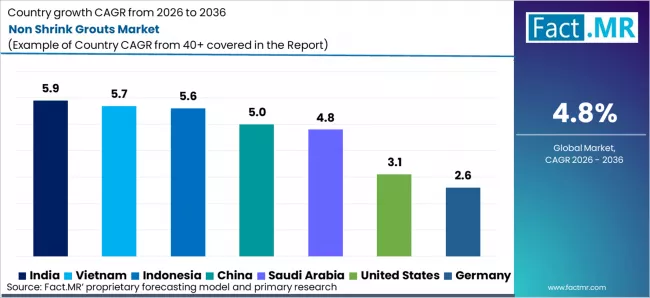
Non Shrink Grouts Market Cagr Analysis By Country | Source: Fact.MR
| Country | CAGR |
|---|---|
| India | 5.9% |
| Vietnam | 5.7% |
| Indonesia | 5.6% |
| China | 5.0% |
| Saudi Arabia | 4.8% |
| United States | 3.1% |
| Germany | 2.6% |
| Japan | 2.2% |
Source: Fact.MR analysis. Updated Feb 16, 2026
Source: Fact.MR analysis, based on proprietary forecasting models and primary research.
Asia Pacific non-shrink grouts market analysis
Asia Pacific acts as a construction execution-led region for non-shrink grouts, supported by transport infrastructure, industrial foundations, and public works. Demand is specification-based and linked to government-issued construction standards and tendered repair works. Regional supply is supported by local manufacturing and contractor procurement channels across multiple countries.
- India: Demand for non-shrink grouts in India is projected to rise at 5.9% CAGR through 2036. Usage is specified under CPWD Works Manual revisions issued in March 2021 and reinforced through metro rail civil works tenders released by Delhi Metro Rail Corporation during July 2022, as per Fact.MR.
- Vietnam: Demand for non-shrink grouts in Vietnam is projected to rise at 5.7% CAGR through 2036. Application is documented in industrial foundation standards issued by the Ministry of Construction in June 2020 and port infrastructure packages approved under the National Seaport Development Plan in September 2022, according to Fact.MR.
- Indonesia: Demand for non-shrink grouts in Indonesia is projected to rise at 5.6% CAGR through 2036. Use is specified within National Strategic Project construction guidelines released in August 2021 and foundation repair tenders issued by state utility PLN in February 2023, based on Fact.MR.
- China: Demand for non-shrink grouts in China is projected to rise at 5.0% CAGR through 2036. Application is governed by equipment foundation requirements under GB construction codes revised in October 2020 and municipal urban rail project tenders issued during May 2022, as per Fact.MR.
- Japan: Demand for non-shrink grouts in Japan is projected to rise at 2.2% CAGR through 2036. Use is referenced in seismic retrofit guidelines issued by MLIT in April 2020 and maintenance specifications reaffirmed by METI for industrial facilities in November 2021, according to Fact.MR.
Fact.MR’s analysis of the non-shrink grouts market in Asia Pacific consists of country-wise assessment that includes India, Vietnam, Indonesia, China, and Japan. Readers can find construction standards, public procurement activity, and application-specific demand references.
Middle East non-shrink grouts market analysis
The Middle East functions as a repair- and retrofit-oriented region for non-shrink grouts, driven by public infrastructure maintenance and industrial asset reinforcement. Demand is governed by engineering specifications issued by state authorities and project owners rather than discretionary use.
- Saudi Arabia: Demand for non-shrink grouts in Saudi Arabia is projected to rise at 4.8% CAGR through 2036. Application is specified under Saudi Aramco engineering standards revised in January 2021 and reinforced through transport infrastructure rehabilitation tenders released by the Ministry of Transport in August 2022, as per Fact.MR.
Fact.MR’s analysis of the non-shrink grouts market in the Middle East consists of country-wise assessment that includes Saudi Arabia. Readers can find engineering standards references, public tender activity, and asset repair specifications.
North America non-shrink grouts market analysis
North America operates as a standards-driven repair market for non-shrink grouts, where use is tied to structural rehabilitation and equipment anchoring. Demand follows federal and state-issued construction and maintenance guidelines applied across public infrastructure projects.
- United States: Demand for non-shrink grouts in the United States is projected to rise at 3.1% CAGR through 2036. Usage is referenced in bridge rehabilitation programs funded under the Infrastructure Investment and Jobs Act enacted in November 2021 and repair specifications issued by AASHTO in March 2022, according to Fact.MR.
Fact.MR’s analysis of the non-shrink grouts market in North America consists of country-wise assessment that includes the United States. Readers can find federal funding references, standards adoption, and repair application documentation.
Europe non-shrink grouts market analysis
Europe functions as a regulated refurbishment market where non-shrink grouts are specified under harmonized structural repair and transport infrastructure standards. Demand is linked to scheduled maintenance cycles across public assets.
- Germany: Demand for non-shrink grouts in Germany is projected to rise at 2.6% CAGR through 2036. Use is documented in bridge maintenance directives issued by the Federal Ministry of Transport in June 2020 and rail infrastructure repair specifications reaffirmed by Deutsche Bahn in February 2022, as per Fact.MR.
Fact.MR’s analysis of the non-shrink grouts market in Europe consists of country-wise assessment that includes Germany. Readers can find regulatory directives, refurbishment programs, and application-level references.
Competitive aligners for market players
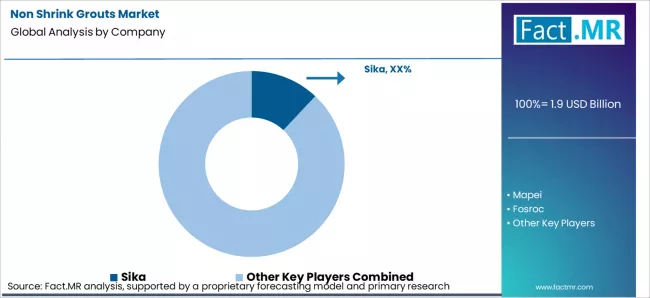
Non Shrink Grouts Market Analysis By Company | Source: Fact.MR
The non-shrink grouts market shows moderate concentration, with competition clustered among established construction chemicals suppliers serving structural, infrastructure, and industrial demand. Participation is typically linked to technical specification approval for projects requiring controlled expansion and high compressive strength. Practical competition revolves around product performance, service support, and certified compliance with standards such as ASTM C1107. General construction chemicals growth supports demand for non-shrink grouts as a segment of cementitious grouting solutions.
Structural advantages accrue to suppliers with broad product portfolios and global distribution. Companies that offer multiple non-shrink grout formulations, from precision mixes to deep pour systems, secure specification inclusion across base plate grouting, anchor bolt seating, and machinery foundations. For example, Master Builders Solutions lists several MasterFlux non shrink grouts in its portfolio, demonstrating product breadth. Smaller regional firms typically depend on distribution partners and lack testing support, limiting access to large infrastructure frameworks.
Buyer leverage is reinforced through dual sourcing and prequalification. Contractors and asset owners include multiple suppliers on approved lists to mitigate dependency risk. Negotiations focus on application reliability, technical backing, and delivery capability rather than price alone.
Recent developments
- Saint-Gobain Finalizes Global Consolidation (Oct 2025): Saint-Gobain officially completed its acquisition of Fosroc, a titan in the non-shrink grout and technical mortar market. This move turned Saint-Gobain into a global construction chemicals powerhouse with combined sales of €6.5 billion across 76 countries. This acquisition is the cornerstone of their "Lead & Grow" strategy, specifically targeting the high-growth infrastructure sectors in India and the Middle East. [5]
- Sika Launches "Five-Country" Expansion (Feb 2026): Just this month, Sika AG inaugurated five new production facilities simultaneously across the United States, Argentina, Colombia, Bangladesh, and Tanzania. These plants are designed with "Industry 4.0" automation to produce advanced concrete admixtures and specialized grouts. The Florida (USA) facility alone is expected to cut 8,000 tons of carbon emissions by 2032 through high-efficiency waste-reduction systems. [6]
Key Players in Non Shrink Grouts Market
- Sika
- Mapei
- Fosroc
- Master Builders Solutions
- Ardex Group
- Saint-Gobain Weber
- Five Star Products
- QUIKRETE
- Pidilite Industries
- Denka
Bibliography
- [1] Saint-Gobain. (2024). Universal registration document 2024. Saint-Gobain.
- [2] ASTM International. (2021). ASTM C1107/C1107M-21: Standard specification for packaged dry, hydraulic-cement grout (nonshrink). ASTM International.
- [3] Sika AG. (2023). Sika expands production capacity. Sika AG.
- [4] ASTM International. (2021). ASTM C1107/C1107M-21: Standard specification for packaged dry, hydraulic-cement grout (nonshrink). ASTM International.
- [5] Saint-Gobain. (2025). Saint-Gobain completes acquisition of Fosroc, a leading player in construction chemicals in Asia and emerging markets. Saint-Gobain.
- [6] Sika AG. (2026). Sika reports preliminary 2025 sales. Sika AG.
Segmentation
Scope of the Report
| Metric | Value |
|---|---|
| Quantitative Units | USD 1.90 billion (2026) to USD 3.00 billion (2036), at a CAGR of 4.8% |
| Market Definition | The non-shrink grouts market covers cementitious and resin-based grouting materials formulated to harden without measurable volume loss after placement, as defined under ASTM C1107. These materials fill gaps between structural elements, transfer loads from equipment bases to foundations, and are applied under machinery, columns, anchor bolts, and precast joints in industrial, infrastructure, and energy projects. |
| Product Type Segmentation | Cementitious Non-Shrink Grouts, Epoxy Grouts, Polyester Grouts, Hybrid/High-Performance Grouts, Other |
| Application Segmentation | Machinery Baseplates, Precast Connections, Structural Repair & Jacketing, Wind Turbines & Energy, Bridge Bearings & Rail |
| End Use Segmentation | Industrial, Infrastructure, Energy & Utilities, Commercial Buildings, Other |
| Regions Covered | Asia Pacific, Europe, North America, Latin America, Middle East & Africa |
| Countries Covered | India, Vietnam, Indonesia, China, Japan, Saudi Arabia, United States, Germany, South Korea, Australia & New Zealand, ASEAN, Rest of Asia Pacific, Italy, France, United Kingdom, Spain, Benelux, Nordics, Central & Eastern Europe, Rest of Europe, Canada, Mexico, Brazil, Argentina, Chile, Rest of Latin America, United Arab Emirates, South Africa, Turkey, Rest of Middle East & Africa |
| Key Companies Profiled | Sika, Mapei, Fosroc, Master Builders Solutions, Ardex Group, Saint-Gobain Weber, Five Star Products, QUIKRETE, Pidilite Industries, Denka |
| Forecast Period | 2026 to 2036 |
| Approach | Hybrid top-down and bottom-up modeling validated through primary interviews with grout manufacturers, civil engineers, contractors, and asset owners, supported by ASTM C1107, EN 1504-6 anchoring standards, government construction data, and trade statistics. |
Source: Fact.MR analysis. Updated Feb 16, 2026
Non Shrink Grouts Market Analysis by Segments
-
Product Type :
- Cementitious Non-Shrink Grouts
- Epoxy Grouts
- Polyester Grouts
- Hybrid/High-Performance
- Other
-
Application :
- Machinery Baseplates
- Precast Connections
- Structural Repair & Jacketing
- Wind Turbines & Energy
- Bridge Bearings & Rail
-
End Use :
- Industrial
- Infrastructure
- Energy & Utilities
- Commercial Buildings
- Other
-
Region :
- Asia Pacific
- India
- China
- Japan
- South Korea
- Indonesia
- Australia & New Zealand
- ASEAN
- Rest of Asia Pacific
- Europe
- Germany
- Italy
- France
- United Kingdom
- Spain
- Benelux
- Nordics
- Central & Eastern Europe
- Rest of Europe
- North America
- United States
- Canada
- Mexico
- Latin America
- Brazil
- Argentina
- Chile
- Rest of Latin America
- Middle East & Africa
- Kingdom of Saudi Arabia
- United Arab Emirates
- South Africa
- Turkey
- Rest of Middle East & Africa
- Asia Pacific
Frequently Asked Questions
How large is the non-shrink grouts market in 2026?
What will the non-shrink grouts market size be by 2036?
What is the expected CAGR for the non-shrink grouts market over 2026–2036?
What was the market value of non-shrink grouts in 2025?
How much absolute value growth will this market add over the decade?
Which product type is expected to lead the market in 2026?
How significant are machinery baseplates as an application segment?
Which country is expected to record the fastest growth in non-shrink grouts?
What is the growth outlook for Vietnam in non-shrink grouts?
How fast is the non-shrink grouts market expected to grow in Indonesia?
What is the projected CAGR for China’s non-shrink grouts market?
How strong is the growth outlook for Saudi Arabia?
How does the U.S. market perform in terms of growth rate?
What is the expected growth rate for Germany in this market?
How fast is the non-shrink grouts market expected to grow in Japan?
Which region is positioned as the fastest-growth engine for this market?
How do emerging markets compare with mature markets in growth terms?
What is the market trajectory from 2026 to 2036 in value terms?
Is market growth characterized by rapid acceleration or measured compounding?
How should buyers interpret the long-term opportunity size in this market?
Who worked on this report


Preview the report firsthand - request a free sample
Free SampleGet the brochure for pricing and purchase details
Download PDF