- Market Value (2025): USD 3.0 Bn
- Estimated Value (2026): USD 3.2 Bn
- Forecast Value (2036): USD 5.4 Bn
- CAGR (2026-2036): 5.4%
What is the Cross-linked Shrink Films Market forecast to be worth by 2036?
USD 5.4 billion by 2036, expanding at a CAGR of 5.4%.
- The market was valued at approximately USD 3.0 billion in 2025.
- Revenue is forecast to rise from USD 3.2 billion in 2026 to USD 5.4 billion in 2036.
- The market is projected to expand at a 5.4% CAGR from 2026 to 2036.
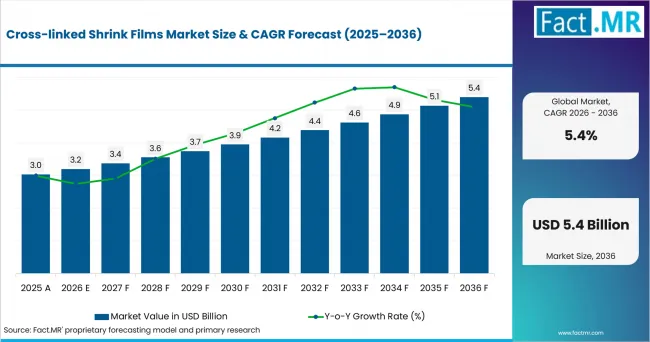
Cross Linked Shrink Films Market Value Analysis | Source: Fact.MR
What are the defining numbers behind Cross-linked Shrink Films Market growth?
An absolute opportunity of USD 2.2 billion is expected between 2026 and 2036. Growth is supported by food and beverage packaging throughput, use of cross-linked polyolefin in demanding wrapping applications, roll-fed automation, and packaging redesign around recyclability and material efficiency.
- Demand Drivers in the Market
- Food protection and shelf-life requirements keep shrink packaging embedded in high-volume food operations. The Food and Agriculture Organization notes that packaging helps keep food fresh and safe, extends shelf life and reduces food loss and waste. For converters and food processors, that translates into recurring demand for plastic film that can seal reliably and resist puncture during handling.
- Radiation cross-linking improves the performance envelope of polymer films. International Atomic Energy Agency technical material describes radiation-induced cross-linking as the formation of a three-dimensional polymer network that can improve mechanical and thermal properties, with heat-shrinkable materials among established industrial applications. Buyers use those properties where conventional films can tear, distort or seal inconsistently on demanding packs.
- Recyclability rules are changing film specifications. The European Commission states that all packaging must be recyclable by 2030 under the Packaging and Packaging Waste Regulation, while recycled-content and minimization requirements also affect plastic packaging design. This is increasing qualification work around thinner polyolefin structures and mono-material packaging that can retain shrink and sealing performance.
- Automated packaging lines reward films with wide operating windows, stable seals and consistent winding. Bolloré Films markets cross-linked polyolefin grades around broad equipment compatibility and toughness, while Intertape Polymer Group positions Exlfilm products for high-speed sealing and machinability. Those properties reduce line interruptions and the cost of rejected packs for processors, co-packers and industrial users.
- Consumer-goods and fulfillment throughput adds secondary demand for protective wrapping and multipack film. U.S. Census Bureau data for the second quarter of 2026 reported USD 340.2 billion in adjusted retail e-commerce sales, up 12.2% year on year. The demand effect is strongest where wrapped goods must retain product integrity through fulfillment, retail handling and display rather than where shrink film is used as the primary shipping package.
- Key Segments Analyzed
- Polyolefin Cross Linked Shrink Films account for 38.4% of Product in 2026. Their combination of clarity, toughness, puncture resistance and broad sealing behavior supports food, consumer-goods and industrial wrapping across varied equipment settings.
- Radiation Cross Linking represents 52.1% of Technology in 2026. Electron-beam and related radiation processing can create a controlled cross-linked network without relying on a chemical cross-linking reaction inside the converting line, supporting consistent mechanical and thermal performance.
- Food Packaging holds 34.9% of Application in 2026. Repeated packaging volumes, food-contact requirements and the need to protect fresh and processed products make seal reliability and puncture performance purchasing priorities.
- Food And Beverage Industry accounts for 36.2% of End Use in 2026. High packaging throughput and tight line-efficiency requirements support repeat purchases of film grades that can run consistently across sealing and shrinking conditions.
- Rolls hold 57.6% of Form in 2026. Continuous roll-fed supply fits automated wrapping equipment, reduces manual handling and allows converters to manage longer production runs with fewer web changes.
- Medium Gauge Films account for 45.8% of Thickness Range in 2026. They balance material use with puncture resistance, seal strength and shrink response, giving users a practical specification before thinner gauges are validated on demanding products.
- Analyst Opinion at Fact.MR
- Shambhu Nath Jha, Principal Consultant, Fact.MR, states, “Cross-linked shrink film demand is moving toward a tighter performance envelope: converters want thinner material without losing puncture strength, clean seals or machine speed, while brand owners face recyclability and food-contact requirements. Suppliers that can control cross-link density, gauge consistency and roll quality across polyolefin grades will be better placed to support automated food and consumer-goods lines.”
- Strategic Implications
- Film qualification should be judged on wrapped-pack economics, including line speed, rejects, film yield and downtime, rather than film price per kilogram alone.
- Suppliers should prioritize recyclable polyolefin structures and downgauging programs while protecting seal strength and puncture resistance. That positioning also aligns cross-linked film development with the broader polyfilm market shift toward material efficiency.
- Roll consistency, gauge control and equipment trials are commercial differentiators because converters bear the cost when film behavior changes across sealers, tunnels or high-speed lines.
- PVC and PET-based shrink-film formats will remain application-specific choices where decoration, sleeve behavior or thermal characteristics justify them, but recycling policy can change their relative attractiveness over the forecast period.
How does the Cross-linked Shrink Films Market break down by segment?
The market is analyzed by Product, Technology, Application, End Use, Form and Thickness Range.
Why does Polyolefin Cross Linked Shrink Films lead Product?
Polyolefin Cross Linked Shrink Films account for 38.4% of Product in 2026.
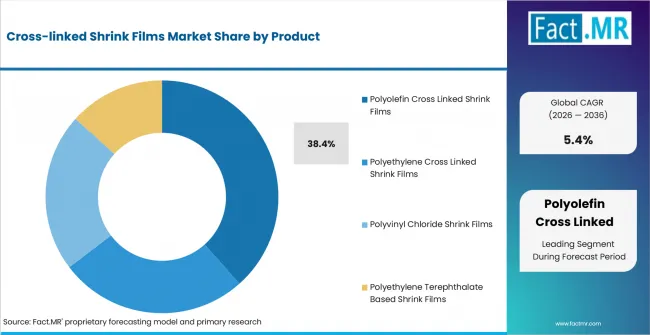
Cross Linked Shrink Films Market Analysis By Product | Source: Fact.MR
Cross-linked polyolefin combines optics with a relatively forgiving sealing and shrinking window, which is important when converters run different product shapes and package sizes on the same equipment. Bolloré Films describes its BZN and BRX cross-linked polyolefin grades around puncture resistance, toughness and broad operating windows, including use on irregular or sharp-edged products.
The purchasing case is operational. Food processors, printers, co-packers and consumer-goods manufacturers can use a versatile film family across more applications while reducing retuning and breakage risk. This makes polyolefin cross-linked shrink film a practical default where presentation, strength and machine compatibility are all required.
Why does Radiation Cross Linking lead Technology?
Radiation Cross Linking represents 52.1% of Technology in 2026.
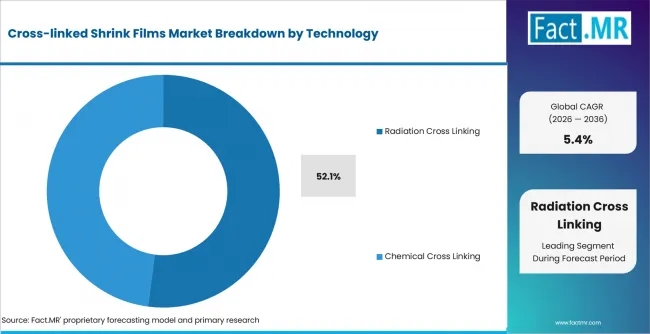
Cross Linked Shrink Films Market Analysis By Technology | Source: Fact.MR
International Atomic Energy Agency material identifies radiation-induced cross-linking as a mature industrial route used to modify polymers and produce heat-shrinkable materials. Cross-linking creates a three-dimensional network that improves mechanical and thermal behavior, which helps films tolerate sealing, shrinking and handling stresses.
For film producers, electron-beam irradiation also offers a controllable processing step that can be integrated with high-throughput film production. Buyers do not purchase the radiation process itself; they purchase the resulting consistency, toughness and wider processing tolerance in the finished film.
Why does Food Packaging lead Application?
Food Packaging holds 34.9% of Application in 2026.
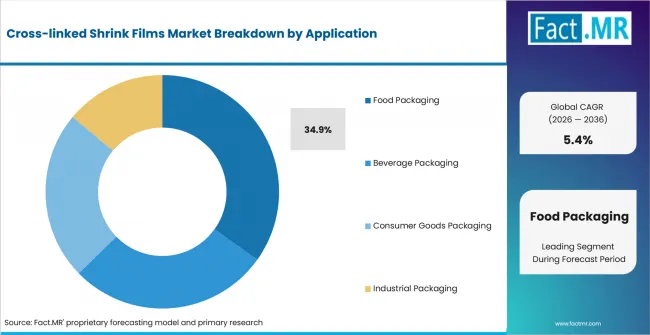
Cross Linked Shrink Films Market Analysis By Application | Source: Fact.MR
The Food and Agriculture Organization links packaging directly with food safety, freshness, shelf-life extension and reduced food loss. These functions create recurring film consumption because fresh and processed food lines operate continuously and require secure wrapping across trays, multipacks and irregular products.
Food-contact qualification raises the cost of switching to an unproven film. FAO's 2024 review of emerging packaging also highlights migration and chemical-safety considerations for new food-contact materials. As a result, food packers value film formulations that combine process stability with documented suitability for the intended food-contact use.
Why does Food and Beverage Industry lead End Use?
Food and Beverage Industry accounts for 36.2% of End Use in 2026.
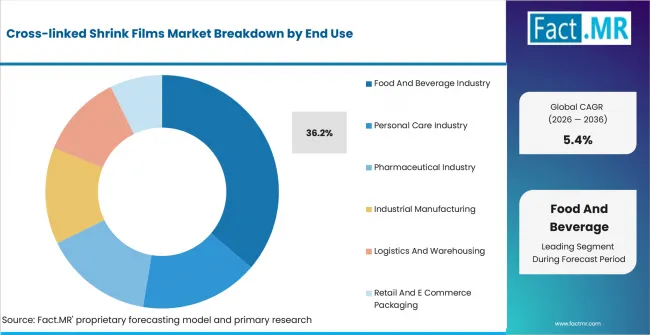
Cross Linked Shrink Films Market Analysis By End Use | Source: Fact.MR
Food and beverage plants generate repeat demand because packaging is consumed with every unit or multipack rather than installed once. Film failures can interrupt filling, sealing, inspection and secondary packaging, so procurement teams place weight on predictable shrink curves, seal integrity and roll quality.
Regulatory scrutiny reinforces that behavior. U.S. Food and Drug Administration guidance requires applicable food-contact substances to be authorized for their intended use and evaluates migration and toxicology in safety reviews. Similar food-contact controls in other countries make validated material systems more valuable to high-volume food and beverage users.
Why do Rolls lead Form?
Rolls hold 57.6% of Form in 2026.
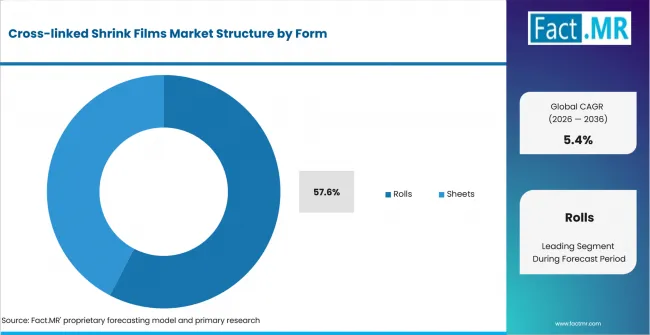
Cross Linked Shrink Films Market Analysis By Form | Source: Fact.MR
Roll form is designed for continuous feeding through automated wrappers, sealers and shrink tunnels. Longer usable footage can reduce the frequency of reel changes, while stable winding and slit quality help keep film tracking consistent at speed.
Bolloré Films explicitly links longer footage per roll in its BTT X110 range with fewer production stops. Intertape Polymer Group likewise positions Exlfilm 307 around high-speed performance and consistent seals. Those operating benefits make rolls the preferred purchasing form where throughput and labor efficiency matter.
Why do Medium Gauge Films lead Thickness Range?
Medium Gauge Films account for 45.8% of Thickness Range in 2026.
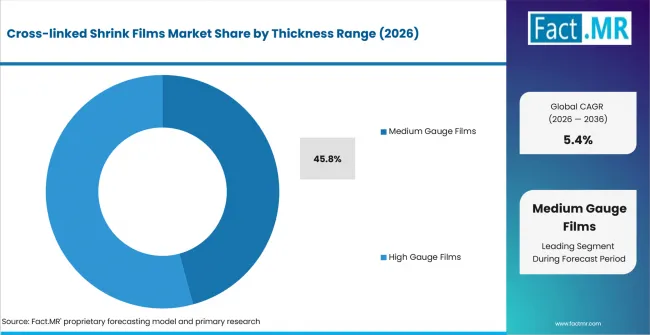
Cross Linked Shrink Films Market Analysis By Thickness Range | Source: Fact.MR
Medium gauge provides a balance between material economy and the physical margin needed for puncture resistance, edge protection and stable sealing. It is often easier to qualify across varied product geometries than an aggressively downgauged structure, particularly where packs contain corners or experience distribution handling.
Thinner films remain an important development path, but they must demonstrate equivalent package performance before large users change specifications. Bolloré Films promotes thin cross-linked grades with mechanical properties comparable with thicker conventional polyolefin films, while Intertape Polymer Group offers cross-linked lower-gauge options. This keeps medium gauge central while creating a measured route toward downgauging.
What is accelerating Cross-linked Shrink Films Market adoption, and what is holding it back?
Food-packaging throughput, automated wrapping, cross-linked polyolefin substitution and recyclability-led redesign are expanding demand. The same film families also benefit from growth in protective packaging where product integrity and handling resistance matter. Adoption is held back by recycling complexity in some multilayer or PVC structures, food-contact qualification for recycled-content materials, resin and energy volatility, and the capital and process-control requirements associated with radiation treatment.
Drivers Impact Analysis
| Factor | (~) % Impact on CAGR | Geographic Relevance | Impact Timeline |
|---|---|---|---|
| Food and beverage packaging throughput | +0.9% | Global | Short term (≤ 2 years) |
| Cross-linked POF substitution for conventional shrink films | +0.7% | Global | Medium term (2-4 years) |
| Automated high-speed packaging lines | +0.6% | USA, Germany and UK | Short term (≤ 2 years) |
| Consumer-goods and e-commerce throughput | +0.4% | USA, UK and Brazil | Short term (≤ 2 years) |
| Recyclability-led film redesign | +0.4% | Germany, UK and Japan | Medium term (2-4 years) |
Source: Fact.MR analysis. Updated Aug 26, 2026
Opportunity Impact Analysis
| Factor | (~) % Impact on CAGR | Geographic Relevance | Impact Timeline |
|---|---|---|---|
| Recyclable mono-material cross-linked POF | +0.6% | Germany, UK and Japan | Medium term (2-4 years) |
| Downgauged high-strength film grades | +0.5% | Global | Short term (≤ 2 years) |
| Recycled-content compatible film variants | +0.4% | Germany, UK, USA and Brazil | Long term (≥ 4 years) |
| Fresh-food and high-clarity packaging applications | +0.3% | USA, Brazil and Japan | Medium term (2-4 years) |
Source: Fact.MR analysis. Updated Aug 26, 2026
Restraints Impact Analysis
| Factor | (~) % Impact on CAGR | Geographic Relevance | Impact Timeline |
|---|---|---|---|
| Recycling complexity for multilayer and PVC structures | -0.7% | Germany, UK and Japan | Short term (≤ 2 years) |
| Resin and energy cost volatility | -0.6% | Global | Short term (≤ 2 years) |
| Food-contact qualification for recycled-content films | -0.4% | USA, Brazil and Germany | Medium term (2-4 years) |
| Radiation-processing equipment and qualification cost | -0.3% | Global | Long term (≥ 4 years) |
Source: Fact.MR analysis. Updated Aug 26, 2026
Which countries are scaling the Cross-linked Shrink Films Market through 2036?
- Germany: Packaging rules now place lifecycle responsibility, recyclability, secondary raw materials and minimization more directly into packaging decisions. This favors cross-linked films that can be downgauged or redesigned for recycling without sacrificing line performance.
- Brazil: National reverse-logistics rules for plastic packaging raise the importance of recovery and recyclability, while food-contact requirements keep material qualification central for food packaging. Suppliers therefore face a dual requirement for circularity and safe application performance.
- USA: Expanding retail e-commerce and high packaged-food throughput support film consumption in fulfillment, food processing and consumer-goods applications, while FDA food-contact review keeps formulation and migration control important for food uses.
- UK: Plastic Packaging Tax and recyclability-based producer-responsibility fees give pack designers an economic reason to reduce virgin plastic use and improve recyclability, supporting thinner and more recyclable shrink-film development where performance can be maintained.
- Japan: Plastic resource-circulation policy emphasizes material reduction, simplified packaging, fewer-material structures, recyclable materials and greater recycled-plastic use, directing film development toward design-for-recycling and controlled material use.
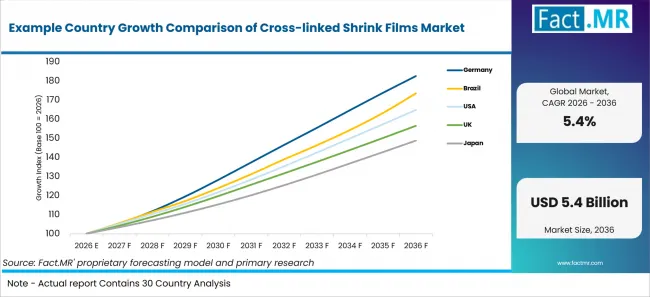
Example Country Growth Comparison Of Cross Linked Shrink Films Market | Source: Fact.MR
Country CAGR (2026-2036)
| Country | CAGR (2026-2036) |
|---|---|
| Germany | 6.2% |
| Brazil | 5.7% |
| USA | 5.1% |
| UK | 4.6% |
| Japan | 4.1% |
Source: Fact.MR analysis. Updated Aug 26, 2026
What is driving Germany's growth through 2036?
Germany is projected to expand at a CAGR of 6.2% from 2026 to 2036.
Germany entered a new packaging-regulation phase on 12 August 2026. The German Environment Agency states that the EU Packaging and Packaging Waste Regulation applies directly from that date and that the national VerpackDG complements it, with requirements around lifecycle responsibility, recyclability, secondary raw materials and packaging minimization. Film buyers therefore have a stronger policy reason to evaluate structures that use less material and fit recycling pathways.
The scale of the packaging system makes those design decisions material. The German Environment Agency reported 17.9 million tonnes of packaging waste in 2023, with 69.4% recycled. Cross-linked shrink-film suppliers can respond through downgauging, polyolefin-focused structures and tighter process control that allows converters to reduce material without adding damage or line losses.
What is driving Brazil's growth through 2036?
Brazil is projected to expand at a CAGR of 5.7% from 2026 to 2036.
Brazil's Decree No. 12,688 of 21 October 2025 established a reverse-logistics system for plastic packaging and set a national recovery target of 32.0% for 2026. The decree also directs manufacturers and importers toward packaging with greater reuse, recyclability, returnability and circular-economy potential, giving converters and brand owners a reason to improve the recovery profile of plastic film packaging.
Food applications require a separate qualification lens. The decree exempts packaging with specific regulation, including food packaging, from its generic recycled-content targets, while Anvisa regulates materials that contact food to prevent unsafe migration and contamination. That combination favors cross-linked film developments that improve recyclability or material efficiency without assuming that recycled-content targets can be applied uniformly to food-contact formats.
What is driving USA's growth through 2036?
USA is projected to expand at a CAGR of 5.1% from 2026 to 2036.
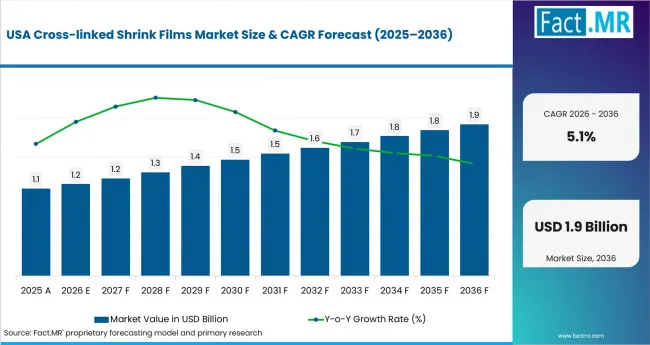
Cross Linked Shrink Films Market Country Value Analysis | Source: Fact.MR
Retail and fulfillment volumes provide a broad demand base for consumer-goods wrapping. The U.S. Census Bureau reported adjusted retail e-commerce sales of USD 340.2 billion in the second quarter of 2026, 12.2% higher than a year earlier and equal to 17.1% of total retail sales. That throughput supports secondary wrapping, multipacks and other flexible packaging applications where film machinability and product protection affect fulfillment efficiency.
Food packaging adds a compliance barrier that favors qualified film systems. The U.S. Food and Drug Administration requires applicable food-contact substances to be authorized for their intended use and evaluates migration and toxicology in its safety review. FDA guidance on recycled plastics also places chemistry and process controls around recycled polymer used in food packaging, so material changes must be validated rather than treated as a simple resin substitution.
What is driving UK's growth through 2036?
UK is projected to expand at a CAGR of 4.6% from 2026 to 2036.
The UK Plastic Packaging Tax creates a direct material-cost signal. HM Revenue & Customs states that plastic packaging components containing less than 30% recycled plastic are subject to the tax, which rose to GBP 228.82 per tonne from 1 April 2026. HMRC also notes that recycled plastic should only be used where other regulations and food-safety standards permit it, so film development has to balance tax exposure with application compliance.
PackUK adds a recyclability signal through extended producer responsibility. Its modulated disposal-fee policy begins applying to the 2026 to 2027 financial year and uses recyclability to vary fees, including a higher factor for red-rated packaging. This strengthens the business case for shrink-film structures that can move toward recyclable polyolefin designs or lower material use without reducing protection.
What is driving Japan's growth through 2036?
Japan is projected to expand at a CAGR of 4.1% from 2026 to 2036.
Japan's Ministry of the Environment uses Plastic Product Design Guidelines under the plastic resource-circulation framework to encourage material reduction, simplified packaging, mono-material or fewer-material designs, recyclable materials and recycled plastics. These priorities reward film designs that simplify structures and use less resin while keeping shrink and sealing performance stable.
The broader Resource Circulation Strategy for Plastics sets a target to reach a 60% reuse and recycling rate for plastic containers and packaging by fiscal 2030 and to double the volume of recycled plastics. Cross-linked film suppliers therefore have an incentive to improve collection compatibility, material identification and downgauging, while converters continue to protect optics, seal quality and package integrity.
Who Leads the Cross-linked Shrink Films Market?
Key players in the Cross-linked Shrink Films Market include Bolloré Group, Intertape Polymer Group, Syfan USA, SABIC The Schlichter GmbH, THE NEW PACK ltd., Ervisa, Bagla Group, CLEARPACK SINGAPORE PTE LTD.
Competition is shaped by the ability to hold cross-link density, shrink behavior, seal strength, gauge and roll quality within converter tolerances. Food and beverage users add food-contact and migration requirements, while industrial and consumer-goods users place more weight on puncture resistance, optics and the ability to run across different sealer and tunnel settings.
Bolloré Films positions BRX and BZN cross-linked polyolefin grades around toughness, puncture resistance and broad operating windows, and its BTT X110 film combines cross-linked construction with longer roll footage intended to reduce production stops. These characteristics show how suppliers compete on package economics and equipment performance rather than resin specification alone.
Intertape Polymer Group describes Exlfilm 307 as a high-speed, multi-layered polyolefin shrink film with a wide operating window and consistent seals. Its Exlfilmplus GPL portfolio uses cross-linked polyolefin construction in lower gauges and highlights machinability and material yield. Across the named suppliers, the commercial battleground is therefore controlled downgauging, stable conversion and fit with recycling requirements.
Which companies are the key providers?
Key providers include Bolloré Group, Intertape Polymer Group, Syfan USA, SABIC The Schlichter GmbH, THE NEW PACK ltd., Ervisa, Bagla Group, CLEARPACK SINGAPORE PTE LTD., Shenyang Weiming Technology Co.Ltd., Zhejiang Zhongcheng Packing Material Co.Ltd. and HuanYuan Plastic Film Co. Ltd.
- Bolloré Group
- Intertape Polymer Group
- Syfan USA
- SABIC
- The Schlichter GmbH
- THE NEW PACK Ltd.
- Ervisa
- Bagla Group
- CLEARPACK SINGAPORE PTE LTD.
- Shenyang Weiming Technology Co. Ltd.
- Zhejiang Zhongcheng Packing Material Co. Ltd.
- HuanYuan Plastic Film Co. Ltd.
Bibliography
- Food and Agriculture Organization of the United Nations. (2021). Reduce, Reuse, Recycle: A Mantra for Food Packaging. FAO.
- Food and Agriculture Organization of the United Nations. (2024). Recent and Emerging Food Packaging Alternatives: Chemical Safety Risks, Current Regulations and Analytical Challenges. FAO.
- International Atomic Energy Agency. (2009). Developments in Electron Beam Processing in Polymer and Petroleum Industries. IAEA.
- International Atomic Energy Agency. (2017). Past, Present and Near Future of Radiation Processing of Polymers. IAEA.
- European Commission. (2025). Packaging and Packaging Waste Regulation and Food Waste. Directorate-General for Environment.
- German Environment Agency. (2026). Verpackungsrecht. Umweltbundesamt.
- German Environment Agency. (2026). Verpackungsabfälle. Umweltbundesamt.
- Presidency of the Republic of Brazil. (2025). Decree No. 12,688 of 21 October 2025. Government of Brazil.
- Agência Nacional de Vigilância Sanitária. (2026). Materiais em Contato com Alimentos. Government of Brazil.
- U.S. Census Bureau. (2026). Quarterly Retail E-Commerce Sales: Second Quarter 2026. U.S. Department of Commerce.
- U.S. Food and Drug Administration. (2024). Food Packaging & Other Substances that Come in Contact with Food: Information for Consumers. FDA.
- U.S. Food and Drug Administration. (2021). Guidance for Industry: Use of Recycled Plastics in Food Packaging (Chemistry Considerations). FDA.
- HM Revenue & Customs. (2026). Plastic Packaging Tax: Steps to Take. UK Government.
- PackUK. (2025). Extended Producer Responsibility for Packaging: Modulated Disposal Fees Statement. UK Government.
- Ministry of the Environment, Japan. (2026). Plastic Product Design Guidelines and Certification System. Government of Japan.
- Ministry of the Environment, Japan. (2019). Resource Circulation Strategy for Plastics. Government of Japan.
- Bolloré Films. (2026). BRX: Crosslinked Soft Shrink Film. Bolloré Group.
- Bolloré Films. (2026). BZN: Crosslinked Polyolefin Multipurpose Shrink Film. Bolloré Group.
- Bolloré Films. (2026). BTT X110: Crosslinked Shrink Film. Bolloré Group.
- Intertape Polymer Group. (2026). Shrink Film: Exlfilm 307. Intertape Polymer Group.
- Intertape Polymer Group. (2022). Exlfilmplus GPL Global Performance Lite Shrink Film. Intertape Polymer Group.
This Report Answers
- How the Cross-linked Shrink Films Market progresses from 2025 through the 2026 to 2036 forecast period.
- Which Product, Technology, Application, End Use, Form and Thickness Range categories lead in 2026 and why buyers prefer them.
- How packaging regulation, food-contact controls, automation and recyclability influence film specifications and purchasing decisions.
- How Germany, Brazil, USA, UK and Japan differ in the mechanisms supporting market growth through 2036.
- Which suppliers are included in the competitive assessment and which operating capabilities shape competition.
What does the Cross-linked Shrink Films Market cover?
The market covers sales of shrink-film products within the defined Product taxonomy, including polyolefin, polyethylene, PVC and PET-based formats, where cross-linking or associated high-performance shrink-film processing is part of the market offering. Revenue is assessed across the specified technologies, applications, end uses, forms and thickness ranges.
What is included in the scope?
Included revenue covers commercial film sales for Food Packaging, Beverage Packaging, Consumer Goods Packaging and Industrial Packaging, together with film used by the Food And Beverage, Personal Care, Pharmaceutical, Industrial Manufacturing, Logistics And Warehousing, and Retail And E Commerce Packaging end-use groups. Both Rolls and Sheets are included, as are the specified Radiation Cross Linking and Chemical Cross Linking routes.
What is excluded from the scope?
The scope excludes shrink-wrap machinery, sealers, tunnels and other capital equipment; stretch film; non-shrink flexible films; raw polymer resin sold separately; labels or sleeves that are not sold as shrink-film products; and contract-packaging service revenue that is not attributable to the film itself.
How Was the Analysis Built?
The analysis combines primary market inputs with desk research and structured sizing across film producers, packaging converters, distributors, packaging-equipment participants and high-volume end users. The work tests film demand against application throughput, product mix, technology route, form, thickness and country packaging conditions.
- Primary Research: Interviews and market checks focus on shrink-film producers, converters, co-packers, food and beverage processors, consumer-goods packers, distributors and packaging-line specialists. Discussions test gauge preferences, line speeds, seal and shrink performance, qualification cycles, roll formats and substitution between film types.
- Desk Research: Evidence is drawn from packaging and waste regulators, food-contact authorities, official retail statistics, radiation-processing technical bodies and current manufacturer technical literature. These sources are used to validate demand mechanisms, regulatory requirements and commercially available performance characteristics.
- Market Sizing and Forecasting: Revenue is assessed using film consumption, average selling prices, packaging-line throughput, Product and Application mix, cross-linking route, roll-versus-sheet use, thickness mix and country-level packaging demand. Forecast assumptions also account for downgauging, substitution, recyclability policy and food-contact qualification.
- Data Validation and Update Cycle: Segment and country outputs are checked for consistency with the market total, operating evidence and the defined taxonomy. Regulatory and company evidence is refreshed against current authoritative sources before publication, and narrative conclusions are reconciled with the quantitative forecast.
Segmentation
What is the report's scope and coverage?
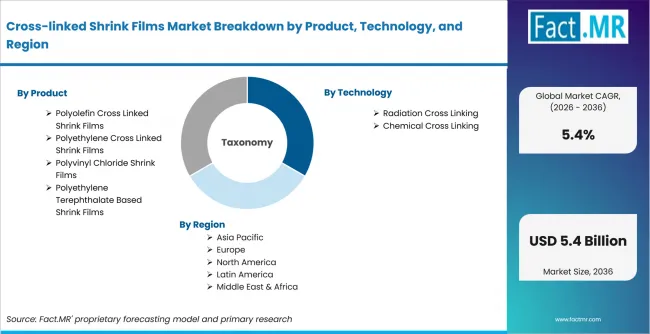
Cross Linked Shrink Films Market Breakdown By Product, Technology, And Region | Source: Fact.MR
| Scope Item | Coverage |
|---|---|
| Quantitative Units | USD billion |
| Market Definition | Revenue from shrink films sold within the defined Product taxonomy and associated cross-linked or high-performance shrink-film processing routes. |
| Segments Covered | Product; Technology; Application; End Use; Form; Thickness Range |
| Regions Covered | North America; Latin America; Europe; East Asia; South Asia and Pacific; Middle East and Africa |
| Countries Covered | Germany; Brazil; USA; UK; Japan |
| Key Companies Profiled | Bolloré Group, Intertape Polymer Group, Syfan USA, SABIC The Schlichter GmbH, THE NEW PACK ltd., Ervisa, Bagla Group, CLEARPACK SINGAPORE PTE LTD., Shenyang Weiming Technology Co.Ltd., Zhejiang Zhongcheng Packing Material Co.Ltd. and HuanYuan Plastic Film Co. Ltd. |
| Forecast Period | 2026-2036 |
| Base Year | 2026 |
| Market Value 2026 | USD 3.2 billion |
| Market Value 2036 | USD 5.4 billion |
| CAGR | 5.4% |
| Absolute Opportunity | USD 2.2 billion |
| Approach | Hybrid demand-side and top-down analysis using film consumption, packaging-line throughput, product and application mix, cross-linking route, form, thickness, average selling prices and country packaging conditions. |
Source: Fact.MR analysis. Updated Aug 26, 2026
How is the market segmented?
-
By Product
- Polyolefin Cross Linked Shrink Films
- Mono Layer Cross Linked POF Films
- Multi Layer Cross Linked POF Films
- Polyethylene Cross Linked Shrink Films
- Low Density Cross Linked PE Films
- High Density Cross Linked PE Films
- Polyvinyl Chloride Shrink Films
- Standard PVC Shrink Films
- Premium PVC Shrink Films
- Polyethylene Terephthalate Based Shrink Films
- PET Shrink Sleeves
- PETG Shrink Films
- Polyolefin Cross Linked Shrink Films
-
By Technology
- Radiation Cross Linking
- Electron Beam Irradiation
- UV Assisted Cross Linking
- Chemical Cross Linking
- Catalyst Assisted Processing
- Thermal Cross Linking Systems
- Radiation Cross Linking
-
By Application
- Food Packaging
- Fresh Food Packaging
- Processed Food Packaging
- Beverage Packaging
- Bottle Labeling
- Multipack Packaging
- Consumer Goods Packaging
- Personal Care Packaging
- Home Care Packaging
- Industrial Packaging
- Heavy Duty Wrapping
- Logistics Packaging
- Food Packaging
-
By End Use
- Food And Beverage Industry
- Personal Care Industry
- Pharmaceutical Industry
- Industrial Manufacturing
- Logistics And Warehousing
- Retail And E Commerce Packaging
-
By Form
- Rolls
- Bulk Rolls
- Retail Ready Rolls
- Sheets
- Industrial Sheets
- Protective Sheets
- Rolls
-
By Thickness Range
- Medium Gauge Films
- Micro Thickness Films
- Light Duty Packaging Films
- High Gauge Films
- Medium Gauge Films
-
By Region:
- North America
- Latin America
- Western Europe
- Eastern Europe
- East Asia
- South Asia and Pacific
- Middle East & Africa
Frequently Asked Questions
What is the Cross-linked Shrink Films Market worth in 2026?
What CAGR is the Cross-linked Shrink Films Market projected to record from 2026 to 2036?
What is the Cross-linked Shrink Films Market forecast to reach by 2036?
Which Product category leads in 2026?
Which Technology category leads in 2026?
Which Application category leads in 2026?
Which End Use category leads in 2026?
Which Form category leads in 2026?
Which Thickness Range category leads in 2026?
What CAGR is Germany projected to record through 2036?
Which companies are included in the market assessment?
Who worked on this report


Preview the report firsthand - request a free sample
Free SampleGet the brochure for pricing and purchase details
Download PDF