- Market Value (2025): USD 268.4 Mn
- Estimated Value (2026): USD 285.0 Mn
- Forecast Value (2036): USD 520.0 Mn
- CAGR (2026-2036): 6.2%
What is the LPG Mixers Market forecast to be worth by 2036?
USD 285.0 million to USD 520.0 million by 2036 at a 6.2% CAGR.
- The market crossed a valuation of USD 268.4 million in 2025, supported by steady replacement demand and site-level fuel security planning.
- Demand is projected to increase from USD 285.0 million in 2026 to USD 520.0 million by 2036.
- The market is forecast to record a 6.2% CAGR from 2026 to 2036 as facilities keep backup gas systems ready for outages, curtailment periods and off-grid operations.
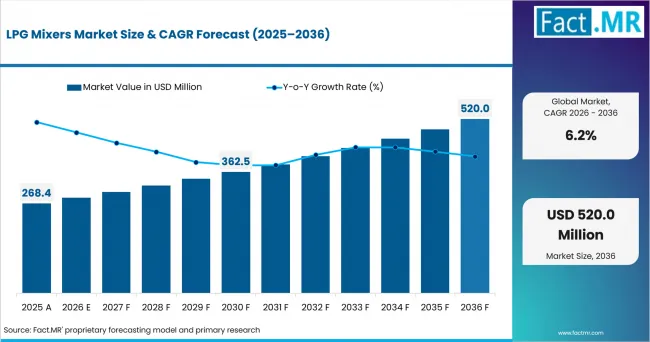
Lpg Mixers Market Value Analysis | Source: Fact.MR
What are the defining numbers behind LPG Mixers Market growth?
USD 235.0 million absolute opportunity is expected by 2036, with growth led by Venturi proportional mixers and direct project sale models.
- Demand Drivers in the Market
- Backup LPG-air systems help factories keep furnaces, boilers and process heaters running when pipeline gas is cut off.
- Sites without access to a gas pipeline can use fuel systems that are easier to transport and install. This avoids waiting for a new gas network to be built.
- Careful mixing helps the fuel match the needs of existing burners when a plant switches from its main gas source to an LPG-air backup.
- Electronic controls help keep the heating level steady even when the mix of LPG changes from one delivery to another.
- Key Segments Analyzed
- By Mixer Technology: Venturi proportional mixers are projected to account for 34.0% of the market in 2026. Their simple design and reliable performance make them a strong fit for backup fuel systems.
- By Capacity: Small systems below 100 Nm3/h are estimated to represent 28.0% of demand in 2026. They suit smaller factories, public buildings and commercial sites that need backup gas without a large custom setup.
- By Application: Peak shaving and standby fuel are anticipated to capture 30.0% share in 2026. These systems help sites stay operational during gas shortages or periods of high demand.
- By End User: Industrial plants are forecast to make up 30.0% of the market in 2026. Fuel interruptions can stop production, so many plants invest in backup systems to reduce downtime.
- By Sales Model: Direct project sales are projected to lead with 35.0% share in 2026. Each system must match the site’s gas pressure, LPG quality and burner limits, which keeps direct contact with the equipment company important.
- Analyst Opinion at Fact.MR
- Shambhu Nath Jha, Senior Analyst at Fact.MR, states, “Choosing an LPG mixer involves more than checking its capacity. Engineers also look at whether it can keep the heating level steady and shut down safely if a problem occurs. They need clear proof that the system meets safety rules for areas where gas is present. Future demand is expected to move toward equipment companies that offer the vaporizer, mixer, controls and service as one complete package.”
- Strategic Implications
- Plant operators can require documented hazardous-area installations before approving gas-mixing or vaporization equipment for critical service.
- Equipment providers should combine the vaporizer, mixer, analyzer and control system within one coordinated package. This gives the plant one point of responsibility for design and startup.
- Service partners can prepare clear activation checks, spare-part plans and commissioning steps so systems remain ready after long idle periods.
UAE is estimated to post a 6.9% CAGR through 2036. USA is anticipated to advance at a 6.2% CAGR from 2026 to 2036. Japan is forecast to record a 6.1% CAGR by 2036. United Kingdom is projected to post a 5.9% CAGR from 2026 to 2036. Germany is estimated to record a 5.6% CAGR through 2036.
How does the LPG Mixers Market break down by segment?
Venturi proportional mixers are expected to lead Mixer Technology at 34.0% share in 2026. Small (<100 Nm3/h) is projected to lead Capacity at 28.0% share in 2026.
Which Mixer Technology holds the main share?
Venturi Proportional Mixers hold 34.0% share in 2026.
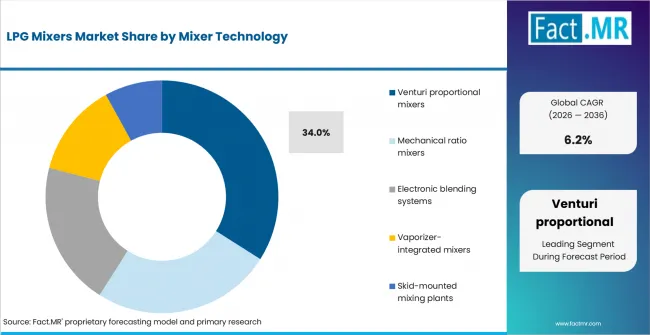
Lpg Mixers Market Analysis By Mixer Technology | Source: Fact.MR
Venturi Proportional Mixers use pressure differential to draw LPG vapor into the air stream without complex moving parts. This gives operators a familiar way to maintain a stable blend during standby or peak-shaving service. Mechanical ratio mixers remain useful for simple fixed settings, while electronic blending systems fit sites that monitor heating value more closely. Integrated vaporizer-mixer packages appeal to projects that want fewer equipment interfaces and one coordinated control point.
What defines the Capacity segment?
Small systems below 100 Nm³/h are estimated to hold 28.0% share in 2026.
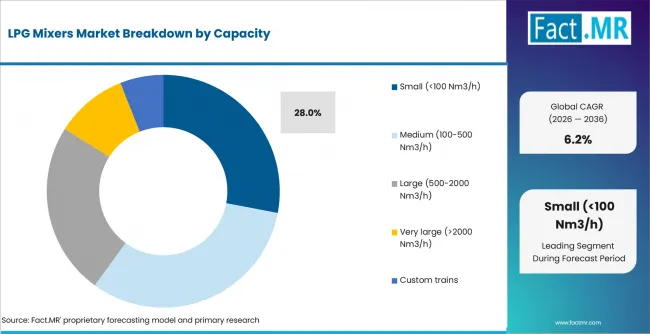
Lpg Mixers Market Analysis By Capacity | Source: Fact.MR
Small units fit localized backup duties where gas demand is limited to one boiler, furnace or process area. Their compact footprint makes installation easier at sites that do not need a full utility-scale blending station. Medium systems serve broader industrial loads, while large and custom trains require more engineering around vapor supply, pressure control and emergency operation. The segment therefore reflects the number of smaller standby applications rather than the scale of individual projects.
Why does Peak Shaving and Standby Fuel remain central?
Peak Shaving and Standby Fuel accounts for 30.0% share in 2026.
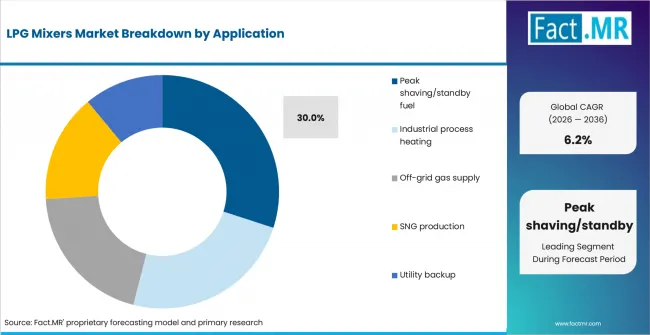
Lpg Mixers Market Analysis By Application | Source: Fact.MR
This application gives LPG-air systems a clear operating role during pipeline curtailment, seasonal shortages or planned gas-network work. The equipment can remain idle for long periods and then supply a substitute fuel when natural gas availability drops. Industrial heating and off-grid supply create additional demand, but standby service places greater value on startup reliability, stored-fuel readiness and repeatable activation procedures.
Which End User creates the broadest demand base?
Industrial Plants lead with 30.0% share in 2026.
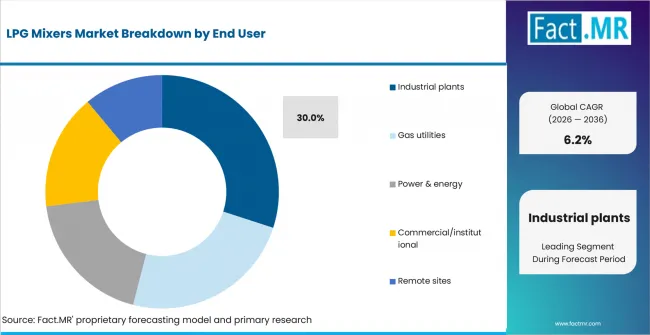
Lpg Mixers Market Analysis By End User | Source: Fact.MR
Industrial plants use LPG-air systems to protect furnaces, dryers, boilers and heat-treatment lines from fuel interruptions. A short outage can stop production or damage material already inside the process. Gas utilities use similar systems to support local networks, while power and energy sites include them within continuity planning. Industrial demand remains broad since the equipment can protect several heat-dependent operations within one facility.
How is the Sales Model structured?
Direct Project Sale holds 35.0% share in 2026.
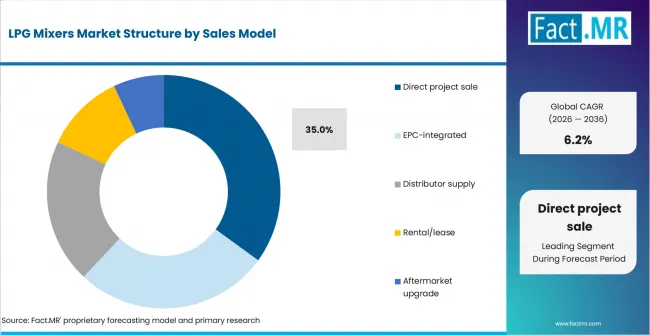
Lpg Mixers Market Analysis By Sales Model | Source: Fact.MR
Direct sales dominate where the package must match site pressure, vapor demand, hazardous-area rules and control philosophy. The equipment provider usually works with the plant from sizing through commissioning. EPC-integrated supply fits larger construction projects, while distributors serve standard replacements and smaller installations. Rental and aftermarket routes remain more suitable for temporary coverage, emergency use or upgrades to existing mixer stations.
What is accelerating LPG Mixers Market adoption, and what is holding it back?
Fuel-security requirements are anticipated to expand LPG Mixers Market demand. Safety and permitting burden is expected to restrain projects that need storage, vaporization and hazardous-area approval.
Drivers Impact Analysis
| DRIVER | (~) % IMPACT ON CAGR | GEOGRAPHIC RELEVANCE | IMPACT TIMELINE |
|---|---|---|---|
| Fuel-security requirements | +1.8% | Industrial and utility sites | Short term (<=2 years) |
| Off-grid industrialization | +1.3% | UAE, Asia and remote regions | Medium term (2-4 years) |
| Burner conversion and backup | +1.0% | Manufacturing and institutions | Short term (<=2 years) |
| Automated heating-value control | +0.6% | Advanced industrial markets | Medium term (2-4 years) |
Source: Fact.MR analysis. Updated Jul 22, 2026
- Fuel-security requirements: Standby LPG-air plants help gas-dependent operations stay ready when pipeline supply is interrupted or reserved for higher-priority use.
- Off-grid industrialization: Remote industrial sites need a fuel option that arrives by road and works before full gas-grid access reaches the location.
- Burner conversion and backup: Controlled blending helps a facility protect existing combustion equipment when it changes between pipeline gas and LPG-air supply.
- Automated heating-value control: Closed-loop blending is expected to reduce manual adjustment where LPG composition changes across deliveries or storage conditions.
- Government statistics are most relevant here when they explain fuel availability and safety review. EIA propane export data points to a large LPG logistics base, while OSHA's 10,000 lb flammable-gas threshold explains why storage and mixer packages need documented controls on larger sites.
Opportunity Impact Analysis
| OPPORTUNITY | (~) % IMPACT ON CAGR | GEOGRAPHIC RELEVANCE | IMPACT TIMELINE |
|---|---|---|---|
| Containerized standby plants | +1.1% | China and UAE | Short term (<=2 years) |
| Gas-quality analytics | +0.8% | China and UAE | Medium term (2-4 years) |
| Rental and emergency supply | +0.6% | China and UAE | Short term (<=2 years) |
Source: Fact.MR analysis. Updated Jul 22, 2026
- Containerized standby plants: Factory-built modules are expected to shorten site work because the vaporizer, mixer and controls arrive as a tested package.
- Gas-quality analytics: Online measurement is projected to improve confidence in the delivered fuel mix and reduce repeated field tuning.
- Rental and emergency supply: Temporary packages support planned outages, commissioning periods and seasonal peaks without forcing every site into permanent capital spending.
Restraints Impact Analysis
| RESTRAINT | (~) % IMPACT ON CAGR | GEOGRAPHIC RELEVANCE | IMPACT TIMELINE |
|---|---|---|---|
| Safety and permitting burden | -1.4% | Global | Short term (<=2 years) |
| Fuel-cost volatility | -1.0% | Global | Short term (<=2 years) |
| Site-specific burner compatibility | -0.7% | Global | Medium term (2-4 years) |
Source: Fact.MR analysis. Updated Jul 22, 2026
- Safety and permitting burden: LPG storage, vaporization and mixing require disciplined design review because flammable gas handling must meet local inspection rules.
- Fuel-cost volatility: Project payback changes when the price spread between LPG and pipeline natural gas moves across contract cycles.
- Site-specific burner compatibility: The delivered blend has to match burner tolerance and emissions limits, so generic packages do not fit every site.
Which countries are scaling LPG Mixers Market fastest?
The global growth rate is based on the combined performance of all countries covered in the study. UAE are growing faster than the global rate of 6.2%. The USA is in line with the global average, while Japan, the U.K. and Germany are growing at a slower pace. These six countries are shown as examples to explain how national growth can differ from the worldwide figure.
- The main difference between these countries is not only their CAGR. It also comes from the local conditions that support demand.
- The UAE is close behind, but growth there is more closely linked to remote sites and the use of backup fuel systems.
- The USA and Japan sit in a similar growth range. In the USA, demand comes mainly from replacing older systems and improving fuel supply reliability. In Japan, companies focus more on backup planning and equipment that fits into smaller industrial sites. Growth in the U.K. and Germany is slower because most demand comes from safety upgrades, better controls and replacement of older equipment.
- Countries with similar growth rates can still develop in different ways. Project schedules, engineering needs and local business conditions can all shape how quickly demand grows.
The full report reviews these trends across every country included in the study. It provides country-level CAGR analysis across North America, Latin America, Europe, East Asia, South Asia, Oceania and the Middle East and Africa.
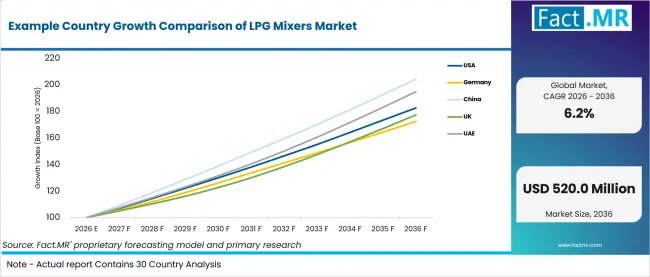
Example Country Growth Comparison Of Lpg Mixers Market | Source: Fact.MR
| COUNTRY | CAGR (2026 to 2036) |
|---|---|
| UAE | 6.9% |
| USA | 6.2% |
| Japan | 6.1% |
| UK | 5.9% |
| Germany | 5.6% |
Source: Fact.MR analysis. Updated Jul 22, 2026
Where is the UAE opportunity developing?
6.9% CAGR, linked to remote facilities and flexible backup-gas supply.
The UAE is building demand around industrial zones and sites that need a secondary gas source without creating a separate burner system. Vaporizer and mixer packages allow stored LPG to be converted into a usable gas stream within one coordinated setup. This approach suits projects where installation speed and limited space influence equipment selection.
What is shaping adoption in the USA?
6.2% CAGR, driven by renewal of existing standby and peak-shaving systems.
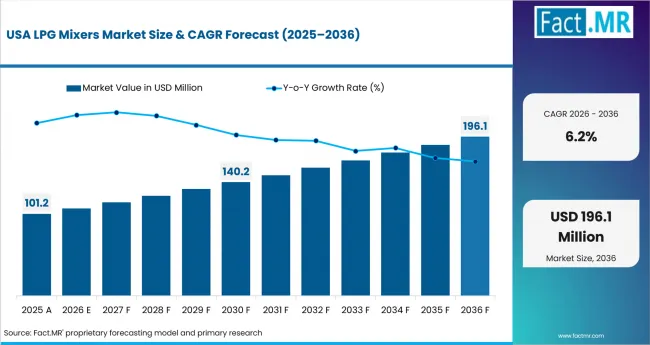
Lpg Mixers Market Country Value Analysis | Source: Fact.MR
The USA market is moving through replacement and modernization rather than broad first-time use. Utilities and large industrial facilities already understand the role of LPG-air blending during gas interruptions. New spending is therefore expected to focus on analyzer accuracy, startup reliability and upgraded controls that keep older systems ready for emergency activation.
Why does Japan favor compact packages?
6.1% CAGR, supported by emergency readiness and space-sensitive installations.
Japan places close attention on restart procedures, equipment checks and fuel availability during supply interruptions. Compact mixer packages fit industrial and commercial sites where floor space is limited and emergency operation must remain easy to verify. Vendors are likely to gain more interest when they provide clear activation steps and dependable service support.
How is the United Kingdom building demand?
5.9% CAGR, shaped by safety-led replacement and site approval requirements.
UK demand is centered on existing LPG installations that need safer and better-documented upgrades. Operators review hazardous-area design, storage integration and emergency procedures before approving new equipment. Mixer systems therefore gain value when the supplier can show a clear safety record and provide the vaporizer, controls and analyzer within one package.
What is changing in Germany?
5.6% CAGR, tied to automation and replacement across mature industrial sites.
Germany already has structured fuel-continuity planning across many large facilities. The next demand cycle is expected to come from older systems that need improved ratio control, updated analyzers and more reliable monitoring. Equipment providers are likely to compete through integration and service depth rather than basic fuel-switching capability.
Who leads the LPG Mixers Market?
Algas-SDI and Ransome Manufacturing have the strongest direct position in LPG-air mixing systems. TransTech Energy and Alternate Energy Systems also support complete backup-gas projects.
Algas-SDI offers propane-air systems that bring together the vaporizer, mixer and controls. These systems are used for backup fuel, peak demand and synthetic natural gas production. Ransome Manufacturing provides proportioning mixers and combined vaporizer-mixer units for factories and public facilities. TransTech Energy handles larger projects that include storage, vaporization and gas-handling equipment. Alternate Energy Systems serves utilities and industrial sites with propane-air systems, while Standby Systems focuses on emergency fuel setups. Pegoraro Gas Technologies adds regulators, vaporizers and gas controls for projects built around site needs.
Through 2036, companies are expected to compete on how well the system works with existing burners and how steadily it maintains the required heating level. Safe use in gas-handling areas will also remain important. Plant operators are likely to compare startup support, gas analyzer accuracy and service after installation. Companies that provide the vaporizer, mixer and controls as one complete system are expected to secure more projects.
Which companies are the key providers?
Key companies include TransTech Energy; Alternate Energy Systems; Standby Systems, Inc.; Algas-SDI; Ransome (Thermogas); Pegoraro Gas Technologies.
- TransTech Energy
- Alternate Energy Systems
- Standby Systems, Inc.
- Algas-SDI
- Ransome (Thermogas)
- Pegoraro Gas Technologies
Bibliography
- Occupational Safety and Health Administration. (2025, June 24). Process Safety Management of Highly Hazardous Chemicals Standard; Extension of the Office of Management and Budget’s approval of information collection requirements. U.S. Department of Labor.
- Ministry of Economy, Trade and Industry. (2026, June 15). Current status of LP gas stockpiling. Agency for Natural Resources and Energy, Ministry of Economy, Trade and Industry.
- U.S. Energy Information Administration. (2026, July 15). Weekly petroleum status report. U.S. Energy Information Administration.
This Report Addresses
- The report provides strategic intelligence on LPG Mixers Market across Mixer Technology and Capacity choices that shape purchasing decisions.
- Segment analysis covers Venturi proportional mixers as the share leader within the 2026 market structure.
- Regional outlook evaluates UAE alongside USA and Japan, while UK and Germany complete the growth comparison.
- Competitive analysis profiles TransTech Energy and Alternate Energy Systems alongside Standby Systems, Inc. and Algas-SDI, followed by additional active providers.
- Use-case assessment covers the categories and applications that shape LPG Mixers Market demand across the forecast period.
What does the LPG Mixers Market cover?
LPG-air mixing systems are used to produce a substitute fuel gas for standby supply, off-grid operations and industrial process heating.
The LPG Mixers Market covers equipment used to combine vaporized liquefied petroleum gas with air at a controlled heating value. Coverage includes Venturi mixers and mechanical ratio mixers. It also includes electronic blending systems and integrated vaporizer packages. Gas analyzers and control systems are included within defined mixing applications. Skid-mounted mixing plants are included when the purchased system performs the LPG-air blending function.
The market differs from general LPG handling equipment because commercial value comes from producing a controlled gas-air fuel mixture. Bulk LPG tanks and cylinder filling equipment remain outside the boundary. Burners and commodity regulators are also excluded. Complete gas-distribution infrastructure outside the mixing plant remains outside the boundary.
What is included in the scope?
LPG mixers are used across industrial plants and commercial sites. Gas utilities and off-grid facilities are also included.
The scope includes Venturi and mechanical gas-air mixers alongside electronic blending systems. Coverage extends to integrated vaporizer packages and skid-mounted mixing plants. It includes analyzers and control systems that maintain the required heating value. Equipment that supports safe delivery into site-level combustion systems is included when it forms part of the LPG-air mixing package.
What is excluded from the scope?
Bulk LPG storage and equipment that does not perform the gas-air mixing function remain outside the scope of this market.
The scope excludes bulk LPG tanks and cylinder filling equipment. Standalone burners and commodity regulators are excluded. Complete gas-distribution infrastructure outside the mixing plant also remains outside the scope. Equipment used only for LPG storage or general fuel handling is excluded when it does not create the controlled LPG-air mixture measured in this market.
How Was the Analysis Built?
The analysis draws on 120+ sources, 35+ company portfolios, 25+ countries, and more than 20 industry interviews.
- Primary Research: Primary research includes discussions with manufacturers, service providers, technology developers, distributors, end users, procurement teams, and subject-matter experts. These conversations examine purchasing priorities, product adoption, operational challenges, approval requirements, competitive positioning, and the factors that influence wider market acceptance.
- Desk Research: Desk research covers government statistics, regulatory publications, company filings, trade data, technical studies, industry associations, standards, public policy, and other authoritative sources. Every source used in the analysis is documented in the bibliography.
- Market Sizing and Forecasting: Market estimates combine historical performance, demand indicators, pricing and volume trends, segment shares, company participation, country-level growth, adoption patterns, investment activity, and barriers to market expansion.
- Data Validation and Update Cycle: Findings are validated by comparing primary interviews with public data, company activity, regulatory changes, trade patterns, and industry developments. Regular updates review new product launches, capacity changes, partnerships, approvals, procurement trends, and shifts in commercial adoption.
Segmentation
What is the report's scope and coverage?
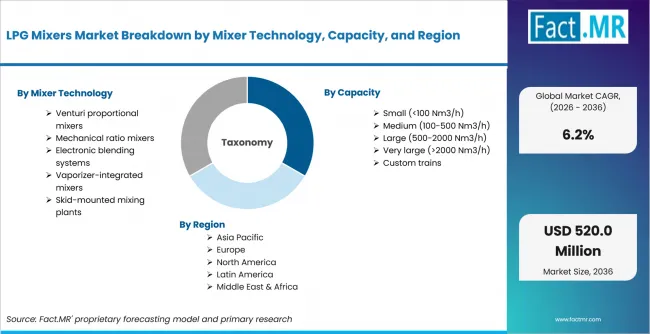
Lpg Mixers Market Breakdown By Mixer Technology, Capacity, And Region | Source: Fact.MR
| Attribute | Details |
|---|---|
| Quantitative Units | USD million in 2026 to USD million by 2036 at a CAGR |
| Market Definition | An LPG mixer takes vaporized liquefied petroleum gas and blends it with air to produce a controlled heating-value fuel mixture for sites that need substitute gas supply. |
| Mixer Technology | Venturi proportional mixers; Mechanical ratio mixers; Electronic blending systems; Vaporizer-integrated mixers; Skid-mounted mixing plants |
| Capacity | Small (<100 Nm3/h); Medium (100-500 Nm3/h); Large (500-2000 Nm3/h); Very large (>2000 Nm3/h); Custom trains |
| Application | Peak shaving/standby fuel; Industrial process heating; Off-grid gas supply; SNG production; Utility backup |
| End User | Industrial plants; Gas utilities; Power & energy; Commercial/institutional; Remote sites |
| Sales Model | Direct project sale; EPC-integrated; Distributor supply; Rental/lease; Aftermarket upgrade |
| Regions Covered | North America; Latin America; Europe; East Asia; South Asia & Oceania; Middle East & Africa |
| Countries Covered | USA; Canada; Brazil; Mexico; Germany; U.K.; France; Italy; Spain; South Korea; Japan; Australia & New Zealand; GCC Countries; South Africa; UAE |
| Key Companies Profiled | TransTech Energy; Alternate Energy Systems; Standby Systems, Inc.; Algas-SDI; Ransome (Thermogas); Pegoraro Gas Technologies |
| Forecast Period | 2026 to 2036 |
| Approach | Hybrid top-down and bottom-up approach using demand indicators across Mixer Technology, Capacity, Application, End User and Sales Model. |
Source: Fact.MR analysis. Updated Jul 22, 2026
How is the market segmented?
-
By Mixer Technology:
- Venturi proportional mixers
- Mechanical ratio mixers
- Electronic blending systems
- Vaporizer-integrated mixers
- Skid-mounted mixing plants
-
By Capacity:
- Small (<100 Nm3/h)
- Medium (100-500 Nm3/h)
- Large (500-2000 Nm3/h)
- Very large (>2000 Nm3/h)
- Custom trains
-
By Application:
- Peak shaving/standby fuel
- Industrial process heating
- Off-grid gas supply
- SNG production
- Utility backup
-
By End User:
- Industrial plants
- Gas utilities
- Power & energy
- Commercial/institutional
- Remote sites
-
By Sales Model:
- Direct project sale
- EPC-integrated
- Distributor supply
- Rental/lease
- Aftermarket upgrade
-
By Region:
- North America
- USA
- Canada
- Latin America
- Brazil
- Mexico
- Rest of Latin America
- Europe
- Germany
- U.K.
- France
- Italy
- Spain
- Rest of Europe
- East Asia
- South Korea
- Japan
- South Asia & Oceania
- Australia & New Zealand
- Rest of South Asia & Oceania
- Middle East & Africa
- GCC Countries
- South Africa
- UAE
- Rest of Middle East & Africa
- North America
Frequently Asked Questions
Which Mixer Technology leads the LPG Mixers Market?
Which Capacity leads the LPG Mixers Market?
Which Application leads the LPG Mixers Market?
Which End User leads the LPG Mixers Market?
Which Sales Model leads the LPG Mixers Market?
Which country records the highest CAGR in the LPG Mixers Market?
How does UAE perform in the LPG Mixers Market?
How does USA perform in the LPG Mixers Market?
What is the primary driver in the LPG Mixers Market?
What is the main restraint in the LPG Mixers Market?
Who worked on this report


Preview the report firsthand - request a free sample
Free SampleGet the brochure for pricing and purchase details
Download PDF