- Base Value(2026): 1664.0 Mn
- Estimated Value(2026): 1664.0 Mn
- Forecast Value (2036): 2559.5 Mn
- CAGR (2026 - 2036): 4.4%
Marine Loading Arms Market Forecast and Outlook 2026 to 2036
The global marine loading arms market is expected to reach USD 1,664.0 million in 2026 and expand to USD 2,559.5 million by 2036, growing at a 4.4% CAGR.
Marine Loading Arms Market Key Takeaways
- Marine Loading Arms Market Value (2026): USD 1,664.0 million
- Marine Loading Arms Market Forecast Value (2036): USD 2,559.5 million
- Marine Loading Arms Market Forecast CAGR 2026 to 2036: 4.4%
- Leading Medium in Marine Loading Arms Market: Crude / Products (40.0%)
- Key Growth Region in Marine Loading Arms Market: Asia Pacific
- Key Players in Marine Loading Arms Market: TechnipFMC, SVT GmbH, Kanon Loading Equipment, Emco Wheaton, MIB Italiana, Liquip International
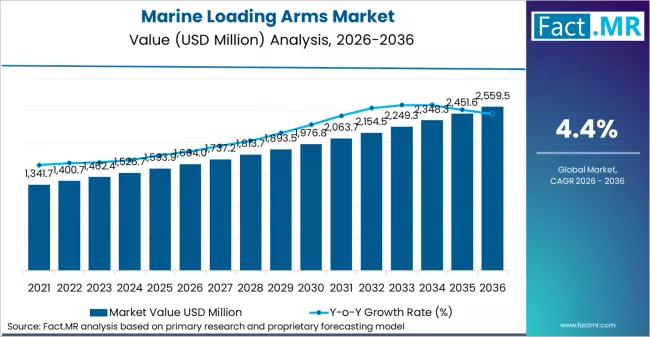
Marine Loading Arms Market Market Value Analysis | Source: Fact.MR
This growth is driven by the increasing demand for efficient and safe fluid transfer systems, particularly for crude oil, chemicals, and liquefied natural gas (LNG). Demand for marine loading arms is influenced by expanding international trade in liquid bulk cargo and the need for high-performance, durable loading arms in diverse environments.
Key factors driving market growth include port infrastructure expansions, stringent environmental regulations, and the shift towards automation and IoT-enabled systems for improved safety and monitoring. Dock-mounted systems lead the market, with a significant share of 66%, due to their stability and efficiency in high-volume cargo handling. Cryogenic LNG loading arms are also witnessing increased demand as energy transitions push for more advanced and efficient fuel transfer solutions.
Marine Loading Arms Market
| Metric | Value |
|---|---|
| Estimated Value in (2026E) | USD 1,664.0 million |
| Forecast Value in (2036F) | USD 2,559.5 million |
| Forecast CAGR 2026 to 2036 | 4.4% |
Source: Fact.MR analysis. Updated Jan 28, 2026
Category
| Category | Segments |
|---|---|
| Medium | Crude / Products; Chemicals; LPG; LNG (Cryogenic) |
| Mounting | Dock-Mounted; Mobile / Truck; Railcar; Offshore / FPSO |
| Size or Rating | 12-16 inch; ≤10-inch; ≥18 inch; Cryogenic Class |
| Region | North America; Europe; Asia Pacific; Latin America; Middle East & Africa |
Source: Fact.MR analysis. Updated Jan 28, 2026
Segmental Analysis
What Is the Impact of Medium on the Marine Loading Arms Market?
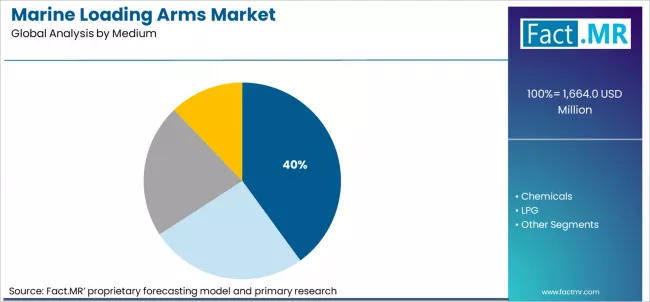
Marine Loading Arms Market Analysis By Medium | Source: Fact.MR
In the marine loading arms market, medium type significantly influences design complexity, material requirements, and operational flexibility. Crude and products account for a 40.0% share, driven by the need for robust, high-capacity loading systems in oil and petroleum product transport. These loading arms are designed to withstand the demanding conditions of transferring large volumes of liquid while ensuring minimal spillage and maintaining safety protocols. The growing global trade of crude oil and refined products, coupled with stricter environmental regulations, drives continued investment in reliable and efficient loading arms for these mediums.
How Does Mounting Type Influence the Marine Loading Arms Market?
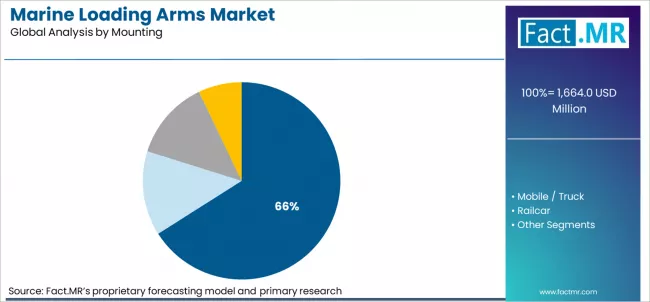
Marine Loading Arms Market Analysis By Mounting | Source: Fact.MR
Mounting type plays a crucial role in determining the installation and mobility options for marine loading arms, with dock-mounted systems leading the market at 66.0%. These systems are the most commonly used in ports, providing fixed and stable loading solutions for ships, tankers, and other large vessels. Dock-mounted loading arms ensure high operational safety, ease of maintenance, and are well-suited for high-volume, continuous cargo transfer. The preference for dock-mounted systems is driven by their ability to offer stable, reliable, and efficient loading/unloading operations in fixed marine infrastructures.
What are the Drivers, Restraints, and Key Trends in the Marine Loading Arms Market?
- Drivers: Demand for marine loading arms is shaped by global growth in crude oil, liquefied natural gas (LNG), chemical and petroleum product exports that require safe, efficient transfer infrastructure at ports and terminals. Operators specify loading arms to support high flow rates, leak minimization and precise alignment with vessel manifolds across diverse fluid types. Selection criteria include structural reliability, articulation range to accommodate tidal variation, and materials compatibility for cryogenic, corrosive or high viscosity products.
- Restraints: High capital cost and long project lead times constrain adoption in price sensitive markets or smaller ports where throughput volumes do not justify major infrastructure upgrades. Technical complexity arises when marine loading arms must integrate with floating hoses, vapour recovery systems, and terminal automation, requiring careful engineering coordination. Variable environmental conditions such as strong currents, wind and wave action affect positioning stability and increase maintenance demands for seals, bearings and swivel mechanisms.
- Trend 1: Advancement of compact, modular arm designs that simplify installation, support easier maintenance and improve adaptability to different vessel sizes without extensive structural modifications.
- Trend 2: Rising adoption of enhanced safety technologies including integrated overfill protection, emergency release coupling systems and remote monitoring sensors that improve operational visibility and reduce risk during transfer operations.
Analysis of the Marine Loading Arms Market by Key Country
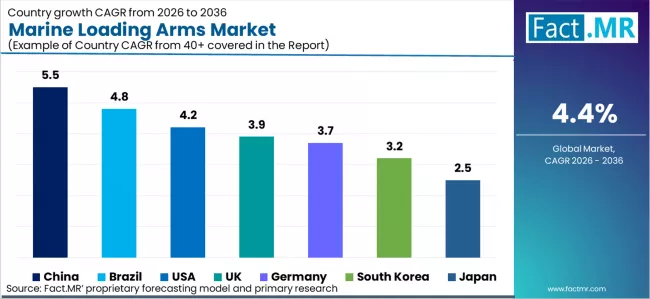
Marine Loading Arms Market Cagr Analysis By Country | Source: Fact.MR
| Country | CAGR (%) |
|---|---|
| China | 5.5% |
| Brazil | 4.8% |
| USA | 4.2% |
| UK | 3.9% |
| Germany | 3.7% |
| South Korea | 3.2% |
| Japan | 2.5% |
Source: Fact.MR analysis. Updated Jan 28, 2026
The report covers an in-depth analysis of 40+ countries; top-performing countries are highlighted below.
What is driving growth of marine loading arms demand in China?
Demand for marine loading arms in China is expanding as the country continues to strengthen its position as a global leader in port throughput and liquid bulk transport. Growth at 5.5% CAGR reflects the expansion of China’s maritime infrastructure and growing oil, gas, and chemical imports and exports. As port facilities upgrade to meet increasing trade volumes, demand for reliable, high-capacity marine loading arms is rising. Additionally, stringent safety and environmental regulations push operators to adopt advanced loading solutions that meet global standards for fluid transfer efficiency, safety, and containment.
- Expansion of maritime trade and port capacity
- Strong demand from oil, gas, and chemical industries
- Regulatory push for safer, more efficient fluid handling
- Infrastructure upgrades at key Chinese ports
Why is Brazil seeing expansion in marine loading arm adoption?
Marine loading arm demand in Brazil is rising as the country strengthens its position as a major exporter of oil, gas, and agricultural products. Growth at 4.8% CAGR reflects the increased need for efficient, safe, and precise loading and unloading systems at Brazilian ports. Port expansions and infrastructure upgrades cater to growing international trade, especially in the energy and chemical sectors. The demand for high-performance, corrosion-resistant marine loading arms is driven by Brazil’s expanding offshore oil production, particularly in the pre-salt layer fields, and growing port activity in key regions.
- Growth of oil, gas, and chemical exports
- Expansion of port infrastructure and offshore production
- Increased emphasis on safety and environmental standards
- Demand for high-performance, durable fluid transfer systems
What factors are shaping marine loading arm sales in the USA?
Sales of marine loading arms in the USA are increasing as the country’s industrial and energy sectors continue to evolve. Growth at 4.2% CAGR reflects the need for safe and efficient loading systems in the oil, gas, and chemical sectors, which dominate the American shipping industry. The USA’s advanced port infrastructure and rising demand for bulk liquid imports and exports drive the adoption of automated and high-efficiency loading arms. Furthermore, regulatory pressure for safe and environmentally responsible transport of hazardous materials encourages the replacement of older, less efficient systems.
- Strong demand from the oil, gas, and chemical sectors
- Port infrastructure modernization and expansion
- Regulatory focus on safety and environmental responsibility
- Emphasis on automation and efficiency in liquid transfer
How is the UK supporting growth of marine loading arms demand?
Marine loading arm demand in the UK is advancing as the country’s ports and maritime industry modernize their fluid transfer capabilities. Growth at 3.9% CAGR reflects the need for more efficient systems in liquid bulk handling across energy, chemical, and import/export industries. The UK’s strong regulatory environment and growing focus on energy security and environmental protection push the adoption of advanced loading arms. As the country works to meet EU and international standards for liquid transport safety, the demand for high-quality, reliable, and environmentally compliant loading solutions continues to grow.
- Modernization of port infrastructure and liquid handling systems
- Regulatory focus on safe and efficient fluid transfer
- Demand from energy, chemical, and bulk liquid transport sectors
- Efforts to meet environmental and safety standards
What is driving expansion of marine loading arms demand in Germany?
Demand for marine loading arms in Germany is rising as the country strengthens its role in the European and global shipping markets. Growth at 3.7% CAGR reflects the continued expansion of German port facilities, particularly in oil, gas, and chemical transport sectors. Germany’s focus on energy transition and sustainability also drives demand for more efficient, eco-friendly loading solutions. Advanced marine loading arms that meet strict safety, efficiency, and environmental standards are essential to Germany’s industrial port operations, especially in compliance with EU regulations.
- Expansion of German port facilities and infrastructure
- Focus on energy efficiency and environmental sustainability
- Increased demand from the oil, gas, and chemical industries
- Strict compliance with EU safety and environmental standards
How is South Korea shaping demand for marine loading arms?
Marine loading arm demand in South Korea is growing as the country’s maritime infrastructure continues to support its role as a global shipping and manufacturing hub. Growth at 3.2% CAGR reflects the expansion of liquid bulk transport in the oil, gas, and petrochemical sectors. The country’s demand for high-quality, durable loading arms is driven by the growth of its major seaports and the increased export of refined petrochemicals. South Korea’s focus on automation and regulatory adherence also supports the adoption of more efficient, safe, and technologically advanced marine loading arms.
- Expansion of oil, gas, and petrochemical exports
- Growth of automated and efficient port operations
- Focus on regulatory compliance and safety
- Demand for high-performance, durable loading arms
What factors are influencing marine loading arm demand in Japan?
Demand for marine loading arms in Japan is expanding gradually as the country’s ports and industrial sectors modernize. Growth at 2.5% CAGR reflects steady adoption within the oil, gas, and chemical transport industries, which remain critical to Japan’s import-export trade. Aging infrastructure and the need for more efficient, environmentally compliant systems drive replacement of outdated equipment. Japan’s focus on meeting strict safety and environmental standards in liquid bulk transport encourages the use of advanced marine loading arms.
- Demand from oil, gas, and chemical industries
- Modernization of port infrastructure
- Need for environmentally compliant transport systems
- Replacement of older equipment with more efficient systems
What Defines the Competitive Landscape for the Marine Loading Arms Market?
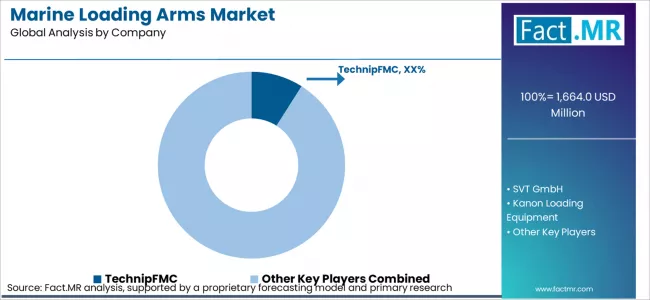
Marine Loading Arms Market Analysis By Company | Source: Fact.MR
Demand for marine loading arms is driven by the expansion of international trade in liquid bulk cargo, the increasing complexity of port infrastructure, and the need for safer, more efficient fuel and chemical transfer systems. Buyers assess arms based on flow capacity, reliability, corrosion resistance, and compliance with international safety and environmental regulations. Evaluation also includes adaptability to a range of cargo types, including LNG, petroleum, and chemicals, and the ability to integrate with automated systems for monitoring and control. Procurement behavior favors suppliers offering durable solutions, efficient maintenance programs, and the ability to customize loading arms for specific terminal and vessel needs. The trend in the market reflects a focus on enhanced safety features, automation, and low-emission operations to meet evolving regulatory standards.
TechnipFMC holds leading positioning with its comprehensive marine loading arms that are widely adopted in LNG, crude oil, and chemical loading operations. SVT GmbH competes through innovative and high-performance arms that cater to a wide range of liquid cargo types, emphasizing safety and durability. Kanon Loading Equipment remains relevant with its advanced arms designed for high-pressure, high-flow applications in the oil and gas industry. Emco Wheaton leads in the petrochemical sector, offering robust, customizable loading arms optimized for efficient bulk cargo handling. MIB Italiana and Liquip International participate through specialized loading solutions, focusing on customizability and regional supply chain reliability. Competitive differentiation centers on safety innovation, flow control precision, corrosion resistance, and adaptability to emerging fuel transfer requirements.
Key Players in the Marine Loading Arms Market
- TechnipFMC
- SVT GmbH
- Kanon Loading Equipment
- Woodfield Systems
- Emco Wheaton
- MIB Italiana
- JLA Loading Technology
- KLAW LNG
- Liquip International
- SAMPI
Bibliographies
- International Organization for Standardization. (2024). ISO 28460: Petroleum, petrochemical and natural gas industries - Installation and equipment for marine loading and unloading of liquid and liquefied gases. ISO.
- International Electrotechnical Commission. (2024). IEC 61892 7: Mobile and fixed offshore units - Electrical installations - Hazardous areas. IEC.
- International Maritime Organization. (2024). International safety guide for oil tankers and terminals (ISGOTT), 7th ed. IMO.
- European Maritime Safety Agency. (2024). Port safety and environmental performance in liquid bulk handling operations. EMSA.
- International Association of Ports and Harbors. (2025). Port infrastructure modernization and safety requirements for liquid bulk cargo. IAPH.
Segmentation
Scope of the Report
| Items | Values |
|---|---|
| Quantitative Units | USD million |
| Medium | Crude / Products; Chemicals; LPG; LNG (Cryogenic) |
| Mounting | Dock-Mounted; Mobile / Truck; Railcar; Offshore / FPSO |
| Size or Rating | 12-16 inch; ≤10-inch; ≥18 inch; Cryogenic Class |
| Regions Covered | Asia Pacific, Europe, North America, Latin America, Middle East & Africa |
| Countries Covered | China, Brazil, USA, UK, Germany, South Korea, Japan, and 40+ countries |
| Key Companies Profiled | TechnipFMC; SVT GmbH; Kanon Loading Equipment; Woodfield Systems; Emco Wheaton; MIB Italiana; JLA Loading Technology; KLAW LNG; Liquip International; SAMPI |
| Additional Attributes | Dollar sales by medium, mounting, size or rating; growing demand for cryogenic LNG marine loading arms; increasing focus on safety and efficiency in offshore and FPSO operations; significant investments in port infrastructure for chemical and petroleum product handling; integration of automation and IoT in marine loading systems for remote monitoring and control; ongoing regulatory updates driving adoption of high-class LNG and chemical loading arms in major industrial ports and marine terminals. |
Source: Fact.MR analysis. Updated Jan 28, 2026
Marine Loading Arms Market Key Segment
-
Medium :
- Crude / Products
- Chemicals
- LPG
- LNG (Cryogenic)
-
Mounting :
- Dock-Mounted
- Mobile / Truck
- Railcar
- Offshore / FPSO
-
Size or Rating :
- 12-16 inch
- ≤10-inch
- ≥18 inch
- Cryogenic Class
-
Region :
- North America
- USA
- Canada
- Mexico
- Europe
- Germany
- UK
- France
- Italy
- Spain
- Nordic Countries
- BENELUX
- Rest of Europe
- Asia Pacific
- China
- Japan
- South Korea
- India
- Australia
- Rest of Asia Pacific
- Latin America
- Brazil
- Argentina
- Rest of Latin America
- Middle East and Africa
- Kingdom of Saudi Arabia
- United Arab Emirates
- South Africa
- Rest of Middle East and Africa
- Other Regions
- Oceania
- Central Asia
- Other Markets
- North America
Frequently Asked Questions
How big is the marine loading arms market in 2026?
What will be the size of marine loading arms market in 2036?
How much will be the marine loading arms market growth between 2026 and 2036?
What are the key product types in the marine loading arms market?
Which mounting segment to contribute significant share in the marine loading arms market in 2026?
Who worked on this report


Preview the report firsthand - request a free sample
Free SampleGet the brochure for pricing and purchase details
Download PDF