- Base Value(2025): 2.5 Bn
- Estimated Value(2026): 2.6 Bn
- Forecast Value (2036): 4.4 Bn
- CAGR (2026 - 2036): 5.3%
Marine Gensets Market Analysis and Forecast by Fact.MR
- The global market for marine gensets is estimated to be around US$ 2.63 billion in 2026 and has been forecast to expand at a CAGR of 5.3% to end up at US$ 4.65 billion by 2036.
- Marine gensets are self-contained power generation units designed to supply onboard electrical power for propulsion support, navigation, communication systems, and auxiliary operations across commercial, offshore, and defense vessels.
- Product configurations include diesel, gas, hybrid, and high-speed variants with varying power ratings.
- The evolution toward dual-fuel and methanol-capable systems is accelerating as operators face tightening emission regulations. Integration with digital monitoring, load management software, and modular power architectures is reshaping the category.
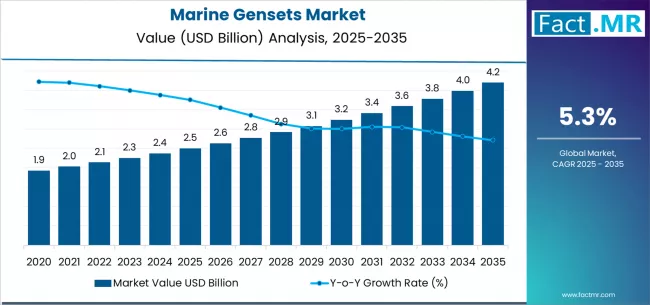
Marine Gensets Market Value Analysis | Source: Fact.MR
Summary of the Marine Gensets Market
- Market Snapshot
- In 2025, the global Marine Gensets Market was valued at approximately USD 2.63 Billion.
- The market is estimated to reach USD 2.63 Billion in 2026 and is projected to attain USD 4.65 Billion by 2036.
- The marine gensets market is likely to expand at a CAGR of 5.3% during the forecast period.
- The market is anticipated to create an absolute dollar opportunity of USD 1.87 Billion between 2026 and 2036.
- Diesel marine gensets account for 35.6% of product segment share in 2026.
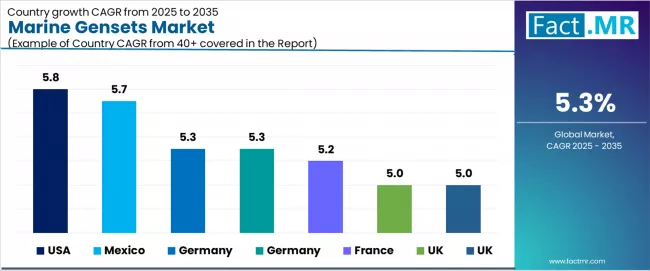
- USA (5.8%) and Mexico (5.7%) are the key growth markets during the forecast period.
- Demand and Growth Drivers
- Rising international trade volumes and fleet expansion programs across container, bulk, and tanker segments are generating sustained procurement of onboard power generation systems.
- Tightening IMO emission standards and regional marine fuel regulations are compelling operators to retrofit older vessels with cleaner and more fuel-efficient genset configurations.
- Growing offshore energy activity, including wind farm installation vessels and floating production units, is creating demand for high-reliability gensets with extended operational cycles.
- Expansion of cruise and ferry fleets, particularly in Europe and Asia Pacific, is supporting adoption of hybrid and dual-fuel gensets with hotel load management capability.
- Rising integration of digital monitoring, load optimization software, and remote diagnostics is increasing operational value and influencing equipment specification decisions.
- Product and Segment View
- Diesel marine gensets account for 35.6% of the product segment in 2026, supported by their proven reliability, fuel availability across global bunkering networks, and broad compatibility with existing vessel power architectures.
- Propulsion support systems represent 32.4% of the application segment in 2026, led by demand from commercial shipping operators requiring continuous auxiliary power for engine room systems, cargo handling, and navigation.
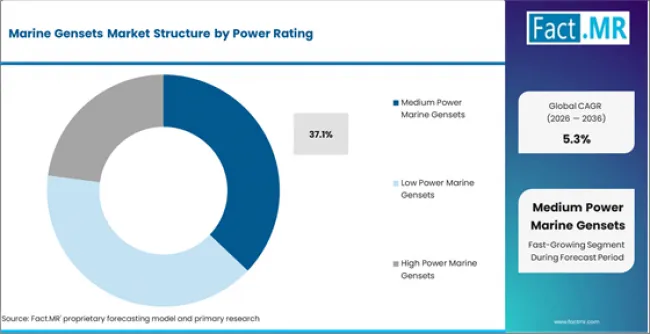
- Medium power marine gensets hold 37.1% of the power rating segment, reflecting the concentration of demand across mid-size commercial vessels, offshore support vessels, and multipurpose fleet applications.
- Key segmentation includes:
- Product Type: Diesel Marine Genset, Gas Marine Genset, Hybrid Marine Genset, High Speed Marine Genset, Portable Marine Genset
- Application: Propulsion Support Systems, Offshore Platform Power Supply, Port and Harbor Operations, Commercial Shipping, Passenger and Cruise Ships
- End Use: Shipping Companies, Oil and Gas Companies, Naval and Defense Organizations, Port Authorities, Passenger Transport Operators
- Technology: Engine Technology, Electrical Technology, Control Technology, Cooling Technology, Fuel System Technology
- Power Rating: Low Power Marine Gensets, Medium Power Marine Gensets, High Power Marine Gensets
- These systems enable:
- Continuous onboard power supply for vessel propulsion support, navigation, and cargo operations
- Auxiliary and emergency power generation across offshore platforms and port infrastructure
- Flexible fuel operation and load management for emission-compliant vessel configurations
- Geography and Competitive Outlook
- North America is a key demand region, supported by fleet modernization, offshore energy investment, and defense vessel procurement across the USA and Canada.
- Europe maintains steady demand for marine gensets, led by offshore wind installation vessels, cruise fleet expansion, and emission-compliant retrofit programs across Germany, France, and the UK.
- Asia Pacific is emerging as a high-growth region, supported by shipbuilding activity in South Korea, China, and Japan, along with rising offshore energy capacity additions.
- USA (5.8%), Mexico (5.7%), Germany (5.3%), and South Korea (5.3%) are among the fastest-growing country markets during the forecast period.
- Key companies active in the market include Caterpillar Inc., MTU Friedrichshafen GmbH, Cummins Inc., Wartsila Corporation, Volvo Penta, Yanmar Holdings Co., Kohler Co., Kawasaki Heavy Industries, MAN Energy Solutions SE, and Rolls-Royce Holdings plc.
- Analyst Opinion
- Shambhu Nath Jha, Principal Consultant at Fact.MR, says 'The marine gensets market is transitioning from a replacement-driven category to one shaped by regulatory compliance and fuel flexibility requirements. Operators are increasingly specifying dual-fuel and methanol-capable systems as part of long-term fleet decarbonization strategies. Diesel remains the volume anchor, but growth is concentrated in hybrid and gas configurations where emission thresholds are tightest. The commercial leverage is shifting toward suppliers that can bundle power hardware with digital monitoring, load optimization, and lifecycle services. Companies that invest in fuel-agnostic platforms and modular power architectures will be best positioned to capture procurement spend across new-build and retrofit programs.'
Key Growth Drivers, Constraints, and Opportunities
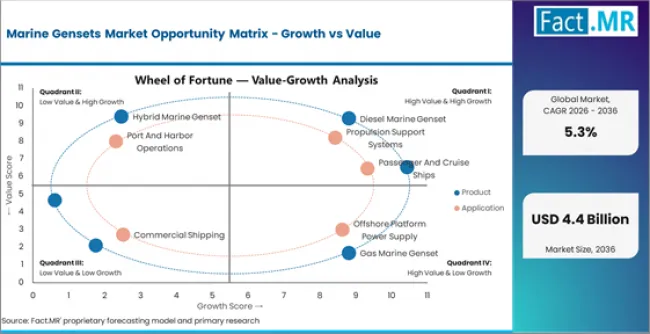
Marine Gensets Market Opportunity Matrix Growth Vs Value | Source: Fact.MR
Key Factors Driving Growth
- Fleet expansion and new vessel commissioning programs across container, LNG carrier, and offshore support segments are generating multi-year procurement pipelines for marine genset OEMs.
- IMO 2030 and regional emission regulations are accelerating replacement of legacy diesel-only systems with dual-fuel, LNG-capable, and methanol-ready genset platforms.
- Growing offshore wind installation vessel fleets in Europe and Asia Pacific require high-load gensets with extended duty cycle ratings and redundancy configurations.
Key Market Constraints
- Long vessel commissioning timelines and conservative naval specification processes limit the pace of new technology adoption across defense and commercial fleets.
- Fuel infrastructure gaps for LNG and methanol bunkering outside major port hubs constrain the practical deployment of alternative-fuel genset configurations.
- Price sensitivity among smaller fleet operators and fishing vessel owners limits the addressable market for connected and higher-specification genset systems.
Key Opportunity Areas
- Methanol-capable and fuel-agnostic genset platforms are creating differentiation opportunities for OEMs that can offer regulatory-compliant solutions across multiple fuel pathways.
- Integration of digital monitoring, predictive maintenance, and remote diagnostics into genset packages is enabling recurring service revenue models and lifecycle value capture.
- Retrofit demand from aging commercial and offshore fleets represents a large and growing share of total procurement, particularly in regions with accelerating emission compliance timelines.
Segment-wise Analysis of the Marine Gensets Market
- Diesel marine gensets hold 35.6% of the product segment in 2026, supported by their compatibility with global bunkering infrastructure, proven operational reliability, and broad acceptance across commercial and defense applications.
- Propulsion support systems represent 32.4% of the application segment in 2026, driven by continuous demand for auxiliary power across vessel navigation, cargo handling, engine room operations, and onboard hotel systems.
- Medium power marine gensets account for 37.1% of the power rating segment, reflecting their use across the largest installed base of mid-size commercial vessels, offshore support ships, and multipurpose platforms.
The marine gensets market is segmented by product type, application, end use, technology, and power rating. By product type, the market covers diesel, gas, hybrid, high-speed, and portable marine gensets. By application, coverage includes propulsion support, offshore platform power supply, port and harbor operations, commercial shipping, and passenger vessels. Diesel configurations lead by value due to their established fuel supply chain and compatibility with existing vessel architectures, while hybrid and gas variants are expected to drive the next phase of growth.
Which Product Type Segment Dominates the Marine Gensets Market?
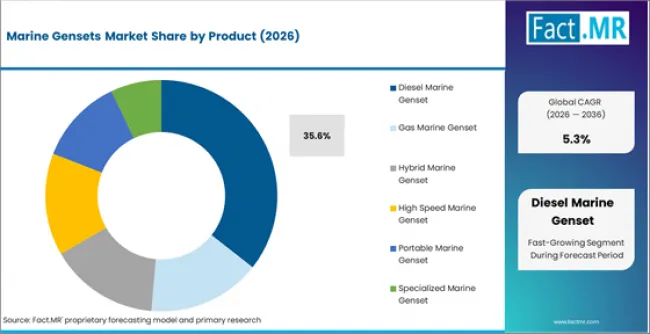
Marine Gensets Market Analysis By Product | Source: Fact.MR
Diesel marine gensets account for an estimated 35.6% of the total product segment value in 2026. The leadership of diesel configurations reflects the entrenched global bunkering network for marine diesel oil, the long operational life of diesel-based power trains, and their continued specification across both new-build and retrofit projects. Diesel gensets remain the default choice for mid-size to large commercial vessels where fuel availability, power density, and maintenance simplicity are primary procurement criteria.
Which Application Segment Dominates the Marine Gensets Market?
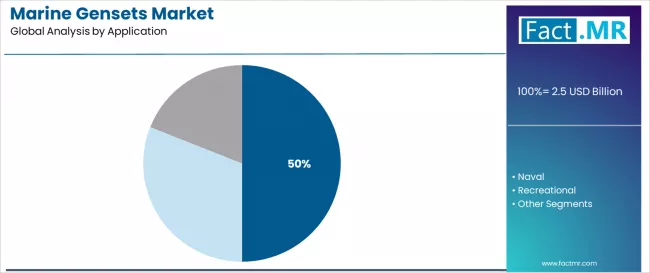
Marine Gensets Market Analysis By Application | Source: Fact.MR
Propulsion support systems are expected to account for 32.4% of the application segment in 2026. The demand is concentrated among commercial shipping operators that require continuous auxiliary power for engine room ventilation, fuel transfer systems, navigation equipment, communication infrastructure, and cargo handling operations. Gensets in this application category operate under sustained load conditions, which drives specification toward medium and high-power configurations with proven duty cycle reliability.
The propulsion support application also benefits from rising vessel electrification, where gensets increasingly supply power for electric propulsion assist systems, ballast water treatment, and emission scrubbers. As fleet operators adopt hybrid architectures and shore power connectivity, the role of onboard gensets is evolving from standalone backup to integrated power management. This transition is expanding the technical specification envelope and supporting demand for gensets with advanced load-sharing, synchronization, and digital control capabilities.
Which Power Rating Segment Dominates the Marine Gensets Market?
Marine Gensets Market Analysis By Power Rating | Source: Fact.MR
Medium power marine gensets are expected to account for 37.1% of the power rating segment in 2026. Their leadership reflects the concentration of installed vessel tonnage in the mid-size commercial fleet, including general cargo ships, coastal tankers, multipurpose vessels, and offshore supply ships. These vessels typically require genset configurations in the 500 kW to 2,000 kW range, matching the medium power category and supporting both primary and auxiliary power demand.
Medium power gensets also benefit from broad applicability across retrofit programs, where fleet operators replace aging equipment without redesigning vessel power architecture. Standardized mounting, modular design, and multi-OEM availability make this segment competitively priced and accessible.
Which Product Trend is Shaping the Next Phase of Growth in the Marine Gensets Market?
Hybrid marine gensets are not yet the largest product segment, but they are emerging as one of the fastest-growing parts of the market. Their share is projected to rise as vessel operators shift toward configurations that combine diesel or gas engines with battery energy storage, enabling variable-speed operation, peak shaving, and emission-free port calls. This is particularly relevant for ferry operators, offshore support vessels, and construction vessel fleets where duty cycles include frequent load variation and port entry requirements.
The shift toward hybrid configurations reflects broader changes in fleet procurement priorities. Operators increasingly evaluate genset systems not only on fuel cost and uptime but also on regulatory compliance, port access fees, and crew safety. As battery costs decline and power management software matures, hybrid gensets are moving from a niche premium category into a structural growth driver. OEMs that combine engine hardware with integrated battery systems, intelligent load management, and remote diagnostics are positioned to capture disproportionate share in the next procurement cycle.
Regional Outlook Across Key Markets
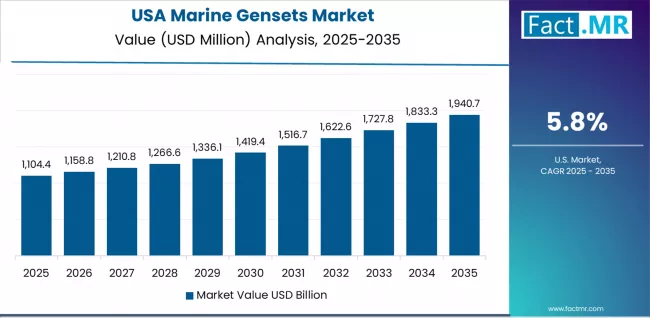
- USA leads country-level growth at 5.8%, supported by fleet modernization, IRA-linked energy investments, defense vessel procurement, and offshore wind support vessel demand along the Atlantic and Gulf coasts.
- Europe maintains stable demand, with Germany at 5.3% growth led by offshore wind installation vessel commissioning and Energiewende-aligned marine emission compliance programs.
- Asia Pacific shipbuilding activity in South Korea and Japan supports OEM-level demand for genset installations across new-build commercial and naval vessels.
- Mexico at 5.7% growth reflects expanding offshore oil and gas operations, port infrastructure upgrades, and growing demand for marine support vessel power systems.
.webp "Top Country Growth Comparison Marine Gensets Market Cagr (2026 2036)")
Top Country Growth Comparison Marine Gensets Market Cagr (2026 2036) | Source: Fact.MR
CAGR Table
| Country | CAGR (%) |
|---|---|
| USA | 5.8% |
| Mexico | 5.7% |
| Germany | 5.3% |
| South Korea | 5.3% |
| France | 5.2% |
| UK | 5.0% |
Source: Fact.MR analysis. Updated Jun 4, 2026
Source: Fact MR (FMR) analysis, based on proprietary forecasting model and primary research.
Marine Gensets Market Cagr Analysis By Country | Source: Fact.MR
Market Outlook for Marine Gensets in the United States
Marine Gensets Market Country Value Analysis | Source: Fact.MR
Demand is concentrated across fleet modernization programs, offshore energy support vessel procurement, and defense shipbuilding activity. The Inflation Reduction Act and associated energy incentives are accelerating investment in offshore wind installation vessels that require high-load marine gensets with redundancy configurations. Navy shipbuilding programs under multi-year defense authorizations are also sustaining procurement of diesel and hybrid genset systems for new surface combatants and support ships.
- Offshore wind vessel fleet expansion along the Atlantic coast is generating new procurement requirements for high-capacity marine gensets.
- EPA Tier 4 emission standards are influencing specification decisions toward cleaner dual-fuel and hybrid genset configurations in new-build programs.
Mexico Marine Gensets Demand Trends
Offshore oil and gas activity in the Gulf of Mexico, combined with port modernization investment under federal infrastructure programs, is supporting rising genset procurement. PEMEX and private operator investments in floating production and offshore support vessels are creating multi-year demand for medium and high-power diesel genset systems. Port expansion projects in Veracruz and Lazaro Cardenas are also driving demand for portable and shore-side genset configurations.
- PEMEX-linked offshore vessel operations sustain recurring procurement of diesel marine gensets for production and support platforms.
- Port modernization and terminal expansion programs are broadening the addressable market beyond traditional vessel installations.
Germany Marine Gensets Market Growth Assessment
EU Industrial Emissions Directive requirements and Energiewende-aligned marine fuel regulations are shaping genset specification across German-flagged and German-built vessels. Offshore wind installation vessel commissioning in the North Sea is a primary demand channel, with operators specifying dual-fuel and hybrid gensets to meet zero-emission port entry targets. DIN/EU CE standards and EASA-equivalent naval specifications ensure that German procurement cycles favor certified OEM systems with documented lifecycle compliance.
- North Sea offshore wind installation vessel demand is generating sustained procurement of high-capacity marine gensets with emission-compliant configurations.
- DIN/EU CE certification requirements create entry barriers that favor established OEMs with documented marine genset compliance records.
South Korea Marine Gensets Demand Analysis
Marine Gensets Market South Korea Market Share Analysis By Application | Source: Fact.MR
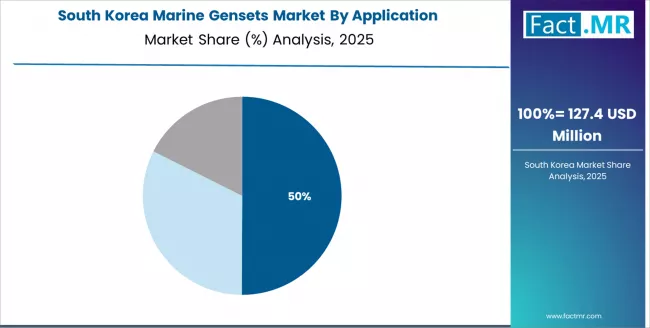
Domestic shipbuilding capacity at Hyundai Heavy Industries, Samsung Heavy Industries, and Daewoo Shipbuilding positions South Korea as a primary installation market for marine gensets. New-build order books across LNG carriers, container ships, and offshore vessels create embedded genset procurement volumes tied to vessel delivery schedules. Government R&D support for next-generation propulsion and power systems is accelerating qualification of dual-fuel and hybrid genset platforms for Korean-built vessels.
- Shipyard order books for LNG carriers and container vessels provide embedded multi-year genset procurement pipelines.
- Government-backed R&D programs for marine power systems are accelerating domestic qualification of alternative-fuel genset configurations.
Competitive Benchmarking and Company Positioning
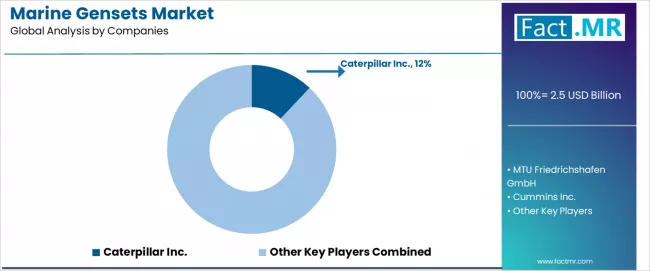
Marine Gensets Market Analysis By Company | Source: Fact.MR
Marine Gensets Market Analysis By Company
- Caterpillar Inc., Wartsila Corporation, MAN Energy Solutions, and Rolls-Royce Holdings hold strong positions in the global marine gensets market through broad power portfolios, established naval and commercial OEM relationships, and growing capabilities in dual-fuel and hybrid genset platforms.
- MTU Friedrichshafen GmbH, Cummins Inc., Volvo Penta, and Yanmar Holdings participate meaningfully across specific vessel segments and regional shipyard channels, with competition shaped by engine efficiency, service network density, and fuel flexibility.
- Technology integration creates an important barrier to differentiation, particularly in hybrid and digitally connected genset systems where load management software, remote diagnostics, and lifecycle service contracts influence buyer stickiness.
The competitive landscape is moderately consolidated, with a mix of global engine OEMs, specialized marine power providers, and regional shipyard-aligned suppliers. Caterpillar, Wartsila, MAN Energy Solutions, and Rolls-Royce compete across the broadest range of vessel classes and power ratings, supported by established service networks, naval qualification records, and fuel-agnostic development programs. These companies are better positioned to capture recurring revenue from lifecycle service contracts and connected genset monitoring platforms.
Below these leaders, MTU, Cummins, Volvo Penta, Yanmar, Kohler, and Kawasaki Heavy Industries maintain relevance across specific power tiers, vessel types, and geographic service territories. Competition among this group is shaped by engine performance, fuel economy ratings, spare parts logistics, and regional shipyard relationships rather than fully integrated power management ecosystems.
Key Companies in the Marine Gensets Market
- Caterpillar Inc., Wartsila Corporation, MAN Energy Solutions SE, and Rolls-Royce Holdings plc are among the leading players globally, supported by broad marine power portfolios, strong naval and commercial OEM relationships, and growing capabilities in alternative-fuel and hybrid genset platforms.
- MTU Friedrichshafen GmbH, Cummins Inc., Volvo Penta, and Yanmar Holdings Co., Ltd. hold established positions across specific vessel segments, power tiers, and regional markets, supported by engine efficiency, service network reach, and long-standing shipyard partnerships.
Recent Industry Developments
- Garrett Motion, Technology Partnership, MEG Turbo Commercial Deployment (February 2026): Garrett Motion announced commercial deployment of its MEG turbo technology with Weichai for large marine and genset engines, targeting higher efficiency and fuel flexibility while improving lifecycle reliability and enabling engine makers to adapt existing platforms for alternative fuels.
- MAN Energy Solutions SE, Product Certification, Methanol Genset Approval (February 2025): MAN Energy Solutions received type approval in China for its methanol-capable generator set, expanding the certified alternative-fuel genset portfolio available to Chinese and international shipyards building methanol-ready vessels.
- Caterpillar Inc., Product Launch, Small Vessel Genset Introduction (2025): Caterpillar launched the C2.2B marine genset, its smallest sound-enclosed generator, with four power ranges from 16 ekW to 26 ekW. The product targets the recreational and small commercial vessel segment, broadening the company's addressable market in the lower power tier.
- VINCI Energies, Acquisition, Marine Electrical Systems (October 2025): VINCI Energies acquired Marine Electrical Systems from Wartsila Corporation, strengthening its position in marine electrical integration services and expanding its capabilities in vessel power system design and installation.
- Wartsila Corporation, R&D Investment, Fuel-Agnostic Platform Development (2025): Wartsila committed EUR 50 million toward fuel-agnostic R&D and deployed testbeds for hydrogen, ammonia, and methanol blends, positioning the company for the next generation of emission-compliant marine power systems.
Leading Companies Shaping the Marine Gensets Market
- Caterpillar Inc.
- MTU Friedrichshafen GmbH
- Cummins Inc.
- Wartsila Corporation
- Volvo Penta (a Volvo Group company)
- Yanmar Holdings Co., Ltd.
- Kohler Co.
- Kawasaki Heavy Industries, Ltd.
- MAN Energy Solutions SE
- Rolls-Royce Holdings plc
Sources and Research References
- Caterpillar Inc. Marine genset product portfolio and technology updates.
- Wartsila Corporation. Marine power system product announcements and R&D disclosures.
- MAN Energy Solutions SE. Methanol and dual-fuel genset certification updates.
- International Maritime Organization (IMO). Emission regulation frameworks and compliance timelines.
- Shipbuilding industry association publications, customs databases, fleet registration records, and OEM product catalogs.
- Primary interviews with genset manufacturers, shipyard procurement teams, fleet operators, defense agencies, and marine equipment distributors.
This bibliography is provided for reader reference and is not exhaustive. The full report contains the complete reference list and detailed citations.
Key Questions This Report Addresses
- What is the current and future size of the Marine Gensets Market?
- How fast is the Marine Gensets Market expected to grow between 2026 and 2036?
- Which product type is likely to lead the market by 2026?
- Which application segment is expected to account for the highest demand by 2026?
- What factors are driving demand for marine gensets globally?
- How is the shift toward hybrid and dual-fuel systems influencing the market?
- Why is the USA emerging as one of the fastest-growing markets?
- How are offshore energy and defense programs supporting demand?
- Which countries are projected to show the fastest growth through 2036?
- What is driving market expansion in the USA, Mexico, and Germany?
- Who are the key companies active in the Marine Gensets Market?
- How does Fact.MR estimate and validate the market forecast?
Marine Gensets Market Definition
The marine gensets market covers self-contained power generation units designed for onboard use in commercial vessels, offshore platforms, naval ships, port infrastructure, and passenger carriers. It includes diesel, gas, hybrid, high-speed, and portable marine genset configurations across all power ratings, encompassing both new-build installations and retrofit replacements.
Marine Gensets Market Inclusions
- The scope covers global and regional market size and forecasts for 2026 to 2036 across product type, application, end use, technology, power rating, and region.
- It includes regional demand analysis across major geographies, based on factors such as fleet expansion, offshore energy activity, emission regulations, defense budgets, and port infrastructure investment.
- The report includes pricing and cost analysis across standard and premium configurations, including hardware, fuel systems, integration costs, and service contracts.
- It covers technology trends, market drivers and constraints, and the competitive landscape, including product portfolios, geographic reach, and strategic positioning of leading players.
Marine Gensets Market Exclusions
- The scope excludes land-based stationary generator sets, mobile construction generators, and data center backup power systems not designed for marine environments.
- It excludes standalone marine propulsion engines sold without integrated power generation capability, as well as battery-only energy storage systems without genset pairing.
- The report excludes military-classified power systems with restricted procurement channels, as well as experimental fuel cell units not yet in commercial deployment.
- It also excludes informal or unbranded assemblies with limited commercial visibility, and secondhand genset resale transactions without OEM involvement.
Marine Gensets Market Research Methodology
- The methodology combines secondary research, primary interviews, and forecast modelling.
- It draws on 120+ secondary sources and benchmarks 60+ company product portfolios.
- Market sizing covers 30+ countries through a demand-side model, supported by top-down validation.
- Key inputs include fleet size, vessel commissioning schedules, offshore energy capacity additions, emission regulation timelines, and bunkering infrastructure data.
- The model cross-checks demand with shipment data, pricing trends, order books, and reported installations.
- Primary validation includes 25+ interviews across genset manufacturers, marine OEMs, shipyards, fleet operators, and defense procurement agencies.
- Final estimates go through trade-flow checks, order-pipeline review, and sensitivity testing.
Segmentation
Scope of Analysis
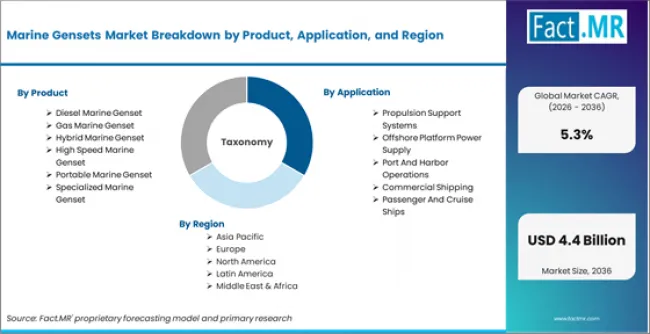
Marine Gensets Market Breakdown By Product, Application, And Region | Source: Fact.MR
| Parameter | Details |
|---|---|
| Quantitative Units | USD 2.77 Billion to USD 4.65 Billion, at a CAGR of 5.3% |
| Market Definition | The Marine Gensets Market covers self-contained power generation units designed for onboard use in commercial vessels, offshore platforms, naval ships, port infrastructure, and passenger carriers across all fuel types and power ratings. |
| Regions Covered | North America, Latin America, Europe, East Asia, South Asia and Pacific, Middle East and Africa |
| Countries Covered | USA, Mexico, Germany, South Korea, France, UK, Japan, 30 plus countries |
| Key Companies | Caterpillar Inc., MTU Friedrichshafen GmbH, Cummins Inc., Wartsila Corporation, Volvo Penta, Yanmar Holdings Co., Kohler Co., Kawasaki Heavy Industries, MAN Energy Solutions SE, Rolls-Royce Holdings plc |
| Forecast Period | 2026 to 2036 |
| Approach | Hybrid demand-side and top-down methodology built on country-level fleet data, vessel commissioning schedules, product benchmarking, pricing analysis, shipment validation, and primary interviews across manufacturers, shipyards, fleet operators, and defense agencies |
Source: Fact.MR analysis. Updated Jun 4, 2026
Marine Gensets Market Segmentation
-
Marine Gensets Market Segmented by Product:
- Diesel Marine Genset
- Low Speed Diesel Marine Genset
- Cargo Vessel Power Supply
- Bulk Carrier Auxiliary Power
- Medium Speed Diesel Marine Genset
- Container Ship Power Systems
- Commercial Shipping Operations
- Low Speed Diesel Marine Genset
- Gas Marine Genset
- LNG Fueled Marine Genset
- Low Emission Shipping Operations
- Cruise Vessel Power Systems
- Dual Fuel Marine Genset
- Flexible Fuel Marine Operations
- Offshore Support Vessels
- LNG Fueled Marine Genset
- Hybrid Marine Genset
- Diesel Electric Hybrid Genset
- Energy Efficient Vessel Propulsion
- Port Operation Power Support
- Battery Integrated Marine Genset
- Short Range Electric Navigation
- Harbor Tug Operations
- Diesel Electric Hybrid Genset
- High Speed Marine Genset
- Compact High Speed Genset
- Small Vessel Power Supply
- Fishing Boat Operations
- Marine Auxiliary High Speed Genset
- Yacht Power Systems
- Recreational Marine Applications
- Compact High Speed Genset
- Portable Marine Genset
- Skid Mounted Marine Genset
- Temporary Ship Power Supply
- Dockside Maintenance Operations
- Containerized Marine Genset
- Emergency Vessel Power Backup
- Remote Offshore Installations
- Skid Mounted Marine Genset
- Specialized Marine Genset
- Explosion Proof Marine Genset
- Oil And Gas Offshore Platforms
- Hazardous Marine Environments
- Silent Marine Genset
- Cruise Ships And Luxury Yachts
- Passenger Comfort Applications
- Explosion Proof Marine Genset
- Diesel Marine Genset
-
Marine Gensets Market Segmented by Application:
- Propulsion Support Systems
- Main Ship Power Generation
- Cargo Vessel Energy Supply
- Container Ship Operations
- Auxiliary Power Systems
- Navigation And Control Systems
- Emergency Ship Power
- Main Ship Power Generation
- Offshore Platform Power Supply
- Oil And Gas Offshore Platforms
- Drilling Rig Power Systems
- Subsea Operations Support
- Floating Production Units
- FPSO Power Generation
- Offshore Energy Systems
- Oil And Gas Offshore Platforms
- Port And Harbor Operations
- Port Equipment Power Supply
- Cranes And Handling Systems
- Shore Power Backup
- Harbor Tug Operations
- Maneuvering Vessel Support
- Dockside Power Systems
- Port Equipment Power Supply
- Commercial Shipping
- Container Shipping Operations
- Long Haul Maritime Transport
- Fleet Power Management
- Bulk Carrier Operations
- Commodity Transport Vessels
- Dry Bulk Shipping
- Container Shipping Operations
- Passenger And Cruise Ships
- Cruise Ship Power Systems
- Hotel Load Management
- Passenger Comfort Systems
- Ferry Operations
- Short Distance Passenger Transport
- Regional Marine Transit
- Cruise Ship Power Systems
- Propulsion Support Systems
-
Marine Gensets Market Segmented by End Use:
- Shipping Companies
- Container Shipping Lines
- International Cargo Transport
- Fleet Energy Management
- Bulk Shipping Operators
- Commodity Transport Operations
- Global Trade Logistics
- Container Shipping Lines
- Oil And Gas Companies
- Offshore Exploration Companies
- Drilling Platform Operations
- Marine Energy Production
- FPSO Operators
- Floating Production Systems
- Offshore Power Infrastructure
- Offshore Exploration Companies
- Naval And Defense Organizations
- Naval Forces
- Warship Power Systems
- Defense Vessel Operations
- Coast Guard Agencies
- Maritime Patrol Operations
- Surveillance Vessel Power
- Naval Forces
- Port Authorities
- Maritime Port Operators
- Cargo Handling Infrastructure
- Terminal Power Systems
- Harbor Management Agencies
- Dockside Energy Management
- Operational Support Systems
- Maritime Port Operators
- Passenger Transport Operators
- Cruise Line Operators
- Luxury Maritime Travel
- Hotel Load Energy Systems
- Ferry Operators
- Short Distance Passenger Transport
- Regional Marine Mobility
- Cruise Line Operators
- Shipping Companies
-
Marine Gensets Market Segmented by Technology:
- Engine Technology
- Diesel Engine Systems
- High Efficiency Marine Power
- Fuel Optimized Operations
- Gas Engine Systems
- Low Emission Marine Power
- LNG Fuel Integration
- Diesel Engine Systems
- Electrical Technology
- Synchronous Generator Systems
- Stable Marine Power Output
- Load Balancing Systems
- Alternator Systems
- Auxiliary Power Generation
- Emergency Backup Systems
- Synchronous Generator Systems
- Control Technology
- Automated Power Management Systems
- Real Time Load Optimization
- Fuel Efficiency Control
- Manual Control Systems
- Basic Marine Operations
- Operator Controlled Power Systems
- Automated Power Management Systems
- Cooling Technology
- Sea Water Cooling Systems
- Engine Temperature Regulation
- Marine Heat Dissipation
- Closed Loop Cooling Systems
- Engine Efficiency Optimization
- Thermal Protection Systems
- Sea Water Cooling Systems
- Fuel System Technology
- Multi Fuel Injection Systems
- Diesel And Gas Switching
- Hybrid Fuel Optimization
- Common Rail Fuel Systems
- Precision Fuel Delivery
- Emission Reduction Systems
- Multi Fuel Injection Systems
- Engine Technology
-
Marine Gensets Market Segmented by Power Rating:
- Medium Power Marine Gensets
- Commercial Vessel Power Systems
- Cargo Ship Auxiliary Power
- Container Ship Operations
- Offshore Support Vessel Power
- Drilling Support Systems
- Supply Vessels
- Commercial Vessel Power Systems
- Low Power Marine Gensets
- Small Vessel Power Systems
- Fishing Boats
- Small Ferries
- Port Auxiliary Power Units
- Dockside Support Operations
- Small Vessel Power Systems
- High Power Marine Gensets
- Large Vessel Power Systems
- Cruise Ships
- Bulk Carrier Operations
- Industrial Offshore Power Systems
- FPSO Units
- Deep Sea Shipping Operations
- Large Vessel Power Systems
- Medium Power Marine Gensets
-
Marine Gensets Market by Region:
- North America
- USA
- Canada
- Mexico
- Latin America
- Brazil
- Chile
- Rest of Latin America
- Western Europe
- Germany
- UK
- Italy
- Spain
- France
- Nordic
- BENELUX
- Rest of Western Europe
- Eastern Europe
- Russia
- Poland
- Hungary
- Balkan & Baltic
- Rest of Eastern Europe
- East Asia
- China
- Japan
- South Korea
- South Asia and Pacific
- India
- ASEAN
- Australia & New Zealand
- Rest of South Asia and Pacific
- Middle East & Africa
- Kingdom of Saudi Arabia
- Other GCC Countries
- Turkiye
- South Africa
- Other African Union
- Rest of Middle East & Africa
- North America
Frequently Asked Questions
How big is the marine gensets market in 2026?
What will be the size of marine gensets market in 2036?
How much will be the marine gensets market growth between 2026 and 2036?
What are the key product types in the marine gensets market?
Which application segment is expected to contribute significant share in the marine gensets market in 2026?
Who worked on this report


Preview the report firsthand - request a free sample
Free SampleGet the brochure for pricing and purchase details
Download PDF