- Market Value (2025): USD 724.5 Mn
- Estimated Value (2026): USD 775 Mn
- Forecast Value (2036): USD 1520 Mn
- CAGR (2026-2036): 7.0%
What is the Cryogenic Marine Loading Arms Market forecast to be worth by 2036?
USD 775 million in 2026 to USD 1,520 million by 2036, at 7.0% CAGR.
- The market stood at roughly USD 724.5 million in 2025, carried by a record year in seaborne LNG trade and a steady replacement cycle at import and export jetties.
- Revenue is projected to grow from USD 775 million in 2026 to USD 1,520 million by 2036 as new liquefaction trains and floating facilities each add ship-to-shore transfer points.
- A 7.0% CAGR from 2026 to 2036 reflects rising arm counts per berth, wider bores for faster turnaround, and retrofit demand for emergency release and quick-connect systems on older arms.
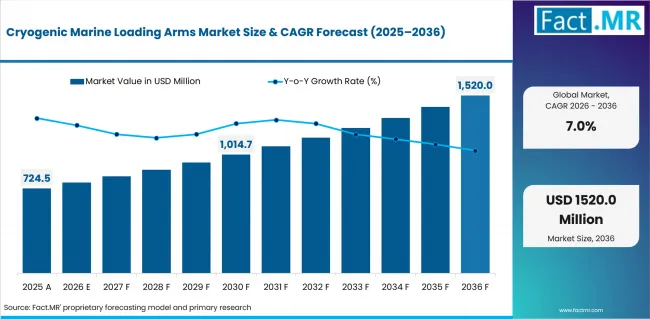
Cryogenic Marine Loading Arms Market Value Analysis | Source: Fact.MR
What are the defining numbers behind Cryogenic Marine Loading Arms Market growth?
USD 745 million absolute opportunity by 2036, led by Double counterweight arms and LNG within their respective segments.
- Demand Drivers in the Market
- LNG terminals add or replace loading arms when new berths or permanent regasification projects move beyond temporary transfer arrangements. Every ship-to-shore connection needs equipment rated for cryogenic service.
- Owners choose arms that match the movement range and manifold height of the carrier fleet calling at the berth. Compatibility with the ship interface is therefore a purchasing requirement.
- Emergency-release capability increasingly influences replacement decisions. A controlled separation protects the jetty and vessel when line tension or vessel movement exceeds the operating limit.
- Older import terminals need arms that can return to service without a major jetty rebuild. Retrofit packages create demand where swivel wear, controls, or connection hardware no longer meet operating requirements.
- LNG bunkering and petrochemical jetties extend demand beyond export and import terminals. Buyers need transfer equipment designed for the fluid, berth layout, and safety controls in use at the site.
- Key Segments Analyzed
- By Arm Configuration: Double counterweight arms lead at 39.4% of 2026 demand because the twin counterweight layout keeps the outboard arm balanced through the full ship motion envelope, which is why the configuration dominates large LNG berths where a 16 to 24 inch arm must track a carrier through tide, draft and wave movement without imposing load on the ship manifold.
- By Fluid Handled: LNG accounts for 48.0% of fluid handled demand, a share built on the sheer number of LNG berths in service and under construction, while ethylene at 28.0% rides the expansion of ethane cracking and ethylene export terminals, particularly along the U.S. Gulf Coast.
- By Terminal Type: LNG import and regasification terminals hold 34.0% of demand, marginally ahead of export terminals at 33.0%, because the post-2022 wave of European and Asian regas projects added berths faster than the liquefaction side, and each regas berth needs the same arm package as an export jetty.
- By Size Class: The 20 inch class takes 35.0% of demand as the standard large-carrier size, balancing transfer rate against arm weight, while 24 inch arms at 32.0% serve the highest throughput export berths where loading time per 174,000 cubic meter carrier directly affects terminal economics.
- By End User: LNG terminal operators hold 41.0% of end user demand, since they own the jetties where arms are installed and carry the maintenance burden, with petrochemical producers at 22.0% specifying arms for ethylene, propylene and LPG service at their own jetties.
- Analyst Opinion at Fact.MR
- Shambhu Nath Jha, Sr. Consultant at Fact.MR, states, “The arm choice is settled at the berth. Buyers must match the vessel envelope with the required transfer rate and the emergency-separation requirement. Those that specify the ship interface early avoid redesigns and protect the operating window once the terminal is live.”
- Strategic Implications
- Terminal developers should freeze the ship matrix and operating envelope before issuing arm specifications, since late changes in size class or PERC logic cascade into swivel, foundation and hydraulic redesign.
- Arm suppliers can defend margin by documenting swivel race life, cooldown performance and emergency separation tests to ISO 16904, rather than competing on fabrication price.
- Regas terminal operators should plan arm maintenance around boil-off and sendout patterns, because unplanned arm downtime at a single-berth FSRU terminal halts the whole facility.
- EPC contractors can reduce commissioning risk by running factory emergency release tests with the actual ship-shore interface controls before arms ship to site.
Technip Energies Loading Systems supplies marine loading arms for LNG and other energy applications. Its current offer covers new equipment and supports upgrades or overhauls, showing that buyers increasingly assess the arm together with the support available across its operating life.
The United States is positioned for 7.9% annual growth from 2026 to 2036 as export capacity additions drive berth construction. Germany is projected to expand at a 7.5% CAGR on the conversion of emergency FSRU projects into permanent import infrastructure. Japan follows at 7.2% on replacement demand at long-serving import terminals, South Korea advances at 6.9% as its shipyards deliver the carrier fleet its terminals must serve.
How does the Cryogenic Marine Loading Arms Market break down by segment?
The leading shares are Double counterweight arms at 39.4% by Arm Configuration and LNG at 48.0% by Fluid Handled.
Why do double counterweight arms lead the configuration mix?
At 39.4% share in 2026, double counterweight arms lead because they balance large-bore outboard arms across the widest ship motion envelope with the lowest manifold loads.
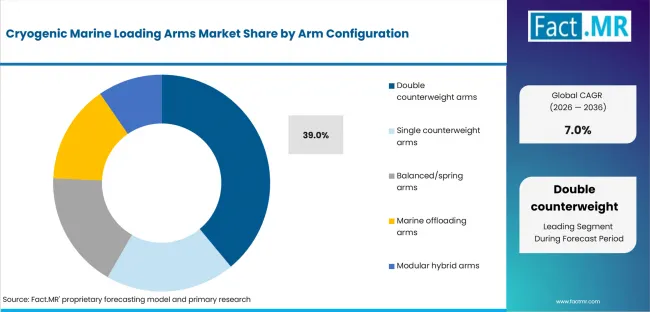
Cryogenic Marine Loading Arms Market Analysis By Arm Configuration | Source: Fact.MR
Double counterweight arms account for 39.4% of demand because big LNG berths need arms that remain balanced whether the carrier is ballasted high or laden low in the water. Single counterweight arms suit smaller jetties and lighter fluids where a simpler mechanism reduces maintenance. Balanced and spring arms, marine offloading arms, and modular hybrid designs address operating envelopes where terminals need a more specialized configuration.
Why does LNG dominate the fluid handled segment?
A 48.0% share puts LNG first in 2026 because the LNG trade operates the largest fleet of cryogenic berths and imposes the strictest arm specifications.
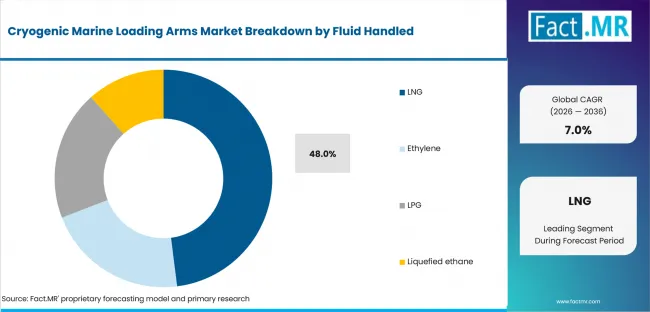
Cryogenic Marine Loading Arms Market Analysis By Fluid Handled | Source: Fact.MR
LNG represents 48.0% of fluid handled demand, supported by 428 million tonnes of seaborne trade in 2025 and a carrier fleet of nearly 900 vessels, according to GIIGNL data reported by the EIA. Ethylene demand follows petrochemical jetty investment on the U.S. Gulf Coast and in Asia. Refrigerated LPG service uses related cryogenic arm design, while liquefied ethane is concentrated in specialized export terminals supplying European and Asian crackers.
Why do import and regasification terminals edge out export terminals?
The 2026 leader is LNG import and regas terminals at 34.0% share because post-2022 energy security programs added receiving berths faster than liquefaction berths.
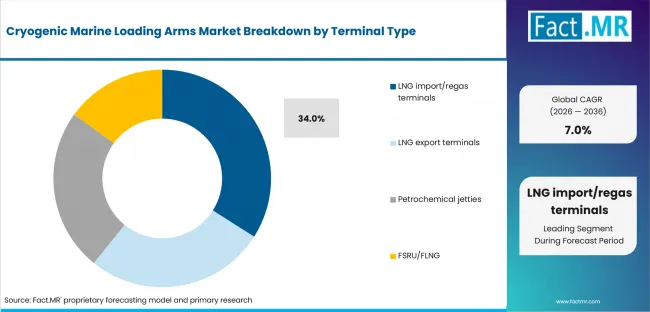
Cryogenic Marine Loading Arms Market Analysis By Terminal Type | Source: Fact.MR
Import and regas terminals account for 34.0% of demand after Europe expanded LNG import capacity by roughly one third in three years, with Germany alone chartering multiple FSRUs for Wilhelmshaven, Brunsbuttel and Lubmin. Export terminals are anchored by U.S. Gulf Coast projects where the EIA tracks capacity rising past 19 Bcf/d in 2026. Petrochemical jetties serve fluid-specific industrial traffic, while FSRU and FLNG facilities use floating transfer arrangements.
Why does the 20 inch size class capture the largest share?
For Size Class, the top 2026 position is 20 inch arms at 35.0% because they match the manifold standard of the dominant 174,000 cubic meter carrier class.
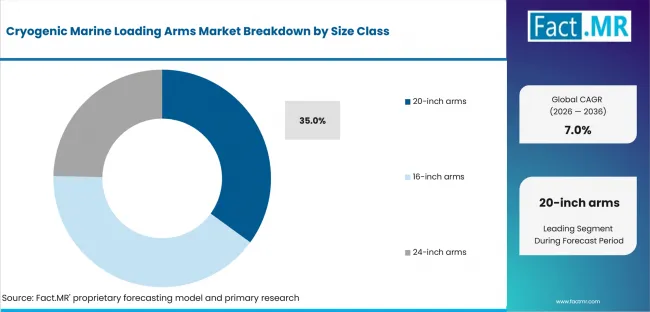
Cryogenic Marine Loading Arms Market Analysis By Size Class | Source: Fact.MR
The 20 inch class accounts for 35.0% of demand because modern Q-Flex and conventional 174,000 cubic meter carriers are built around this transfer diameter, giving terminals the rate they need without the structural burden of the largest arms. The 16 inch class suits smaller and older berths, while 24 inch arms are used at high-throughput export terminals where shorter loading windows raise berth utilization.
Why do LNG terminal operators lead the end user group?
The leading 2026 share is 41.0% for LNG terminal operators because they own the berths, carry the safety case, and control arm replacement timing.
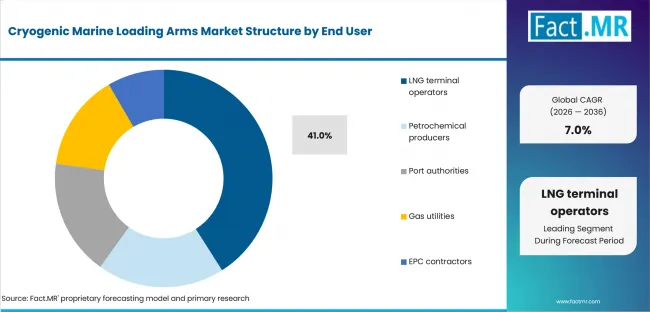
Cryogenic Marine Loading Arms Market Analysis By End User | Source: Fact.MR
LNG terminal operators represent 41.0% of demand because the arm sits on their jetty, inside their safety case, and on their maintenance budget. Petrochemical producers specify arms for ethylene and LPG jetties attached to their plants. Port authorities procure equipment for common-user berths, gas utilities operate import-terminal infrastructure, and EPC contractors purchase arms inside lump-sum terminal contracts.
What is accelerating Cryogenic Marine Loading Arms Market adoption, and what is holding it back?
The principal accelerator is the buildout of LNG liquefaction and regasification berths, each of which is a captive buyer of certified cryogenic arms. Adoption is slowed by long lead times for large swivels, the cost of ISO 16904 qualification testing, and competition from cryogenic hose systems on floating projects.
Drivers Impact Analysis
| DRIVER | (~) % IMPACT ON CAGR | GEOGRAPHIC RELEVANCE | IMPACT TIMELINE |
|---|---|---|---|
| U.S. export capacity wave | +1.2% | United States Gulf Coast | Medium term (2-4 years) |
| European regas buildout | +1.0% | Germany, Netherlands, Italy | Short term (<= 2 years) |
| Fleet growth and berth calls | +0.9% | Global | Long term (>= 4 years) |
| Arm replacement and ERS retrofit | +0.7% | Japan, Europe, mature terminals | Medium term (2-4 years) |
| Ethylene and ethane jetty projects | +0.5% | United States, China | Long term (>= 4 years) |
Source: Fact.MR analysis. Updated Jul 24, 2026
- U.S. export capacity wave: The EIA expects U.S. LNG export capacity to pass 19 Bcf/d during 2026 as Golden Pass starts up and Plaquemines and Corpus Christi Stage 3 complete. Each new train adds berths, and each berth adds two to four large cryogenic arms plus spares.
- European regas buildout: Europe expanded LNG import capacity by about one third from 2021 to 2024, and governments are now converting chartered FSRUs into permanent facilities. Permanent jetties specify full marine arm packages rather than temporary hose arrangements.
- Replacement and ERS retrofit: Many Asian import terminals date from the 1980s and 1990s. Arm renewal programs increasingly bundle powered emergency release couplings and quick connect couplers, raising the value per replacement arm.
Opportunity Impact Analysis
| OPPORTUNITY | (~) % IMPACT ON CAGR | GEOGRAPHIC RELEVANCE | IMPACT TIMELINE |
|---|---|---|---|
| Emergency release retrofit kits | +0.5% | Mature import terminals | Short term (<= 2 years) |
| Ammonia-ready arm designs | +0.4% | Japan, South Korea, Europe | Long term (>= 4 years) |
| Swivel and seal service contracts | +0.4% | Global | Medium term (2-4 years) |
| FLNG and FSRU transfer packages | +0.3% | Africa, Southeast Asia | Medium term (2-4 years) |
Source: Fact.MR analysis. Updated Jul 24, 2026
- Emergency release retrofit kits: Terminals can add PERC capability to existing arms without full replacement. Suppliers that certify retrofits against the ISO 16904 emergency release definitions open a large installed-base business.
- Ammonia-ready designs: Japan and South Korea are studying ammonia cofiring and imports at scale. Arms designed with materials and seals suitable for future ammonia service position suppliers for the next fluid cycle.
- Service contracts: Swivel race overhauls and seal replacements follow cryogenic duty cycles. Multi-year service agreements attached to new arm sales smooth revenue and lock in terminal relationships.
Restraints Impact Analysis
| RESTRAINT (~) % IMPACT ON CAGR | GEOGRAPHIC RELEVANCE | IMPACT TIMELINE | |
|---|---|---|---|
| Long swivel and forging lead times | -0.5% | Global | Short term (<= 2 years) |
| Qualification testing cost | -0.4% | New terminal projects | Medium term (2-4 years) |
| Cryogenic hose competition | -0.3% | Floating and small-scale projects | Medium term (2-4 years) |
| Trade route disruption | -0.2% | Middle East-linked flows | Short term (<= 2 years) |
Source: Fact.MR analysis. Updated Jul 24, 2026
- Long swivel and forging lead times: Large cryogenic swivels and forged components come from a small supplier base. Delivery schedules for 20 and 24 inch arms can stretch well beyond a year, pushing berth commissioning dates.
- Qualification testing cost: ISO 16904 testing of prototypes, including emergency separation behavior, adds engineering cost that smaller fabricators struggle to absorb, concentrating orders among established suppliers.
- Cryogenic hose competition: Hose transfer systems compete with rigid arms on floating and small-scale projects where relative motion is complex, trimming the addressable arm count on some FSRU and FLNG schemes.
How do the leading cryogenic marine loading arm markets compare?
United States 7.9% CAGR. Germany 7.5%. Japan 7.2%. South Korea 6.9%.
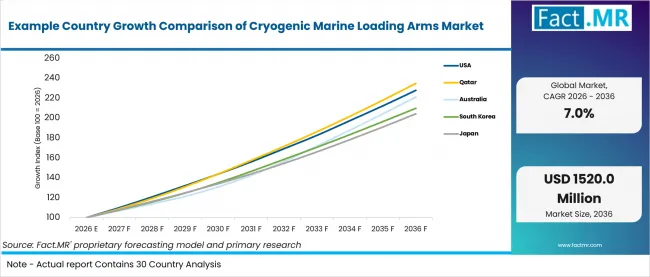
Example Country Growth Comparison Of Cryogenic Marine Loading Arms Market | Source: Fact.MR
| COUNTRY | CAGR |
|---|---|
| United States | 7.9% |
| Germany | 7.5% |
| Japan | 7.2% |
| South Korea | 6.9% |
Source: Fact.MR analysis. Updated Jul 24, 2026
Why Is the Gulf Coast Export Wave Making the United States the Fastest-Growing Arm Market?
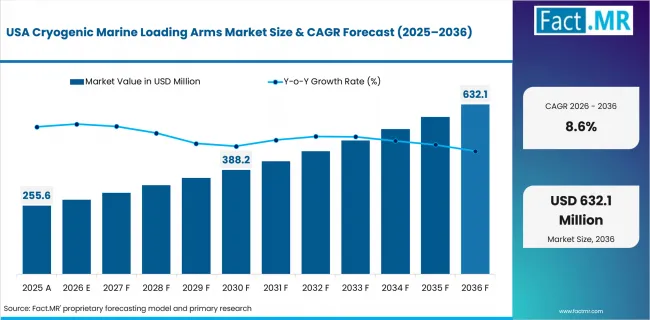
Cryogenic Marine Loading Arms Market Country Value Analysis | Source: Fact.MR
American demand is being set by liquefaction construction that federal data describe in hard numbers. The U.S. Energy Information Administration reports that U.S. LNG exports rose 26% to 15.1 Bcf/d in 2025 and forecasts further increases to 17.4 Bcf/d in 2026 and 18.6 Bcf/d in 2027. Export capacity is on track to climb from about 17 Bcf/d at the end of 2025 to slightly more than 19 Bcf/d during 2026 as Golden Pass starts up and Corpus Christi Stage 3 completes, with Plaquemines already running.
Every one of those trains terminates at a jetty that needs large double counterweight arms with certified emergency release systems. FERC’s federal authorization process and PHMSA’s safety jurisdiction give terminal specifications a regulatory backbone, so arms bought for U.S. berths are engineered to the full ISO 16904 envelope. The United States is expected to grow at 7.9% CAGR from 2026 to 2036.
Why Are Permanent LNG Terminals Replacing Emergency FSRUs in Germany?
Germany built its LNG import base in a hurry after 2022, chartering FSRUs for Wilhelmshaven, Brunsbuttel and Lubmin as an emergency response documented by the EIA’s European regasification tracking. EU and UK import capacity expanded by roughly 34% between 2021 and 2024, and Germany’s contribution came largely from floating units designed as a bridge.
That bridge is now being made permanent. Fixed terminals at Stade, Brunsbuttel and Wilhelmshaven are moving through construction and commissioning, and permanent jetties buy full marine loading arm packages rather than the hose-based arrangements used on charter tonnage. European LNG imports rose 29% in 2025 according to GIIGNL data reported by the EIA, keeping berth utilization high. Germany’s arm demand grows at a 7.5% CAGR from 2026 to 2036.
Why Does Japan’s Ageing Import Fleet Drive Steady Replacement Demand?
Japan built the world’s first generation of large LNG import terminals, and many of its jetties and arms have been in cryogenic service for decades. Replacement demand follows duty cycles, and Japanese buyers tend to renew arms with upgraded emergency release and quick-connect systems rather than like-for-like units.
The policy backdrop supports continued throughput. METI’s energy planning keeps LNG at the center of Japanese supply security, and Japan remains one of the largest LNG importers in GIIGNL’s trade accounting. Utility and terminal operators run disciplined maintenance programs, which makes Japan a service-rich market for swivels and seals as well as complete arms. Japan’s demand grows at a 7.2% CAGR from 2026 to 2036.
Why Do Korean Shipyards and Terminals Pull Each Other Forward in South Korea?
South Korea builds a large share of the LNG carrier fleet that GIIGNL counts at 899 vessels after 8% fleet growth, and its domestic terminals must receive the same ships its yards deliver. Korean import terminals on the west and south coasts continue to expand storage and berth capacity as national gas demand shifts with power sector dispatch.
Korean engineering standards for jetty equipment are among the most demanding in Asia, which favors established arm suppliers with documented swivel and ERS testing. The combination of berth expansion at home and carrier deliveries abroad keeps Korean arm demand on a 6.9% CAGR from 2026 to 2036.
Who leads the Cryogenic Marine Loading Arms Market?
Technip Energies Loading Systems, SVT GmbH, Emco Wheaton, Woodfield Systems, and Niigata Loading Systems serve the market through their equipment and service capabilities.
Competition depends on support for the operating envelope and retrofit work. Technip Energies Loading Systems supplies marine loading arms and provides retrofit and overhaul services. The other named providers compete through their own equipment and service offerings.
Competitive differentiation depends on whether a supplier can upgrade existing arms and support equipment across a terminal's operating life.
Which companies are the key providers?
The company set includes Technip Energies Loading Systems, SVT GmbH, Woodfield Systems, Emco Wheaton, and Niigata Loading Systems.
- Technip Energies Loading Systems
- SVT GmbH
- Woodfield Systems
- Emco Wheaton
- Niigata Loading Systems
The five named manufacturers anchor the comparison, and the full report reviews more than 30 equipment suppliers and service specialists.
Bibliography
- U.S. Energy Information Administration. (2026). Global liquefied natural gas trade volumes reached record high in 2025 (data source: GIIGNL).
- U.S. Energy Information Administration. (2022). Europe’s LNG import capacity set to expand by one-third by end of 2024.
- International Organization for Standardization. (2016). ISO 16904:2016, Petroleum and natural gas industries: Design and testing of LNG marine transfer arms for conventional onshore terminals.
- International Institute of Refrigeration. (2026). LNG-fuelled ships continue to lead despite 47% decrease in alternative maritime fuels market (data source: DNV).
- Technip Energies. (n.d.). Loading Systems advanced technologies.
- SVT GmbH. (n.d.). Marine Loading Arms for Cryogenic Service.
This Report Addresses
- The report quantifies the 2025 baseline and forecasts revenue from 2026 through 2036.
- The country analysis covers U.S. export terminals, German import-berth additions, Japanese replacement demand, South Korean shipbuilding, and Chinese jetty modernization across more than 30 markets.
- It evaluates Technip Energies Loading Systems, SVT GmbH, Woodfield Systems, Emco Wheaton, and Niigata Loading Systems.
- It examines arm configuration, fluid, terminal type, size class, and end user choices.
- It separates LNG, ethylene, LPG, and ethane transfer demand across export, import, petrochemical, and floating terminals.
- It tests the forecast against export capacity additions, regas buildouts, fleet growth, and replacement cycles.
What does the Cryogenic Marine Loading Arms Market cover?
The study follows cryogenic marine loading arms from jetty specification and fabrication through commissioning, swivel service, and installed-base replacement.
Revenue includes the arm structure, inboard and outboard piping, swivel joints, counterweight or balancing systems, hydraulic power units, control systems, and PERC and QCDC equipment supplied with the arm. Foundation and civil works are excluded.
Demand is segmented by configuration, fluid, terminal type, size class, and end user. Country estimates reflect terminal construction and throughput, fleet arrivals, supplier access, and the age of installed arms.
What is included in the scope?
Included systems are articulated marine arms designed and tested for cryogenic service at ship-to-shore interfaces.
Double counterweight, single counterweight, balanced, offloading, and modular hybrid arms are counted when designed for LNG, ethylene, LPG, or ethane duty. Swivels, insulation, hydraulic drives, control and monitoring systems, PERCs, and QCDCs are covered when sold with the arm or as a certified retrofit.
Swivel and seal overhauls, emergency release testing, and spare parts are included only when billed by the arm supplier or an authorized service channel.
What is excluded from the scope?
Cryogenic hose systems, jetty civil works, and non-cryogenic arms are not included.
The study excludes cryogenic transfer hoses and hose handling cranes, jetty structures, dolphins, and approach trestles, ambient-temperature loading arms for oil and chemicals, and shipboard equipment on the carrier side of the manifold flange.
How was the analysis built?
Terminal project data, berth-level arm counts, supplier interviews, and forecast cross-checks referencing more than 30 countries.
- Primary Research: Primary research targets terminal operators, jetty designers, EPC contractors, arm manufacturers, swivel specialists, and classification society plan approval staff. Interviews test berth configurations, arm counts per berth, size class selection, PERC and QCDC attachment rates, overhaul intervals, and replacement triggers.
- Desk Research: Desk research reviews terminal approval filings, EIA and GIIGNL trade and capacity data, ISO 16904 design requirements, manufacturer product literature, and classification society rules. Named projects are used only when supported by government or intergovernmental sources listed in the bibliography.
- Market-Sizing and Forecasting: Sizing is developed from berth counts, arms per berth, size class and configuration mixes, realized pricing, retrofit attachment, and replacement cycles. The result is reconciled to USD 775 million in 2026 and USD 1,520 million in 2036.
- Data Validation and Update Cycle: Validation compares segment shares, supplier positions, and country growth with terminal commissioning schedules and trade data. Update signals include liquefaction train start-ups, regas terminal openings, carrier deliveries, arm refurbishment awards, and ISO standard revisions.
Segmentation
What is the report’s scope and coverage?
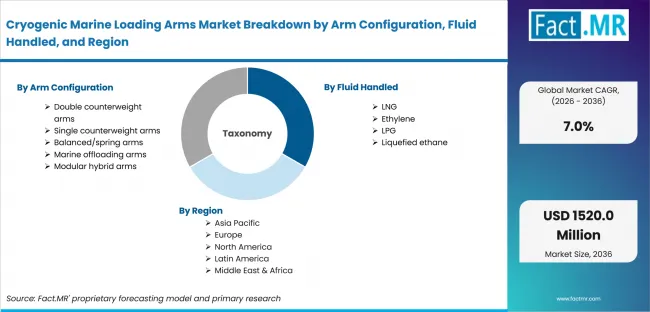
Cryogenic Marine Loading Arms Market Breakdown By Arm Configuration, Fluid Handled, And Region | Source: Fact.MR
| ATTRIBUTE | DETAILS |
|---|---|
| Quantitative Units | USD 775 million in 2026 to USD 1,520 million by 2036 at 7.0% CAGR |
| Market Definition | The market covers articulated cryogenic marine loading arms for ship-to-shore transfer of LNG, ethylene, LPG and liquefied ethane at export, import, petrochemical and floating terminals, including swivels, counterweight systems, PERCs and QCDCs sold with the arm. |
| Arm Configuration | Double counterweight arms; Single counterweight arms; Balanced/spring arms; Marine offloading arms; Modular hybrid arms |
| Fluid Handled | LNG; Ethylene; LPG; Liquefied ethane |
| Terminal Type | LNG export terminals; LNG import/regas terminals; Petrochemical jetties; FSRU/FLNG |
| Size Class | 16-inch arms; 20-inch arms; 24-inch arms |
| End User | LNG terminal operators; Petrochemical producers; Port authorities; Gas utilities; EPC contractors |
| Regions Covered | North America; Europe; Asia Pacific |
| Countries Covered | United States; Germany; Japan; South Korea; (full report analyzes 30+ countries) |
| Key Companies Profiled | Technip Energies Loading Systems; SVT GmbH; Woodfield Systems; Emco Wheaton; Niigata Loading Systems |
| Forecast Period | 2026 to 2036 |
| Approach | Sizing combines berth-level arm counts at operating and under-construction terminals, realized prices by size class and configuration, replacement and retrofit cycles, and separately billed swivel and emergency release service. |
Source: Fact.MR analysis. Updated Jul 24, 2026
How is the market segmented?
-
By Arm Configuration
- Double counterweight arms
- Single counterweight arms
- Balanced/spring arms
- Marine offloading arms
- Modular hybrid arms
-
By Fluid Handled
- LNG
- Ethylene
- LPG
- Liquefied ethane
-
By Terminal Type
- LNG export terminals
- LNG import/regas terminals
- Petrochemical jetties
- FSRU/FLNG
-
By Size Class
- 16-inch arms
- 20-inch arms
- 24-inch arms
-
By End User
- LNG terminal operators
- Petrochemical producers
- Port authorities
- Gas utilities
- EPC contractors
-
By Region
- North America
- Europe
- Asia Pacific
Frequently Asked Questions
What is the cryogenic marine loading arms market worth in 2026?
What revenue level is projected for cryogenic marine loading arms in 2036?
What CAGR is expected through 2036?
Which arm configuration leads demand?
Which fluid is the largest segment?
Which terminal type has the largest share?
What size class leads the market?
Which end user is most common?
Who worked on this report


Preview the report firsthand - request a free sample
Free SampleGet the brochure for pricing and purchase details
Download PDF