- Market Value (2025): USD 756.5 Mn
- Estimated Value (2026): USD 820 Mn
- Forecast Value (2036): USD 1837 Mn
- CAGR (2026-2036): 8.4%
What is the Marine Shaft Generator Systems Market forecast to be worth by 2036?
USD 820 million in 2026 to USD 1,837 million by 2036, at 8.4% CAGR.
- The marine shaft generator systems market reached USD 756.5 million in 2025.
- Demand is projected to increase from USD 820 million in 2026 to USD 1837 million by 2036.
- The market is expected to expand at 8.4% CAGR from 2026 to 2036.
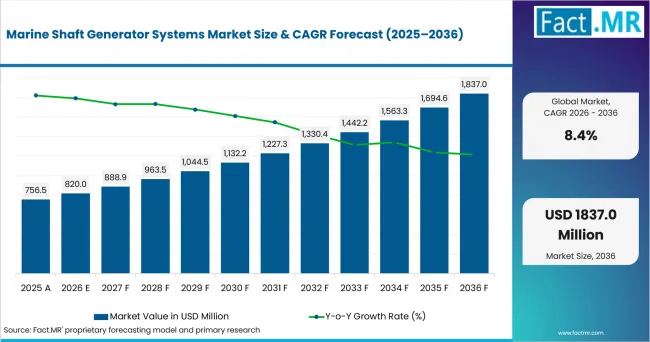
Marine Shaft Generator Systems Market Value Analysis | Source: Fact.MR
What are the defining numbers behind Marine Shaft Generator Systems Market growth?
USD 1,017 million in absolute opportunity is expected between 2026 and 2036.
- Demand Drivers in the Market
- IMO EEXI/CII regulations compelling vessel operators to adopt shaft-generator solutions that reduce auxiliary engine runtime and improve carbon intensity ratings.
- Rising marine fuel costs and the narrowing spread between HFO/MGO and LNG, making the fuel-saving economics of PTI/PTO shaft generator systems compelling across deep-sea fleets.
- Electrification of shipboard power systems and the shift to DC-grid architectures that integrate shaft generators with battery banks for peak-shaving and zero-emission port operations.
- Newbuild ordering patterns favoring energy-efficient container ships and LNG carriers, where shaft generators are increasingly specified as standard equipment to meet charterer sustainability requirements.
- Retrofit activity in the European and Asian short-sea fleet, driven by EU ETS inclusion of shipping and regional green-corridor initiatives that reward shaft-generator-equipped vessels.
- Key Segments Analyzed
- By System Type: The PTO (power take-off) category is expected to account for 42.0% of the marine shaft generator systems market in 2026. PTO is the direct shaft-to-electricity arrangement and suits vessels focused on reducing auxiliary-engine load at sea.
- By Power Rating: The 1-5 MW category is projected to account for 46.0% of the marine shaft generator systems market in 2026. The 1-5 MW range aligns with the hotel and auxiliary loads of many commercial vessels.
- By Vessel Type: The Container ships category is projected to account for 29.0% share. Container ships combine sustained sea passages with substantial onboard electrical demand.
- By Installation: The Newbuild category is set to account for 61.0% of the marine shaft generator systems market in 2026. Newbuild integration allows the generator, converter, switchboard and control architecture to be optimized at the design stage.
- Analyst Opinion at Fact.MR
- Shambhu Nath Jha, Senior Consultant at Fact.MR, states, "A shaft generator project is decided at system level. Owners compare the expected reduction in auxiliary-engine hours with converter losses, operating profile, class approval and the time available for installation. Newbuild integration remains simpler, but retrofit demand is expanding where the vessel has sufficient remaining life and the efficiency gain can be captured without an extended off-hire period."
- Strategic Implications
- Shipyards that standardize shaft-generator integration in their base design packages will capture design-phase specification advantage, particularly in the competitive mid-size container and bulk-carrier segments where series-build economics apply.
- The growing overlap between shaft-generator control systems and vessel energy-management software creates an integration layer that favors suppliers offering combined hardware-software platforms over component-only vendors.
- Retrofit demand will increasingly concentrate in dry-dock hubs in China, Singapore, and the Middle East, shifting the service-and-installation value pool toward yards with shaft-generator engineering capability.
- DC-grid adoption in the ferry and offshore-vessel segments will blur the boundary between shaft generators and propulsion motors, making permanent-magnet machine technology the decisive differentiator in the 1-5 MW power band.
- European shipping's rising EU ETS exposure through 2026 will strengthen the economics of fuel-saving retrofits decisions, compressing the typical shaft-generator sales cycle and favoring suppliers with modular, classification-pre-approved retrofit packages.
How does the Marine Shaft Generator Systems Market break down by segment?
Why does the PTO (power take-off) category lead System Type?
The PTO (power take-off) category is projected to account for 42.0% share in 2026.
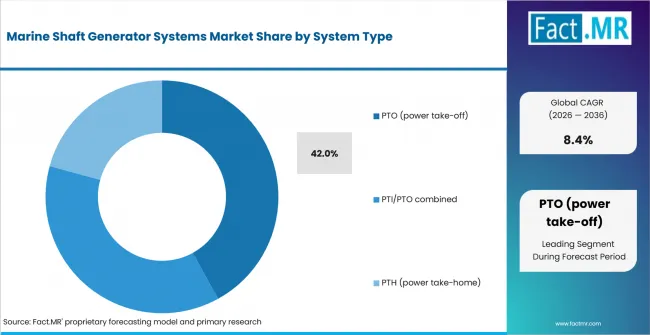
Marine Shaft Generator Systems Market Analysis By System Type | Source: Fact.MR
A PTO arrangement converts mechanical power from the main propulsion shaft into electricity during normal sailing. It can reduce reliance on auxiliary generator sets when the main engine operates within a suitable speed and load range.
The architecture is comparatively direct, which supports its use on vessels with predictable sea passages. Combined PTI/PTO systems add propulsion-assist and take-home functions, but also require more complex power electronics and control integration.
Why does the 1-5 MW category lead Power Rating?
The 1-5 MW category is anticipated to account for 46.0% share in 2026.
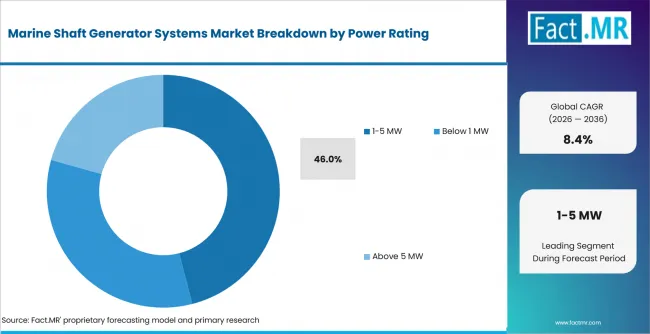
Marine Shaft Generator Systems Market Analysis By Power Rating | Source: Fact.MR
A 1-5 MW rating covers the auxiliary and hotel loads of many container ships, bulk carriers, tankers and ferries. It is large enough to displace meaningful generator-set operation without moving into the engineering requirements of very large electrical plants.
Ratings below 1 MW suit smaller vessels and limited service loads. Systems above 5 MW are more application-specific and depend on vessel size, reefer demand, propulsion architecture and the owner's redundancy philosophy.
Why does the Container ships category lead Vessel Type?
The Container ships category is projected to account for 29.0% share in 2026.
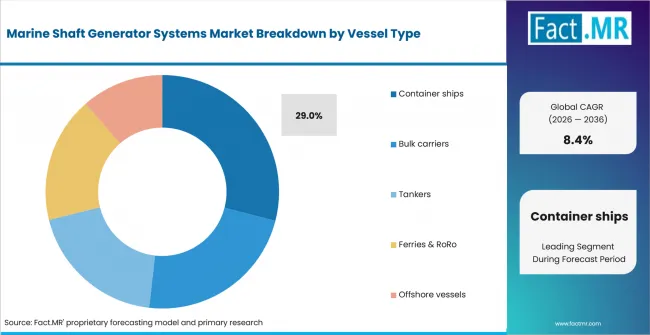
Marine Shaft Generator Systems Market Analysis By Vessel Type | Source: Fact.MR
Container ships spend long periods at sea and carry substantial electrical loads from pumps, ventilation, cargo systems and refrigerated containers. The operating profile creates repeated opportunities to generate electricity from the propulsion shaft.
Owners assess the system against fuel consumption, emissions performance and schedule reliability over the vessel life. Bulk carriers and tankers offer related use cases, although their route and load profiles can produce different utilization patterns.
Why does the Newbuild category lead Installation?
The Newbuild category is projected to account for 61.0% share in 2026.
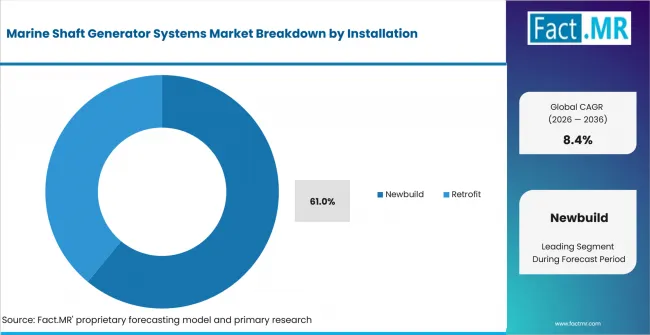
Marine Shaft Generator Systems Market Analysis By Installation | Source: Fact.MR
Newbuild installation allows the shaft line, generator, frequency converter, switchboard and cooling arrangement to be coordinated before construction. Design-stage integration reduces compromises in space, cabling and control interfaces.
Retrofit projects remain viable during major dry-dock periods, but they require a detailed survey of the existing propulsion train and electrical plant. The additional engineering and outage risk keeps newbuild projects ahead in the installation mix.
What is accelerating Marine Shaft Generator Systems Market adoption, and what is holding it back?
Adoption is being driven by vessel-efficiency regulations and fuel savings from reduced auxiliary-engine operation, while high integration costs and retrofit constraints can slow investment on older vessels.
Drivers Impact Analysis
| Driver | (~) % Impact on CAGR | Geographic Relevance | Impact Timeline |
|---|---|---|---|
| IMO EEXI/CII compliance pressure on vessel efficiency | +0.8% | Global (EU-flagged emphasis) | Near term |
| Rising marine fuel costs improving shaft-generator payback | +0.6% | Asia-Pacific, Middle East | Near term |
| DC-grid and battery-hybrid newbuild adoption | +0.9% | Northern Europe, Norway | Mid term |
| EU ETS extension to shipping accelerating retrofits | +0.7% | EU/EEA flagged fleet | Mid term |
Opportunity Impact Analysis
| Opportunity | (~) % Impact on CAGR | Geographic Relevance | Impact Timeline |
|---|---|---|---|
| Permanent-magnet shaft generator technology | +1.2% | Global (newbuild) | Mid term |
| Green-corridor and zero-emission port mandates | +1.0% | Northern Europe, Asia-Pacific | Long term |
| Integrated vessel energy-management platforms | +0.8% | Global | Long term |
Restraints Impact Analysis
| Restraint | (~) % Impact on CAGR | Geographic Relevance | Impact Timeline |
|---|---|---|---|
| High upfront Capex of PTI/PTO systems for smaller owners | -0.5% | Fragmented owner markets (SE Asia, Med) | Near term |
| Yard-slot availability constraining retrofit throughput | -0.4% | Global dry-dock hubs | Mid term |
| Compatibility challenges with legacy slow-speed engines | -0.3% | aging bulk-carrier and tanker fleet | Near term |
Which countries are scaling the Marine Shaft Generator Systems Market through 2036?
- Denmark: Denmark's leadership in marine shaft generator adoption is rooted in its position as a global maritime technology hub. Maersk's fleet-renewal strategy and the Danish Maritime Authority's proactive alignment with IMO decarbonization targets have made shaft-generator equipment a standard specification across Danish-controlled tonnage. The country's concentration of marine engineering talent and the presence of major system integrators ensure that Danish-flagged and Danish-operated vessels consistently lead in shaft-generator penetration rates.
- South Korea: South Korea is a major shipbuilding center for shaft-generator system integration, with Hyundai Heavy Industries, Samsung Heavy Industries, and Hanwha Ocean specifying shaft generators across their container-ship and LNG-carrier orderbooks. The Korean government's K-Shipbuilding 2.0 initiative explicitly supports electrification and energy-efficiency technologies, and domestic component suppliers are investing in permanent-magnet machine manufacturing capacity to capture a larger share of the shaft-generator value chain.
- Japan: Japan's shaft-generator market is characterized by deep integration between shipyards, engine builders, and electrical system manufacturers within the keiretsu structure. Japanese owners operating in the bulk-carrier and tanker segments are adopting shaft generators as a practical means of improving EEXI ratings without the complexity of alternative decarbonization technologies. Domestic classification society ClassNK has issued comprehensive guidelines for shaft-generator installation that have streamlined the approval process for both newbuild and retrofit projects.
- Norway: Norway's shaft-generator market is driven by the advanced electrification of its offshore and ferry fleets under the Norwegian Green Shipping program. The country's fjord-based operations create natural use cases for hybrid shaft-generator-battery architectures, and Norwegian owners have been early adopters of DC-grid and permanent-magnet shaft generator technology. Norwegian government support through Enova and Innovation Norway continues to subsidise the incremental cost of advanced shaft-generator systems, particularly for the coastal and aquaculture service vessel fleet.
- Germany: Germany's maritime supply chain, anchored by equipment manufacturers and engineering firms, positions its shipowners as early adopters of shaft-generator technology. German-controlled container and multi-purpose vessel fleets operate predominantly on schedules that maximize shaft-generator utilization, and the country's prominence in the global charter market means that German owners' technical specifications increasingly set the standard for time-charter-attached tonnage in the Atlantic and Mediterranean trades.
- Greece: Greece, as the globally significant ship-owning nation by tonnage, represents a substantial addressable market for shaft-generator retrofit and newbuild specification. Greek owners, traditionally focused on Capex discipline, are now compelled by charterer requirements and EU ETS exposure to invest in shaft-generator systems that deliver demonstrable fuel savings and CII rating improvement. The concentration of Greek technical management offices in Piraeus creates a dense market for equipment suppliers and systems integrators, and Greek-controlled tonnage under European flags is subject to the same regulatory drivers as Northern European fleets.
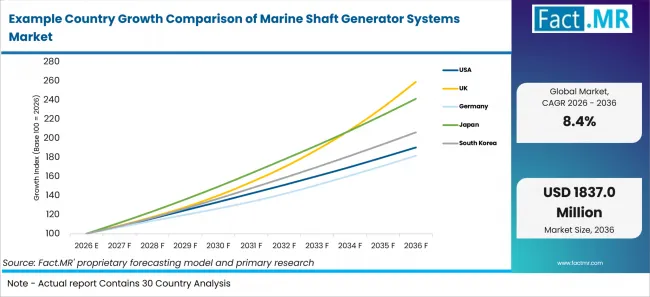
Example Country Growth Comparison Of Marine Shaft Generator Systems Market | Source: Fact.MR
| Country | CAGR (2026-2036) |
|---|---|
| Denmark | 8.8% |
| South Korea | 10.4% |
| Japan | 8.0% |
| Norway | 9.2% |
| Germany | 7.8% |
| Greece | 9.6% |
What is driving Denmark's growth through 2036?
Demand in Denmark is projected to expand at 8.8% CAGR from 2026 to 2036.
Denmark combines an active shipowning base with marine-energy engineering and decarbonization programs. Long operating profiles and exposure to European efficiency rules make shaft generation relevant in both newbuild specifications and selected retrofits.
What is driving South Korea's growth through 2036?
Demand in South Korea is projected to expand at 10.4% CAGR from 2026 to 2036.
South Korea's large shipbuilding base allows shaft generators, converters and vessel control systems to be engineered at the newbuild stage. Integration at the yard reduces interface risk and supports higher-power installations on container ships, tankers and gas carriers.
What is driving Japan's growth through 2036?
Demand in Japan is projected to expand at 8.0% CAGR from 2026 to 2036.
Japan brings together shipbuilders, marine-equipment suppliers and classification expertise. Operators can evaluate shaft generation as part of broader vessel-efficiency upgrades, with standardized approval and system reliability carrying weight in procurement.
What is driving Norway's growth through 2036?
Demand in Norway is projected to expand at 9.2% CAGR from 2026 to 2036.
Norway's experience with hybrid propulsion, offshore vessels and electrically intensive ferries supports demand for coordinated shaft-generation and energy-management systems. Retrofit decisions are pronounced where the vessel has a predictable duty cycle and sufficient remaining service life.
What is driving Germany's growth through 2036?
Demand in Germany is projected to expand at 7.8% CAGR from 2026 to 2036.
Germany has an established marine-engineering base and owner-controlled container and multipurpose fleets. Fuel cost, EU carbon exposure and charter economics encourage operators to compare shaft-generation savings against installation time and off-hire.
What is driving Greece's growth through 2036?
Demand in Greece is projected to expand at 9.6% CAGR from 2026 to 2036.
Greece's owner-managed merchant fleet creates a sizable retrofit audience across bulk carriers and tankers. Project timing depends on vessel age, dry-dock schedules and whether expected auxiliary-engine savings justify the installation window.
Who leads the Marine Shaft Generator Systems Market?
Wärtsilä, ABB and Kongsberg Maritime fit where shaft generation connects with vessel electrification and power-management integration. ABB adds recent relevance through its February 2025 order for permanent-magnet shaft generator systems for 30 LNG carriers, while The Switch surpassed 500 marine permanent-magnet shaft generator orders in 2025.
The market includes marine propulsion integrators, electrical-system suppliers and specialist permanent-magnet machine providers. Wärtsilä can combine shaft generation with propulsion and vessel-system integration, while ABB and Kongsberg Maritime participate through electrical drives, automation and marine power-management capabilities.
The Switch, part of the BEMAC Group, focuses on permanent-magnet machine technology. HD Hyundai Electric brings marine rotating-machine experience and access to shipbuilding programs, and WE Tech Solutions addresses shaft-generation packages within vessel energy-management and DC-link architectures.
Competition turns on total-system efficiency, class documentation, converter performance and project execution at the shipyard or dry dock. Retrofit work places added weight on compact design, interface engineering and a credible installation schedule because off-hire cost can outweigh a small difference in equipment price.
Which companies are the key providers?
Key Companies includes Wärtsilä; ABB; Kongsberg Maritime; The Switch, part of the BEMAC Group; HD Hyundai Electric; WE Tech Solutions
- Wärtsilä
- ABB
- Kongsberg Maritime
- The Switch, part of the BEMAC Group
- HD Hyundai Electric
- WE Tech Solutions
Bibliography
- International Maritime Organization. 2023 IMO Strategy on Reduction of GHG Emissions from Ships.
- International Maritime Organization. EEXI and CII guidance and implementation material.
- European Commission. EU Emissions Trading System rules for maritime transport.
- European Union. Regulation (EU) 2023/1805 on the use of renewable and low-carbon fuels in maritime transport.
- DNV. Guidance on vessel energy-efficiency measures and shaft-generator retrofits.
- ClassNK. Guidelines for shaft generator systems on ships.
- Wärtsilä. Inline shaft-generator and marine electrification documentation.
- ABB Marine & Ports. Shaft-generator and marine-drive system documentation.
- Kongsberg Maritime. Marine power-management and shaft-generator documentation.
- The Switch, a Yaskawa company. Permanent-magnet shaft-generator technology documentation.
- HD Hyundai Electric. Marine rotating-machine and electrical-system product documentation.
- WE Tech Solutions. Shaft-generation and vessel energy-management system documentation.
This Report Answers
- The report analyzes system type, power rating, vessel class and installation route for marine shaft generation.
- It explains the operating distinction between power take-off, combined propulsion support and take-home capability.
- Country coverage considers shipbuilding activity, fleet ownership and marine-electrification programs in the listed markets.
- The competitive section reviews propulsion integration, power electronics and permanent-magnet machine capabilities among the profiled suppliers.
- The scope separates shaft-driven shipboard generation from auxiliary gensets, standalone propulsion motors and unrelated waste-heat recovery equipment.
What does the Marine Shaft Generator Systems Market cover?
Shaft-driven electrical generator systems installed on commercial seagoing vessels of 500 GT and above, including PTO, PTI/PTO combined, and PTH configurations.
Systems delivered as complete packages - generator machine, power electronics (drive/converter), control system, and integration engineering - across newbuild and retrofit applications.
What is included in the scope?
Permanent-magnet, induction, and wound-rotor synchronous shaft generator machines; power-converter and drive systems; shaft-generator control and energy-management software; installation and commissioning services.
Retrofit kits comprising generator machine, foundation modification, converter panels, and classification-society approval support for in-service vessels.
What is excluded from the scope?
Auxiliary diesel generator sets, emergency diesel generators, and harbour generator sets that are not shaft-driven.
Pure propulsion motors (electric propulsion without generation capability), bow-thruster motors, and steering-gear motors.
How Was the Analysis Built?
The analysis defines a shaft generator as an electrical-generation package mechanically connected to the main propulsion shaft or engine train.
- Primary Research: Interviews target shipowners, naval architects, shipyard engineers and marine-electrical teams involved in newbuild specifications or retrofit feasibility.
- Secondary Research: IMO material, European maritime rules, classification guidance and official supplier documentation inform the technology and country assessment.
- Market Sizing and Forecasting: Demand is modeled from vessel ordering, retrofit suitability, power band, system configuration and project values across the covered vessel classes.
- Validation and Updates: System counts, country shares and supplier names are checked against the defined marine scope, with auxiliary diesel generators and propulsion-only motors removed.
What is the report's scope and coverage?
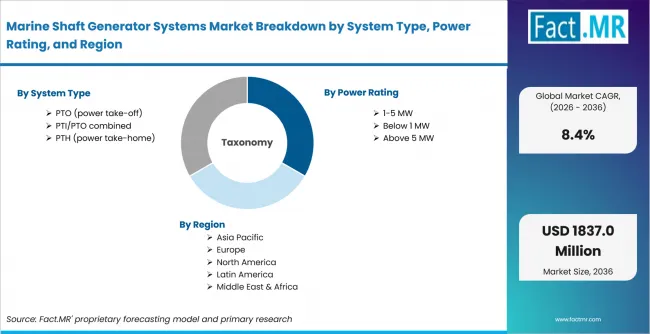
Marine Shaft Generator Systems Market Breakdown By System Type, Power Rating, And Region | Source: Fact.MR
| Attribute | Details |
|---|---|
| Quantitative Units | USD Million |
| Market Definition | Shaft generator systems that produce electrical power from a vessel's propulsion shaft and may also support propulsion or take-home operation through integrated power electronics. |
| Segments Covered | System Type; Power Rating; Vessel Type; Installation |
| Regions Covered | North America; Latin America; Europe; East Asia; South Asia and Oceania; Middle East and Africa |
| Countries Covered | Denmark; South Korea; Japan; Norway; Germany; Greece |
| Key Companies Profiled | Wärtsilä; ABB; Kongsberg Maritime; The Switch, a Yaskawa company; HD Hyundai Electric; WE Tech Solutions |
| Forecast Period | 2026 to 2036 |
| Base Year | 2025 |
| Market Value, 2026 | USD 820 million |
| Market Value, 2036 | USD 1,837 million |
| CAGR, 2026-2036 | 8.4% |
| Absolute Opportunity | USD 1,017 million |
| Approach | Demand is modeled from vessel ordering, retrofit suitability, power band, system configuration and project values across the covered vessel classes. |
How is the market segmented?
-
By System Type:
- PTO (power take-off)
- PTI/PTO combined
- PTH (power take-home)
-
By Power Rating:
- Below 1 MW
- 1-5 MW
- Above 5 MW
-
By Vessel Type:
- Container ships
- Bulk carriers
- Tankers
- Ferries & RoRo
- Offshore vessels
-
By Installation:
- Newbuild
- Retrofit