Marine Power Battery System Market (2026 - 2036)

Marine Power Battery System Market is segmented by Power Source Type (Lithium-ion Battery, Fuel Cell Battery, and Lead-acid Battery), by Application (Hybrid Powered Ships and Fully Electric Ships) and Region. Forecast for 2026 to 2036.

Core Findings

    Marine Power Battery System Market Forecast and Outlook 2026 to 2036

    In 2025, the marine power battery system market was valued at USD 1.5 billion. Based on Fact.MR analysis, demand for marine power battery systems is estimated to grow to USD 1.7 billion in 2026 and USD 3.3 billion by 2036. Fact.MR projects a CAGR of 6.4% during the forecast period.

    The absolute dollar growth from 2026 to 2036 represents an incremental gain of USD 1.6 billion, a substantial expansion reflecting the accelerating electrification of coastal ferry, offshore support, and inland waterway vessel fleets under IMO 2030 and 2050 GHG reduction targets and national maritime decarbonization programs. Growth is supported by tightening port emission regulations that make legacy diesel-electric systems less viable, steady improvements in lithium-ion energy density and cycle life, and the rise of hybrid propulsion architectures that allow gradual electrification without full vessel redesign. The main constraint is the slow pace of maritime class society approvals, which can extend battery system qualification timelines by 12 to 36 months compared to land-based applications.

    As Fredrik Witte, CEO of Corvus Energy said, “Blue Whale NxtGen is more than a new product launch, it represents a strategic step forward for Corvus Energy and the maritime industry. Without compromising on Corvus´ strong focus on quality, safety, security and sustainability, we are introducing contract manufacturing to optimize cost, stronger focus in China, more robust diversified global sourcing and the ability to swap battery cells without changing the product design.” [1]

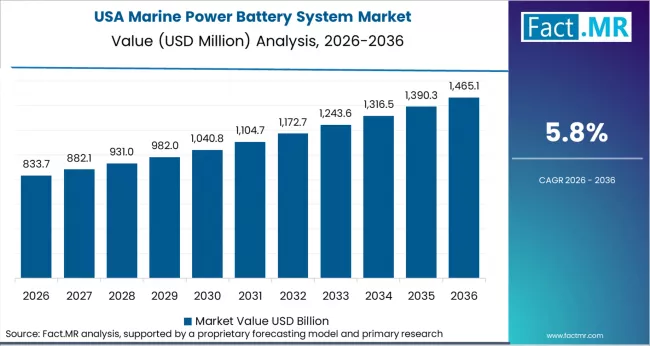
    Growth varies by regulation and shipbuilding strength. India leads at 8.5%, followed by South Korea at 7.9%, China at 6.4%, the United States at 5.8%, and Norway at 5.0%, with faster percentage gains now shifting toward emerging Asian markets.
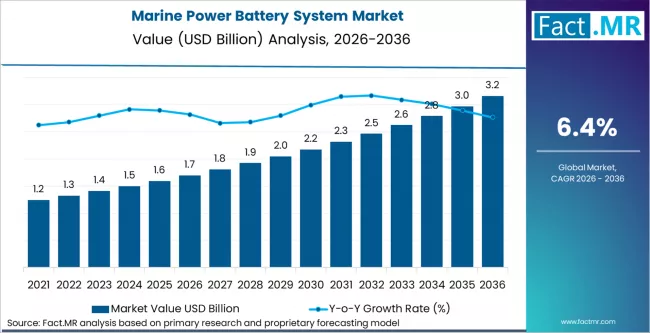
    Marine Power Battery System Market Market Value Analysis

    Market Definition

    The marine power battery system market includes certified electrochemical energy storage systems installed in commercial and passenger vessels for propulsion or onboard power. It covers lithium-ion, fuel cell, and lead-acid systems integrated with power management, cooling, and marine safety enclosures. Key uses include ferries, offshore vessels, inland cargo ships, and auxiliary power systems. The market refers to complete certified marine battery systems, not standalone cells.

    Market Inclusions

    The report provides global and regional forecasts from 2026 to 2036 by power source and application. It assesses IMO GHG compliance timelines, class society certification standards, lithium-ion performance improvements, system pricing trends, and competitive positioning of marine battery integrators and suppliers.

    Market Exclusions

    The scope excludes standalone battery cells and modules, diesel-electric systems without storage integration, shore charging infrastructure, leisure boat batteries, and military or submarine applications. It focuses only on certified commercial marine battery systems and their integration supply chain.

    Research Methodology

    • Primary Research: Interviews were conducted with shipyard engineers, naval architects, ferry and offshore operators, fleet decarbonization heads, and class society surveyors across Norway, South Korea, China, and India.
    • Desk Research: Secondary sources included IMO regulatory documents, national maritime electrification programs, company reports from major marine integrators, and certification guidelines from DNV, Bureau Veritas, and Lloyd’s Register.
    • Market Sizing and Forecasting: Estimates combined vessel electrification volumes with average battery system values by vessel type. Results were validated against company order backlogs and national decarbonization budgets.
    • Data Validation and Update Cycle: Findings were cross-checked with corporate revenue disclosures, project announcements, IMO milestones, and shipbuilding order data. Data is reviewed semi-annually and updated annually.

    Marine Power Battery System Market Summary

    • Market Definition
      • The marine power battery system market covers marine-certified lithium-ion, fuel cell, and lead-acid energy storage systems used in hybrid and fully electric commercial and passenger vessels for propulsion, peak shaving, and auxiliary power across coastal, offshore, inland waterway, and short-sea fleets worldwide.
    • Demand Drivers
      • The IMO’s revised GHG strategy sets a 20 to 30 percent emissions reduction target by 2030 and a net-zero ambition by 2050. These binding timelines are accelerating battery and hybrid propulsion investments as ship-owners seek compliant and commercially viable decarbonization pathways.
      • Norway’s Enova and the Norwegian Public Roads Administration have funded a national zero-emission ferry program that has electrified most coastal ferry routes since 2015. This government-backed tender model provides proven operational data and strong policy support, making Norway a global reference market for marine batteries.
      • Major South Korean shipyards are integrating hybrid battery systems into LNG carriers, bulk vessels, and offshore ships. Emission regulations and sustainability requirements from global shipping clients are driving large-scale battery demand from the world’s largest shipbuilding base.
    • Key Segments Analyzed
      • By power source type, lithium-ion batteries hold 80% share, driven by high energy density, longer cycle life, and established marine certification approvals.
      • By application, hybrid powered ships account for 68% share, supported by fuel savings and emission reduction benefits without full-electric range limitations.
      • By geography, Asia Pacific leads in installation volume due to inland waterway electrification and shipbuilding scale, while Europe drives retrofit demand through strict emission regulations.
    • Analyst Opinion at FACT.MR
      • Shambhu Nath Jha, Principal Consultant at Fact.MR, opines, ‘CXOs will find this report explains how IMO 2030 and 2050 targets are driving a multi-decade marine battery replacement cycle across key vessel segments. It identifies the battery technologies and regional markets offering the strongest long-term opportunities for integrators and suppliers.’
    • Strategic Implications / Executive Takeaways
      • Marine battery integrators should secure DNV, Bureau Veritas, and Lloyd’s Register certifications before expanding in Asia, as class approval is the primary qualification requirement for shipyard contracts.
      • Suppliers entering South Korea and China must build local engineering and service capabilities, since shipyards require in-country commissioning and warranty support.
      • Ferry and short-sea operators should lock in multi-year battery supply agreements early, as rising demand is extending delivery timelines and may affect IMO compliance schedules.
    • Methodology
      • Market sizing combined vessel electrification volumes with average battery system values and was cross-checked against disclosed order backlogs from major integrators.
      • Segment analysis incorporated IMO timelines, national decarbonization programs, and class society certification data.
      • Country forecasts were validated using shipyard order books, port authority registration data, and maritime decarbonization budget allocations.

    Segmental Analysis

    Marine Power Battery System Market Analysis by Power Source Type
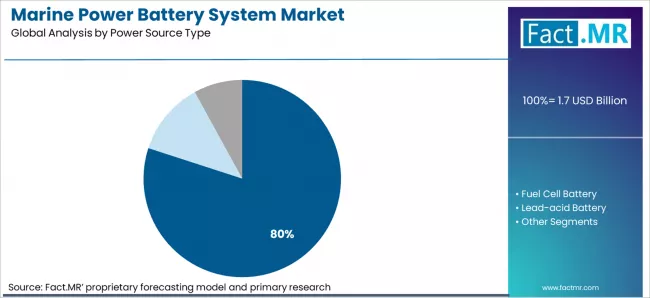
    Marine Power Battery System Market Analysis By Power Source Type

    Based on FACT.MR’s report, lithium-ion systems hold 80% share in 2026. They offer the best balance of energy density, safety certification, cycle life, and power delivery for commercial vessels, supported by a strong global operational track record.

    • Corvus Energy Fleet Expansion: Corvus Energy reported record backlog growth for its Orca and Dolphin lithium-ion systems, driven by ferry and offshore vessel demand in Norway, South Korea, and the U.S. [5]
    • Kongsberg Hydrogen Fuel Cell Integration: Kongsberg Maritime is advancing hydrogen fuel cell hybrid systems to extend zero-emission range for offshore and coastal vessels. [6]
    • Lead-Acid Phase-Out Trend: Lead-acid systems are declining in new builds as lithium-ion delivers lower weight, longer life, and better total cost performance over vessel lifecycles. [7]

    Marine Power Battery System Market Analysis by Application
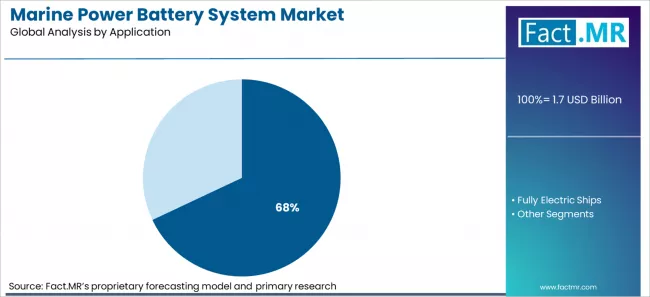
    Marine Power Battery System Market Analysis By Application

    Hybrid powered ships account for 68% share in 2026. Hybrid systems reduce fuel use by 10 to 30 percent and meet emissions rules without full reliance on charging infrastructure, making them commercially attractive across vessel types.

    • ABB Marine Hybrid Integration: ABB continues expanding its hybrid propulsion portfolio, securing contracts for battery-integrated DC grid systems across offshore and cargo vessels. [8]
    • Wartsila Fully Electric Vessel Program: Wartsila is developing fully electric propulsion solutions for ferries and short-sea routes in Scandinavia and Asia. [9]
    • Ferry Electrification Growth Trajectory: Fully electric vessels are the fastest-growing segment, supported by zero-emission ferry tenders in Norway, Denmark, North America, and emerging Asian markets. [4]

    Drivers, Restraints, and Opportunities

    Fact.MR analysis shows the marine power battery system market has reached USD 1,664.2 million as lithium-ion technology matured and IMO emissions rules tightened under MARPOL Annex VI. Norway’s early ferry electrification program proved that battery propulsion is commercially viable, and adoption has since expanded across Scandinavia, South Korea, and China.

    The main tension lies between regulatory urgency and vessel readiness. Ferries and harbor craft are fully electrification-ready, while offshore and short-sea vessels benefit from hybrid systems. Deep-sea shipping remains limited by battery energy density, keeping current demand concentrated in short-route segments.

    • IMO 2030 GHG Reduction Strategy: The IMO’s 2023 revised strategy mandates a 20 to 30 percent emissions cut by 2030 and net zero by 2050. This creates a structural demand floor for battery and hybrid propulsion investment across global fleets. [2]
    • EU ETS Maritime Extension: From 2024, the EU ETS requires large vessels on EU routes to pay for carbon emissions. Battery peak shaving lowers fuel use and carbon allowance costs, strengthening the financial case for hybrid systems. [3]
    • India Coastal Ferry Electrification Drive: India’s Maritime India Vision 2030 supports electric and hybrid vessel procurement across inland and coastal routes. Government tenders are creating a fast-growing emerging demand center for marine batteries. [4]

    Regional Analysis

    The marine power battery system market is analyzed across North America, Europe, Asia Pacific, Latin America, and Middle East and Africa. Regional demand patterns reflect the maturity of national maritime decarbonization programs, the volume and vessel type composition of domestic commercial fleets requiring electrification or hybridization, coastal ferry and inland waterway infrastructure development. The full report offers detailed market attractiveness analysis comparing regulatory mandate timelines, shipbuilding capacity, and competitive intensity by region.
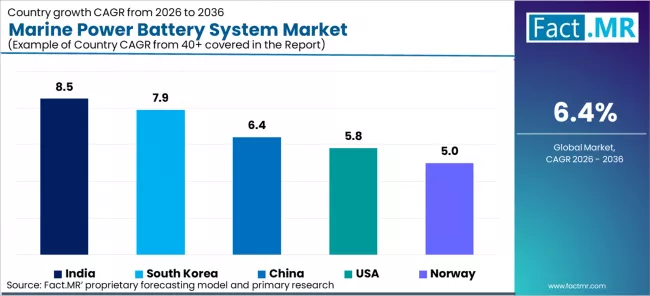
    Marine Power Battery System Market Cagr Analysis By Country

    Country CAGR%
    India 8.5%
    South Korea 7.9%
    China 6.4%
    United States 5.8%
    Norway 5.0%

    Source: Fact.MR (FACT.MR) analysis, based on proprietary forecasting model and primary research

    Asia Pacific Marine Power Battery System Market Analysis

    Asia Pacific is the main volume growth and shipbuilding hub for marine battery systems. South Korea leads global shipbuilding, China drives inland waterway electrification, and India is emerging as a new demand center. International suppliers work alongside growing domestic battery manufacturers in the region.

    • India: Demand is projected to rise at 8.5% CAGR through 2036. Growth is driven by Maritime India Vision 2030 and large-scale inland and coastal ferry electrification. Government tenders for battery-electric vessels on the Ganga and funding for charging infrastructure are building a structured demand pipeline.
    • South Korea: Demand is projected to rise at 7.9% CAGR through 2036. As the world’s largest shipbuilder, Korea is integrating battery hybrid systems into LNG carriers, offshore vessels, and container ships. Government green shipping targets and shipyard investments are accelerating adoption.
    • China: Demand is projected to rise at 6.4% CAGR through 2036. Inland electrification under the 14th Five-Year Plan has deployed hundreds of battery-electric vessels on the Yangtze and Pearl Rivers. Domestic suppliers such as CATL and BYD are lowering system costs and expanding local supply.

    FACT.MR’s Asia Pacific coverage includes India, South Korea, China, Japan, and ASEAN markets, with analysis of national decarbonization programs, shipyard investments, and supplier positioning.

    Europe Marine Power Battery System Market Analysis
    Marine Power Battery System Market Country Value Analysis

    Europe is the technology leader and regulatory benchmark for marine battery systems. Norway’s long-running zero-emission ferry program created the first large-scale commercial reference market. The EU ETS maritime extension from 2024 is strengthening hybrid adoption across European fleets.

    • Norway: Demand is projected to rise at 5.0% CAGR through 2036. More than 100 zero-emission ferry routes are operational, supported by Enova-funded tenders. Updated ferry requirements from 2025 will extend zero-emission mandates to additional routes, sustaining battery demand.
    • United States: Demand is projected to rise at 5.8% CAGR through 2036. Growth is supported by state ferry electrification programs and EPA emissions standards. Washington State Ferries and inland operators are investing in battery hybrid and electric vessels to reduce fuel and compliance costs.

    FACT.MR’s Europe coverage includes Norway, Germany, the United Kingdom, France, Denmark, and the Netherlands, with analysis of ferry tenders, EU ETS impacts, and hybrid vessel adoption trends.

    Competitive Aligners for Market Players
    Marine Power Battery System Market Analysis By Company

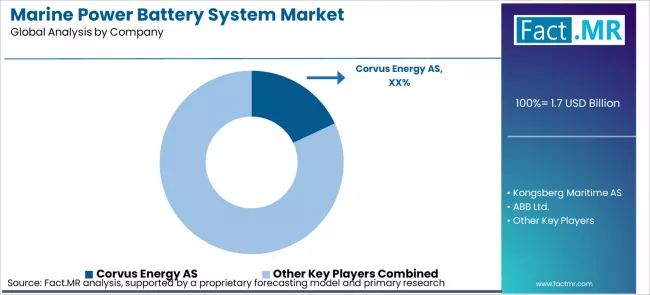
    The marine power battery system market is moderately concentrated at the integration level. Corvus Energy, Kongsberg Maritime, ABB, Wartsila, and Leclanché together account maximum share of certified global installations by capacity. Smaller regional integrators and domestic Korean and Chinese suppliers compete in niche vessel segments. Competition is driven less by price and more by certification coverage, proven vessel references, and long-term service capability.

    Strong competitive advantage comes from operational track record. Corvus Energy has systems installed on more than 600 vessels, giving buyers confidence through real-world performance data and class society acceptance. Kongsberg Maritime benefits from offering batteries as part of integrated propulsion, automation, and power management packages, allowing it to capture higher system-level value.

    Large operators usually qualify two or three suppliers per vessel category to balance cost and supply security. Switching suppliers mid-program is costly due to retrofit downtime and integration complexity. As fleets expand, local technical support and remote service capability are becoming key differentiators, especially in offshore and emerging ferry markets.

    Recent Development

    • In December 2025, Corvus Energy introduced Blue Whale NxtGen, its next-generation marine LFP battery platform featuring a modular design, upgraded battery management system, and improved lifecycle durability, with initial commercial deliveries.
    • In May 2025, Corvus Energy confirmed a contract to supply battery systems for four BC Ferries “Island Class” vessels, delivering more than 8 MWh of total installed energy storage capacity.

    Key Players

    • Corvus Energy AS
    • Kongsberg Maritime AS
    • ABB Ltd.
    • Wartsila Corporation
    • Leclanche SA
    • Echandia AB
    • Saft Groupe S.A.
    • Siemens Energy AG
    • Spear Power Systems Inc.
    • EST-Floattech BV

    Scope of Report

    Items Values
    Quantitative Units USD 1.7 Billion in 2026 and USD 3.3 Billion by 2036, CAGR 6.4%
    Market Definition The marine power battery system market covers lithium-ion, fuel cell, and lead-acid battery systems integrated into hybrid powered and fully electric commercial and passenger vessels for primary propulsion and auxiliary power supply across international shipping, coastal ferries, offshore operations, and inland waterway transport.
    By Power Source Type Lithium-ion Battery, Fuel Cell Battery, Lead-acid Battery
    By Application Hybrid Powered Ships, Fully Electric Ships
    Regions Covered Asia Pacific, Europe, North America, Latin America, Middle East & Africa
    Countries Covered China, Japan, South Korea, Australia & New Zealand, India, ASEAN, Rest of Asia Pacific, Norway, Germany, United Kingdom, France, Spain, Netherlands, Nordics, Rest of Europe, United States, Canada, Mexico, Brazil, Chile, Ecuador, Rest of Latin America, Kingdom of Saudi Arabia, United Arab Emirates, South Africa, Turkey, Rest of Middle East & Africa
    Key Companies Profiled Corvus Energy AS, Kongsberg Maritime AS, ABB Ltd., Wartsila Corporation, Leclanche SA, Echandia AB, Saft Groupe S.A., Siemens Energy AG, Spear Power Systems Inc., EST-Floattech BV
    Forecast Period 2026 to 2036
    Approach Hybrid top-down and bottom-up market modeling validated through primary interviews with naval architects, marine electrical engineers, shipyard procurement managers, ferry operator fleet directors, and offshore energy company vessel procurement specialists, supported by IMO emissions regulation documentation, national maritime authority fleet decarbonization program data, and corporate vessel electrification investment disclosures.

    Marine Power Battery System Market by Segment

    • By Power Source Type :

      • Lithium-ion Battery
      • Fuel Cell Battery
      • Lead-acid Battery
    • By Application :

      • Hybrid Powered Ships
      • Fully Electric Ships
    • Region :

      • Asia Pacific
        • China
        • Japan
        • South Korea
        • Australia & New Zealand
        • India
        • ASEAN
        • Rest of Asia Pacific
      • Europe
        • Norway
        • Germany
        • United Kingdom
        • France
        • Spain
        • Netherlands
        • Nordics
        • Rest of Europe
      • North America
        • United States
        • Canada
        • Mexico
      • Latin America
        • Brazil
        • Chile
        • Ecuador
        • Rest of Latin America
      • Middle East & Africa
        • Kingdom of Saudi Arabia
        • United Arab Emirates
        • South Africa
        • Turkey
        • Rest of Middle East & Africa

    Bibliography

    • [1] Maritimt Magasin. (2025, December 5). New product launch from battery supplier Corvus Energy.
    • [2] International Maritime Organization, MARPOL Annex VI and NTC 2008 with Guidelines for Implementation, updated 2023.
    • [3] European Commission, Directive 2023/959 Amending the EU Emissions Trading System to Include Maritime Shipping, May 2023.
    • [4] Ministry of Ports Shipping and Waterways of India, Maritime India Vision 2030, March 2021.
    • [5] Corvus Energy AS, Annual Report 2023, March 2024.
    • [6] Kongsberg Maritime AS, Sustainability and Technology Report 2023, April 2024.
    • [7] DNV, Maritime Battery Forum and Marine Battery Certification Guidelines, January 2024.
    • [8] ABB Ltd., Annual Report 2023 Marine and Ports Segment Disclosure, February 2024.

    This Report Addresses

    • Market intelligence for strategic planning with analysis of marine power battery system market evolution from coastal ferry demonstration programs toward IMO-driven multi-vessel-class hybrid and fully electric propulsion adoption across global commercial and passenger shipping fleets.
    • Market size and forecast showing global valuation of USD 1.7 billion in 2026 and projected USD 3.3 billion by 2036 at a CAGR of 6.4%.
    • Growth opportunity mapping across lithium-ion hybrid peak shaving systems for offshore support and short-sea cargo vessels, fully electric battery propulsion for coastal ferry electrification programs, and fuel cell battery integration for zero-emission vessels in Scandinavia, South Korea, and India.
    • Segment and regional forecasts covering all major countries with power source type and application breakdowns including hybrid powered ship and fully electric ship demand analysis by vessel category and geography.
    • Competition strategy assessment of leading marine battery system integrators including class society certification breadth, operational vessel reference base by type, aftersales service network geography, and long-term fleet supply agreement pipeline for Corvus Energy, Kongsberg Maritime, ABB, Wartsila, and Leclanché.
    • Regulatory compliance tracking of IMO GHG strategy 2023 revised targets and implementation milestones, EU Emissions Trading System maritime extension carbon pricing impacts, national zero-emission ferry tender program requirements in Norway, Denmark, the United Kingdom, and India, and IMO MARPOL Annex VI carbon intensity indicator enforcement timelines.
    • Technology adoption analysis covering marine-certified lithium-ion energy density and cycle life advances, hydrogen fuel cell battery hybrid architecture development, battery management system optimization for variable vessel duty cycles, class society certification timeline analysis for new marine battery chemistries, and shore power charging infrastructure deployment by port geography.
    • Report delivery in Excel, PowerPoint, and PDF formats with fully validated data, primary research evidence, and verified regulatory and company source documentation.

    Table of Content

    1. Executive Summary
      • Global Market Outlook
      • Demand to side Trends
      • Supply to side Trends
      • Technology Roadmap Analysis
      • Analysis and Recommendations
    2. Market Overview
      • Market Coverage / Taxonomy
      • Market Definition / Scope / Limitations
    3. Research Methodology
      • Chapter Orientation
      • Analytical Lens and Working Hypotheses
        • Market Structure, Signals, and Trend Drivers
        • Company Annual and Sustainability Reports
        • Peer-reviewed Journals and Academic Literature
        • Corporate Websites, Product Literature, and Technical Notes
        • Earnings Decks and Investor Briefings
        • Statutory Filings and Regulatory Disclosures
        • Technical White Papers and Standards Notes
        • Trade Journals, Industry Magazines, and Analyst Briefs
        • Conference Proceedings, Webinars, and Seminar Materials
        • Government Statistics Portals and Public Data Releases
        • Press Releases and Reputable Media Coverage
        • Specialist Newsletters and Curated Briefings
        • Sector Databases and Reference Repositories
        • FMR Internal Proprietary Databases and Historical Market Datasets
        • Subscription Datasets and Paid Sources
        • Social Channels, Communities, and Digital Listening Inputs
        • Additional Desk Sources
      • Expert Input and Fieldwork (Primary Evidence)
        • Primary Modes
          • Qualitative Interviews and Expert Elicitation
          • Quantitative Surveys and Structured Data Capture
          • Blended Approach
        • Why Primary Evidence is Used
        • Field Techniques
          • Interviews
          • Surveys
          • Focus Groups
          • Observational and In-context Research
          • Social and Community Interactions
        • Stakeholder Universe Engaged
          • C-suite Leaders
          • Board Members
          • Presidents and Vice Presidents
          • R&D and Innovation Heads
          • Technical Specialists
          • Domain Subject-matter Experts
          • Scientists
          • Physicians and Other Healthcare Professionals
        • Governance, Ethics, and Data Stewardship
          • Research Ethics
          • Data Integrity and Handling
      • Tooling, Models, and Reference Databases
    4. Data Engineering and Model Build
      • Data Acquisition and Ingestion
      • Cleaning, Normalisation, and Verification
      • Synthesis, Triangulation, and Analysis
    5. Quality Assurance and Audit Trail
    6. Market Background
      • Market Dynamics
        • Drivers
        • Restraints
        • Opportunity
        • Trends
      • Scenario Forecast
        • Demand in Optimistic Scenario
        • Demand in Likely Scenario
        • Demand in Conservative Scenario
      • Opportunity Map Analysis
      • Product Life Cycle Analysis
      • Supply Chain Analysis
      • Investment Feasibility Matrix
      • Value Chain Analysis
      • PESTLE and Porter’s Analysis
      • Regulatory Landscape
      • Regional Parent Market Outlook
      • Production and Consumption Statistics
      • Import and Export Statistics
    7. Global Market Analysis 2021 to 2025 and Forecast, 2026 to 2036
      • Historical Market Size Value (USD Million) Analysis, 2021 to 2025
      • Current and Future Market Size Value (USD Million) Projections, 2026 to 2036
        • Y to o to Y Growth Trend Analysis
        • Absolute $ Opportunity Analysis
    8. Global Market Pricing Analysis 2021 to 2025 and Forecast 2026 to 2036
    9. Global Market Analysis 2021 to 2025 and Forecast 2026 to 2036, By Power Source Type
      • Introduction / Key Findings
      • Historical Market Size Value (USD Million) Analysis By Power Source Type , 2021 to 2025
      • Current and Future Market Size Value (USD Million) Analysis and Forecast By Power Source Type , 2026 to 2036
        • Lithium-ion Battery
        • Fuel Cell Battery
        • Lead-acid Battery
      • Y to o to Y Growth Trend Analysis By Power Source Type , 2021 to 2025
      • Absolute $ Opportunity Analysis By Power Source Type , 2026 to 2036
    10. Global Market Analysis 2021 to 2025 and Forecast 2026 to 2036, By Application
      • Introduction / Key Findings
      • Historical Market Size Value (USD Million) Analysis By Application, 2021 to 2025
      • Current and Future Market Size Value (USD Million) Analysis and Forecast By Application, 2026 to 2036
        • Hybrid Powered Ships
        • Fully Electric Ships
      • Y to o to Y Growth Trend Analysis By Application, 2021 to 2025
      • Absolute $ Opportunity Analysis By Application, 2026 to 2036
    11. Global Market Analysis 2021 to 2025 and Forecast 2026 to 2036, By Region
      • Introduction
      • Historical Market Size Value (USD Million) Analysis By Region, 2021 to 2025
      • Current Market Size Value (USD Million) Analysis and Forecast By Region, 2026 to 2036
        • North America
        • Latin America
        • Western Europe
        • Eastern Europe
        • East Asia
        • South Asia and Pacific
        • Middle East & Africa
      • Market Attractiveness Analysis By Region
    12. North America Market Analysis 2021 to 2025 and Forecast 2026 to 2036, By Country
      • Historical Market Size Value (USD Million) Trend Analysis By Market Taxonomy, 2021 to 2025
      • Market Size Value (USD Million) Forecast By Market Taxonomy, 2026 to 2036
        • By Country
          • USA
          • Canada
          • Mexico
        • By Power Source Type
        • By Application
      • Market Attractiveness Analysis
        • By Country
        • By Power Source Type
        • By Application
      • Key Takeaways
    13. Latin America Market Analysis 2021 to 2025 and Forecast 2026 to 2036, By Country
      • Historical Market Size Value (USD Million) Trend Analysis By Market Taxonomy, 2021 to 2025
      • Market Size Value (USD Million) Forecast By Market Taxonomy, 2026 to 2036
        • By Country
          • Brazil
          • Chile
          • Rest of Latin America
        • By Power Source Type
        • By Application
      • Market Attractiveness Analysis
        • By Country
        • By Power Source Type
        • By Application
      • Key Takeaways
    14. Western Europe Market Analysis 2021 to 2025 and Forecast 2026 to 2036, By Country
      • Historical Market Size Value (USD Million) Trend Analysis By Market Taxonomy, 2021 to 2025
      • Market Size Value (USD Million) Forecast By Market Taxonomy, 2026 to 2036
        • By Country
          • Germany
          • UK
          • Italy
          • Spain
          • France
          • Nordic
          • BENELUX
          • Rest of Western Europe
        • By Power Source Type
        • By Application
      • Market Attractiveness Analysis
        • By Country
        • By Power Source Type
        • By Application
      • Key Takeaways
    15. Eastern Europe Market Analysis 2021 to 2025 and Forecast 2026 to 2036, By Country
      • Historical Market Size Value (USD Million) Trend Analysis By Market Taxonomy, 2021 to 2025
      • Market Size Value (USD Million) Forecast By Market Taxonomy, 2026 to 2036
        • By Country
          • Russia
          • Poland
          • Hungary
          • Balkan & Baltic
          • Rest of Eastern Europe
        • By Power Source Type
        • By Application
      • Market Attractiveness Analysis
        • By Country
        • By Power Source Type
        • By Application
      • Key Takeaways
    16. East Asia Market Analysis 2021 to 2025 and Forecast 2026 to 2036, By Country
      • Historical Market Size Value (USD Million) Trend Analysis By Market Taxonomy, 2021 to 2025
      • Market Size Value (USD Million) Forecast By Market Taxonomy, 2026 to 2036
        • By Country
          • China
          • Japan
          • South Korea
        • By Power Source Type
        • By Application
      • Market Attractiveness Analysis
        • By Country
        • By Power Source Type
        • By Application
      • Key Takeaways
    17. South Asia and Pacific Market Analysis 2021 to 2025 and Forecast 2026 to 2036, By Country
      • Historical Market Size Value (USD Million) Trend Analysis By Market Taxonomy, 2021 to 2025
      • Market Size Value (USD Million) Forecast By Market Taxonomy, 2026 to 2036
        • By Country
          • India
          • ASEAN
          • Australia & New Zealand
          • Rest of South Asia and Pacific
        • By Power Source Type
        • By Application
      • Market Attractiveness Analysis
        • By Country
        • By Power Source Type
        • By Application
      • Key Takeaways
    18. Middle East & Africa Market Analysis 2021 to 2025 and Forecast 2026 to 2036, By Country
      • Historical Market Size Value (USD Million) Trend Analysis By Market Taxonomy, 2021 to 2025
      • Market Size Value (USD Million) Forecast By Market Taxonomy, 2026 to 2036
        • By Country
          • Kingdom of Saudi Arabia
          • Other GCC Countries
          • Turkiye
          • South Africa
          • Other African Union
          • Rest of Middle East & Africa
        • By Power Source Type
        • By Application
      • Market Attractiveness Analysis
        • By Country
        • By Power Source Type
        • By Application
      • Key Takeaways
    19. Key Countries Market Analysis
      • USA
        • Pricing Analysis
        • Market Share Analysis, 2025
          • By Power Source Type
          • By Application
      • Canada
        • Pricing Analysis
        • Market Share Analysis, 2025
          • By Power Source Type
          • By Application
      • Mexico
        • Pricing Analysis
        • Market Share Analysis, 2025
          • By Power Source Type
          • By Application
      • Brazil
        • Pricing Analysis
        • Market Share Analysis, 2025
          • By Power Source Type
          • By Application
      • Chile
        • Pricing Analysis
        • Market Share Analysis, 2025
          • By Power Source Type
          • By Application
      • Germany
        • Pricing Analysis
        • Market Share Analysis, 2025
          • By Power Source Type
          • By Application
      • UK
        • Pricing Analysis
        • Market Share Analysis, 2025
          • By Power Source Type
          • By Application
      • Italy
        • Pricing Analysis
        • Market Share Analysis, 2025
          • By Power Source Type
          • By Application
      • Spain
        • Pricing Analysis
        • Market Share Analysis, 2025
          • By Power Source Type
          • By Application
      • France
        • Pricing Analysis
        • Market Share Analysis, 2025
          • By Power Source Type
          • By Application
      • India
        • Pricing Analysis
        • Market Share Analysis, 2025
          • By Power Source Type
          • By Application
      • ASEAN
        • Pricing Analysis
        • Market Share Analysis, 2025
          • By Power Source Type
          • By Application
      • Australia & New Zealand
        • Pricing Analysis
        • Market Share Analysis, 2025
          • By Power Source Type
          • By Application
      • China
        • Pricing Analysis
        • Market Share Analysis, 2025
          • By Power Source Type
          • By Application
      • Japan
        • Pricing Analysis
        • Market Share Analysis, 2025
          • By Power Source Type
          • By Application
      • South Korea
        • Pricing Analysis
        • Market Share Analysis, 2025
          • By Power Source Type
          • By Application
      • Russia
        • Pricing Analysis
        • Market Share Analysis, 2025
          • By Power Source Type
          • By Application
      • Poland
        • Pricing Analysis
        • Market Share Analysis, 2025
          • By Power Source Type
          • By Application
      • Hungary
        • Pricing Analysis
        • Market Share Analysis, 2025
          • By Power Source Type
          • By Application
      • Kingdom of Saudi Arabia
        • Pricing Analysis
        • Market Share Analysis, 2025
          • By Power Source Type
          • By Application
      • Turkiye
        • Pricing Analysis
        • Market Share Analysis, 2025
          • By Power Source Type
          • By Application
      • South Africa
        • Pricing Analysis
        • Market Share Analysis, 2025
          • By Power Source Type
          • By Application
    20. Market Structure Analysis
      • Competition Dashboard
      • Competition Benchmarking
      • Market Share Analysis of Top Players
        • By Regional
        • By Power Source Type
        • By Application
    21. Competition Analysis
      • Competition Deep Dive
        • Corvus Energy AS
          • Overview
          • Product Portfolio
          • Profitability by Market Segments (Product/Age /Sales Channel/Region)
          • Sales Footprint
          • Strategy Overview
            • Marketing Strategy
            • Product Strategy
            • Channel Strategy
        • Kongsberg Maritime AS
        • ABB Ltd.
        • Wartsila Corporation
        • Leclanche SA
        • Echandia AB
        • Saft Groupe S.A.
        • Siemens Energy AG
        • Spear Power Systems Inc.
        • EST-Floattech BV
    22. Assumptions & Acronyms Used

    List Of Table

    • Table 1: Global Market Value (USD Million) Forecast by Region, 2021 to 2036
    • Table 2: Global Market Value (USD Million) Forecast by Power Source Type , 2021 to 2036
    • Table 3: Global Market Value (USD Million) Forecast by Application, 2021 to 2036
    • Table 4: North America Market Value (USD Million) Forecast by Country, 2021 to 2036
    • Table 5: North America Market Value (USD Million) Forecast by Power Source Type , 2021 to 2036
    • Table 6: North America Market Value (USD Million) Forecast by Application, 2021 to 2036
    • Table 7: Latin America Market Value (USD Million) Forecast by Country, 2021 to 2036
    • Table 8: Latin America Market Value (USD Million) Forecast by Power Source Type , 2021 to 2036
    • Table 9: Latin America Market Value (USD Million) Forecast by Application, 2021 to 2036
    • Table 10: Western Europe Market Value (USD Million) Forecast by Country, 2021 to 2036
    • Table 11: Western Europe Market Value (USD Million) Forecast by Power Source Type , 2021 to 2036
    • Table 12: Western Europe Market Value (USD Million) Forecast by Application, 2021 to 2036
    • Table 13: Eastern Europe Market Value (USD Million) Forecast by Country, 2021 to 2036
    • Table 14: Eastern Europe Market Value (USD Million) Forecast by Power Source Type , 2021 to 2036
    • Table 15: Eastern Europe Market Value (USD Million) Forecast by Application, 2021 to 2036
    • Table 16: East Asia Market Value (USD Million) Forecast by Country, 2021 to 2036
    • Table 17: East Asia Market Value (USD Million) Forecast by Power Source Type , 2021 to 2036
    • Table 18: East Asia Market Value (USD Million) Forecast by Application, 2021 to 2036
    • Table 19: South Asia and Pacific Market Value (USD Million) Forecast by Country, 2021 to 2036
    • Table 20: South Asia and Pacific Market Value (USD Million) Forecast by Power Source Type , 2021 to 2036
    • Table 21: South Asia and Pacific Market Value (USD Million) Forecast by Application, 2021 to 2036
    • Table 22: Middle East & Africa Market Value (USD Million) Forecast by Country, 2021 to 2036
    • Table 23: Middle East & Africa Market Value (USD Million) Forecast by Power Source Type , 2021 to 2036
    • Table 24: Middle East & Africa Market Value (USD Million) Forecast by Application, 2021 to 2036

    List Of Figures

    • Figure 1: Global Market Pricing Analysis
    • Figure 2: Global Market Value (USD Million) Forecast 2021 to 2036
    • Figure 3: Global Market Value Share and BPS Analysis by Power Source Type , 2026 and 2036
    • Figure 4: Global Market Y to o to Y Growth Comparison by Power Source Type , 2026 to 2036
    • Figure 5: Global Market Attractiveness Analysis by Power Source Type
    • Figure 6: Global Market Value Share and BPS Analysis by Application, 2026 and 2036
    • Figure 7: Global Market Y to o to Y Growth Comparison by Application, 2026 to 2036
    • Figure 8: Global Market Attractiveness Analysis by Application
    • Figure 9: Global Market Value (USD Million) Share and BPS Analysis by Region, 2026 and 2036
    • Figure 10: Global Market Y to o to Y Growth Comparison by Region, 2026 to 2036
    • Figure 11: Global Market Attractiveness Analysis by Region
    • Figure 12: North America Market Incremental Dollar Opportunity, 2026 to 2036
    • Figure 13: Latin America Market Incremental Dollar Opportunity, 2026 to 2036
    • Figure 14: Western Europe Market Incremental Dollar Opportunity, 2026 to 2036
    • Figure 15: Eastern Europe Market Incremental Dollar Opportunity, 2026 to 2036
    • Figure 16: East Asia Market Incremental Dollar Opportunity, 2026 to 2036
    • Figure 17: South Asia and Pacific Market Incremental Dollar Opportunity, 2026 to 2036
    • Figure 18: Middle East & Africa Market Incremental Dollar Opportunity, 2026 to 2036
    • Figure 19: North America Market Value Share and BPS Analysis by Country, 2026 and 2036
    • Figure 20: North America Market Value Share and BPS Analysis by Power Source Type , 2026 and 2036
    • Figure 21: North America Market Y to o to Y Growth Comparison by Power Source Type , 2026 to 2036
    • Figure 22: North America Market Attractiveness Analysis by Power Source Type
    • Figure 23: North America Market Value Share and BPS Analysis by Application, 2026 and 2036
    • Figure 24: North America Market Y to o to Y Growth Comparison by Application, 2026 to 2036
    • Figure 25: North America Market Attractiveness Analysis by Application
    • Figure 26: Latin America Market Value Share and BPS Analysis by Country, 2026 and 2036
    • Figure 27: Latin America Market Value Share and BPS Analysis by Power Source Type , 2026 and 2036
    • Figure 28: Latin America Market Y to o to Y Growth Comparison by Power Source Type , 2026 to 2036
    • Figure 29: Latin America Market Attractiveness Analysis by Power Source Type
    • Figure 30: Latin America Market Value Share and BPS Analysis by Application, 2026 and 2036
    • Figure 31: Latin America Market Y to o to Y Growth Comparison by Application, 2026 to 2036
    • Figure 32: Latin America Market Attractiveness Analysis by Application
    • Figure 33: Western Europe Market Value Share and BPS Analysis by Country, 2026 and 2036
    • Figure 34: Western Europe Market Value Share and BPS Analysis by Power Source Type , 2026 and 2036
    • Figure 35: Western Europe Market Y to o to Y Growth Comparison by Power Source Type , 2026 to 2036
    • Figure 36: Western Europe Market Attractiveness Analysis by Power Source Type
    • Figure 37: Western Europe Market Value Share and BPS Analysis by Application, 2026 and 2036
    • Figure 38: Western Europe Market Y to o to Y Growth Comparison by Application, 2026 to 2036
    • Figure 39: Western Europe Market Attractiveness Analysis by Application
    • Figure 40: Eastern Europe Market Value Share and BPS Analysis by Country, 2026 and 2036
    • Figure 41: Eastern Europe Market Value Share and BPS Analysis by Power Source Type , 2026 and 2036
    • Figure 42: Eastern Europe Market Y to o to Y Growth Comparison by Power Source Type , 2026 to 2036
    • Figure 43: Eastern Europe Market Attractiveness Analysis by Power Source Type
    • Figure 44: Eastern Europe Market Value Share and BPS Analysis by Application, 2026 and 2036
    • Figure 45: Eastern Europe Market Y to o to Y Growth Comparison by Application, 2026 to 2036
    • Figure 46: Eastern Europe Market Attractiveness Analysis by Application
    • Figure 47: East Asia Market Value Share and BPS Analysis by Country, 2026 and 2036
    • Figure 48: East Asia Market Value Share and BPS Analysis by Power Source Type , 2026 and 2036
    • Figure 49: East Asia Market Y to o to Y Growth Comparison by Power Source Type , 2026 to 2036
    • Figure 50: East Asia Market Attractiveness Analysis by Power Source Type
    • Figure 51: East Asia Market Value Share and BPS Analysis by Application, 2026 and 2036
    • Figure 52: East Asia Market Y to o to Y Growth Comparison by Application, 2026 to 2036
    • Figure 53: East Asia Market Attractiveness Analysis by Application
    • Figure 54: South Asia and Pacific Market Value Share and BPS Analysis by Country, 2026 and 2036
    • Figure 55: South Asia and Pacific Market Value Share and BPS Analysis by Power Source Type , 2026 and 2036
    • Figure 56: South Asia and Pacific Market Y to o to Y Growth Comparison by Power Source Type , 2026 to 2036
    • Figure 57: South Asia and Pacific Market Attractiveness Analysis by Power Source Type
    • Figure 58: South Asia and Pacific Market Value Share and BPS Analysis by Application, 2026 and 2036
    • Figure 59: South Asia and Pacific Market Y to o to Y Growth Comparison by Application, 2026 to 2036
    • Figure 60: South Asia and Pacific Market Attractiveness Analysis by Application
    • Figure 61: Middle East & Africa Market Value Share and BPS Analysis by Country, 2026 and 2036
    • Figure 62: Middle East & Africa Market Value Share and BPS Analysis by Power Source Type , 2026 and 2036
    • Figure 63: Middle East & Africa Market Y to o to Y Growth Comparison by Power Source Type , 2026 to 2036
    • Figure 64: Middle East & Africa Market Attractiveness Analysis by Power Source Type
    • Figure 65: Middle East & Africa Market Value Share and BPS Analysis by Application, 2026 and 2036
    • Figure 66: Middle East & Africa Market Y to o to Y Growth Comparison by Application, 2026 to 2036
    • Figure 67: Middle East & Africa Market Attractiveness Analysis by Application
    • Figure 68: Global Market - Tier Structure Analysis
    • Figure 69: Global Market - Company Share Analysis

    - FAQs -

    How large is the marine power battery system market in 2025?

    The marine power battery system market was valued at USD 1.5 billion in 2025.

    What will the market size be in 2026?

    The market is estimated to grow to USD 1.6 billion in 2026.

    What is the projected market size by 2036?

    The market is projected to reach USD 3.3 billion by 2036.

    What is the expected CAGR for the forecast period 2026 to 2036?

    Fact.MR projects a CAGR of 6.4% from 2026 to 2036.

    Which Power Source Type segment holds the largest share?

    Lithium-ion battery systems account for 80% share in 2026.

    Which Application segment dominates in 2026?

    Hybrid powered ships hold 68% application share in 2026.

    Which country shows the fastest CAGR?

    India projects the fastest country-level CAGR at 8.5% through 2036.

    What is the absolute dollar growth from 2026 to 2036?

    The absolute dollar growth from 2026 to 2036 represents an incremental gain of USD 1,522.2 million.

    How significant is the hybrid powered ships segment?

    Hybrid powered ships represent the dominant application segment at 68% share in 2026.

    Marine Power Battery System Market