- Market Value (2025): USD 98.1 Mn
- Estimated Value (2026): USD 102.7 Mn
- Forecast Value (2036): USD 162.4 Mn
- CAGR (2026-2036): 4.7%
Marine Stove-Ovens Market Forecast and Outlook 2026 to 2036
According to Fact.MR analysis, the marine stove-ovens market surpassed a value of USD 98.1 million in 2025 and is projected to grow from USD 102.7 million in 2026 to USD 162.4 million by 2036. Demand for marine stove-ovens is likely to grow at a CAGR of 4.7% over the forecast period.
Demand for marine stove-ovens is rising as sailors, liveaboards and workboat crews need combined hob and oven units that cook safely in motion. Manufacturers are offering gimbaled gas, diesel and electric units. For example, Wallas of Finland and Dickinson Marine of Canada sell diesel-fired cookers that avoid carrying propane aboard. Similar safety preferences are projected to drive sales of marine stove-ovens through 2036.
Key Takeaways from the Marine Stove-Ovens Market
- Marine Stove-Ovens Market Value (2025): USD 98.1 million
- Marine Stove-Ovens Market Value (2026): USD 102.7 million
- Marine Stove-Ovens Market Forecast Value (2036): USD 162.4 million
- Marine Stove-Ovens Market Forecast CAGR (2026-2036): 4.7%
- Leading Product Type: Gas Stove-Ovens (38.7%)
- Key Market Participants: Dometic Group, Wallas-Marin, Dickinson Marine, Kenyon International Inc., Force 10 Marine, Thetford Corporation
- Key Growth Regions: United States, United Kingdom, Brazil, Germany, Japan
Boat builders are moving toward electric galleys powered by lithium batteries, while offshore sailors still favor gas and diesel for independence from shore power. Demand for marine stove-ovens is growing in both fuel types as owners refit galleys. Manufacturers are offering dual-fuel and electric ovens. Similar diversity is projected to drive sales.
Marine Stove-Ovens Market
| Metric | Value |
|---|---|
| Estimated Value in (2026) | USD 102.7 million |
| Forecast Value in (2036) | USD 162.4 million |
| Forecast CAGR (2026 to 2036) | 4.7% |
Source: Fact.MR analysis. Updated Nov 21, 2026
Source: Fact.MR analysis.
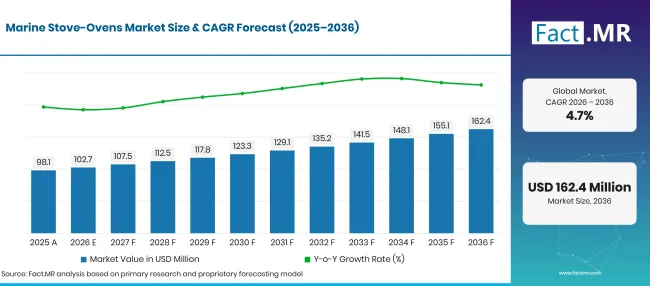
Marine Stove Ovens Market Forecast Global | Source: Fact.MR
Category
| Category | Segments |
|---|---|
| Product Type | Gas Stove-Ovens, Electric Stove-Ovens, Dual Fuel Stove-Ovens |
| Application | Commercial Vessels, Recreational Boats, Military Ships |
| Distribution Channel | Offline, Online |
| Material | Stainless Steel, Aluminum, Cast Iron |
| Region | United States; United Kingdom; Brazil; Germany; Japan |
Source: Fact.MR analysis. Updated Nov 21, 2026
Segmental Analysis
What is sustaining gas stove-oven sales in the Marine Stove-Ovens Market?
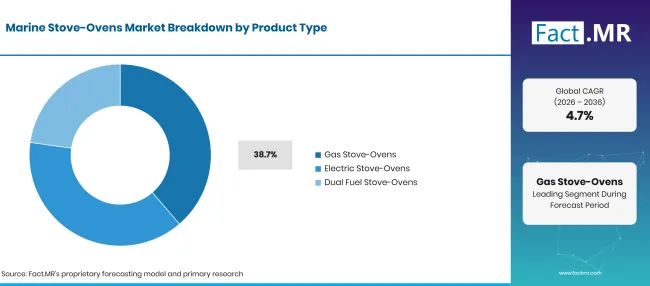
Marine Stove Ovens Market Breakdown Product Type | Source: Fact.MR
Demand for gas stove-ovens account for 38.7% of revenue in 2026, about USD 39.7 million, as propane offers high heat and long range for cruising sailboats. Electric and dual-fuel units grow on powered cruisers. Suppliers such as Force 10 and Dometic offer gimbaled gas units. Similar cruising needs are projected to keep gas in the lead. Propane-powered units remain relevant for sailboats and fishing vessels, while electric models attract powered cruisers. Demand is further supported by the continued presence of commercial seafarers. India's Directorate General of Shipping recorded 323,429 distinct Indian seafarers employed on Indian and foreign-flagged merchant ships in 2025, highlighting the scale of onboard accommodation requirements.
Which vessel applications are generating the highest sales of marine stove-ovens?
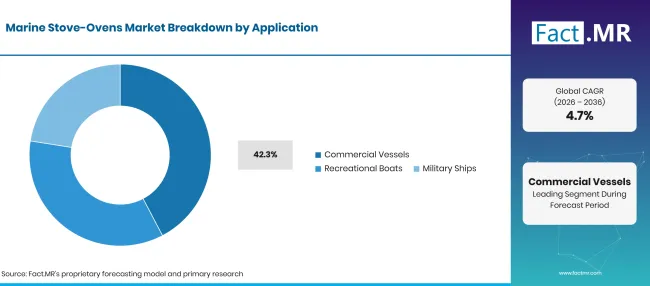
Marine Stove Ovens Market Breakdown Application | Source: Fact.MR
Commercial vessels lead with 42.3% of revenue in 2026, about USD 43.4 million, as fishing boats and workboats feed crews at sea. Recreational and military uses follow. Company players Suppliers support chandleries. are offering heavy-duty units. Similar needs are projected to keep commercial vessels in the lead. Fishing vessels and workboats require compact cooking equipment that withstands continuous onboard use. The Government of India's Directorate General of Shipping reported 554,054 total seafarer engagements in 2025, compared with 481,045 in 2023, indicating increased maritime workforce activity and supporting demand for onboard facilities.
How are offline distribution channels influencing marine stove-oven purchases?
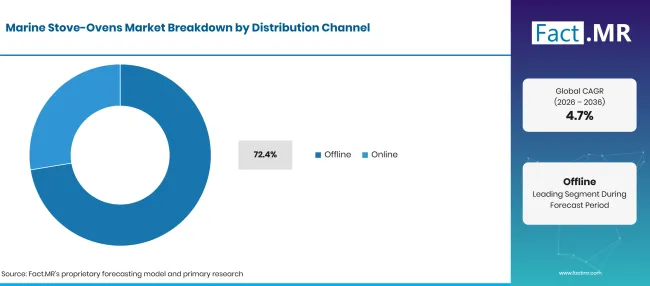
Marine Stove Ovens Market Breakdown Distribution Channel | Source: Fact.MR
Sales through offline channels segment represents 72.4% of revenue in 2026, about USD 74.3 million, as buyers need fitting advice. Online sales grow. Marine equipment suppliers distribute products through chandleries. Similar needs are projected to keep offline in the lead. Chandlers, specialist marine retailers and authorized dealers provide installation guidance, fuel compatibility checks and after-sales assistance. The U.S. Coast Guard's 2026 National Recreational Boating Safety Survey is inviting more than 50,000 households to participate, reflecting the scale of boating activity being monitored and the importance of the recreational marine equipment market.
How does corrosion resistance influence stainless steel demand in marine stove-ovens?
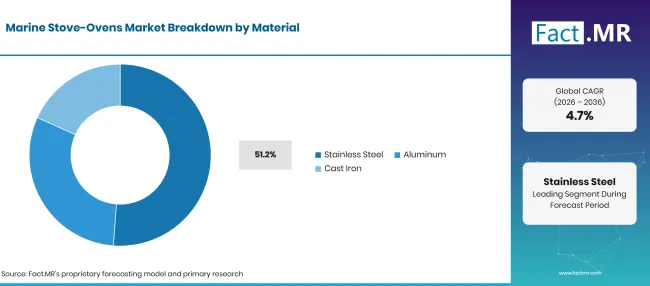
Marine Stove Ovens Market Breakdown Material | Source: Fact.MR
Stainless steel segment leads with 51.2% of revenue in 2026, about USD 52.6 million, as it resists corrosion. Exposure to moisture and salt spray increases corrosion risks for onboard kitchen equipment, encouraging manufacturers to use marine-grade stainless steel for burners, housings and cooking surfaces. Replacement purchases and demand for longer-lasting equipment support material sales across commercial and recreational vessels.
Marine Stove-Ovens Market-Drivers, Restraints & Trends
Drivers: Replacement of ageing onboard galley equipment
Demand for marine stove-ovens can benefit from maintenance and replacement activity across an ageing vessel fleet. India's Directorate General of Shipping published a fleet-age analysis in September 2026 showing 5,814 vessels aged over 20 years in 2024, compared with 3,393 in 2014. The number of vessels aged 16–20 years also increased from 1,433 to 4,301 over the same period. Although these figures cover India's registered commercial fleet rather than recreational boats, they demonstrate the growing presence of older vessels requiring maintenance and equipment renewal. Replacement-compatible marine stove-ovens, including models designed for existing galley openings and mounting arrangements, can benefit from this broader refit requirement.
Restraints: Softer new-boat purchases and concerns over gas cooking
New-boat affordability and onboard gas-safety requirements can limit demand for conventional marine stove-ovens. The National Marine Manufacturers Association reported that US new-boat retail unit sales declined 8.8% in 2025, to 215,237 units, compared with 236,070 in 2024. This is industry data rather than a government statistic, but it indicates weaker recent purchasing activity. Separately, the UK government's boat-fire guidance highlights the risks of LPG leaks, fire and carbon monoxide exposure, recommending proper installation, ventilation and routine servicing of gas appliances. These considerations may encourage some owners to consider electric cooking alternatives, particularly when upgrading their galleys.
Opportunity: Diesel cooking systems as an alternative to LPG
Diesel-fired cooking systems offer an opportunity among boat owners seeking to reduce dependence on onboard LPG storage. The UK Maritime and Coastguard Agency's small fishing-vessel safety code specifically recognizes appliances fired by LPG, diesel or paraffin and requires carbon monoxide alarms in relevant enclosed spaces containing fired cooking or heating appliances. It also requires fitted cooking appliances to meet applicable standards, be suitable for boats and undergo regular maintenance. This regulatory recognition confirms diesel-fired equipment as an established marine appliance category. Manufacturers offering compact diesel cookers, controlled combustion and integrated safety features can address owners looking for alternatives to propane-based cooking systems.
Trend: Electric ovens and lithium-powered boats
The development of marine battery systems is creating opportunities for compact electric cooking appliances, although onboard power availability remains an important purchasing consideration. In January 2026, the International Maritime Organization agreed on a workplan to develop safety regulations covering lithium-ion batteries and swappable battery containers on ships. The UK Maritime and Coastguard Agency also updated its guidance on fire safety and the storage of small electric-powered craft on yachts in January 2026, addressing lithium-ion battery handling and onboard storage. These developments reflect growing attention to marine electrification and battery safety. Efficient electric ovens with controlled power consumption may become more attractive as vessels adopt larger battery systems and upgraded electrical installations.
Marine Stove-Ovens Market by Analysis by Key Country
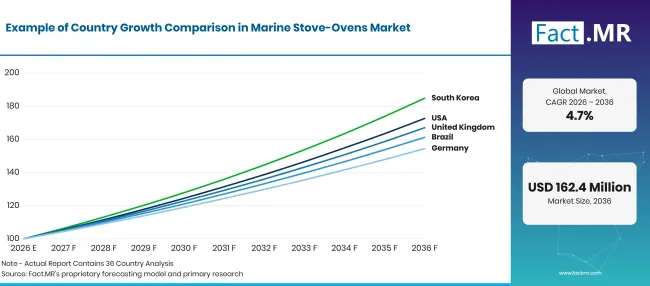
Marine Stove Ovens Market Growth Index | Source: Fact.MR
| Country | CAGR (2026-2036) |
|---|---|
| United States | 5.6% |
| United Kingdom | 5.3% |
| Brazil | 4.9% |
| Germany | 4.4% |
| Japan | 3.9% |
Source: Fact.MR analysis. Updated Nov 21, 2026
Source: Fact.MR analysis.
Why is the United States the fastest-growing market for marine stove-ovens?
Sales of marine stove-ovens in the United States are projected to grow at a 5.6% CAGR, the fastest among the five key countries, as liveaboard cruisers, Great Loop boaters and fishing fleets refit galleys.
Force 10, Dometic and Kenyon serve US chandleries. Similar refits are projected to drive sales. The U.S. Coast Guard’s 2026 National Recreational Boating Safety Survey estimates 84.5 million recreational boaters operating more than 25.5 million boats across the country. This broad boating base creates opportunities for galley equipment suppliers, particularly among cruising, fishing and liveaboard boat owners. Replacement demand from existing vessels can also support sales of compact stove-ovens designed for established galley layouts.
What is shaping marine stove-oven demand in the United Kingdom?
Demand in the United Kingdom is estimated to record a 5.3% CAGR as tens of thousands of licensed canal boats, many lived on year-round, need compact cookers, alongside coastal sailors.
Thetford and Dometic supply UK chandlers. Increasing liveaboard demand is projected to drive sales. In January 2026, the UK Government confirmed that the Canal & River Trust recorded 33,080 boats on its waterways in its 2025 survey, while the Environment Agency recorded just over 20,000 boats on its waterways. The government also acknowledged that neither authority systematically records how many occupants sleep aboard. Nevertheless, the size of the inland boating population provides a substantial potential customer base for compact cookers and replacement galley equipment.
What is supporting marine stove-oven demand in Brazil?
Sales in Brazil are anticipated to represent a 4.9% CAGR as boatbuilders in Santa Catarina and São Paulo fit galleys in cruisers for domestic buyers.
Similar production is projected to drive sales in Brazil. In June 2026, Brazil’s Ministry of Ports and Airports reported that 10 vessels were under construction in Itajaí and six in Navegantes, Santa Catarina, with more than 2,000 workers involved across the two locations. The projects include maritime support vessels, while the state also has an established recreational boating industry. New vessel construction can create opportunities for galley equipment suppliers, particularly where builders install cooking facilities in larger cruisers.
Which factors are shaping marine stove-oven demand in Germany?
Demand in Germany is projected to grow at a 4.4% CAGR as Baltic and inland sailors refit older yachts and favor diesel cookers that share engine fuel.
The Federal Ministry of Transport identifies approximately 7,300 km of waterways and more than 6 million people participating in water sports, including sailing and motorboating. This established boating culture supports demand for onboard equipment and maintenance services. However, the figure covers all water-sport participants rather than owners of cruising yachts, so it should be treated as an indicator of the broader recreational market. Replacement cookers and compact diesel-powered galley appliances may find demand among boat owners undertaking vessel upgrades.
Why is marine stove-oven growth slower in Japan?
Demand in Japan is estimated to record a 3.9% CAGR, the slowest among the five key countries, as cruising sailboats are few and most leisure boats are day boats without full galleys.
Similar usage is projected to keep growth slower. The Japan Craft Inspection Organization provides 2026 vessel statistics covering pleasure motorboats, pleasure yachts and other small vessels, with separate monthly and annual registration datasets. Its published definitions distinguish recreational motorboats from pleasure yachts, making the data useful for assessing the potential market for full galley appliances. An earlier U.S. Department of Commerce market report cited approximately 221,000 registered leisure craft in 2021.
Competitive Landscape for Marine Stove-Ovens Market
Competition in the marine stove-ovens market is shaped by differences in fuel technology, vessel requirements and galley configurations. Dometic, Force 10 Marine and Dickinson Marine compete through propane-powered ranges, gimballed stoves and integrated oven designs, while Kenyon International focuses on electric cooking appliances. Wallas-Marin differentiates itself through diesel and low-power cooking systems, whereas Thetford participates in the broader marine and recreational vehicle cooking appliance segment. Product selection is influenced by corrosion resistance, onboard power availability, installation flexibility and operational safety.
From 2024 onwards, competition has increasingly emphasized compact installations, electric cooking alternatives and fuel-efficient galley equipment. Force 10's propane ranges and gimballed electric models demonstrate continued investment in conventional marine cooking formats, while Dickinson Marine maintains its position through propane stoves and associated installation accessories. Kenyon's electric cooktops provide an alternative for vessels with suitable electrical capacity. Wallas-Marin's diesel-focused portfolio offers another fuel option for offshore applications. Manufacturers that combine compact dimensions, dependable operation and compatibility with modern vessel electrical systems are positioned to capture replacement and new-installation demand.
Recent Developments
- In May 2026, Wallas-Marin Introduces Updated 76D Diesel Convection Oven. Wallas published updated product specifications for its 76D marine convection oven, featuring improved air circulation, precise temperature control, standard gimbal installation and Greenboost combustion technology.
- In May 2026, Wallas-Marin Expands Its Diesel Cooking Portfolio. Wallas released product information for its 600 DUO diesel stove, expanding its marine cooking equipment range with updated onboard cooking solutions.
- In October, 2026, Kenyon's Signature Induction Cooktop received the 2026 IBEX Innovation Award, recognizing its bridge cooking function, matte-black ceramic surface and advanced touch controls.
Key Players in Marine Stove-Ovens Market
Key companies profiled include Dometic Group; Wallas-Marin; Dickinson Marine; Kenyon International Inc.; Force 10 Marine; and Thetford Corporation.
- Dometic Group
- Wallas-Marin
- Dickinson Marine
- Kenyon International Inc.
- Force 10 Marine
- Thetford Corporation
Bibliography
- Dickinson Marine. (2025). Marine stoves.
- Dometic Group AB. (2025). Annual report 2024.
- International Maritime Organization. (2026, January). Draft workplan agreed on safety rules for battery, wind and nuclear-powered ships.
- Japan Craft Inspection Organization. (n.d.). Vessel statistics and information.
- Kenyon International. (2026). Kenyon Signature Induction Cooktop Series wins 2026 IBEX Innovation Award.
- Ministry of Ports and Airports, Brazil. (2026, June). Tome França visits vessel construction works at Detroit Brasil shipyard in Itajaí, SC.
- National Marine Manufacturers Association. (2026). Latest data shows retail boat sales softened in 2025.
- U.S. Coast Guard. (2026). National recreational boating safety survey.
- U.S. Department of Commerce. (n.d.). Japan recreational boating and personal watercraft market. International Trade Administration.
- Wallas-Marin Oy. (n.d.). 76 D diesel cooker.
- Wallas-Marin Oy. (n.d.). Documents.
- Wallas-Marin Oy. (2025). Diesel cookers.
- UK Government. (n.d.). Code of practice for the safety of small fishing vessels of less than 15 metres length overall.
- UK Government. (n.d.). Fire safety on boats.
- UK Government. (2026). MGN 681 (M) Amendment 1: Fire safety and storage of small electric-powered craft on yachts.
- UK Parliament. (2026, January 28). Canal boats and inland waterways: Written question HL13753.
- U.S. Department of Transportation, Directorate General of Shipping, India. (2026, September). Fleet analysis by age of vessel.
- Federal Ministry of Transport, Germany. (n.d.). Water sports.
Segmentation
Scope of Report
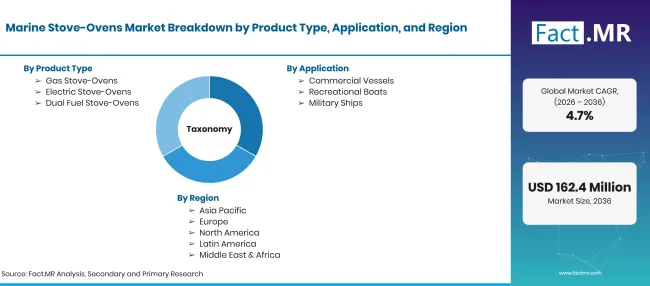
Marine Stove Ovens Market Taxonomy | Source: Fact.MR
| Items | Values |
|---|---|
| Quantitative Units (2026) | USD 102.7 Million |
| Product Type | Gas Stove-Ovens, Electric Stove-Ovens, Dual Fuel Stove-Ovens |
| Application | Commercial Vessels, Recreational Boats, Military Ships |
| Distribution Channel | Offline, Online |
| Material | Stainless Steel, Aluminum, Cast Iron |
| Regions Covered | North America, Latin America, Europe, East Asia, South Asia and Pacific, Middle East & Africa |
| Countries Covered | United States, Germany, Japan, United Kingdom, Brazil, and other countries |
| Key Companies Profiled | Dometic Group, Wallas-Marin, Dickinson Marine, Kenyon International Inc., Force 10 Marine, Thetford Corporation |
| Additional Attributes | Dollar revenue in the Marine Stove-Ovens Market is segmented by product type (gas stove-ovens, electric stove-ovens, dual fuel stove-ovens); application (commercial vessels, recreational boats, military ships); distribution channel (offline, online); material (stainless steel, aluminum, cast iron) and region. |
Source: Fact.MR analysis. Updated Nov 21, 2026
Marine Stove-Ovens Market by Segments
-
Product Type
- Gas Stove-Ovens
- Electric Stove-Ovens
- Dual Fuel Stove-Ovens
-
Application
- Commercial Vessels
- Recreational Boats
- Military Ships
-
Distribution Channel
- Offline
- Online
-
Material
- Stainless Steel
- Aluminum
- Cast Iron
-
Region:
- North America
- United States
- Canada
- Mexico
- Europe
- Germany
- United Kingdom
- France
- Italy
- Spain
- Rest of Europe
- Asia Pacific
- China
- India
- Japan
- South Korea
- Australia
- Rest of Asia Pacific
- Latin America
- Brazil
- Mexico
- Argentina
- Rest of Latin America
- Middle East & Africa
- GCC Countries
- South Africa
- Rest of Middle East & Africa
- North America
Frequently Asked Questions
How big is the global Marine Stove-Ovens Market in 2026?
What will be the size of the Marine Stove-Ovens Market by 2036?
How fast will the Marine Stove-Ovens Market grow during the forecast period?
Which product type segment holds the largest share of the Marine Stove-Ovens Market?
Who worked on this report


Preview the report firsthand - request a free sample
Free SampleGet the brochure for pricing and purchase details
Download PDF