- Market Value (2025): USD 4.0 Bn
- Estimated Value (2026): USD 4.2 Bn
- Forecast Value (2036): USD 6.8 Bn
- CAGR (2026-2036): 4.9%
What is the Masonry Sealers Market forecast to be worth by 2036?
USD 6.8 billion by 2036 at a 4.9% CAGR.
- The Masonry Sealers Market reached approximately USD 4.0 billion in 2025.
- Demand is projected to increase from USD 4.2 billion in 2026 to USD 6.8 billion by 2036.
- The market is projected to expand at a 4.9% CAGR from 2026 to 2036.
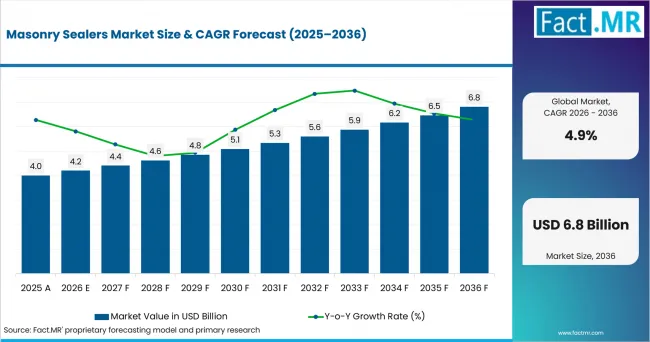
Masonry Sealers Market Value Analysis | Source: Fact.MR
What are the defining numbers behind Masonry Sealers Market growth?
An absolute opportunity of USD 2.6 billion is expected between 2026 and 2036.
- Demand Drivers in the Market
- Concrete and masonry surfaces require regular protection because water and dissolved salts can contribute to scaling and reinforcement corrosion. The Federal Highway Administration identifies both penetrating and film-forming sealers for bridge decks, with silane used to reduce water entry into concrete pores.
- Building owners also use surface sealers alongside broader waterproofing chemicals where masonry is exposed to rain or below-grade moisture but does not require a full membrane system.
- Renovation work supports demand for penetrating treatments that limit water absorption without trapping moisture inside the substrate. National Park Service guidance notes the use of silane and siloxane chemistries for masonry protection. This creates some overlap with protective coatings used on exposed building and infrastructure surfaces.
- Water-based sealers are gaining relevance in occupied buildings and residential projects where odor and VOC levels matter. U.S. EPA rules covering architectural coatings regulate VOC content across sealer and concrete-protection categories, supporting continued development of waterborne products within the wider paints and coatings market.
- Horizontal concrete and stone surfaces create another recurring use case. Garages and plazas need protection from water as well as oil or salt exposure, bringing sealers closer to concrete floor coatings in traffic-bearing areas.
- Aesthetic appearance also influences purchases for patios and driveways. Clear and wet-look sealers can deepen surface color while reducing visible staining, creating some overlap with stain-resistant coatings while remaining focused on porous mineral surfaces.
- Key Segments Analyzed
- Penetrating Sealers account for 58.4% of Product in 2026. Silane, siloxane, siliconate and fluoropolymer treatments work within the pore structure, helping protect masonry while preserving its natural appearance and vapor movement.
- Concrete represents 44.7% of Substrate in 2026. Its extensive use in homes, parking areas, commercial buildings and infrastructure creates a large surface base exposed to water, salts, freeze-thaw conditions and staining.
- Waterproofing holds 41.9% of Application in 2026. Limiting water entry helps reduce efflorescence, cracking, reinforcement corrosion and surface deterioration across exposed masonry.
- Water Based accounts for 48.6% of Technology in 2026. Lower odor, easier cleanup and VOC advantages support use in residential and occupied commercial environments, while newer formulations continue to improve penetration and water repellency.
- Residential represents 39.5% of End Use in 2026. Driveways, patios, facades, retaining walls, basements and decorative masonry create recurring demand during both new construction and renovation.
- Indirect Sales account for 63.2% of Distribution Channel in 2026. Contractors and property owners often purchase through distributors, home-improvement stores and online channels that provide access to different chemistries, pack sizes and application-specific products.
- Analyst Opinion at Fact.MR
- Shambhu Nath Jha, Senior Consultant, Fact.MR says, "Masonry sealer selection is moving from a simple clear-coat decision to a substrate-and-exposure decision. The winning products are those that match pore structure, moisture movement, chloride or stain exposure and local VOC requirements without creating appearance or adhesion problems. Suppliers that combine penetrating chemistry, water-based options and strong contractor guidance can capture both new-build and recurring maintenance demand."
- Strategic Implications
- Suppliers should match sealer selection to the surface and its exposure conditions. Dense brick and porous concrete behave differently, while natural stone or traffic-bearing pavers may need a different balance of penetration and appearance.
- Water-based systems remain an important area for formulation work. Lower odor and easier cleanup support use in occupied spaces, but buyers still expect reliable resistance to water and chloride exposure.
- Commercial and infrastructure buyers tend to look for documented performance such as penetration depth and freeze-thaw resistance. Residential customers usually place more emphasis on ease of application and how the surface will look after treatment.
- Clear application guidance also matters. Poor surface preparation or sealing over trapped moisture can cause failure, particularly on older masonry, which can lead to callbacks and damage supplier credibility.
How does the Masonry Sealers Market break down by segment?
The Masonry Sealers Market is segmented by Product, Substrate, Application, Technology, End Use and Distribution Channel.
Why do Penetrating Sealers lead Product?
Penetrating Sealers account for 58.4% of Product in 2026.
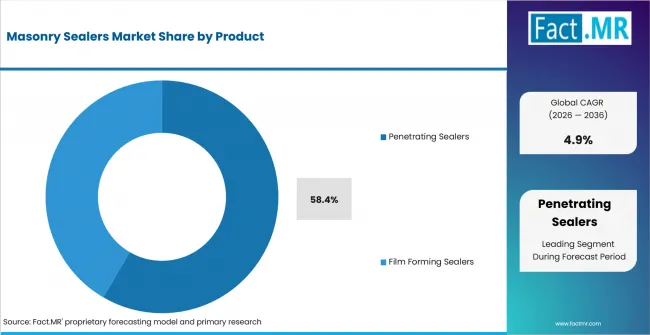
Masonry Sealers Market Analysis By Product | Source: Fact.MR
These sealers work below the surface, which makes them well suited to porous masonry. Water and dissolved salts can move through concrete pores, so reducing that movement helps protect the material without adding a thick surface layer. FHWA guidance describes penetrating sealers as treatments that enter the concrete pore structure, with silane used to resist water ingress.
They are also useful where the original appearance of brick or stone needs to be retained. National Park Service guidance notes that many modern masonry repellents penetrate the substrate and allow vapor movement, making them suitable for surfaces where a visible coating would be undesirable.
Why does Concrete lead Substrate?
Concrete accounts for 44.7% of Substrate in 2026.
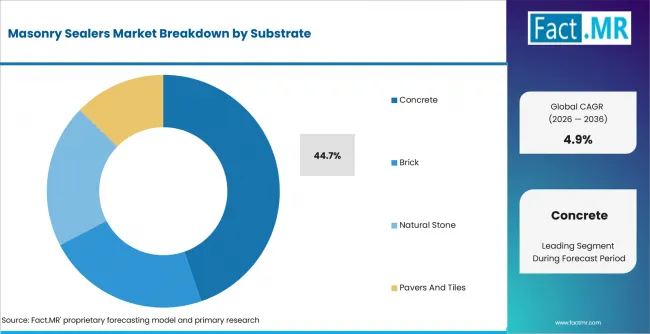
Masonry Sealers Market Analysis By Substrate | Source: Fact.MR
Concrete is used across a wide range of exposed structures, from driveways and parking areas to facades and bridge decks. Many of these surfaces face repeated contact with rain or deicing salts, creating an ongoing need for protection against moisture-related deterioration.
The depth of supplier activity reflects this demand. Companies such as Sika and W. R. Meadows offer sealers specifically for concrete applications, including parking structures and infrastructure surfaces where water penetration can shorten service life.
Why does Waterproofing lead Application?
Waterproofing accounts for 41.9% of Application in 2026.
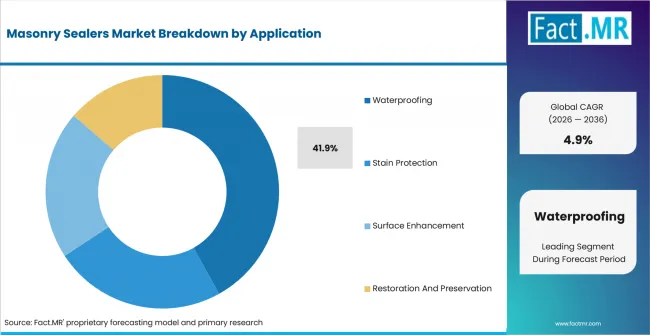
Masonry Sealers Market Analysis By Application | Source: Fact.MR
Water control is one of the main reasons masonry surfaces are sealed. Limiting absorption can reduce moisture-related staining and slow the movement of salts into concrete, helping protect both the surface and embedded reinforcement.
U.S. EPA coating definitions separately recognize waterproofing sealers for concrete and masonry. Their use is particularly relevant on exposed walls and paved surfaces where repeated wetting can increase maintenance requirements.
Why does Water Based lead Technology?
Water Based accounts for 48.6% of Technology in 2026.
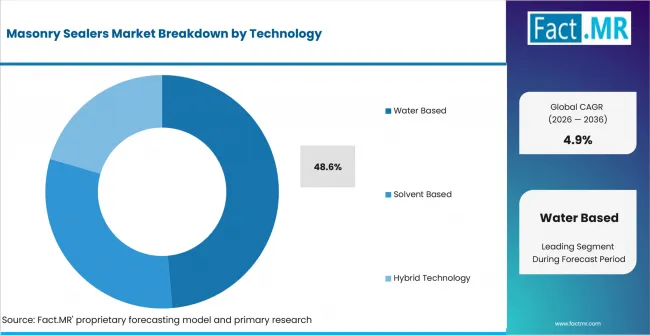
Masonry Sealers Market Analysis By Technology | Source: Fact.MR
Water-based sealers are practical in homes and occupied buildings because they generally produce less odor and are easier to clean up after application. They also give manufacturers more flexibility in meeting VOC requirements.
The technology is no longer limited to basic acrylic products. Suppliers now offer water-based penetrating systems using silane or siloxane chemistry, allowing users to combine lower-emission application with effective masonry protection.
Why does Residential lead End Use?
Residential accounts for 39.5% of End Use in 2026.
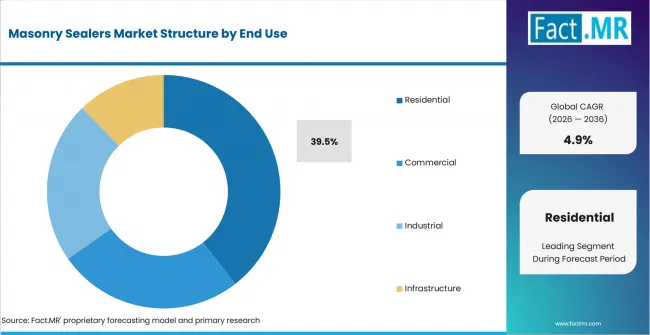
Masonry Sealers Market Analysis By End Use | Source: Fact.MR
Homes contain many surfaces that can require sealing over time. Driveways and patios are common examples, while brickwork and basement walls add further demand during repair or renovation.
Residential purchases are driven by both protection and appearance. Some buyers select penetrating treatments to control moisture, while others choose film-forming products when they want stronger color or a more visible finish.
Why do Indirect Sales lead Distribution Channel?
Indirect Sales account for 63.2% of Distribution Channel in 2026.
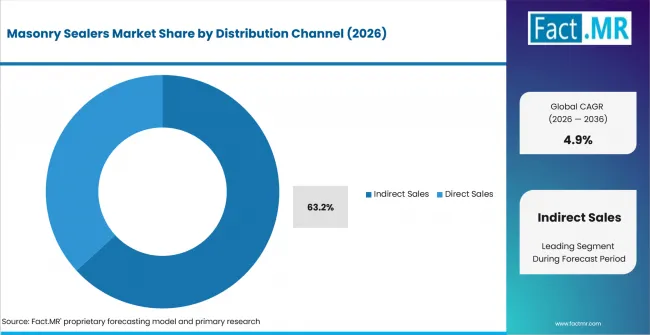
Masonry Sealers Market Analysis By Distribution Channel | Source: Fact.MR
Most buyers do not purchase masonry sealers directly from manufacturers. Contractors and property owners typically source them through distributors or home-improvement channels where several chemistries and pack sizes can be compared quickly.
Distributor networks also help customers choose products suited to the surface being treated. Online channels extend this model further by making smaller quantities and application-specific products easier to source for residential and small commercial work.
What is accelerating Masonry Sealers Market adoption, and what is holding it back?
Infrastructure maintenance is supporting demand for penetrating sealers on reinforced concrete exposed to water and chlorides Adoption can slow when the wrong product is used for the substrate. Trapped moisture or changes in appearance can create failures, especially on older masonry.
Drivers Impact Analysis
| Factor | (~) % Impact on CAGR | Geographic Relevance | Impact Timeline |
|---|---|---|---|
| Repair and maintenance of exposed concrete and masonry | +1.2% | North America, Europe, East Asia | 2026-2036 |
| Penetrating silane and siloxane protection against water and chlorides | +0.9% | USA, Germany, UK, Japan | 2026-2034 |
| Residential and commercial renovation activity | +0.8% | Global | 2026-2036 |
| Shift toward water-based and lower-VOC formulations | +0.6% | USA, Europe, Japan | 2026-2032 |
Source: Fact.MR analysis. Updated Aug 31, 2026
Opportunity Impact Analysis
| Factor | (~) % Impact on CAGR | Geographic Relevance | Impact Timeline |
|---|---|---|---|
| Bridge, parking and civil-structure preservation programs | +0.7% | USA, Germany, Japan, UK | 2026-2036 |
| Historic masonry restoration using breathable water repellents | +0.5% | Europe and North America | 2027-2036 |
| Paver, natural-stone and decorative concrete enhancement | +0.4% | Residential and hospitality markets | 2026-2034 |
| Distributor and e-commerce access for small projects | +0.3% | Global | 2026-2032 |
Source: Fact.MR analysis. Updated Aug 31, 2026
Restraints Impact Analysis
| Factor | (~) % Impact on CAGR | Geographic Relevance | Impact Timeline |
|---|---|---|---|
| Moisture trapping or inappropriate use on historic masonry | -0.5% | Europe and North America | 2026-2036 |
| Substrate variability and surface-preparation sensitivity | -0.4% | Global | 2026-2036 |
| VOC compliance and solvent-formulation reformulation costs | -0.3% | USA and Europe | 2026-2031 |
| Weather and cure-window constraints during application | -0.2% | Cold and high-rainfall regions | 2026-2033 |
Source: Fact.MR analysis. Updated Aug 31, 2026
Which countries are scaling the Masonry Sealers Market through 2036?
- Germany is seeing demand from building refurbishment and concrete maintenance. Freeze-thaw exposure also supports penetrating treatments that reduce water uptake without leaving a visible coating on the surface.
- Brazil has steady use across exterior masonry and residential concrete. Warm and wet conditions increase the need to protect facades and pavers from moisture-related staining and surface deterioration.
- USA demand is supported by infrastructure maintenance and a large installed base of parking and transport concrete. Penetrating sealers are also used in bridge-deck protection, while renovation adds demand across residential and commercial buildings.
- UK has a substantial stock of brick and stone buildings that require repair and moisture protection. This supports breathable repellents and restoration treatments where appearance needs to be preserved.
- Japan continues to require sealers for existing buildings and civil infrastructure. Rainfall and coastal exposure create recurring protection needs across concrete surfaces and facades.
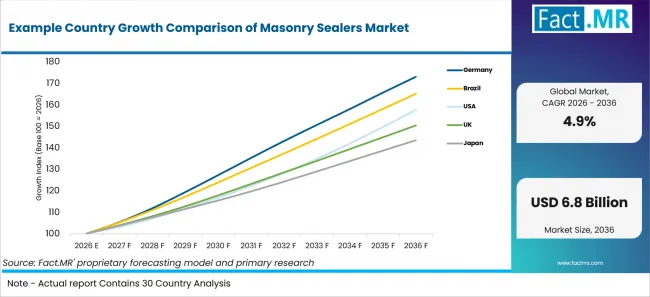
Example Country Growth Comparison Of Masonry Sealers Market | Source: Fact.MR
Country CAGR (2026-2036)
| Country | CAGR (2026-2036) |
|---|---|
| Germany | 5.6% |
| Brazil | 5.2% |
| USA | 4.7% |
| UK | 4.2% |
| Japan | 3.7% |
Source: Fact.MR analysis. Updated Aug 31, 2026
What is driving Germany's growth through 2036?
Demand in Germany is projected to rise at a 5.6% CAGR from 2026 to 2036.
Germany combines new-build recovery with a large refurbishment opportunity. Destatis reported that housing permits increased in 2025 after three consecutive annual declines and that permits also included dwellings created through conversion of existing buildings. Both new construction and remodeling expand the surface area requiring weather protection, especially concrete balconies, facades, pavers and masonry walls.
Refurbishment remains structurally important. KfW continues to finance energy-efficient renovation of existing residential and non-residential buildings in 2026. Envelope upgrades often expose repaired masonry, joints and concrete surfaces to renewed waterproofing and preservation work, supporting penetrating sealers that limit rain and freeze-thaw moisture while retaining a natural appearance.
What is driving Brazil's growth through 2036?
Demand in Brazil is projected to rise at a 5.2% CAGR from 2026 to 2036.
Brazil offers a large construction base and a climate that exposes exterior masonry to repeated rain, humidity and staining. IBGE reported that construction grew 4.3% in 2024, supported by employment, construction inputs and credit, while its 2024 Annual Survey of Construction Industry tracks a broad formal sector spanning buildings, infrastructure and specialized construction services.
This activity supports masonry-sealer demand in residential facades, concrete floors, pavers, commercial buildings and renovation. Water-based penetrating systems are particularly relevant where users want moisture protection with lower odor and straightforward application in occupied or densely built environments.
What is driving USA's growth through 2036?
Demand in the USA is projected to rise at a 4.7% CAGR from 2026 to 2036.
The United States combines a large private building base with substantial public construction. U.S. Census Bureau data show public construction spending increased in 2025, including major highway and educational categories. These assets create recurring demand for water-repellent and protective treatments on concrete walls, decks, parking facilities and pedestrian surfaces.
Infrastructure practice is especially supportive of penetrating systems. FHWA documents silane sealers for bridge decks and notes their ability to react within concrete and resist water entry. At the same time, EPA architectural-coating VOC rules influence formulation choices, supporting water-based and lower-VOC products across residential and commercial channels.
What is driving UK's growth through 2036?
Demand in the UK is projected to rise at a 4.2% CAGR from 2026 to 2036.
Repair and maintenance are central to the UK construction mix. The Office for National Statistics reported that both new work and repair and maintenance grew in the three months to May 2026, and its August 2026 release showed infrastructure new work contributing positively in the second quarter. This activity supports resealing after facade repair, paving work and concrete rehabilitation.
The UK also has extensive brick and stone building stock where moisture movement matters. Government conservation guidance for historic masonry stresses the need for breathable wall finishes and warns against treatments that prevent moisture from leaving walls. This favors carefully specified penetrating repellents over impermeable films in preservation-sensitive projects.
What is driving Japan's growth through 2036?
Demand in Japan is projected to rise at a 3.7% CAGR from 2026 to 2036.
Japan maintains a large construction and maintenance market. The Ministry of Land, Infrastructure, Transport and Tourism publishes an annual construction investment outlook and separately defines maintenance and repair as work that preserves or restores the functions of existing buildings and civil structures. That recurring repair base supports protective treatments on concrete and masonry rather than relying only on new construction.
Frequent rainfall, coastal exposure and dense urban infrastructure raise the value of sealers that limit water and salt ingress without adding excessive film build. Penetrating silane or siloxane systems are suited to bridge, parking, facade and paving applications where vapor transmission and appearance are also important.
Who Leads the Masonry Sealers Market?
Key players in the Masonry Sealers Market include PPG Industries, Sherwin-Williams, Sika AG, RPM International Inc., W. R. Meadows, Inc., Euclid Chemical Company and PROSOCO, Inc.
Competition depends on how well products protect masonry without creating unwanted changes in appearance or moisture movement. Buyers compare water repellency and substrate compatibility closely, while VOC profile and availability also influence product selection.
PPG offers acrylic masonry sealers as well as silane and siloxane water repellents. Sherwin-Williams competes with water-based concrete and masonry waterproofing products, while Sika supplies penetrating systems used across building and infrastructure applications.
W. R. Meadows competes through its PENTREAT range, including water-based and high-active silane products. PROSOCO focuses on breathable repellents for concrete and masonry. Euclid Chemical operates within RPM International, so the two names represent related entries within the competitive landscape.
Which companies are the key providers?
PPG Industries, Sherwin-Williams, Sika AG, RPM International Inc., W. R. Meadows, Inc., Euclid Chemical Company and PROSOCO, Inc. are the key providers assessed in the market.
- PPG Industries
- Sherwin-Williams
- Sika AG
- RPM International Inc.
- W. R. Meadows, Inc.
- Euclid Chemical Company
- PROSOCO, Inc.
Bibliography
- Federal Highway Administration. (2017). Current Information on the Use of Overlays and Sealers. U.S. Department of Transportation.
- National Park Service. (2000). Preservation Brief 1: Assessing Cleaning and Water-Repellent Treatments for Historic Masonry Buildings. U.S. Department of the Interior.
- U.S. Environmental Protection Agency. (2026). Architectural Coatings: National Volatile Organic Compounds Emission Standards. U.S. EPA.
- Federal Statistical Office of Germany. (2026). 10.8% More Building Permits for Dwellings in 2025. Destatis.
- KfW. (2026). Federal Funding for Efficient Buildings: Adjustments and Refurbishment Support. KfW Banking Group.
- Brazilian Institute of Geography and Statistics. (2025). GDP Grows 3.4% in 2024 and Construction Expands 4.3%. IBGE.
- Brazilian Institute of Geography and Statistics. (2026). Annual Survey of Construction Industry 2024. IBGE.
- U.S. Census Bureau. (2026). Construction Spending: December 2025. U.S. Department of Commerce.
- Office for National Statistics. (2026). Construction Output in Great Britain: May 2026. ONS.
- Office for National Statistics. (2026). Construction Output in Great Britain: June 2026. ONS.
- Department for Communities. (2022). Technical Note: Historic External Wall Finishes. Northern Ireland Government.
- Ministry of Land, Infrastructure, Transport and Tourism. (2025). FY2025 Construction Investment Outlook. Government of Japan.
- Ministry of Land, Infrastructure, Transport and Tourism. (2026). Construction Statistics Handbook: Maintenance and Repair Work. Government of Japan.
- PPG Paints. (2026). Perma-Crete Interior/Exterior Acrylic Masonry Surface Sealer. PPG Industries.
- Sherwin-Williams. (2026). H&C Hydro-Defend Concrete & Masonry Waterproofer Sealer. The Sherwin-Williams Company.
- Sika Corporation. (2026). Sikagard SN-40 Silane Based Reactive Water Repellent Penetrating Sealer. Sika AG.
- Sika Corporation. (2026). Sikagard-701 W Silane Siloxane Water Repellent. Sika AG.
- RPM International Inc. (2026). Euclid Chemical: Construction Products Group. RPM International Inc.
- W. R. Meadows. (2026). PENTREAT Penetrating Sealers for Concrete and Masonry. W. R. Meadows, Inc.
- PROSOCO. (2026). Sure Klean Weather Seal Siloxane PD. PROSOCO, Inc.
This Report Answers
- What is the Masonry Sealers Market worth in 2026 and 2036?
- Why do penetrating sealers hold the leading product share?
- Why is concrete the leading substrate for masonry sealers?
- Which applications create the strongest demand for masonry sealers?
- Why are water-based technologies gaining share?
- Which end users and distribution channels account for leading demand?
- Which companies supply penetrating and film-forming masonry sealers?
What does the Masonry Sealers Market cover?
The market covers commercial penetrating and film-forming sealers sold for concrete, brick, natural stone, pavers, tiles and related masonry. Revenue includes products used for waterproofing, stain protection, surface enhancement, restoration and preservation across residential, commercial, industrial and infrastructure settings.
The assessment counts the sealer product value at the point of sale. It does not include the downstream value of construction, renovation, bridge maintenance, painting or restoration services in which the sealer is applied.
What is included in the scope?
- Penetrating silane, siloxane, siliconate and fluoropolymer sealers, plus film-forming acrylic, polyurethane, epoxy and silicone sealers within the across penetrating and film-forming product categories.
- Concrete, brick, natural stone, pavers and tiles, including poured and block concrete, clay and cement brick, granite, limestone, sandstone, and concrete and stone pavers
- Waterproofing, stain protection, surface enhancement, restoration and preservation uses in residential, commercial, industrial and infrastructure settings.
- Water-based, solvent-based and hybrid technologies sold through building-material distributors, home-improvement stores, e-commerce and manufacturer-direct channels.
What is excluded from the scope?
- Sheet and liquid-applied waterproofing membranes that function as separate barrier systems rather than masonry sealers.
- Decorative paints, elastomeric wall coatings and heavy protective coatings whose primary function is film build, color or industrial chemical protection rather than masonry sealing.
- Structural concrete repair mortars, crack fillers, joint sealants, admixtures and curing compounds that are not sold primarily as sealers for cured masonry surfaces.
- Application labor, contractor service revenue, cleaning equipment and diagnostic instruments used to prepare or inspect masonry surfaces.
How Was the Analysis Built?
The analysis draws on more than 120 technical and market sources, over 35 company and product portfolios and more than 20 industry interviews across at least 25 countries.
Primary Research: Interviews with sealer manufacturers, construction-chemical distributors, waterproofing contractors, restoration specialists, facility managers, civil contractors, architects and building-material retailers examine product selection, substrate preparation, coverage, VOC requirements, recoat cycles, channel preferences and field performance.
Desk Research: The assessment uses government construction statistics, bridge-preservation guidance, historic-masonry conservation guidance, architectural-coating regulation, supplier technical literature and public information on building refurbishment. External publications used in the article are recorded in the bibliography.
Market Sizing and Forecasting: Estimates combine construction and renovation activity, exposed masonry area, sealer usage rates, application frequency, product mix, technology mix, channel structure and country-level maintenance demand across residential, commercial, industrial and infrastructure uses.
Data Validation and Update Cycle: Findings are cross-checked against supplier portfolios, public construction activity, product specifications and primary interviews. Updates account for formulation changes, VOC requirements, building and infrastructure spending, renovation activity, channel shifts and adoption of penetrating versus film-forming systems.
Segmentation
What is the report's scope and coverage?
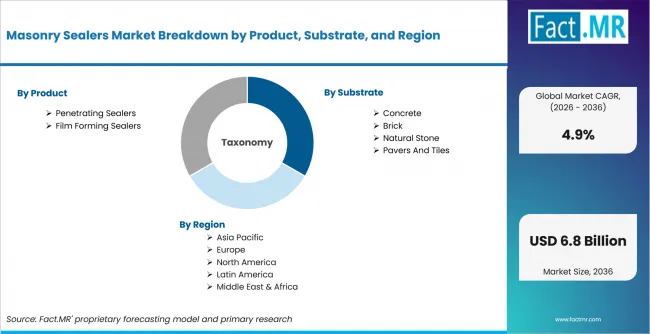
Masonry Sealers Market Breakdown By Product, Substrate, And Region | Source: Fact.MR
| Attribute | Details |
|---|---|
| Quantitative Units | USD billion; shares and CAGR in percent |
| Market Definition | Commercial penetrating and film-forming products sold to reduce water, salt, stain and weather intrusion into concrete, brick, stone, pavers and related masonry, or to enhance and preserve surface appearance |
| Segmentation | Product; Substrate; Application; Technology; End Use; Distribution Channel |
| Geographic Coverage | North America; Latin America; Europe; East Asia; South Asia and Pacific; Middle East and Africa |
| Countries Assessed | Germany; Brazil; USA; UK; Japan |
| Companies Profiled | PPG Industries; Sherwin-Williams; Sika AG; RPM International Inc.; W. R. Meadows, Inc.; Euclid Chemical Company; Prosoco, Inc. |
| Forecast Period | 2026 to 2036 |
| Base Year | 2025 |
| Market Value, 2026 | USD 4.2 billion |
| Market Value, 2036 | USD 6.8 billion |
| CAGR, 2026-2036 | 4.9% |
| Absolute Opportunity | USD 2.6 billion |
| Approach | Hybrid supply-side and demand-side assessment using construction and renovation activity, exposed masonry area, product usage, technology mix, channel structure, supplier portfolios and primary interviews |
Source: Fact.MR analysis. Updated Aug 31, 2026
How is the market segmented?
-
By Product:
- Penetrating Sealers
- Silane Sealers
- Siloxane Sealers
- Siliconate Sealers
- Fluoropolymer Sealers
- Film Forming Sealers
- Acrylic Sealers
- Polyurethane Sealers
- Epoxy Sealers
- Silicone Sealers
- Penetrating Sealers
-
By Substrate:
- Concrete
- Poured Concrete
- Blocked Concrete
- Brick
- Clay Brick
- Cement Brick
- Natural Stone
- Granite
- Limestone
- Sandstone
- Pavers And Tiles
- Concrete Pavers
- Stone Pavers
- Concrete
-
By Application:
- Waterproofing
- Above Grade Protection
- Below Grade Protection
- Stain Protection
- Oil Resistance
- Chemical Resistance
- Surface Enhancement
- Color Enhancement
- Gloss Enhancement
- Restoration And Preservation
- Historic Building Preservation
- Surface Rehabilitation
- Waterproofing
-
By Technology:
- Water Based
- Acrylic Water Based
- Silane Water Based
- Solvent Based
- Acrylic Solvent Based
- Siloxane Solvent Based
- Hybrid Technology
- Silane Siloxane Blends
- Nanotechnology Based Sealers
- Water Based
-
By End Use:
- Residential
- New Construction
- Renovation
- Commercial
- Office Buildings
- Retail Buildings
- Industrial
- Manufacturing Facilities
- Logistics Infrastructure
- Infrastructure
- Bridges
- Tunnels
- Residential
-
By Distribution Channel:
- Indirect Sales
- Building Material Distributors
- Home Improvement Stores
- E Commerce
- Direct Sales
- Manufacturer Direct Supply
- Indirect Sales
-
By Region:
- North America
- Latin America
- Western Europe
- Eastern Europe
- East Asia
- South Asia and Pacific
- Middle East & Africa
Frequently Asked Questions
How large is the Masonry Sealers Market in 2026?
What CAGR is expected from 2026 to 2036?
What will the market be worth by 2036?
How much absolute opportunity is expected over the forecast period?
Which Product segment leads in 2026?
Which Substrate segment leads in 2026?
Which Application segment leads in 2026?
Which Technology segment leads in 2026?
Which End Use segment leads in 2026?
Which Distribution Channel segment leads in 2026?
What factors shape market growth?
Who worked on this report


Preview the report firsthand - request a free sample
Free SampleGet the brochure for pricing and purchase details
Download PDF