- Market Value (2025): USD 13.8 Bn
- Estimated Value (2026): USD 14.7 Bn
- Forecast Value (2036): USD 26.8 Bn
- CAGR (2026-2036): 6.2%
What is the Dust Control Systems and Suppression Chemicals Market forecast to be worth by 2036?
USD 14.7 billion in 2026 to USD 26.8 billion by 2036 at a 6.2% CAGR.
- The dust control systems and suppression chemicals market reached USD 13.8 billion in 2025 as mines and industrial sites kept dust control within operating budgets.
- Demand is projected to increase from USD 14.7 billion in 2026 to USD 26.8 billion by 2036.
- The market is forecast to record a 6.2% CAGR from 2026 to 2036.
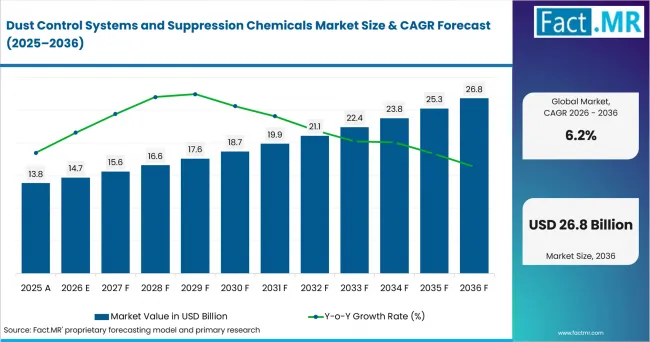
Dust Control Systems And Suppression Chemicals Market Value Analysis | Source: Fact.MR
What are the defining numbers behind Dust Control Systems and Suppression Chemicals Market growth?
USD 12.2 billion absolute opportunity by 2036 is led by dust suppression chemicals and mining operations.
- Demand Drivers in the Market
- Mining and quarry sites require road-dust control that can work during routine hauling without stopping production.
- Construction contractors are expected to favor mobile misting when earthmoving creates visible dust near nearby communities.
- Industrial facilities use collection systems when dry material handling affects worker exposure or equipment reliability.
- Procurement teams are likely to compare dosage guidance and field records before repeat chemical orders are approved.
- Key Segments Analyzed
- By Product Category: Dust Suppression Chemicals are expected to hold 41.0% share in 2026 since they fit recurring use across haul roads and exposed storage areas.
- By Application Area: Mining Operations are projected to account for 44.0% share in 2026 as dust control remains a daily operating requirement around extraction areas.
- By End-use Industry: Mining is anticipated to capture 46.0% share in 2026 where dust exposure and equipment wear are reviewed together.
- By Customer Group: Mining Companies are estimated to represent 43.0% share in 2026 due to centralized procurement and frequent site-level validation.
- By Suppression Technology: Chemical Dust Suppression is forecast to hold 39.0% share in 2026 with long-duration control across unpaved roads and open piles.
- Analyst Opinion at Fact.MR
- Shambhu Nath Jha, Senior Consultant at Fact.MR, states, “Dust-control products must work well as traffic, material and weather conditions change. Repeat orders are expected to depend on longer-lasting dust control, proven results and reliable supply rather than low price alone.”
- Strategic Implications
- Mining operators may separate road dust and crusher dust before quotations influence procurement decisions.
- Chemical suppliers strengthen retention by giving site teams clear dilution guidance and storage instructions.
- Distributors gain better inventory control by planning around mining and construction use cases rather than broad catalog claims.
- Pricing teams protect margins when performance proof is stronger than a low-cost substitute offer.
The USA leads at 7.1% CAGR through mining compliance. Australia follows at 6.8% through large mine sites. Canada reaches 6.5% through resource extraction. Germany posts 6.2% through industrial process control. China records 5.9% through mining and construction activity. India reaches 5.6% through infrastructure work. Brazil closes at 5.3% through outdoor material movement.
How does the Dust Control Systems and Suppression Chemicals Market break down by segment?
Dust Suppression Chemicals are expected to lead Product Category at 41.0% share in 2026. Mining Operations are projected to lead Application Area at 44.0% share in 2026.
Which Product Category dominates?
Dust Suppression Chemicals are projected to account for 41.0% share in 2026.
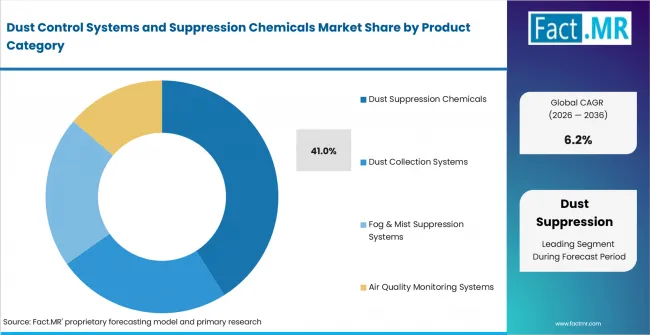
Dust Control Systems And Suppression Chemicals Market Analysis By Product Category | Source: Fact.MR
Dust Suppression Chemicals lead when sites need repeat treatment for haul roads and stockpiles. Dust Collection Systems remain important inside plants. Fog and Mist Suppression Systems serve loading zones. Air Quality Monitoring Systems help buyers check performance.
What leads the Application Area segment?
Mining Operations are expected to hold 44.0% share in 2026.
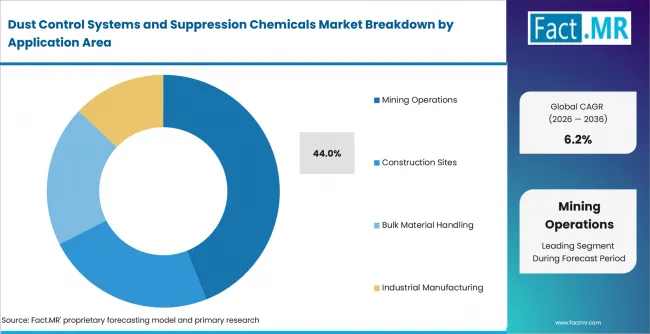
Dust Control Systems And Suppression Chemicals Market Analysis By Application Area | Source: Fact.MR
Mining Operations create repeated control needs across haul routes and crushers. Suppliers can prove dosage through daily use. Construction Sites need mobile suppression. Bulk Material Handling supports ports and terminals. Industrial Manufacturing requires enclosed capture.
How does End-use Industry shape demand?
Mining is anticipated to lead with 46.0% share in 2026.
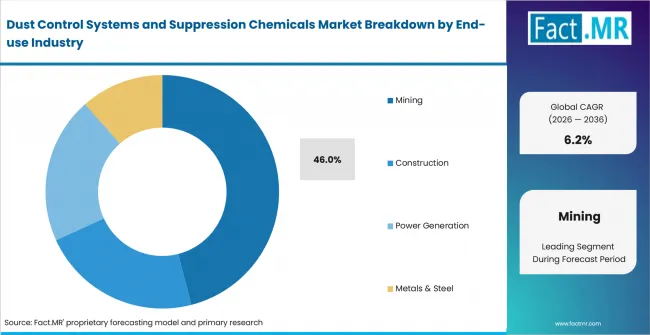
Dust Control Systems And Suppression Chemicals Market Analysis By End Use Industry | Source: Fact.MR
Mining leads because dust affects worker exposure and equipment maintenance together. Site managers need products that work during repeated hauling and crushing. Construction follows through earthmoving and demolition. Power Generation and Metals & Steel need control around ash handling.
What supports Mining Companies within Customer Group?
Mining Companies are estimated to represent 43.0% share in 2026.
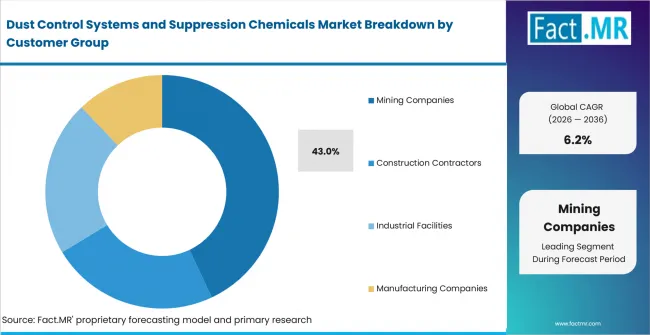
Dust Control Systems And Suppression Chemicals Market Analysis By Customer Group | Source: Fact.MR
Mining Companies buy through structured procurement and need evidence before site-wide use expands. Suppliers gain advantage when treatment frequency is clear. Construction Contractors use dust control for project compliance. Industrial Facilities select systems when dust creates safety issues.
Why does Chemical Dust Suppression lead Suppression Technology?
Chemical Dust Suppression is forecast to hold 39.0% share in 2026.
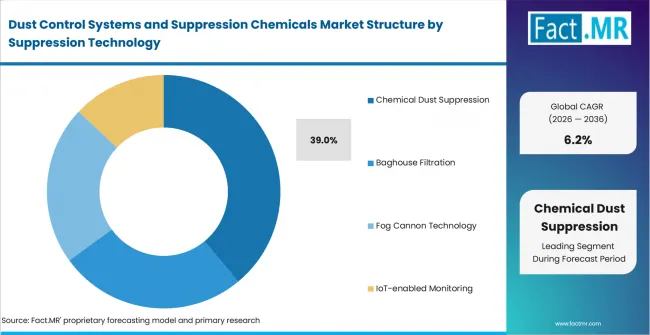
Dust Control Systems And Suppression Chemicals Market Analysis By Suppression Technology | Source: Fact.MR
Chemical Dust Suppression leads when roads and piles need control between water cycles. It can reduce repeat wetting where water spraying fades quickly. Baghouse Filtration remains valuable indoors. Fog Cannon Technology serves outdoor points. IoT-enabled Monitoring gives site records.
What is accelerating Dust Control Systems and Suppression Chemicals Market adoption, and what is holding it back?
Demand is expected to rise through mining dust control and clearer supplier documentation. Growth may be limited by cost pressure and lower-cost substitutes.
Drivers Impact Analysis
| DRIVER | (~) % IMPACT ON CAGR | GEOGRAPHIC RELEVANCE | IMPACT TIMELINE |
|---|---|---|---|
| Adoption and integration | +1.6% | Global | Short term (<= 2 years) |
| Regulatory and compliance support | +1.4% | USA, Germany, UK | Short term (<= 2 years) |
| Channel and access expansion | +1.1% | Global | Medium term (2-4 years) |
| Clear specification and documentation | +0.9% | USA, UK, Canada | Medium term (2-4 years) |
| Cost and efficiency gains | +0.6% | Global | Long term (>= 4 years) |
Source: Fact.MR analysis. Updated Aug 7, 2026
- Adoption and integration: Sites are expected to favor products that fit existing water trucks or spray bars without lengthy installation work.
- Regulatory and compliance support: Mine buyers are likely to give more weight to documented particulate control when exposure rules require clearer records.
- Clear specification and documentation: Suppliers that explain dosage and compatibility can reduce approval friction for technical buyers.
Opportunity Impact Analysis
| OPPORTUNITY | (~) % IMPACT ON CAGR | GEOGRAPHIC RELEVANCE | IMPACT TIMELINE |
|---|---|---|---|
| Emerging application expansion | +1.0% | Global | Medium term (2-4 years) |
| Premium and specialist positioning | +0.8% | USA, UK, Germany | Medium term (2-4 years) |
| Channel and partner expansion | +0.7% | Global | Long term (>= 4 years) |
| Standards and compliance alignment | +0.5% | USA, Canada, Singapore | Long term (>= 4 years) |
Source: Fact.MR analysis. Updated Aug 7, 2026
- Emerging application expansion: Ports and recycling yards are expected to create demand where outdoor material movement produces visible dust.
- Premium and specialist positioning: Products designed for ores or climate conditions may gain attention where water spraying performs poorly.
- Channel and partner expansion: Local distributors can shorten replenishment time for remote mines and large construction corridors.
Restraints Impact Analysis
| RESTRAINT | (~) % IMPACT ON CAGR | GEOGRAPHIC RELEVANCE | IMPACT TIMELINE |
|---|---|---|---|
| Cost and complexity | -1.1% | Global | Short term (<= 2 years) |
| Specification and compliance checks | -0.9% | USA, UK, Germany | Short term (<= 2 years) |
| Substitution by lower-cost alternatives | -0.7% | Import-dependent markets | Medium term (2-4 years) |
| Supply chain and pricing pressure | -0.5% | Global | Long term (>= 4 years) |
Source: Fact.MR analysis. Updated Aug 7, 2026
- Cost and complexity: Buyers may delay upgrades when pumps and chemical supply contracts must be approved together.
- Specification and compliance checks: Technical teams often require compatibility and safety documentation before regular use begins.
- Substitution by lower-cost alternatives: Some sites may keep water-only control when budgets are tight and dust exposure is viewed as manageable.
Which countries are scaling the Dust Control Systems and Suppression Chemicals Market fastest?
- The country comparison spans 1.8% points and forms a compact growth range across the forecast period.
- The USA remains 0.3% point above Australia through mining compliance and wider supplier coverage.
- Australia remains 0.3% point above Canada through large mine sites and haul-road treatment needs.
- Canada remains 0.3% point above Germany through resource extraction and remote operations.
- Germany remains 0.3% point above China as industrial sites focus on process cleanliness.
- China remains 0.3% point above India through mining and construction activity.
- India remains 0.3% point above Brazil through infrastructure work and dust-control needs in cement sites.
Comparable CAGRs can still create different entry conditions due to site scale and channel reach. Full report coverage includes North America; Latin America; Europe; East Asia; South Asia and Pacific; Middle East and Africa.
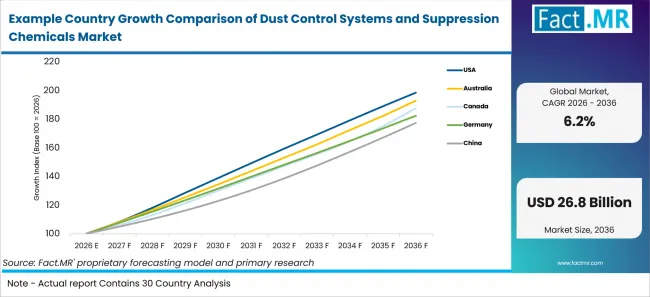
Example Country Growth Comparison Of Dust Control Systems And Suppression Chemicals Market | Source: Fact.MR
| Country | CAGR (2026-2036) |
|---|---|
| USA | 7.1% |
| Australia | 6.8% |
| Canada | 6.5% |
| Germany | 6.2% |
| China | 5.9% |
| India | 5.6% |
| Brazil | 5.3% |
Source: Fact.MR analysis. Updated Aug 7, 2026
What is driving USA growth through 2036?
7.1% CAGR, supported by wider application depth and stronger channel access.
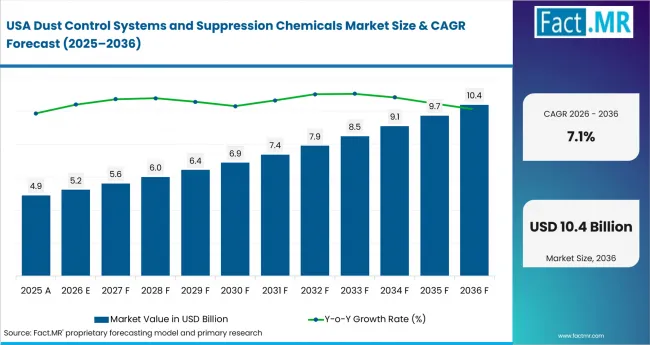
Dust Control Systems And Suppression Chemicals Market Country Value Analysis | Source: Fact.MR
U.S. buyers evaluate field proof before expanding dust-control orders across mines and aggregates sites. Suppliers with service coverage and clear safety documents are better placed for repeat orders.
How is Australia scaling demand?
6.8% CAGR, supported by large mining operations and haul-road suppression needs.
Australia demand is shaped by open-pit mines and long unpaved haul routes. Operators are expected to prefer chemicals that reduce watering frequency and keep road surfaces stable.
What supports Canada adoption?
6.5% CAGR, backed by resource extraction and remote-site operating needs.
Canada presents a remote-site buying environment where seasonal weather can affect treatment plans. Products that remain practical across long supply routes are likely to receive stronger consideration.
How does Germany perform?
6.2% CAGR, led by industrial process control and documentation-led purchasing.
Germany’s outlook is shaped by manufacturing and heavy industrial sites that review dust capture as part of process discipline. Buyers are expected to examine filtration load and chemical documentation before approval.
What is driving China growth from 2026 to 2036?
5.9% CAGR with support from mining and construction plus bulk material handling activity.
China’s demand base is broad because ores and construction materials move through high-volume sites. Customers are expected to compare systems that can handle frequent transfer points.
How is India developing demand?
5.6% CAGR, driven by infrastructure activity and dust-control needs in mining and cement sites.
India’s growth path is tied to construction corridors and cement operations that need practical dust control. Buyers are likely to balance product cost with water use and site reliability.
What supports Brazil growth?
5.3% CAGR with support from mining and quarrying plus bulk outdoor material movement.
Brazil’s opportunity is concentrated around exposed stockpiles and unpaved roads. Field performance and dependable supply are expected to matter when sites operate far from major service hubs.
Who leads the Dust Control Systems and Suppression Chemicals Market?
Ecolab Inc. and Solenis LLC show direct relevance through water treatment and process-chemical capabilities. Borregaard ASA strengthens the chemical side through lignin-based binders and specialty additives used in industrial applications.
Nederman Holding AB and Donaldson Company, Inc. support the equipment side through dust collection and filtration portfolios. Quaker Houghton adds industrial process-fluid experience. Cargill, Incorporated contributes adjacent chemical and bio-based material exposure. Benetech, Inc. extends the provider set through material-handling and monitoring capabilities.
Competition is expected to depend on application evidence and reliable supply. Buyers are likely to prefer providers that can explain how products perform at a site before repeat orders expand.
Which companies are the key providers?
Key companies include Ecolab Inc., Solenis LLC, Borregaard ASA, Nederman Holding AB, Donaldson Company, Inc., Quaker Houghton, Cargill, Incorporated, Benetech, Inc., and Global Road Technology International Holdings Pty Ltd.
- Ecolab Inc.
- Solenis LLC
- Borregaard ASA
- Nederman Holding AB
- Donaldson Company, Inc.
- Quaker Houghton
- Cargill, Incorporated
- Benetech, Inc.
- Global Road Technology International Holdings Pty Ltd
Bibliography
- Mine Safety and Health Administration. (2026, February 27). Mine safety and health at a glance [Fact sheet]. U.S. Department of Labor.
- U.S. Census Bureau. (2026, August 3). Monthly construction spending, June 2026 (Release No. CB26-126).
- Australian Bureau of Statistics. (2026, March 3). Mineral and petroleum exploration, Australia, December 2025.
- Ministry of Statistics and Programme Implementation. (2026, January 7). Press note on first advance estimates of gross domestic product for 2025–26. Government of India.
This Report Answers
- The report provides strategic intelligence on the Dust Control Systems and Suppression Chemicals Market across Product Category and Application Area choices.
- Segment analysis covers Dust Suppression Chemicals and Mining Operations as the share leaders within the 2026 market.
- Country outlook evaluates the USA and Australia alongside Canada and Germany. China, India and Brazil complete the growth comparison.
- Competitive analysis profiles Ecolab Inc. and Solenis LLC alongside Borregaard ASA and Nederman Holding AB. Donaldson Company, Inc. and other providers complete the set.
- Application assessment covers Mining Operations and Construction Sites. Bulk Material Handling and Industrial Manufacturing complete the application view.
What does the Dust Control Systems and Suppression Chemicals Market cover?
Dust control systems and suppression chemicals reduce airborne and fugitive dust where safety and equipment protection influence supplier selection. The market covers road dust and stockpile control.
Coverage extends to dust chemicals and fixed collection systems. It includes fog and mist systems and monitoring tools. The assessment can overlap with bulk material handling equipment when transfer points create dust-control demand.
What is included in the scope?
Dust Control Systems and Suppression Chemicals are assessed across the covered segments and countries. Company coverage is tied to named providers that can serve the defined product use cases.
The scope includes Product Category and Application Area alongside End-use Industry, Customer Group and Suppression Technology. It covers Chemical Dust Suppression and baghouse filtration systems when they are sold into defined dust-control use cases.
What is excluded from the scope?
Products outside the assessed segments and applications remain outside this market.
The scope excludes general cleaning equipment and unrelated air-handling systems. Chemicals not sold for dust suppression are excluded. Services without a direct product connection are outside the count.
How Was the Analysis Built?
The analysis draws on 120+ sources, 35+ company portfolios, 25+ countries, and more than 20 interviews.
- Primary Research: Interviews with manufacturers, retailers, salon operators, and experts examine purchase priorities, adoption, approval requirements, and competitive positioning.
- Desk Research: Desk research covers government statistics, regulatory publications, company filings, trade data, technical studies, industry associations, standards, and public policy.
- Market Sizing and Forecasting: Estimates combine historical performance, demand indicators, pricing, segment shares, company participation, country growth, adoption patterns, and barriers to expansion.
- Data Validation and Update Cycle: Findings are validated against public data, company activity, regulatory changes, product launches, recalls, and adoption shifts.
Segmentation
What is the report’s scope and coverage?
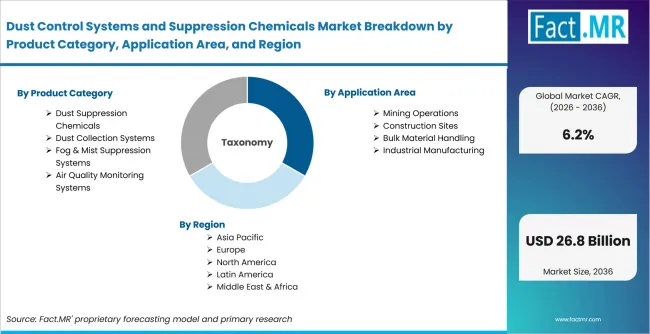
Dust Control Systems And Suppression Chemicals Market Breakdown By Product Category, Application Area, And Region | Source: Fact.MR
| Attribute | Details |
|---|---|
| Quantitative Units | USD billion in 2026 to USD billion by 2036 at CAGR |
| Market Definition | Dust control systems and suppression chemicals used to reduce airborne or fugitive dust where exposure, visibility, equipment reliability and documentation influence buyer selection |
| Product Category | Dust Suppression Chemicals; Dust Collection Systems; Fog & Mist Suppression Systems; Air Quality Monitoring Systems |
| Application Area | Mining Operations; Construction Sites; Bulk Material Handling; Industrial Manufacturing |
| End-use Industry | Mining; Construction; Power Generation; Metals & Steel |
| Customer Group | Mining Companies; Construction Contractors; Industrial Facilities; Manufacturing Companies |
| Suppression Technology | Chemical Dust Suppression; Baghouse Filtration; Fog Cannon Technology; IoT-enabled Monitoring |
| Regions Covered | North America; Latin America; Europe; East Asia; South Asia and Pacific; Middle East and Africa |
| Countries Covered | USA; Australia; Canada; Germany; China; India; Brazil |
| Key Companies Profiled | Ecolab Inc.; Solenis LLC; Borregaard ASA; Nederman Holding AB; Donaldson Company, Inc.; Quaker Houghton; Cargill, Incorporated; Benetech, Inc.; Global Road Technology International Holdings Pty Ltd |
| Forecast Period | 2026 to 2036 |
| Approach | Hybrid top-down and bottom-up approach using segment demand; share; country growth; application fit; pricing; supplier documentation; and company portfolio review |
Source: Fact.MR analysis. Updated Aug 7, 2026
How is the market segmented?
-
By Product Category
- Dust Suppression Chemicals
- Lignosulfonate-based Products
- Polymer-based Suppressants
- Dust Collection Systems
- Baghouse Collectors
- Cyclone Dust Collectors
- Fog & Mist Suppression Systems
- High-pressure Fog Systems
- Low-pressure Misting Systems
- Air Quality Monitoring Systems
- PM Monitoring Sensors
- Remote Air Monitoring
- Dust Suppression Chemicals
-
By Application Area
- Mining Operations
- Open Pit Mining
- Underground Mining
- Construction Sites
- Road Construction
- Tunneling Projects
- Bulk Material Handling
- Conveyor Transfer Points
- Stockpile Management
- Industrial Manufacturing
- Foundries
- Cement Plants
- Mining Operations
-
By End-use Industry
- Mining
- Metal Mining
- Coal Mining
- Construction
- Infrastructure Development
- Cement Manufacturing
- Power Generation
- Coal-fired Power Plants
- Biomass Power Plants
- Metals & Steel
- Steel Plants
- Non-ferrous Metals
- Mining
-
By Customer Group
- Mining Companies
- Mine Operators
- Mineral Processing Companies
- Construction Contractors
- Infrastructure Developers
- Civil Engineering Firms
- Industrial Facilities
- Bulk Material Operators
- Port Authorities
- Manufacturing Companies
- Industrial Plant Operators
- Process Industries
- Mining Companies
-
By Suppression Technology
- Chemical Dust Suppression
- Surface Binding Technology
- Polymer Stabilization
- Baghouse Filtration
- Cartridge Filtration
- Wet Scrubber Systems
- Fog Cannon Technology
- Automated Misting Systems
- Intelligent Spray Control
- IoT-enabled Monitoring
- Real-time Dust Analytics
- Cloud-based Monitoring
- Chemical Dust Suppression
-
By Region
- North America
- Latin America
- Western Europe
- Eastern Europe
- East Asia
- South Asia and Pacific
- Middle East & Africa
Frequently Asked Questions
How big is the dust control systems and suppression chemicals market in 2026?
What is the CAGR of the dust control systems and suppression chemicals market from 2026 to 2036?
Which product category leads the dust control systems and suppression chemicals market?
Which application area leads the dust control systems and suppression chemicals market?
Who are the leading companies in the dust control systems and suppression chemicals market?
Who worked on this report


Preview the report firsthand - request a free sample
Free SampleGet the brochure for pricing and purchase details
Download PDF