- Market Value (2025): USD 5.1 Bn
- Estimated Value (2026): USD 5.6 Bn
- Forecast Value (2036): USD 14.3 Bn
- CAGR (2026-2036): 9.8%
What is the Modular Extrusion Control Units Market forecast to be worth by 2036?
USD 5.6 billion in 2026 to USD 14.3 billion by 2036 at a 9.8% CAGR.
- The Modular Extrusion Control Units Market reached USD 5.1 billion in 2025.
- Demand is set to increase from USD 5.6 billion in 2026 to USD 14.3 billion by 2036.
- The market is forecast to record 9.8% CAGR from 2026 to 2036 as plants update controls around extrusion, feeding and line-level output data.
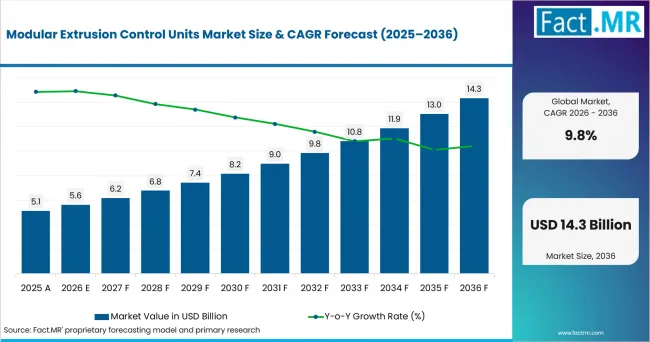
Modular Extrusion Control Units Market Value Analysis | Source: Fact.MR
What are the defining numbers behind Modular Extrusion Control Units Market growth?
An absolute opportunity of USD 8.7 billion is expected between 2026 and 2036.
- Demand Drivers in the Market
- Plant teams need modules that solve one clear control problem without rebuilding the full control setup. Single-zone retrofits and distributed I/O support targeted upgrades.
- Food extrusion teams need one operator view from weighing through extrusion and cutting. Recipe control is especially useful where several formulations share the same line, as seen in automated pet food production.
- Plant teams also need room to expand without rebuilding one large cabinet. I/O modules and standard links let plants add sensors or functions under one main control layer.
- Key Segments Analyzed
- By Control Module: Extruder PLC is expected to hold 38.0% share in 2026 because the PLC remains the core layer for interlocks, drive control, alarm logic and staff commands across modular lines.
- By Extrusion Process: Film is projected to account for 34.0% share in 2026 as film lines depend on stable melt conditions, synchronized downstream speed and close control of thickness-related line values.
- By Modularity: Single-zone retrofit is projected to capture 30.0% share in 2026 owing to the ability to address a defined feeder, heating, pressure or auxiliary-control need without replacing the complete control platform.
- By Control Objective: Throughput is forecast to represent 37.0% share in 2026 since processors use feed-rate control, screw-load monitoring and line-speed control to raise output while staying inside quality limits.
- Analyst Opinion at Fact.MR
- Shambhu Nath Jha, Principal Consultant at Fact.MR, states, “The commercial value of a modular line controller comes from how cleanly it fits around the installed line. Plants want to add control where variation is costing output or staff time. Demand is expected to favor platforms that connect PLC logic with feeding, heat, and recipe data. Vendors that combine open interfaces with line-specific control knowledge are better placed to support retrofit and new-line projects.”
- Strategic Implications
- Control-system vendors should support standard protocols and modular I/O so plant teams can connect existing feeders, drives, and heat loops with less custom interface work.
- Extruder makers should show core line values in one staff view because steady mixes depend on linked line settings.
- Food-extrusion integrators should connect mix settings with line status and staff member controls. In October 2025, Tetra Pak showcased an extrusion line for complex ice-cream shapes and layered textures at the Indian Ice Cream Expo.
- Control suppliers are set to compete on clean integration with installed machines. Open interfaces, clear mix handling and scalable I/O reduce the amount of custom work needed when plants extend a line.
The USA leads at 11.0% CAGR through plastics investment and plant-level control upgrades. Germany follows at 10.7% as machinery demand and factory-control depth support modular line systems. France reaches 10.4% through machinery activity and process-line upgrades. Japan records 8.9% as precision manufacturing and plastic-product output sustain control demand, while the UK posts 8.3% through its broad rubber and plastics manufacturing base and retrofit requirements.
How does the Modular Extrusion Control Units Market break down by segment?
Extruder PLC is set to lead Control Module at 38.0% share in 2026; while Throughput leads Control goal at 37.0% share.
Which Control Module dominates?
Extruder PLC is set to hold 38.0% share in 2026.
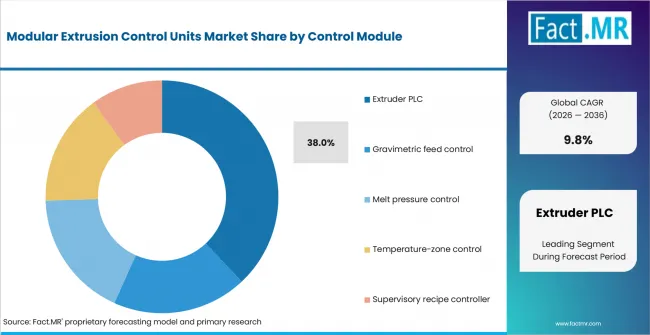
Modular Extrusion Control Units Market Analysis By Control Module | Source: Fact.MR
Extruder PLCs link machine steps, interlocks, and modular I/O. Gravimetric feed and melt-pressure controls address mass flow and die stability, while heat modules manage barrel zones. Recipe controllers help keep settings steady across products.
What leads the Extrusion Process segment?
Film is set to account for 34.0% share in 2026.
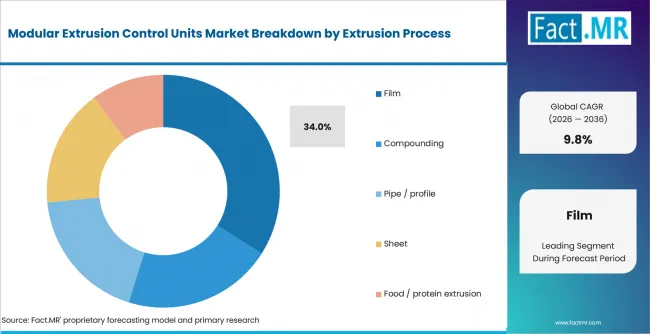
Modular Extrusion Control Units Market Analysis By Extrusion Process | Source: Fact.MR
Film lines need stable melt conditions and linked downstream speed to hold thickness. Compounding relies on steady feed and screw load, while pipe, profile, and sheet lines use control to hold size. Food extrusion adds recipe control for feed and heat. Good line control helps staff hold speed and size through each run.
How does Modularity shape demand?
Single-zone retrofit is projected to lead with 30.0% share in 2026.
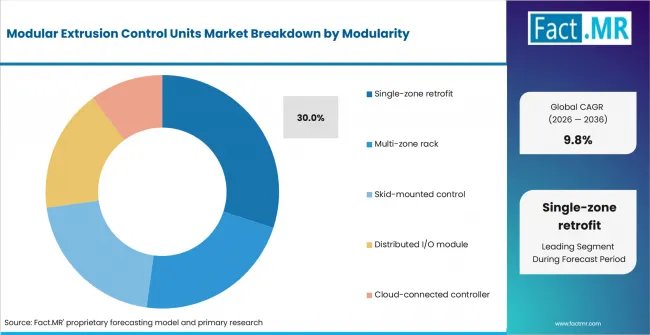
Modular Extrusion Control Units Market Analysis By Modularity | Source: Fact.MR
Single-zone retrofits suit plants that can isolate one control problem. Multi-zone racks cover broader projects, skid controls arrive with packaged auxiliaries, and distributed I/O supports phased expansion. Cloud-connected controllers add remote viewing where plant policy permits it. The work can stay limited when only one zone needs a fix.
What helps Throughput within Control goal?
Throughput is forecast to represent 37.0% share in 2026.
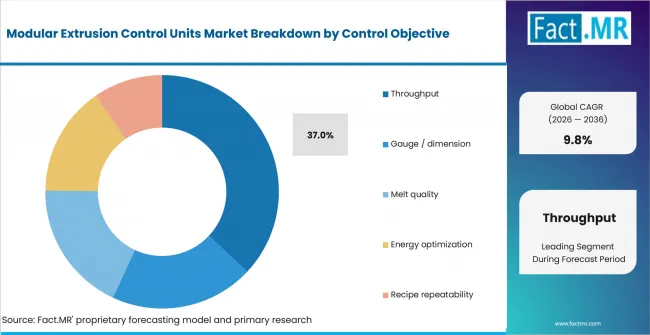
Modular Extrusion Control Units Market Analysis By Control Objective | Source: Fact.MR
Throughput control keeps kilograms per hour stable within quality limits. Gauge control helps film, sheet, pipe and profile dimensions, while melt-quality control serves mixing and food extrusion. Energy and mix goals become more relevant where digital controls expose drive, heater and changeover performance. That gives staff one clear rate to watch as the line runs. The same view helps staff act fast when feed starts to drift.
What is accelerating Modular Extrusion Control Units Market adoption, and what is holding it back?
upgrade-friendly control and mix repeatability help adoption. Linking work and plant-specific control logic restrain it.
Drivers Impact Analysis
| DRIVER | (~) % IMPACT ON CAGR | GEOGRAPHIC RELEVANCE | IMPACT TIMELINE |
|---|---|---|---|
| Retrofit modernization of installed extrusion lines | +1.5% | North America, Europe | Short term (<= 2 years) |
| Recipe and feeding repeatability | +1.2% | Global | Short term (<= 2 years) |
| Open PLC and OPC-UA integration | +1.0% | Europe, North America, East Asia | Medium term (2-4 years) |
| Line-level production data and remote visibility | +0.8% | Global | Medium term (2-4 years) |
Opportunity Impact Analysis
| OPPORTUNITY | (~) % IMPACT ON CAGR | GEOGRAPHIC RELEVANCE | IMPACT TIMELINE |
|---|---|---|---|
| Single-zone retrofit packages | +1.1% | North America, Europe | Short term (<= 2 years) |
| Modular controls for food and protein extrusion | +0.9% | Europe, North America, Japan | Medium term (2-4 years) |
| Cloud-connected service and diagnostics | +0.7% | Global | Long term (>= 4 years) |
Restraints Impact Analysis
| RESTRAINT | (~) % IMPACT ON CAGR | GEOGRAPHIC RELEVANCE | IMPACT TIMELINE |
|---|---|---|---|
| Legacy interface and protocol mismatch | -0.6% | Global | Short term (<= 2 years) |
| Validation and shutdown cost for retrofit work | -0.5% | North America, Europe, Japan | Medium term (2-4 years) |
| Application-specific tuning requirements | -0.4% | Global | Long term (>= 4 years) |
Which countries are scaling the Modular Extrusion Control Units Market through 2036?
- The country comparison spans 2.7 points across the five profiled markets.
- The USA remains 0.3 point above Germany as plastics spending and control upgrades help upgrade demand.
- Germany remains 0.3 point above France through machine design and plant control depth.
- France remains 1.5 points above Japan as machinery and food-processing activity support line-control spending.
- Japan remains 0.6 point above the UK as factory machines and plastic-product output help precision control needs.
- The UK closes the displayed range with a large rubber and plastics factory base that helps control replacement and line links.
Comparable CAGRs can produce different project mixes because installed machines and local technical depth vary. Coverage also spans the listed global regions. Each market still has its own mix of old and new lines.
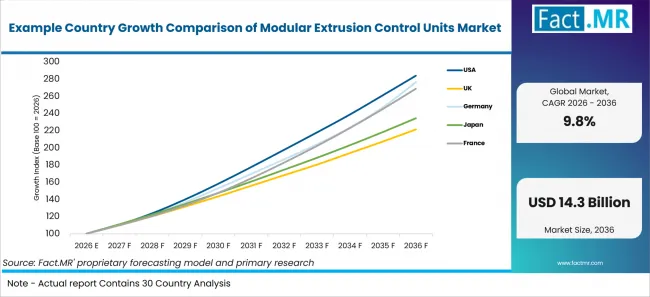
Example Country Growth Comparison Of Modular Extrusion Control Units Market | Source: Fact.MR
| Country | CAGR (2026-2036) |
|---|---|
| United States | 11.0% |
| Germany | 10.7% |
| France | 10.4% |
| Japan | 8.9% |
| United Kingdom | 8.3% |
What supports USA adoption?
11.0% CAGR, backed by plastics investment and plant-level control upgrades.
U.S. plants have a large plastics and rubber base that supports new-line and retrofit control work. The U.S. Bureau of Economic Analysis reported on June 10, 2026 that new foreign direct investment in plastics and rubber products manufacturing reached USD 19.0 billion in 2025. Modular PLC, feed, and pressure controls let plants add a clear function around lines already in use while keeping familiar drives and field devices.
What is supporting Germany’s adoption?
10.7% CAGR, shaped by machine design and factory control needs.
Germany combines a deep machinery base with broad skill in plant controls, which supports line-specific projects. Destatis reported on August 6, 2026 that new orders for machinery and equipment increased 12.7% month on month in June 2026. That work supports PLC racks, distributed I/O, and recipe controls on compounding or profile lines where builders need close links between the main line and auxiliary equipment.
How is France developing demand?
10.4% CAGR, supported by machine activity and process-line upgrades.
French line projects draw on a sizeable machine and food-processing base where plants manage several product formats. INSEE reported on June 30, 2026 that the seasonally and working-day-adjusted turnover index for machinery and equipment goods reached 125.51 in April 2026, with 2021 equal to 100. Modular control units fit this setting because plants can change feed, heat, or recipe functions in stages while keeping the wider control setup.
How does Japan perform?
8.9% CAGR, led by machine needs and precise process control.
Japan’s factory base favors compact controls that help steady settings and accurate line response. METI reported on February 27, 2026 that the industrial production index reached 104.0 in January 2026, up 2.2% from the prior month; plastic products were among the main contributors. Distributed I/O and recipe controls suit lines where staff need stable feed, heat, and pressure across frequent product changes.
What supports the United Kingdom’s growth?
8.3% CAGR, backed by a large rubber and plastic products base.
The UK retains a broad rubber and plastics base that supports replacement and retrofit demand for line controls. The Office for National Statistics reported that turnover from the manufacture of rubber and plastic products totaled GBP 26.2431 billion in 2025. Single-zone controls and modular I/O suit plants that want to update ageing machine functions while keeping existing line hardware in service.
Who leads the Modular Extrusion Control Units Market?
Bühler combines extrusion equipment with operator-focused controls and digital process monitoring. On May 6, 2026, the company launched the Nutrex 7 Series for food and feed extrusion. Bühler states that its hygienic design can reduce cleaning and audit-readiness times by up to 50%. The platform also supports guided operation, clear process visualization, browser-based monitoring, and modular configuration.
Coperion provides PLC-based extruder controls with recipe management, production-data recording, feeding calculation, historical-data evaluation, and OPC-UA connectivity. The former Schenck Process Food and Performance Materials group officially transitioned to the Coperion name in August 2024, expanding Coperion's portfolio across feeding, material handling, extrusion, and related process technologies.
GEA's xTru Twin platform uses a supervisory control system that monitors the process from dosing to cutting and displays parameters including raw-material flows, extrusion torque, specific mechanical energy, barrel temperatures, and die pressure. AZO provides automated raw-material handling, weighing, dosing, and control systems, while Tetra Pak supplies integrated food and ice-cream extrusion lines.
Which companies are the key providers?
Key firms cover Bühler; Coperion, including former Schenck Process FPM assets; GEA; AZO; and Tetra Pak.
- Bühler
- Coperion (including former Schenck Process FPM assets)
- GEA
- AZO
- Tetra Pak
Bibliography
- Bühler Group. (2026, May 6). Bühler ushers in a new era of extrusion systems with Nutrex 7 Series.
- Office for National Statistics. (2026, September 11). UKProdTO: 22 - Manufacture of Rubber and Plastic Products TOTAL (£m).
- Ministry of Economy, Trade and Industry. (2026, February 27). Indices of industrial production: Preliminary report for January 2026.
- Institut national de la statistique et des études économiques. (2026, June 30). In April 2026, manufacturing turnover accelerated (+2.5%).
- Federal Statistical Office (Destatis). (2026, August 6). New orders in manufacturing in June 2026: +3.1% on the previous month.
- U.S. Bureau of Economic Analysis. (2026, June 10). New foreign direct investment in the United States, 2025.
- GEA Group Aktiengesellschaft. (2025, June 16). GEA launches new high-speed bake extruder.
- Tetra Pak. (2025, October 6). Tetra Pak showcases world-class, made-in-India solutions at Indian Ice Cream Expo 2025.
- Coperion. (2025, April 15). Trailblazing technologies for manufacturing tasty, nutritious meat alternatives.
This Report Answers
- The report explains use across control module, line process, modularity and control objective. It shows where each type of control fits in the line.
- Segment analysis identifies the leading subsegments and their operating rationale. It links each share to the task that plant teams must run.
- Country analysis reviews five markets and the conditions shaping extrusion-control spending. The same frame makes it easy to see why needs differ by place.
- Company analysis reviews current extrusion, feeding and linked-control suppliers. Use analysis assesses the control objectives that influence system specifications.
What does the Modular Extrusion Control Units Market cover?
The market covers configurable controls for plastics, compounding and food extrusion, including PLC, feed, pressure, heat and recipe functions. Related fields include extrusion aids and plastic processing equipment, but this report stays focused on modular line-control units.
Coverage includes new-line controls and retrofit units supplied as racks, skids or I/O modules across the listed line types. Cloud-connected controllers are included only when they directly monitor or control line tasks. A unit can serve one zone or link to a wider line plan.
What is included in the scope?
The scope includes PLCs, feeder controls, pressure modules, heat controllers and recipe platforms sold for direct extrusion use. Associated staff view, alarms, data capture and industrial communication are included when tied to line control. Each item must have a direct role in how the line is run.
Retrofit packages are included when a plant adds a defined function to an installed line. New-line systems qualify when modular controls remain identifiable within the control package, including linked food-extrusion feeding control. This keeps the scope tied to real line control work.
What is excluded from the scope?
The scope excludes complete extruders without separable control value, general SCADA without line control, standalone sensors and generic cloud analytics. Injection molding, blow molding and unrelated line controls are also excluded. The report stays focused on the control unit and its direct use.
Enterprise software and maintenance platforms are excluded unless they issue extrusion commands. Drives, motors, heaters and valves count only when sold within a defined modular control package. The link to line commands must be clear for the unit to count.
How Was the Analysis Built?
The analysis draws on 120+ sources, 35+ company portfolios, 25+ countries, and more than 20 industry interviews.
- Primary Research: Primary research includes discussions with manufacturers, service providers, technology developers, distributors, end users, and subject-matter experts. These conversations examine purchasing priorities, product adoption, operational challenges, approval requirements, competitive positioning, and the factors that influence wider market acceptance.
- Desk Research: Desk research covers government statistics, regulatory publications, company filings, trade data, technical studies, industry associations, standards, public policy, and other authoritative sources. Every source used in the analysis is documented in the bibliography.
- Market Sizing and Forecasting: Market estimates combine historical performance, demand indicators, pricing and volume trends, segment shares, company participation, country-level growth, adoption patterns, investment activity, and barriers to market expansion.
- Data Validation and Update Cycle: Findings are validated by comparing primary interviews with public data, company activity, regulatory changes, trade patterns, and industry developments. Regular updates review new product launches, capacity changes, partnerships, approvals, and shifts in commercial adoption.
What is the report’s scope and coverage?
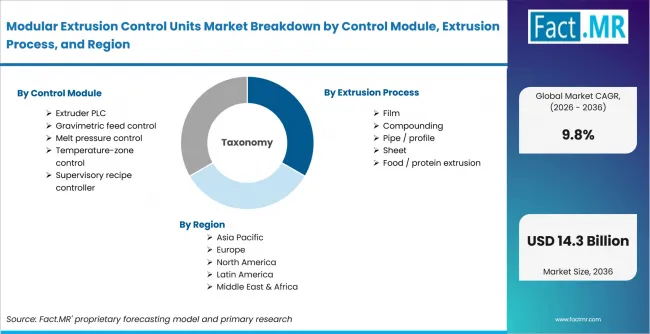
Modular Extrusion Control Units Market Breakdown By Control Module, Extrusion Process, And Region | Source: Fact.MR
| Attribute | Details |
|---|---|
| Quantitative Units | USD billion |
| Market Definition | Modular control hardware and associated control software used to monitor or regulate extrusion equipment through configurable PLC, feeding, pressure, temperature, recipe or distributed I/O functions that can be deployed as a unit or integrated into a wider line-control architecture. |
| Control Module | Extruder PLC; Gravimetric feed control; Melt pressure control; Temperature-zone control; Supervisory recipe controller |
| Extrusion Process | Film; Compounding; Pipe / profile; Sheet; Food / protein extrusion |
| Modularity | Single-zone retrofit; Multi-zone rack; Skid-mounted control; Distributed I/O module; Cloud-connected controller |
| Control Objective | Throughput; Gauge / dimension; Melt quality; Energy optimization; Recipe repeatability |
| Regions Covered | North America; Latin America; Western Europe; Eastern Europe; East Asia; South Asia & Pacific; Middle East & Africa |
| Countries Covered | United States; United Kingdom; Germany; Japan; France |
| Key Companies Profiled | Bühler; Coperion; GEA; AZO; Tetra Pak |
| Forecast Period | 2026 to 2036 |
| Approach | Hybrid top-down and bottom-up approach using extrusion-line installations; control retrofit intensity; PLC and feeder-control adoption; application mix; country manufacturing indicators; and provider portfolio review. |
How is the market segmented?
-
By Control Module:
- Extruder PLC
- Gravimetric feed control
- Melt pressure control
- Temperature-zone control
- Supervisory recipe controller
-
By Extrusion Process:
- Film
- Compounding
- Pipe / profile
- Sheet
- Food / protein extrusion
-
By Modularity:
- Single-zone retrofit
- Multi-zone rack
- Skid-mounted control
- Distributed I/O module
- Cloud-connected controller
-
By Control Objective:
- Throughput
- Gauge / dimension
- Melt quality
- Energy optimization
- Recipe repeatability
-
By Region:
- North America
- Latin America
- Western Europe
- Eastern Europe
- East Asia
- South Asia & Pacific
- Middle East & Africa