- Market Value (2025): USD 478.2 Mn
- Estimated Value (2026): USD 580.0 Mn
- Forecast Value (2036): USD 3999.8 Mn
- CAGR (2026-2036): 21.3%
What is the Modular Field-Emission Thrusters Market forecast to be worth by 2036?
USD 580.0 million in 2026 to USD 3999.8 million by 2036 at a 21.3% CAGR.
- The market is valued at USD 478.2 million in 2025.
- Demand is projected to increase from USD 580.0 million in 2026 to USD 3999.8 million by 2036.
- The market is forecast to record a 21.3% CAGR from 2026 to 2036 as low-thrust control moves into a wider set of small-spacecraft and precision-orbit missions.
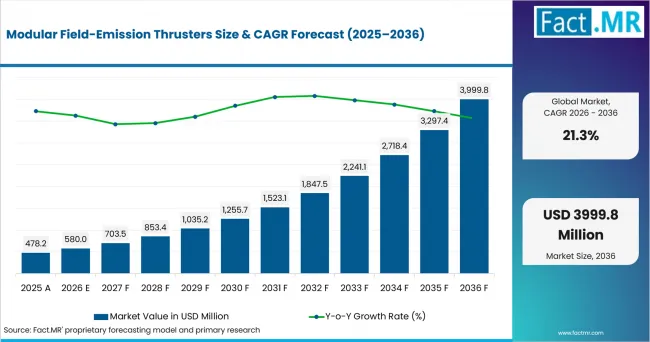
Modular Field Emission Thrusters Value Analysis | Source: Fact.MR
What are the defining numbers behind Modular Field-Emission Thrusters Market growth?
USD 3,419.8 million in absolute opportunity is expected between 2026 and 2036.
- Demand Drivers in the Market
- Small-spacecraft propulsion is becoming a more formal subsystem decision. NASA's 2026 State-of-the-Art of Small Spacecraft Technology includes a dedicated in-space propulsion chapter, reflecting the range of propulsion choices now available to compact spacecraft programs.
- Precision missions favor propulsion that can operate at micro- and milli-newton levels for long durations. ESA identifies this operating range as a natural fit for electric propulsion, increasing the relevance of emitter-based systems where fine thrust control matters.
- European technology roadmaps explicitly include electrospray thrusters, field-emission electric propulsion, power processing units, test facilities and thrust balances. This makes subsystem integration and qualification part of the purchasing decision rather than a separate laboratory step.
- Small-satellite programs create a practical route from technology demonstration to flight hardware. ASI describes CubeSats and other small satellites as increasingly capable platforms for in-orbit demonstrations and more complex missions.
- The same adoption chain supports adjacent demand for all-electric satellites, where propulsion efficiency and spacecraft power allocation are already central design considerations.
- Key Segments Analyzed
- FEEP liquid-metal accounts for 37.0% of Emission Source in 2026 because liquid-metal field emission can deliver fine electrostatic thrust while keeping propellant storage compact.
- The 0.1-1 mN band represents 36.0% of Thrust in 2026, balancing fine control with enough maneuver authority for recurring small-spacecraft corrections.
- Single thruster module accounts for 31.0% of Module Form in 2026 because it can be qualified and integrated as a discrete propulsion subsystem before buyers scale to tiles or clustered panels.
- Precision formation flying represents 31.0% of Mission in 2026 because relative-position control requires small repeatable corrections rather than high-impulse maneuvers.
- Analyst Opinion at Fact.MR
- Shambhu Nath Jha, Senior Consultant, Fact.MR.The commercial threshold is precise thrust delivery within a qualified spacecraft subsystem. Buyers have to evaluate emitter repeatability, power-processing compatibility, contamination behavior and integration limits together because a high-resolution emitter has little value if the complete module cannot sustain the mission duty cycle.
- Strategic Implications
- Thruster suppliers should qualify the emitter, feed system and power-processing interface as a repeatable module rather than treating thrust generation as an isolated component test.
- Satellite integrators should compare thrust resolution with total maneuver authority so that precision control does not create an impractically long correction time.
- Qualification planning should begin early because vacuum performance, thrust measurement and electrical integration can affect program schedules. Related small satellite testing capacity therefore remains part of the commercialization path.
- Power electronics need to be assessed with the thruster rather than after mechanical integration. This connects directly with space power HIL work used to validate spacecraft electrical behavior before flight.
How does the Modular Field-Emission Thrusters Market break down by segment?
The market is segmented by Emission Source, Thrust, Module Form, Mission, and Region.
Why does FEEP liquid-metal lead Emission Source?
FEEP liquid-metal is projected to account for 37.0% of Emission Source in 2026.
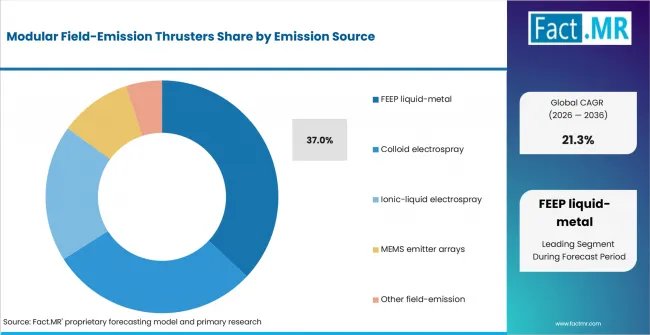
Modular Field Emission Thrusters Analysis By Emission Source | Source: Fact.MR
Field-emission propulsion uses strong electric fields to extract and accelerate charged particles. A liquid-metal reservoir can provide a compact propellant source for this process, which suits spacecraft that need many small control actions over a long mission rather than short high-thrust burns.
ESA's electric-propulsion technology scope explicitly includes electrospray thrusters and Field Emission Electric Propulsion alongside power-processing units, flow control and thrust measurement. The architecture therefore competes at subsystem level, where emitter stability and electronics matter together.
This qualification logic also supports demand for thruster test equipment that can resolve low thrust in vacuum while checking power and plume behavior.
Why does the 0.1-1 mN band lead Thrust?
The 0.1-1 mN band is projected to account for 24.0% of Thrust in 2026.
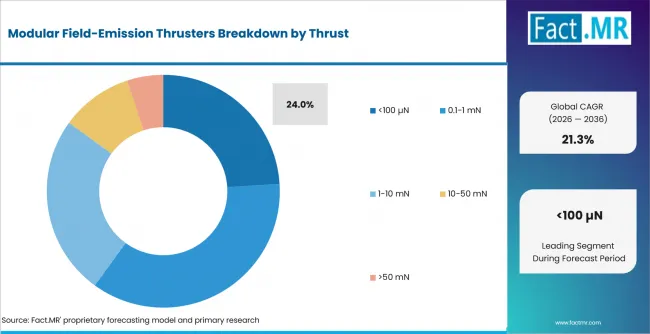
Modular Field Emission Thrusters Analysis By Thrust | Source: Fact.MR
This range sits above ultra-fine disturbance compensation while remaining low enough for controlled continuous or repeated corrections. It can therefore serve spacecraft that need precise orbit or attitude changes without moving into propulsion classes designed for large impulsive maneuvers.
ESA identifies electric propulsion as suitable for micro- and milli-newton long-duration applications. The 0.1-1 mN band falls directly inside that operating logic, giving buyers useful control authority while preserving the mass-efficiency advantage associated with electric propulsion.
Why does Single thruster module lead Module Form?
Single thruster module is projected to account for 31.0% of Module Form in 2026.
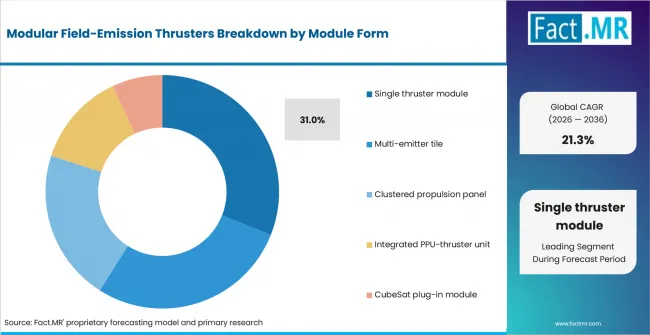
Modular Field Emission Thrusters Analysis By Module Form | Source: Fact.MR
A discrete module limits the first integration problem to one feed path, one emitter assembly and one defined electrical interface. That makes functional testing, failure isolation and spacecraft accommodation more manageable before an integrator adopts multi-emitter tiles or clustered panels.
ECSS has expanded its standards architecture with an Industrialization, Production and Maintenance branch, while its existing quality and engineering standards continue to shape space-hardware qualification. Modular propulsion suppliers therefore benefit when manufacturing controls can be repeated from unit to unit.
Manufacturing repeatability also matters as propulsion hardware adopts complex compact parts. The related 3D printed satellites market illustrates the wider push to qualify lower-mass space hardware without weakening verification requirements.
Why does Precision formation flying lead Mission?
Precision formation flying is projected to account for 31.0% of Mission in 2026.
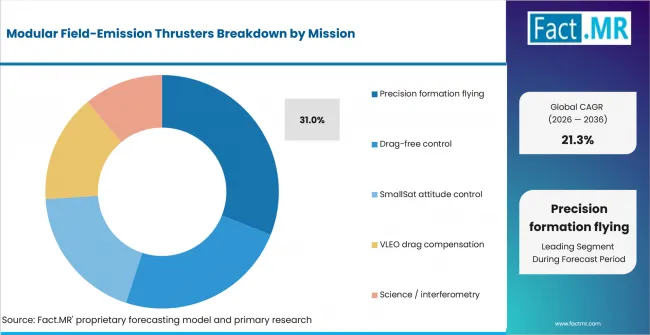
Modular Field Emission Thrusters Analysis By Mission | Source: Fact.MR
Formation-flying spacecraft must control relative position and velocity with small corrections that do not overwhelm the guidance loop. A propulsion module with fine thrust resolution can support this requirement by spreading control authority over repeated low-impulse actions.
NASA's 2026 small-spacecraft technology report treats in-space propulsion and guidance, navigation and control as separate but linked subsystems. That relationship is important for formation flying because propulsion performance has to remain predictable inside the spacecraft's closed-loop control architecture.
Mission planners evaluating distributed or security-sensitive spacecraft can also compare propulsion choices with the broader evolution of defence satellites where responsive in-orbit control has increasing operational value.
What is accelerating Modular Field-Emission Thrusters Market adoption, and what is holding it back?
Demand is being accelerated by precision-orbit missions and smaller spacecraft that need efficient low-thrust control. The main opportunity lies in multi-emitter and integrated PPU architectures, while qualification burden and limited maneuver authority at very low thrust can delay adoption.
Fact.MR estimates the following directional effects on CAGR. The factors interact, so their impacts should not be added together.
Drivers Impact Analysis
| Factor | (~) % Impact on CAGR | Geographic Relevance | Impact Timeline |
|---|---|---|---|
| Precision formation and drag-free control programs | +4.8% | Europe, USA | Short term (<= 2 years) |
| Small-satellite propulsion integration | +4.1% | USA, Italy, Finland | Medium term (2-4 years) |
| Mass-efficient electric propulsion for low-thrust missions | +3.7% | Global | Long term (>= 4 years) |
Source: Fact.MR analysis. Updated Sep 15, 2026
Opportunity Impact Analysis
| Factor | (~) % Impact on CAGR | Geographic Relevance | Impact Timeline |
|---|---|---|---|
| Multi-emitter tiles and clustered propulsion panels | +3.2% | Europe, USA | Medium term (2-4 years) |
| Integrated PPU-thruster units | +2.7% | USA, Europe | Short term (<= 2 years) |
| VLEO drag-compensation architectures | +2.5% | Europe | Long term (>= 4 years) |
Source: Fact.MR analysis. Updated Sep 15, 2026
Restraints Impact Analysis
| Factor | (~) % Impact on CAGR | Geographic Relevance | Impact Timeline |
|---|---|---|---|
| Qualification and contamination-control burden | -3.4% | Europe, USA | Short term (<= 2 years) |
| Limited maneuver authority at very low thrust | -2.6% | Global | Medium term (2-4 years) |
| High-voltage and PPU integration complexity | -2.2% | Global | Medium term (2-4 years) |
Source: Fact.MR analysis. Updated Sep 15, 2026
Which countries are scaling the Modular Field-Emission Thrusters Market through 2036?
- Austria: National space programs and ESA participation support a domestic route for propulsion development, vacuum testing and flight demonstration within a compact space-industry base.
- USA: NASA's 2026 small-spacecraft technology work keeps in-space propulsion inside the core subsystem roadmap for increasingly capable small spacecraft.
- France: ONERA maintains electric-propulsion research and vacuum-test capability, including the ERIS chamber and precision thrust-measurement infrastructure.
- Italy: ASI's micro- and nanosatellite programs create recurring opportunities to demonstrate enabling technologies on standardized small-spacecraft platforms.
- Finland: VTT combines CubeSat mission experience with component testing and qualification services, supporting the development path for compact space hardware.
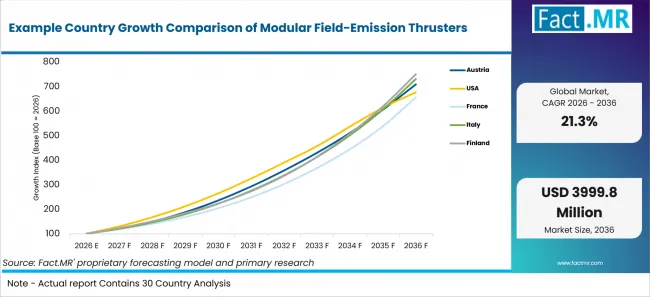
Example Country Growth Comparison Of Modular Field Emission Thrusters | Source: Fact.MR
| Country | CAGR (2026-2036) |
|---|---|
| Austria | 21.7% |
| USA | 21.2% |
| France | 20.7% |
| Italy | 22.0% |
| Finland | 22.3% |
Source: Fact.MR analysis. Updated Sep 15, 2026
What is driving Austria's growth through 2036?
Austria is forecast to expand at a 21.7% CAGR from 2026 to 2036.
Austria's federal space program supports technology development, pilot projects and participation in ESA programs. The ministry also maintains the Austrian Registry for Space Objects, tying domestic spacecraft activity to a formal national space framework.
For modular field-emission thrusters, the commercial mechanism is access to programs that can move a propulsion subsystem from laboratory testing into an integrated spacecraft demonstration. A smaller national ecosystem can still create repeat demand when qualification knowledge is reused across successive missions.
What is driving the USA's growth through 2036?
The USA is forecast to expand at a 21.2% CAGR from 2026 to 2036.
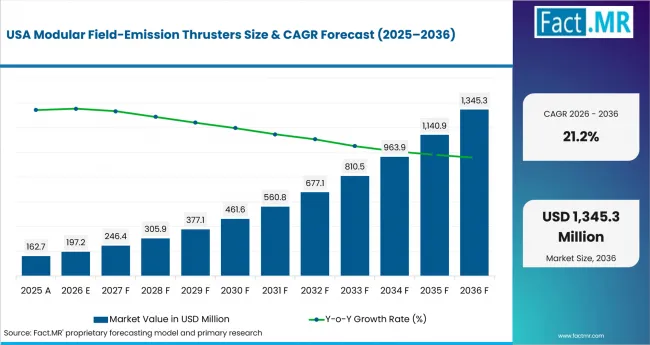
Modular Field Emission Thrusters Country Value Analysis | Source: Fact.MR
NASA's 2026 State-of-the-Art of Small Spacecraft Technology updates the complete in-space propulsion chapter and links current propulsion choices to more capable SmallSat missions. That keeps low-mass propulsion relevant to spacecraft designers that need maneuvering without a large propulsion allocation.
The USA market is therefore tied to mission demonstrations, subsystem qualification and a broad small-spacecraft development base. Field-emission suppliers have to show that the full propulsion module can be integrated with spacecraft power and control systems, not merely that an emitter produces thrust.
What is driving France's growth through 2036?
France is forecast to expand at a 20.7% CAGR from 2026 to 2036.
ONERA's 2025 electric-propulsion work documents the ECRA thruster program and the ERIS vacuum chamber, which includes thrust balances and plasma measurement capability. This type of infrastructure matters because low-thrust propulsion has to be measured accurately under representative vacuum conditions.
France's growth mechanism is therefore linked to propulsion research depth and test capability. Although field-emission architectures differ from ECRA technology, the same qualification need applies: thrust, plasma behavior and subsystem performance must be characterized before flight integration.
What is driving Italy's growth through 2036?
Italy is forecast to expand at a 22.0% CAGR from 2026 to 2036.
ASI treats micro- and nanosatellites as platforms for increasingly complex missions and in-orbit demonstrations. Its small-satellite programs give propulsion developers a practical route to test miniaturized enabling technologies within standardized spacecraft architectures.
This supports modular field-emission demand where integrators need compact propulsion with a clear mechanical and electrical interface. A discrete module can enter a demonstration mission before the same emitter technology is scaled into a larger tile or clustered propulsion panel.
What is driving Finland's growth through 2036?
Finland is forecast to expand at a 22.3% CAGR from 2026 to 2036.
VTT develops components and systems for small satellites and offers testing, modelling and qualification services. Its CubeSat mission experience creates a practical environment for compact hardware that has to move from prototype into a flight-ready subsystem.
For field-emission thrusters, the relevant mechanism is integration discipline. Miniaturized propulsion competes for limited spacecraft volume and power, so suppliers that can provide stable module behavior and test evidence are better positioned for repeat small-satellite programs.
Who Leads the Modular Field-Emission Thrusters Market?
Competition is distributed across specialized propulsion developers with different emitter architectures, module formats and mission heritage.
Enpulsion, Busek, Accion Systems, SITAEL, ThrustMe and Aurora Propulsion Technologies participate in the competitive landscape. Supplier differentiation depends on thrust stability, power-processing integration, package size, qualification evidence and the ability to support spacecraft-level integration.
The market remains technically selective because the propulsion unit is a mission-critical subsystem. Buyers therefore place weight on repeatable performance and integration support before scaling from a single module to multi-emitter or clustered architectures.
Which companies are the key providers?
Key Companies include Enpulsion; Busek; Accion Systems; SITAEL; ThrustMe; Aurora Propulsion Technologies
- Enpulsion
- Busek
- Accion Systems
- SITAEL
- ThrustMe
- Aurora Propulsion Technologies
Bibliography
- Federal Ministry for Innovation, Mobility and Infrastructure. (2026). Space Technology. Republic of Austria.
- National Aeronautics and Space Administration. (2026). State-of-the-Art of Small Spacecraft Technology: In-Space Propulsion. NASA.
- ONERA. (2025). Electric Propulsion: ECRA Technology. French Aerospace Lab.
- Italian Space Agency. (2026). Micro and Nanosatellites. ASI.
- VTT Technical Research Centre of Finland. (2026). Space Technology. VTT.
- European Space Agency. (2026). Electric Propulsion Technologies. ESA Technology Harmonisation.
- European Space Agency. (2026). What is Electric Propulsion? ESA.
- European Cooperation for Space Standardization. (2025). I-Branch is born! ECSS.
- European Cooperation for Space Standardization. (2025). Cleanliness and Contamination Control. ECSS-Q-ST-70-01C Rev.1.
This Report Answers
- How field-emission and electrospray propulsion fit into small-spacecraft control architectures.
- Which emission-source, thrust, module-form and mission categories shape current demand.
- Why qualification, power-processing integration and low-thrust measurement influence procurement.
- How the five covered countries differ in space-program, research and qualification mechanisms.
- Where multi-emitter tiles, clustered panels and integrated PPU-thruster units can expand the addressable market.
- Which specialized propulsion companies participate in the competitive landscape.
What does the Modular Field-Emission Thrusters Market cover?
The market covers modular spacecraft propulsion units that generate low thrust through field-emission or electrospray mechanisms. Commercial value includes complete thruster modules and integrated propulsion forms built around FEEP liquid-metal, colloid electrospray, ionic-liquid electrospray, MEMS emitter arrays or other field-emission architectures.
The market boundary extends from ultra-low-thrust control below 100 µN through systems above 50 mN when the underlying propulsion mechanism remains within the defined field-emission scope. Mission coverage includes precision formation flying, drag-free control, SmallSat attitude control, VLEO drag compensation and science or interferometry applications.
What is included in the scope?
- FEEP liquid-metal, colloid electrospray, ionic-liquid electrospray, MEMS emitter arrays and other field-emission propulsion sources.
- Thrust classes below 100 µN, 0.1-1 mN, 1-10 mN, 10-50 mN and above 50 mN.
- Single thruster modules, multi-emitter tiles, clustered propulsion panels, integrated PPU-thruster units and CubeSat plug-in modules.
- Precision formation flying, drag-free control, SmallSat attitude control, VLEO drag compensation and science or interferometry missions.
- Country analysis for Austria, USA, France, Italy and Finland, together with the standard global regional coverage.
What is excluded from the scope?
- Hall-effect, gridded-ion, resistojet, arcjet, cold-gas and chemical thrusters when they are sold without a field-emission or electrospray propulsion function.
- Standalone satellite buses, payloads, launch vehicles and ground-segment services.
- Vacuum chambers, thrust stands and diagnostic equipment sold as independent test-equipment markets rather than as part of a propulsion module.
- Standalone power-processing units, feed electronics and mission software when they are not supplied as an integrated thruster unit.
How Was the Analysis Built?
- Primary Research
- Validation is structured around propulsion developers, satellite integrators, test engineers and technical procurement teams that evaluate thrust range, module integration, qualification and mission fit.
- Desk Research
- The evidence base uses national space agencies, public research centres, ESA technical material and ECSS standards to explain propulsion mechanisms, small-satellite programs and qualification requirements.
- Market Sizing and Forecasting
- Sizing considers module value, propulsion architecture, thrust class, spacecraft integration path and mission adoption across the defined market boundary. Forecast assumptions distinguish single-module deployment from multi-emitter and clustered configurations.
- Data Validation and Update Cycle
- Market direction is checked against current space-program activity, propulsion research, test capability and standards changes that can alter qualification requirements or the timing of flight adoption.
Segmentation
What is the report's scope and coverage?
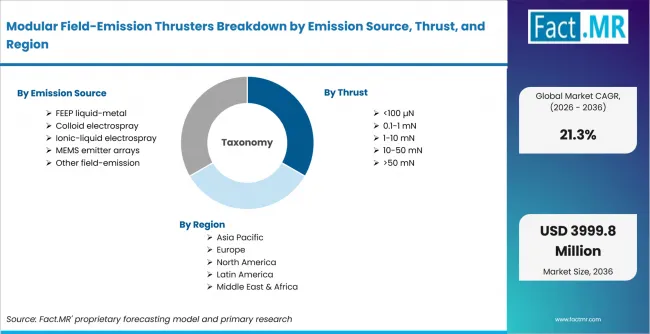
Modular Field Emission Thrusters Breakdown By Emission Source, Thrust, And Region | Source: Fact.MR
| Attribute | Details |
|---|---|
| Quantitative Units | USD million |
| Market Definition | Modular field-emission and electrospray spacecraft thruster systems for precision low-thrust control. |
| Segments Covered | Emission Source; Thrust; Module Form; Mission; Region |
| Regions Covered | North America; Latin America; Western Europe; Eastern Europe; East Asia; South Asia & Pacific; Middle East & Africa |
| Countries Covered | Austria; USA; France; Italy; Finland |
| Key Companies Profiled | Enpulsion; Busek; Accion Systems; SITAEL; ThrustMe; Aurora Propulsion Technologies |
| Forecast Period | 2026 to 2036 |
| Market Value, 2025 | USD 478.2 million |
| Market Value, 2026 | USD 580.0 million |
| Market Value, 2036 | USD 3,999.8 million |
| CAGR, 2026-2036 | 21.3% |
| Absolute Opportunity | USD 3,419.8 million |
| Approach | Module-level sizing supported by mission adoption, thrust-class mix and qualification conditions. |
Source: Fact.MR analysis. Updated Sep 15, 2026
How is the market segmented?
-
By Emission Source
- FEEP liquid-metal
- Colloid electrospray
- Ionic-liquid electrospray
- MEMS emitter arrays
- Other field-emission
-
By Thrust
- <100 µN
- 0.1-1 mN
- 1-10 mN
- 10-50 mN
- >50 mN
-
By Module Form
- Single thruster module
- Multi-emitter tile
- Clustered propulsion panel
- Integrated PPU-thruster unit
- CubeSat plug-in module
-
By Mission
- Precision formation flying
- Drag-free control
- SmallSat attitude control
- VLEO drag compensation
- Science / interferometry
-
By Region
- North America
- Latin America
- Western Europe
- Eastern Europe
- East Asia
- South Asia & Pacific
- Middle East & Africa
Frequently Asked Questions
What is the Modular Field-Emission Thrusters Market value in 2026?
At what CAGR is the market projected to grow?
What is the projected market value by 2036?
Which Emission Source leads the market?
Which Thrust class leads the market?
Which Module Form leads the market?
Which Mission leads the market?
Which country records the highest listed CAGR?
What is the primary demand driver?
What is the main restraint?
Which companies are included in the market assessment?
Who worked on this report


Preview the report firsthand - request a free sample
Free SampleGet the brochure for pricing and purchase details
Download PDF