mRNA Cancer Vaccine Biologic Lines Market

mRNA Cancer Vaccine Biologic Lines Market Size and Share Forecast Outlook 2026 to 2036

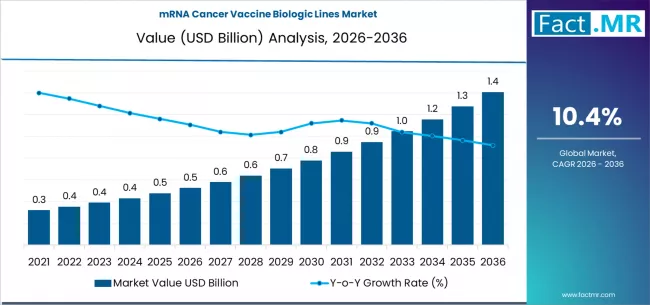
mRNA cancer vaccine biologic lines market is projected to grow from USD 0.5 billion in 2026 to USD 1.4 billion by 2036, at a CAGR of 10.4%. Solid tumors will dominate with a 37.5% market share, while phase ii will lead the development stage segment with a 39.9% share.

mRNA Cancer Vaccine Biologic Lines Market Forecast and Outlook 2026 to 2036

The global market for mRNA cancer vaccine biologic production lines is projected to total USD 0.52 billion in 2026, advancing to USD 1.41 billion by 2036. A compound annual growth rate of 10.4% is forecast for the period from 2026 to 2036.

This expansion is fundamentally driven by the transition of mRNA vaccine technology from pandemic response to a promising new modality in oncology, necessitating specialized, scalable manufacturing infrastructure.

Key Takeaways from the mRNA Cancer Vaccine Biologic Lines Market

  • Market Value for 2026: USD 0.52 Billion
  • Market Value for 2036: USD 1.41 Billion
  • Forecast CAGR 2026 to 2036: 10.4%
  • Leading Indication Segment (2026): Solid Tumors (37%)
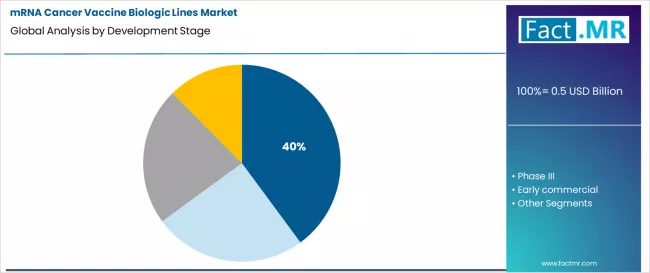
  • Leading Development Stage Segment (2026): Phase II (40%)
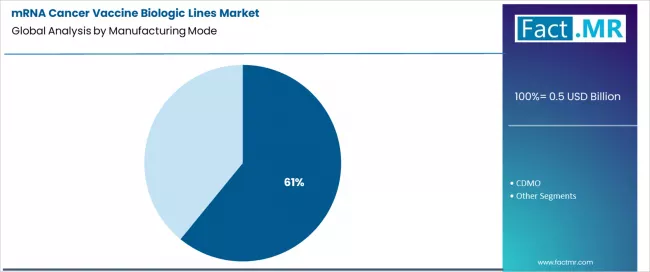
  • Leading Manufacturing Mode Segment (2026): In-house (61%)
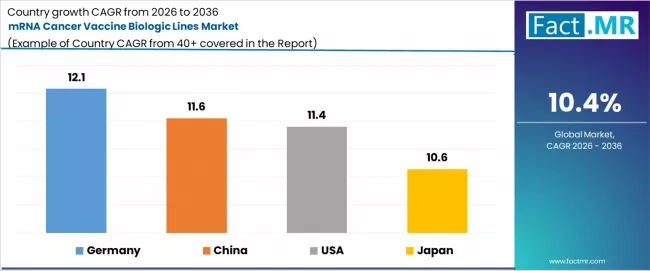
  • Key Growth Countries: Germany (12.1% CAGR), China (11.6% CAGR), USA (11.4% CAGR), Japan (10.6% CAGR)
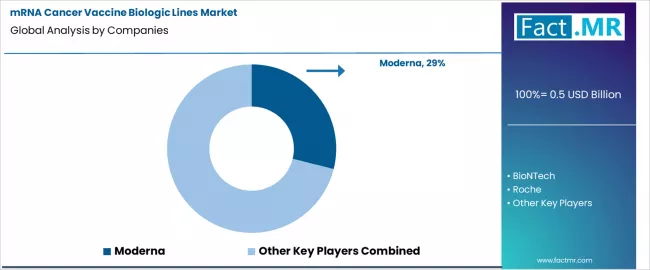
  • Key Players in the Market: Moderna, BioNTech, Roche, Pfizer Inc., CureVac, GSK

Mrna Cancer Vaccine Biologic Lines Market Market Value Analysis

The shift from developing infectious disease vaccines to personalized or shared-antigen cancer vaccines introduces complex new production requirements. These include handling diverse DNA templates, managing smaller, multi-product batches, and ensuring stringent aseptic processing for patient-specific therapies.

Dedicated mRNA biologic lines have become indispensable, engineered to provide the flexibility, regulatory compliance, and process control necessary to support clinical trials and eventual commercialization of these novel immunotherapies.

The market's growth is a direct product of robust clinical pipelines demonstrating proof-of-concept and the strategic preparation by biopharma firms for potential launches. This landscape, encompassing everything from neoantigen targeting to fixed-antigen vaccines, makes advanced, purpose-built manufacturing solutions a critical enabler of the emerging mRNA oncology sector.

Metric

Metric Value
Market Value (2026) USD 0.52 Billion
Market Forecast Value (2036) USD 1.41 Billion
Forecast CAGR 2026 to 2036 10.4%

Category

Category Segments
Indication Solid Tumors, Melanoma, Colorectal Cancer, Lung Cancer, Other Oncology Indications
Development Stage Phase II, Phase III, Early Commercial, Pre-registration
Manufacturing Mode In-house, CDMO
Region North America, Latin America, Western Europe, Eastern Europe, East Asia, South Asia & Pacific, MEA

Segmental Analysis

By Indication, Which Cancer Type is the Primary Focus of Current Research?

Mrna Cancer Vaccine Biologic Lines Market Analysis By Indication

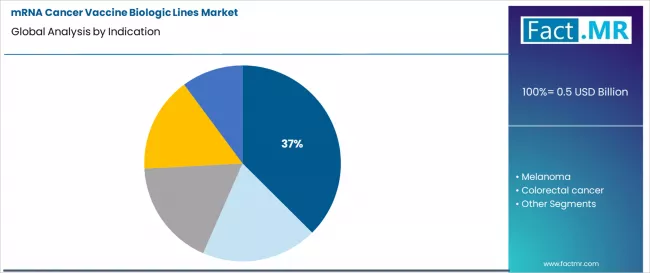
Solid tumors command a leading 37% share. This broad segment's dominance reflects the high unmet need across numerous cancer types and the applicability of mRNA platforms to target shared tumor-associated antigens or patient-specific neoantigens prevalent in carcinomas and sarcomas.

The significant incidence and mortality rates associated with cancers like breast, prostate, and pancreatic drive concentrated R&D efforts, making this category the primary testing ground for novel mRNA vaccine candidates and their associated production processes.

By Development Stage, Where is the Heaviest Investment in Manufacturing Readiness?

Mrna Cancer Vaccine Biologic Lines Market Analysis By Development Stage

Phase II trials lead the development stage segment with a 40% share. This phase represents the critical juncture where proof-of-concept is established and planning for potential commercialization intensifies.

Investment in dedicated or reserved biologic production lines at this stage is essential to ensure supply for larger Phase III trials and to de-risk the regulatory pathway by demonstrating consistent, scalable manufacturing processes early, justifying significant capital allocation for facility fit-outs and technology transfers.

By Manufacturing Mode, Who Controls the Core Production Technology?

Mrna Cancer Vaccine Biologic Lines Market Analysis By Manufacturing Mode

In-house manufacturing constitutes the dominant segment, holding 61% of the market. Pioneering mRNA vaccine developers, having invested heavily in proprietary platform technology and lipid nanoparticle formulation, maintain tight control over core production to protect intellectual property and ensure process fidelity.

This strategy allows for rapid iteration and scaling as clinical programs advance. Building internal GMP capacity is viewed as a strategic imperative for securing supply and controlling timelines for these high-value, complex biologic products.

What are the Principal Drivers, Constraints, and Evolving Dynamics of this Market?

The principal driver is the critical bandwidth demand of edge AI accelerators, where HBM's stacked architecture uniquely delivers necessary terabytes-per-second speed within strict power and thermal limits, overcoming the memory bottleneck for real-time performance.

A major restraint is the high cost and complex manufacturing involving through-silicon vias and precise stacking, which results in lower yields and elevated prices, hindering adoption in cost-sensitive edge applications.

A key opportunity exists in developing specialized HBM variants, like ultra-low-power or ruggedized stacks, tailored for specific edge environments such as mobile devices or industrial systems, opening high-margin niche markets.

The defining trend is the deep co-design partnership between HBM suppliers, AI chip designers, and packaging foundries. This collaboration is shifting from standard products to creating custom-stacked memory solutions optimized for specific processor architectures, making HBM a bespoke, system-critical component.

Analysis of the mRNA Cancer Vaccine Biologic Lines Market by Key Countries

Mrna Cancer Vaccine Biologic Lines Market Cagr Analysis By Country

Country CAGR 2026 to 2036
Germany 12.1%
China 11.6%
USA 11.4%
Japan 10.6%

How does Germany's Biotech Innovation and Regulatory Leadership Foster Growth?

Germany's leading growth rate of 12.1% CAGR is anchored in its position as a European biotech powerhouse, home to mRNA pioneers like BioNTech and CureVac. The country’s growth is fueled by substantial public and private R&D investment in oncology immunotherapies and a strong regulatory environment through the Paul-Ehrlich-Institut.

This ecosystem supports a high concentration of clinical trial activity for mRNA cancer vaccines, which in turn drives demand for state-of-the-art, flexible pilot and commercial-scale production lines within domestic facilities to serve both European and global markets.

What drives China's Rapid Expansion in Advanced Biologics Manufacturing?

China's growth at 11.6% CAGR is propelled by a strategic national focus on achieving self-reliance in advanced biomanufacturing as part of its Made in China 2025 healthcare objectives. The market is expanding through massive investments in building local GMP capacity that meets international standards.

Domestic biopharma companies are aggressively licensing and co-developing mRNA oncology candidates, while multinationals are establishing local production hubs. This dual activity creates significant demand for new, technologically advanced fill-finish and lipid nanoparticle assembly lines tailored for the Chinese biopharma landscape.

How does the USA's Concentrated Biopharma Ecosystem Catalyze Investment?

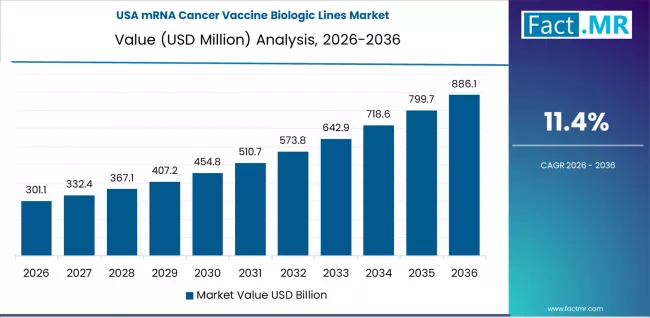
Mrna Cancer Vaccine Biologic Lines Market Country Value Analysis

The USA's growth, forecast at 11.4% CAGR, is driven by its dense ecosystem of leading oncology research centers, venture capital, and established biopharma giants. The high number of mRNA cancer vaccine candidates progressing through the US FDA's clinical trial pathways creates immediate, localized demand for manufacturing scale-up.

Growth is characterized by investments in flexible, modular production facilities that can pivot between different vaccine candidates and by strategic partnerships between innovators and established manufacturers preparing for potential first-to-market launches in the lucrative US oncology sector.

What Factors Underpin Japan's Focus on Precision Oncology and Manufacturing Quality?

Japan's significant growth at 10.6% CAGR is driven by its rapid adoption of advanced cancer therapies, a supportive regulatory framework for regenerative and cell therapy products (which shares parallels with mRNA vaccines), and an aging demographic with high cancer prevalence.

The market emphasis is on ultra-high-quality, automated manufacturing systems that ensure precision and aseptic integrity, aligning with Japan's stringent GMP standards. Partnerships between domestic pharmaceutical companies and international mRNA technology leaders are key, driving investments in dedicated production suites to serve the precise needs of the Japanese and broader Asian markets.

Competitive Landscape of the mRNA Cancer Vaccine Biologic Lines Market

Mrna Cancer Vaccine Biologic Lines Market Analysis By Company

The competitive landscape features established mRNA platform leaders like Moderna and BioNTech, who are vertically integrating manufacturing, and large pharmaceutical companies like Roche, Pfizer, and GSK entering through partnerships and acquisitions. Competition centers on technological leadership in rapid, scalable mRNA production and lipid nanoparticle formulation, as well as securing strategic manufacturing capacity for late-stage clinical and early commercial supply.

Success depends on demonstrating robust, transferable processes, securing regulatory approvals for manufacturing sites, and forming alliances with CDMOs for global reach. The high technical and capital barriers create an advantage for early movers with proven pandemic-scale production experience.

Key Players in the mRNA Cancer Vaccine Biologic Lines Market

  • Moderna
  • BioNTech
  • Roche
  • Pfizer Inc.
  • CureVac
  • GSK

Scope of Report

Items Values
Quantitative Units USD Billion
Indication Solid Tumors, Melanoma, Colorectal Cancer, Lung Cancer, Other Oncology Indications
Development Stage Phase II, Phase III, Early Commercial, Pre-registration
Manufacturing Mode In-house, CDMO
Key Countries Germany, China, USA, Japan
Key Companies Moderna, BioNTech, Roche, Pfizer, CureVac, GSK
Additional Analysis Comparative analysis of capital expenditure for flexible vs. dedicated mRNA production suites; study of supply chain risks for lipid nanoparticles and nucleotides; total cost of goods analysis for personalized vs. off-the-shelf cancer vaccines; impact of regulatory pathways (e.g., accelerated approval) on manufacturing scale-up timing; assessment of single-use versus stainless-steel technologies in mRNA biologic lines.

Market by Segments

  • Indication :

    • Solid Tumors
    • Melanoma
    • Colorectal Cancer
    • Lung Cancer
    • Other Oncology Indications
  • Development Stage :

    • Phase II
    • Phase III
    • Early Commercial
    • Pre-registration
  • Manufacturing Mode :

    • In-house
    • CDMO
  • Region :

    • North America
      • USA
      • Canada
    • Latin America
      • Brazil
      • Mexico
      • Argentina
      • Rest of Latin America
    • Western Europe
      • Germany
      • France
      • Italy
      • Spain
      • UK
      • BENELUX
      • Rest of Western Europe
    • Eastern Europe
      • Russia
      • Poland
      • Czech Republic
      • Rest of Eastern Europe
    • East Asia
      • China
      • Japan
      • South Korea
      • Rest of East Asia
    • South Asia & Pacific
      • India
      • ASEAN
      • Australia
      • Rest of South Asia & Pacific
    • MEA
      • GCC Countries
      • South Africa
      • Turkiye
      • Rest of MEA

References

  • Dolgin, E. (2024). The tangled history of mRNA vaccines. Nature, 625(7995), 20-25. International Society for Pharmaceutical Engineering. (2025). ISPE Baseline Guide: Advanced Therapeutic Medicinal Products (ATMPs). ISPE.
  • Pardi, N., Hogan, M. J., & Weissman, D. (2024). Recent advances in mRNA vaccine technology. Current Opinion in Immunology, 88, 102234.
  • Sahin, U., & Türeci, Ö. (2025). mRNA: A game-changer for personalized cancer immunotherapy. Elsevier.
  • World Health Organization. (2025). Guidelines for the production and quality control of mRNA vaccines. WHO Technical Report Series, No. 1045.

Table of Content

  1. Executive Summary
    • Global Market Outlook
    • Demand to side Trends
    • Supply to side Trends
    • Technology Roadmap Analysis
    • Analysis and Recommendations
  2. Market Overview
    • Market Coverage / Taxonomy
    • Market Definition / Scope / Limitations
  3. Market Background
    • Market Dynamics
      • Drivers
      • Restraints
      • Opportunity
      • Trends
    • Scenario Forecast
      • Demand in Optimistic Scenario
      • Demand in Likely Scenario
      • Demand in Conservative Scenario
    • Opportunity Map Analysis
    • Product Life Cycle Analysis
    • Supply Chain Analysis
    • Investment Feasibility Matrix
    • Value Chain Analysis
    • PESTLE and Porter’s Analysis
    • Regulatory Landscape
    • Regional Parent Market Outlook
    • Production and Consumption Statistics
    • Import and Export Statistics
  4. Global Market Analysis 2021 to 2025 and Forecast, 2026 to 2036
    • Historical Market Size Value (USD Million) Analysis, 2021 to 2025
    • Current and Future Market Size Value (USD Million) Projections, 2026 to 2036
      • Y to o to Y Growth Trend Analysis
      • Absolute $ Opportunity Analysis
  5. Global Market Pricing Analysis 2021 to 2025 and Forecast 2026 to 2036
  6. Global Market Analysis 2021 to 2025 and Forecast 2026 to 2036, By Indication
    • Introduction / Key Findings
    • Historical Market Size Value (USD Million) Analysis By Indication, 2021 to 2025
    • Current and Future Market Size Value (USD Million) Analysis and Forecast By Indication, 2026 to 2036
      • Solid tumors
      • Melanoma
      • Colorectal cancer
      • Lung cancer
      • Other Oncology Indications
    • Y to o to Y Growth Trend Analysis By Indication, 2021 to 2025
    • Absolute $ Opportunity Analysis By Indication, 2026 to 2036
  7. Global Market Analysis 2021 to 2025 and Forecast 2026 to 2036, By Development Stage
    • Introduction / Key Findings
    • Historical Market Size Value (USD Million) Analysis By Development Stage, 2021 to 2025
    • Current and Future Market Size Value (USD Million) Analysis and Forecast By Development Stage, 2026 to 2036
      • Phase II
      • Phase III
      • Early commercial
      • Pre-registration
    • Y to o to Y Growth Trend Analysis By Development Stage, 2021 to 2025
    • Absolute $ Opportunity Analysis By Development Stage, 2026 to 2036
  8. Global Market Analysis 2021 to 2025 and Forecast 2026 to 2036, By Manufacturing Mode
    • Introduction / Key Findings
    • Historical Market Size Value (USD Million) Analysis By Manufacturing Mode, 2021 to 2025
    • Current and Future Market Size Value (USD Million) Analysis and Forecast By Manufacturing Mode, 2026 to 2036
      • In-house
      • CDMO
    • Y to o to Y Growth Trend Analysis By Manufacturing Mode, 2021 to 2025
    • Absolute $ Opportunity Analysis By Manufacturing Mode, 2026 to 2036
  9. Global Market Analysis 2021 to 2025 and Forecast 2026 to 2036, By Region
    • Introduction
    • Historical Market Size Value (USD Million) Analysis By Region, 2021 to 2025
    • Current Market Size Value (USD Million) Analysis and Forecast By Region, 2026 to 2036
      • North America
      • Latin America
      • Western Europe
      • Eastern Europe
      • East Asia
      • South Asia and Pacific
      • Middle East & Africa
    • Market Attractiveness Analysis By Region
  10. North America Market Analysis 2021 to 2025 and Forecast 2026 to 2036, By Country
    • Historical Market Size Value (USD Million) Trend Analysis By Market Taxonomy, 2021 to 2025
    • Market Size Value (USD Million) Forecast By Market Taxonomy, 2026 to 2036
      • By Country
        • USA
        • Canada
        • Mexico
      • By Indication
      • By Development Stage
      • By Manufacturing Mode
    • Market Attractiveness Analysis
      • By Country
      • By Indication
      • By Development Stage
      • By Manufacturing Mode
    • Key Takeaways
  11. Latin America Market Analysis 2021 to 2025 and Forecast 2026 to 2036, By Country
    • Historical Market Size Value (USD Million) Trend Analysis By Market Taxonomy, 2021 to 2025
    • Market Size Value (USD Million) Forecast By Market Taxonomy, 2026 to 2036
      • By Country
        • Brazil
        • Chile
        • Rest of Latin America
      • By Indication
      • By Development Stage
      • By Manufacturing Mode
    • Market Attractiveness Analysis
      • By Country
      • By Indication
      • By Development Stage
      • By Manufacturing Mode
    • Key Takeaways
  12. Western Europe Market Analysis 2021 to 2025 and Forecast 2026 to 2036, By Country
    • Historical Market Size Value (USD Million) Trend Analysis By Market Taxonomy, 2021 to 2025
    • Market Size Value (USD Million) Forecast By Market Taxonomy, 2026 to 2036
      • By Country
        • Germany
        • UK
        • Italy
        • Spain
        • France
        • Nordic
        • BENELUX
        • Rest of Western Europe
      • By Indication
      • By Development Stage
      • By Manufacturing Mode
    • Market Attractiveness Analysis
      • By Country
      • By Indication
      • By Development Stage
      • By Manufacturing Mode
    • Key Takeaways
  13. Eastern Europe Market Analysis 2021 to 2025 and Forecast 2026 to 2036, By Country
    • Historical Market Size Value (USD Million) Trend Analysis By Market Taxonomy, 2021 to 2025
    • Market Size Value (USD Million) Forecast By Market Taxonomy, 2026 to 2036
      • By Country
        • Russia
        • Poland
        • Hungary
        • Balkan & Baltic
        • Rest of Eastern Europe
      • By Indication
      • By Development Stage
      • By Manufacturing Mode
    • Market Attractiveness Analysis
      • By Country
      • By Indication
      • By Development Stage
      • By Manufacturing Mode
    • Key Takeaways
  14. East Asia Market Analysis 2021 to 2025 and Forecast 2026 to 2036, By Country
    • Historical Market Size Value (USD Million) Trend Analysis By Market Taxonomy, 2021 to 2025
    • Market Size Value (USD Million) Forecast By Market Taxonomy, 2026 to 2036
      • By Country
        • China
        • Japan
        • South Korea
      • By Indication
      • By Development Stage
      • By Manufacturing Mode
    • Market Attractiveness Analysis
      • By Country
      • By Indication
      • By Development Stage
      • By Manufacturing Mode
    • Key Takeaways
  15. South Asia and Pacific Market Analysis 2021 to 2025 and Forecast 2026 to 2036, By Country
    • Historical Market Size Value (USD Million) Trend Analysis By Market Taxonomy, 2021 to 2025
    • Market Size Value (USD Million) Forecast By Market Taxonomy, 2026 to 2036
      • By Country
        • India
        • ASEAN
        • Australia & New Zealand
        • Rest of South Asia and Pacific
      • By Indication
      • By Development Stage
      • By Manufacturing Mode
    • Market Attractiveness Analysis
      • By Country
      • By Indication
      • By Development Stage
      • By Manufacturing Mode
    • Key Takeaways
  16. Middle East & Africa Market Analysis 2021 to 2025 and Forecast 2026 to 2036, By Country
    • Historical Market Size Value (USD Million) Trend Analysis By Market Taxonomy, 2021 to 2025
    • Market Size Value (USD Million) Forecast By Market Taxonomy, 2026 to 2036
      • By Country
        • Kingdom of Saudi Arabia
        • Other GCC Countries
        • Turkiye
        • South Africa
        • Other African Union
        • Rest of Middle East & Africa
      • By Indication
      • By Development Stage
      • By Manufacturing Mode
    • Market Attractiveness Analysis
      • By Country
      • By Indication
      • By Development Stage
      • By Manufacturing Mode
    • Key Takeaways
  17. Key Countries Market Analysis
    • USA
      • Pricing Analysis
      • Market Share Analysis, 2025
        • By Indication
        • By Development Stage
        • By Manufacturing Mode
    • Canada
      • Pricing Analysis
      • Market Share Analysis, 2025
        • By Indication
        • By Development Stage
        • By Manufacturing Mode
    • Mexico
      • Pricing Analysis
      • Market Share Analysis, 2025
        • By Indication
        • By Development Stage
        • By Manufacturing Mode
    • Brazil
      • Pricing Analysis
      • Market Share Analysis, 2025
        • By Indication
        • By Development Stage
        • By Manufacturing Mode
    • Chile
      • Pricing Analysis
      • Market Share Analysis, 2025
        • By Indication
        • By Development Stage
        • By Manufacturing Mode
    • Germany
      • Pricing Analysis
      • Market Share Analysis, 2025
        • By Indication
        • By Development Stage
        • By Manufacturing Mode
    • UK
      • Pricing Analysis
      • Market Share Analysis, 2025
        • By Indication
        • By Development Stage
        • By Manufacturing Mode
    • Italy
      • Pricing Analysis
      • Market Share Analysis, 2025
        • By Indication
        • By Development Stage
        • By Manufacturing Mode
    • Spain
      • Pricing Analysis
      • Market Share Analysis, 2025
        • By Indication
        • By Development Stage
        • By Manufacturing Mode
    • France
      • Pricing Analysis
      • Market Share Analysis, 2025
        • By Indication
        • By Development Stage
        • By Manufacturing Mode
    • India
      • Pricing Analysis
      • Market Share Analysis, 2025
        • By Indication
        • By Development Stage
        • By Manufacturing Mode
    • ASEAN
      • Pricing Analysis
      • Market Share Analysis, 2025
        • By Indication
        • By Development Stage
        • By Manufacturing Mode
    • Australia & New Zealand
      • Pricing Analysis
      • Market Share Analysis, 2025
        • By Indication
        • By Development Stage
        • By Manufacturing Mode
    • China
      • Pricing Analysis
      • Market Share Analysis, 2025
        • By Indication
        • By Development Stage
        • By Manufacturing Mode
    • Japan
      • Pricing Analysis
      • Market Share Analysis, 2025
        • By Indication
        • By Development Stage
        • By Manufacturing Mode
    • South Korea
      • Pricing Analysis
      • Market Share Analysis, 2025
        • By Indication
        • By Development Stage
        • By Manufacturing Mode
    • Russia
      • Pricing Analysis
      • Market Share Analysis, 2025
        • By Indication
        • By Development Stage
        • By Manufacturing Mode
    • Poland
      • Pricing Analysis
      • Market Share Analysis, 2025
        • By Indication
        • By Development Stage
        • By Manufacturing Mode
    • Hungary
      • Pricing Analysis
      • Market Share Analysis, 2025
        • By Indication
        • By Development Stage
        • By Manufacturing Mode
    • Kingdom of Saudi Arabia
      • Pricing Analysis
      • Market Share Analysis, 2025
        • By Indication
        • By Development Stage
        • By Manufacturing Mode
    • Turkiye
      • Pricing Analysis
      • Market Share Analysis, 2025
        • By Indication
        • By Development Stage
        • By Manufacturing Mode
    • South Africa
      • Pricing Analysis
      • Market Share Analysis, 2025
        • By Indication
        • By Development Stage
        • By Manufacturing Mode
  18. Market Structure Analysis
    • Competition Dashboard
    • Competition Benchmarking
    • Market Share Analysis of Top Players
      • By Regional
      • By Indication
      • By Development Stage
      • By Manufacturing Mode
  19. Competition Analysis
    • Competition Deep Dive
      • Moderna
        • Overview
        • Product Portfolio
        • Profitability by Market Segments (Product/Age /Sales Channel/Region)
        • Sales Footprint
        • Strategy Overview
          • Marketing Strategy
          • Product Strategy
          • Channel Strategy
      • BioNTech
      • Roche
      • Pfizer
      • CureVac
      • GSK
  20. Assumptions & Acronyms Used
  21. Research Methodology

List Of Table

  • Table 1: Global Market Value (USD Million) Forecast by Region, 2021 to 2036
  • Table 2: Global Market Value (USD Million) Forecast by Indication, 2021 to 2036
  • Table 3: Global Market Value (USD Million) Forecast by Development Stage, 2021 to 2036
  • Table 4: Global Market Value (USD Million) Forecast by Manufacturing Mode, 2021 to 2036
  • Table 5: North America Market Value (USD Million) Forecast by Country, 2021 to 2036
  • Table 6: North America Market Value (USD Million) Forecast by Indication, 2021 to 2036
  • Table 7: North America Market Value (USD Million) Forecast by Development Stage, 2021 to 2036
  • Table 8: North America Market Value (USD Million) Forecast by Manufacturing Mode, 2021 to 2036
  • Table 9: Latin America Market Value (USD Million) Forecast by Country, 2021 to 2036
  • Table 10: Latin America Market Value (USD Million) Forecast by Indication, 2021 to 2036
  • Table 11: Latin America Market Value (USD Million) Forecast by Development Stage, 2021 to 2036
  • Table 12: Latin America Market Value (USD Million) Forecast by Manufacturing Mode, 2021 to 2036
  • Table 13: Western Europe Market Value (USD Million) Forecast by Country, 2021 to 2036
  • Table 14: Western Europe Market Value (USD Million) Forecast by Indication, 2021 to 2036
  • Table 15: Western Europe Market Value (USD Million) Forecast by Development Stage, 2021 to 2036
  • Table 16: Western Europe Market Value (USD Million) Forecast by Manufacturing Mode, 2021 to 2036
  • Table 17: Eastern Europe Market Value (USD Million) Forecast by Country, 2021 to 2036
  • Table 18: Eastern Europe Market Value (USD Million) Forecast by Indication, 2021 to 2036
  • Table 19: Eastern Europe Market Value (USD Million) Forecast by Development Stage, 2021 to 2036
  • Table 20: Eastern Europe Market Value (USD Million) Forecast by Manufacturing Mode, 2021 to 2036
  • Table 21: East Asia Market Value (USD Million) Forecast by Country, 2021 to 2036
  • Table 22: East Asia Market Value (USD Million) Forecast by Indication, 2021 to 2036
  • Table 23: East Asia Market Value (USD Million) Forecast by Development Stage, 2021 to 2036
  • Table 24: East Asia Market Value (USD Million) Forecast by Manufacturing Mode, 2021 to 2036
  • Table 25: South Asia and Pacific Market Value (USD Million) Forecast by Country, 2021 to 2036
  • Table 26: South Asia and Pacific Market Value (USD Million) Forecast by Indication, 2021 to 2036
  • Table 27: South Asia and Pacific Market Value (USD Million) Forecast by Development Stage, 2021 to 2036
  • Table 28: South Asia and Pacific Market Value (USD Million) Forecast by Manufacturing Mode, 2021 to 2036
  • Table 29: Middle East & Africa Market Value (USD Million) Forecast by Country, 2021 to 2036
  • Table 30: Middle East & Africa Market Value (USD Million) Forecast by Indication, 2021 to 2036
  • Table 31: Middle East & Africa Market Value (USD Million) Forecast by Development Stage, 2021 to 2036
  • Table 32: Middle East & Africa Market Value (USD Million) Forecast by Manufacturing Mode, 2021 to 2036

List Of Figures

  • Figure 1: Global Market Pricing Analysis
  • Figure 2: Global Market Value (USD Million) Forecast 2021 to 2036
  • Figure 3: Global Market Value Share and BPS Analysis by Indication, 2026 and 2036
  • Figure 4: Global Market Y to o to Y Growth Comparison by Indication, 2026 to 2036
  • Figure 5: Global Market Attractiveness Analysis by Indication
  • Figure 6: Global Market Value Share and BPS Analysis by Development Stage, 2026 and 2036
  • Figure 7: Global Market Y to o to Y Growth Comparison by Development Stage, 2026 to 2036
  • Figure 8: Global Market Attractiveness Analysis by Development Stage
  • Figure 9: Global Market Value Share and BPS Analysis by Manufacturing Mode, 2026 and 2036
  • Figure 10: Global Market Y to o to Y Growth Comparison by Manufacturing Mode, 2026 to 2036
  • Figure 11: Global Market Attractiveness Analysis by Manufacturing Mode
  • Figure 12: Global Market Value (USD Million) Share and BPS Analysis by Region, 2026 and 2036
  • Figure 13: Global Market Y to o to Y Growth Comparison by Region, 2026 to 2036
  • Figure 14: Global Market Attractiveness Analysis by Region
  • Figure 15: North America Market Incremental Dollar Opportunity, 2026 to 2036
  • Figure 16: Latin America Market Incremental Dollar Opportunity, 2026 to 2036
  • Figure 17: Western Europe Market Incremental Dollar Opportunity, 2026 to 2036
  • Figure 18: Eastern Europe Market Incremental Dollar Opportunity, 2026 to 2036
  • Figure 19: East Asia Market Incremental Dollar Opportunity, 2026 to 2036
  • Figure 20: South Asia and Pacific Market Incremental Dollar Opportunity, 2026 to 2036
  • Figure 21: Middle East & Africa Market Incremental Dollar Opportunity, 2026 to 2036
  • Figure 22: North America Market Value Share and BPS Analysis by Country, 2026 and 2036
  • Figure 23: North America Market Value Share and BPS Analysis by Indication, 2026 and 2036
  • Figure 24: North America Market Y to o to Y Growth Comparison by Indication, 2026 to 2036
  • Figure 25: North America Market Attractiveness Analysis by Indication
  • Figure 26: North America Market Value Share and BPS Analysis by Development Stage, 2026 and 2036
  • Figure 27: North America Market Y to o to Y Growth Comparison by Development Stage, 2026 to 2036
  • Figure 28: North America Market Attractiveness Analysis by Development Stage
  • Figure 29: North America Market Value Share and BPS Analysis by Manufacturing Mode, 2026 and 2036
  • Figure 30: North America Market Y to o to Y Growth Comparison by Manufacturing Mode, 2026 to 2036
  • Figure 31: North America Market Attractiveness Analysis by Manufacturing Mode
  • Figure 32: Latin America Market Value Share and BPS Analysis by Country, 2026 and 2036
  • Figure 33: Latin America Market Value Share and BPS Analysis by Indication, 2026 and 2036
  • Figure 34: Latin America Market Y to o to Y Growth Comparison by Indication, 2026 to 2036
  • Figure 35: Latin America Market Attractiveness Analysis by Indication
  • Figure 36: Latin America Market Value Share and BPS Analysis by Development Stage, 2026 and 2036
  • Figure 37: Latin America Market Y to o to Y Growth Comparison by Development Stage, 2026 to 2036
  • Figure 38: Latin America Market Attractiveness Analysis by Development Stage
  • Figure 39: Latin America Market Value Share and BPS Analysis by Manufacturing Mode, 2026 and 2036
  • Figure 40: Latin America Market Y to o to Y Growth Comparison by Manufacturing Mode, 2026 to 2036
  • Figure 41: Latin America Market Attractiveness Analysis by Manufacturing Mode
  • Figure 42: Western Europe Market Value Share and BPS Analysis by Country, 2026 and 2036
  • Figure 43: Western Europe Market Value Share and BPS Analysis by Indication, 2026 and 2036
  • Figure 44: Western Europe Market Y to o to Y Growth Comparison by Indication, 2026 to 2036
  • Figure 45: Western Europe Market Attractiveness Analysis by Indication
  • Figure 46: Western Europe Market Value Share and BPS Analysis by Development Stage, 2026 and 2036
  • Figure 47: Western Europe Market Y to o to Y Growth Comparison by Development Stage, 2026 to 2036
  • Figure 48: Western Europe Market Attractiveness Analysis by Development Stage
  • Figure 49: Western Europe Market Value Share and BPS Analysis by Manufacturing Mode, 2026 and 2036
  • Figure 50: Western Europe Market Y to o to Y Growth Comparison by Manufacturing Mode, 2026 to 2036
  • Figure 51: Western Europe Market Attractiveness Analysis by Manufacturing Mode
  • Figure 52: Eastern Europe Market Value Share and BPS Analysis by Country, 2026 and 2036
  • Figure 53: Eastern Europe Market Value Share and BPS Analysis by Indication, 2026 and 2036
  • Figure 54: Eastern Europe Market Y to o to Y Growth Comparison by Indication, 2026 to 2036
  • Figure 55: Eastern Europe Market Attractiveness Analysis by Indication
  • Figure 56: Eastern Europe Market Value Share and BPS Analysis by Development Stage, 2026 and 2036
  • Figure 57: Eastern Europe Market Y to o to Y Growth Comparison by Development Stage, 2026 to 2036
  • Figure 58: Eastern Europe Market Attractiveness Analysis by Development Stage
  • Figure 59: Eastern Europe Market Value Share and BPS Analysis by Manufacturing Mode, 2026 and 2036
  • Figure 60: Eastern Europe Market Y to o to Y Growth Comparison by Manufacturing Mode, 2026 to 2036
  • Figure 61: Eastern Europe Market Attractiveness Analysis by Manufacturing Mode
  • Figure 62: East Asia Market Value Share and BPS Analysis by Country, 2026 and 2036
  • Figure 63: East Asia Market Value Share and BPS Analysis by Indication, 2026 and 2036
  • Figure 64: East Asia Market Y to o to Y Growth Comparison by Indication, 2026 to 2036
  • Figure 65: East Asia Market Attractiveness Analysis by Indication
  • Figure 66: East Asia Market Value Share and BPS Analysis by Development Stage, 2026 and 2036
  • Figure 67: East Asia Market Y to o to Y Growth Comparison by Development Stage, 2026 to 2036
  • Figure 68: East Asia Market Attractiveness Analysis by Development Stage
  • Figure 69: East Asia Market Value Share and BPS Analysis by Manufacturing Mode, 2026 and 2036
  • Figure 70: East Asia Market Y to o to Y Growth Comparison by Manufacturing Mode, 2026 to 2036
  • Figure 71: East Asia Market Attractiveness Analysis by Manufacturing Mode
  • Figure 72: South Asia and Pacific Market Value Share and BPS Analysis by Country, 2026 and 2036
  • Figure 73: South Asia and Pacific Market Value Share and BPS Analysis by Indication, 2026 and 2036
  • Figure 74: South Asia and Pacific Market Y to o to Y Growth Comparison by Indication, 2026 to 2036
  • Figure 75: South Asia and Pacific Market Attractiveness Analysis by Indication
  • Figure 76: South Asia and Pacific Market Value Share and BPS Analysis by Development Stage, 2026 and 2036
  • Figure 77: South Asia and Pacific Market Y to o to Y Growth Comparison by Development Stage, 2026 to 2036
  • Figure 78: South Asia and Pacific Market Attractiveness Analysis by Development Stage
  • Figure 79: South Asia and Pacific Market Value Share and BPS Analysis by Manufacturing Mode, 2026 and 2036
  • Figure 80: South Asia and Pacific Market Y to o to Y Growth Comparison by Manufacturing Mode, 2026 to 2036
  • Figure 81: South Asia and Pacific Market Attractiveness Analysis by Manufacturing Mode
  • Figure 82: Middle East & Africa Market Value Share and BPS Analysis by Country, 2026 and 2036
  • Figure 83: Middle East & Africa Market Value Share and BPS Analysis by Indication, 2026 and 2036
  • Figure 84: Middle East & Africa Market Y to o to Y Growth Comparison by Indication, 2026 to 2036
  • Figure 85: Middle East & Africa Market Attractiveness Analysis by Indication
  • Figure 86: Middle East & Africa Market Value Share and BPS Analysis by Development Stage, 2026 and 2036
  • Figure 87: Middle East & Africa Market Y to o to Y Growth Comparison by Development Stage, 2026 to 2036
  • Figure 88: Middle East & Africa Market Attractiveness Analysis by Development Stage
  • Figure 89: Middle East & Africa Market Value Share and BPS Analysis by Manufacturing Mode, 2026 and 2036
  • Figure 90: Middle East & Africa Market Y to o to Y Growth Comparison by Manufacturing Mode, 2026 to 2036
  • Figure 91: Middle East & Africa Market Attractiveness Analysis by Manufacturing Mode
  • Figure 92: Global Market - Tier Structure Analysis
  • Figure 93: Global Market - Company Share Analysis

- FAQs -

How big is the mrna cancer vaccine biologic lines market in 2026?

The global mrna cancer vaccine biologic lines market is estimated to be valued at USD 0.5 billion in 2026.

What will be the size of mrna cancer vaccine biologic lines market in 2036?

The market size for the mrna cancer vaccine biologic lines market is projected to reach USD 1.4 billion by 2036.

How much will be the mrna cancer vaccine biologic lines market growth between 2026 and 2036?

The mrna cancer vaccine biologic lines market is expected to grow at a 10.4% CAGR between 2026 and 2036.

What are the key product types in the mrna cancer vaccine biologic lines market?

The key product types in mrna cancer vaccine biologic lines market are solid tumors, melanoma, colorectal cancer, lung cancer and other oncology indications.

Which development stage segment to contribute significant share in the mrna cancer vaccine biologic lines market in 2026?

In terms of development stage, phase ii segment to command 39.9% share in the mrna cancer vaccine biologic lines market in 2026.
mRNA Cancer Vaccine Biologic Lines Market