- Forecast Value (2036): 2.2 Bn
- CAGR (2036): 20.5%
What is the mRNA storage bags market forecast to be worth by 2036?
USD 0.34 billion in 2026 to USD 2.2 billion by 2036, at 20.5% CAGR.
- The mRNA storage bags market crossed a valuation of USD 0.2 billion in 2025. Demand is expected to increase from USD 0.3 billion in 2026 to USD 2.2 billion by 2036. The market is forecast to record 20.5% CAGR from 2026 to 2036 as mRNA vaccine developers and therapy manufacturers scale closed storage workflows.
- mRNA storage bags are sterile single-use bioprocess containers used to hold mRNA, lipid nanoparticle suspensions and related drug substance streams. The category connects with bioprocess containers because mRNA storage uses validated films and closed fluid paths. The strongest adoption case comes from frozen storage where product loss can be costly.
- Single Use Support stated in 2024 that mRNA products need controlled ultra-cold freezing and storage. The company also highlighted single-use bioprocess containers as part of mRNA manufacturing and transport workflows. [1] This supports demand for protected bag systems across mRNA supply chains.
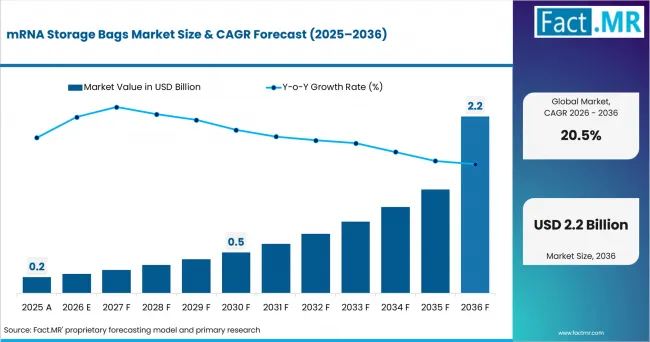
Mrna Storage Bags Market Market Value Analysis | Source: Fact.MR
What are the defining numbers behind mRNA storage bags market growth?
USD 1.8 billion absolute opportunity by 2036, led by the United States and Germany.
- Demand Drivers in the Market
- mRNA manufacturers need closed bags that reduce contamination exposure.
- CDMOs need storage formats that fit multiple client batch sizes.
- Process engineers need bags that perform during ultra-cold storage.
- Quality teams need validated films with clear extractables documentation.
- Key Segments Analyzed
- By Bag Format: 2D Freeze-Thaw Bags are expected to hold 38.0% share in 2026 because small and mid-scale mRNA lots need protected frozen storage.
- By Film Type: Multilayer Polyolefin and EVA Films lead because established bioprocess films support current storage validation. The share is projected at 44.0% in 2026.
- By Storage Temperature: Ultra-Low Temperature Storage is likely to account for 42.0% share in 2026 because mRNA-LNP stability often requires frozen handling.
- By Capacity: 1 L to 20 L Bags lead with 36.0% share in 2026 because clinical and early commercial batches need flexible volume handling.
- By End Use: mRNA Vaccine and Therapeutic Developers are expected to hold 48.0% share in 2026 because product owners control storage specifications.
- By Geography: The United States is projected to record 22.8% CAGR through 2036 as mRNA pipeline activity increases.
- Analyst Opinion at Fact.MR
- Shambhu Nath Jha, Senior Analyst at Fact.MR, states, “mRNA storage bags are becoming a critical link in genetic medicine manufacturing. We see process teams moving from improvised frozen storage toward validated single-use containers. Suppliers that prove film compatibility and cold-chain robustness will gain stronger access to mRNA manufacturing programs.”
- Strategic Implications
- Bag suppliers should support mRNA-LNP stability testing with film data.
- CDMOs should standardize storage bag formats across client programs.
- Drug developers should test adsorption risk before late-stage scale-up.
- Cold-chain providers should design systems around bag protection.
Cytiva stated in 2024 that single-use technology helps mRNA-LNP manufacturers maintain sterility and supports scale-up across production volumes. [2] This reinforces the storage bag opportunity because mRNA workflows require closed fluid handling across formulation and hold steps. A 2025 Physics of Fluids study reported that mRNA-loaded LNPs remained stable and functional for six months at -80°C in single-use bags. [3] This gives the market a stronger technical basis for drug substance storage in bag formats.
The United States is projected to record 22.8% CAGR through 2036 as mRNA vaccine and oncology therapy pipelines expand. Germany is expected to post 21.6% CAGR through 2036 as European bioprocess suppliers and CDMOs scale mRNA process support. Switzerland is likely to record 20.4% CAGR as high-value biologics manufacturing uses validated storage systems. Japan is forecast to advance at 19.8% CAGR as pharmaceutical manufacturers adopt smaller batch mRNA workflows. South Korea is set to record 19.1% CAGR as vaccine and biomanufacturing capacity supports single-use adoption.
How does the mRNA storage bags market break down by segment?
2D Freeze-Thaw Bags lead at 38.0%; Ultra-Low Temperature Storage leads at 42.0%.
Which bag format dominates?
2D Freeze-Thaw Bags hold 38.0% share in 2026.
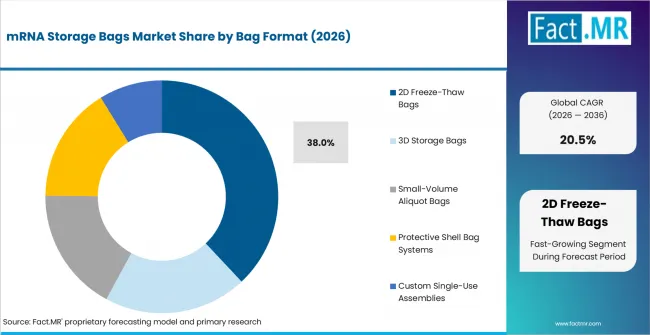
Mrna Storage Bags Market Analysis By Bag Format | Source: Fact.MR
2D Freeze-Thaw Bags are expected to hold 38.0% share in 2026 because mRNA workflows often use small and mid-sized frozen lots. The format supports controlled filling and easier freezer handling. It also reduces handling steps before downstream processing. The segment connects with vaccine storage equipment because frozen bag handling must match validated cold-chain conditions.
Which film type dominates?
Multilayer Polyolefin and EVA Films account for 44.0% share in 2026.
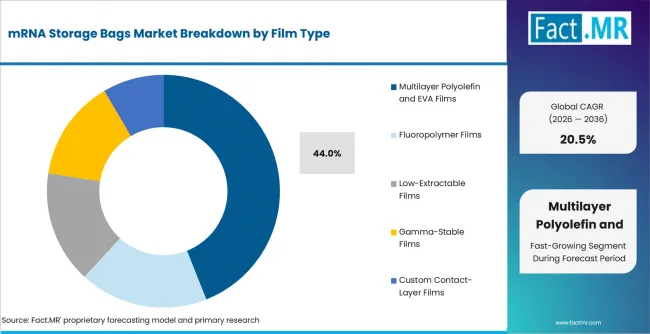
Mrna Storage Bags Market Analysis By Film Type | Source: Fact.MR
Multilayer Polyolefin and EVA Films lead because many bioprocess storage workflows already qualify these materials. The film type is projected to capture 44.0% share in 2026. These films support sterile bag assemblies and broad supplier availability. Fluoropolymer films are growing where low adsorption and cold durability are priorities. Entegris reported mRNA-LNP contact testing for Aramus fluoropolymer bags in its single-use systems application note. [4]
Which storage temperature dominates?
Ultra-Low Temperature Storage holds 42.0% share in 2026.
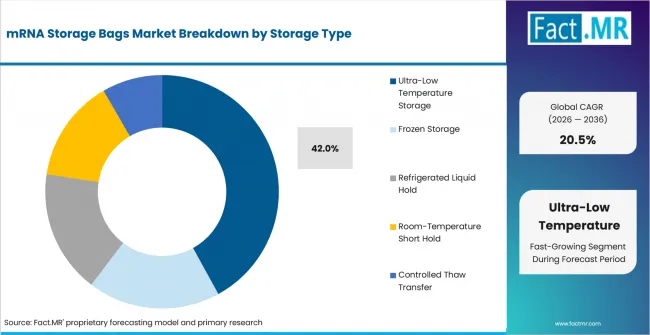
Mrna Storage Bags Market Analysis By Storage Type | Source: Fact.MR
Ultra-Low Temperature Storage leads because mRNA and mRNA-LNP materials need strong stability protection. The storage temperature category is likely to account for 42.0% share in 2026. The 2025 single-use bag stability study supports −80°C storage as a technical reference point for mRNA-LNPs. This segment links with temperature controlled packaging because storage bags need compatible frozen shipping workflows.
Which capacity range dominates?
1 L to 20 L Bags lead with 36.0% share in 2026.
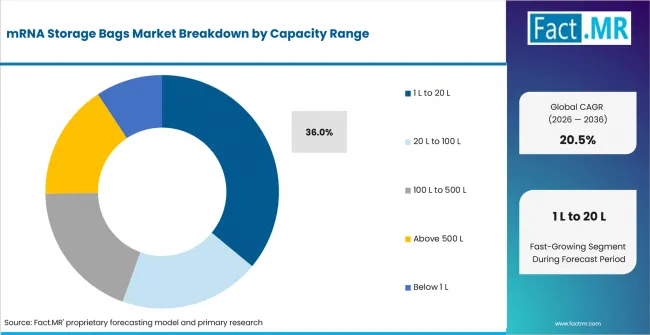
Mrna Storage Bags Market Analysis By Capacity Range | Source: Fact.MR
1 L to 20 L Bags lead because mRNA programs often operate through clinical and modular production lots. The capacity range is expected to hold 36.0% share in 2026. Bags in this range balance process flexibility with manageable frozen handling. Very small bags support formulation studies and aliquot storage. Large 3D bags gain traction when mRNA platforms move into repeat commercial production.
Which end use dominates?
mRNA Vaccine and Therapeutic Developers hold 48.0% share in 2026.
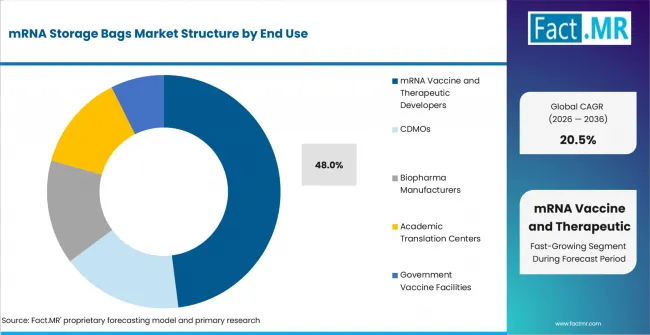
Mrna Storage Bags Market Analysis By End Use | Source: Fact.MR
mRNA Vaccine and Therapeutic Developers lead because product owners define storage conditions and container compatibility requirements. The end use is expected to hold 48.0% share in 2026. Developers need film data before transferring processes to CDMOs. They also need storage formats that protect product quality during scale-up. The biologics contract manufacturing link is important because CDMOs execute many of these storage workflows.
What is accelerating mRNA storage bags demand, and what is holding it back?
mRNA-LNP scale-up drives demand; adsorption risk restrains validation.
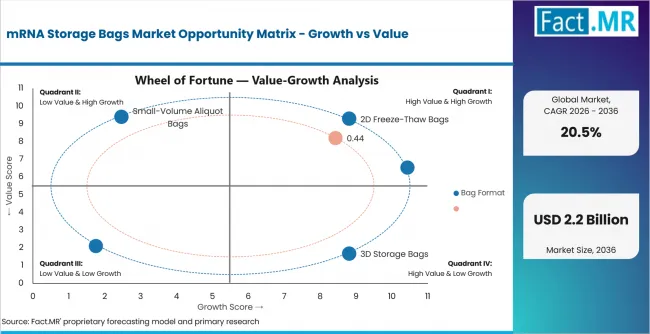
Mrna Storage Bags Market Opportunity Matrix Growth Vs Value | Source: Fact.MR
mRNA-LNP scale-up is the main driver. Developers need storage systems that protect sensitive materials between formulation, filling and release testing. Single-use bags reduce cleaning burden and simplify multi-product facility operation. Sartorius stated in 2025 that its Aubagne expansion nearly doubled cleanroom space and added automated production lines for 2D and 3D single-use bags. [5] This supports demand growth because bag supply and quality consistency are central to biologics manufacturing.
The main restraint is adsorption risk. mRNA-LNPs can interact with container surfaces during storage. Suppliers and drug developers need compatibility studies before selecting bag films for late-stage programs.
Where do the biggest mRNA storage bag opportunities sit?
Clinical mRNA pipelines, CDMO storage workflows and ultra-cold transport.
- Clinical mRNA Pipelines: Developers can qualify storage bags earlier in formulation development.
- CDMO Storage Workflows: Contract manufacturers can standardize bag formats across client programs.
- Ultra-Cold Transport: Suppliers can combine bags with shells and cold-chain shipping systems.
Which countries are scaling mRNA storage bags fastest?
United States 22.8%, Germany 21.6%, Switzerland 20.4%, Japan 19.8%, South Korea 19.1%.
Based on regional analysis, the mRNA storage bags market is segmented into North America, Western Europe, Asia Pacific, Latin America, and Middle East and Africa.
.webp "Top Country Growth Comparison Mrna Storage Bags Market Cagr (2026 2036)")
Top Country Growth Comparison Mrna Storage Bags Market Cagr (2026 2036) | Source: Fact.MR
| Country | CAGR |
|---|---|
| United States | 22.8% |
| Germany | 21.6% |
| Switzerland | 20.4% |
| Japan | 19.8% |
| South Korea | 19.1% |
Source: Fact.MR analysis. Updated Jun 26, 2026
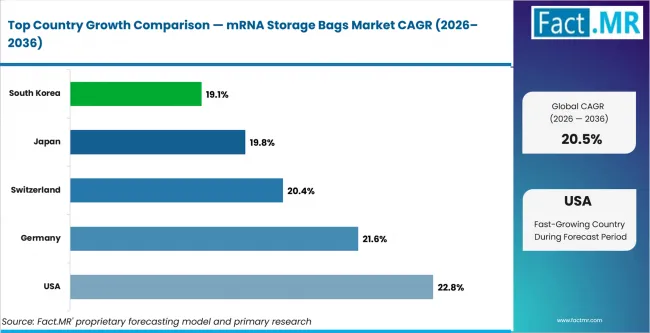
Mrna Storage Bags Market Cagr Analysis By Country | Source: Fact.MR
What is powering the United States lead?
22.8% CAGR, driven by Thermo Fisher Scientific and mRNA therapy pipelines.
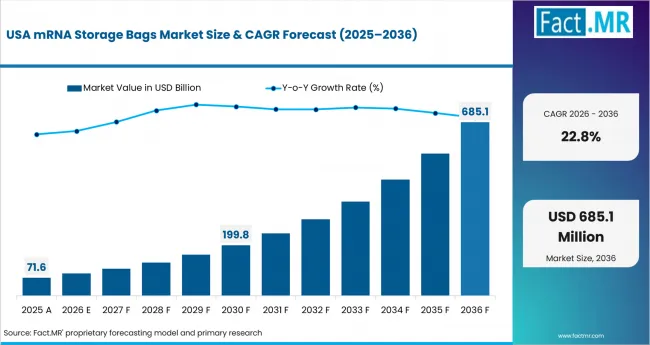
Mrna Storage Bags Market Country Value Analysis | Source: Fact.MR
The United States is projected to record 22.8% CAGR by 2036 as mRNA vaccine and oncology therapy pipelines expand. Thermo Fisher Scientific supports bioprocessing through single-use technologies and BioProcess Containers. Developers need closed storage bags for clinical and commercial transfer. Growth will favor suppliers with validation support and local manufacturing capacity.
How is Germany scaling mRNA storage bag demand?
21.6% CAGR, supported by Sartorius and European mRNA manufacturing.
Germany is expected to post 21.6% CAGR through 2036 as European bioprocess suppliers and CDMOs scale mRNA process support. Sartorius strengthens regional supply through single-use bag manufacturing and fluid management expertise. Developers need storage formats that support GMP transfer between process steps. Growth will favor suppliers with strong extractables documentation.
What supports Switzerland’s outlook?
20.4% CAGR, driven by Lonza-linked mRNA manufacturing and high-value biologics storage.
Switzerland is likely to record 20.4% CAGR from 2026 to 2036 as high-value biologics manufacturing uses validated storage systems. CDMO networks require bags that match strict product quality expectations. mRNA workflows need reliable frozen hold steps. Growth will favor storage bags with proven film compatibility and strong quality files.
What underpins Japan’s growth?
19.8% CAGR, backed by mRNA vaccine development and smaller batch manufacturing.
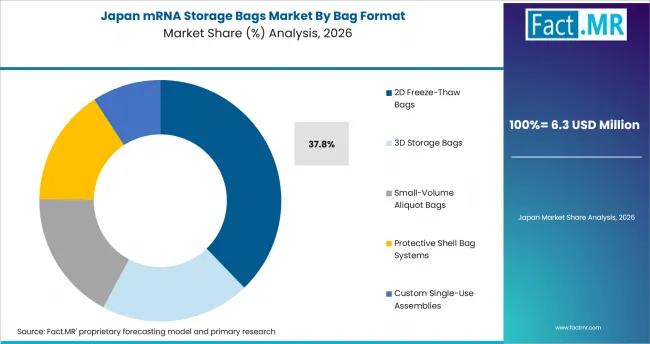
Mrna Storage Bags Market Japan Market Share Analysis By Bag Format | Source: Fact.MR
Japan is forecast to advance at 19.8% CAGR through 2036 as pharmaceutical manufacturers adopt smaller batch mRNA workflows. Local developers need storage bags for formulation and clinical production. Small-volume bags fit early-stage process development. Growth will favor suppliers that support compact GMP suites.
How is South Korea scaling mRNA storage bag adoption?
19.1% CAGR, driven by vaccine capacity and biomanufacturing expansion.
South Korea is set to record 19.1% CAGR by 2036 as vaccine and biomanufacturing capacity supports single-use adoption. CDMOs need flexible storage systems for client programs. mRNA and LNP workflows require closed handling during scale-up. Growth will favor bag suppliers with regional service and cold-chain integration.
Who leads the mRNA storage bags market?
Sartorius and Thermo Fisher Scientific lead through single-use bioprocess bag portfolios.
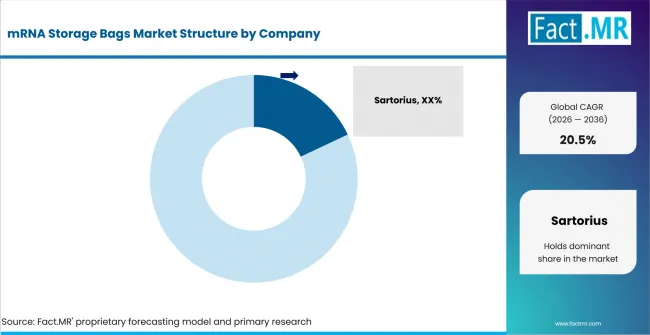
Mrna Storage Bags Market Analysis By Company | Source: Fact.MR
mRNA storage bags are supplied by single-use bioprocessing firms and specialty film suppliers. Sartorius leads through Flexsafe and Celsius single-use storage systems. Thermo Fisher Scientific supports mRNA workflows through BioProcess Containers and single-use fluid management solutions.
Cytiva competes through Allegro storage systems and RNA-LNP manufacturing support. Merck KGaA, operating as MilliporeSigma in the United States and Canada, supports Mobius single-use bag assemblies. Entegris competes through Aramus fluoropolymer bag assemblies for high-value fluids. Single Use Support supports protected single-use bag workflows through IRIS bags and RoSS-based storage platforms.
Competition through 2036 will depend on film compatibility and cold-chain performance. Suppliers need strong documentation and bag integrity data. The mRNA therapeutics link will shape demand as clinical programs move toward larger batches. The biopharmaceutical excipients layer also matters because formulation buffers and stabilizers affect storage behavior.
Which companies are the key providers?
Sartorius and Thermo Fisher Scientific are key providers. Cytiva and Merck KGaA are also profiled. Entegris and Single Use Support complete the company set.
- Sartorius
- Thermo Fisher Scientific
- Cytiva
- Merck KGaA
- Entegris
- Single Use Support
Bibliography
- [1] Single Use Support. (2024, January 8). Single-use technology in mRNA manufacturing. Single Use Support.
- [2] Cytiva. (2024, November 26). Single-use technology is transforming mRNA-LNP manufacturing. Cytiva.
- [3] Takeda, Y. S., Wang, F., Gu, X., Delaunay, L., & Akbari, S. (2025). Single-use bags as a viable solution for long-term stability of lipid nanoparticles. Physics of Fluids, 37(3), 037120.
- [4] Entegris. (2025). Particulate contamination levels in single-use systems: Aramus™ bag assemblies and AccuSizer® SPOS systems. Entegris.
- [5] Sartorius. (2025, June 17). Sartorius Stedim Biotech expands manufacturing and R&D capacities for innovative bioprocess solutions in France. Sartorius.
This Report Addresses
- Strategic intelligence on mRNA storage bags across bag format and film type.
- Segment analysis covering 2D Freeze-Thaw Bags and Ultra-Low Temperature Storage.
- Regional outlook covering the United States, Germany, Switzerland, Japan and South Korea.
- Competitive analysis of Sartorius, Thermo Fisher Scientific, Cytiva, Merck KGaA, Entegris and Single Use Support.
- Technology assessment covering sterile single-use films, protective shells and freeze-thaw compatibility.
- Use case assessment covering mRNA-LNP storage, CDMO workflows and ultra-cold transport.
- Primary interviews, provider checks and official source review support the forecast.
What does the mRNA storage bags market cover?
Sterile single-use bags for mRNA and mRNA-LNP storage during biomanufacturing.
The mRNA storage bags market covers sterile bags used for frozen storage, liquid hold and transfer of mRNA-related materials. It includes 2D bags and related assemblies. The scope connects with single-use bioreactors because many mRNA facilities already rely on disposable fluid paths.
The market differs from general bioprocess bags because mRNA materials are sensitive to temperature and handling stress. Bag films must limit contamination risk and support validated extractables testing. Storage bags must also work with cold-chain systems and filling equipment.
What is included in the scope?
2D and 3D storage bags used for mRNA drug substance workflows.
The scope includes sterile 2D storage bags and 3D bioprocess bags used for mRNA-LNP intermediates. It also covers freeze-thaw bags and small-volume aliquot bags. The scope includes pharmaceutical packaging overlap where bag systems protect high-value biologic liquids before final fill.
The scope includes bags used by vaccine developers, therapy companies and CDMOs. It covers storage before fill-finish and transfer between process steps. It also includes protective secondary containers when they are sold as part of the mRNA bag storage workflow.
What is excluded from the scope?
Final vials and ordinary laboratory tubes.
The scope excludes finished vaccine vials and syringes. It excludes ordinary lab tubes used for research-scale storage. It excludes cold freezers unless they are sold with bag-compatible storage systems. It also excludes general single-use tubing unless it is part of a bag assembly.
How was the analysis built?
100+ sources, 40+ company portfolios, 25+ countries, 20+ interviews.
- Primary Research: Primary research includes interviews with mRNA process development heads and bioprocess engineers. It includes input from single-use bag suppliers and CDMO operations teams.
- Desk Research: Desk research reviews official supplier sources and mRNA-LNP storage studies. It covers freeze-thaw bags, polymer films and cold chain packaging systems used for biologics storage.
- Market-Sizing and Forecasting: Forecasting uses mRNA pipeline growth and single-use storage adoption. CDMO expansion and freeze-thaw workflow demand support the market assessment.
- Data Validation and Update Cycle: Forecasts are validated through supplier checks and process technology references. Product launches and scientific stability data help confirm market direction.
Segmentation
What is the report’s scope and coverage?
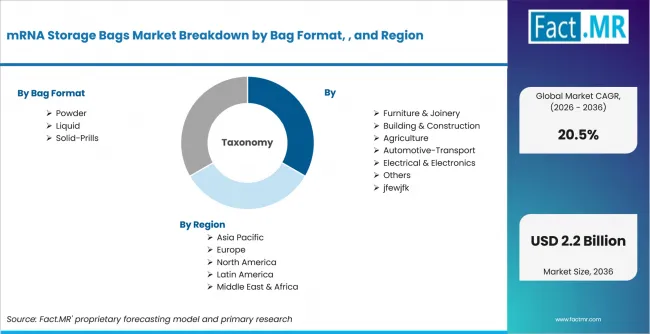
Mrna Storage Bags Market Breakdown By Bag Format, , And Region | Source: Fact.MR
| Attribute | Details |
|---|---|
| Quantitative Units | USD Billion in 2026 to USD Billion by 2036 at CAGR |
| Market Definition | Sterile single-use bags used to store mRNA and mRNA-LNP materials during biomanufacturing |
| Bag Format | 2D Freeze-Thaw Bags; 3D Storage Bags; Small-Volume Aliquot Bags; Protective Shell Bag Systems; Custom Single-Use Assemblies |
| Film Type | Multilayer Polyolefin and EVA Films; Fluoropolymer Films; Low-Extractable Films; Gamma-Stable Films; Custom Contact-Layer Films |
| Storage Temperature | Ultra-Low Temperature Storage; Frozen Storage; Refrigerated Liquid Hold; Room-Temperature Short Hold; Controlled Thaw Transfer |
| Capacity | Below 1 L; 1 L to 20 L; 20 L to 100 L; 100 L to 500 L; Above 500 L |
| End Use | mRNA Vaccine and Therapeutic Developers; CDMOs; Biopharma Manufacturers; Academic Translation Centers; Government Vaccine Facilities |
| Regions Covered | North America; Western Europe; Asia Pacific; Latin America; Middle East and Africa |
| Countries Covered | United States; Germany; Switzerland; Japan; South Korea |
| Key Companies Profiled | Sartorius; Thermo Fisher Scientific; Cytiva; Merck KGaA; Entegris; Single Use Support |
| Forecast Period | 2026 to 2036 |
| Approach | Hybrid top-down and bottom-up approach using mRNA pipeline activity, single-use bag adoption, freeze-thaw workflow demand and provider validation |
Source: Fact.MR analysis. Updated Jun 26, 2026
How is the market segmented?
-
By Bag Format:
- 2D Freeze-Thaw Bags
- 3D Storage Bags
- Small-Volume Aliquot Bags
- Protective Shell Bag Systems
- Custom Single-Use Assemblies
-
By Film Type:
- Multilayer Polyolefin and EVA Films
- Fluoropolymer Films
- Low-Extractable Films
- Gamma-Stable Films
- Custom Contact-Layer Films
-
By Storage Temperature:
- Ultra-Low Temperature Storage
- Frozen Storage
- Refrigerated Liquid Hold
- Room-Temperature Short Hold
- Controlled Thaw Transfer
-
By Capacity:
- Below 1 L
- 1 L to 20 L
- 20 L to 100 L
- 100 L to 500 L
- Above 500 L
-
By End Use:
- mRNA Vaccine and Therapeutic Developers
- CDMOs
- Biopharma Manufacturers
- Academic Translation Centers
- Government Vaccine Facilities
-
Region:
- North America
- United States
- Canada
- Europe
- Germany
- Switzerland
- France
- United Kingdom
- Belgium
- Asia Pacific
- Japan
- South Korea
- China
- Singapore
- India
- Latin America
- Brazil
- Mexico
- Argentina
- Middle East & Africa
- UAE
- Saudi Arabia
- South Africa
- Israel
- North America
Frequently Asked Questions
Which bag format leads the mRNA Storage Bags Market?
Which film type leads the mRNA Storage Bags Market?
Which storage temperature leads the mRNA Storage Bags Market?
Which capacity range leads the mRNA Storage Bags Market?
Which end use leads the mRNA Storage Bags Market?
Which country expands fastest in the mRNA Storage Bags Market?
How does Germany perform in the mRNA Storage Bags Market?
How does Switzerland perform in the mRNA Storage Bags Market?
How does Japan perform in the mRNA Storage Bags Market?
How does South Korea perform in the mRNA Storage Bags Market?
What is the primary driver in the mRNA Storage Bags Market?
What is the main restraint in the mRNA Storage Bags Market?
Why are 2D freeze-thaw bags important?
Why are ultra-low temperature workflows important in this market?
Who worked on this report


Preview the report firsthand - request a free sample
Free SampleGet the brochure for pricing and purchase details
Download PDF