- Market Value (2025): USD 0.9 Bn
- Estimated Value (2026): USD 1.1 Bn
- Forecast Value (2036): USD 4.2 Bn
- CAGR (2026-2036): 14.6%
What is the Multi-Band Reflectarray Antennas Market forecast to be worth by 2036?
USD 1.1 billion in 2026 to USD 4.2 billion by 2036 at a 14.6% CAGR.
- The Multi-Band Reflectarray Antennas Market crossed a valuation of USD 0.9 billion in 2025.
- Demand is projected to increase from USD 1.1 billion in 2026 to USD 4.2 billion by 2036.
- The market is forecast to record 14.6% CAGR from 2026 to 2036 as satellite integrators and defence terminal teams shift more link functions into compact multi-band apertures.
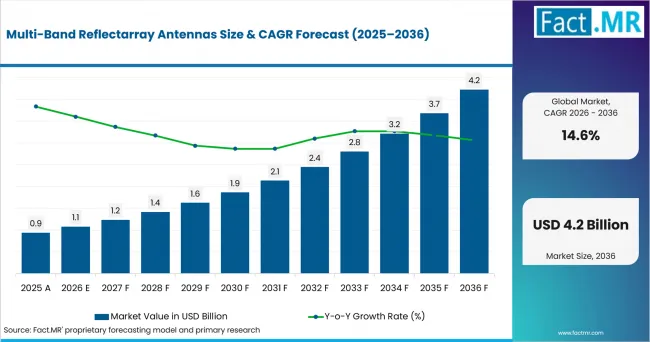
Multi Band Reflectarray Antennas Value Analysis | Source: Fact.MR
What are the defining numbers behind Multi-Band Reflectarray Antennas Market growth?
USD 3.1 billion absolute opportunity is expected between 2026 and 2036.
- Demand Drivers in the Market
- Satellite payload teams need fewer apertures per spacecraft as panel space is shared with power, thermal and mission electronics.
- Defence communication units require multi-band terminals after Space Systems Command awarded contracts totaling USD 437.7 million for PTS-G in June 2026.
- Mobile SATCOM integrators need single-aperture Ku/Ka designs that reduce roof space and simplify field terminal integration.
- Aviation integrators seek low-profile antennas that reduce drag while maintaining links for passenger connectivity and mission data.
- Key Segments Analyzed
- By Band Combination: X/Ku is expected to hold 27.0% share in 2026 supported by secure mission links and higher-capacity satellite channels.
- By Reflectarray Type: Passive printed reflectarray is projected to account for 34.0% share in 2026 owing to lower part count and simpler power needs.
- By Platform: Satellites are anticipated to capture 41.0% share in 2026 due to compact payload requirements and relay hardware needs.
- By Function: SATCOM is estimated to represent 38.0% share in 2026 driven by resilient connectivity across civil and defence networks.
- Analyst Opinion at Fact.MR
- Shambhu Nath Jha of Fact.MR states, “The commercial question in this market is wider than gain or frequency coverage. Program teams want proof that one flat aperture can replace heavier assemblies while keeping qualification risk controlled. Suppliers that combine RF design discipline, space-grade materials and mission-level test evidence are expected to gain preference.”
- Strategic Implications
- Antenna manufacturers should document gain stability, thermal behavior and band isolation under mission-like vibration and radiation conditions.
- Satellite integrators should place reflectarray layout work early in the payload design cycle so panel area and feed placement stay manageable.
- Defence terminal suppliers should pair multi-band operation with secure control software and field-service records for mobile units.
- Testing partners should expand near-field validation for thin antennas where OTA antenna test systems must handle wider bands and low-profile panels.
The USA is projected to record 16.4% CAGR through 2036 supported by protected SATCOM modernization and commercial space launch activity. The UK is forecast to post 16.0% CAGR owing to public satellite communications funding and space-enabled services. France is anticipated to advance at 15.7% CAGR due to military SATCOM terminal work and domestic spacecraft programs. Germany is estimated to reach 15.3% CAGR supported by ESA satellite communications funding. Japan is expected to register 13.6% CAGR through next-generation defence communications satellite activity.
How does the Multi-Band Reflectarray Antennas Market break down by segment?
Satellites are projected to lead Platform at 41.0% share in 2026; SATCOM is anticipated to lead Function at 38.0% share.
Which Band Combination dominates?
X/Ku is expected to hold 27.0% share in 2026.
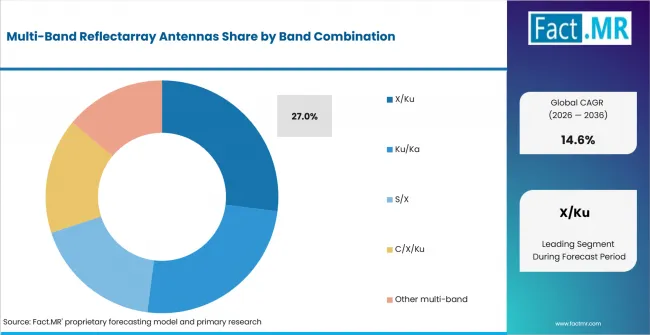
Multi Band Reflectarray Antennas Analysis By Band Combination | Source: Fact.MR
X/Ku leads the band combination segment because defence users often need a bridge between protected mission links and higher-throughput channels. The same pairing appears in military antenna systems where communication reliability and spectrum discipline are central to platform acceptance.
Terminal designers use the combination to limit antenna count on mobile platforms. Secure X-band traffic remains relevant for defence communications, while Ku-band adds service availability across government and commercial satellite networks.
What leads the Reflectarray Type segment?
Passive printed reflectarray is projected to account for 34.0% share in 2026.
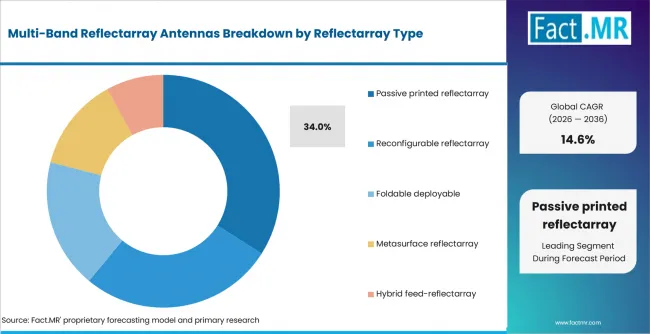
Multi Band Reflectarray Antennas Analysis By Reflectarray Type | Source: Fact.MR
Passive printed reflectarray designs lead because they offer a simpler route to flat-panel architecture than fully active arrays. Lower part count and lower power draw help spacecraft and mobile terminal programs manage heat and mass.
Suppliers still need careful phase control and feed integration. The segment overlaps with advanced antenna systems where compact form factor and beam control shape evaluation.
How does Platform shape demand?
Satellites are anticipated to capture 41.0% share in 2026.
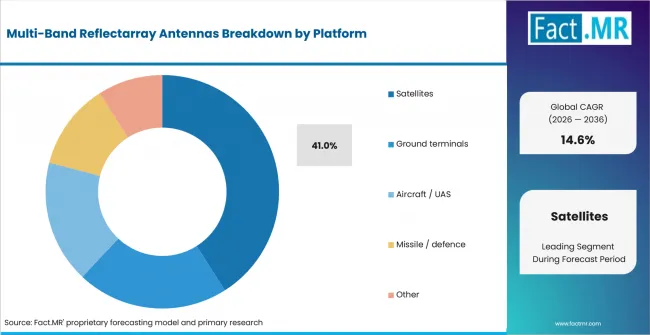
Multi Band Reflectarray Antennas Analysis By Platform | Source: Fact.MR
Satellites lead the platform segment because reflectarray antennas help spacecraft builders manage aperture area, payload mass and stowed volume. The European Space Agency reported in July 2026 that the upstream space market reached EUR 75 billion in 2025.
Smaller spacecraft have limited panel area for power systems and communications hardware. Flat reflectarray designs support the same need visible in software-defined defence satellites where payload flexibility is linked to antenna and mission-system design.
What supports SATCOM within Function?
SATCOM is estimated to represent 38.0% share in 2026.
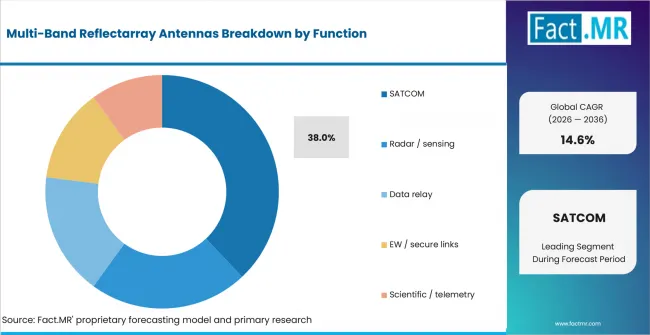
Multi Band Reflectarray Antennas Analysis By Function | Source: Fact.MR
SATCOM leads because secure connectivity is the most direct use case for multi-band reflectarray antennas. The function aligns with satellite communication equipment where higher-throughput systems and resilient service links shape network design.
Mobile and defence users are adding multi-orbit service paths. This favors reflectarray designs that manage frequency agility without adding a separate mechanical antenna for every service layer, especially across mobile satellite services.
What is accelerating Multi-Band Reflectarray Antennas Market adoption, and what is holding it back?
Demand is expected to rise through protected SATCOM modernization and satellite payload density. Growth is limited by RF qualification, spectrum coordination and thermal limits inside compact antenna packages.
Drivers Impact Analysis
| DRIVER | (~) % IMPACT ON CAGR | GEOGRAPHIC RELEVANCE | IMPACT TIMELINE |
|---|---|---|---|
| Protected multi-band SATCOM contracts | +1.8% | USA, France, UK | Short term (<= 2 years) |
| Flat antenna needs in satellite payloads | +1.4% | Global | Medium term (2-4 years) |
| Low-profile aircraft and UAS terminals | +1.0% | North America, Europe | Medium term (2-4 years) |
| Secure relay and telemetry workloads | +0.8% | USA, Japan, Germany | Long term (>= 4 years) |
Opportunity Impact Analysis
| OPPORTUNITY | (~) % IMPACT ON CAGR | GEOGRAPHIC RELEVANCE | IMPACT TIMELINE |
|---|---|---|---|
| Ku/Ka flat-panel terminal programs | +1.2% | USA, Europe | Short term (<= 2 years) |
| Secure European connectivity programs | +0.9% | UK, France, Germany | Medium term (2-4 years) |
| Foldable deployable satellite apertures | +0.7% | Japan, USA | Long term (>= 4 years) |
Restraints Impact Analysis
| RESTRAINT | (~) % IMPACT ON CAGR | GEOGRAPHIC RELEVANCE | IMPACT TIMELINE |
|---|---|---|---|
| RF qualification and thermal validation | -0.8% | Global | Short term (<= 2 years) |
| Spectrum and orbital coordination pressure | -0.6% | Europe, USA, Japan | Medium term (2-4 years) |
| Power budget limits in compact platforms | -0.4% | Global | Long term (>= 4 years) |
Which countries are scaling the Multi-Band Reflectarray Antennas Market through 2036?
- The country comparison spans 2.8 percentage points and forms two practical growth bands across the forecast period.
- The USA remains 0.4 percentage point above the UK through protected SATCOM modernization and commercial launch activity.
- The UK remains 0.3 percentage point above France as public satellite communications funding supports terminal development.
- France remains 0.4 percentage point above Germany through military SATCOM terminal programs and spacecraft activity.
- Germany remains 1.7 percentage points above Japan as ESA satellite communications funding supports antenna engineering.
- Japan closes the displayed range through next-generation defence communications satellite work and domestic space programs.
Comparable CAGRs create different entry conditions due to program timing, security requirements, spectrum filings and launch infrastructure. Full report coverage includes North America, Latin America, Western Europe, Eastern Europe, East Asia, South Asia & Pacific, Middle East & Africa.
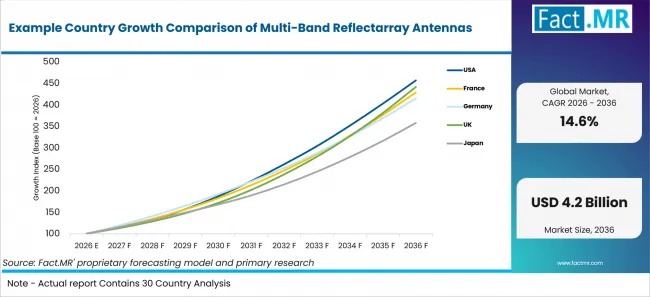
Example Country Growth Comparison Of Multi Band Reflectarray Antennas | Source: Fact.MR
| Country | CAGR (2026-2036) |
|---|---|
| United States | 16.4% |
| United Kingdom | 16.0% |
| France | 15.7% |
| Germany | 15.3% |
| Japan | 13.6% |
What supports USA adoption?
16.4% CAGR, supported by protected SATCOM modernization and launch activity.
The USA benefits from defence satellite communications programs and a deep spacecraft integration base. The Federal Aviation Administration marked its 1,000th licensed or permitted commercial space vehicle operation in August 2025, highlighting the growing cadence of U.S. commercial space activity.
What supports the United Kingdom’s growth?
16.0% CAGR, backed by satellite communications funding and space-enabled services.
The UK builds demand through space-enabled connectivity, defence communications and aircraft antenna integration. The UK Space Agency announced GBP 6.9 million for five next-generation satellite communications projects in November 2025, including funded development of regenerative payload systems, user terminals and ground-interface technologies.
How is France supporting demand?
15.7% CAGR, driven by military SATCOM terminal programs and spacecraft activity.
France links the market to sovereign military communications and satellite payload work. CNES confirmed in July 2025 that the four CO3D satellites were successfully placed into orbit. The constellation, developed with Airbus Defence and Space, is designed to map the Earth's surface in three dimensions and provide two-dimensional imagery for institutional and commercial users.
What is supporting Germany’s adoption?
15.3% CAGR, supported by ESA satellite communications funding.
Germany’s market is tied to ESA subscriptions and secure connectivity programs. DLR reported in November 2025 that Germany earmarked approximately EUR 320 million for satellite communications within its ESA contribution, supporting secure transmission of large data volumes and programmes in optical, quantum and next-generation connectivity.
How does Japan perform?
13.6% CAGR, led by next-generation defence communications satellite activity.
Japan’s adoption path is linked to defence space spending and satellite communications replacement work. Japan’s Ministry of Defense announced in February 2026 a JPY 123.53 billion contract with Mitsubishi Electric for manufacturing and related work on the next-generation defense communications satellite that will succeed Kirameki-2. Separately, the FY2026 defense budget includes ground-equipment acquisition associated with the next-generation defense satellite communications program.
Who leads the Multi-Band Reflectarray Antennas Market?
Airbus Defence and Space and Thales Alenia Space are prominent participants in the competitive landscape through their involvement in satellite systems, secure communications and mission-level payload integration. Their positioning is relevant where customers need antenna hardware to fit broader spacecraft and defence communication architectures.
Meridian Space / SpinLaunch participates within the space-antenna provider set, while Robin Space adds another specialized participant focused on compact antenna solutions for satellite and related communication applications. These suppliers compete where platform designers prioritize low-profile apertures, payload efficiency and integration flexibility.
Anywaves also forms part of the key provider group, supporting the competitive landscape for advanced spaceborne antenna systems. Its relevance is strongest where integrators evaluate compact RF hardware alongside frequency agility, payload constraints and qualification requirements.
Competition therefore centers on multi-band performance, RF efficiency, beam control, payload compatibility, thermal behavior, qualification evidence and mission-level integration support. Suppliers that can combine compact antenna architecture with reliable secure-link performance and strong spacecraft integration capability are better positioned for wider adoption.
Which companies are the key providers?
Key companies include Meridian Space / SpinLaunch; Robin Space; Anywaves; Airbus Defence and Space; Thales Alenia Space.
- Thales Alenia Space
- Airbus Defence and Space
- Meridian Space / SpinLaunch
- Robin Space
- Anywaves
Bibliography
- Airbus Defence and Space. (2026, July 15). DGA awards CAMELEON military SATCOM programme to Airbus, Greenerwave and Thales.
- Centre Spatial Guyanais. (2025, July 26). VV27 launch successful: Vega-C places MicroCarb and the CO3D Constellation into orbit.
- European Space Agency. (2026, July 13). ESA releases 2026 Space Economy Report.
- Federal Aviation Administration. (2025, August 14). 1,000 commercial space operations.
- German Aerospace Center (DLR). (2025, November 28). Germany invests 5.4 billion euros in the future of European space.
- Ofcom. (2026, March 2). Statement: Updates to procedures for the management of satellite filings.
- Space Systems Command. (2026, June 9). U.S. Space Force advances satellite communications modernization, awards contracts for first global protected tactical constellation.
- UK Space Agency. (2025, November 21). UK backs next-generation satellite communications with £6.9 million investment. GOV.UK.
This Report Answers
- The report explains where multi-band reflectarray antennas are used across band combinations, antenna type, platform and function.
- Segment analysis identifies the leading subsegments and the technical reasons integrators prioritize them.
- Country analysis examines the listed markets and the public programs shaping satellite communications and antenna qualification.
- Competitive analysis reviews current providers across space antennas, flat-panel terminals and secure SATCOM payloads.
- Application analysis assesses how frequency agility, mass, profile and qualification needs influence purchasing decisions.
What does the Multi-Band Reflectarray Antennas Market cover?
The Multi-Band Reflectarray Antennas Market covers antennas that combine reflectarray architecture with multi-band operation for satellite communications and related RF functions. It includes flat printed panels, reconfigurable designs, deployable satellite apertures and hybrid feed-reflectarray systems used when platform space is limited.
The assessment covers X/Ku and Ku/Ka combinations across satellite and terminal use cases. S/X and C/X/Ku combinations are included for airborne and secure-link applications. Antenna performance is assessed where it shapes sensing, tracking and resilient communication needs.
What is included in the scope?
The scope includes commercial and defence-grade reflectarray antennas where multi-band capability is part of the product design or payload function. It includes satellite-mounted antennas and ground terminals. Aircraft, UAS and missile or defence platforms are included when reflectarray functionality is part of the assembly.
It includes passive printed reflectarrays and reconfigurable reflectarrays. Metasurface reflectarrays, deployable arrays and hybrid feed arrangements are included. The scope covers antennas sold as finished assemblies or mission-specific integrated subsystems.
What is excluded from the scope?
The scope excludes single-band parabolic reflectors, general RF cables, raw antenna materials and base station antennas sold without reflectarray functionality. It excludes payload software sold separately from antenna hardware.
General space electronics stay outside the scope unless they directly control or support antenna operation. Standard telecom tower hardware and consumer satellite receivers are outside the market boundary.
How Was the Analysis Built?
The analysis draws on 120+ references and 35+ company portfolios. It also covers 25+ countries and more than 20 industry interviews.
- Primary Research: Primary research includes discussions with antenna manufacturers and satellite integrators. It also covers defence terminal providers, test laboratories and end users. These conversations examine RF performance needs, qualification barriers and platform constraints. They review pricing behavior and service support expectations.
- Desk Research: Desk research covers government statistics, regulator publications and company announcements. It also reviews technical studies, standards and official space-agency material. The bibliography records the evidence base used in the analysis.
- Market Sizing and Forecasting: Market estimates combine historical demand, payload build rates and terminal adoption. They also review segment shares, program activity and country-level growth. Barriers to wider antenna deployment are weighed in the forecast.
- Data Validation and Update Cycle: Findings are validated by comparing primary interviews with public data and company activity. Regulatory changes and industry developments are reviewed during update cycles. Regular updates review launches, contracts and payload programs. They also track terminal deployments and shifts in commercial adoption.
What is the report’s scope and coverage?
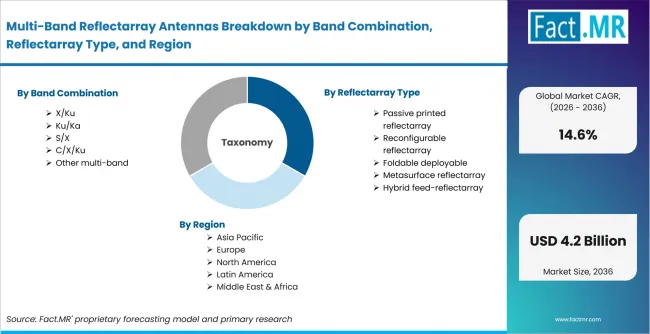
Multi Band Reflectarray Antennas Breakdown By Band Combination, Reflectarray Type, And Region | Source: Fact.MR
| Attribute | Details |
|---|---|
| Quantitative Units | USD billion |
| Market Definition | Multi-band reflectarray antennas are flat or low-profile antenna structures that use printed, passive, reconfigurable, metasurface or hybrid reflecting elements to support more than one frequency band for satellite, aircraft, ground terminal, defence and telemetry applications. |
| Band Combination | X/Ku; Ku/Ka; S/X; C/X/Ku; Other multi-band |
| Reflectarray Type | Passive printed reflectarray; Reconfigurable reflectarray; Foldable deployable; Metasurface reflectarray; Hybrid feed-reflectarray |
| Platform | Satellites; Ground terminals; Aircraft / UAS; Missile / defence; Other |
| Function | SATCOM; Radar / sensing; Data relay; EW / secure links; Scientific / telemetry |
| Regions Covered | North America; Latin America; Western Europe; Eastern Europe; East Asia; South Asia & Pacific; Middle East & Africa |
| Countries Covered | United States; United Kingdom; France; Germany; Japan |
| Key Companies Profiled | Meridian Space / SpinLaunch; Robin Space; Anywaves; Airbus Defence and Space; Thales Alenia Space |
| Forecast Period | 2026 to 2036 |
| Approach | Hybrid top-down and bottom-up approach using satellite payload demand, terminal adoption, platform mix, frequency-band needs, country program activity and provider portfolio review. |
How is the market segmented?
-
By Band Combination
- X/Ku
- Ku/Ka
- S/X
- C/X/Ku
- Other multi-band
-
By Reflectarray Type
- Passive printed reflectarray
- Reconfigurable reflectarray
- Foldable deployable
- Metasurface reflectarray
- Hybrid feed-reflectarray
-
By Platform
- Satellites
- Ground terminals
- Aircraft / UAS
- Missile / defence
- Other
-
By Function
- SATCOM
- Radar / sensing
- Data relay
- EW / secure links
- Scientific / telemetry
-
By Region
- North America
- Latin America
- Western Europe
- Eastern Europe
- East Asia
- South Asia & Pacific
- Middle East & Africa