- Market Value (2025): USD 7.5 Bn
- Estimated Value (2026): USD 8.4 Bn
- Forecast Value (2036): USD 27.0 Bn
- CAGR (2026-2036): 12.4%
What is the Anti-Jamming MILSATCOM Systems Market forecast to be worth by 2036?
USD 8.4 billion in 2026 to USD 27.0 billion by 2036 at a 12.4% CAGR.
- The Anti-Jamming MILSATCOM Systems Market reached USD 7.5 billion in 2025.
- Demand is projected to increase from USD 8.4 billion in 2026 to USD 27.0 billion by 2036.
- The market is forecast to record 12.4% CAGR from 2026 to 2036 as armed forces harden satellite links for contested operations.
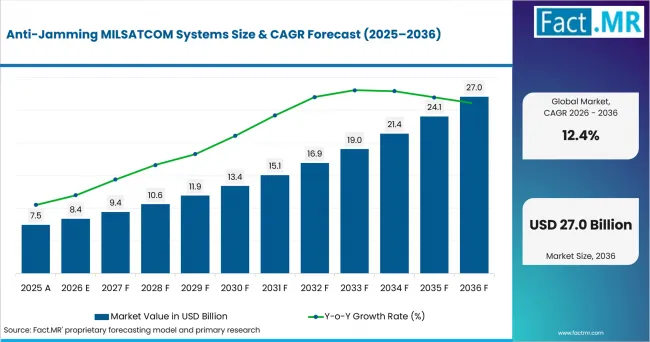
Anti Jamming Milsatcom Systems Value Analysis | Source: Fact.MR
What are the defining numbers behind Anti-Jamming MILSATCOM Systems Market growth?
An absolute opportunity of USD 18.6 billion is expected between 2026 and 2036.
- Demand Drivers in the Market
- Space commands need protected tactical SATCOM that keeps wideband links usable when hostile transmitters interfere with ordinary radio-frequency paths.
- Naval operators need multi-band terminals that shift traffic between X-band, Ka-band and UHF links across long-distance missions.
- Air and land forces need smaller terminals that support protected waveforms while fitting existing vehicles and aircraft integration limits.
- Ground-network teams need cryptographic units and mission-management tools that assign capacity and protect waveform keys across allied users.
- Space Systems Command awarded two PTS-G production contracts totaling USD 437.7 million in June 2026 for satellites designed to provide anti-jam communications and maintain connectivity in denied environments.
- Key Segments Analyzed
- By Anti-Jam Technique: Null-steering phased array is expected to hold 31.0% share in 2026 as antenna control suppresses hostile signals near protected beams.
- By Band: Ka-band is projected to account for 29.0% share in 2026 owing to higher-throughput protected links for mobile and fixed users.
- By System Element: User terminals are anticipated to capture 30.0% share in 2026 because terminal upgrades convert protected waveform capacity into field use.
- By Platform: Fixed ground is estimated to represent 28.0% share in 2026 due to gateway, anchor-station and command-site requirements in protected networks.
- Analyst Opinion at Fact.MR
- At Fact.MR, Principal Consultant Shambhu Nath Jha states, “Protected MILSATCOM is judged by how well the whole link survives interference. Payloads and terminals have to work together before a buyer trusts the network. Suppliers are expected to gain preference when they combine waveform proof, crypto readiness and secure control software in one deployable architecture.”
- Strategic Implications
- Satellite manufacturers should prove payload flexibility under jamming scenarios before production schedules move into full-rate delivery.
- Terminal suppliers should make modem and waveform upgrades practical for deployed ground, maritime and airborne assets.
- Crypto vendors should align secure units with protected waveform programs and national certification requirements early in the qualification cycle.
- Defence integrators should package space, ground and user elements in a way that reduces handoff risk for ministries.
Australia is anticipated to record 13.2% CAGR through secure multi-orbit SATCOM renewal. The USA is forecast to post 12.8% CAGR as protected tactical waveform readiness reaches more field terminals. Germany reaches 12.4% CAGR through SATCOMBw modernization. The UK posts 12.1% CAGR through SKYNET 6 ground and space renewal. France advances at 11.8% CAGR as Syracuse IV sustains sovereign protected communications.
How does the Anti-Jamming MILSATCOM Systems Market break down by segment?
Null-steering phased array leads at 31.0%; User terminals lead at 30.0%.
Which Anti-Jam Technique dominates?
Null-steering phased array is expected to hold 31.0% share in 2026.
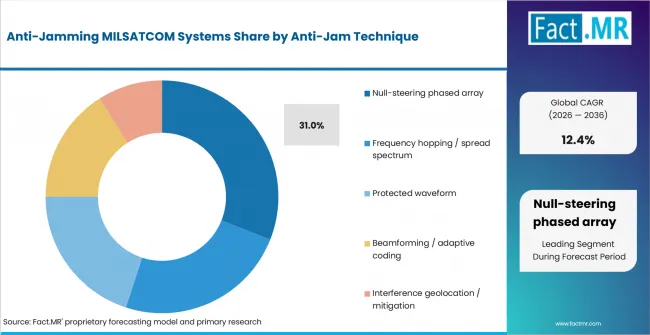
Anti Jamming Milsatcom Systems Analysis By Anti Jam Technique | Source: Fact.MR
Null-steering phased arrays lead because they help antennas reduce hostile signals while keeping the user link active. The technique fits protected SATCOM where commanders need directional gain and interference rejection in the same antenna path.
Space Systems Command reported in August 2025 that its Protected Tactical Waveform demonstration achieved frequency hopping at variable interference levels and over-the-air operations using five PTW-enabled terminals. The exercise demonstrated integrated waveform, terminal and SATCOM operations for anti-jam communications in contested environments.
What leads the Band segment?
Ka-band is projected to account for 29.0% share in 2026.
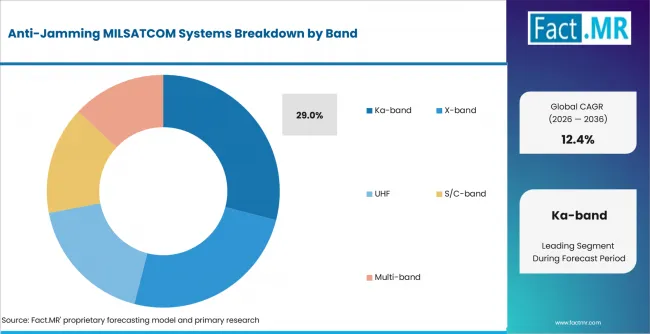
Anti Jamming Milsatcom Systems Analysis By Band | Source: Fact.MR
Ka-band remains important within protected military SATCOM architectures alongside X-band and UHF. Current UK military SATCOM planning keeps military Ka-band in the wideband requirement while UHF remains a narrowband tactical capability.
The SKYNET 6 Wideband Satellite System requirement includes military-hardened satellite systems incorporating X-band and military Ka-band payloads. This confirms that military Ka-band remains part of the design space for protected allied SATCOM requiring assured, high-capacity communications.
How does System Element shape demand?
User terminals are anticipated to capture 30.0% share in 2026.
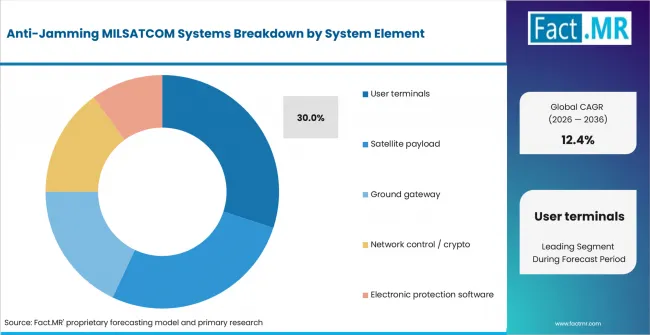
Anti Jamming Milsatcom Systems Analysis By System Element | Source: Fact.MR
User terminals shape spending because protected capacity reaches forces through field equipment. Ministries often keep existing antennas and vehicles, so modem and terminal refresh cycles become the practical route to adoption.
Terminal vendors therefore compete on waveform compatibility, crypto fit and platform integration support. The buying decision favors equipment that fits deployed vehicles, ships and aircraft while lowering the effort needed to reach protected networks.
What supports Fixed Ground within Platform?
Fixed ground is estimated to represent 28.0% share in 2026.
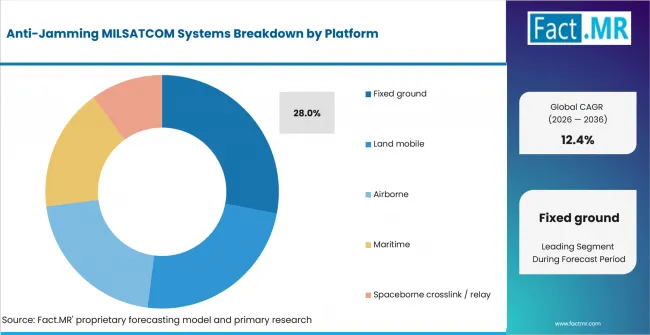
Anti Jamming Milsatcom Systems Analysis By Platform | Source: Fact.MR
Fixed ground sites lead the platform view because protected SATCOM depends on anchor stations, gateways and control nodes. These sites manage capacity, keys and network operations before traffic reaches mobile forces.
Ground gateways also connect national programs to allied capacity-sharing models. This gives fixed infrastructure a durable role even as mobile terminals and spaceborne relay options expand across multi-orbit architectures.
What is accelerating Anti-Jamming MILSATCOM Systems Market adoption, and what is holding it back?
Demand is expected to rise through protected tactical SATCOM production, multi-orbit planning and terminal modernization. Growth is moderated by certification load, spectrum coordination and long satellite qualification cycles.
Drivers Impact Analysis
| DRIVER | (~) % IMPACT ON CAGR | GEOGRAPHIC RELEVANCE | IMPACT TIMELINE |
|---|---|---|---|
| Protected tactical SATCOM production programs | +1.8% | North America, allied users | Short term (<= 2 years) |
| Multi-band terminal refresh across services | +1.4% | Global | Medium term (2-4 years) |
| Sovereign and allied secure SATCOM programs | +1.2% | Europe, Australia | Medium term (2-4 years) |
| Ground hub and crypto modernization | +0.8% | North America, Europe | Long term (>= 4 years) |
Source: Fact.MR analysis. Updated Sep 16, 2026
Opportunity Impact Analysis
| OPPORTUNITY | (~) % IMPACT ON CAGR | GEOGRAPHIC RELEVANCE | IMPACT TIMELINE |
|---|---|---|---|
| Protected waveform modem upgrades | +1.3% | North America, Europe | Short term (<= 2 years) |
| Spaceborne crypto with reprogrammability | +1.0% | USA, allied programs | Medium term (2-4 years) |
| Interoperable allied access to secure capacity | +0.7% | NATO, Five Eyes | Long term (>= 4 years) |
Source: Fact.MR analysis. Updated Sep 16, 2026
Restraints Impact Analysis
| RESTRAINT | (~) % IMPACT ON CAGR | GEOGRAPHIC RELEVANCE | IMPACT TIMELINE |
|---|---|---|---|
| Long qualification and certification cycles | -0.6% | Global | Medium term (2-4 years) |
| Spectrum congestion and interference management | -0.5% | Global | Short term (<= 2 years) |
| Budget timing in sovereign programs | -0.4% | Europe, Asia Pacific | Long term (>= 4 years) |
Source: Fact.MR analysis. Updated Sep 16, 2026
Which countries are scaling the Anti-Jamming MILSATCOM Systems Market through 2036?
- The country comparison spans 1.4 percentage points and forms a narrow protected-communications growth band across the forecast period.
- Australia remains 0.4 percentage point above the USA through secure multi-orbit SATCOM planning and maritime terminal renewal.
- The USA remains 0.4 percentage point above Germany as protected tactical waveform readiness reaches more fielded terminals.
- Germany matches the global CAGR through SATCOMBw modernization and European secure-connectivity infrastructure.
- The UK remains 0.3 percentage point above France as SKYNET 6 renews space, ground and user segments.
- France closes the displayed range through Syracuse IV ground-station deployment and sovereign protected communications.
Comparable CAGRs create different entry conditions due to sovereign satellite ownership, allied capacity access, terminal upgrade timing and ground-hub readiness. Full report coverage includes North America, Latin America, Western Europe, Eastern Europe, East Asia, South Asia & Pacific, Middle East & Africa.
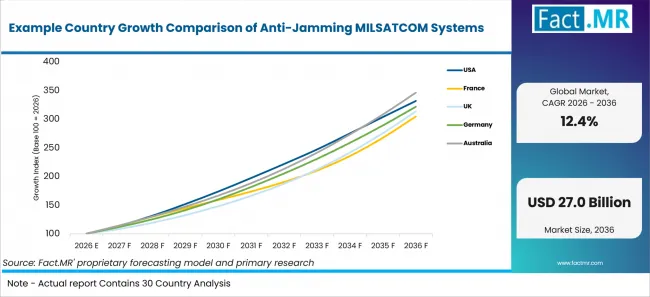
Example Country Growth Comparison Of Anti Jamming Milsatcom Systems | Source: Fact.MR
| Country | CAGR (2026-2036) |
|---|---|
| Australia | 13.2% |
| United States | 12.8% |
| Germany | 12.4% |
| United Kingdom | 12.1% |
| France | 11.8% |
Source: Fact.MR analysis. Updated Sep 16, 2026
What supports Australia adoption?
13.2% CAGR, supported by secure multi-orbit SATCOM and maritime terminal renewal.
Australia’s adoption path is shaped by defence planning that treats secure space links as a national operating requirement. The 2026 Integrated Investment Program allocates A$425 billion over the decade and identifies delivery of a resilient and secure multi-orbit satellite communications system among seven investment priorities. Navy SATCOM modernization is replacing MASTIS with King Cobra and Cobra systems, providing wider access across multiple orbital regimes and compatibility with the Wideband Global SATCOM constellation. These investments combine Australian-supported terminal and maritime communications capability with continued access to allied satellite networks.
What supports USA adoption?
12.8% CAGR, supported by protected tactical waveform readiness and Space Force investment.
The USA is pairing protected wideband SATCOM production with terminal-side waveform readiness. The Department of the Air Force FY2026 Budget Overview placed the U.S. Space Force budget request at USD 39.9 billion, including USD 26.1 billion in discretionary funding. Space Systems Command demonstrated Protected Tactical Waveform communications with joint warfighters in 2025, including frequency hopping at variable interference levels and over-the-air operation through five PTW-enabled terminals. As PTS-G, PTES and service-specific anti-jam modems are integrated within the Protected Tactical SATCOM Family of Systems, the architecture can support demand across satellite payloads, user-terminal equipment and protected communications hardware.
What is supporting Germany’s adoption?
12.4% CAGR, supported by SATCOMBw modernization and European secure-capacity alignment.
Germany’s market is rooted in sovereign SATCOMBw modernization and European secure-connectivity infrastructure. The Bundeswehr reported in August 2025 that SATCOMBw, with the COMSATBw satellites, is being modernized for EUR 1.4 billion. At the European level, the permanent EU GOVSATCOM Hub site in Cologne will connect authorized government users with pooled secure satellite-communications capacity from participating countries. Together, these programs involve ground stations, user terminals and network-management infrastructure supporting secure national and European SATCOM services.
What supports the United Kingdom’s growth?
12.1% CAGR, driven by SKYNET 6 space, ground and user-segment renewal.
The United Kingdom’s route comes through SKYNET 6 renewal across space, ground and user segments. GOV.UK guidance updated in August 2025 states that over GBP 5 billion is being invested in the SKYNET programme over the next ten years. Ground- and user-segment modernization includes new terminals and modems, extending the programme beyond satellites into field-access hardware. SKYNET 6 requirements include UHF narrowband capability and hardened wideband satellites incorporating X-band and military Ka-band payloads, alongside access to allied and commercial SATCOM services.
How does France perform?
11.8% CAGR, led by Syracuse IV resilience and sovereign military communications.
France is expected to scale through Syracuse IV as a sovereign communications backbone for deployed forces. The French Ministry of the Armed Forces stated in May 2026 that up to 380 ground stations would be deployed across the three armed forces under Syracuse IV. The system supports X- and Ka-band communications and is hardened against jamming, high-altitude nuclear threats and cyberattacks. These requirements can support demand for secure ground terminals, X/Ka-band interfaces and operational tools linked to French military SATCOM networks.
Who leads the Anti-Jamming MILSATCOM Systems Market?
Lockheed Martin is active through secure military communications and MUOS service-life-extension work. In February 2025, the company completed an Early Design Review for its MUOS SLE satellite design for U.S. Space Force Space Systems Command. MUOS provides secure beyond-line-of-sight UHF communications through orbiting satellites, relay ground stations and military user terminals.
Northrop Grumman participates through protected military satellite-communications payloads and ground systems. Its portfolio includes the Protected Tactical SATCOM Rapid Prototype and Enhanced Polar System capabilities for secure, jam-resistant communications in the northern polar region, together with control, mission-planning and cryptographic-planning ground systems.
L3Harris participates through the NSA-certified KSV-650 cryptographic unit developed under the Protected Tactical SATCOM SHIELD programme. Viasat received a PTS-G Swarm 1 Delivery Order in June 2026 for a dual X/Ka-band mini-GEO satellite with associated ground stations and operations support. Collins Aerospace supports military communications through ARC-210 radios offering MUOS SATCOM and SATURN anti-jam capability. Thales supports protected military SATCOM through Modem 21 anti-jam technology and its Syracuse IV ground-segment role.
Which companies are the key providers?
Key companies include Lockheed Martin; Northrop Grumman; L3Harris; RTX; Thales; and Viasat.
- Lockheed Martin
- Northrop Grumman
- L3Harris
- RTX
- Thales
- Viasat
Bibliography
- Mullins, C. R., Hohman, K., Paintal, S. S., Corey, R., & Johnson, I. (2025, September 14–19). BHT-6000 Hall thruster qualification and production status [Conference presentation]. 39th International Electric Propulsion Conference, Imperial College London, London, United Kingdom.
- European Space Agency. (2026, July 31). Space environment statistics. Retrieved September 15, 2026.
- Federal Aviation Administration. (2025, August 14). U.S. Transportation Secretary Duffy, FAA celebrate milestone of 1,000th commercial space operation.
- German Aerospace Center (DLR). (2025, November 28). Germany invests 5.4 billion euros in the future of European space.
- Japan Aerospace Exploration Agency. (2025, September 22). Five CubeSats successfully deployed from “Kibo”!
- L3Harris Technologies. (2025, December 16). L3Harris delivers most powerful thrusters for NASA’s Lunar Gateway.
- Moog Inc. (2025a, May 28). Air Force Research Laboratory awards Moog contract to develop new multimode propulsion system to enhance dynamic space operations.
- Moog Inc. (2025b, September 22). Moog breaks ground on new propulsion clean room to support satellite and missile growth.
- Figliozzi, G. (2025, December 18). NASA’s DiskSat technology demo launches to low Earth orbit. National Aeronautics and Space Administration.
- Friesen, T. (2025, December 17). NASA’s two-in-one satellite propulsion demo begins in-space test. National Aeronautics and Space Administration.
- Présidence de la République. (2025, December 2). Compte rendu du conseil des ministres du 2 décembre 2025.
- UK Space Agency. (2025a, November 21). UK backs next-generation satellite communications with £6.9 million investment. GOV.UK.
- UK Space Agency. (2025b, December 3). UK Space Agency invests £17 million to drive next wave of space innovation. GOV.UK.
- UK Space Agency. (2026, July 14). UK Space Agency Annual Report and Accounts 2025-2026. GOV.UK.
This Report Answers
- The report explains how anti-jamming MILSATCOM systems connect with satellite communication systems, protected waveforms and military ground infrastructure. It covers anti-jam technique, band, system element and platform.
- Segment analysis reviews null-steering phased arrays, Ka-band links, user terminals and fixed ground sites.
- Country analysis examines the listed markets and the defence programs shaping protected capacity.
- Competitive analysis reviews payload suppliers, terminal providers, crypto vendors and integrators.
- Application analysis considers jam resistance, spectrum monitoring and communications continuity.
What does the Anti-Jamming MILSATCOM Systems Market cover?
The Anti-Jamming MILSATCOM Systems Market covers systems that protect military satellite communications from deliberate interference. It includes phased-array null steering, protected waveforms, spread-spectrum techniques and traffic-protection functions connected with electronic warfare systems.
The assessment covers user terminals and satellite payloads. It also reviews gateways, network control and cryptographic equipment tied to space cybersecurity controls where secure command traffic depends on trusted links.
What is included in the scope?
The scope includes anti-jam payload capabilities and field terminals. It also includes ground gateways, waveform support and interference mitigation tools. Optical or RF transport support is included only when such equipment is sold into protected SATCOM architectures, including RF-over-fiber links.
It includes space-qualified electronics, crypto units and relay elements when they form part of protected communications links. Adjacent component review includes radiation-hardened electronics used in satellite payload and gateway environments.
What is excluded from the scope?
Outside the scope are ordinary commercial broadband satcom services, general telecom service subscriptions, civil broadcasting equipment and navigation-only anti-jam products when sold apart from military communications networks.
Cybersecurity tools are outside the scope when they secure ordinary IT systems apart from satellite communications links. Electronic warfare products are outside the scope when the equipment attacks hostile emitters apart from protecting MILSATCOM traffic.
How Was the Analysis Built?
The analysis draws on 120+ sources and 35+ company portfolios, reviews 25+ countries and incorporates more than 20 industry interviews.
- Primary Research: Primary research includes discussions with manufacturers and service providers. It also covers technology developers, distributors and end users. These conversations examine purchasing priorities and product adoption. They also review operational challenges, approval requirements and competitive positioning.
- Desk Research: Desk research covers government statistics and regulatory publications. It also reviews company filings, trade data and technical studies. Industry associations, standards and public policy sources are used where they support the analysis.
- Market Sizing and Forecasting: Market estimates combine historical performance and demand indicators. Pricing trends, volume trends and segment shares are then tested against company participation and country-level adoption.
- Data Validation and Update Cycle: Findings are validated by comparing primary interviews with public data. Company activity, regulatory changes and trade patterns are reviewed in the update cycle. Regular updates cover product launches, approvals and shifts in commercial adoption.
Segmentation
What is the report’s scope and coverage?
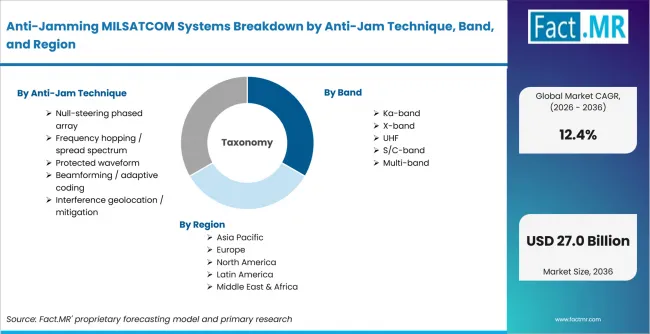
Anti Jamming Milsatcom Systems Breakdown By Anti Jam Technique, Band, And Region | Source: Fact.MR
| Attribute | Details |
|---|---|
| Quantitative Units | USD billion |
| Market Definition | Systems that protect military satellite communications from jamming, interference and hostile signal activity, including payload features, waveform support, terminals, gateways, cryptographic equipment and electronic protection software. |
| Anti-Jam Technique | Null-steering phased array; Frequency hopping / spread spectrum; Protected waveform; Beamforming / adaptive coding; Interference geolocation / mitigation |
| Band | Ka-band; X-band; UHF; S/C-band; Multi-band |
| System Element | User terminals; Satellite payload; Ground gateway; Network control / crypto; Electronic protection software; Spaceborne crosslink / relay |
| Platform | Fixed ground; Land mobile; Airborne; Maritime |
| Regions Covered | North America; Latin America; Western Europe; Eastern Europe; East Asia; South Asia & Pacific; Middle East & Africa |
| Countries Covered | United States; France; United Kingdom; Germany; Australia |
| Key Companies Profiled | Lockheed Martin; Northrop Grumman; L3Harris; RTX; Thales; Viasat |
| Forecast Period | 2026 to 2036 |
| Approach | Hybrid top-down and bottom-up approach using defence SATCOM program activity; payload and terminal demand; band mix; country-level modernization; and provider portfolio review. |
Source: Fact.MR analysis. Updated Sep 16, 2026
How is the market segmented?
-
By Anti-Jam Technique:
- Null-steering phased array
- Frequency hopping / spread spectrum
- Protected waveform
- Beamforming / adaptive coding
- Interference geolocation / mitigation
-
By Band:
- Ka-band
- X-band
- UHF
- S/C-band
- Multi-band
-
By System Element:
- User terminals
- Satellite payload
- Ground gateway
- Network control / crypto
- Electronic protection software
- Spaceborne crosslink / relay
-
By Platform:
- Fixed ground
- Land mobile
- Airborne
- Maritime
-
By Region:
- North America
- Latin America
- Western Europe
- Eastern Europe
- East Asia
- South Asia & Pacific
- Middle East & Africa
Frequently Asked Questions
How big is the anti-jamming MILSATCOM systems market in 2026?
What is the CAGR of the anti-jamming MILSATCOM systems market from 2026 to 2036?
Which anti-jam technique leads the anti-jamming MILSATCOM systems market?
Which band leads the anti-jamming MILSATCOM systems market?
Who are the leading companies in the anti-jamming MILSATCOM systems market?
Who worked on this report


Preview the report firsthand - request a free sample
Free SampleGet the brochure for pricing and purchase details
Download PDF