- Market Value (2025): USD 6.8 Bn
- Estimated Value (2026): USD 7.6 Bn
- Forecast Value (2036): USD 22.8 Bn
- CAGR (2026-2036): 11.6%
What is the Multi-Chem UPS Units Market forecast to be worth by 2036?
USD 7.6 billion in 2026 to USD 22.8 billion by 2036 at an 11.6% CAGR.
- The Multi-Chem UPS Units Market reached USD 6.8 billion in 2025.
- Demand is projected to increase from USD 7.6 billion in 2026 to USD 22.8 billion by 2036.
- The market is forecast to record 11.6% CAGR from 2026 to 2036 as data-center expansion, lithium-based retrofit economics and demand for chemistry-flexible backup architectures widen both new-build and replacement spending.
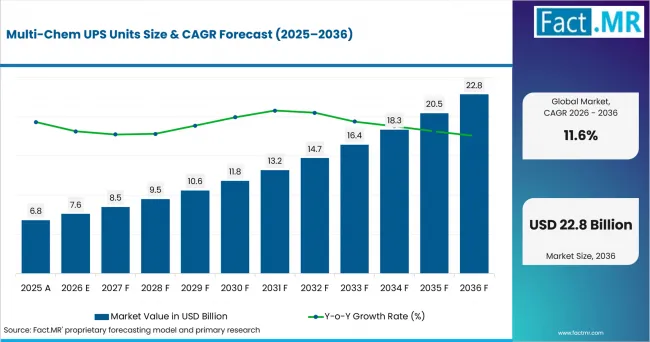
Multi Chem Ups Units Value Analysis | Source: Fact.MR
What are the defining numbers behind Multi-Chem UPS Units Market growth?
An absolute opportunity of USD 15.2 billion is expected between 2026 and 2036.
- Demand Drivers in the Market
- Data centers need more backup energy in less floor area as rack power rises. France announced more than EUR 109 billion of AI infrastructure commitments in February 2025, including major data-center investment.
- LFP is expanding the lithium choice set. Eaton states that its 9PX LFP UPS uses lithium iron phosphate cells with high thermal stability and an expected eight-to-ten-year life.
- Edge sites value compact, remotely managed lithium systems. Schneider Electric's Smart-UPS Ultra line uses lithium-ion technology in units reaching 10 kW for edge and micro data-center environments.
- Key Segments Analyzed
- Lithium-ion NMC accounts for 34.0% of Battery Chemistry demand in 2026. Lithium-ion NMC leads because it offers high energy density and an established supplier base across data-center and telecom UPS systems.
- Online double-conversion represents 58.0% of the UPS Topology mix in 2026. Online double-conversion dominates because it continuously conditions incoming power and isolates sensitive loads from common voltage and frequency disturbances.
- The 100-500 kVA band captures 27.0% of Power Rating demand in 2026. The 100-500 kVA band leads because it serves modular data halls, industrial lines, hospitals and larger commercial facilities without moving every installation into multi-megawatt custom engineering.
- Data centers account for 39.0% of End-use demand in 2026. Data centers lead through continuous uptime requirements, high power quality expectations and frequent capacity additions.
- Analyst Opinion at Fact.MR
- Shambhu Nath Jha, Principal Consultant at Fact.MR, states, “Multi-chemistry UPS demand is not a race to replace every lead-acid string. It is a portfolio decision across runtime, space, temperature, service and safety. Suppliers that let customers compare and operate chemistries under one tested control and maintenance framework can capture both greenfield projects and gradual campus conversions.”
- Strategic Implications
- UPS vendors should publish chemistry-specific thermal, fire, runtime and end-of-life assumptions instead of presenting one generic lithium case. Eaton's LFP offer demonstrates how cell stability and expected service life can be central product claims.
- Data-center suppliers should pair battery selection with load-step and power-quality performance. ABB noted in November 2025 that AI data centers can exceed 100 kW per rack and introduce unpredictable power spikes that require flexible critical power.
- Telecom and edge providers should package remote battery health with demand-response or peak-management options. Delta has documented telecom deployments that combine site power systems with peak shaving and remote operation.
UK demand is projected to expand at 12.6% CAGR through 2036 as new AI infrastructure intersects with a mixed-age colocation estate. France follows at 12.0% on large data-center commitments, with Germany at 10.5% through lifecycle-focused industrial and digital demand. Singapore records 9.5% under tight space and thermal constraints, while the mature USA market grows at 8.5% through replacement and selective chemistry migration.
How does the Multi-Chem UPS Units Market break down by segment?
Battery Chemistry: Lithium-ion NMC (34.0%); UPS Topology: Online double-conversion (58.0%); Power Rating: 100-500 kVA (27.0%); End-use: Data centers (39.0%).
Which Battery Chemistry leads?
Lithium-ion NMC: 34.0% share in 2026.
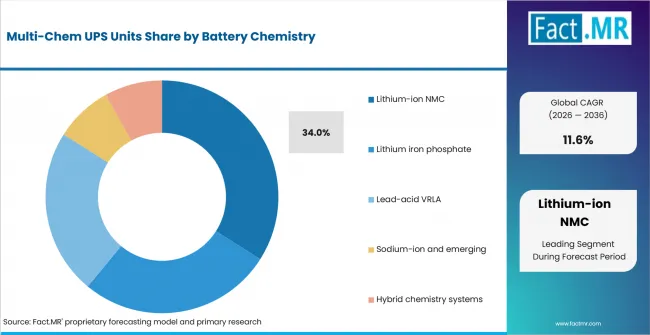
Multi Chem Ups Units Analysis By Battery Chemistry | Source: Fact.MR
Lithium-ion NMC leads because it offers high energy density and an established supplier base across data-center and telecom UPS systems. The chemistry supports smaller cabinets and longer replacement intervals than conventional lead acid when thermal controls and battery management are properly engineered.
Why does Online double-conversion dominate?
Online double-conversion: 58.0% share in 2026.
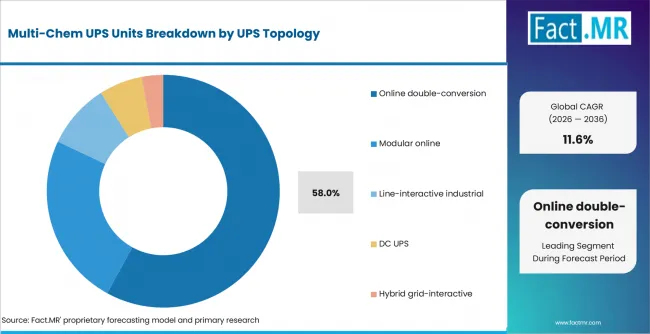
Multi Chem Ups Units Analysis By Ups Topology | Source: Fact.MR
Online double-conversion dominates because it continuously conditions incoming power and isolates sensitive loads from common voltage and frequency disturbances. Mission-critical facilities accept its conversion path in exchange for predictable output quality and established redundancy design.
What supports the 100-500 kVA Power Rating?
100-500 kVA: 27.0% share in 2026.
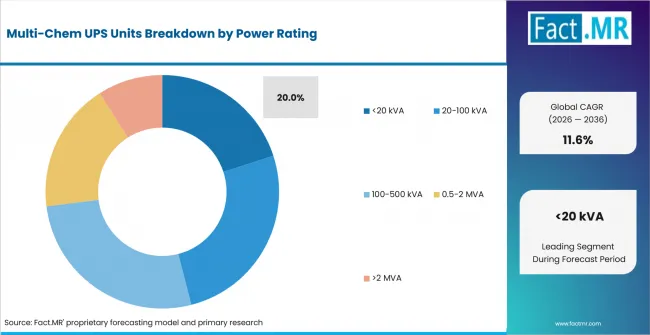
Multi Chem Ups Units Analysis By Power Rating | Source: Fact.MR
The 100-500 kVA band leads because it serves modular data halls, industrial lines, hospitals and larger commercial facilities without moving every installation into multi-megawatt custom engineering. It also supports parallel growth as loads are added.
Which End-use accounts for the largest share?
Data centers: 39.0% share in 2026.
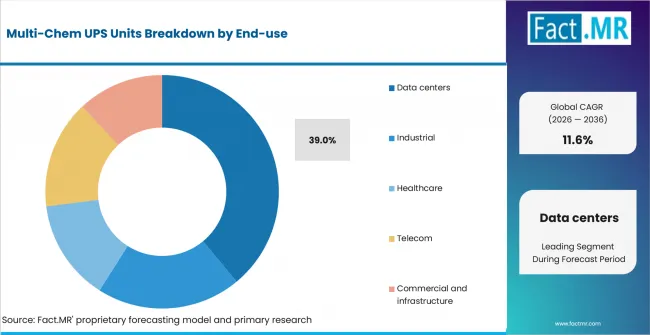
Multi Chem Ups Units Analysis By End Use | Source: Fact.MR
Data centers lead through continuous uptime requirements, high power quality expectations and frequent capacity additions. Battery chemistry directly affects white-space use, cooling, maintenance windows and the timing of large replacement events.
What is accelerating Multi-Chem UPS Units Market adoption, and what is holding it back?
Demand is rising as buyers seek smaller battery footprints, longer service intervals and a choice of safety and cycle-life profiles. Fire-code review, recycling routes, control compatibility and uncertainty about emerging chemistry bankability constrain faster conversion.
Drivers Impact Analysis
| DRIVER | (~) % IMPACT ON CAGR | GEOGRAPHIC RELEVANCE | IMPACT TIMELINE |
|---|---|---|---|
| Data-center backup capacity growth | +1.7% | USA, UK, France, Singapore | Short term (<= 2 years) |
| Lithium lifecycle and footprint advantages | +1.2% | Global | Medium term (2-4 years) |
| Chemistry-flexible modular UPS design | +0.9% | North America, Europe, Asia | Medium term (2-4 years) |
| Grid-interactive critical power | +0.6% | Europe, telecom networks | Long term (>= 4 years) |
- Data-center backup capacity growth: More halls and higher rack loads increase both UPS power and stored-energy requirements.
- Lithium lifecycle and footprint advantages: Longer replacement intervals and smaller cabinets can offset a higher initial battery price in constrained facilities.
- Chemistry-flexible modular UPS design: Common controls and service procedures reduce the disruption of converting a campus in stages.
Opportunity Impact Analysis
| OPPORTUNITY | (~) % IMPACT ON CAGR | GEOGRAPHIC RELEVANCE | IMPACT TIMELINE |
|---|---|---|---|
| LFP retrofits for edge and mid-size sites | +1.0% | USA, Europe, Singapore | Short term (<= 2 years) |
| Hybrid chemistry campus management | +0.8% | Large data-center markets | Medium term (2-4 years) |
| Sodium-ion validation for stationary backup | +0.5% | Europe, Asia | Long term (>= 4 years) |
- LFP retrofits for edge and mid-size sites: Thermal stability and long service life can create a clear conversion case where cabinet space and site visits are expensive.
- Hybrid chemistry campus management: Software that presents common runtime, health and alarm views can help operators retain serviceable VRLA while adding lithium strings.
- Sodium-ion validation for stationary backup: Lithium-free systems may diversify supply, but vendors need bankable field evidence and compatible power electronics.
Restraints Impact Analysis
| RESTRAINT | (~) % IMPACT ON CAGR | GEOGRAPHIC RELEVANCE | IMPACT TIMELINE |
|---|---|---|---|
| Fire and permitting review | -0.8% | Global urban data-center markets | Short term (<= 2 years) |
| Chemistry-specific controls and service skills | -0.6% | Global | Medium term (2-4 years) |
| Uncertain recycling paths for newer cells | -0.4% | Europe, North America, Asia | Long term (>= 4 years) |
- Fire and permitting review: Battery type, cabinet arrangement and suppression strategy can alter approval schedules even when the UPS power electronics are unchanged.
- Chemistry-specific controls and service skills: Technicians need battery-management diagnostics and safe procedures that differ from familiar VRLA maintenance.
- Uncertain recycling paths for newer cells: Buyers may delay emerging chemistries until collection, transport and residual-value arrangements are contractually clear.
Which countries are scaling the Multi-Chem UPS Units Market through 2036?
- The UK creates parallel demand for greenfield lithium designs and controlled conversion of older rooms.
- France brings a stronger new-build component, allowing chemistry and grid interaction to be specified before facility commissioning.
- Germany turns total lifecycle cost and serviceability into formal purchase criteria across industrial and digital sites.
- Singapore places unusual weight on cabinet footprint, cooling burden and battery behavior in a hot, constrained environment.
- The USA closes the displayed range because its large installed base converts in stages, even as absolute replacement volume remains substantial.
Installed UPS age, fire approval, ambient conditions and battery service economics shape the country cases. Broader regional coverage includes North America, Latin America, Western Europe, Eastern Europe, East Asia, South Asia & Pacific, Middle East & Africa.
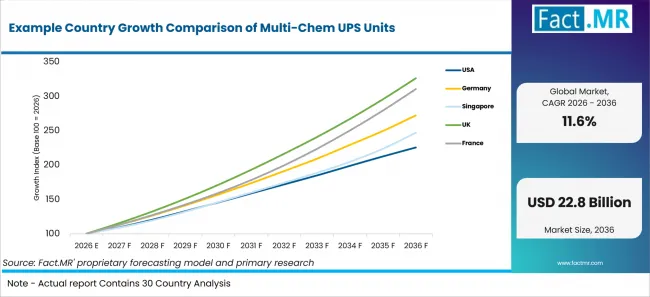
Example Country Growth Comparison Of Multi Chem Ups Units | Source: Fact.MR
| Country | CAGR (2026-2036) |
|---|---|
| USA | 8.5% |
| Germany | 10.5% |
| Singapore | 9.5% |
| UK | 12.6% |
| France | 12.0% |
Why is USA growth steady rather than explosive?
8.5% CAGR, supported by a vast installed UPS base and selective chemistry conversion.
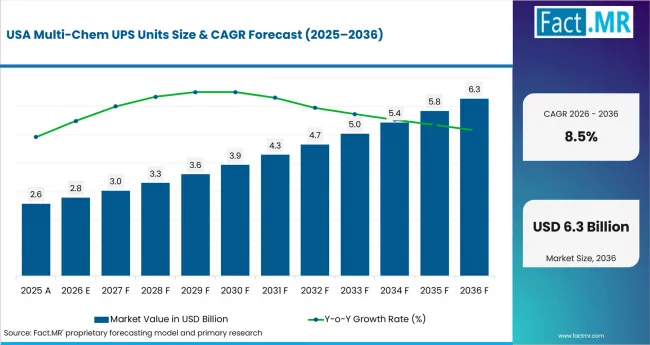
Multi Chem Ups Units Country Value Analysis | Source: Fact.MR
The USA has the broadest installed population of enterprise and data-center UPS systems, which creates a dependable replacement cycle but also slows percentage growth. Buyers can choose lithium-ion for space and lifecycle benefits while retaining VRLA in cost-sensitive rooms with established maintenance routines. The strongest multi-chem opportunity sits in phased campuses that need one controls layer across old and new battery strings.
What drives Germany's chemistry choices?
10.5% CAGR, shaped by efficiency, lifecycle cost and industrial continuity.
German users scrutinize battery safety, service life and end-of-life handling across industrial and digital facilities. Data-center efficiency requirements raise the value of smaller footprints and lower cooling loads, while manufacturing sites still prize proven service networks. LFP is likely to gain where thermal stability and cycle life matter, but VRLA remains relevant for predictable standby duty and familiar maintenance.
How does Singapore's climate alter the buying case?
9.5% CAGR, supported by space-constrained data centers and hot-climate lifecycle economics.
Singapore's premium on floor area favors higher-energy-density battery cabinets, yet ambient conditions make thermal management and cell supervision central to approval. The national Green Data Centre Roadmap links capacity growth with efficiency, which pushes operators to evaluate the entire UPS and battery room rather than headline cell energy density. Modular replacement strategies gain where live facilities cannot surrender capacity during changeovers.
What is supporting the UK's 12.6% CAGR through 2036?
12.6% CAGR, driven by AI infrastructure growth and mixed-age colocation estates.
The UK's combination of new AI capacity and established colocation rooms creates a two-track market. New halls can specify lithium-based or hybrid architectures from the outset, while older sites convert cabinet by cabinet as runtime and fire strategies are revalidated. AI Growth Zone planning adds project momentum, and the varied estate raises demand for controls that can manage more than one chemistry across a campus.
Where does France create new UPS demand?
12.0% CAGR, backed by large AI infrastructure commitments and site development.
France is adding greenfield demand alongside enterprise replacement. The Élysée reported more than EUR 109 billion of announced AI infrastructure investment in February 2025, including up to EUR 15 billion from Brookfield for data centers. New facilities can choose chemistry around lifecycle, footprint and grid interaction, while national site-screening work can shorten the route from power allocation to equipment tender.
Who leads the Multi-Chem UPS Units Market?
Schneider Electric, Vertiv, Eaton, Huawei Digital Power, Delta Electronics and ABB.
Schneider Electric leads through APC and Galaxy UPS portfolios spanning edge, enterprise and data-center applications. Its lithium offers and EcoStruxure management provide a route from compact Smart-UPS installations to larger critical-power systems.
Vertiv combines Liebert UPS systems, lithium-ion battery cabinets, DC power and infrastructure monitoring. The company is positioned where data-center operators want power, thermal and service design coordinated around changing load profiles.
Eaton competes across online and modular UPS, VRLA, lithium-ion and LFP choices. Its LFP 9PX and larger compatible lithium battery systems give customers chemistry options across distributed and facility-scale deployments.
Huawei Digital Power and Delta Electronics bring strong telecom, modular data-center and conversion capabilities, particularly in Asian and emerging infrastructure markets. ABB participates in high-power UPS and medium-voltage critical systems for industrial and AI facilities.
Competition centers on safety documentation, field service, battery-management integration and lifecycle guarantees. A chemistry choice becomes defensible when suppliers can show performance under the actual temperature, load and replacement plan.
Which companies are the key providers?
Key companies include Schneider Electric; Vertiv; Eaton; Huawei Digital Power; Delta Electronics; ABB.
- Schneider Electric
- Vertiv
- Eaton
- Huawei Digital Power
- Delta Electronics
- ABB
Bibliography
- Schneider Electric. (2026). Smart-UPS Ultra lithium-ion systems for edge and micro data centers.
- Eaton. (2026). 9PX lithium iron phosphate UPS product information.
- Eaton. (2026). Lithium-ion battery systems for 93PM and 9395 UPS platforms.
- Vertiv. (2026). Lithium-ion batteries in edge and remote mission-critical applications.
- ABB. (2025, November 10). How critical power systems can adapt to AI's demands.
- Delta Electronics. (2025). Smart power management for telecom networks.
- Élysée. (2025, February 11). Artificial intelligence infrastructure investment announcements.
- Direction générale des Entreprises. (2025, November 28). Guide to data-center siting in France.
- Department for Science, Innovation and Technology. (2025). Delivering AI Growth Zones.
- Infocomm Media Development Authority. (2024). Green Data Centre Roadmap.
- Federal Ministry for Economic Affairs and Energy, Germany. (2025). Data-center energy efficiency briefing.
This Report Answers
- The report explains how multi-chem UPS units demand is distributed across Battery Chemistry, UPS Topology, Power Rating and End-use.
- Segment analysis identifies the 2026 leaders and explains their purchase logic: Battery Chemistry: Lithium-ion NMC at 34.0%; UPS Topology: Online double-conversion at 58.0%; Power Rating: 100-500 kVA at 27.0%; End-use: Data centers at 39.0%.
- The country outlook differentiates the USA, Germany, Singapore, UK and France by installed UPS age, fire approval, ambient conditions and battery service economics.
- Competitive analysis reviews current positions for Schneider Electric, Vertiv, Eaton, Huawei Digital Power, Delta Electronics and ABB.
- Application analysis tests data-center backup capacity growth against the limiting effect of fire and permitting review.
What does the Multi-Chem UPS Units Market cover?
Uninterruptible power supply units and integrated battery systems designed to support two or more established or emerging battery chemistry pathways across critical digital, industrial and infrastructure loads.
Adjacent Fact.MR coverage includes modular uninterruptible power supplies, critical power and cooling, and industrial batteries, which clarify neighboring demand pools without being counted in this market.
What is included in the scope?
The scope includes UPS units sold with NMC, LFP, VRLA, sodium-ion, hybrid or other commercially supported chemistry choices. Online double-conversion, modular online, line-interactive industrial, DC and grid-interactive topologies are covered.
The boundary also considers lead acid batteries and sodium nickel chloride batteries where those markets influence purchase timing but remain separately valued.
Revenue includes integrated battery cabinets, battery-management functions and chemistry-specific controls when sold as part of the UPS package. Coverage spans data centers, industrial sites, telecom, healthcare and critical commercial infrastructure.
What is excluded from the scope?
The scope excludes stand-alone batteries sold without a UPS application, consumer backup products, utility-scale energy storage and vehicle traction systems. Generator and transfer-switch revenue is separately valued.
UPS maintenance contracts are excluded unless embedded in the initial unit value. Experimental cell systems without a commercial stationary backup route are not counted.
How Was the Analysis Built?
The analysis draws on 120+ sources, 35+ company portfolios, 25+ countries, and more than 20 industry interviews.
- Primary Research: Interviews cover manufacturers, technology developers, integrators, channel partners, end users and subject-matter experts relevant to this market. Discussions test purchase triggers, specification tradeoffs, implementation barriers, supplier positioning and the conditions required for wider commercial adoption.
- Desk Research: Research covers government statistics, regulatory publications, standards, company announcements, technical studies, trade information and industry associations. Published claims used in the analysis are documented in the bibliography.
- Market Sizing and Forecasting: The model combines UPS shipments and installed-base replacement by power band, battery value per system, chemistry attachment, topology mix and end-use requirements. Forecast weights reflect data-center capacity, battery service life, lithium conversion, permitting, thermal conditions and supplier support by country.
- Data Validation and Update Cycle: Findings are triangulated across interviews, public evidence, company activity, policy changes, trade patterns and implementation signals. Updates review product launches, capacity shifts, partnerships, approvals, procurement behavior and material changes in commercial adoption.
What is the report's scope and coverage?
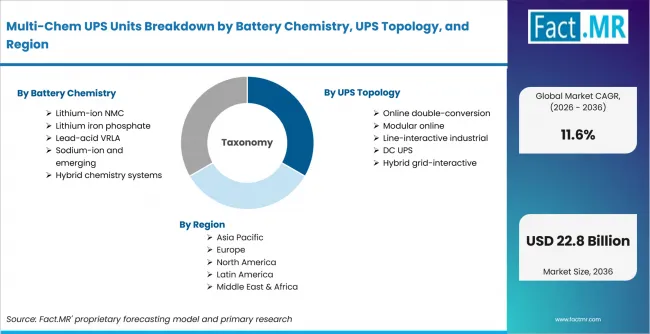
Multi Chem Ups Units Breakdown By Battery Chemistry, Ups Topology, And Region | Source: Fact.MR
| Attribute | Details |
|---|---|
| Quantitative Units | USD 7.6 billion in 2026 to USD 22.8 billion by 2036 at an 11.6% CAGR |
| Market Definition | Uninterruptible power supply units and integrated battery systems designed to support two or more established or emerging battery chemistry pathways across critical digital, industrial and infrastructure loads. |
| Battery Chemistry | Lithium-ion NMC; Lithium iron phosphate; Lead-acid VRLA; Sodium-ion and emerging; Hybrid chemistry systems |
| UPS Topology | Online double-conversion; Modular online; Line-interactive industrial; DC UPS; Hybrid grid-interactive |
| Power Rating | <20 kVA; 20-100 kVA; 100-500 kVA; 0.5-2 MVA; >2 MVA |
| End-use | Data centers; Industrial; Healthcare; Telecom; Commercial and infrastructure |
| Regions Covered | North America; Latin America; Western Europe; Eastern Europe; East Asia; South Asia & Pacific; Middle East & Africa |
| Countries Covered | USA; Germany; Singapore; UK; France |
| Key Companies | Schneider Electric; Vertiv; Eaton; Huawei Digital Power; Delta Electronics; ABB |
| Forecast Period | 2026 to 2036 |
| Approach | The model combines UPS shipments and installed-base replacement by power band, battery value per system, chemistry attachment, topology mix and end-use requirements. Forecast weights reflect data-center capacity, battery service life, lithium conversion, permitting, thermal conditions and supplier support by country. |
How is the market segmented?
-
By Battery Chemistry
- Lithium-ion NMC
- Lithium iron phosphate
- Lead-acid VRLA
- Sodium-ion and emerging
- Hybrid chemistry systems
-
By UPS Topology
- Online double-conversion
- Modular online
- Line-interactive industrial
- DC UPS
- Hybrid grid-interactive
-
By Power Rating
- <20 kVA
- 20-100 kVA
- 100-500 kVA
- 0.5-2 MVA
- >2 MVA
-
By End-use
- Data centers
- Industrial
- Healthcare
- Telecom
- Commercial and infrastructure
-
By Region
- North America
- Latin America
- Western Europe
- Eastern Europe
- East Asia
- South Asia & Pacific
- Middle East & Africa