- Base Value(2025): 29.4 Bn
- Estimated Value(2026): 32.8 Bn
- Forecast Value (2036): 97.4 Bn
- CAGR (2026 - 2036): 11.5%
Critical Power and Cooling Market Forecast 2026 to 2036
In 2025, the critical power and cooling market was valued at USD 29.4 billion. Based on FMR analysis, demand for critical power and cooling solutions is estimated to grow to USD 32.8 billion in 2026 and USD 97.4 billion by 2036. FMR projects a CAGR of 11.5% during the forecast period.
The absolute dollar growth from 2026 to 2036 is USD 64.6 billion. This growth is driven by increasing data center deployments, rising demand for uninterrupted power supply, and the need for energy-efficient cooling solutions in IT, telecom, and industrial sectors. The adoption of high-density computing infrastructure and the expansion of cloud services are key factors supporting market expansion. However, challenges such as high upfront capital costs and complex installation requirements may impact growth in some regions.
As Giordano (Gio) Albertazzi, Chief Executive Officer of Vertiv, noted regarding the growing need for power and cooling infrastructure for AI workloads, “With AI driving rack densities into three- and four-digit kWs, the need for advanced and scalable solutions to power and cool those racks … has never been higher.”
South Korea leads with a CAGR of 14.6%, driven by rapid expansion of data centers and high-tech industries. The UK follows with 13.5%, supported by increasing cloud adoption and enterprise IT infrastructure upgrades. China grows at 13.1%, fueled by large-scale data center deployment and industrial growth. India shows a CAGR of 13.0%, reflecting rising demand for IT and telecom infrastructure. The USA grows at 12.4%, driven by consistent investments in data centers and critical industrial facilities.
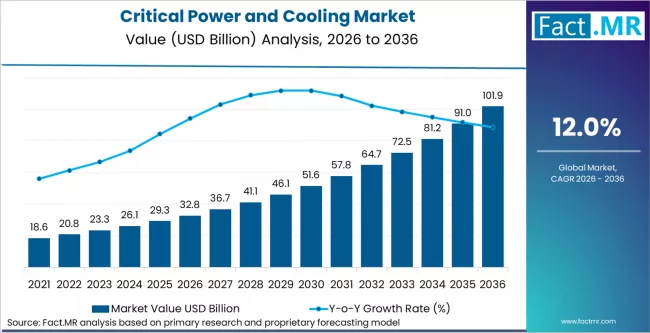
Critical Power And Cooling Market Market Value Analysis | Source: Fact.MR
Critical Power and Cooling Market
| Metric | Value |
|---|---|
| Estimated Value in (2026E) | USD 32.8 billion |
| Forecast Value in (2036F) | USD 97.4 billion |
| Forecast CAGR (2026 to 2036) | 11.5% |
Source: Fact.MR analysis. Updated Mar 7, 2026
Critical Power and Cooling Market Definition
The Critical Power and Cooling Market involves the provision and sale of systems and solutions that ensure continuous, reliable power and temperature control for mission‑critical facilities such as data centres, hospitals, industrial plants, and telecommunication hubs.
Market Inclusions
This report covers global and regional market sizes for critical power and cooling over a defined forecast period, including solution types (UPS systems, generators, precision cooling, CRAC/CRAH units), application segments (data centres, healthcare, manufacturing), and end‑use industries.
Market Exclusions
The scope excludes general power distribution equipment not specific to critical reliability and cooling, consumer HVAC products, and ancillary facility infrastructure not tied to continuity of power and temperature control.
Research Methodology
- Primary Research: Interviews were conducted with system integrators, facility engineers, and procurement specialists.
- Desk Research: Data was sourced from industry reports, energy and cooling publications, and trade association statistics.
- Market‑Sizing and Forecasting: A hybrid model combining top‑down demand forecasts with bottom‑up shipment and revenue data was used.
- Data Validation and Update Cycle: Findings were validated through expert review and aligned with recent production, adoption, and trade figures.
Summary of the Critical Power and Cooling Market
- Market Definition
- The Critical Power and Cooling Market includes global production and deployment of UPS systems, generators, and cooling units, used to ensure uninterrupted power and thermal management across industrial, commercial, and IT facilities. The market serves data centers, hospitals, manufacturing plants, and transportation facilities, supporting reliability, uptime, and operational efficiency.
- Demand Drivers
- Expansion of Data Centers: Increasing cloud adoption and digital services are driving large-scale deployment of data centers requiring robust power and cooling solutions.
- High-Density IT Infrastructure: Advanced servers, edge computing, and high-performance computing generate significant heat, necessitating efficient cooling and continuous power supply.
- Operational Continuity in Industry: Industrial and manufacturing sectors require reliable power and thermal management to prevent downtime and equipment damage.
- Energy Efficiency and Compliance: Investments in efficient cooling and UPS systems help reduce energy consumption and meet environmental and safety regulations.
- Reliability and Uptime Standards: Mission-critical facilities demand certified and resilient solutions to maintain strict uptime requirements.
- Key Segments Analyzed
- Type: UPS, Generators, Cooling Units, Others.
- End-Use Industry: Industrial, IT & Telecom, Commercial, Transportation.
- Facility: Data Centers (51% of the market), Hospitals, Manufacturing, Others.
- Geography: South Korea leads with 14.6% CAGR, followed by the UK (13.5%), China (13.1%), India (13.0%), and USA (12.4%).
- Analyst Opinion at Fact MR
- Shambhu Nath Jha, Principal Consultant at Fact MR, stated, "The critical power and cooling market is experiencing rapid expansion due to increasing demand for high-density IT infrastructure and mission-critical facilities. Growth is strongly tied to data center deployments, industrial automation, and the adoption of energy-efficient and scalable power and cooling solutions."
- Strategic Implications / Executive Takeaways
- Target High-Growth Regions: Focus on South Korea, UK, China, India, and the USA to capitalize on rising data center and industrial investments.
- Promote Advanced Cooling & UPS Solutions: Emphasize modular UPS, lithium-ion energy storage, and precision cooling systems to meet high-density IT and industrial requirements.
- Enhance Service and Maintenance Networks: Providing strong regional support and preventive maintenance can improve customer retention and uptime assurance.
- Integrate Energy Efficiency Solutions: Promote eco-friendly and cost-efficient systems to comply with sustainability and regulatory standards.
- Collaborate with Data Center and Industrial Developers: Partnering with enterprises and cloud providers can drive bulk adoption and long-term contracts.
- Methodology
- Primary Research: Interviews with system integrators, facility engineers, and procurement specialists.
- Desk Research: Data sourced from industry reports, energy and cooling publications, and trade associations.
- Market Sizing & Forecasting: Hybrid top-down and bottom-up approach combining historical adoption, shipment data, and revenue forecasts.
Segmental Analysis
Critical Power and Cooling Market Analysis by Facility
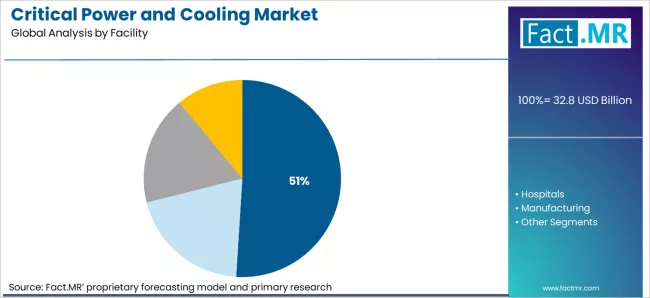
Critical Power And Cooling Market Analysis By Facility | Source: Fact.MR
- Market Overview: Data centers are expected to capture 51% of the market share by 2026. Data centers require robust critical power and cooling systems to ensure uninterrupted operation of servers, networking equipment, and IT infrastructure. Efficient cooling is essential to prevent overheating, maintain performance, and extend equipment lifespan.
- Demand Drivers:
- Rising Demand for Cloud Services: The rapid growth of cloud computing and digital services has led to increased deployment of data centers, driving demand for critical power and cooling solutions.
- High Energy Consumption of IT Equipment: Servers and networking devices generate significant heat, necessitating advanced cooling systems to maintain optimal performance and prevent failures.
- Emphasis on Reliability and Uptime: Data centers require continuous power supply and cooling to meet strict uptime requirements, making reliable critical power and cooling solutions essential for operations.
Critical Power and Cooling Market Analysis by End Use
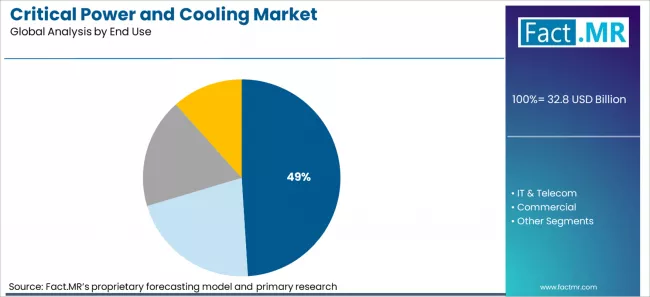
Critical Power And Cooling Market Analysis By End Use | Source: Fact.MR
- Market Overview: Industrial applications are projected to hold 49% of the market share by 2026. Industries such as manufacturing, oil and gas, and process industries rely on critical power and cooling systems to maintain uninterrupted operations and protect sensitive equipment.
- Demand Drivers:
- Operational Continuity: Industrial facilities require stable power and temperature management to prevent downtime, production loss, and equipment damage.
- Increased Automation and Equipment Sensitivity: As industrial processes adopt advanced automation and electronic control systems, the need for reliable cooling and power solutions grows to ensure operational efficiency.
- Energy Efficiency and Regulatory Compliance: Industries are investing in efficient cooling and power systems to reduce energy consumption and comply with environmental and safety regulations, driving market adoption.
Critical Power and Cooling Market Drivers, Restraints, and Opportunities
FMR analysts observe that the critical power and cooling market is a growth‑aligned, infrastructure‑essential segment driven by expanding digitalization, data center build‑outs, and uptime priorities across enterprise, cloud, and telecom networks. Historically, basic UPS and HVAC systems supported facility needs; as power density, compute loads, and availability expectations increased, structural demand emerged for integrated critical power and precision cooling solutions that maintain reliability, efficiency, and thermal control. The 2026 valuation reflects this shift, with adoption tied to data center growth and stringent service level expectations rather than standalone, commodity products.
While traditional generators and basic air conditioners remain in use for backup and ambient comfort, advanced modular UPS systems, lithium‑ion energy storage, and liquid cooling are gaining share because they deliver higher efficiency, redundancy, and scalability. These premium solutions carry higher per‑unit pricing, contributing to net market value growth even as total unit volumes grow in line with facility expansion and retrofit cycles. The market exists because operational continuity, thermal management, and energy cost pressures make robust power and cooling systems indispensable.
- Digital Infrastructure Demand: Growth of data centers, edge computing, and telecom networks drives uptake of precision power and cooling over basic standby systems.
- Reliability & Uptime Standards: Service level and uptime requirements push adoption of certified, resilient power and cooling solutions that meet defined performance thresholds.
- Regional Deployment Dynamics: In North America and Asia‑Pacific, strong digital services growth and facility investment accelerate advanced system adoption compared with regions with slower infrastructure build‑out.
Regional Analysis
The market analysis covers key global regions, including East Asia, South Asia, Western Europe, and North America. It is segmented geographically, with specific market dynamics for each region. The full report provides a detailed market attractiveness analysis.
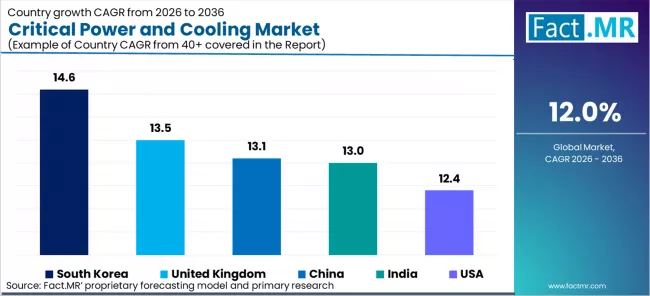
Critical Power And Cooling Market Cagr Analysis By Country | Source: Fact.MR
| Country | CAGR (2026-2036) |
|---|---|
| South Korea | 14.6% |
| United Kingdom | 13.5% |
| China | 13.1% |
| India | 13.0% |
| USA | 12.4% |
Source: Fact.MR analysis. Updated Mar 7, 2026
Source: Fact MR (FMR) analysis, based on proprietary forecasting model and primary research
East Asia:
South Korea and China are major markets, driven by growing data center construction, industrial automation, and increased deployment of energy-efficient cooling solutions.
- South Korea: Demand for critical power and cooling solutions in South Korea is projected to rise at 14.6% CAGR through 2036. Growth is supported by government smart city initiatives (02-2025) and Schneider Electric’s regional facility expansion (07-2025).
- China: Demand for critical power and cooling solutions in China is projected to rise at 13.1% CAGR through 2036. Growth is influenced by rapid expansion of cloud data centers (03-2025) and ABB’s regional infrastructure projects (08-2025).
South Asia:
India is a key market, supported by the growth of cloud computing, IT infrastructure, and industrial power needs.
- India: Demand for critical power and cooling solutions in India is projected to rise at 13.0% CAGR through 2036. Growth is driven by government data center programs (05-2025) and Vertiv’s expansion of power and cooling solutions across metropolitan regions (09-2025).
Western Europe:
The United Kingdom leads in adoption of critical power and cooling technologies, backed by investments in data centers and renewable energy integration.
- United Kingdom: Demand for critical power and cooling solutions in the UK is projected to rise at 13.5% CAGR through 2036. Growth is supported by National Grid infrastructure upgrades (06-2025) and Eaton’s deployment of energy-efficient cooling systems (10-2025).
North America:
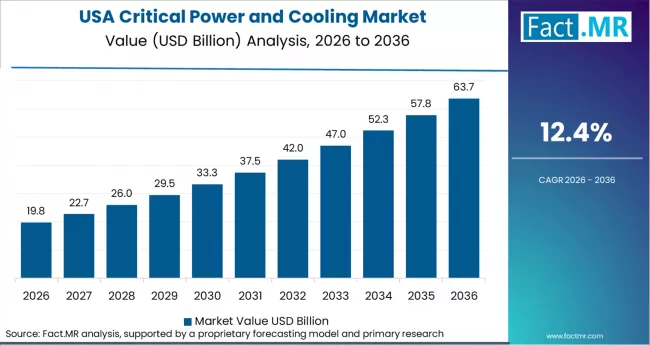
Critical Power And Cooling Market Country Value Analysis | Source: Fact.MR
The USA represents a large market, supported by enterprise data centers, cloud computing growth, and industrial facility modernization.
- USA: Demand for critical power and cooling solutions in the U.S. is projected to rise at 12.4% CAGR through 2036. Growth is influenced by federal data center optimization programs (04-2025) and Schneider Electric’s U.S. operations expansion (08-2025).
Fact MR's analysis of the critical power and cooling market in East Asia, South Asia, Western Europe, and North America consists of country-wise assessments that include South Korea, China, India, the United Kingdom, and the USA. Readers can find detailed trends, regulatory updates, and company-specific investments shaping market growth in these countries.
What is the Competitive Structure and Buyer Behavior in the Critical Power and Cooling Market?
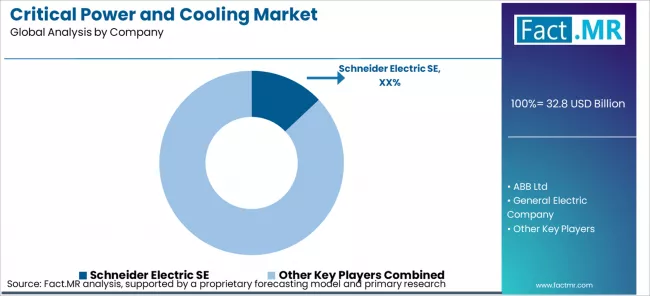
Critical Power And Cooling Market Analysis By Company | Source: Fact.MR
The critical power and cooling market is moderately concentrated, with major global electrical and infrastructure firms such as Schneider Electric SE, ABB Ltd, General Electric Company, Eaton Corporation plc, Delta Electronics, Inc., Vertiv Holdings Co., and STULZ GmbH capturing a substantial share. The primary competitive variables are system reliability, energy efficiency, uptime performance, integration capability with building management and data center infrastructure, and lifecycle cost, which heavily influence procurement by data centers, telecommunications facilities, and industrial users. Companies with broad portfolios, extensive engineering expertise, global service networks, and established brand reputations hold structural advantages because they can support complex installations, offer preventive maintenance programs, and meet stringent uptime and safety requirements. Large institutional and enterprise buyers exert notable leverage by qualifying multiple suppliers, negotiating long‑term service and pricing agreements, and standardizing technical specifications to manage risk and ensure performance consistency across sites. To manage supplier dependency, these buyers diversify approved vendors and emphasize strong service support and rapid response capability, which limits individual suppliers’ pricing power. As a result, competition centers on performance reliability, integration support, and service infrastructure rather than on price alone.
Recent Industry Developments
- Vertiv & Generate Strategic Alliance: On March 4, 2026, Vertiv announced a major collaboration with Generate Capital to provide "Bring Your Own Power & Cooling" (BYOP&C) solutions. This allows data center operators to bypass utility grid delays by deploying on-site natural gas turbines, fuel cells, and modular cooling units financed through Generate’s "as-a-service" model.
- Agentic AI in Facility Management: Schneider Electric debuted its EcoStruxure Foresight Operation AI platform in early 2026. This "Agentic AI" system moves beyond monitoring to autonomously simulate and optimize power/cooling flows using digital twins (via ETAP and Aveva) to prevent "thermal runaway" in racks now exceeding 100 kW.
- Industrial BESS Milestone: In February 2026, Delta Electronics successfully commissioned a 6.4 MWh Battery Energy Storage System (BESS) for the Kolkata Metro. This marks a significant 2026 trend where critical power providers are using large-scale batteries not just for backup, but for "peak shaving" to manage the massive energy spikes of urban infrastructure.
Key Players of the Critical Power and Cooling Market
- Schneider Electric SE
- ABB Ltd
- General Electric Company
- Eaton Corporation plc
- Delta Electronics, Inc.
- Vertiv Holdings Co.
- STULZ GmbH
Report Scope
| Metric | Value |
|---|---|
| Quantitative Units | USD 32.8 billion (2026) to USD 97.4 billion (2036), at a CAGR of 11.5% |
| Market Definition | The Critical Power and Cooling Market includes global production and deployment of UPS systems, generators, and cooling units, used to ensure uninterrupted power and thermal management across industrial, commercial, and IT facilities. |
| Type | UPS, Generators, Cooling Units, Others |
| End Use | Industrial, IT & Telecom, Commercial, Transportation |
| Facility | Data Centers, Hospitals, Manufacturing, Others |
| Regions Covered | North America, Latin America, Europe, East Asia, South Asia, Oceania, Middle East and Africa |
| Countries Covered | United States, Canada, Mexico, Brazil, Argentina, Germany, France, United Kingdom, Italy, Spain, China, India, Japan, South Korea, Indonesia, Australia, and 40+ countries |
| Key Companies Profiled | Schneider Electric SE, ABB Ltd, General Electric Company, Eaton Corporation plc, Delta Electronics, Inc., Vertiv Holdings Co., STULZ GmbH |
| Forecast Period | 2026 to 2036 |
| Approach | Hybrid top-down and bottom-up market modeling validated through primary interviews with power and cooling equipment manufacturers, supported by trade data benchmarking and plant-level capacity verification. |
Source: Fact.MR analysis. Updated Mar 7, 2026
Bibliographies
- International Energy Agency. (2023). Data centres and data transmission networks: Tracking energy use and efficiency trends. International Energy Agency.
- Uptime Institute. (2023). Annual data center survey: Reliability, power infrastructure, and cooling trends. Uptime Institute.
- International Organization for Standardization. (2023). ISO 22237: Information technology — Data centre facilities and infrastructures. International Organization for Standardization.
- U.S. Department of Energy. (2024). Energy efficiency opportunities in data center cooling and power management. U.S. Department of Energy.
- Vertiv Holdings Co. (2026, March). Vertiv and Generate Capital collaborate to accelerate data center capacity. Vertiv Holdings Co.
- Schneider Electric SE. (2026, February). Schneider Electric to demonstrate advanced power and cooling solutions at Data Centre World 2026. Schneider Electric SE.
- Delta Electronics, Inc. (2026, February). Delta commissions 6.4 MWh battery energy storage system for Kolkata Metro infrastructure. Delta Electronics, Inc.
This report addresses
- Market intelligence enabling comprehensive assessment of leading countries and product segments across the Critical Power and Cooling Market globally.
- Market volume (sales units and revenue) estimates and 10-year revenue forecasts from 2026 to 2036, validated through manufacturer shipment data, facility adoption surveys, and country-level demand modeling.
- Growth opportunity mapping across solution types (UPS, Generators, Cooling Units, Others), end-use industries (Industrial, IT & Telecom, Commercial, Transportation), and facility types (Data Centers, Hospitals, Manufacturing, Others).
- Segment and regional revenue forecasts by solution type, end-use industry, facility, and geography across 40+ countries.
- Competition strategy analysis covering system reliability, energy efficiency, uptime performance, integration with building and data center management systems, and lifecycle cost, including major players like Schneider Electric SE, ABB Ltd, General Electric Company, Eaton Corporation plc, Delta Electronics, Inc., Vertiv Holdings Co., and STULZ GmbH.
- Product and regulatory compliance tracking aligned with industrial safety standards, data center uptime guidelines, energy efficiency regulations, and thermal management certifications.
- Regulatory impact analysis addressing data center, industrial, commercial, and transportation standards, workplace safety, environmental compliance, and energy efficiency policies across key markets.
- Report delivery in PDF, Excel, PowerPoint, and interactive dashboard formats for executive, procurement, and operational planning use.
Segmentation
Critical Power and Cooling Market Key Segments
-
Type
- UPS
- Generators
- Cooling Units
- Others
-
End-Use Industry
- Industrial
- IT & Telecom
- Commercial
- Transportation
-
Facility
- Data Centers
- Hospitals
- Manufacturing
- Others
-
Region
- North America
- USA
- Canada
- Mexico
- Europe
- Germany
- UK
- France
- Italy
- Spain
- Nordic Countries
- BENELUX
- Rest of Europe
- Asia Pacific
- China
- Japan
- South Korea
- India
- Australia
- Rest of Asia Pacific
- Latin America
- Brazil
- Argentina
- Rest of Latin America
- Middle East and Africa
- Kingdom of Saudi Arabia
- United Arab Emirates
- South Africa
- Rest of Middle East and Africa
- Other Regions
- Oceania
- Central Asia
- Other Markets
- North America
Frequently Asked Questions
How large is the demand for Critical Power and Cooling solutions in the global market in 2026?
What will be the market size of Critical Power and Cooling solutions in the global market by 2036?
What is the expected demand growth for Critical Power and Cooling solutions in the global market between 2026 and 2036?
Which facility type is expected to dominate the market?
Which region is expected to show the highest growth rate for Critical Power and Cooling solutions?
How significant is the growth outlook for the United Kingdom in this market?
What is the growth outlook for China in the Critical Power and Cooling market?
What is the growth forecast for India in the Critical Power and Cooling market?
What is the growth forecast for the United States in the Critical Power and Cooling market?
Which company is identified as a leading player in the Critical Power and Cooling market?
What are Critical Power and Cooling solutions used for?
What does the Critical Power and Cooling market include in this report?
How is the market forecast developed in this report?
What is meant by the Critical Power and Cooling market in this report?
Who worked on this report


Preview the report firsthand - request a free sample
Free SampleGet the brochure for pricing and purchase details
Download PDF