- Base Value(2025): 2.83 Bn
- Estimated Value(2026): 3.12 Bn
- Forecast Value (2036): 8.16 Bn
- CAGR (2026 - 2036): 10.1%
Nanocatalysts Market Size, Market Forecast and Outlook By Fact.MR
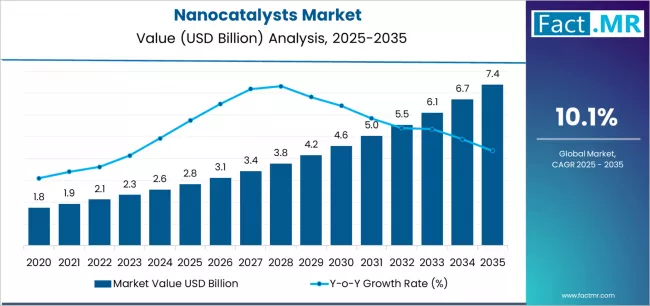
The nanocatalysts market was valued at USD 2.83 billion in 2025, projected to reach USD 3.12 billion in 2026, and is forecast to expand to USD 8.16 billion by 2036 at a 10.1% CAGR. Petroleum refinery operators seeking higher conversion yields from heavier crude feedstocks and fuel cell manufacturers requiring platinum group metal loading reductions are driving adoption of nanostructured catalyst systems that deliver superior active site density compared to conventional bulk catalyst formulations. Chemical process engineers that once selected catalysts based on loading weight now evaluate catalyst performance on a per-active-site basis, fundamentally reshaping procurement specifications toward engineered nanoparticle systems.
Nanocatalysts Market Market Value Analysis | Source: Fact.MR
Summary of Nanocatalysts Market
- Market Overview
- The nanocatalysts market is valued at USD 2.83 billion in 2025 and is projected to reach USD 8.16 billion by 2036.
- The industry is expected to grow at a 10.1% CAGR from 2026 to 2036, creating an incremental opportunity of USD 5.04 billion.
- The market is a technology-intensive, performance-driven category where active site density optimization, precious metal loading reduction, and process conversion yield improvement define competitive positioning.
- Demand and Growth Drivers
- Demand is accelerating as petroleum refiners adopt nanostructured catalysts that deliver higher conversion yields from heavier crude feedstocks compared to conventional bulk catalyst formulations.
- Fuel cell manufacturers are specifying nanocatalysts to reduce platinum group metal loading per membrane electrode assembly while maintaining power density targets.
- Environmental remediation applications including photocatalytic water treatment and VOC abatement are expanding nanocatalyst consumption in titanium dioxide and zinc oxide nanoparticle segments.
- Among key countries, India leads at 13.5% CAGR, followed by China at 12.2%, South Korea at 10.5%, the USA at 9.0%, Germany at 8.5%, the UK at 8.0%, and Japan at 7.8%.
- Product and Segment View
- Nanocatalysts are engineered catalyst materials with particle dimensions below 100 nanometers that deliver superior active site density and catalytic activity per unit mass compared to conventional bulk catalysts, used in refining, chemical synthesis, emission control, fuel cells, and environmental remediation.
- Primary applications span petroleum refining, chemical manufacturing, environmental treatment, energy and fuel cells, automotive emission control, electronics, pharmaceuticals, and food processing.
- Metal-based Nanocatalysts lead by Material with 32.7% share in 2026.
- Petroleum Refining leads by Application with 31.7% share in 2026.
- Scope includes metal-based, metal oxide, carbon-based, polymeric, and composite nanocatalyst materials, excluding conventional bulk catalyst materials, catalyst support substrates, and catalyst regeneration services.
- Geography and Competitive Outlook
- India and China are the fastest-growing markets due to refinery modernization, fuel cell development, and automotive emission standard upgrades, while the USA and Germany represent mature technology-driven markets shaped by refining optimization and Euro 7 emission compliance.
- Competition is shaped by nanoparticle synthesis IP portfolios, precious metal utilization efficiency, and catalyst performance validation partnerships with refinery and fuel cell OEM customers.
- Key companies include BASF SE, Dow Inc., Bayer AG, Evonik Industries AG, NanoScale Corporation, Nanophase Technologies Corporation, Catalytic Solution Inc., Hyperion Catalysis International, Headwaters NanoKinetix Inc., and Nanostellar Inc.
- Analyst Opinion at Fact.MR
- Shambhu Nath Jha , Principal Consultant for Chemicals and Materials, opines: 'In my analysis, I have observed that the true adoption barrier for nanocatalysts is not material cost but the process validation burden required to substitute a nanostructured catalyst for an established conventional catalyst in a continuous refinery or chemical production unit. Refinery operators contemplating nanocatalyst adoption face 6 to 12 month pilot trial programs that consume engineering resources and require production unit downtime during catalyst changeover windows. Fuel cell manufacturers integrating nanocatalyst membrane electrode assemblies must complete accelerated durability testing cycles that extend product qualification by 12 to 18 months. Companies delaying nanocatalyst qualification risk competitive disadvantage as process conversion yield improvements compound into permanent cost advantages for early adopters.'
- Strategic Implications / Executive Takeaways
- Nanocatalyst producers must establish pilot trial support programs that help refinery operators validate conversion yield improvements within the compressed catalyst changeover windows available during scheduled maintenance turnarounds.
- Fuel cell OEM procurement teams should initiate nanocatalyst membrane electrode assembly qualification at least 18 months before vehicle production launch dates to accommodate accelerated durability testing requirements.
- Environmental technology companies must develop application-specific nanocatalyst formulations pre-validated for target contaminant degradation profiles to reduce customer qualification testing timelines.
Nanocatalysts Market Key Takeaways
| Metric | Details |
|---|---|
| Industry Size (2026) | USD 3.12 billion |
| Industry Value (2036) | USD 8.16 billion |
| CAGR (2026 to 2036) | 10.1% |
Source: Fact.MR analysis. Updated Apr 7, 2026
The absolute dollar opportunity of USD 5.04 billion between 2026 and 2036 reflects accelerating substitution of conventional catalyst materials with nanoengineered alternatives across refining, chemical synthesis, environmental remediation, and energy conversion applications. Metal-based nanocatalysts utilizing platinum, palladium, and gold nanoparticles command significant price premiums but deliver catalytic activity per unit mass that reduces total precious metal consumption in automotive emission control and fuel cell membrane electrode assemblies. Environmental remediation applications including photocatalytic water treatment and VOC abatement systems represent a high-growth segment where titanium dioxide and zinc oxide nanocatalysts enable contaminant degradation at ambient conditions.
All major nanocatalyst adoption corridors reflect accelerated growth patterns. India sets the pace with a 13.5% CAGR as refinery modernization programs and automotive emission standard upgrades drive nanocatalyst specification. China follows at 12.2% with rapid fuel cell vehicle development and petrochemical capacity expansion. South Korea tracks at 10.5% through hydrogen fuel cell technology commercialization programs. United States operations advance at 9.0%, supported by refinery optimization investments and Environmental Protection Agency emission control mandates. Germany registers an 8.5% pace anchored by automotive catalyst technology development for Euro 7 emission compliance. United Kingdom expands at 8.0% through clean energy and environmental remediation research commercialization. Japan tracks at 7.8% through fuel cell vehicle catalyst loading reduction programs.
Why is the Nanocatalysts Market Growing?
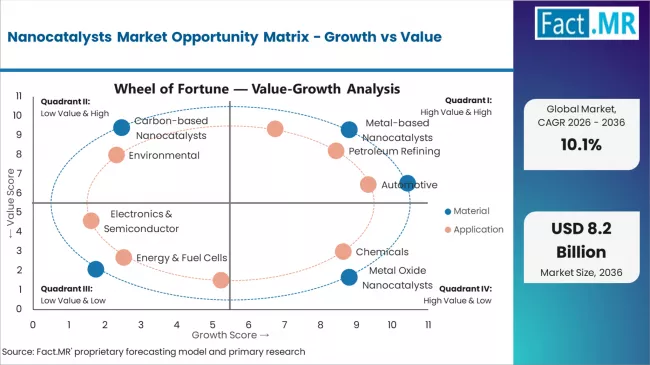
Nanocatalysts Market Opportunity Matrix Growth Vs Value | Source: Fact.MR
The nanocatalysts market grows by enabling industrial manufacturers to achieve superior reaction efficiency and product selectivity while addressing energy consumption reduction and environmental compliance that conventional bulk catalysts cannot deliver across petroleum refining, chemical synthesis, and emission control applications.
Manufacturers face mounting pressure to minimize waste generation and improve process economics while meeting increasingly stringent environmental regulations for air quality and water discharge, with modern nanocatalysts typically providing orders of magnitude higher surface area, enhanced mass transfer characteristics, and superior turnover frequencies compared to traditional catalyst materials alone, making nanoscale solutions essential for next-generation industrial processes.
The chemical and energy industries' need for highly efficient and selective catalytic materials creates demand for specialized nanocatalyst solutions that can provide lower activation energies, operate at milder reaction conditions, and deliver improved product yields without compromising process safety or catalyst lifetime.
Automotive emission regulations and proven performance in catalytic converter applications drive adoption across vehicle manufacturers, petroleum refineries, and chemical processing facilities, where catalytic efficiency has direct impact on regulatory compliance and operational profitability.
The expanding hydrogen economy globally, requiring efficient fuel cell catalysts for clean energy conversion, creates growing opportunities for platinum-based and composite nanocatalyst formulations. Rising environmental awareness about industrial pollution and water contamination enables widespread adoption of photocatalytic nanocatalysts for remediation applications.
However, high costs for noble metal precursors and technical challenges in preventing nanoparticle agglomeration may limit universal nanocatalyst adoption and create barriers for cost-sensitive industrial processes among diverse manufacturing operations with varying capital investment capabilities.
Segmental Analysis
The market is segmented by material, application, and region. By material, the market is divided into metal-based nanocatalysts, metal oxide nanocatalysts, carbon-based nanocatalysts, polymeric nanocatalysts, and composite nanocatalysts.
Based on application, the market is categorized into petroleum refining, chemicals, environmental, energy & fuel cells, automotive, electronics & semiconductor, pharmaceuticals & biotechnology, and food & beverage. Regionally, the market is divided into Asia Pacific, Europe, North America, Latin America, and Middle East & Africa.
By Material, Which Segment Accounts for the Dominant Market Share?
Nanocatalysts Market Analysis By Material | Source: Fact.MR
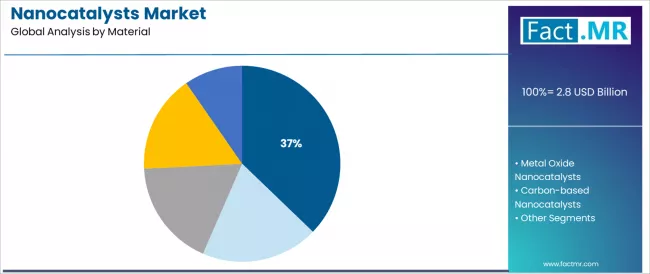
The metal-based nanocatalysts segment represents the dominant force in the nanocatalysts market, capturing 37.2% of the total market share in 2025. This established material category encompasses solutions featuring noble metal nanoparticles and transition metal nanoclusters, including advanced synthesis approaches combining chemical reduction, physical vapor deposition, and electrochemical methods that enable superior catalytic activity and exceptional selectivity across petroleum refining, automotive emission control, and fine chemical synthesis applications worldwide.
The metal-based nanocatalysts segment's market leadership stems from its unparalleled catalytic performance and proven industrial track record, with solutions capable of achieving remarkable turnover numbers and operating under demanding temperature and pressure conditions while maintaining excellent stability and resistance to poisoning across diverse reaction environments.
Within the metal-based segment, platinum-based nanocatalysts represent the gold standard for many applications, driven by exceptional catalytic properties in hydrogenation reactions, fuel cell electrodes, and automotive catalytic converters requiring superior performance. This sub-segment benefits from continuous innovation in platinum utilization efficiency and alloy formulations reducing precious metal loading while maintaining activity.
The composite nanocatalysts segment maintains a substantial market share in the 22.0% range, serving advanced applications and multifunctional requirements where synergistic combinations including metal nanoparticles supported on carbon nanotubes, graphene, or polymeric matrices deliver enhanced stability, improved electron transfer, and superior durability compared to single-component systems.
These nanocatalysts offer breakthrough performance for manufacturers managing complex catalytic challenges while providing sufficient versatility to accommodate multiple reaction pathways. The composite segment demonstrates rapid growth potential, driven by expanding fuel cell applications and emerging photocatalytic systems requiring integrated functionalities.
Within the material category, metal oxide nanocatalysts including titanium dioxide, cerium oxide, and zinc oxide demonstrate important adoption across photocatalysis and environmental remediation. Carbon-based nanocatalysts address metal-free catalysis requirements, while polymeric nanocatalysts represent emerging opportunities in asymmetric synthesis.
Key performance advantages driving the metal-based segment include:
- Advanced catalytic activity enabling reaction rate acceleration by orders of magnitude and supporting process intensification opportunities across industrial applications
- Established selectivity control providing targeted product formation and minimizing unwanted byproducts while maintaining catalyst integrity throughout extended operation
- Enhanced stability characteristics preventing sintering and agglomeration while delivering consistent performance across thermal cycling and harsh chemical environments
- Superior electron transfer properties enabling efficient redox reactions and supporting electrocatalytic applications including fuel cells and electrochemical synthesis
What Drives the Composite Nanocatalysts Segment Growth?
Composite nanocatalysts represent a rapidly growing material segment in the nanocatalysts market with a 22.0% market share in 2025, reflecting the synergistic advantages of combining multiple nanomaterial components to achieve enhanced catalytic performance and multifunctional capabilities.
The composite segment demonstrates strong growth momentum driven by the need for durable fuel cell catalysts and stable photocatalytic systems requiring integrated support structures preventing metal nanoparticle aggregation while maintaining high surface accessibility.
Within composite applications, hybrid metal-carbon composites represent the most advanced category, driven by exceptional electrical conductivity in carbon supports combined with catalytic activity of metal nanoparticles enabling superior performance in electrochemical applications. The segment benefits from graphene and carbon nanotube integration providing large surface areas and excellent electron mobility.
The metal-polymer composites category emerges as an important segment with specialized requirements, driven by selective catalysis needs in pharmaceutical synthesis and fine chemical production requiring controlled microenvironments around active sites. Researchers seeking chiral selectivity drive adoption of polymer-stabilized metal nanoclusters offering precise control over reaction stereochemistry.
Within material types, metal oxide nanocatalysts demonstrate significant presence through photocatalytic water splitting and environmental pollutant degradation applications. Carbon-based materials address sustainable metal-free catalysis requirements, while polymeric systems represent opportunities in organocatalysis and biomimetic processes.
Key material dynamics include:
- Composite formulation requirements accelerating across fuel cell applications with emphasis on platinum utilization efficiency and durability enhancement
- Carbon support integration driving demand for graphene-based and carbon nanotube-supported metal nanocatalysts offering superior conductivity
- Metal-polymer hybrid development creating opportunities for stereoselective catalysis and controlled release catalytic systems
- Environmental stability emphasis promoting corrosion-resistant composite structures protecting active metal sites from deactivation
By Application, Which Segment Accounts for a Significant Market Share?
Nanocatalysts Market Analysis By Application | Source: Fact.MR
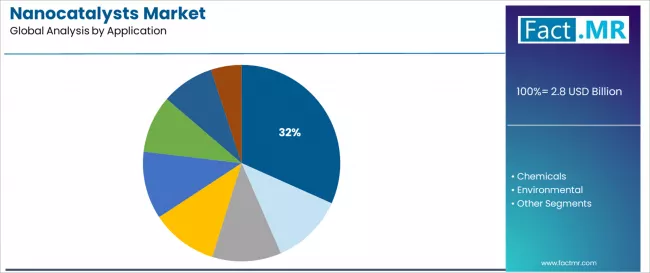
Petroleum refining represents the leading application segment in the nanocatalysts market with a 31.7% market share in 2025, reflecting the fundamental role of catalysts in hydrocarbon conversion processes and fuel production optimization supporting global energy demand. The petroleum refining segment demonstrates consistent demand driven by ongoing capacity expansion in emerging markets and continuous process improvement initiatives requiring enhanced catalyst performance for upgrading heavy crude oil and producing ultra-low sulfur fuels.
Within petroleum refining applications, hydrocracking catalysts represent the largest category, driven by critical requirements for converting heavy petroleum fractions into lighter, more valuable products including diesel and jet fuel. The segment benefits from continuous innovation in bifunctional nanocatalysts combining acidic and metal functions optimizing hydrogenation and cracking activities.
The chemicals segment emerges as an important application category with robust growth potential, driven by expanding specialty chemical production and pharmaceutical intermediate synthesis requiring highly selective catalytic transformations. Manufacturers seeking green chemistry solutions drive adoption of nanocatalysts enabling milder reaction conditions and improved atom economy.
Within application types, environmental applications demonstrate specialized requirements through photocatalytic degradation of organic pollutants and catalytic oxidation of volatile organic compounds. Energy & fuel cells address hydrogen production and electrochemical energy conversion, while automotive applications represent emission control through three-way catalytic converters.
Key application dynamics include:
- Petroleum refining requirements accelerating across heavy oil upgrading operations with emphasis on hydrocracking efficiency and desulfurization performance
- Chemical synthesis applications driving demand for selective oxidation catalysts and asymmetric hydrogenation systems supporting pharmaceutical production
- Environmental remediation prioritizing photocatalytic water purification and air pollution control addressing sustainable treatment technologies
- Fuel cell development creating opportunities for oxygen reduction catalysts and hydrogen oxidation catalysts supporting clean energy infrastructure
What Drives the Chemicals Segment Growth?
Chemicals represent a significant application segment demonstrating strong growth potential with a 21.0% market share in 2025, driven by nanocatalysts' role in enabling selective transformations and sustainable synthesis routes across polymerization, fine chemical production, and specialty chemical manufacturing.
The chemicals segment benefits from expanding pharmaceutical industries requiring complex molecular syntheses and growing demand for sustainable chemical processes minimizing waste generation.
Within chemical applications, polymerization catalysts represent the core technology, driven by requirements for precise molecular weight control and narrow polydispersity in polymer production including polyolefins, specialty polymers, and advanced materials. The segment benefits from single-site nanocatalyst developments offering unprecedented control over polymer architecture.
The fine chemicals category emerges with specialized requirements, driven by pharmaceutical active ingredient synthesis and agrochemical intermediate production requiring high selectivity and enantiomeric purity. Pharmaceutical manufacturers seeking efficient synthetic routes drive adoption of chiral nanocatalysts offering asymmetric catalysis capabilities.
Within application types, environmental applications address water treatment through advanced oxidation processes and air purification via catalytic decomposition. Energy & fuel cells emphasize proton exchange membrane fuel cells and direct methanol fuel cells, while electronics applications represent emerging opportunities in semiconductor processing and nanofabrication.
Key application dynamics include:
- Chemical synthesis requirements growing across pharmaceutical intermediates with emphasis on enantioselective catalysis and C-H activation reactions
- Polymerization control applications driving demand for metallocene-based nanocatalysts and single-site polymerization systems
- Environmental catalysis expanding through photocatalytic degradation of emerging contaminants and catalytic ozonation processes
- Fuel cell commercialization creating opportunities for low-platinum-loading catalysts and non-precious-metal alternatives supporting cost reduction
What are the Drivers, Restraints, and Key Trends of the Nanocatalysts Market?
The market is driven by three concrete demand factors tied to industrial efficiency and environmental compliance. First, rising automotive emission standards create expanding opportunities for advanced catalytic converter formulations across global vehicle markets, with nanocatalysts representing a critical enabler for meeting Euro 7 and China VI regulations through enhanced low-temperature activity and improved oxygen storage capacity, requiring comprehensive catalyst optimization.
Second, growing hydrogen economy investments drive fuel cell catalyst demand, with proton exchange membrane fuel cells demonstrating significant deployment supporting clean transportation and stationary power generation requiring efficient platinum-based nanocatalysts by 2030. Third, increasing petroleum refining complexity enables more demanding catalyst requirements that improve heavy crude oil upgrading efficiency while supporting ultra-low sulfur diesel production through advanced hydroprocessing nanocatalysts.
Market restraints include high raw material costs for noble metals including platinum, palladium, and gold that can challenge economic viability and limit widespread adoption, particularly in cost-sensitive applications where precious metal prices significantly impact overall catalyst economics.
Synthesis scalability challenges and reproducibility issues pose another significant obstacle, as laboratory-scale nanocatalyst preparation methods often fail to translate effectively to industrial production volumes, potentially limiting commercialization of promising formulations and creating quality consistency concerns.
Nanoparticle stability concerns including agglomeration, sintering, and leaching create additional technical challenges, demanding sophisticated stabilization strategies and protective coating technologies for maintaining catalytic activity throughout extended operational lifetimes.
Key trends indicate accelerated non-precious metal catalyst development in developed markets, particularly North America and Europe, where researchers demonstrate progress toward replacing platinum-group metals with earth-abundant alternatives including iron, cobalt, and nickel-based nanocatalysts supporting cost reduction objectives.
Computational catalyst design trends toward machine learning approaches and density functional theory calculations enable rational nanocatalyst optimization that accelerates development timelines and reduces experimental screening requirements. However, the market thesis could face disruption if significant breakthroughs in enzyme catalysis or major advances in homogeneous catalyst immobilization reduce reliance on traditional heterogeneous nanocatalyst systems.
Analysis of the Nanocatalysts Market by Key Countries
.webp "Top Country Growth Comparison Nanocatalysts Market Cagr (2026 2036)")
Top Country Growth Comparison Nanocatalysts Market Cagr (2026 2036) | Source: Fact.MR
| Country | CAGR (2026 to 2036) |
|---|---|
| China | 10.8% |
| India | 10.3% |
| South Korea | 9.5% |
| USA | 9.1% |
| Brazil | 8.9% |
| Germany | 8.4% |
| Japan | 7.6% |
Source: Fact.MR analysis. Updated Apr 7, 2026
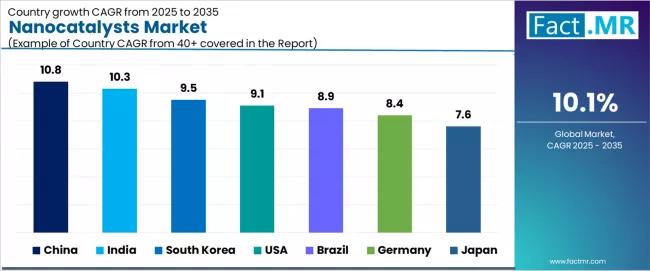
Nanocatalysts Market Cagr Analysis By Country | Source: Fact.MR
The global nanocatalysts market is expanding rapidly, with China leading at a 10.8% CAGR through 2036, driven by massive petroleum refining capacity expansion and aggressive fuel cell vehicle development programs requiring advanced catalytic technologies. India follows at 10.3%, supported by growing chemical manufacturing sector and expanding automotive production. South Korea records 9.5%, reflecting strong electronics industry presence and advanced fuel cell research initiatives.
USA advances at 9.1%, leveraging automotive emission control innovation and extensive fuel cell commercialization efforts. Brazil posts 8.9%, focusing on petrochemical industry growth and biofuel production expansion, while Germany grows steadily at 8.4%, emphasizing automotive catalysis excellence and green chemistry leadership. Japan demonstrates 7.6% growth, anchored by advanced materials research and precision catalyst manufacturing capabilities.
How is China Leading Global Market Expansion?
China demonstrates the strongest growth potential in the nanocatalysts market with a CAGR of 10.8% through 2036. The country's leadership position stems from massive petroleum refining capacity requiring advanced hydroprocessing catalysts, extensive chemical manufacturing activities, and aggressive national strategy for fuel cell vehicle deployment supporting comprehensive nanocatalyst consumption across industrial, automotive, and energy applications.
Growth is concentrated in major industrial clusters and technology zones, including Jiangsu, Zhejiang, Shandong, and Guangdong provinces, where refineries and chemical plants increasingly adopt nanocatalyst technologies for process intensification and environmental compliance. Distribution channels through specialized catalyst suppliers, direct relationships with research institutes, and emerging technology transfer platforms expand accessibility across state-owned enterprises and private manufacturers. The country's massive investments in hydrogen infrastructure provide strong momentum for fuel cell catalyst adoption, including comprehensive government support across automotive, stationary power, and portable energy segments.
Key market factors:
- Petroleum refining capacity concentrated in coastal provinces with extensive upgrading requirements for heavy crude oil processing
- Fuel cell vehicle targets through national clean energy policies driving platinum-based and alternative nanocatalyst development
- Comprehensive chemical manufacturing ecosystem supporting fine chemical synthesis and polymerization catalyst requirements
- Local nanocatalyst producers developing cost-effective synthesis methods offering competitive alternatives to imported materials
Why is India Emerging as a High-Growth Market?
In major industrial regions including Maharashtra, Gujarat, Tamil Nadu, and Uttar Pradesh, the adoption of nanocatalyst solutions is accelerating across petroleum refineries, chemical plants, and automotive manufacturing facilities, driven by expanding refining capacity and stringent emission regulations requiring advanced catalytic technologies.
The market demonstrates strong growth momentum with a CAGR of 10.3% through 2036, linked to comprehensive industrialization programs and increasing emphasis on sustainable manufacturing practices. Indian manufacturers are implementing advanced nanocatalyst formulations for hydrodesulfurization processes and catalytic converters to enhance environmental compliance while meeting growing domestic fuel and vehicle demand. The country's expanding pharmaceutical sector creates ongoing demand for selective nanocatalysts supporting complex organic synthesis and chiral compound production operations.
Key development areas:
- Refinery modernization programs leading nanocatalyst adoption with emphasis on diesel quality improvement and sulfur removal
- Distribution expansion through specialized catalyst distributors and technical service providers offering application support
- Automotive emission compliance initiatives implementing advanced three-way catalysts and diesel oxidation catalysts
- Growing pharmaceutical manufacturing requiring chiral nanocatalysts and selective oxidation catalysts supporting active ingredient synthesis
What drives USA’s Market Resilience?
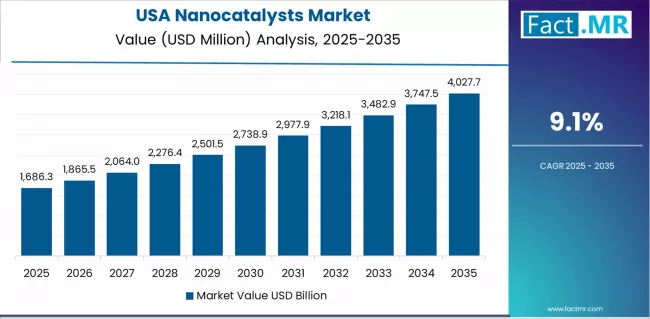
Nanocatalysts Market Country Value Analysis | Source: Fact.MR
USA’s market expansion is driven by diverse innovation requirements, including automotive emission control catalyst development for increasingly stringent standards and fuel cell catalyst optimization for hydrogen vehicle commercialization across sophisticated technology segments. The country demonstrates steady growth potential with a CAGR of 9.1% through 2036, supported by continuous research investment from established catalyst manufacturers and university research programs.
American researchers face implementation challenges related to scaling laboratory discoveries to commercial production and achieving cost parity with conventional catalysts, requiring comprehensive process development and manufacturing optimization. However, established automotive and energy industries create stable baseline demand for advanced nanocatalysts, particularly among fuel cell developers pursuing transportation applications where platinum-based catalysts drive primary technology enablement.
Market characteristics:
- Automotive manufacturers and fuel cell developers showing robust demand with substantial research funding across emission control and clean energy
- Regional preferences varying between California zero-emission vehicle programs and Midwest traditional automotive catalyst focus
- Future projections indicate continued innovation emphasis with focus on non-precious metal catalysts and enhanced durability formulations
- Growing emphasis on distributed hydrogen production and fuel cell backup power systems supporting stationary catalyst applications
How does Germany Demonstrate Automotive Catalysis Leadership?
The market in Germany leads in automotive catalyst innovation based on comprehensive engineering expertise and stringent emission standards driving advanced catalytic converter development across premium vehicle segments and diesel engine applications. The country shows strong potential with a CAGR of 8.4% through 2036, driven by continuous technology advancement and quality excellence in major automotive regions, including Baden-Württemberg, Bavaria, North Rhine-Westphalia, and Lower Saxony.
German manufacturers are adopting advanced nanocatalyst formulations for selective catalytic reduction systems, particularly in diesel vehicles requiring nitrogen oxide emission control and particle filter regeneration supporting regulatory compliance. Distribution channels through established catalyst suppliers and automotive tier-one component manufacturers expand coverage across precision engineering operations and quality-focused production facilities.
Leading market segments:
- Automotive catalyst manufacturing in major vehicle production centers implementing advanced emission control technologies and on-board diagnostics
- Chemical industry partnerships with specialty chemical manufacturers achieving high selectivity requirements across pharmaceutical intermediates
- Strategic collaborations between catalyst developers and automotive OEMs expanding fuel cell system integration
- Focus on green chemistry initiatives and sustainable catalysis research addressing environmental impact reduction and process intensification
What Positions South Korea for Technology Innovation Leadership?
In Seoul, Ulsan, and other major industrial centers, companies are implementing nanocatalyst solutions through advanced fuel cell research programs and electronics manufacturing applications, with documented innovation in membrane electrode assembly production showing substantial performance improvements across proton exchange membrane fuel cell systems.
The market shows steady growth potential with a CAGR of 9.5% through 2036, linked to ongoing fuel cell vehicle commercialization, semiconductor industry catalyst requirements, and emerging hydrogen economy infrastructure development programs. Manufacturers are adopting advanced platinum alloy nanocatalysts and carbon-supported formulations to enhance fuel cell durability while reducing precious metal loading demanded by cost-competitive hydrogen vehicle production. The country's electronics industry leadership creates ongoing opportunities for specialty nanocatalysts supporting semiconductor processing and display manufacturing operations.
Market development factors:
- Fuel cell vehicle manufacturers leading nanocatalyst adoption with emphasis on durability enhancement and platinum reduction
- Technology partnerships enabling advanced catalyst layer fabrication with comprehensive performance optimization protocols
- Strategic emphasis on hydrogen infrastructure development and fuel cell system cost reduction initiatives
- Focus on electronics applications and semiconductor processing catalysts addressing advanced manufacturing requirements
How does Japan Show Precision Manufacturing Leadership?
Japan's nanocatalysts market demonstrates sophisticated research capabilities focused on fundamental catalysis understanding and advanced characterization techniques, with documented integration of state-of-the-art analytical methods achieving substantial insights into nanoparticle structure-activity relationships across automotive, fuel cell, and chemical synthesis applications.
The country maintains steady growth momentum with a CAGR of 7.6% through 2036, driven by mature market dynamics emphasizing research excellence and continuous innovation methodologies that align with Japanese scientific leadership principles applied to materials science. Major research centers, including Tokyo, Osaka, and Fukuoka regions, showcase advanced catalyst development programs where sophisticated microscopy techniques integrate seamlessly with computational modeling and comprehensive performance evaluation systems.
Key market characteristics:
- Quality-focused automotive manufacturers driving demand for premium catalyst formulations with emphasis on long-term stability validation
- Technology partnerships enabling advanced characterization capabilities with comprehensive atomic-resolution imaging protocols
- Collaboration between Japanese universities and industrial partners expanding fundamental catalysis research
- Emphasis on precious metal recycling and catalyst regeneration technologies addressing sustainability requirements
What Characterizes Brazil's Market Development?
In major industrial states including São Paulo, Rio de Janeiro, Minas Gerais, and Bahia, the adoption of nanocatalyst solutions is expanding across petroleum refineries, petrochemical complexes, and biofuel production facilities, driven by growing refining capacity and increasing emphasis on fuel quality standards. The market demonstrates solid growth potential with a CAGR of 8.9% through 2036, linked to comprehensive energy sector development and increasing chemical manufacturing sophistication.
Brazilian refiners are implementing advanced hydroprocessing nanocatalysts for upgrading heavy crude oil and reducing sulfur content to enhance fuel quality while meeting growing domestic demand. The country's leadership in biofuel production creates ongoing opportunities for catalytic biomass conversion and biodiesel synthesis catalysts supporting renewable energy objectives.
Key development areas:
- Petroleum refining operations leading nanocatalyst adoption with emphasis on heavy oil upgrading and diesel desulfurization
- Distribution expansion through specialized catalyst suppliers and technical service organizations providing application support
- Biofuel industry integration supporting catalytic transesterification and cellulosic ethanol production technologies
- Chemical manufacturing growth requiring polymerization catalysts and selective oxidation systems supporting petrochemical derivatives
Europe Market Split by Country
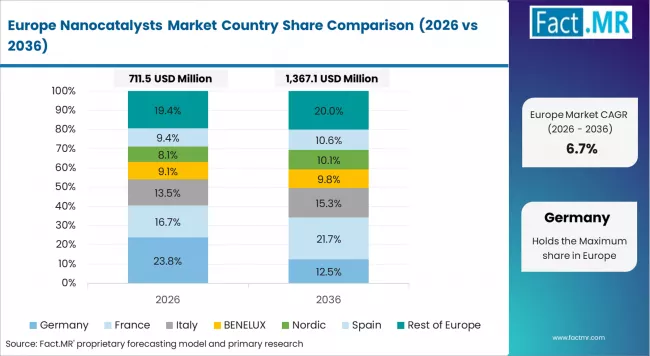
Nanocatalysts Market Europe Country Market Share Analysis, 2026 & 2036 | Source: Fact.MR
The nanocatalysts market in Europe is projected to grow from USD 0.71 billion in 2026 to USD 1.72 billion by 2036, registering a CAGR of 9.3% over the forecast period. Germany is expected to maintain its leadership position with a 32.0% market share in 2026, adjusting to 31.5% by 2036, supported by its extensive automotive manufacturing concentration, comprehensive chemical industry expertise, and advanced catalysis research capabilities serving major European markets.
France follows with a 21.0% share in 2026, projected to reach 21.5% by 2036, driven by comprehensive petroleum refining capacity and specialty chemical manufacturing concentrating in major industrial regions implementing sustainable catalysis programs. The United Kingdom holds a 18.0% share in 2026, expected to maintain 18.2% by 2036 through ongoing academic catalysis research and emerging fuel cell commercialization initiatives.
Italy commands a 14.0% share, while Spain accounts for 10.0% in 2026. The rest of Europe region is anticipated to gain momentum, expanding its collective share from 5.0% to 5.3% by 2036, attributed to increasing nanocatalyst adoption in Nordic countries and emerging Eastern European chemical manufacturing facilities implementing modern catalytic technologies.
How Does Quality Define Nanocatalysts Adoption in Japan?
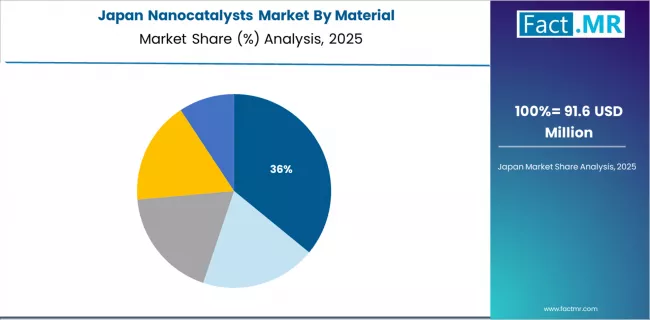
Nanocatalysts Market Japan Market Share Analysis By Material | Source: Fact.MR
The Japanese nanocatalysts market demonstrates a mature and research-intensive landscape, characterized by sophisticated integration of advanced characterization technologies with fundamental catalysis studies across automotive, fuel cell, and chemical synthesis applications, supported by world-class analytical facilities and collaborative research programs. Japan's emphasis on scientific excellence and precision manufacturing drives demand for meticulously engineered nanocatalyst formulations that support fundamental understanding of catalytic mechanisms and enable rational catalyst design approaches.
The market benefits from strong partnerships between international catalyst suppliers and domestic research institutions, including leading universities and corporate research centers, creating comprehensive knowledge ecosystems that prioritize breakthrough discoveries and systematic innovation. Research centers showcase advanced catalyst development programs where aberration-corrected electron microscopy techniques achieve atomic-resolution imaging combined with in-situ spectroscopy and comprehensive computational modeling approaches.
What Drives Innovation Positioning in South Korea's Market?
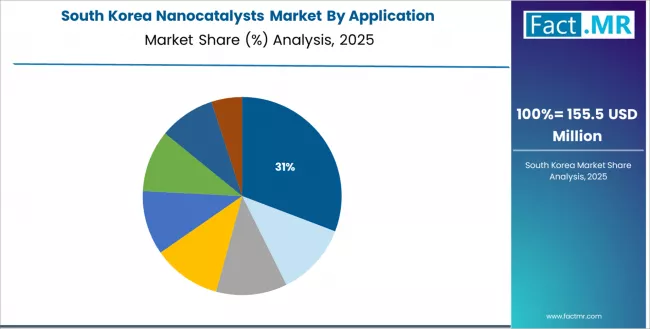
Nanocatalysts Market South Korea Market Share Analysis By Application | Source: Fact.MR
The South Korean nanocatalysts market is characterized by strong technology-driven presence, with companies like domestic chemical manufacturers and international catalyst suppliers maintaining significant positions through comprehensive research portfolios and advanced formulations for fuel cell and electronics applications.
The market is demonstrating a growing emphasis on hydrogen economy infrastructure and specialized semiconductor processing catalysts, as Korean manufacturers increasingly demand high-performance nanocatalyst formulations that combine durability with cost-effectiveness and precise activity control deployed across automotive fuel cell systems and advanced electronics fabrication facilities.
Local innovations and specialty catalyst launches are gaining market share through strategic emphasis on core-shell nanostructures, offering specialized architectures including platinum-enriched surfaces and non-precious metal alternatives for comprehensive fuel cell cost reduction. The competitive landscape shows increasing collaboration between catalyst manufacturers and fuel cell system integrators, creating integrated development models that combine nanomaterial expertise with electrochemical engineering insights and rapid prototype validation capabilities.
Competitive Landscape of the Nanocatalysts Market
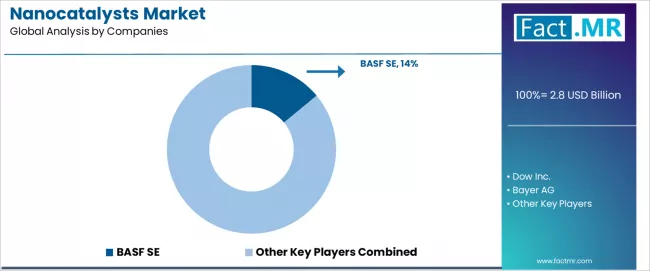
Nanocatalysts Market Analysis By Company | Source: Fact.MR
The nanocatalysts market features approximately 15-20 meaningful players with moderate concentration, where the top three companies control roughly 25-35% of global market share through established research capabilities, proprietary synthesis technologies, and extensive industrial customer relationships. Competition centers on catalyst performance optimization, synthesis methodology innovation, and application-specific formulation development rather than commodity pricing alone.
Market leaders include BASF maintaining a 14.0% market share, Dow, and Bayer, which maintain competitive advantages through vertically integrated chemical operations, comprehensive catalysis research programs, and deep expertise in industrial catalyst applications, creating strong customer retention among petroleum refiners and chemical manufacturers seeking reliable performance. These companies leverage continuous innovation in nanomaterial synthesis and strategic acquisitions to defend market positions while expanding into adjacent categories including photocatalysts and electrocatalysts.
Challengers encompass specialized nanomaterial companies including Evonik Industries, NanoScale Corporation, and Nanophase Technologies, which compete through proprietary synthesis platforms and niche application expertise. Technology-focused players, including Catalytic Solution, Hyperion Catalysis International, and Headwaters NanoKinetix, focus on specific catalyst types and targeted applications, offering differentiated capabilities in carbon nanotube catalysts, fuel cell materials, and environmental catalysis solutions.
Emerging nanotechnology startups and university spin-offs create competitive pressure through breakthrough catalyst architectures and novel synthesis approaches, particularly in high-growth applications including fuel cells and sustainable chemistry, where innovative formulations provide advantages in performance metrics and cost reduction potential.
Market dynamics favor companies that combine fundamental catalysis knowledge with scalable manufacturing capabilities and comprehensive application support that addresses the complete value chain from catalyst synthesis through industrial implementation and performance optimization.
Strategic emphasis on non-precious metal alternatives, recyclable catalyst systems, and computational catalyst design enables differentiation in increasingly cost-conscious and sustainability-focused industrial sectors across petroleum, chemicals, and automotive industries worldwide.
Global Nanocatalysts Market - Stakeholder Contribution Framework
Nanocatalysts represent a critical enabling technology that allows industrial manufacturers to achieve superior reaction efficiency and product selectivity while addressing energy consumption reduction and environmental compliance that conventional bulk catalysts cannot deliver across petroleum refining, chemical synthesis, and emission control applications, typically providing orders of magnitude higher surface area, enhanced mass transfer characteristics, and superior turnover frequencies compared to traditional materials alone while ensuring process intensification and comprehensive sustainability improvements.
With the market projected to grow from USD 2.83 billion in 2025 to USD 7.40 billion by 2035 at a 10.1% CAGR, these solutions offer compelling advantages for petroleum upgrading, sustainable chemical synthesis, and diverse clean energy applications. Scaling market penetration and cost-effective production achievement requires coordinated action across research funding, technical standards development, nanomaterial producers, industrial end-users, and safety assessment initiatives.
How Could Governments Spur Local Development and Adoption?
- Clean Energy Technology Programs: Include nanocatalyst research in national innovation strategies, providing targeted support for fuel cell catalyst development and supporting research institutions through fundamental catalysis grants and advanced characterization facility investments.
- Tax Policy & Investment Support: Implement reduced tax rates for nanocatalyst manufacturing facilities, provide tax incentives for companies investing in scalable nanomaterial synthesis technologies and catalyst recycling infrastructure, and establish favorable trade policies that encourage domestic catalyst production over imports.
- Regulatory Framework Development: Create streamlined approval processes for novel catalyst formulations across petroleum refining and chemical manufacturing applications, establish clear safety assessment protocols and environmental impact evaluation requirements, and develop international harmonization efforts that facilitate cross-border catalyst commercialization.
- Research & Innovation Support: Establish public-private partnerships for advanced catalysis research, support academic-industry collaborations investigating earth-abundant metal catalysts and sustainable synthesis routes, and create regulatory environments that encourage innovation in green chemistry applications.
- Safety & Standardization Initiatives: Fund comprehensive nanosafety research addressing workplace exposure and environmental fate, invest in standardized characterization protocols enabling reproducible catalyst performance assessment, and explore best practice frameworks for responsible nanomaterial manufacturing.
How Could Industry Bodies Support Market Development?
- Performance Standards & Testing Protocols: Define standardized activity measurement methodologies for nanocatalyst performance assessment across diverse applications, establish universal characterization requirements and quality specifications, and create catalyst property databases that researchers and engineers can rely on for material selection.
- Market Education & Application Guidelines: Lead messaging that demonstrates nanocatalyst advantages over conventional catalysts, emphasizing efficiency improvements, sustainability benefits, and economic value propositions through coordinated industry awareness campaigns.
- Safety & Handling Standards: Develop guidelines for safe nanomaterial handling, exposure monitoring, personal protective equipment requirements, and waste disposal procedures, ensuring worker protection across synthesis and application operations.
- Professional Development: Run certification programs for catalysis scientists, process engineers, and industrial operators on optimizing nanocatalyst performance, troubleshooting deactivation mechanisms, and implementing best practices across diverse manufacturing environments.
How Could Manufacturers and Technology Players Strengthen the Ecosystem?
- Advanced Product Development: Develop next-generation nanocatalyst formulations with enhanced activity, optimized selectivity, and application-specific characteristics that improve process efficiency while reducing costs through earth-abundant metal utilization and efficient synthesis routes.
- Scalable Manufacturing Innovation: Provide comprehensive scale-up methodologies, continuous synthesis technologies, and quality control systems that enable transition from laboratory discoveries to industrial production volumes maintaining performance consistency.
- Technical Application Support: Offer comprehensive catalyst selection guidance, process optimization consultation, and performance troubleshooting assistance that helps industrial users successfully implement nanocatalysts into commercial operations.
- Research & Development Networks: Build comprehensive R&D capabilities, collaborative testing programs, and advanced characterization facilities that ensure nanocatalysts maintain superior performance standards and continuous innovation across diverse industrial applications.
How Could End-User Industries and Manufacturers Navigate the Market?
- Advanced Catalyst Integration: Incorporate high-performance nanocatalyst systems into comprehensive process optimization strategies, with particular focus on energy efficiency improvements, yield enhancement, and environmental footprint reduction.
- Performance Validation Excellence: Establish rigorous catalyst testing protocols, accelerated aging studies, and comprehensive characterization programs through optimized evaluation frameworks and benchmarking systems.
- Supply Chain Partnership: Implement collaborative relationships with nanocatalyst suppliers ensuring reliable material supply, technical support access, and joint development opportunities throughout catalyst lifecycle.
- Innovation Collaboration: Develop co-creation programs with catalyst developers exploring new applications, optimized formulations, and process intensification opportunities that differentiate products and enhance operational efficiency.
How Could Investors and Financial Enablers Unlock Value?
- Production Capacity Financing: Provide growth capital for established companies like BASF, Dow, and specialty manufacturers to expand synthesis facilities and scale-up capabilities supporting market demand growth.
- Innovation Investment: Back startups developing earth-abundant metal catalysts, novel synthesis platforms, and breakthrough catalyst architectures that enhance performance credentials while reducing costs.
- Market Expansion Funding: Finance distribution network expansion for nanocatalyst producers establishing operations in high-growth regions including China and India, supporting localization initiatives that address regional industrial requirements.
- Technology Integration Investment: Support companies developing AI-driven catalyst design tools, high-throughput screening platforms, and computational modeling systems that enhance development efficiency through technology-enabled solutions.
Key Players in the Nanocatalysts Market
- BASF SE
- Dow Inc.
- Bayer AG
- Evonik Industries AG
- NanoScale Corporation
- Nanophase Technologies Corporation
- Catalytic Solution Inc.
- Hyperion Catalysis International
- Headwaters NanoKinetix Inc.
- Nanostellar Inc.
Bibliography
- U.S. Department of Energy. (2024). Hydrogen and fuel cell technologies office: Catalyst cost reduction targets and progress update. DOE EERE.
- European Commission. (2024, November). Euro 7 emission standards: Implementation timeline and catalyst technology requirements. EC, DG GROW.
- International Organization for Standardization. (2024). ISO/TS 80004-2:2024 Nanotechnologies, vocabulary, Part 2: Nano-objects, nanoparticle catalyst terminology. ISO.
- Ministry of Ecology and Environment, China. (2025, January). China VI emission standard: Phase 2 catalyst performance validation requirements. MEE.
- National Institute of Standards and Technology. (2024). Nanocatalyst characterization: Measurement protocols for catalytic activity and selectivity. NIST.
This bibliography is provided for reader reference. The full Fact.MR report contains the complete reference list with primary research documentation.
This Report Addresses
- Market sizing and quantitative forecast metrics detailing nanocatalyst expenditure across petroleum refining, chemical, environmental, and energy conversion sectors through 2036.
- Segmentation analysis mapping adoption velocity by nanocatalyst material type and evaluating the performance qualification barriers driving supplier selection.
- Regional deployment intelligence comparing refinery modernization and fuel cell programs in Asia against emission compliance and clean energy technology markets in North America and Europe.
- Technology readiness assessment analyzing how nanoparticle synthesis scale-up and catalyst durability validation shape commercial adoption timelines across target applications.
- Competitive posture evaluation tracking nanocatalyst synthesis IP portfolios, precious metal utilization efficiency, and performance validation partnerships with refinery and fuel cell OEM customers.
- Process optimization guidance defining the catalyst loading, activity, and durability specifications required for nanocatalysts to displace conventional materials in target refining and energy applications.
- Supply chain analysis identifying nanoparticle synthesis scale-up constraints and precious metal sourcing factors that affect nanocatalyst production economics.
- Custom data delivery formats encompassing interactive dashboards, raw Excel datasets, and comprehensive PDF narrative reports.
Nanocatalysts Market Definition
Nanocatalysts are engineered catalytic materials with particle dimensions below 100 nanometers that exhibit enhanced catalytic activity, selectivity, and efficiency compared to conventional bulk catalyst materials. The nanoscale particle size provides a dramatically higher surface-area-to-volume ratio that increases the density of catalytically active sites per unit mass of material. Material categories include metal nanoparticles (platinum, palladium, gold, silver), metal oxide nanoparticles (titanium dioxide, zinc oxide, cerium oxide), carbon-based nanocatalysts (carbon nanotubes, graphene oxide), polymeric nanocatalysts, and composite nanostructured materials.
Nanocatalysts Market Inclusions
Market scope includes metal-based, metal oxide, carbon-based, polymeric, and composite nanocatalyst materials sold for petroleum refining, chemical synthesis, environmental remediation, fuel cell, automotive emission control, and other catalytic applications. The report covers global and regional market sizes, forecast period 2026 to 2036, and segment breakdowns by material and application.
Nanocatalysts Market Exclusions
The scope excludes conventional bulk catalyst materials (pellets, extrudates, rings), catalyst support substrates (alumina, silica carriers), catalyst regeneration and recycling services, and nanomaterials not used in catalytic applications.
Nanocatalysts Market Research Methodology
- Primary Research: Analysts engaged with nanocatalyst synthesis researchers, refinery process optimization engineers, and fuel cell MEA manufacturing directors to map catalyst qualification cycles and performance benchmarking criteria.
- Desk Research: Data collection aggregated nanocatalyst patent filing trends, refinery catalyst changeover schedules, automotive emission standard implementation timelines, and fuel cell technology demonstration program reports.
- Market-Sizing and Forecasting: Baseline values derive from a bottom-up aggregation of nanocatalyst consumption volumes per refinery processing unit, fuel cell stack, and emission control system, applying technology-specific catalyst loading rates.
- Data Validation and Update Cycle: Projections are tested against publicly reported catalyst segment revenues from major chemical companies and refinery operator catalyst procurement expenditure disclosures.
Segmentation
Scope of the Report
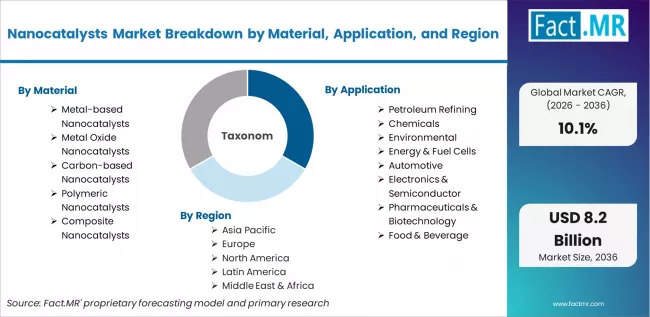
Nanocatalysts Market Breakdown By Material, Application, And Region | Source: Fact.MR
| Metric | Value |
|---|---|
| Quantitative Units | USD 3.12 billion to USD 8.16 billion, at a CAGR of 10.1% |
| Market Definition | Nanocatalysts are engineered catalytic materials with particle dimensions below 100 nanometers that exhibit enhanced catalytic activity, selectivity, and efficiency compared to conventional bulk catalyst materials. The nanoscale particle size provides a dramatically higher surface-area-to-volume ratio that increases the density of catalytically active sites per unit mass of material. Material categories include metal nanoparticles (platinum, palladium, gold, silver), metal oxide nanoparticles (titanium dioxide, zinc oxide, cerium oxide), carbon-based nanocatalysts (carbon nanotubes, graphene oxide), polymeric nanocatalysts, and composite nanostructured materials. |
| Material Segmentation | Metal-based Nanocatalysts, Metal Oxide Nanocatalysts, Carbon-based Nanocatalysts, Polymeric Nanocatalysts, Composite Nanocatalysts |
| Application Segmentation | Petroleum Refining, Chemicals, Environmental, Energy & Fuel Cells, Automotive, Electronics & Semiconductor, Pharmaceuticals & Biotechnology, Food & Beverage |
| Regions Covered | North America, Latin America, Europe, East Asia, South Asia, Oceania, Middle East & Africa |
| Countries Covered | India, China, USA, Germany, Japan, South Korea, UK, and 40 plus countries |
| Key Companies Profiled | BASF SE, Dow Inc., Bayer AG, Evonik Industries AG, NanoScale Corporation, Nanophase Technologies Corporation, Catalytic Solution Inc., Hyperion Catalysis International, Headwaters NanoKinetix Inc., Nanostellar Inc. |
| Forecast Period | 2026 to 2036 |
| Approach | Baseline values derive from a bottom-up aggregation of nanocatalyst consumption volumes per refinery processing unit, fuel cell stack, and emission control system, applying technology-specific catalyst loading rates. |
Source: Fact.MR analysis. Updated Apr 7, 2026
Nanocatalysts Market by Segments
-
Material :
- Metal-based Nanocatalysts
- Metal Oxide Nanocatalysts
- Carbon-based Nanocatalysts
- Polymeric Nanocatalysts
- Composite Nanocatalysts
-
Application :
- Petroleum Refining
- Chemicals
- Environmental
- Energy & Fuel Cells
- Automotive
- Electronics & Semiconductor
- Pharmaceuticals & Biotechnology
- Food & Beverage
-
Region :
- Asia Pacific
- China
- Japan
- South Korea
- India
- Australia
- Thailand
- Rest of Asia Pacific
- Europe
- Germany
- UK
- France
- Italy
- Spain
- Denmark
- Sweden
- Norway
- Rest of Europe
- North America
- USA
- Canada
- Mexico
- Latin America
- Brazil
- Argentina
- Rest of Latin America
- Middle East & Africa
- South Africa
- Saudi Arabia
- UAE
- Kuwait
- Rest of Middle East & Africa
- Asia Pacific
Frequently Asked Questions
How large is the demand for nanocatalysts in the global market in 2026?
What will be the market size of nanocatalysts in the global market by 2036?
What is the expected demand growth for nanocatalysts in the global market between 2026 and 2036?
Which Material is poised to lead global sales by 2026?
How significant is the role of Petroleum Refining in driving nanocatalyst adoption in 2026?
What is the India growth outlook in this report?
What is China's growth outlook in this report?
What are nanocatalysts and what are they mainly used for?
Who worked on this report


Preview the report firsthand - request a free sample
Free SampleGet the brochure for pricing and purchase details
Download PDF