- Market Value (2025): USD 3.9 Bn
- Estimated Value (2026): USD 4.1 Bn
- Forecast Value (2036): USD 7.6 Bn
- CAGR (2026-2036): 6.3%
What is the Natural Infant Care Formulas Market forecast to be worth by 2036?
USD 4.1 billion in 2026 to USD 7.6 billion by 2036, at a 6.3% CAGR.
- As per Fact.MR analysis, the natural infant care formulas market was valued at USD 3.9 billion in 2025.
- Demand is projected to increase from USD 4.1 billion in 2026 to USD 7.6 billion by 2036.
- As per Fact.MR analysis, the market is forecast to record a 6.3% CAGR from 2026 to 2036.
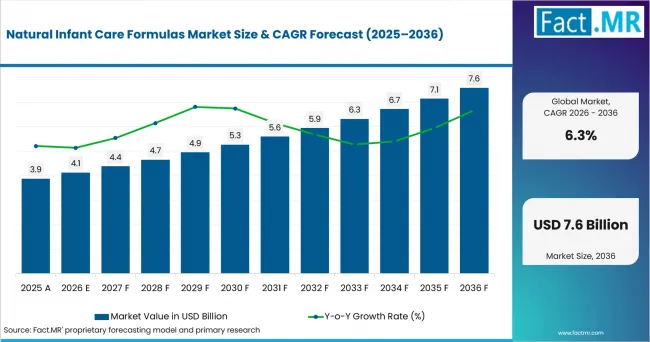
Natural Infant Care Formulas Market Value Analysis | Source: Fact.MR
What are the defining numbers behind Natural Infant Care Formulas Market growth?
USD 3.4664 billion absolute opportunity by 2036, led by Baby wash, Plant oils, Gentle cleansing, and Fragrance-free formulations.
- Demand Drivers in the Market
- Parents need mild baby cleansers because baby skin can become dry and irritated easily. In April 2026, the American Academy of Dermatology reported that eczema affects up to 25% of children worldwide. This increases demand for gentle baby washes and moisturizers.
- Parents check ingredients before choosing baby care products. Plant oils help keep skin soft, while oat and grain ingredients help with dry skin. Plant extracts and mild cleansers are also used in simple baby care products.
- Retailers need clear labels that help parents compare fragrance-free and hypoallergenic products. Natural and organic labels provide information about the ingredients and their source.
- Baby care products need to be mild and easy to use every day. Pumps and caps should be easy to open and use with one hand. The product should also spread and rinse easily.
- Key Segments Analyzed
- By Product: Baby wash is expected to hold a 35.0% share in 2026 because it is used regularly to clean baby skin.
- By Natural Base: Plant oils are projected to account 31.0% share in 2026 due to they are used in baby lotions, balms, oils, and skin creams.
- By Skin Need: Gentle cleansing is anticipated to capture 38.0% share in 2026 as parents prefer mild products for baby skin.
- By Claim: Fragrance-free products are estimated to represent 34.0% share in 2026 owing to parents prefer products without added fragrance for sensitive baby skin.
- Analyst Opinion at Fact.MR
- Shambhu Nath Jha, Principal Consultant at Fact.MR, states, “Parents check ingredients before choosing baby care products. They want to know why cleansers, oils, moisturizers, and fragrances are used. Demand is higher for mild products with clear claims and test results for daily use.”
- Strategic Implications
- Brands should explain why each natural ingredient is used in the product. Clear labels help parents understand the use of oils, extracts, and cleansers and choose products easily.
- Baby wash and shampoo should clean gently and rinse easily. The amount of foam, how easily the product spreads, and how the skin feels after washing are important for daily use.
- Retailers should arrange products by skin need and claim so parents can compare them easily. Fragrance-free and hypoallergenic products can be grouped for sensitive skin, while natural and organic products can have clear labels.
- Quality teams should keep product and facility records updated. In September 2026, the U.S. Food and Drug Administration reported 16,398 active cosmetic facility registrations under MoCRA [6]. Updated records help brands manage changes and keep product information the same across sales channels.
The United Kingdom is expected to grow at 6.9% CAGR through 2036, followed by Japan at 6.2% and the United States at 5.9%. Germany is expected to grow at 5.6%, while France records 5.3%.
How does the Natural Infant Care Formulas Market break down by segment?
Gentle cleansing leads Skin Need at 38.0%; Baby wash leads Product at 35.0%; Fragrance-free leads Claim at 34.0%; Plant oils lead Natural Base at 31.0%.
Which Product dominates?
Baby wash is expected to hold 35.0% share in 2026.
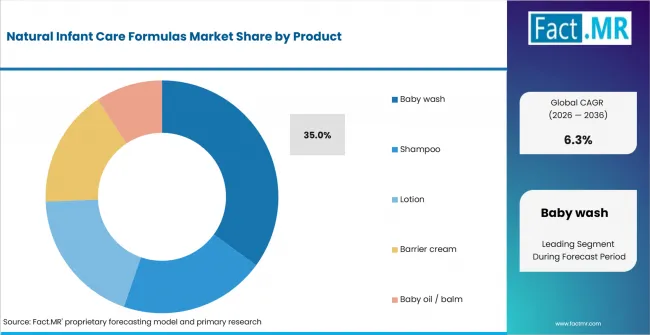
Natural Infant Care Formulas Market Analysis By Product | Source: Fact.MR
Baby wash is expected to hold a 35.0% share in 2026 because it is used regularly for baby skin care. Shampoo cleans the scalp, while lotions and barrier creams moisturize the skin and protect the diaper area. In June 2025, Weleda said calendula is used in more than 20 NATRUE-certified baby and body care products. Regular use of baby wash supports repeat sales.
What leads the Natural Base segment?
Plant oils are projected to account for 31.0% share in 2026.
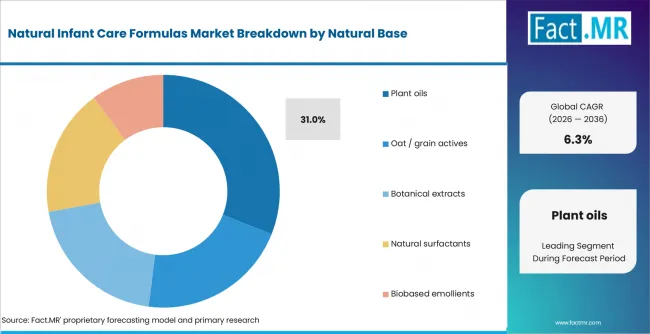
Natural Infant Care Formulas Market Analysis By Natural Base | Source: Fact.MR
Plant oils are expected to hold a 31.0% share in 2026 because they are used in lotions, oils, balms, and skin protection products. Oat and grain ingredients are used for dry or sensitive skin, while plant extracts are used in natural baby care products. Natural cleansers are also used to make mild baby wash products.
How does Skin Need shape demand?
Gentle cleansing is anticipated to hold 38.0% share in 2026.
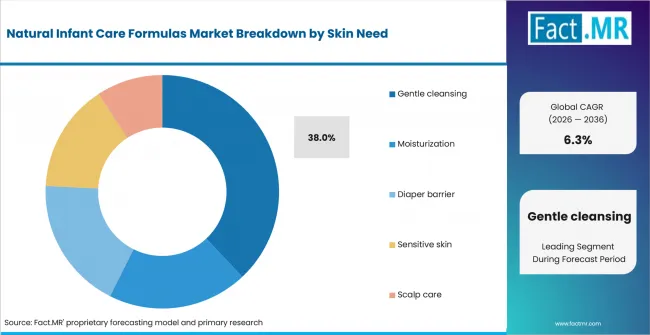
Natural Infant Care Formulas Market Analysis By Skin Need | Source: Fact.MR
Gentle cleansing is anticipated to hold a 38.0% share in 2026 as baby wash products are used often on delicate skin. Moisturizers are used after bathing, while barrier products protect the diaper area. Sensitive-skin and scalp-care products meet different daily baby care needs.
What supports Fragrance-free within Claim?
Fragrance-free is estimated to represent 34.0% share in 2026.
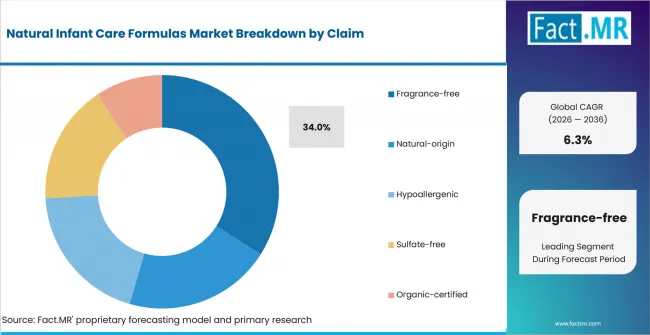
Natural Infant Care Formulas Market Analysis By Claim | Source: Fact.MR
Fragrance-free products are estimated to represent 34.0% share in 2026 because parents can easily understand this claim. Natural claims show where ingredients come from, while hypoallergenic and sulfate-free claims help parents choose products based on skin and cleaning needs. Organic certification gives parents more information about the product.
What is accelerating Natural Infant Care Formulas Market adoption, and what is holding it back?
Daily use of mild baby care products and natural ingredients increases demand, while stricter product records and price pressure can slow growth.
Drivers Impact Analysis
| DRIVER | (~) % IMPACT ON CAGR | GEOGRAPHIC RELEVANCE | IMPACT TIMELINE |
|---|---|---|---|
| Preference for mild infant cleansing formulas | +1.4% | Global | Short term (<= 2 years) |
| Natural-base ingredient positioning | +1.1% | North America, Europe, East Asia | Medium term (2-4 years) |
| Sensitive-skin and fragrance-free claims | +0.9% | North America, Europe | Short term (<= 2 years) |
| Wider pharmacy and e-commerce availability | +0.7% | Global | Medium term (2-4 years) |
| Baby skincare research and formula differentiation | +0.5% | East Asia, Europe | Long term (>= 4 years) |
Opportunity Impact Analysis
| OPPORTUNITY | (~) % IMPACT ON CAGR | GEOGRAPHIC RELEVANCE | IMPACT TIMELINE |
|---|---|---|---|
| Fragrance-free and sensitive-skin line extensions | +1.0% | North America, Europe | Short term (<= 2 years) |
| Plant-oil and botanical formula platforms | +0.8% | Europe, East Asia | Medium term (2-4 years) |
| Certified and culturally adapted baby skincare | +0.6% | Asia Pacific, Europe | Medium term (2-4 years) |
| Refill and lower-material packaging formats | +0.4% | Europe, North America | Long term (>= 4 years) |
Restraints Impact Analysis
| RESTRAINT | (~) % IMPACT ON CAGR | GEOGRAPHIC RELEVANCE | IMPACT TIMELINE |
|---|---|---|---|
| Lower birth volumes in mature markets | -0.8% | USA, UK, Germany, Japan, France | Long term (>= 4 years) |
| Cosmetic compliance and documentation cost | -0.6% | North America, Europe | Medium term (2-4 years) |
| Claim substantiation risk | -0.4% | Global | Short term (<= 2 years) |
| Price sensitivity in premium natural formulas | -0.3% | Global | Medium term (2-4 years) |
Which countries are scaling the Natural Infant Care Formulas Market through 2036?
- The country comparison spans 1.6 percentage points across the forecast period.
- The United Kingdom remains 0.7 percentage point ahead of Japan through established baby-care retail and natural formula positioning.
- Japan remains 0.3 percentage point ahead of the United States as infant-skin research supports specialized baby-care ranges.
- The United States remains 0.3 percentage point ahead of Germany through broad retail access and formal cosmetic product documentation.
- Germany remains 0.3 percentage point ahead of France through established skincare routines and natural personal-care familiarity.
- France closes the displayed range through pharmacy-oriented baby skincare and natural-origin formulation choices.
Comparable CAGRs create different entry conditions through retail access, product regulation, formula preferences, and parent care routines, and Full report coverage includes North America, Latin America, Western Europe, Eastern Europe, East Asia, South Asia & Pacific, Middle East & Africa.
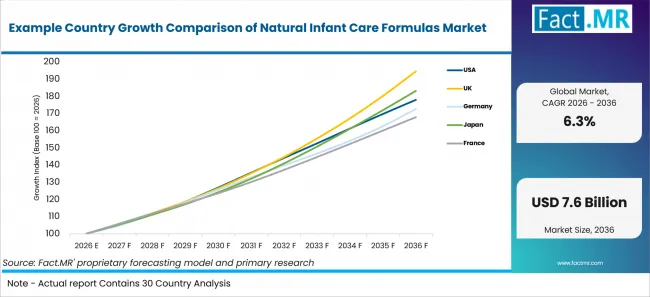
Example Country Growth Comparison Of Natural Infant Care Formulas Market | Source: Fact.MR
| Country | CAGR (2026-2036) |
|---|---|
| United Kingdom | 5.9% |
| Japan | 6.2% |
| United States | 5.9% |
| Germany | 5.6% |
| France | 5.3% |
What supports United Kingdom adoption?
5.9% CAGR through 2036, supported by established baby-care retail and regulated cosmetic safety requirements.
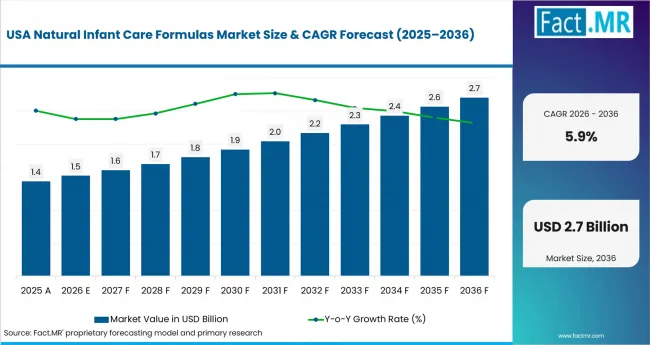
Natural Infant Care Formulas Market Country Value Analysis | Source: Fact.MR
UK parents can buy baby wash, lotions, and barrier products from pharmacies, supermarkets, and online stores. In June 2025, Weleda said calendula is used as the basis for more than 20 NATRUE-certified baby and body care products. Its Calendula baby-care range includes products for regular cleansing and moisturizing [4]. Easy access to these products across stores and online supports regular baby care purchases.
How is Japan scaling demand?
6.2% CAGR through 2036, shaped by infant-skin research and specialized baby-care ranges.
Japanese baby care brands focus on mild products that keep baby skin comfortable. In May 2026, the Statistics Bureau of Japan estimated that 13.29 million children under age 15 lived in the country as of April 1, 2026 [5]. Brands can offer products for different skin needs and simple daily care routines.
What supports the United States outlook?
5.9% CAGR through 2036, supported by broad distribution and formal cosmetic product documentation.
Parents in the United States can buy baby wash and skin care products from supermarkets, pharmacies, specialty stores, and online shops. In April 2026, the CDC National Center for Health Statistics reported 3,606,400 U.S. births in 2025 [3]. Easy access to baby wash, lotions, and barrier products supports regular purchases.
What underpins Germany’s growth?
5.6% CAGR through 2036, reinforced by natural skincare familiarity and European cosmetic safety requirements.
Germany has a strong market for natural and sensitive-skin care products. In July 2026, Destatis reported 654,241 births in Germany in 2025 [1]. Easy access through pharmacies and interest in natural baby care support regular use of baby wash, lotions, and barrier products.
How does France perform?
5.3% CAGR through 2036, led by pharmacy-oriented baby skincare and natural-origin formulation choices.
French parents often buy baby skin care products from pharmacies and choose products based on the baby’s skin needs. In July 2026, Insee reported 643,905 births in France in 2025 [2]. Clear product claims support regular use of baby cleansers, moisturizers, and barrier products.
Who leads the Natural Infant Care Formulas Market?
Kenvue, Pigeon, Mustela, and Weleda provide direct infant skincare coverage, while Unilever and Beiersdorf add wider personal-care scale.
Kenvue offers baby care products through Johnson’s Baby. Pigeon sells baby soap, shampoo, lotions, creams, and oils. Mustela offers cleansers, moisturizers, diaper care, and products for sensitive skin. Weleda uses calendula in its NATRUE-certified natural baby care products.
Beiersdorf sells skin care products through NIVEA and Bambino. In June 2025, Beiersdorf said its Poznań expansion would add six automated production lines and increase yearly production to 500 million units. Unilever also sells skin cleansing products through its personal care brands. Suppliers compete on mild formulas, ingredients, skin care claims, and ease of use.
Which companies are the key providers?
Kenvue, Pigeon, Mustela, Weleda, Unilever, and Beiersdorf are profiled providers.
- Kenvue Inc. (Johnson’s Baby)
- Pigeon Corporation
- Laboratoires Expanscience (Mustela)
- Weleda AG
- Unilever PLC
- Beiersdorf AG
Bibliography
- [1] Statistisches Bundesamt (Destatis). (2026, July 1). Total fertility rate drops to 1.32 children per woman in 2025.
- [2] Insee. (2026, July 6). Births in 2025: A continuing decrease in the number of births.
- [3] National Center for Health Statistics. (2026, April 9). U.S. births down 1% in 2025.
- [4] Office for National Statistics. (2026, September 8). Births in England and Wales: 2025 (final rates).
- [5] Statistics Bureau of Japan. (2026, May 28). Number of children in Japan - in honor of Children's Day.
- [6] U.S. Food and Drug Administration. (2026, September 9). FDA clarifies it does not provide certificates or other documents to verify compliance for cosmetic product facility registration.
- [7] Weleda Group. (2025, June 4). Calendula Oil.
- [8] American Academy of Dermatology. (2026, April 7). American Academy of Dermatology issues first-ever pediatric atopic dermatitis guidelines, highlighting prevention strategies and effective treatments.
- [9] Beiersdorf AG. (2025, June 5). Beiersdorf strengthens its global production network and invests €300 million in plant expansion in Poznań.
This Report Answers
- The report explains where natural infant care formulas are used across product type, natural base, skin need, claim, and geography, and Related Fact.MR coverage of baby personal care provides context for adjacent cleansing, moisturization, and barrier-care categories.
- Segment analysis identifies the leading subsegments and explains why baby wash, plant oils, gentle cleansing, and fragrance-free claims carry the stated 2026 shares.
- Country analysis reviews the United Kingdom, Japan, the United States, Germany, and France through the stated CAGRs and current official infant-demographic evidence.
- Competitive analysis reviews active providers across baby cleansing, moisturization, barrier care, sensitive skin, and natural formulation platforms.
What does the Natural Infant Care Formulas Market cover?
The Natural Infant Care Formulas Market covers topical products formulated for infant cleansing and skin care, and Included products are baby wash, shampoo, lotion, barrier cream, and baby oil or balm, and Fact.MR coverage of baby care products provides wider context across adjacent infant-care categories.
The assessment covers daily-use products sold for babies and young children through mainstream retail, pharmacy, specialty baby stores, and online channels, and Nutritional infant formula, baby food, diapers, wipes, nursery equipment, prescription treatments, and general adult skincare fall outside this topical-care scope.
What is included in the scope?
The scope includes finished topical infant-care formulas used for washing, scalp cleansing, moisturization, diaper-area barrier support, sensitive-skin routines, and massage or balm use, and Adjacent hygiene context is available in Fact.MR coverage of baby wipes.
Natural positioning includes plant oils, botanical extracts, oat or grain actives, natural surfactants, and biobased emollients where these ingredients form part of the product formula, and Fact.MR coverage of natural and organic personal care provides context for broader ingredient and claim trends.
What is excluded from the scope?
Outside the core scope are breast-milk substitutes, powdered or liquid nutritional infant formula, baby cereal, ingestible nutrition products, diapers, and disposable wipes, and these categories serve feeding or absorbent-hygiene needs beyond topical skin-care formulas.
Prescription medicines, medicated dermatology treatments, and products regulated primarily as drugs remain outside the core scope, and General family or adult personal-care products are covered only when a dedicated infant formulation is part of the range.
How Was the Analysis Built?
The analysis draws on 120+ sources, 35+ company portfolios, 25+ countries, and more than 20 industry interviews.
- Primary Research: Primary research includes discussions with manufacturers, service providers, technology developers, distributors, end users, and subject-matter experts. These conversations examine purchasing priorities, product adoption, operational challenges, approval requirements, competitive positioning, and the factors that influence wider market acceptance.
- Desk Research: Desk research covers government statistics, regulatory publications, company filings, trade data, technical studies, industry associations, standards, public policy, and other authoritative sources. Every source used in the analysis is documented in the bibliography.
- Market Sizing and Forecasting: Market estimates combine historical performance, demand indicators, pricing and volume trends, segment shares, company participation, country-level growth, adoption patterns, investment activity, and barriers to market expansion.
- Data Validation and Update Cycle: Findings are validated by comparing primary interviews with public data, company activity, regulatory changes, trade patterns, and industry developments. Regular updates review new product launches, capacity changes, partnerships, approvals, and shifts in commercial adoption.
What is the report’s scope and coverage?
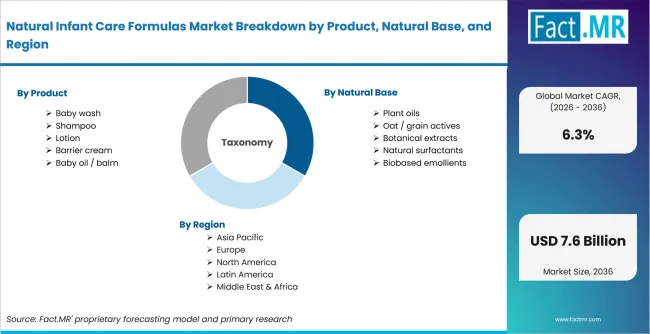
Natural Infant Care Formulas Market Breakdown By Product, Natural Base, And Region | Source: Fact.MR
| Attribute | Details |
|---|---|
| Quantitative Units | USD billion in 2026 to USD billion by 2036 at a CAGR |
| Market Definition | Topical formulas made for infant cleansing and skin care, including baby wash, shampoo, lotion, barrier cream, oil, and balm, and Feeding formula, diapers, wipes, medicines, and general adult skincare fall outside the core scope. |
| Product | Baby wash; Shampoo; Lotion; Barrier cream; Baby oil / balm |
| Natural Base | Plant oils; Oat / grain actives; Botanical extracts; Natural surfactants; Biobased emollients |
| Skin Need | Gentle cleansing; Moisturization; Diaper barrier; Sensitive skin; Scalp care |
| Claim | Fragrance-free; Natural-origin; Hypoallergenic; Sulfate-free; Organic-certified |
| Regions Covered | North America; Latin America; Western Europe; Eastern Europe; East Asia; South Asia & Pacific; Middle East & Africa |
| Countries Covered | United States; United Kingdom; Germany; Japan; France |
| Key Companies Profiled | Kenvue Inc.; Pigeon Corporation; Laboratoires Expanscience; Weleda AG; Unilever PLC; Beiersdorf AG |
| Forecast Period | 2026 to 2036 |
| Approach | Hybrid top-down and bottom-up approach using market values, segment shares and country CAGRs, supported by infant demographics, regulatory evidence, company portfolios and product-development activity. |
How is the market segmented?
-
By Product
- Baby wash
- Shampoo
- Lotion
- Barrier cream
- Baby oil / balm
-
By Natural Base
- Plant oils
- Oat / grain actives
- Botanical extracts
- Natural surfactants
- Biobased emollients
-
By Skin Need
- Gentle cleansing
- Moisturization
- Diaper barrier
- Sensitive skin
- Scalp care
-
By Claim
- Fragrance-free
- Natural-origin
- Hypoallergenic
- Sulfate-free
- Organic-certified
-
By Region
- North America
- Latin America
- Western Europe
- Eastern Europe
- East Asia
- South Asia & Pacific
- Middle East & Africa