Net-Zero Apartment Multi-Zone Thermostats Market
Net-Zero Apartment Multi-Zone Thermostats Market Size and Share Forecast Outlook 2026 to 2036
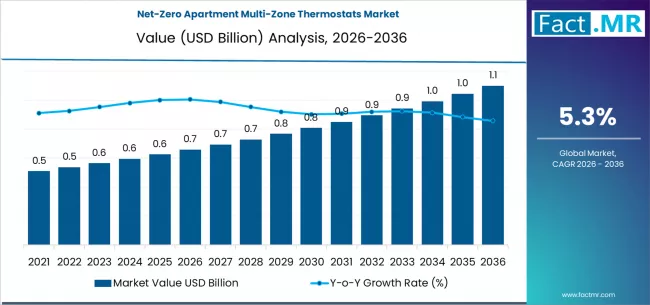
Net-zero apartment multi-zone thermostats market is projected to grow from USD 0.7 billion in 2026 to USD 1.1 billion by 2036, at a CAGR of 5.3%. Smart zoning control will dominate with a 39.7% market share, while <50 units will lead the building size segment with a 35.7% share.
Net-Zero Apartment Multi-Zone Thermostats Market Forecast and Outlook 2026 to 2036
Likely to total USD 0.66 billion in 2026, the global net-zero apartment multi-zone thermostats market has a stable future. A 5.3% CAGR is expected to elevate this industry to USD 1.10 billion by 2036.
Evolution of building codes and sustainability certifications worldwide generate bright prospects for this market. This is occurring as mandating of drastic reductions in operational carbon emissions from the residential sector become compulsory.
Key Takeaways from the Net-Zero Apartment Multi-Zone Thermostats Market
- Market Value for 2026: USD 0.66 Billion
- Market Value for 2036: USD 1.10 Billion
- Forecast CAGR 2026 to 2036: 5.3%
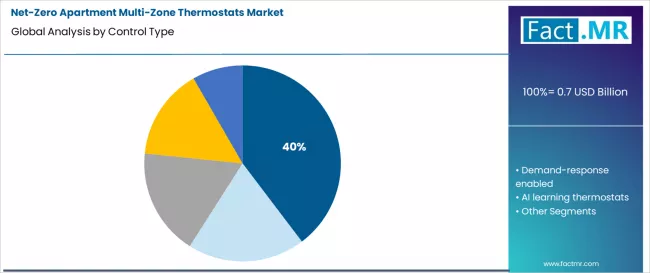
- Leading Control Type Segment (2026): Smart Zoning Control (40%)
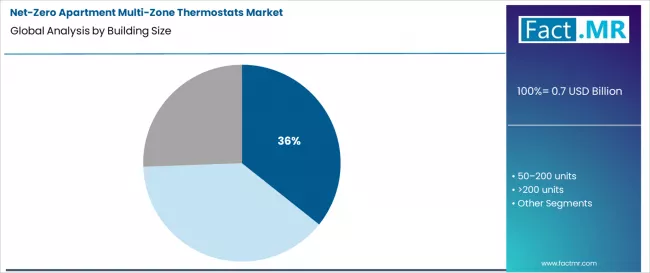
- Leading Building Size Segment (2026): <50 Units (36%)
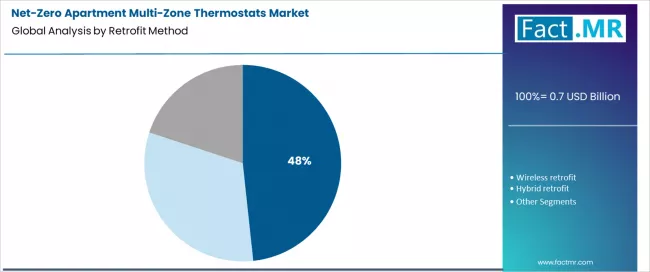
- Leading Retrofit Method Segment (2026): Wired Retrofit (48%)
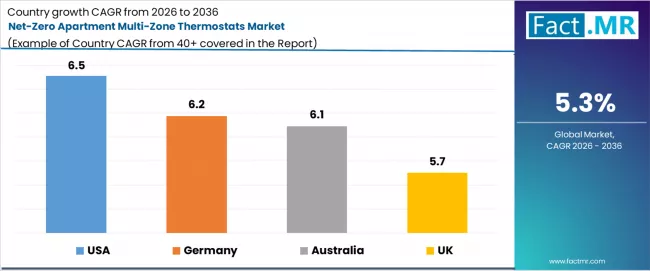
- Key Growth Countries: USA (6.5% CAGR), Germany (6.2% CAGR), Australia (6.1% CAGR), UK (5.7% CAGR)
- Key Players in the Market: Honeywell Home, Schneider Electric, Siemens, Johnson Controls, Ecobee, Tado

Achieving net-zero energy performance in multi-unit dwellings requires moving beyond whole-building HVAC control to granular, zone-by-zone management of heating and cooling. Advanced multi-zone thermostats are critical for this, enabling precise energy allocation, eliminating tenant over-conditioning, and dynamically balancing loads across apartments.
Their ability to integrate with heat pumps, renewable energy sources, and grid demand signals transforms them from comfort devices into essential tools for meeting stringent environmental targets and minimizing utility costs for building owners and residents alike.
The expansion of this market is fueled by the significant renovation wave targeting existing apartment stock for energy efficiency. As retrofit projects seek the highest impact upgrades, intelligent zoning systems delivering immediate energy savings and enhanced occupant comfort are becoming a standard specification. This is driving adoption beyond new luxury constructions into the mainstream refurbishment sector.
Metric
| Metric | Value |
|---|---|
| Market Value (2026) | USD 0.66 Billion |
| Market Forecast Value (2036) | USD 1.10 Billion |
| Forecast CAGR 2026 to 2036 | 5.3% |
Category
| Category | Segments |
|---|---|
| Control Type | Smart Zoning Control, Demand-Response Enabled, AI Learning Thermostats, Programmable Smart, BMS-Integrated Nodes |
| Building Size | <50 Units, 50-200 Units, >200 Units |
| Retrofit Method | Wired Retrofit, Wireless Retrofit, Hybrid Retrofit |
| Region | North America, Latin America, Western Europe, Eastern Europe, East Asia, South Asia & Pacific, MEA |
Segmental Analysis
By Control Type, Which Technology Enables Precise Energy Allocation?

Smart zoning control commands a leading 40% share. This segment's dominance is based on its foundational role in dividing a building into independent thermal zones, allowing for customized temperature settings and schedules.
This precision prevents energy waste from heating or cooling unoccupied spaces and addresses varying solar exposure or occupancy patterns across different apartments, delivering the core efficiency gains required for net-zero operations and satisfying diverse tenant comfort preferences.
By Building Size, Which Segment Presents the Most Immediate Retrofit Opportunity?

Buildings with fewer than 50 units lead the building size segment with a 36% share. This category represents a sweet spot for retrofits, being large enough to justify the investment in a centralized zoning system yet small enough to manage the project complexity and cost-effectively.
These buildings are often owned by private landlords or smaller developers who are increasingly targeted by incentive programs and can see a faster return on investment from energy savings, driving initial adoption.
By Retrofit Method, Which Approach Minimizes Disruption in Existing Buildings?

Wired retrofit is the leading method with a 48% share. In many existing apartment buildings, especially concrete or steel structures, running new low-voltage wiring for thermostats and zone controllers is often more reliable and secure than wireless solutions.
This method provides a robust, permanent installation with no concerns over signal interference or battery changes, making it the preferred choice for professional installers and building engineers seeking a dependable, long-term solution.
What are the Principal Drivers, Constraints, and Evolving Dynamics of this Market?
| Attribute | Market Impact |
|---|---|
| Stringent Net-Zero Building Codes & Certifications | Regulations like the EU's EPBD and local decarbonization mandates are compelling building owners to install advanced zoning systems to achieve required energy performance levels, creating compliance-driven demand. |
| High Installation Cost & Retrofit Complexity | The significant labor and material cost to install new zoning infrastructure in existing buildings acts as a primary barrier, slowing adoption in price-sensitive markets and older building stocks. |
| Integration with Grid Demand-Response Programs | Thermostats that can automatically adjust building loads in response to grid signals allow owners to earn revenue, transforming the system from a cost center into a value-generating asset. |
| Shift to AI-Driven Predictive Climate Control | The trend is moving beyond simple scheduling to using AI and machine learning to predict occupancy and weather patterns, optimizing comfort and efficiency autonomously with minimal user input. |
Analysis of the Net-Zero Apartment Multi-Zone Thermostats Market by Key Countries

| Country | CAGR 2026 to 2036 |
|---|---|
| USA | 6.5% |
| Germany | 6.2% |
| Australia | 6.1% |
| UK | 5.7% |
How do Evolving Building Codes and Utility Incentives Drive the US Market?
The USA's leading growth rate of 6.5% CAGR is propelled by a patchwork of increasingly strict state and local building energy codes, alongside substantial federal and utility-led incentive programs for energy efficiency retrofits. The market is characterized by high awareness among property managers of the operational cost savings from smart HVAC controls. Growth is particularly strong in regions with high electricity costs and aging multi-family housing stock, where retrofit projects actively seek out smart zoning solutions to qualify for rebates and meet emerging electrification and decarbonization standards for buildings.
What is the Role of Germany's Pioneering Energy Efficiency Regulations?
Pioneering and rigorous building energy laws, such as the Building Energy Act (GEG), which sets ambitious primary energy demand limits, fundamentally drive Germany’s robust growth at 6.2% CAGR. Compliance with these standards for both new constructions and major renovations essentially mandates highly efficient HVAC zoning.
The market in Germany is characterized by a strong preference for high-quality, wired systems that integrate seamlessly with other building automation technology, purchased through specialized engineering and trade channels that emphasize durability and long-term performance.
How Does Australia's Climate and Energy Price Volatility Shape Demand?
Climate variability and some of the world’s highest retail electricity prices fuel Australia’s significant growth at 6.1% CAGR. This creates a powerful economic incentive for apartment building owners to invest in systems that minimize HVAC energy use.
The market is further shaped by a growing trend toward all-electric buildings utilizing heat pumps, which benefit enormously from precise zoning control for efficiency. Australian consumers are also early adopters of technology that offers both cost control and enhanced comfort, supporting the uptake of advanced smart and AI-learning thermostats.
What Factors Underpin the UK's Focus on Retrofit and Building Standards?
The UK's growth, forecast at 5.7% CAGR, is centered on the massive challenge of upgrading its old and inefficient building stock to meet net-zero targets. Government programs and funding focused on residential retrofit, alongside standards like the Future Homes Standard, drive demand.
The UK is particularly attuned to solutions that minimize disruption for tenants during retrofit, favoring hybrid wired-wireless systems. Growth is methodical, linked to policy cycles and the availability of funding for social housing and private sector retrofits, with a strong emphasis on achieving measurable energy performance improvements.
Competitive Landscape of the Net-Zero Apartment Multi-Zone Thermostats Market

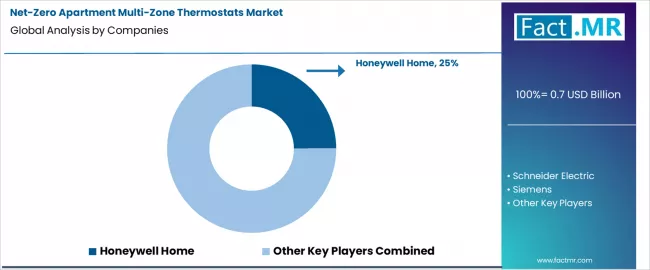
The competitive landscape features established building automation and HVAC giants like Honeywell, Siemens, and Johnson Controls competing with agile smart home specialists like Ecobee and Tado. Competition revolves around the depth of integration with other building systems such as BMS, heat pumps, and renewables, the sophistication of energy-saving algorithms, and the ease of installation and configuration for professional installers.
Success is determined by securing partnerships with large property developers, retrofit contractors, and utility demand-response programs, as well as by offering scalable platforms that work across building sizes from small boutique apartments to large high-rise complexes.
Key Players in the Net-Zero Apartment Multi-Zone Thermostats Market
- Honeywell Home
- Schneider Electric
- Siemens
- Johnson Controls
- Ecobee
- Tado
Scope of Report
| Items | Values |
|---|---|
| Quantitative Units | USD Billion |
| Control Type | Smart Zoning Control, Demand-Response Enabled, AI Learning Thermostats, Programmable Smart, BMS-Integrated Nodes |
| Building Size | <50 Units, 50-200 Units, >200 Units |
| Retrofit Method | Wired Retrofit, Wireless Retrofit, Hybrid Retrofit |
| Key Countries | USA, Germany, Australia, UK |
| Key Companies | Honeywell Home, Schneider Electric, Siemens, Johnson Controls, Ecobee, Tado |
| Additional Analysis | Comparative analysis of energy savings from zoning in different climate zones; study of tenant comfort satisfaction and its impact on rental premiums; total cost of ownership analysis for wired vs. wireless retrofit systems; impact of open vs. proprietary communication protocols on system flexibility; assessment of data privacy and security in cloud-connected multi-tenant building systems. |
Market by Segments
-
Control Type :
- Smart Zoning Control
- Demand-Response Enabled
- AI Learning Thermostats
- Programmable Smart
- BMS-Integrated Nodes
-
Building Size :
- <50 Units
- 50-200 Units
- 200 Units
-
Retrofit Method :
- Wired Retrofit
- Wireless Retrofit
- Hybrid Retrofit
-
Region :
-
North America
- USA
- Canada
-
Latin America
- Brazil
- Mexico
- Argentina
- Rest of Latin America
-
Western Europe
- Germany
- France
- Italy
- Spain
- UK
- BENELUX
- Rest of Western Europe
-
Eastern Europe
- Russia
- Poland
- Czech Republic
- Rest of Eastern Europe
-
East Asia
- China
- Japan
- South Korea
- Rest of East Asia
-
South Asia & Pacific
- India
- ASEAN
- Australia
- Rest of South Asia & Pacific
-
MEA
- GCC Countries
- South Africa
- Turkiye
- Rest of MEA
-
Bibliography
- International Energy Agency. (2025). Building Envelopes and HVAC Systems: A Technology Roadmap. IEA.
- Pérez-Lombard, L., Ortiz, J., & Pout, C. (2024). A review on buildings energy consumption information. Energy and Buildings, 56, 85-92.
- U.S. Department of Energy. (2025). Installation Guidelines for Advanced HVAC Controls in Multi-Family Buildings. DOE/EE-2087.
- UN Environment Programme. (2025). Global Status Report for Buildings and Construction. UNEP.
- Vereniging Eigen Huis. (2024). Smart Home Technology Adoption in Multi-Unit Dwellings. Rotterdam School of Management.
Table of Content
- Executive Summary
- Global Market Outlook
- Demand to side Trends
- Supply to side Trends
- Technology Roadmap Analysis
- Analysis and Recommendations
- Market Overview
- Market Coverage / Taxonomy
- Market Definition / Scope / Limitations
- Market Background
- Market Dynamics
- Drivers
- Restraints
- Opportunity
- Trends
- Scenario Forecast
- Demand in Optimistic Scenario
- Demand in Likely Scenario
- Demand in Conservative Scenario
- Opportunity Map Analysis
- Product Life Cycle Analysis
- Supply Chain Analysis
- Investment Feasibility Matrix
- Value Chain Analysis
- PESTLE and Porter’s Analysis
- Regulatory Landscape
- Regional Parent Market Outlook
- Production and Consumption Statistics
- Import and Export Statistics
- Market Dynamics
- Global Market Analysis 2021 to 2025 and Forecast, 2026 to 2036
- Historical Market Size Value (USD Million) Analysis, 2021 to 2025
- Current and Future Market Size Value (USD Million) Projections, 2026 to 2036
- Y to o to Y Growth Trend Analysis
- Absolute $ Opportunity Analysis
- Global Market Pricing Analysis 2021 to 2025 and Forecast 2026 to 2036
- Global Market Analysis 2021 to 2025 and Forecast 2026 to 2036, By Control Type
- Introduction / Key Findings
- Historical Market Size Value (USD Million) Analysis By Control Type, 2021 to 2025
- Current and Future Market Size Value (USD Million) Analysis and Forecast By Control Type, 2026 to 2036
- Smart zoning control
- Demand-response enabled
- AI learning thermostats
- Programmable smart
- BMS-integrated nodes
- Smart zoning control
- Y to o to Y Growth Trend Analysis By Control Type, 2021 to 2025
- Absolute $ Opportunity Analysis By Control Type, 2026 to 2036
- Global Market Analysis 2021 to 2025 and Forecast 2026 to 2036, By Building Size
- Introduction / Key Findings
- Historical Market Size Value (USD Million) Analysis By Building Size, 2021 to 2025
- Current and Future Market Size Value (USD Million) Analysis and Forecast By Building Size, 2026 to 2036
- <50 units
- 50–200 units
- >200 units
- <50 units
- Y to o to Y Growth Trend Analysis By Building Size, 2021 to 2025
- Absolute $ Opportunity Analysis By Building Size, 2026 to 2036
- Global Market Analysis 2021 to 2025 and Forecast 2026 to 2036, By Retrofit Method
- Introduction / Key Findings
- Historical Market Size Value (USD Million) Analysis By Retrofit Method, 2021 to 2025
- Current and Future Market Size Value (USD Million) Analysis and Forecast By Retrofit Method, 2026 to 2036
- Wired retrofit
- Wireless retrofit
- Hybrid retrofit
- Wired retrofit
- Y to o to Y Growth Trend Analysis By Retrofit Method, 2021 to 2025
- Absolute $ Opportunity Analysis By Retrofit Method, 2026 to 2036
- Global Market Analysis 2021 to 2025 and Forecast 2026 to 2036, By Region
- Introduction
- Historical Market Size Value (USD Million) Analysis By Region, 2021 to 2025
- Current Market Size Value (USD Million) Analysis and Forecast By Region, 2026 to 2036
- North America
- Latin America
- Western Europe
- Eastern Europe
- East Asia
- South Asia and Pacific
- Middle East & Africa
- Market Attractiveness Analysis By Region
- North America Market Analysis 2021 to 2025 and Forecast 2026 to 2036, By Country
- Historical Market Size Value (USD Million) Trend Analysis By Market Taxonomy, 2021 to 2025
- Market Size Value (USD Million) Forecast By Market Taxonomy, 2026 to 2036
- By Country
- USA
- Canada
- Mexico
- By Control Type
- By Building Size
- By Retrofit Method
- By Country
- Market Attractiveness Analysis
- By Country
- By Control Type
- By Building Size
- By Retrofit Method
- Key Takeaways
- Latin America Market Analysis 2021 to 2025 and Forecast 2026 to 2036, By Country
- Historical Market Size Value (USD Million) Trend Analysis By Market Taxonomy, 2021 to 2025
- Market Size Value (USD Million) Forecast By Market Taxonomy, 2026 to 2036
- By Country
- Brazil
- Chile
- Rest of Latin America
- By Control Type
- By Building Size
- By Retrofit Method
- By Country
- Market Attractiveness Analysis
- By Country
- By Control Type
- By Building Size
- By Retrofit Method
- Key Takeaways
- Western Europe Market Analysis 2021 to 2025 and Forecast 2026 to 2036, By Country
- Historical Market Size Value (USD Million) Trend Analysis By Market Taxonomy, 2021 to 2025
- Market Size Value (USD Million) Forecast By Market Taxonomy, 2026 to 2036
- By Country
- Germany
- UK
- Italy
- Spain
- France
- Nordic
- BENELUX
- Rest of Western Europe
- By Control Type
- By Building Size
- By Retrofit Method
- By Country
- Market Attractiveness Analysis
- By Country
- By Control Type
- By Building Size
- By Retrofit Method
- Key Takeaways
- Eastern Europe Market Analysis 2021 to 2025 and Forecast 2026 to 2036, By Country
- Historical Market Size Value (USD Million) Trend Analysis By Market Taxonomy, 2021 to 2025
- Market Size Value (USD Million) Forecast By Market Taxonomy, 2026 to 2036
- By Country
- Russia
- Poland
- Hungary
- Balkan & Baltic
- Rest of Eastern Europe
- By Control Type
- By Building Size
- By Retrofit Method
- By Country
- Market Attractiveness Analysis
- By Country
- By Control Type
- By Building Size
- By Retrofit Method
- Key Takeaways
- East Asia Market Analysis 2021 to 2025 and Forecast 2026 to 2036, By Country
- Historical Market Size Value (USD Million) Trend Analysis By Market Taxonomy, 2021 to 2025
- Market Size Value (USD Million) Forecast By Market Taxonomy, 2026 to 2036
- By Country
- China
- Japan
- South Korea
- By Control Type
- By Building Size
- By Retrofit Method
- By Country
- Market Attractiveness Analysis
- By Country
- By Control Type
- By Building Size
- By Retrofit Method
- Key Takeaways
- South Asia and Pacific Market Analysis 2021 to 2025 and Forecast 2026 to 2036, By Country
- Historical Market Size Value (USD Million) Trend Analysis By Market Taxonomy, 2021 to 2025
- Market Size Value (USD Million) Forecast By Market Taxonomy, 2026 to 2036
- By Country
- India
- ASEAN
- Australia & New Zealand
- Rest of South Asia and Pacific
- By Control Type
- By Building Size
- By Retrofit Method
- By Country
- Market Attractiveness Analysis
- By Country
- By Control Type
- By Building Size
- By Retrofit Method
- Key Takeaways
- Middle East & Africa Market Analysis 2021 to 2025 and Forecast 2026 to 2036, By Country
- Historical Market Size Value (USD Million) Trend Analysis By Market Taxonomy, 2021 to 2025
- Market Size Value (USD Million) Forecast By Market Taxonomy, 2026 to 2036
- By Country
- Kingdom of Saudi Arabia
- Other GCC Countries
- Turkiye
- South Africa
- Other African Union
- Rest of Middle East & Africa
- By Control Type
- By Building Size
- By Retrofit Method
- By Country
- Market Attractiveness Analysis
- By Country
- By Control Type
- By Building Size
- By Retrofit Method
- Key Takeaways
- Key Countries Market Analysis
- USA
- Pricing Analysis
- Market Share Analysis, 2025
- By Control Type
- By Building Size
- By Retrofit Method
- Canada
- Pricing Analysis
- Market Share Analysis, 2025
- By Control Type
- By Building Size
- By Retrofit Method
- Mexico
- Pricing Analysis
- Market Share Analysis, 2025
- By Control Type
- By Building Size
- By Retrofit Method
- Brazil
- Pricing Analysis
- Market Share Analysis, 2025
- By Control Type
- By Building Size
- By Retrofit Method
- Chile
- Pricing Analysis
- Market Share Analysis, 2025
- By Control Type
- By Building Size
- By Retrofit Method
- Germany
- Pricing Analysis
- Market Share Analysis, 2025
- By Control Type
- By Building Size
- By Retrofit Method
- UK
- Pricing Analysis
- Market Share Analysis, 2025
- By Control Type
- By Building Size
- By Retrofit Method
- Italy
- Pricing Analysis
- Market Share Analysis, 2025
- By Control Type
- By Building Size
- By Retrofit Method
- Spain
- Pricing Analysis
- Market Share Analysis, 2025
- By Control Type
- By Building Size
- By Retrofit Method
- France
- Pricing Analysis
- Market Share Analysis, 2025
- By Control Type
- By Building Size
- By Retrofit Method
- India
- Pricing Analysis
- Market Share Analysis, 2025
- By Control Type
- By Building Size
- By Retrofit Method
- ASEAN
- Pricing Analysis
- Market Share Analysis, 2025
- By Control Type
- By Building Size
- By Retrofit Method
- Australia & New Zealand
- Pricing Analysis
- Market Share Analysis, 2025
- By Control Type
- By Building Size
- By Retrofit Method
- China
- Pricing Analysis
- Market Share Analysis, 2025
- By Control Type
- By Building Size
- By Retrofit Method
- Japan
- Pricing Analysis
- Market Share Analysis, 2025
- By Control Type
- By Building Size
- By Retrofit Method
- South Korea
- Pricing Analysis
- Market Share Analysis, 2025
- By Control Type
- By Building Size
- By Retrofit Method
- Russia
- Pricing Analysis
- Market Share Analysis, 2025
- By Control Type
- By Building Size
- By Retrofit Method
- Poland
- Pricing Analysis
- Market Share Analysis, 2025
- By Control Type
- By Building Size
- By Retrofit Method
- Hungary
- Pricing Analysis
- Market Share Analysis, 2025
- By Control Type
- By Building Size
- By Retrofit Method
- Kingdom of Saudi Arabia
- Pricing Analysis
- Market Share Analysis, 2025
- By Control Type
- By Building Size
- By Retrofit Method
- Turkiye
- Pricing Analysis
- Market Share Analysis, 2025
- By Control Type
- By Building Size
- By Retrofit Method
- South Africa
- Pricing Analysis
- Market Share Analysis, 2025
- By Control Type
- By Building Size
- By Retrofit Method
- USA
- Market Structure Analysis
- Competition Dashboard
- Competition Benchmarking
- Market Share Analysis of Top Players
- By Regional
- By Control Type
- By Building Size
- By Retrofit Method
- Competition Analysis
- Competition Deep Dive
- Honeywell Home
- Overview
- Product Portfolio
- Profitability by Market Segments (Product/Age /Sales Channel/Region)
- Sales Footprint
- Strategy Overview
- Marketing Strategy
- Product Strategy
- Channel Strategy
- Schneider Electric
- Siemens
- Johnson Controls
- Ecobee
- Tado
- Honeywell Home
- Competition Deep Dive
- Assumptions & Acronyms Used
- Research Methodology
List Of Table
- Table 1: Global Market Value (USD Million) Forecast by Region, 2021 to 2036
- Table 2: Global Market Value (USD Million) Forecast by Control Type, 2021 to 2036
- Table 3: Global Market Value (USD Million) Forecast by Building Size, 2021 to 2036
- Table 4: Global Market Value (USD Million) Forecast by Retrofit Method, 2021 to 2036
- Table 5: North America Market Value (USD Million) Forecast by Country, 2021 to 2036
- Table 6: North America Market Value (USD Million) Forecast by Control Type, 2021 to 2036
- Table 7: North America Market Value (USD Million) Forecast by Building Size, 2021 to 2036
- Table 8: North America Market Value (USD Million) Forecast by Retrofit Method, 2021 to 2036
- Table 9: Latin America Market Value (USD Million) Forecast by Country, 2021 to 2036
- Table 10: Latin America Market Value (USD Million) Forecast by Control Type, 2021 to 2036
- Table 11: Latin America Market Value (USD Million) Forecast by Building Size, 2021 to 2036
- Table 12: Latin America Market Value (USD Million) Forecast by Retrofit Method, 2021 to 2036
- Table 13: Western Europe Market Value (USD Million) Forecast by Country, 2021 to 2036
- Table 14: Western Europe Market Value (USD Million) Forecast by Control Type, 2021 to 2036
- Table 15: Western Europe Market Value (USD Million) Forecast by Building Size, 2021 to 2036
- Table 16: Western Europe Market Value (USD Million) Forecast by Retrofit Method, 2021 to 2036
- Table 17: Eastern Europe Market Value (USD Million) Forecast by Country, 2021 to 2036
- Table 18: Eastern Europe Market Value (USD Million) Forecast by Control Type, 2021 to 2036
- Table 19: Eastern Europe Market Value (USD Million) Forecast by Building Size, 2021 to 2036
- Table 20: Eastern Europe Market Value (USD Million) Forecast by Retrofit Method, 2021 to 2036
- Table 21: East Asia Market Value (USD Million) Forecast by Country, 2021 to 2036
- Table 22: East Asia Market Value (USD Million) Forecast by Control Type, 2021 to 2036
- Table 23: East Asia Market Value (USD Million) Forecast by Building Size, 2021 to 2036
- Table 24: East Asia Market Value (USD Million) Forecast by Retrofit Method, 2021 to 2036
- Table 25: South Asia and Pacific Market Value (USD Million) Forecast by Country, 2021 to 2036
- Table 26: South Asia and Pacific Market Value (USD Million) Forecast by Control Type, 2021 to 2036
- Table 27: South Asia and Pacific Market Value (USD Million) Forecast by Building Size, 2021 to 2036
- Table 28: South Asia and Pacific Market Value (USD Million) Forecast by Retrofit Method, 2021 to 2036
- Table 29: Middle East & Africa Market Value (USD Million) Forecast by Country, 2021 to 2036
- Table 30: Middle East & Africa Market Value (USD Million) Forecast by Control Type, 2021 to 2036
- Table 31: Middle East & Africa Market Value (USD Million) Forecast by Building Size, 2021 to 2036
- Table 32: Middle East & Africa Market Value (USD Million) Forecast by Retrofit Method, 2021 to 2036
List Of Figures
- Figure 1: Global Market Pricing Analysis
- Figure 2: Global Market Value (USD Million) Forecast 2021 to 2036
- Figure 3: Global Market Value Share and BPS Analysis by Control Type, 2026 and 2036
- Figure 4: Global Market Y to o to Y Growth Comparison by Control Type, 2026 to 2036
- Figure 5: Global Market Attractiveness Analysis by Control Type
- Figure 6: Global Market Value Share and BPS Analysis by Building Size, 2026 and 2036
- Figure 7: Global Market Y to o to Y Growth Comparison by Building Size, 2026 to 2036
- Figure 8: Global Market Attractiveness Analysis by Building Size
- Figure 9: Global Market Value Share and BPS Analysis by Retrofit Method, 2026 and 2036
- Figure 10: Global Market Y to o to Y Growth Comparison by Retrofit Method, 2026 to 2036
- Figure 11: Global Market Attractiveness Analysis by Retrofit Method
- Figure 12: Global Market Value (USD Million) Share and BPS Analysis by Region, 2026 and 2036
- Figure 13: Global Market Y to o to Y Growth Comparison by Region, 2026 to 2036
- Figure 14: Global Market Attractiveness Analysis by Region
- Figure 15: North America Market Incremental Dollar Opportunity, 2026 to 2036
- Figure 16: Latin America Market Incremental Dollar Opportunity, 2026 to 2036
- Figure 17: Western Europe Market Incremental Dollar Opportunity, 2026 to 2036
- Figure 18: Eastern Europe Market Incremental Dollar Opportunity, 2026 to 2036
- Figure 19: East Asia Market Incremental Dollar Opportunity, 2026 to 2036
- Figure 20: South Asia and Pacific Market Incremental Dollar Opportunity, 2026 to 2036
- Figure 21: Middle East & Africa Market Incremental Dollar Opportunity, 2026 to 2036
- Figure 22: North America Market Value Share and BPS Analysis by Country, 2026 and 2036
- Figure 23: North America Market Value Share and BPS Analysis by Control Type, 2026 and 2036
- Figure 24: North America Market Y to o to Y Growth Comparison by Control Type, 2026 to 2036
- Figure 25: North America Market Attractiveness Analysis by Control Type
- Figure 26: North America Market Value Share and BPS Analysis by Building Size, 2026 and 2036
- Figure 27: North America Market Y to o to Y Growth Comparison by Building Size, 2026 to 2036
- Figure 28: North America Market Attractiveness Analysis by Building Size
- Figure 29: North America Market Value Share and BPS Analysis by Retrofit Method, 2026 and 2036
- Figure 30: North America Market Y to o to Y Growth Comparison by Retrofit Method, 2026 to 2036
- Figure 31: North America Market Attractiveness Analysis by Retrofit Method
- Figure 32: Latin America Market Value Share and BPS Analysis by Country, 2026 and 2036
- Figure 33: Latin America Market Value Share and BPS Analysis by Control Type, 2026 and 2036
- Figure 34: Latin America Market Y to o to Y Growth Comparison by Control Type, 2026 to 2036
- Figure 35: Latin America Market Attractiveness Analysis by Control Type
- Figure 36: Latin America Market Value Share and BPS Analysis by Building Size, 2026 and 2036
- Figure 37: Latin America Market Y to o to Y Growth Comparison by Building Size, 2026 to 2036
- Figure 38: Latin America Market Attractiveness Analysis by Building Size
- Figure 39: Latin America Market Value Share and BPS Analysis by Retrofit Method, 2026 and 2036
- Figure 40: Latin America Market Y to o to Y Growth Comparison by Retrofit Method, 2026 to 2036
- Figure 41: Latin America Market Attractiveness Analysis by Retrofit Method
- Figure 42: Western Europe Market Value Share and BPS Analysis by Country, 2026 and 2036
- Figure 43: Western Europe Market Value Share and BPS Analysis by Control Type, 2026 and 2036
- Figure 44: Western Europe Market Y to o to Y Growth Comparison by Control Type, 2026 to 2036
- Figure 45: Western Europe Market Attractiveness Analysis by Control Type
- Figure 46: Western Europe Market Value Share and BPS Analysis by Building Size, 2026 and 2036
- Figure 47: Western Europe Market Y to o to Y Growth Comparison by Building Size, 2026 to 2036
- Figure 48: Western Europe Market Attractiveness Analysis by Building Size
- Figure 49: Western Europe Market Value Share and BPS Analysis by Retrofit Method, 2026 and 2036
- Figure 50: Western Europe Market Y to o to Y Growth Comparison by Retrofit Method, 2026 to 2036
- Figure 51: Western Europe Market Attractiveness Analysis by Retrofit Method
- Figure 52: Eastern Europe Market Value Share and BPS Analysis by Country, 2026 and 2036
- Figure 53: Eastern Europe Market Value Share and BPS Analysis by Control Type, 2026 and 2036
- Figure 54: Eastern Europe Market Y to o to Y Growth Comparison by Control Type, 2026 to 2036
- Figure 55: Eastern Europe Market Attractiveness Analysis by Control Type
- Figure 56: Eastern Europe Market Value Share and BPS Analysis by Building Size, 2026 and 2036
- Figure 57: Eastern Europe Market Y to o to Y Growth Comparison by Building Size, 2026 to 2036
- Figure 58: Eastern Europe Market Attractiveness Analysis by Building Size
- Figure 59: Eastern Europe Market Value Share and BPS Analysis by Retrofit Method, 2026 and 2036
- Figure 60: Eastern Europe Market Y to o to Y Growth Comparison by Retrofit Method, 2026 to 2036
- Figure 61: Eastern Europe Market Attractiveness Analysis by Retrofit Method
- Figure 62: East Asia Market Value Share and BPS Analysis by Country, 2026 and 2036
- Figure 63: East Asia Market Value Share and BPS Analysis by Control Type, 2026 and 2036
- Figure 64: East Asia Market Y to o to Y Growth Comparison by Control Type, 2026 to 2036
- Figure 65: East Asia Market Attractiveness Analysis by Control Type
- Figure 66: East Asia Market Value Share and BPS Analysis by Building Size, 2026 and 2036
- Figure 67: East Asia Market Y to o to Y Growth Comparison by Building Size, 2026 to 2036
- Figure 68: East Asia Market Attractiveness Analysis by Building Size
- Figure 69: East Asia Market Value Share and BPS Analysis by Retrofit Method, 2026 and 2036
- Figure 70: East Asia Market Y to o to Y Growth Comparison by Retrofit Method, 2026 to 2036
- Figure 71: East Asia Market Attractiveness Analysis by Retrofit Method
- Figure 72: South Asia and Pacific Market Value Share and BPS Analysis by Country, 2026 and 2036
- Figure 73: South Asia and Pacific Market Value Share and BPS Analysis by Control Type, 2026 and 2036
- Figure 74: South Asia and Pacific Market Y to o to Y Growth Comparison by Control Type, 2026 to 2036
- Figure 75: South Asia and Pacific Market Attractiveness Analysis by Control Type
- Figure 76: South Asia and Pacific Market Value Share and BPS Analysis by Building Size, 2026 and 2036
- Figure 77: South Asia and Pacific Market Y to o to Y Growth Comparison by Building Size, 2026 to 2036
- Figure 78: South Asia and Pacific Market Attractiveness Analysis by Building Size
- Figure 79: South Asia and Pacific Market Value Share and BPS Analysis by Retrofit Method, 2026 and 2036
- Figure 80: South Asia and Pacific Market Y to o to Y Growth Comparison by Retrofit Method, 2026 to 2036
- Figure 81: South Asia and Pacific Market Attractiveness Analysis by Retrofit Method
- Figure 82: Middle East & Africa Market Value Share and BPS Analysis by Country, 2026 and 2036
- Figure 83: Middle East & Africa Market Value Share and BPS Analysis by Control Type, 2026 and 2036
- Figure 84: Middle East & Africa Market Y to o to Y Growth Comparison by Control Type, 2026 to 2036
- Figure 85: Middle East & Africa Market Attractiveness Analysis by Control Type
- Figure 86: Middle East & Africa Market Value Share and BPS Analysis by Building Size, 2026 and 2036
- Figure 87: Middle East & Africa Market Y to o to Y Growth Comparison by Building Size, 2026 to 2036
- Figure 88: Middle East & Africa Market Attractiveness Analysis by Building Size
- Figure 89: Middle East & Africa Market Value Share and BPS Analysis by Retrofit Method, 2026 and 2036
- Figure 90: Middle East & Africa Market Y to o to Y Growth Comparison by Retrofit Method, 2026 to 2036
- Figure 91: Middle East & Africa Market Attractiveness Analysis by Retrofit Method
- Figure 92: Global Market - Tier Structure Analysis
- Figure 93: Global Market - Company Share Analysis
- FAQs -
How big is the net-zero apartment multi-zone thermostats market in 2026?
The global net-zero apartment multi-zone thermostats market is estimated to be valued at USD 0.7 billion in 2026.
What will be the size of net-zero apartment multi-zone thermostats market in 2036?
The market size for the net-zero apartment multi-zone thermostats market is projected to reach USD 1.1 billion by 2036.
How much will be the net-zero apartment multi-zone thermostats market growth between 2026 and 2036?
The net-zero apartment multi-zone thermostats market is expected to grow at a 5.3% CAGR between 2026 and 2036.
What are the key product types in the net-zero apartment multi-zone thermostats market?
The key product types in net-zero apartment multi-zone thermostats market are smart zoning control, demand-response enabled, ai learning thermostats, programmable smart and bms-integrated nodes.
Which building size segment to contribute significant share in the net-zero apartment multi-zone thermostats market in 2026?
In terms of building size, <50 units segment to command 35.7% share in the net-zero apartment multi-zone thermostats market in 2026.