- Base Value(2025): 3.6 Bn
- Estimated Value(2026): 3.9 Bn
- Forecast Value (2036): 7.8 Bn
- CAGR (2026 - 2036): 7.2%
Telemetry-Linked Smart Fertilizer Program Market Forecast and Outlook By Fact.MR
- The telemetry-linked smart fertilizer program market was valued at USD 3.6 billion in 2025.
- According to Fact.MR, demand is projected to reach USD 3.9 billion in 2026 and expand to USD 7.8 billion by 2036, reflecting a CAGR of 7.2% during the forecast period.
Summary of Telemetry-Linked Smart Fertilizer Program Market
- Market Definition
- The market includes fertilizer programs that use connected sensors, telemetry, and remote data streams to guide nutrient timing, dosing, or placement.
- Demand Drivers
- Remote-access sensing is improving field visibility, which strengthens demand for nutrient programs that respond to moisture, stress, and irrigation conditions rather than fixed schedules.
- Smart fertigation systems are gaining importance because IoT-linked monitoring supports more timely water and nutrient decisions.
- Digital agricultural technologies are increasingly associated with efficiency and environmental gains, which supports demand for telemetry-linked nutrient programs.
- Key Segments Analyzed
- By Program Type: Sensor-linked fertigation programs are estimated to lead with approximately 34% share in 2026, supported by strong fit with real-time irrigation and nutrient control.
- By Application: Fertigation programs are expected to hold approximately 38% share in 2026, driven by easier integration of telemetry with irrigated nutrient delivery.
- By Crop Type: Fruits & vegetables are projected to account for approximately 31% share in 2026, supported by higher-value production and stronger need for precise input timing.
- By Geography: India leads growth at 8.4% CAGR through 2036, supported by expanding smart-agriculture adoption and fertigation relevance.
- Analyst Opinion at Fact.MR
- Shambhu Nath Jha, Senior Analyst at Fact.MR, notes, “CXOs should read this market as a connected decision category rather than a premium fertilizer niche. Buyers are not simply purchasing nutrients. They are purchasing field visibility that helps nutrients move at the right time, in the right amount, under real crop conditions.”
- Strategic Implications
- Invest in nutrient programs that connect sensor data with fertigation or variable-rate execution rather than treating monitoring and fertilizer management as separate tools.
- Build technical sales capability around remote data interpretation, irrigation-linked nutrient timing, and decision confidence rather than nutrient formulation alone.
- Position subscription-based and platform-led nutrient programs where growers need ongoing remote visibility across irrigated or high-value fields.
- Methodology
- Market sizing uses irrigated acreage relevance, telemetry adoption, crop-value intensity, and adoption potential across connected fertilizer programs.
- Analysis includes extension guidance on remote-access sensing and peer-reviewed reviews of smart sensors, digital agriculture, and smart fertigation.
- Forecasts account for rising sensor adoption, broader digital-agriculture use, and stronger demand for connected nutrient scheduling.
The market is expected to generate an absolute opportunity of USD 3.9 billion between 2026 and 2036, supported by increasing digitization in agriculture. Growth is being driven by wider use of remote-access sensors, stronger adoption of digital irrigation systems, and rising demand for nutrient programs that can respond to field conditions in near real time. Research from University of Minnesota highlights that soil-moisture sensors enable remote data access, supporting more precise irrigation decisions. Broader smart agriculture studies also link IoT-based monitoring with improved fertigation and nutrient management outcomes. These developments are encouraging the shift toward integrated fertilizer programs that combine sensing, data analytics, and application control to improve efficiency, reduce input waste, and stabilize crop performance.
India is projected to lead with a CAGR of 8.4% through 2036, driven by rising digital-agriculture adoption, fertigation growth, and stronger pressure to improve input efficiency. Brazil follows at 7.9%, supported by broad-acre precision agriculture and telemetry adoption in irrigated systems. The United States is expected to grow at 7.4%, underpinned by sensor-led irrigation scheduling and variable-rate nutrient management. China records 7.1%, backed by fast-moving smart-agriculture adoption in intensive cropping systems. Mexico grows at 6.6%, supported by irrigated horticulture and connected fertigation programs.
Segmental Analysis
Telemetry-Linked Smart Fertilizer Program Market Analysis by Program Type
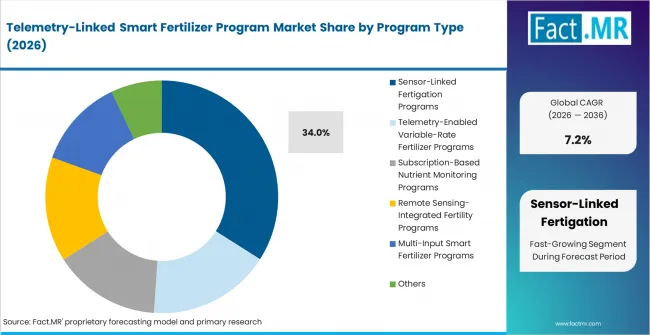
Telemetry Linked Smart Fertilizer Program Market Analysis By Program Type | Source: Fact.MR
Sensor-linked fertigation programs are estimated to hold 34% share in 2026. They lead because fertigation is one of the most natural points of integration between telemetry and fertilizer management. Connected soil-moisture monitoring, environmental sensing, and nutrient scheduling can be brought together in one program, which makes telemetry especially valuable in irrigated systems where nutrient timing depends on water movement. Recent smart-agriculture research describes IoT-based data collection on environmental conditions and soil moisture as central to optimizing irrigation and fertigation, while broader smart-sensor reviews continue to position digital monitoring as a key part of precision crop management.
- Fertigation Anchor: Sensor-linked fertigation programs lead because telemetry fits directly into irrigated nutrient delivery workflows.
- Platform Pull: Subscription programs gain traction where buyers want decision support and remote alerts rather than sensor ownership alone.
- Remote Imaging Upside: Imaging-linked nutrient programs are gaining relevance where field variability must be tracked across larger production zones.
Telemetry-Linked Smart Fertilizer Program Market Analysis by Application
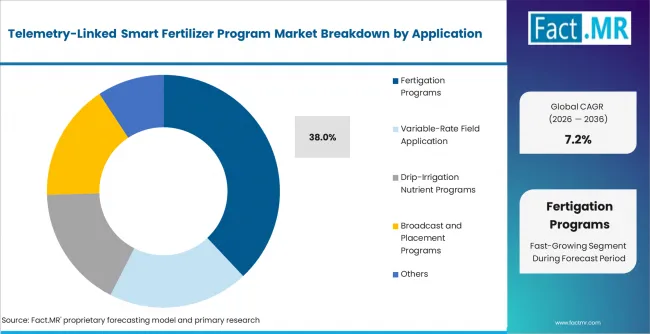
Telemetry Linked Smart Fertilizer Program Market Analysis By Application | Source: Fact.MR
Based on Fact.MR’s analysis, fertigation programs are expected to reach 38% share in 2026. This segment leads because irrigation and fertilizer delivery already operate together in these systems, which makes telemetry more immediately useful than in less connected application modes. Sensor-linked irrigation scheduling, controller logic, and real-time field monitoring allow growers to adjust nutrient timing with stronger confidence when water flow and crop conditions are changing. Variable-rate field application also remains highly relevant where telemetry is paired with equipment control and field data. Drip-irrigation nutrient programs keep strong commercial importance in horticulture and protected cultivation because connected nutrient delivery can be managed more precisely in those systems. Application leadership in this market favors methods where remote data can influence nutrient movement quickly and directly.
- Irrigation Linkage: Fertigation leads because telemetry can affect nutrient and water decisions in the same operating cycle.
- Drip-System Strength: Drip programs are commercially attractive where precise nutrient placement already matters in high-value crops.
- Variable-Rate Growth: Field application programs are gaining traction where telemetry is integrated with precision machinery and field-zone management.
Telemetry-Linked Smart Fertilizer Program Market Analysis by Crop Type
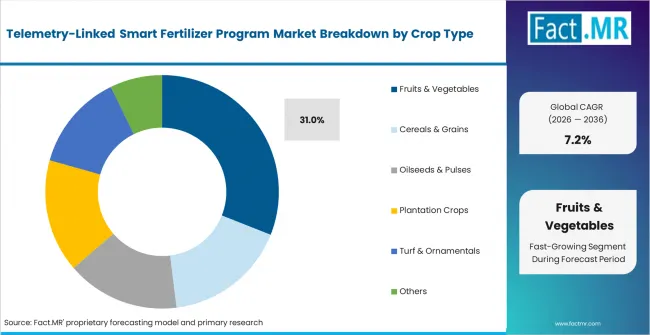
Telemetry Linked Smart Fertilizer Program Market Analysis By Crop Type | Source: Fact.MR
Fruits & vegetables are projected to account for approximately 31% share in 2026. They lead because these crops are more management-intensive and more responsive to timing errors in nutrient and water delivery than many lower-value broad-acre systems. Precision agriculture guidance for vegetable crops continues to emphasize the value of advanced monitoring tools for observing plant and soil response, which supports stronger fit for telemetry-linked nutrient programs in this segment. Cereals and grains remain important where large-acre precision systems justify digital nutrient planning, though the strongest commercial pull comes from high-value irrigated crops where each scheduling decision has more visible economic impact. Crop leadership in this market is therefore shaped by input sensitivity and telemetry readiness as much as by acreage.
- High-Value Fit: Fruits and vegetables create stronger demand because nutrient timing matters more directly to crop quality and marketability.
- Monitoring Advantage: Telemetry is easier to justify where growers already track crop and soil response closely.
- Broad-Acre Opportunity: Cereals and grains remain relevant where variable-rate systems and remote data infrastructure are already in place.
Drivers, Restraints, and Opportunities
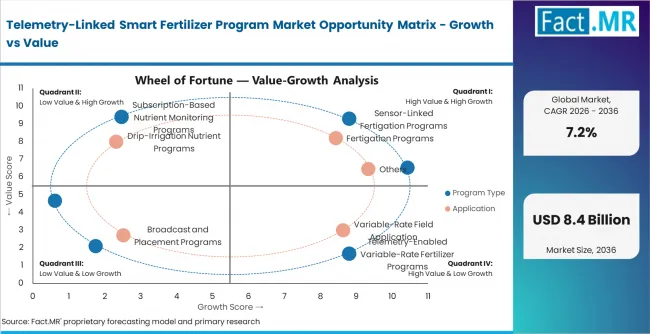
Telemetry Linked Smart Fertilizer Program Market Opportunity Matrix Growth Vs Value | Source: Fact.MR
Fact.MR analysts observe that the telemetry-linked smart fertilizer program market is being shaped by the need to make nutrient management more responsive to real field conditions. Structural demand is anchored in the fact that connected sensors, remote access, and digital monitoring can make irrigation and fertilizer decisions more adaptive and more precise. Smart-sensor reviews and digital-agriculture research continue to frame these technologies around efficiency, resource optimization, and more timely intervention, which gives telemetry-linked nutrient programs a strong commercial foundation. The market becomes more attractive when growers see telemetry as a way to improve decision timing rather than only as a hardware purchase.
The main restraint is integration complexity. Remote sensors, telemetry, nutrient scheduling, controller compatibility, and data interpretation do not always fit together easily across every farm. Extension guidance also notes that sensor systems can be costly and represent only a small area of influence, which means growers still need confidence that the data are worth the investment. Another restraint is proof burden. Growers may accept remote irrigation monitoring faster than telemetry-linked fertilizer control unless they can see direct agronomic or economic benefit from the added layer of nutrient decision support.
- Smart Fertigation Expansion: Connected fertigation remains the clearest commercial opportunity because telemetry fits naturally into irrigated nutrient delivery.
- Subscription Programs: Platform-led nutrient services create higher-value opportunity where growers prefer advisory outputs over raw sensor feeds.
- Remote Sensing Integration: Telemetry programs linked with remote crop observation create stronger opportunity where field variability must be tracked continuously.
Regional Analysis
The telemetry-linked smart fertilizer program market is assessed across North America, Europe, Asia Pacific, Latin America, and Middle East and Africa, covering 40+ countries with demand profiles shaped by digital-agriculture maturity, irrigated acreage, sensor adoption, and connected nutrient-management readiness.
.webp "Top Country Growth Comparison Telemetry Linked Smart Fertilizer Program Market Cagr (2026 2036)")
Top Country Growth Comparison Telemetry Linked Smart Fertilizer Program Market Cagr (2026 2036) | Source: Fact.MR
| Country | CAGR (2026 to 2036) |
|---|---|
| India | 8.4% |
| Brazil | 7.9% |
| United States | 7.4% |
| China | 7.1% |
| Mexico | 6.6% |
Source: Fact.MR analysis. Updated Jun 15, 2026
Source: Fact.MR analysis, based on proprietary forecasting model and primary research
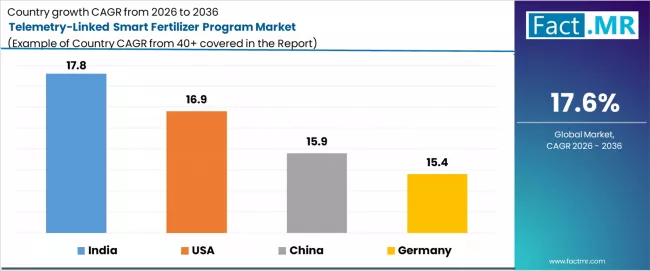
Telemetry Linked Smart Fertilizer Program Market Cagr Analysis By Country | Source: Fact.MR
North America Telemetry-Linked Smart Fertilizer Program Market Analysis
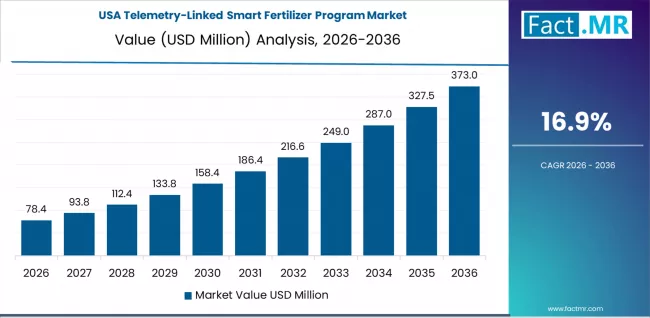
Telemetry Linked Smart Fertilizer Program Market Country Value Analysis | Source: Fact.MR
North America remains an important commercial region because it combines strong precision-agriculture infrastructure, remote monitoring adoption, and higher-value irrigated crop systems. The region also benefits from stronger extension support for irrigation sensors and growing familiarity with remote-access data, which helps connected nutrient programs gain credibility faster than in less digitized markets. Demand is strongest where growers already use sensor-led irrigation scheduling or variable-rate field management and want fertilizer programs to follow the same data logic.
- United States: Precision nutrient placement and sensor-led irrigation management continue to support demand across the United States. The market is projected to expand at a CAGR of 7.4% through 2036, driven by increasing adoption of data-driven farming practices. Growers are integrating telemetry with fertigation and nutrient programs to improve application accuracy, reduce input waste, and enhance crop performance across large-scale and specialty farming systems.
- Canada: Strong digital-agriculture discipline and a focus on reliable crop establishment support adoption across Canada. Telemetry-linked smart fertilizer program demand is expected to grow at a CAGR of 6.1% through 2036, as producers increasingly rely on connected systems to optimize nutrient delivery under shorter growing seasons. Use is particularly relevant in precision-managed cereal and oilseed production.
- Mexico: Irrigated horticulture and the need for connected fertigation systems create a practical commercial fit in Mexico. Sales of telemetry-linked smart fertilizer programs are likely to rise at a CAGR of 6.6% during the forecast period, supported by high-value crop cultivation. Growers are adopting these solutions to synchronize irrigation and nutrient delivery, improve efficiency, and maintain consistent crop quality under intensive production conditions.
Fact.MR’s analysis of North America covers the United States, Canada, and Mexico. Includes sensor-led irrigation, precision nutrient placement, and connected fertigation demand.
Asia Pacific and Latin America Telemetry-Linked Smart Fertilizer Program Market Analysis
Asia Pacific and Latin America offer the strongest long-term expansion potential because digital-agriculture uptake, irrigated crop intensity, and pressure for input efficiency are rising across multiple crop systems. Demand is likely to strengthen where growers move from general fertilizer use toward connected nutrient-management systems that respond to moisture, crop condition, and irrigation behavior in near real time. Adoption depends on digital infrastructure, service support, and the ability of suppliers to turn telemetry into practical nutrient decisions rather than raw data alone.
- India: Expanding smart-agriculture adoption and the growing relevance of fertigation continue to support demand across India. The market is projected to grow at an 8.4% CAGR through 2036, driven by increasing use of connected irrigation systems, digital advisory tools, and precision nutrient management. Adoption is particularly visible in horticulture and high-value crops where synchronized nutrient delivery improves efficiency and crop performance.
- Brazil: Broad-acre precision agriculture and telemetry-linked irrigation systems support expansion in Brazil. Telemetry-linked smart fertilizer program demand is expected to rise at a 7.9% CAGR through 2036, driven by large-scale farming operations and increasing use of data-driven input management. Growers are leveraging connected systems to optimize nutrient application, improve field-level efficiency, and sustain yields across diverse soil and climate conditions.
Fact.MR’s analysis covers India, China, Japan, ASEAN, Australia, Brazil, Argentina, and Rest of Latin America. Includes digital-agriculture expansion, connected fertigation demand, and telemetry-linked nutrient-management adoption.
Competitive Aligners for Market Players
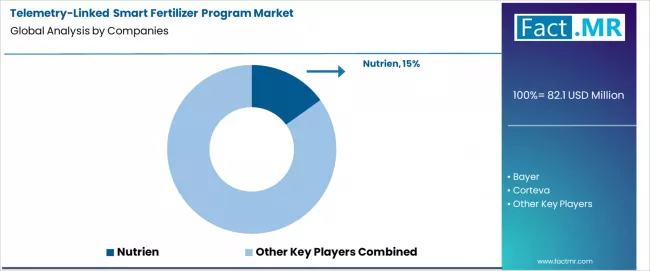
Telemetry Linked Smart Fertilizer Program Market Analysis By Company | Source: Fact.MR
The telemetry-linked smart fertilizer program market is moderately concentrated at the platform and program-design level, while sensor supply, advisory services, and field integration remain fragmented. Competitive strength comes from the ability to combine telemetry, nutrient logic, and agronomic interpretation into one usable program. Suppliers need more than sensor hardware. They need a clear explanation of how remote data improve nutrient timing, dosing, or field variability management.
Competitive advantage is defined by system integration, decision quality, and ease of adoption. Sensor-linked fertigation providers benefit from clearer real-time use cases. Platform-led programs benefit from subscription and advisory revenue logic. Remote-sensing-integrated programs gain attention where growers want broader field coverage than fixed sensors can provide. Buyers in this market usually choose on decision confidence and operational fit rather than on fertilizer content alone.
Buyer dynamics vary by digital maturity and crop intensity. Precision operations and large farms are more likely to adopt first because they can use telemetry across larger acreages and multiple decisions. Broader adoption will depend on whether suppliers can show that connected nutrient programs improve field outcomes consistently enough to justify the extra digital layer. Competitive intensity is therefore rising fastest in irrigated and data-managed systems rather than in ordinary fertilizer distribution.
Key Players
- Nutrien Ltd.
- Yara International ASA
- ICL Group Ltd.
- Haifa Group
- Netafim Ltd.
- Valmont Industries
- Lindsay Corporation
- Jain Irrigation Systems Ltd.
Bibliography
- Nutrien Ltd. (2022, August 15). Digitally engaged acres: Enabling sustainable ag through tech. Nutrien Ltd.
- Yara International ASA. (2026). Yara annual report 2025. Yara International ASA.
- ICL Group Ltd. (2025, May 15). ICL’s role in sustainable agriculture and food security. ICL Group Ltd.
- Netafim Ltd. (2024, September 4). Orbia’s precision agriculture business, Netafim, successfully delivers digital farming with all-in-one irrigation operating system GrowSphere™. Netafim Ltd.
This Report Addresses
- Strategic intelligence on telemetry-linked smart fertilizer program demand across irrigated farms, fertigation systems, and precision-managed crop programs.
- Growth opportunity mapping across sensor-linked fertigation, telemetry-enabled variable-rate programs, remote sensing-integrated fertility programs, and subscription nutrient platforms.
- Segment analysis by program type, application, crop type, and end use.
- Regional outlook covering North America, Europe, Asia Pacific, Latin America, and Middle East and Africa.
- Competitive analysis of Nutrien, Yara, ICL, Haifa Group, Netafim, Valmont, Lindsay, and other participants.
- Connected nutrient-management analysis covering telemetry, remote sensing, digital-agriculture integration, and irrigation-linked fertilizer decisions.
- Report delivered in PDF, Excel datasets, and presentation formats. Supported by primary interviews, extension guidance, and current smart-agriculture literature.
Telemetry-Linked Smart Fertilizer Program Market Definition
The market covers fertilizer programs that use telemetry, remote sensors, connected controllers, or digitally transmitted agronomic data to adjust nutrient timing, dosing, or placement. It includes programs where nutrient decisions are informed by sensor-linked irrigation data, field telemetry, crop monitoring, and connected platform logic rather than fixed nutrient schedules alone.
Telemetry-Linked Smart Fertilizer Program Market Inclusions
Covers global and regional forecasts from 2026 to 2036. Includes sensor-linked fertigation systems, telemetry-enabled nutrient monitoring platforms, remote sensing-linked fertilizer programs, variable-rate nutrient application tied to field data, and multi-input smart fertilizer systems used in irrigated and precision-managed farming. Covers products and service models positioned to improve nutrient-use efficiency through connected decision support and remote field visibility.
Telemetry-Linked Smart Fertilizer Program Market Exclusions
Excludes standard fertilizer programs with no telemetry, no connected sensor input, and no remote data-driven decision layer. Omits general precision agriculture hardware sold without a nutrient-management program, irrigation-only control systems with no fertilizer management component, and broad farm software platforms that are not used to guide fertilizer timing or dosing.
Telemetry-Linked Smart Fertilizer Program Market Research Methodology
- Primary Research
- Interviews with fertigation specialists, irrigation automation advisors, precision-agriculture consultants, digital agronomy teams, greenhouse nutrient managers, and large-farm input planners across major agricultural regions.
- Desk Research
- Uses extension materials on remote-access soil moisture sensing, peer-reviewed reviews on smart sensors and digital agriculture, and research on telemetry-linked irrigation and fertigation optimization.
- Market-Sizing and Forecasting
- Hybrid model using irrigated acreage relevance, digital-agriculture maturity, telemetry adoption, crop-value intensity, and adoption potential across connected fertilizer programs.
- Data Validation and Update Cycle
- Validated using extension irrigation-scheduling guidance, digital-agriculture literature, sensor-system research, and recurring checks on commercial fit in fertigation, variable-rate, and remote-monitoring nutrient systems.
Segmentation
Scope of Report
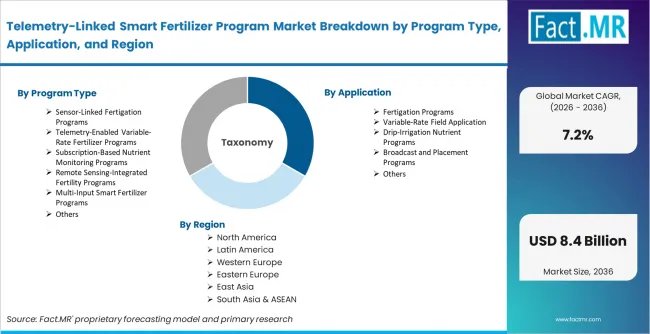
Telemetry Linked Smart Fertilizer Program Market Breakdown By Program Type, Application, And Region | Source: Fact.MR
| Attribute | Details |
| Quantitative Units | USD billion (2026) to USD billion (2036), at a CAGR |
| Market Definition | Fertilizer programs that use telemetry, connected sensors, remote data, or platform-driven monitoring to guide nutrient timing, dosing, or placement. |
| Program Type Segmentation | Sensor-Linked Fertigation Programs, Telemetry-Enabled Variable-Rate Fertilizer Programs, Subscription-Based Nutrient Monitoring Programs, Remote Sensing-Integrated Fertility Programs, Multi-Input Smart Fertilizer Programs, Others |
| Application Segmentation | Fertigation Programs, Variable-Rate Field Application, Drip-Irrigation Nutrient Programs, Broadcast and Placement Programs, Others |
| Crop Type Segmentation | Fruits & Vegetables, Cereals & Grains, Oilseeds & Pulses, Plantation Crops, Turf & Ornamentals, Others |
| Regions Covered | North America, Europe, Asia Pacific, Latin America, Middle East and Africa |
| Countries Covered | United States, Canada, Mexico, Spain, Netherlands, Germany, France, India, China, Australia, Brazil, Argentina, and 40+ countries |
| Key Companies Profiled | Nutrien Ltd., Yara International ASA, ICL Group Ltd., Haifa Group, Netafim Ltd., Valmont Industries, Lindsay Corporation, Jain Irrigation Systems Ltd. |
| Forecast Period | 2026 to 2036 |
| Approach | Hybrid top-down and bottom-up model using irrigated acreage relevance, telemetry adoption, crop-value intensity, digital-agriculture maturity, and primary interviews with growers, distributors, and agronomy teams. |
Source: Fact.MR analysis. Updated Jun 15, 2026
Telemetry-Linked Smart Fertilizer Program Market by Segments
-
By Program Type:
- Sensor-Linked Fertigation Programs
- Telemetry-Enabled Variable-Rate Fertilizer Programs
- Subscription-Based Nutrient Monitoring Programs
- Remote Sensing-Integrated Fertility Programs
- Multi-Input Smart Fertilizer Programs
- Others
-
By Application:
- Fertigation Programs
- Variable-Rate Field Application
- Drip-Irrigation Nutrient Programs
- Broadcast and Placement Programs
- Others
-
By Crop Type:
- Fruits & Vegetables
- Cereals & Grains
- Oilseeds & Pulses
- Plantation Crops
- Turf & Ornamentals
- Others
-
By Region:
- North America
- United States
- Canada
- Latin America
- Brazil
- Mexico
- Argentina
- Chile
- Rest of Latin America
- Western Europe
- Germany
- France
- United Kingdom
- Italy
- Spain
- Nordic Countries
- BENELUX
- Rest of Western Europe
- Eastern Europe
- Russia
- Poland
- Hungary
- Balkan and Baltic
- Rest of Eastern Europe
- East Asia
- China
- Japan
- South Korea
- South Asia and Pacific
- India
- ASEAN
- Australia and New Zealand
- Rest of South Asia and Pacific
- Middle East and Africa
- Kingdom of Saudi Arabia
- Other GCC Countries
- Türkiye
- South Africa
- Rest of Middle East and Africa
- North America
Frequently Asked Questions
What is the expected CAGR from 2026 to 2036?
Which program type is poised to lead the market?
Which application segment holds the largest share?
Which crop segment is expected to remain strongest?
Which farm operations are likely to adopt telemetry-linked smart fertilizer programs fastest?
Which country shows the fastest growth?
What is driving demand for telemetry-linked smart fertilizer programs?
What is the key challenge in this market?
Who worked on this report


Preview the report firsthand - request a free sample
Free SampleGet the brochure for pricing and purchase details
Download PDF