- Base Value(2025): 5.10 Bn
- Estimated Value(2026): 5.58 Bn
- Forecast Value (2036): 13.70 Bn
- CAGR (2026 - 2036): 9.40%
Nitrile Gloves Market Size, Market Forecast and Outlook By Fact.MR
The nitrile gloves market was valued at USD 5.10 billion in 2025, projected to reach USD 5.58 billion in 2026, and is forecast to expand to USD 13.70 billion by 2036 at a 9.40% CAGR. Mandatory hand protection compliance across medical, food processing, pharmaceutical, and industrial workplaces is sustaining procurement growth for nitrile gloves globally. The post-pandemic normalization of personal protective equipment consumption at elevated baseline volumes, combined with the progressive regulatory phase-out of powdered medical gloves in major markets, continues to channel demand toward powder-free nitrile formulations that offer superior chemical resistance and reduced allergenicity compared to latex alternatives.
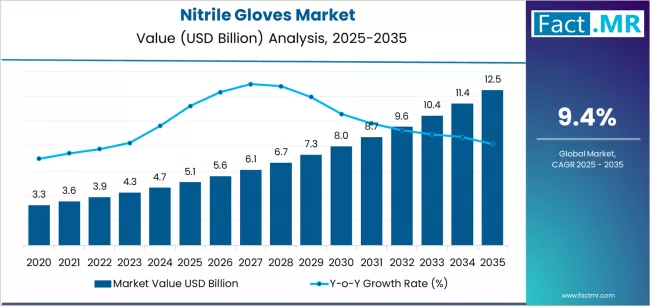
Nitrile Gloves Market Market Value Analysis | Source: Fact.MR
Summary of Nitrile Gloves Market
- Market Overview
- The market is valued at USD 5.10 billion in 2025 and is projected to reach USD 13.70 billion by 2036.
- The industry is expected to grow at a 9.40% CAGR from 2026 to 2036, creating an incremental opportunity of USD 8.12 billion.
- The market operates as a high-volume, compliance-driven personal protective equipment category where powder-free formulation, chemical resistance certification, and manufacturing cost efficiency define competitive positioning across healthcare, food processing, and industrial end-use sectors.
- Demand and Growth Drivers
- Mandatory hand protection regulations in healthcare, food processing, pharmaceutical, and industrial settings sustain elevated baseline consumption of nitrile examination and industrial gloves.
- Progressive regulatory phase-out of powdered medical gloves in the USA, EU, and other major markets channels demand toward powder-free nitrile formulations.
- Expanding healthcare infrastructure and food safety regulation enforcement in India, China, and Brazil create high-growth demand corridors for disposable nitrile gloves.
- Among key countries, India leads at 11.3% CAGR, followed by China at 10.8%, the USA at 8.9%, Canada at 8.4%, Brazil at 8.1%, Germany at 7.7%, and the UK at 7.5%.
- Product and Segment View
- Nitrile gloves are disposable or durable hand protection products manufactured from synthetic acrylonitrile butadiene rubber, offering chemical resistance, puncture resistance, and latex-free allergen safety.
- Powder Free accounts for 73.9% of the Type segment in 2026, driven by FDA and EU medical device regulation mandating powder-free formulations for clinical examination and surgical applications.
- Disposable gloves command 66.4% of the Product segment in 2026, reflecting the high-volume, single-use consumption pattern in medical, food handling, and laboratory environments.
- Medical & Healthcare holds 41.7% of the End Use segment in 2026, representing the largest procurement pool across hospitals, clinics, dental practices, and diagnostic laboratories.
- Scope includes powder-free and powdered nitrile gloves in disposable and durable formats across medical, automotive, food, pharmaceutical, cleanroom, and industrial applications. Latex and vinyl gloves, reusable rubber chemical gloves, and cut-resistant textile gloves are excluded.
- Geography and Competitive Outlook
- India and China are the fastest-growing markets, driven by healthcare infrastructure expansion, food safety regulation enforcement, and domestic manufacturing capacity buildout.
- The USA and Germany represent mature, high-value demand bases anchored by medical facility procurement volumes, pharmaceutical cleanroom requirements, and automotive manufacturing standards.
- Competition is shaped by manufacturing scale, production cost efficiency, and global distribution reach, with Top Glove Corporation Berhad, Ansell Limited, Hartalega Holdings Berhad, Kossan Rubber Industries Berhad, Cardinal Health, Inc., and Medline Industries, LP among the principal suppliers.
- Analyst Opinion at Fact.MR
- Shambhu Nath Jha, Principal Consultant for Healthcare, opines: 'In my analysis, I have observed that the competitive dynamics in the global nitrile gloves market are shifting from post-pandemic capacity overshoot correction toward a structural cost optimization phase. Malaysian manufacturers that invested in automated production lines during the 2020 to 2022 capacity expansion cycle now hold a durable cost advantage over competitors relying on labor-intensive processes. Healthcare procurement groups consolidating supplier panels are prioritizing unit cost stability and supply continuity guarantees over brand preference, creating a market environment where manufacturing efficiency determines contract retention.'
- Strategic Implications / Executive Takeaways
- Manufacturers must invest in automated production line technology to achieve unit cost positions that meet healthcare group purchasing organization price benchmarks in competitive tender cycles.
- Distribution partners should develop vendor-managed inventory programmes for hospital systems to secure multi-year procurement contracts based on supply continuity guarantees.
- Product development teams need to expand thin-gauge, high-sensitivity nitrile formulations for surgical and diagnostic applications where tactile precision commands premium pricing above commodity examination glove levels.
Nitrile Gloves Market Key Takeaways
| Metric | Details |
|---|---|
| Industry Size (2026) | USD 5.58 billion |
| Industry Value (2036) | USD 13.70 billion |
| CAGR (2026 to 2036) | 9.40% |
Source: Fact.MR analysis. Updated Apr 3, 2026
Between 2026 and 2036, the market is set to register an absolute dollar opportunity of USD 8.12 billion. This expansion reflects the structural elevation of glove consumption rates across healthcare and food handling sectors, capacity expansion by Malaysian and Southeast Asian manufacturers, and the broadening of industrial workplace hand protection mandates in emerging economies. Nitrile raw material (acrylonitrile butadiene) pricing fluctuations and energy costs at manufacturing facilities introduce margin variability that shapes competitive pricing dynamics.
India leads with an 11.3% CAGR, driven by expanding healthcare infrastructure, food safety regulation enforcement, and industrial workplace safety mandate adoption. China follows at 10.8%, reflecting domestic manufacturing capacity expansion and rising food processing hygiene standards. The USA registers 8.9%, supported by sustained medical facility procurement volumes and OSHA workplace protection compliance. Canada tracks at 8.4%, while Brazil advances at 8.1%. Germany registers 7.7%, anchored by pharmaceutical cleanroom and automotive manufacturing demand. The UK follows at 7.5%.
Why is the Nitrile Gloves Market Growing?
Market expansion is being supported by the exponential increase in healthcare safety awareness and the corresponding need for sophisticated barrier protection solutions in medical applications across global healthcare operations.
Healthcare professionals are increasingly focused on advanced nitrile glove technologies that can prevent cross-contamination, provide chemical resistance, and optimize hand protection while meeting stringent regulatory requirements.
The proven efficacy of nitrile glove products in various healthcare and industrial applications makes them an essential component of comprehensive infection control strategies and workplace safety programs.
The growing emphasis on latex allergy prevention standards and powder-free glove integration is driving demand for advanced nitrile glove solutions that meet stringent performance specifications and safety requirements for medical applications.
Healthcare providers' preference for reliable, high-quality barrier protection products that can ensure consistent safety outcomes is creating opportunities for innovative nitrile formulations and customized glove solutions.
The rising influence of OSHA regulations and infection prevention guidelines is also contributing to increased adoption of certified nitrile glove products across different healthcare categories and industrial systems requiring advanced protective technology.
Opportunity Pathways - Nitrile Gloves Market
The nitrile gloves market represents a transformative growth opportunity, expanding from USD 5.1 billion in 2025 to USD 12.5 billion by 2035 at a 9.4% CAGR. As healthcare professionals prioritize infection control optimization, latex-free protection delivery, and safety excellence in complex medical environments, nitrile glove solutions have evolved from an alternative protective product to an essential healthcare component enabling precise barrier protection, comprehensive allergen-free strategies, and multi-application safety operations across surgical platforms and industrial safety applications.
The convergence of pandemic preparedness acceleration, increasing latex allergy awareness penetration, advanced manufacturing technology integration, and stringent safety mandates creates momentum in demand. High-quality powder-free formulations offering superior tactile sensitivity, cost-effective disposable solutions balancing functionality with economics, and specialized gloves for medical applications will capture market premiums, while geographic expansion into high-growth Asian manufacturing markets and emerging healthcare infrastructure ecosystems will drive volume leadership. Healthcare provider emphasis on safety compliance and product reliability provides structural support.
- Pathway A - Powder Free Type Dominance: Leading with 73.9% market share, powder-free nitrile glove applications drive primary demand through enhanced safety characteristics requiring comprehensive allergen elimination capabilities for healthcare protection optimization. Advanced powder-free formulations enabling improved donning ease, reduced contamination risk, and superior skin compatibility command premium positioning from healthcare facilities requiring stringent safety specifications and regulatory compliance. Expected revenue pool: USD 3.8-9.2 billion.
- Pathway B - Disposable Product Leadership: Dominating with 66.4% market share through optimal balance of infection control and cost-effectiveness, disposable nitrile glove applications serve most healthcare requirements while meeting diverse medical and industrial demands. This product category addresses both single-use safety needs and cross-contamination prevention expectations, making it the preferred configuration for healthcare providers and industrial operators seeking comprehensive barrier protection capabilities. Opportunity: USD 3.4-8.3 billion.
- Pathway C - Asian Market Acceleration: India (11.3% CAGR) and China (10.8% CAGR) lead global growth through healthcare infrastructure expansion, manufacturing capacity development, and domestic consumption capability advancement. Strategic partnerships with local healthcare distributors, production localization expertise, and cost optimization enable the expansion of nitrile glove applications in major hospital and industrial safety hubs. Geographic expansion upside: USD 2.8-4.9 billion.
- Pathway D - Medical & Healthcare End Use Segment: Medical and healthcare applications with 41.7% market share serve critical patient care requirements demanding reliable barrier protection for diverse clinical procedures. Optimized glove specifications supporting surgical applications, examination requirements, and proven infection control effectiveness maintain significant volumes from hospitals and healthcare facilities. Revenue potential: USD 2.1-5.2 billion.
- Pathway E - Advanced Material Innovation & Manufacturing Excellence: Companies investing in next-generation nitrile compounds, enhanced polymer blends, and automated production systems gain competitive advantages through consistent quality delivery and production efficiency. Advanced capabilities enabling customized thickness specifications and accelerated manufacturing scalability capture premium healthcare partnerships. Technology premium: USD 1.0-2.5 billion.
- Pathway F - Distribution Excellence & Supply Chain Reliability: Specialized medical distribution networks, strategic healthcare facility partnerships, and comprehensive inventory management systems create competitive differentiation in markets requiring consistent product availability. Companies offering guaranteed supply continuity, just-in-time delivery services, and comprehensive product training gain preferred supplier status with quality-focused healthcare operators. Distribution value: USD 0.8-2.0 billion.
- Pathway G - Emerging Applications & Market Development: Beyond traditional medical applications, nitrile gloves in food service operations, cleanroom environments, and specialized chemical handling represent growth opportunities. Companies developing sector-specific formulations, supporting safety certification programs, and expanding into adjacent protective equipment markets capture incremental demand while diversifying revenue streams. Emerging opportunity: USD 0.7-1.6 billion.
Segmental Analysis
The market is segmented by type, product, end use, and region. By type, the market is divided into powder free and powdered. Based on product, the market is categorized into disposable and durable.
By end use, the market is segmented into medical & healthcare, automotive, oil & gas, food & beverage, metal & machinery, chemical & petrochemical, pharmaceutical, cleanroom, and others. Regionally, the market is divided into North America, Europe, Asia Pacific, Latin America, and Middle East & Africa.
Which Nitrile Gloves Type are Preferred by End Users?
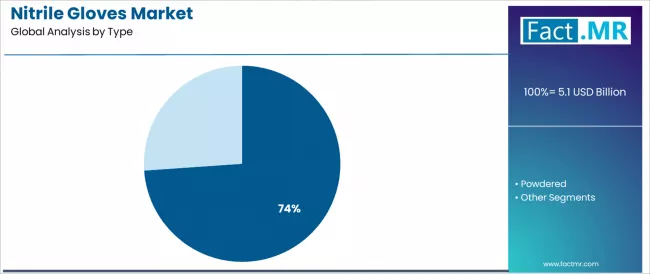
Nitrile Gloves Market Analysis By Type | Source: Fact.MR
Powder free nitrile gloves are projected to account for 73.9% of the nitrile gloves market in 2025, reaffirming its position as the category's dominant type specification. Healthcare professionals increasingly recognize the optimal balance of safety performance and allergen elimination offered by powder-free nitrile gloves for medical examination applications, particularly in surgical procedures and patient care environments with strict contamination controls.
This category addresses both latex allergy prevention requirements and powder-related complications while providing reliable barrier protection across diverse healthcare operations. This segment forms the foundation of most healthcare safety protocols for patient care and surgical applications, as it represents the most clinically appropriate and safety-validated type category in the nitrile gloves industry. Regulatory validation standards and extensive clinical application continue to strengthen confidence in powder-free nitrile glove systems among healthcare professionals and safety officers.
With increasing recognition of powder contamination impact on wound healing and respiratory sensitivity requirements, powder-free nitrile glove technologies align with both current healthcare practices and patient safety evolution goals, making them the central growth driver of comprehensive infection control strategies across multiple healthcare platforms. Powdered gloves represent the remaining market segment, reflecting legacy applications and cost-sensitive industrial uses where powder donning aids provide practical benefits in specific operational environments.
Why is Preference for Disposable Nitrile Gloves Increasing?
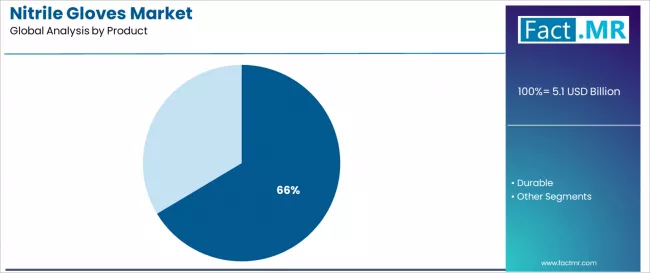
Nitrile Gloves Market Analysis By Product | Source: Fact.MR
Disposable nitrile gloves represent 66.4% of total demand in 2025, underscoring its role as the primary product type driving market adoption and safety protocol deployment. Healthcare facilities recognize that disposable glove requirements, including single-use infection control, cross-contamination prevention, and cost-effective barrier protection, provide the largest addressable market that reusable alternatives cannot match in safety assurance and regulatory compliance.
Disposable nitrile gloves utilized in medical settings offer enhanced contamination prevention characteristics and broad application compatibility essential for serving diverse clinical procedures and patient care requirements. The segment is supported by the expanding nature of global infection control standards, requiring protective products capable of delivering guaranteed sterility, managing infectious disease exposure, and providing single-use safety assurance, and the increasing recognition that disposable glove systems can eliminate reprocessing risks.
Healthcare providers are increasingly adopting single-use protocols that mandate disposable glove utilization for optimal patient safety and regulatory compliance. As understanding of cross-contamination pathways advances and infection prevention standards become more stringent, disposable nitrile glove systems will continue to play a crucial role in comprehensive healthcare safety differentiation strategies.
Durable products represent the remaining 33.6% share, reflecting specialized industrial applications and extended-use requirements in chemical handling and heavy-duty industrial operations requiring thicker gauge construction and enhanced mechanical protection.
Which is the Dominant End Use Segment in the Nitrile Gloves Market?
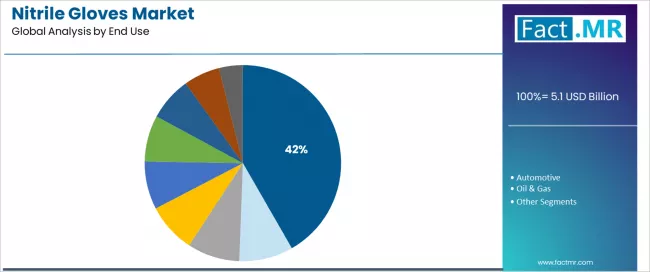
Nitrile Gloves Market Analysis By End Use | Source: Fact.MR
The medical & healthcare end use segment is projected to account for 41.7% of the nitrile gloves market in 2025, establishing its position as the leading application category. Healthcare administrators and clinical professionals increasingly recognize that medical applications, encompassing surgical procedures, patient examinations, and diagnostic testing, represent the most safety-critical and volume-intensive category requiring certified nitrile glove protection due to infection control requirements and patient safety standards.
This end use type addresses both barrier protection demands and regulatory compliance requirements while delivering critical safety outcomes across varied clinical environments. The segment is supported by the continuing nature of healthcare service expansion in global medical systems, driven by aging populations, chronic disease management, and preventive care initiatives requiring consistent barrier protection.
Healthcare facilities are increasingly implementing universal precautions protocols that mandate appropriate glove usage and optimize safety compliance while maintaining clinical effectiveness. As healthcare delivery models evolve and infection prevention becomes more emphasized, medical and healthcare nitrile glove applications will continue to serve a crucial role in ensuring patient safety and healthcare worker protection within global medical systems.
Automotive applications represent 14.8% of end use categories, reflecting assembly line operations, maintenance procedures, and chemical handling requirements. Oil & gas, food & beverage, metal & machinery, chemical & petrochemical, pharmaceutical, cleanroom, and other end uses encompass specialized industrial applications including hazardous material handling, food safety compliance, precision manufacturing, and emerging safety-critical operations requiring reliable barrier protection and chemical resistance characteristics.
What are the Drivers, Restraints, and Key Trends of the Nitrile Gloves Market?
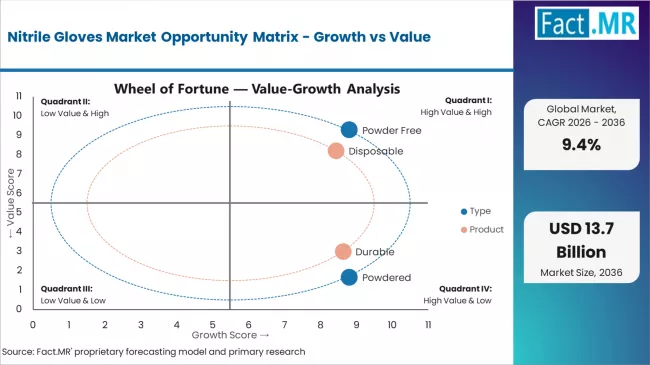
Nitrile Gloves Market Opportunity Matrix Growth Vs Value | Source: Fact.MR
The nitrile gloves market is advancing rapidly due to increasing recognition of infection prevention importance and growing demand for latex-free protective solutions across the healthcare sector.
The market faces challenges, including raw material cost volatility in nitrile butadiene rubber supply, environmental concerns regarding single-use product disposal, and market oversupply conditions following pandemic-driven capacity expansion. Innovation in sustainable materials and advanced manufacturing methodologies continues to influence product development and market expansion patterns.
Proliferation of Infection Prevention Protocols and Universal Precautions
The rising implementation of stringent infection control standards is enabling the development of more comprehensive safety compliance applications and barrier protection protocols that can meet stringent regulatory and clinical requirements.
Healthcare administrators demand advanced nitrile glove integration for safety programs, including standardized sizing systems and comprehensive quality assurance formulations that are particularly important for achieving consistent protection characteristics in complex clinical applications.
Advanced infection prevention frameworks provide mandated demand for certified barrier protection that can optimize healthcare worker safety strategies and prevent pathogen transmission while maintaining clinical functionality for diverse medical procedures.
Integration of Sustainable Manufacturing and Biodegradable Technologies
Modern glove manufacturing organizations are incorporating advanced technologies such as renewable raw material sourcing, biodegradable nitrile formulations, and waste reduction interfaces to enhance environmental sustainability and regulatory compliance.
These systems improve ecological footprint, enable seamless conventional-to-sustainable production transitions, and provide better integration between protective performance and environmental responsibility throughout the product lifecycle.
Advanced sustainability capabilities also enable regulatory compliance optimization and early adoption of circular economy principles or material recovery programs, supporting proactive environmental management and improved corporate sustainability outcomes.
Analysis of the Nitrile Gloves Market by Key Countries
.webp "Top Country Growth Comparison Nitrile Gloves Market Cagr (2026 2036)")
Top Country Growth Comparison Nitrile Gloves Market Cagr (2026 2036) | Source: Fact.MR
| Country | CAGR (2026-2036) |
|---|---|
| India | 11.3% |
| China | 10.8% |
| USA | 8.9% |
| Canada | 8.4% |
| Brazil | 8.1% |
| Germany | 7.7% |
| UK | 7.5% |
Source: Fact.MR analysis. Updated Apr 3, 2026
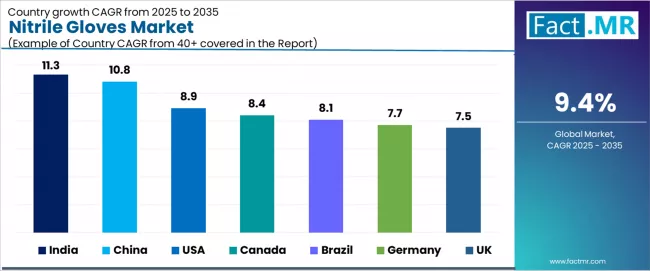
Nitrile Gloves Market Cagr Analysis By Country | Source: Fact.MR
The nitrile gloves market is experiencing exceptional growth globally, with India leading at an 11.3% CAGR through 2036, driven by healthcare infrastructure expansion, growing manufacturing capacity, and comprehensive medical safety standard development across major urban and industrial centers. China follows at 10.8%, supported by massive manufacturing hub status, domestic consumption growth, and comprehensive PPE production modernization initiatives.
USA records 8.9% growth, benefiting from high healthcare consumption and domestic manufacturing investment. Canada demonstrates 8.4% growth, emphasizing increased PPE procurement standards and healthcare preparedness. Brazil shows 8.1% growth with growing healthcare sector and industrial safety expansion. Germany records 7.7% growth, representing strict safety compliance and medical quality standards, while UK shows 7.5% growth, representing rising healthcare awareness and cleanroom application requirements.
How does India Demonstrate Exceptional Market Leadership with Healthcare Expansion?
Revenue from nitrile gloves in India is projected to exhibit exceptional growth with a CAGR of 11.3% through 2036, driven by rapid healthcare infrastructure development and increasing emphasis on medical safety standards as an essential component for public health improvement and industrial growth.
The country's expanding hospital network and growing medical device manufacturing capabilities are creating significant opportunities for nitrile glove deployment across both healthcare facilities and emerging industrial safety segments.
Major international glove manufacturers and domestic producers are establishing production facilities to serve the expanding demand from hospitals and industrial operators requiring safety protection across medical procedures, food processing operations, and industrial applications throughout India's diverse healthcare and manufacturing regions.
The Indian government's strategic emphasis on healthcare access improvement and manufacturing capability development is driving substantial investments in medical supply capabilities and safety product availability. This policy support, combined with the country's enormous population base and growing healthcare awareness, creates a favorable environment for nitrile glove market development. Indian manufacturers are increasingly focusing on domestic production capacity expansion to meet local demand, with advanced nitrile glove systems representing a key component in this healthcare supply capability building.
- Government healthcare initiatives and manufacturing incentive programs are driving demand for nitrile glove solutions across medical and industrial segments
- Hospital expansion and healthcare infrastructure development are supporting appropriate utilization of barrier protection among medical professionals nationwide
- Healthcare facilities and industrial operators are increasingly recognizing infection control importance in safety protocols, creating new consumption capabilities
- Rising healthcare investment and growing awareness of worker protection benefits are accelerating nitrile glove adoption across application categories
What Makes China Demonstrate Strong Market Growth with Manufacturing Leadership?
Revenue from nitrile gloves in China is expanding at a CAGR of 10.8%, supported by the world's largest manufacturing capacity, expanding domestic healthcare consumption, and advancing quality standard integration across the country's developed industrial corridors. The country's massive glove production infrastructure and increasing local market sophistication are driving both export supply and domestic demand for nitrile glove solutions in healthcare and industrial applications. International brands and domestic manufacturers maintain comprehensive production operations to serve global export markets while capturing growing domestic consumption from hospitals and industrial facilities.
China's manufacturing sector continues to benefit from established production infrastructure, expanding automation capabilities, and growing quality consciousness. The country's focus on upgrading manufacturing standards is driving investments in advanced production technologies including automated dipping lines and quality control systems. This development is particularly important for nitrile glove applications, as manufacturers seek competitive cost positions while meeting international quality standards and domestic regulatory requirements.
- Manufacturing scale advantages and production technology advancement are creating cost-competitive nitrile glove solutions
- Growing domestic healthcare consumption and industrial safety modernization are supporting increased deployment of quality barrier protection across application categories
- Expanding quality standards and emerging certification requirements are driving applications of nitrile gloves in medical and cleanroom applications
- Production capacity leadership is enabling global supply chain dominance, supporting market growth and export competitiveness
How does USA Maintain Healthcare Consumption Leadership?
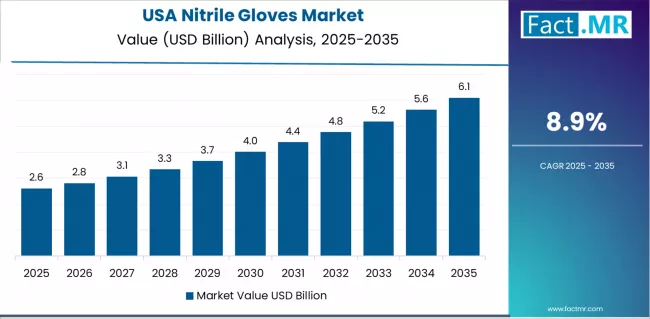
Nitrile Gloves Market Country Value Analysis | Source: Fact.MR
The USA's advanced healthcare market demonstrates sophisticated nitrile glove utilization with documented effectiveness in hospital platforms and industrial safety applications through integration with comprehensive infection control protocols and regulatory compliance frameworks. The country leverages healthcare infrastructure leadership and comprehensive safety culture to maintain an 8.9% CAGR through 2036.
Healthcare facilities, including major hospital systems and ambulatory care centers, showcase extensive nitrile glove implementations where powder-free products integrate with comprehensive hand hygiene programs and ongoing safety training to optimize infection prevention and worker protection.
American healthcare providers prioritize quality assurance and regulatory compliance in medical supply selection, creating demand for premium nitrile glove solutions with proven capabilities, including FDA certification and integration with hospital infection control standards. The market benefits from established healthcare supply chains and willingness to invest in quality protective products that provide superior safety performance and compliance with OSHA requirements and CDC guidelines.
Strategic Market Considerations:
- Medical and industrial segments leading consumption with focus on quality assurance and comprehensive safety compliance applications
- High healthcare expenditure and safety consciousness supporting nitrile glove market development through premium product adoption
- Regulatory standards and infection prevention protocols ensuring consistent product quality and safety optimization
- Domestic manufacturing initiatives and supply chain resilience priorities influencing sourcing strategies and supplier relationships
What Drives Canada Market Growth with Procurement Standards?
Revenue from nitrile gloves in Canada is projected to exhibit strong growth with a CAGR of 8.4% through 2036, driven by enhanced PPE procurement standards and comprehensive healthcare preparedness programs. The country's emphasis on pandemic preparedness and healthcare system resilience is creating sustained opportunities for nitrile glove consumption across both healthcare and industrial applications. Canadian healthcare authorities and procurement agencies are maintaining elevated safety stock levels and standardized procurement protocols.
The Canadian market benefits from established healthcare infrastructure supporting consistent product demand, enabling reliable nitrile glove consumption and comprehensive safety protocol integration. This development is particularly important for nitrile glove applications, as healthcare systems maintain strategic reserves and implement rigorous procurement standards that ensure product availability and quality assurance.
Strategic Market Considerations:
- Healthcare and public sector segments leading consumption with focus on preparedness planning and strategic inventory applications
- Government procurement standards and pandemic preparedness initiatives supporting nitrile glove demand through centralized purchasing
- Healthcare quality requirements and safety culture supporting market stability in Canadian medical sector
- Cold storage considerations and supply chain logistics influencing distribution strategies and inventory management
How does Brazil Drive Latin American Market Development?
Revenue from nitrile gloves in Brazil is projected to exhibit moderate growth with a CAGR of 8.1% through 2036, driven by expanding healthcare sector and growing industrial safety awareness. The country's position as the largest Latin American economy and increasing healthcare infrastructure investment are creating opportunities for nitrile glove adoption across both public health systems and private medical facilities. Brazilian healthcare providers and industrial operators are increasing safety product procurement to meet regulatory requirements and improve worker protection.
The Brazilian market benefits from growing healthcare access supporting medical supply demand, enabling increased nitrile glove consumption and comprehensive safety adoption. This development is particularly important for nitrile glove applications, as healthcare expansion and industrial modernization drive demand for quality barrier protection in medical and manufacturing environments.
Strategic Market Considerations:
- Healthcare expansion and industrial growth segments leading consumption with focus on safety compliance and infection control applications
- Public health programs and workplace safety regulations driving nitrile glove adoption through mandatory protection requirements
- Healthcare infrastructure development and industrial modernization supporting market growth in Latin American sector
- Cost sensitivity and import dependency influencing product selection and supplier strategies
What Drives Germany Market Growth with Safety Compliance?
Revenue from nitrile gloves in Germany is projected to exhibit moderate growth with a CAGR of 7.7% through 2036, driven by strict occupational safety regulations and comprehensive medical quality standards. The country's emphasis on worker protection and healthcare quality assurance is creating sustained demand for certified nitrile glove products across both medical and industrial applications. German healthcare facilities and industrial operators prioritize compliance with stringent safety regulations and product certification requirements.
The German market benefits from rigorous regulatory framework supporting quality product adoption, enabling premium nitrile glove consumption and comprehensive safety compliance. This development is particularly important for nitrile glove applications, as regulations mandate appropriate protective equipment and certified products that meet German and EU safety standards.
Strategic Market Considerations:
- Medical and automotive segments demonstrating stable consumption with emphasis on regulatory compliance and quality assurance applications
- Strict occupational safety regulations and medical device directives influencing nitrile glove specifications and certification requirements
- Quality consciousness and safety culture supporting premium product positioning in German market
- Environmental regulations and sustainability initiatives beginning to influence product selection and waste management practices
How does UK Demonstrate Healthcare Awareness Growth?
Revenue from nitrile gloves in UK is projected to exhibit moderate growth with a CAGR of 7.5% through 2036, driven by rising healthcare infection control awareness and expanding cleanroom application requirements. The country's comprehensive healthcare system and growing pharmaceutical manufacturing sector are creating opportunities for nitrile glove utilization across medical and controlled environment applications. UK healthcare providers and pharmaceutical manufacturers prioritize infection prevention and contamination control through appropriate barrier protection.
The UK market benefits from established healthcare infrastructure supporting consistent product demand, enabling reliable nitrile glove consumption and comprehensive safety protocol integration. This development is particularly relevant for nitrile glove applications, as NHS procurement and pharmaceutical GMP requirements drive demand for certified products meeting stringent quality standards.
Strategic Market Considerations:
- NHS and pharmaceutical segments leading consumption with emphasis on infection control and cleanroom compliance applications
- Healthcare procurement standards and pharmaceutical manufacturing regulations influencing product specifications and supplier qualification
- Safety awareness and professional standards supporting market stability in UK healthcare sector
- Brexit considerations and supply chain adjustments influencing sourcing strategies and inventory management
Europe Market Split by Country
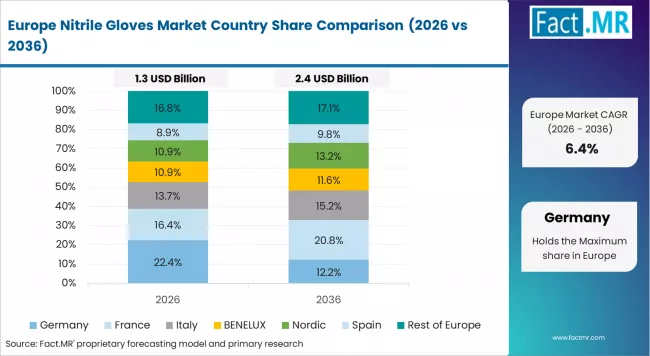
Nitrile Gloves Market Europe Country Market Share Analysis, 2026 & 2036 | Source: Fact.MR
The nitrile gloves market in Europe is projected to grow from USD 1.2 billion in 2026 to USD 2.3 billion by 2036, registering a CAGR of 6.8% over the forecast period. Germany is expected to maintain its leadership position with a 32.4% market share in 2026, rising to 33.8% by 2036, supported by its dominant healthcare infrastructure, comprehensive occupational safety regulations, and advanced manufacturing quality standards throughout major hospital systems and industrial facilities.
France follows with a 23.6% share in 2026, projected to reach 23.2% by 2036, driven by healthcare system sophistication, pharmaceutical manufacturing presence, and established medical supply distribution serving both domestic and European markets. The UK holds a 21.7% share in 2026, expected to decrease to 20.4% by 2036, reflecting post-Brexit supply chain adjustments. Italy commands a 13.8% share in 2026, projected to reach 13.6% by 2036, while Spain accounts for 6.2% in 2026, expected to reach 6.4% by 2036.
The rest of Europe region, including Nordic countries with advanced healthcare standards, Eastern European emerging medical markets, and smaller Western European healthcare systems, is anticipated to hold 2.3% in 2026, increasing slightly to 2.6% by 2036, attributed to healthcare infrastructure development in select markets with expanding safety requirements and nitrile glove adoption.
Competitive Landscape of the Nitrile Gloves Market
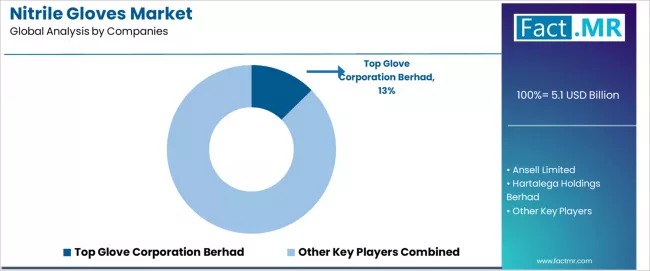
Nitrile Gloves Market Analysis By Company | Source: Fact.MR
The nitrile gloves market is characterized by intense competition among established glove manufacturers, specialized medical supply companies, and comprehensive personal protective equipment organizations focused on delivering high-quality, reliable, and certified nitrile glove products.
Companies are investing in production capacity expansion programs, advanced manufacturing automation, strategic healthcare distribution partnerships, and comprehensive quality certification initiatives to deliver effective, consistent, and compliant barrier protection solutions that meet stringent healthcare standards and safety expectations. Product quality assurance, regulatory compliance, and supply chain reliability strategies are central to strengthening product portfolios and market presence.
Top Glove Corporation Berhad leads the market with a 12.6% market share, offering comprehensive nitrile glove solutions with a focus on manufacturing scale expertise and global distribution capabilities for diverse medical and industrial applications. Ansell Ltd provides specialized protective solutions platforms with emphasis on healthcare and industrial segments and comprehensive safety product portfolios across global markets.
Hartalega Holdings Berhad focuses on innovative nitrile glove manufacturing and advanced production technology serving international healthcare communities. Unigloves (UK) Limited delivers European distribution excellence with strong healthcare facility relationships and regional market integration.
Adenna LLC (Hospeco Brands Group) operates with a focus on North American medical supply and comprehensive glove product portfolios for healthcare and industrial applications. Kossan Rubber Industries Bhd provides Malaysian manufacturing leadership emphasizing production capacity and export market integration. Superior Glove specializes in industrial and specialty glove solutions with emphasis on diverse application requirements.
MCR Safety delivers comprehensive safety product distribution to enhance market accessibility and provide integrated protective equipment offerings. Supermax Corporation Berhad, Ammex Corporation, Cardinal Health, Medline Industries, LP, Globus, Atlantic Safety Products, and MAPA Professional focus on regional manufacturing capabilities, healthcare distribution networks, and specialized application solutions, emphasizing product quality and comprehensive safety protocols through dedicated nitrile glove strategies.
Key Players in the Nitrile Gloves Market
- Top Glove Corporation Berhad
- Ansell Limited
- Hartalega Holdings Berhad
- Unigloves (UK) Limited
- Adenna LLC (Hospeco Brands Group)
- Kossan Rubber Industries Berhad
- Superior Glove Works Limited
- MCR Safety
- Supermax Corporation Berhad
- Ammex Corporation
- Cardinal Health, Inc.
- Medline Industries, LP
- Globus Group
- Atlantic Safety Products, Inc.
- MAPA Professional
Bibliography
- U.S. Food and Drug Administration. (2024). Banned devices: Powdered surgeon's and patient examination gloves. FDA.
- Malaysian Rubber Glove Manufacturers Association. (2025). MARGMA annual industry report: Production and export statistics. MARGMA.
- Occupational Safety and Health Administration. (2025). Personal protective equipment standards: Hand protection compliance guidance. OSHA.
- European Commission. (2024). Medical Device Regulation (EU) 2017/745: Examination glove classification guidance. EC.
- World Health Organization. (2024). Infection prevention and control: Global hand hygiene and glove use guidelines. WHO.
- This bibliography is provided for reader reference. The full Fact.MR report contains the complete reference list with primary research documentation.
This Report Addresses
- Market sizing and quantitative forecast metrics detailing nitrile glove expenditure across global healthcare, food processing, and industrial sectors through 2036.
- Segmentation analysis mapping procurement velocity across powder-free and powdered types, disposable and durable formats, and nine end-use categories.
- Country-level deployment intelligence comparing healthcare spending, food safety regulation enforcement, and industrial safety compliance across India, China, USA, Canada, Brazil, Germany, and UK.
- Manufacturing capacity assessment evaluating production scale, automation investment, and cost efficiency among Malaysian and global nitrile glove manufacturers.
- Competitive posture evaluation tracking production volume, unit cost positioning, and distribution network reach among leading glove suppliers.
- Regulatory compliance assessment identifying medical device classification requirements, powdered glove restrictions, and workplace safety mandates across covered markets.
- Custom data delivery formats encompassing interactive dashboards, raw Excel datasets, and comprehensive PDF narrative reports.
Nitrile Gloves Market Definition
Nitrile gloves are hand protection products manufactured from synthetic acrylonitrile butadiene rubber through a dipping and curing process. Available in powder-free and powdered variants, these gloves provide chemical resistance, puncture resistance, and latex-free allergen safety for medical examination, surgical, food handling, pharmaceutical, and industrial applications. The market covers manufacture, distribution, and sale of nitrile gloves globally.
Nitrile Gloves Market Inclusions
Market scope includes powder-free and powdered nitrile gloves in disposable and durable formats. End-use coverage spans medical and healthcare, automotive, oil and gas, food and beverage, metal and machinery, chemical and petrochemical, pharmaceutical, cleanroom, and other industrial applications. Country coverage spans India, China, USA, Canada, Brazil, Germany, and UK. Forecast covers 2026 to 2036 with base year 2025.
Nitrile Gloves Market Exclusions
Natural rubber latex gloves, vinyl (PVC) gloves, neoprene gloves, reusable heavy-duty chemical resistant gloves, and cut-resistant textile gloves are excluded. Glove manufacturing machinery and raw acrylonitrile butadiene rubber supply fall outside the scope.
Nitrile Gloves Market Research Methodology
- Primary Research: Analysts engaged with hospital procurement directors, food processing plant safety managers, and industrial PPE distribution executives to map purchasing cycles, specification requirements, and supplier selection criteria.
- Desk Research: Data collection phases aggregated FDA medical device clearance records, EU MDR classification data, OSHA workplace safety compliance statistics, and Malaysian Rubber Glove Manufacturers Association production reports.
- Market-Sizing and Forecasting: Baseline values derive from a bottom-up aggregation of nitrile glove shipment volumes by type and end-use sector, applying healthcare spending indices and industrial workplace safety adoption rates to project demand velocity.
- Data Validation and Update Cycle: Projections are tested against publicly reported glove production data from the Malaysian Rubber Glove Manufacturers Association and medical device procurement statistics from national healthcare systems.
Segmentation
Scope of the Report
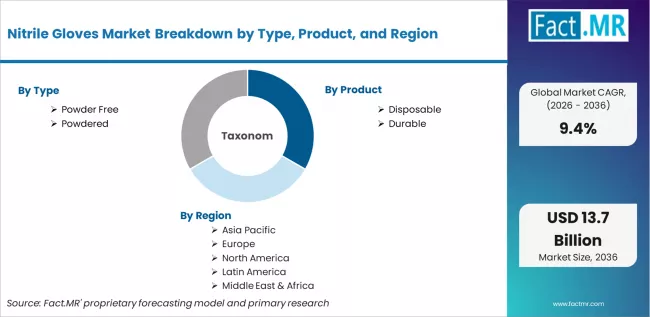
Nitrile Gloves Market Breakdown By Type, Product, And Region | Source: Fact.MR
| Metric | Value |
|---|---|
| Quantitative Units | USD 5.58 billion to USD 13.70 billion, at a CAGR of 9.40% |
| Market Definition | Nitrile gloves encompass powder-free and powdered synthetic rubber hand protection products in disposable and durable formats for medical, food processing, pharmaceutical, cleanroom, and industrial applications distributed globally. |
| Type Segmentation | Powder Free, Powdered |
| Product Segmentation | Disposable, Durable |
| End Use Segmentation | Medical & Healthcare, Automotive, Oil & Gas, Food & Beverage, Metal & Machinery, Chemical & Petrochemical, Pharmaceutical, Cleanroom, Others |
| Regions Covered | India, China, USA, Canada, Brazil, Germany, UK |
| Key Companies Profiled | Top Glove Corporation Berhad, Ansell Limited, Hartalega Holdings Berhad, Unigloves (UK) Limited, Adenna LLC (Hospeco Brands Group), Kossan Rubber Industries Berhad, Superior Glove Works Limited, MCR Safety, Supermax Corporation Berhad, Ammex Corporation, Cardinal Health, Inc., Medline Industries, LP, Globus Group, Atlantic Safety Products, Inc., MAPA Professional |
| Forecast Period | 2026 to 2036 |
| Approach | Forecasting models apply a bottom-up methodology starting with global nitrile glove production shipment data and end-use consumption indices, cross-validated against healthcare procurement records and industrial safety equipment expenditure reports. |
Source: Fact.MR analysis. Updated Apr 3, 2026
Nitrile Gloves Market by Segments
-
Type :
- Powder Free
- Powdered
-
Product :
- Disposable
- Durable
-
End Use :
- Medical & Healthcare
- Automotive
- Oil & Gas
- Food & Beverage
- Metal & Machinery
- Chemical & Petrochemical
- Pharmaceutical
- Cleanroom
- Others
-
Region :
-
North America
- United States
- Canada
- Mexico
-
Europe
- Germany
- France
- United Kingdom
- Italy
- Spain
- Nordic
- BENELUX
- Rest of Europe
-
Asia Pacific
- China
- India
- Japan
- South Korea
- ASEAN
- Australia & New Zealand
- Rest of Asia Pacific
-
Latin America
- Brazil
- Argentina
- Chile
- Rest of Latin America
-
Middle East & Africa
- Kingdom of Saudi Arabia
- Other GCC Countries
- Turkey
- South Africa
- Other African Countries
- Rest of Middle East & Africa
-
Frequently Asked Questions
How large is the nitrile gloves market in 2026?
What will be the market size by 2036?
What is the expected demand growth between 2026 and 2036?
Which Type leads the market in 2026?
Which End Use commands the largest share?
Which country is the fastest-growing market?
What is included in the scope?
What is excluded?
Who worked on this report


Preview the report firsthand - request a free sample
Free SampleGet the brochure for pricing and purchase details
Download PDF