- Market Value (2025): USD 2.5 Bn
- Estimated Value (2026): USD 2.7 Bn
- Forecast Value (2036): USD 5.9 Bn
- CAGR (2026-2036): 8.2%
What is the Non-BPA Internal Coatings Market forecast to be worth by 2036?
USD 2.7 billion in 2026 to USD 5.9 billion by 2036, at 8.2% CAGR.
- The Non-BPA Internal Coatings Market reached USD 2.5 billion in 2025.
- Demand is expected to increase from USD 2.7 billion in 2026 to USD 5.9 billion by 2036.
- The market is forecast to record an 8.2% CAGR from 2026 to 2036 as canmakers and coating makers qualify non-BPA chemistries for food, beverage and specialty container interiors.
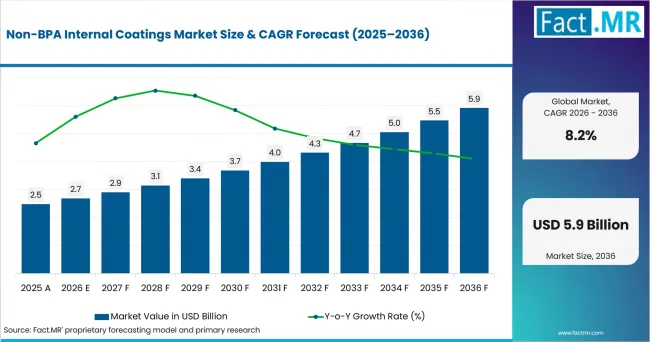
Non Bpa Internal Coatings Market Value Analysis | Source: Fact.MR
What are the defining numbers behind Non-BPA Internal Coatings Market growth?
USD 3.2 billion absolute opportunity by 2036, led by polyester coatings, beverage cans and corrosion-resistant internal protection.
- Demand Drivers in the Market
- Beverage canmakers need internal films that resist acidic and carbonated products while preserving taste. Resin selection is expected to balance corrosion control with high-speed canmaking and flavor performance across beverage fills.
- Food-can producers need coatings that withstand retort heat and aggressive food chemistries. Destatis reported in January 2026 that Germany produced 1.7 million tonnes of ready meals in 2024, highlighting the scale of the country’s processed-food industry. In canned-food applications, internal can barriers require strong barrier performance and resistance to filling and thermal-processing conditions.
- Brand owners need compliant food-contact systems as bisphenol rules tighten. European Commission guidance on Regulation (EU) 2024/3190 states that final food-contact articles complying with the previous rules may generally be first placed on the EU market until 20 July 2026, with specific transitional exceptions allowing certain products to be first placed on the market until 20 January 2028.
- Key Segments Analyzed
- By Resin Platform: Polyester is expected to hold 35.0% share in 2026. Its balance of flexibility, adhesion and chemical resistance fits several can and closure formats.
- By Container: Beverage can is expected to hold 37.0% share in 2026 owing to large coating area needs and strict flavor, corrosion and line-speed performance needs.
- By Product Contact: Acidic beverage is forecast to capture 33.0% share in 2026 as low-pH fills place sustained demands on barrier integrity and flavor neutrality.
- By Performance: Corrosion resistance is expected to hold 29.0% share in 2026. Preventing metal exposure remains a core function of the internal film during shelf life.
- Analyst Opinion at Fact.MR
- Shambhu Nath Jha, Principal Consultant at Fact.MR, states, “Canmakers need a coating to pass food-contact needs and run on existing equipment without creating new corrosion or flavor risks. Suppliers that combine application support with documented retort, migration and pack-performance data are expected to gain broader testing across beverage and food formats.”
- Strategic Implications
- Coating makers should build use-specific testing packages for acidic beverages and retorted foods while fatty products receive separate checks instead of one generic non-BPA claim.
- Canmakers should align resin selection with substrate, forming method and thermal process. The internal film must survive fabrication before it protects the final pack.
- Brand owners should require sensory and migration records alongside corrosion results so chemistry changes preserve flavor and food-contact compliance.
- Rule teams should map dates by country and pack type so product approvals follow the correct food-contact framework. Separate review paths across major markets can reduce rework when the same coating family is offered internationally.
The UK is forecast to record 8.4% CAGR through 2036 as bisphenol policy work increases testing work. Japan is projected at 8.0% as food and beverage packaging remains a broad use base. The USA is expected to post 7.7% owing to packaged-food scale and established non-BPA coating availability. Germany is estimated at 7.4% as EU bisphenol rules reshape internal coating review. France is forecast at 7.1% as food-contact needs reshape coating design.
How does the Non-BPA Internal Coatings Market break down by segment?
Beverage can leads Container at 37.0%; Polyester leads Resin Platform at 35.0%.
Which Resin Platform dominates?
Polyester is expected to hold 35.0% share in 2026.
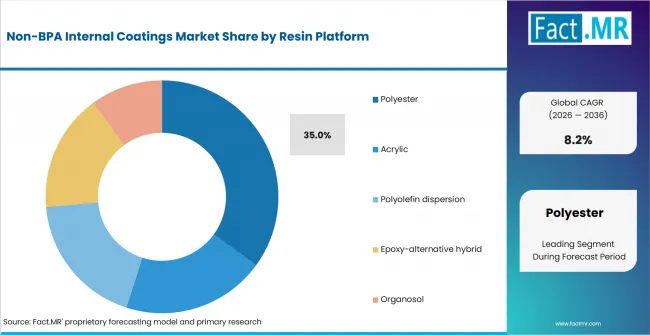
Non Bpa Internal Coatings Market Analysis By Resin Platform | Source: Fact.MR
Polyester is expected to lead Resin Platform at 35.0% share because it offers flexibility and chemical resistance across formed metal packs. Acrylic systems suit low-film-weight and waterborne uses while polyolefin dispersions offer another non-BPA barrier route. Epoxy-alternative hybrids and organosols address specialized forming or food-contact conditions. Sherwin-Williams lists non-BPA polyester and acrylic platforms within its current valPure packaging portfolio, confirming commercial availability across several resin families.
What leads the Container segment?
Beverage can is expected to hold 37.0% share in 2026.
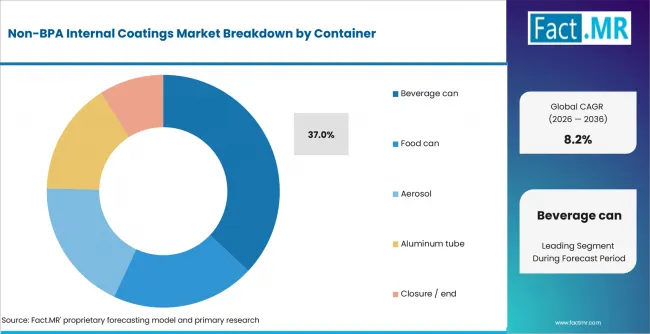
Non Bpa Internal Coatings Market Analysis By Container | Source: Fact.MR
Beverage cans are projected to account for 37.0% share owing to the large internal area exposed to carbonated and acidic fills. Food cans require retort durability for sterilization and long shelf life while aerosols and aluminum tubes need films that tolerate forming and product contact. Destatis reported in February 2026 that Germany produced 7.7 billion liters of sugar-containing soft drinks in 2024, highlighting the scale of the country’s beverage-processing sector. High-volume beverage applications support demand for packaging systems that maintain product protection and coating performance.
How does Product Contact shape demand?
Acidic beverage is forecast to capture 33.0% share in 2026.
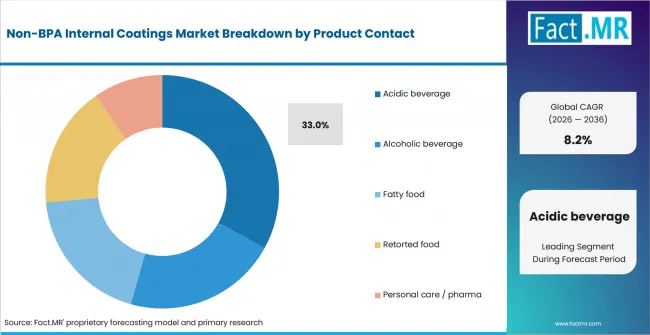
Non Bpa Internal Coatings Market Analysis By Product Contact | Source: Fact.MR
Acidic beverages are forecast to capture 33.0% share because low-pH products place sustained chemical stress on the internal film. Alcoholic beverages place extra weight on flavor neutrality while fatty and retorted foods require fit checks under heat and storage. Product-contact chemistry so remains central to coating selection across package formats.
What supports Corrosion Resistance within Performance?
Corrosion resistance is expected to hold 29.0% share in 2026.
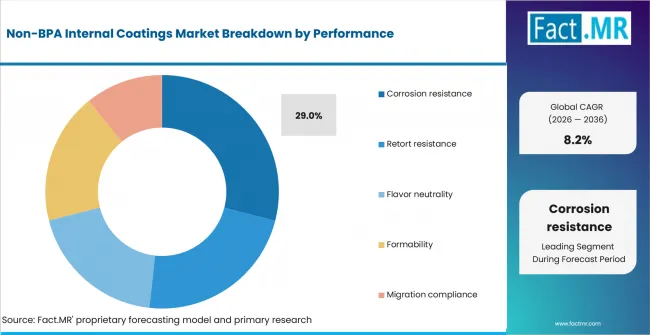
Non Bpa Internal Coatings Market Analysis By Performance | Source: Fact.MR
Corrosion resistance is expected to hold 29.0% share. The internal film must isolate the packed product from aluminum or steel throughout shelf life. Thermally processed food cans require retort resistance while beverage uses place more weight on flavor neutrality. Drawn cans and ends need formability so the film remains intact after shaping. Current coating portfolios so balance barrier strength with production flexibility.
What is accelerating Non-BPA Internal Coatings Market adoption, and what is holding it back?
Bisphenol restrictions drive substitution; testing complexity restrains conversion speed.
Drivers Impact Analysis
| Driver | (~) % Impact on CAGR | Geographic Relevance | Impact Timeline |
|---|---|---|---|
| EU and UK bisphenol restrictions | +1.5% | Europe | Short term (<= 2 years) |
| Beverage-can chemistry conversion | +1.2% | Global | Short term (<= 2 years) |
| Processed-food and retort packaging demand | +0.9% | North America, Europe, East Asia | Medium term (2-4 years) |
| Metal-packaging recycling economics | +0.6% | Europe, Japan | Medium term (2-4 years) |
| Broader non-BPA resin qualification | +0.5% | Global | Long term (>= 4 years) |
Opportunity Impact Analysis
| Opportunity | (~) % Impact on CAGR | Geographic Relevance | Impact Timeline |
|---|---|---|---|
| Retort-capable food-can systems | +0.8% | Europe, North America | Medium term (2-4 years) |
| Low-film-weight beverage coatings | +0.7% | Global | Short term (<= 2 years) |
| BPA-NI closure and end coatings | +0.6% | Europe, Asia | Medium term (2-4 years) |
| Multi-region compliance platforms | +0.4% | Global | Long term (>= 4 years) |
Restraints Impact Analysis
| Restraint | (~) % Impact on CAGR | Geographic Relevance | Impact Timeline |
|---|---|---|---|
| Long pack-testing and qualification cycles | -0.7% | Global | Short term (<= 2 years) |
| Different regional BPA rules | -0.5% | North America, Europe | Medium term (2-4 years) |
| Performance trade-offs by fill type | -0.4% | Global | Medium term (2-4 years) |
| Conversion cost and line tuning | -0.3% | Global | Long term (>= 4 years) |
Which countries are scaling the Non-BPA Internal Coatings Market through 2036?
- The country comparison spans 1.3 percentage points and forms a narrow set of growth bands across the forecast period.
- The UK remains 0.4 percentage point above Japan as bisphenol policy work advances coating testing.
- Japan remains 0.3 percentage point above the USA as established food and beverage packaging supports internal coating demand.
- The USA remains 0.3 percentage point above Germany through packaged-food scale and broad non-BPA coating availability.
- Germany remains 0.3 percentage point above France as EU bisphenol rules affect canmakers and food processors.
- France closes the displayed range as food-contact rules and packaging recovery priorities influence coating design.
Comparable CAGRs can create different entry conditions due to food-contact rules, canmaking capacity, packaged-food activity and coating testing cycles. Full report coverage includes North America, Latin America, Western Europe, Eastern Europe, East Asia, South Asia & Pacific, Middle East & Africa.
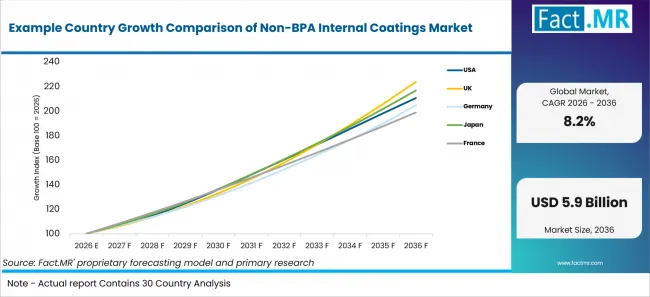
Example Country Growth Comparison Of Non Bpa Internal Coatings Market | Source: Fact.MR
| Country | CAGR (2026-2036) |
|---|---|
| United Kingdom | 8.4% |
| Japan | 8.0% |
| United States | 7.7% |
| Germany | 7.4% |
| France | 7.1% |
What supports United Kingdom adoption?
8.4% CAGR, supported by bisphenol policy work and food-production activity.
The United Kingdom is forecast to record 8.4% CAGR as food-contact policy work increases the need for coating review and pack testing. In October 2025, the Food Standards Agency opened a consultation on implementing a ban on BPA, other bisphenols, and bisphenol derivatives in food-contact materials. The policy process gives canmakers and coating makers a clear reason to align migration records with corrosion and retort testing during chemistry conversion.
How is Japan scaling demand?
8.0% CAGR, shaped by established packaged-food use and national packaging systems.
Japan is expected to post 8.0% CAGR as metal containers remain established across food and beverage uses. In March 2026, Japan’s Ministry of the Environment reported that 1,740 municipalities had prepared five-year sorted-collection plans for packaging waste beginning in FY2026. That nationwide planning framework keeps packaging materials under close review and supports coating systems that meet food-contact needs while fitting established metal-package recovery routes.
What supports USA adoption?
7.7% CAGR, supported by packaged-food scale and established non-BPA coating availability.
The United States is expected to record 7.7% CAGR. Large food-at-home activity supports a wide range of metal-package uses. The USDA Economic Research Service reported in June 2026 that inflation-adjusted U.S. food-at-home expenditures reached USD 1.10 trillion in 2025. Canmakers serving this base need internal films that preserve taste and resist corrosion across varied product chemistries without disrupting established filling and forming operations.
What is supporting Germany’s adoption?
7.4% CAGR, driven by EU food-contact rules and metal-packaging recovery activity.
Germany is expected to advance at 7.4% CAGR as EU bisphenol rules increase attention to internal can chemistry and pack validation. The German Environment Agency and Central Agency Packaging Register reported in January 2026 that about 5.5 million tonnes of dual-system packaging were recycled in 2024. The scale of the recovery system reinforces demand for coating choices that preserve metal-package performance while fitting broader recycling and rule needs.
How does France perform?
7.1% CAGR, supported by EU food-contact rules and packaging recovery priorities.
France is forecast to record 7.1% CAGR as canmakers and food brands adapt internal coating design to EU bisphenol rules. ADEME reported in April 2026 that about 4,893 kt of household packaging and graphic papers were sorted for recycling in 2024. The established recovery framework gives packaging teams a clear reason to pair compliant internal coatings with metal formats that can remain functional through filling, storage and end-of-life collection.
Who leads the Non-BPA Internal Coatings Market?
PPG Industries, AkzoNobel, Sherwin-Williams, ACTEGA and Henkel are profiled active providers in non-BPA or closely related can-coating systems.
PPG Industries has direct internal-can coverage through its INNOVEL and NUTRISHIELD coating families. In November 2025, AkzoNobel announced that it would introduce its Accelshield BPAni beverage-can coatings to the Brazilian market at Abralatas 2025. Sherwin-Williams maintains valPure non-BPA technologies across food cans, beverage cans, ends, closures, and other light-metal packaging applications. Across these portfolios, food-contact compliance, corrosion resistance, pack compatibility, and reliable application on production lines are important performance requirements.
ACTEGA and Henkel complete the profiled provider set with coatings, sealants, and related surface technologies for cans and closures. ACTEGA supplies internal coatings and other metal-packaging materials for food and beverage applications, while Henkel provides internal and external coatings, surface treatments, and food-safe sealants for metal packaging. Supplier portfolios therefore compete across regulatory compliance, pack performance, coating-process compatibility, and consistent production-line performance.
Which companies are the key providers?
Key companies include PPG Industries, AkzoNobel, Sherwin-Williams, ACTEGA and Henkel.
- PPG Industries
- AkzoNobel
- Sherwin-Williams
- ACTEGA
- Henkel
Bibliography
- PPG. (2025, July 21). PPG adds BPA-NI beverage can end coatings to PPG INNOVEL and PPG iSENSE series.
- AkzoNobel Packaging Coatings. (2025, November 4). AkzoNobel introduces next-generation BPAni coatings to Brazilian beverage market at Abralatas 2025.
- European Commission. (2025, December 17). Note for guidance on the implementation of Commission Regulation (EU) 2024/3190 on the use of bisphenol A (BPA) and other bisphenols and bisphenol derivatives with harmonised classification for specific hazardous properties in certain materials and articles intended to come into contact with food (C/2025/6721).
- Sherwin-Williams. (2025, April 16). Discovering a new epoxy coating - How valPure® V70 changed the game [Video].
- Zeballos, E., & Sinclair, W. (2026, June 11). Total U.S. food spending reached $2.51 trillion in 2025. U.S. Department of Agriculture, Economic Research Service.
- Food Standards Agency. (2025, October 2). Consultation on the proposal to implement a ban on the use of bisphenol A (BPA) other bisphenols and bisphenol derivatives in food contact materials.
- Department for Environment, Food & Rural Affairs. (2026, September 23). UK statistics on waste.
- German Environment Agency, & Central Agency Packaging Register. (2026, January 27). Facts against myths: Packaging waste recycling in Germany is working.
- Statistisches Bundesamt (Destatis). (2026, January 14). Produktion von Fertiggerichten binnen fünf Jahren mengenmäßig um 25,6 % gestiegen [Production of ready meals increased by 25.6% in volume within five years].
- Statistisches Bundesamt (Destatis). (2026, February 12). 93 Liter zuckerhaltige Erfrischungsgetränke 2024 pro Kopf produziert [93 litres of sugar-containing soft drinks produced per capita in 2024].
- Van de Voorde, J., & Parisot, F. (2026, March). Emballages ménagers et papiers graphiques : données 2024. ADEME.
This Report Answers
- The report explains where non-BPA internal coatings are used across resin platform and container type. It also covers product-contact needs and performance criteria.
- Segment analysis identifies the leading resin, container, product-contact and performance subsegments and explains the operating reasons behind their 2026 shares.
- Country analysis compares the listed markets and the rule, production or packaging-system conditions supporting coating conversion.
- Competitive analysis reviews active providers across non-BPA can coatings and adjacent metal-packaging coating systems.
- Application analysis assesses how corrosion, retort exposure, flavor neutrality and forming needs influence internal coating selection.
What does the Non-BPA Internal Coatings Market cover?
Polyester, acrylic, polyolefin dispersion, epoxy-alternative hybrid and organosol internal coatings used on metal packages.
The Non-BPA Internal Coatings Market covers protective films applied inside beverage cans, food cans, aerosols, aluminum tubes and closures or ends where the formulation is designed without intentionally added BPA. Selection depends on corrosion protection, retort resistance, flavor neutrality, formability and migration compliance for the package and fill.
What is included in the scope?
Non-BPA internal coating systems used on metal cans, ends, closures, aerosols and aluminum tubes.
The scope includes polyester, acrylic, polyolefin dispersion, epoxy-alternative hybrid and organosol chemistries used on internal metal-package surfaces. It covers beverage cans, food cans, aerosols, aluminum tubes and closures or ends. Product-contact analysis spans beverages, foods, and selected personal-care or pharmaceutical fills. Performance coverage includes corrosion resistance, retort durability, flavor neutrality, formability and migration compliance.
What is excluded from the scope?
External decorative coatings, printing inks, can-label adhesives and raw metal substrates are outside the scope.
External overprint varnishes and decorative inks are excluded unless an internal layer is separately analyzed. Can-label adhesives, seam sealants, paper barrier coatings and metal pretreatments fall outside the core market. Conventional BPA-based epoxy systems are excluded from sizing except as the incumbent technology being replaced during testing and conversion. Related packaging adhesives analysis provides adjacent market context.
How Was the Analysis Built?
The analysis draws on 120+ sources, 35+ company portfolios, 25+ countries, and more than 20 industry interviews.
- Primary Research: Primary research includes discussions with manufacturers, service providers, technology developers, distributors, end users, and subject-matter experts. These conversations examine purchasing priorities, product adoption, operational challenges, approval requirements, competitive positioning, and the factors that influence wider market acceptance.
- Desk Research: Desk research covers government statistics, regulatory publications, company filings, trade data, technical studies, industry associations, standards, public policy, and other authoritative sources. Every source used in the analysis is documented in the bibliography.
- Market Sizing and Forecasting: Market estimates combine historical performance, demand indicators, pricing and volume trends, segment shares, company participation, country-level growth, adoption patterns, investment activity, and barriers to market expansion.
- Data Validation and Update Cycle: Findings are validated by comparing primary interviews with public data, company activity, regulatory changes, trade patterns, and industry developments. Regular updates review new product launches, capacity changes, partnerships, approvals, and shifts in commercial adoption.
What is the report’s scope and coverage?
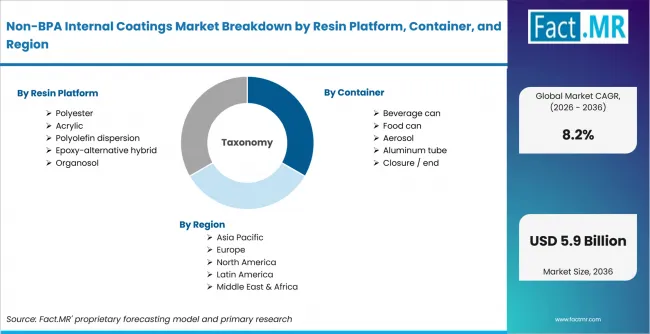
Non Bpa Internal Coatings Market Breakdown By Resin Platform, Container, And Region | Source: Fact.MR
| Attribute | Details |
|---|---|
| Quantitative Units | USD Billion |
| Market Definition | Internal protective coatings formulated without intentionally added bisphenol A for metal cans, ends, closures and tubes used with food, beverages and selected personal-care or pharmaceutical contents. |
| Resin Platform | Polyester; Acrylic; Polyolefin dispersion; Epoxy-alternative hybrid; Organosol |
| Container | Beverage can; Food can; Aerosol; Aluminum tube; Closure / end |
| Product Contact | Acidic beverage; Alcoholic beverage; Fatty food; Retorted food; Personal care / pharma |
| Performance | Corrosion resistance; Retort resistance; Flavor neutrality; Formability; Migration compliance |
| Regions Covered | North America; Latin America; Western Europe; Eastern Europe; East Asia; South Asia & Pacific; Middle East & Africa |
| Countries Covered | United States; United Kingdom; Germany; Japan; France |
| Key Companies Profiled | PPG Industries; AkzoNobel; Sherwin-Williams; ACTEGA; Henkel |
| Forecast Period | 2026 to 2036 |
| Approach | Hybrid top-down and bottom-up approach using metal-packaging demand, coating replacement cycles, food-contact regulation, resin qualification, container mix and provider portfolio review. |
How is the market segmented?
-
By Resin Platform:
- Polyester
- Acrylic
- Polyolefin dispersion
- Epoxy-alternative hybrid
- Organosol
-
By Container:
- Beverage can
- Food can
- Aerosol
- Aluminum tube
- Closure / end
-
By Product Contact:
- Acidic beverage
- Alcoholic beverage
- Fatty food
- Retorted food
- Personal care / pharma
-
By Performance:
- Corrosion resistance
- Retort resistance
- Flavor neutrality
- Formability
- Migration compliance
-
By Region:
- North America
- Latin America
- Western Europe
- Eastern Europe
- East Asia
- South Asia & Pacific
- Middle East & Africa