- Base Value(2025): 132.4 Bn
- Estimated Value(2026): 141.3 Bn
- Forecast Value (2036): 270.2 Bn
- CAGR (2026 - 2036): 6.7%
Ready-to-Drink Packaging Market Analysis and Forecast by Fact.MR
- The global market for ready-to-drink packaging is estimated to be around US$ 141.3 billion in 2026 and has been forecast to expand at a CAGR of 6.7% to end up at US$ 270.2 billion by 2036.
- Ready-to-drink packaging covers bottles, cans, cartons, pouches, and cups used for beverages that require no preparation before consumption.
- Materials include PET, HDPE, glass, aluminum, and multi-layer laminates with barrier properties suited to carbonated, ambient, and chilled distribution.
- Growth reflects rising packaged beverage consumption across urban populations, the expansion of on-the-go consumption formats, tighter recyclability mandates driving material innovation, and increasing private label penetration in retail channels that demands flexible, cost-effective packaging solutions at scale.
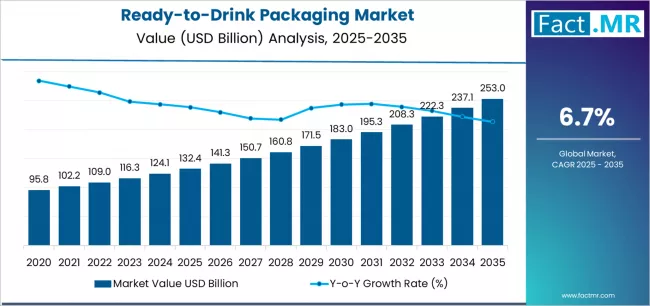
Ready To Drink Packaging Market Market Value Analysis | Source: Fact.MR
Summary of Ready-to-Drink Packaging Market
- Market Snapshot
- In 2025, the global Ready-to-Drink Packaging Market was valued at approximately USD 132.4 billion.
- The market is estimated to reach USD 141.3 billion in 2026 and is projected to attain USD 270.2 billion by 2036.
- The ready-to-drink packaging market is likely to expand at a CAGR of 6.7% during the forecast period.
- The market is anticipated to create an absolute dollar opportunity of USD 128.9 billion between 2026 and 2036.
- Bottles accounts for 40% of packaging type share in 2026.
- China (7.1%) and India (6.8%) are the key growth markets during the forecast period.
- Demand and Growth Drivers
- Accelerating consumption of packaged beverages across urban populations in Asia Pacific and Latin America is expanding volume demand for bottles, cans, and cartons.
- Tightening recyclability and extended producer responsibility regulations in Europe and North America are driving material substitution toward mono-material and recyclable packaging formats.
- Rising penetration of private label beverages in organized retail is increasing demand for cost-effective, high-speed packaging lines with flexible format capabilities.
- Growth in functional, health-oriented, and plant-based beverages is creating demand for specialized barrier packaging that preserves sensitive formulations across ambient distribution.
- Expansion of e-commerce and direct-to-consumer beverage delivery is raising requirements for packaging durability, secondary protection, and lightweight shipping formats.
- Product and Segment View
- Bottles account for 40% of packaging type share in 2026, supported by consistent demand across primary end-use applications.
- Plastic accounts for 45% of material type share in 2026, supported by consistent demand across primary end-use applications.
- Screw Caps account for 50% of closure type share in 2026, supported by consistent demand across primary end-use applications.
- Key segmentation includes:
- Packaging Type: Bottles, Metal Cans, Cartons, Pouches
- Material Type: Plastic, Glass, Metal, Paperboard
- Closure Type: Screw Caps, Pull Tabs and Easy Open Ends, Spouts and Fitments
- Application: Non-alcoholic Beverages, Alcoholic Beverages, Functional Beverages, Ready-to-Drink Tea and Coffee
- These systems enable:
- Protection of beverage quality through barrier properties, UV shielding, and tamper evidence
- High-speed filling, sealing, and labeling across multiple packaging formats and materials
- Extended shelf life and distribution versatility across ambient, chilled, and frozen supply chains
- Geography and Competitive Outlook
- Asia Pacific leads growth with China at 7.1%, India at 6.8%, Japan at 6.5%, supported by expanding industrial capacity and infrastructure investment.
- North America shows steady demand with Brazil at 6.3%, USA at 6.2%, reflecting established end-use markets and replacement-led procurement.
- Europe maintains stable growth with UK at 6%, Germany at 5.9%, supported by regulatory compliance requirements and technology upgrades.
- China (7.1%) and India (6.8%) are the key growth markets, reflecting strong investment activity and expanding addressable demand.
- Leading participants include Amcor plc, Ball Corporation, Tetra Pak International S.A., Berry Global, Inc., ALPLA Werke Alwin Lehner GmbH & Co KG, WestRock Company.
- Analyst Opinion
- Shambhu Nath Jha, Principal Consultant at Fact.MR, says 'The ready-to-drink packaging market is being reshaped by two forces: regulatory pressure on recyclability and the rapid diversification of beverage categories. Packaging buyers are moving away from multi-material laminates toward mono-material solutions that meet extended producer responsibility targets without sacrificing shelf life. At the same time, the growth of functional and plant-based beverages is creating demand for formats that protect sensitive ingredients. Companies that can offer flexible, high-speed packaging with strong barrier performance and a credible sustainability profile are best positioned to capture volume across both established and emerging beverage categories.'
Key Growth Drivers, Constraints, and Opportunities
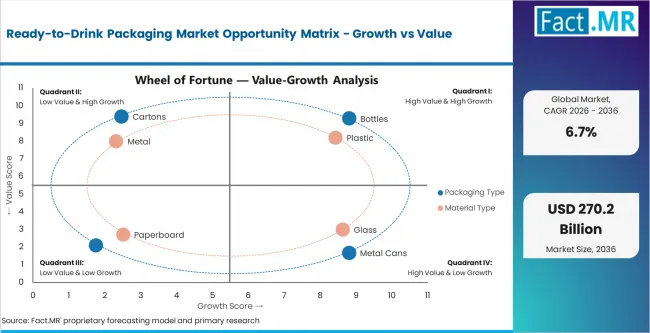
Ready To Drink Packaging Market Opportunity Matrix Growth Vs Value | Source: Fact.MR
Key Factors Driving Growth
- Rising packaged beverage consumption across urban populations in developing economies is increasing primary packaging demand across bottles, cans, and cartons.
- Regulatory mandates on recyclability and extended producer responsibility are pushing material innovation and format changes across mature and developing markets.
- Diversification of beverage categories into functional, plant-based, and health-oriented products is creating demand for specialized packaging formats with barrier protection.
Key Market Constraints
- Volatility in raw material costs for PET, aluminum, and paper-based substrates creates pricing pressure across the packaging value chain.
- Complexity of recycling multi-layer and multi-material packaging formats limits progress toward circular economy targets in several markets.
- Capital intensity of packaging line conversions for format changes can slow adoption of new packaging types, particularly among smaller beverage producers.
Key Opportunity Areas
- Transition from multi-material to mono-material packaging opens opportunities for suppliers with recyclable format expertise and material science capabilities.
- Growth of direct-to-consumer and e-commerce beverage distribution creates demand for durable, lightweight, and transport-optimized packaging solutions.
- Rising demand for aseptic and ultra-clean filling solutions in functional beverages supports premium packaging equipment and material procurement.
Segment-wise Analysis of the Ready-to-Drink Packaging Market
- Bottles hold 40% of the packaging type segment in 2026, supported by established demand across primary end-use applications.
- Plastic represents 45% of the material type segment in 2026, with consistent adoption across core applications.
- Screw Caps account for 50% of the closure type segment in 2026, reflecting concentrated demand in the leading vertical.
The ready-to-drink packaging market is segmented by packaging type, material type, closure type, application, and region. Bottles lead by value in the near term, while emerging categories are expected to drive the next phase of growth as end-use requirements evolve.
Which Packaging Type Segment Dominates the Ready-to-Drink Packaging Market?
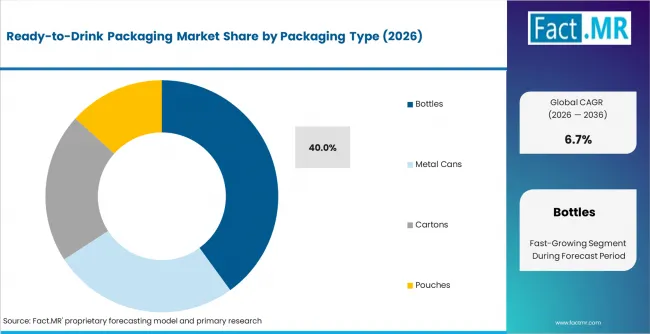
Ready To Drink Packaging Market Analysis By Packaging Type | Source: Fact.MR
Bottles is expected to account for 40% of the packaging type segment in the global Ready-to-Drink Packaging Market by 2026. Demand is supported by consistent procurement across primary end-use applications, where established performance requirements and pricing accessibility sustain the installed base.
The segment is expected to maintain its position through the forecast period as replacement demand and capacity expansion in core verticals continue to generate steady procurement. Emerging alternatives are gaining share, but bottles remain the primary volume category because of buyer familiarity and application suitability across mature and developing markets.
Which Material Type Segment Dominates the Ready-to-Drink Packaging Market?
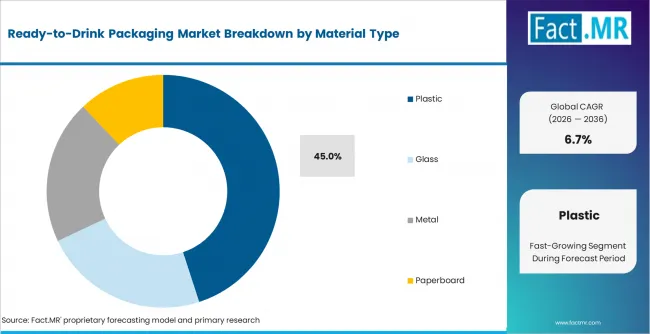
Ready To Drink Packaging Market Analysis By Material Type | Source: Fact.MR
Plastic is expected to account for 45% of the material type segment in the global Ready-to-Drink Packaging Market by 2026. Demand is supported by consistent procurement across primary end-use applications, where established performance requirements and pricing accessibility sustain the installed base.
The segment is expected to maintain its position through the forecast period as replacement demand and capacity expansion in core verticals continue to generate steady procurement. Emerging alternatives are gaining share, but plastic remains the primary volume category because of buyer familiarity and application suitability across mature and developing markets.
Which Closure Type Segment Dominates the Ready-to-Drink Packaging Market?
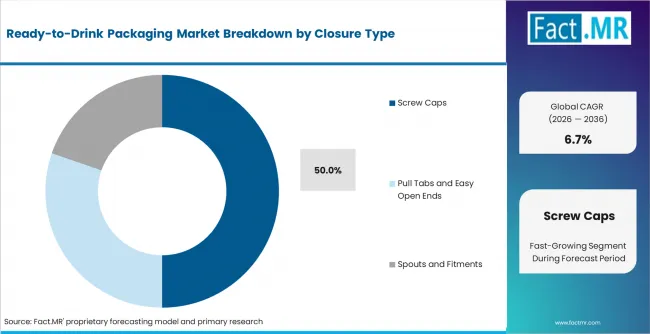
Ready To Drink Packaging Market Analysis By Closure Type | Source: Fact.MR
Screw Caps is expected to account for 50% of the closure type segment in the global Ready-to-Drink Packaging Market by 2026. Demand is supported by consistent procurement across primary end-use applications, where established performance requirements and pricing accessibility sustain the installed base.
The segment is expected to maintain its position through the forecast period as replacement demand and capacity expansion in core verticals continue to generate steady procurement. Emerging alternatives are gaining share, but screw caps remain the primary volume category because of buyer familiarity and application suitability across mature and developing markets.
Which Product Trend is Shaping the Next Phase of Growth in the Ready-to-Drink Packaging Market?
Recyclable mono-material packaging is not yet the dominant format, but it is emerging as the fastest-growing category as regulators and brand owners push toward circular economy targets. Material suppliers are developing PET, aluminum, and paper-based solutions that deliver the barrier properties and shelf life previously achieved only through multi-layer laminates, without compromising filling line compatibility or retail shelf presentation.
The shift toward recyclable and mono-material formats reflects broader procurement changes among beverage producers. Brand owners are increasingly making packaging recyclability a supply chain requirement rather than a marketing claim. This is creating sustained demand for packaging solutions that meet extended producer responsibility targets while maintaining cost competitiveness and performance across ambient, chilled, and carbonated distribution channels.
Regional Outlook Across Key Markets
.webp "Top Country Growth Comparison Ready To Drink Packaging Market Cagr (2026 2036)")
Top Country Growth Comparison Ready To Drink Packaging Market Cagr (2026 2036) | Source: Fact.MR
- China leads growth at 7.1%, supported by expanding domestic demand, industrial capacity investment, and broadening end-use adoption across commercial and institutional applications.
- The U.S. at 6.2% reflects a mature market where replacement demand and technology upgrades are the primary growth drivers.
- European demand remains steady, with the UK at 6% and Germany at 5.9%, supported by regulatory compliance requirements and technology-led procurement upgrades.
CAGR Table
| Country | CAGR (%) |
|---|---|
| China | 7.1% |
| India | 6.8% |
| Japan | 6.5% |
| Brazil | 6.3% |
| USA | 6.2% |
| UK | 6% |
| Germany | 5.9% |
Source: Fact.MR analysis. Updated May 25, 2026
Source: Fact MR (FMR) analysis, based on proprietary forecasting model and primary research.
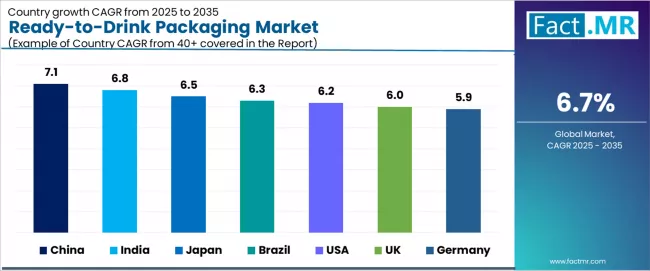
Ready To Drink Packaging Market Cagr Analysis By Country | Source: Fact.MR
Market Outlook for Ready-to-Drink Packagings in China
The China ready-to-drink packaging market is projected to grow at a CAGR of 7.1% through 2036. Demand is supported by expanding end-use activity and growing adoption of higher-specification products across key application segments.
- Expanding end-use demand supports procurement across primary applications.
- Infrastructure investment is broadening the installed equipment base.
- Growing performance requirements support mid-range and premium demand.
Demand Trends for Ready-to-Drink Packagings in India
The India ready-to-drink packaging market is projected to grow at a CAGR of 6.8% through 2036. Demand is supported by expanding end-use activity and growing adoption of higher-specification products across key application segments.
- Expanding end-use demand supports procurement across primary applications.
- Infrastructure investment is broadening the installed equipment base.
- Growing performance requirements support mid-range and premium demand.
Growth Assessment for Ready-to-Drink Packagings in Japan
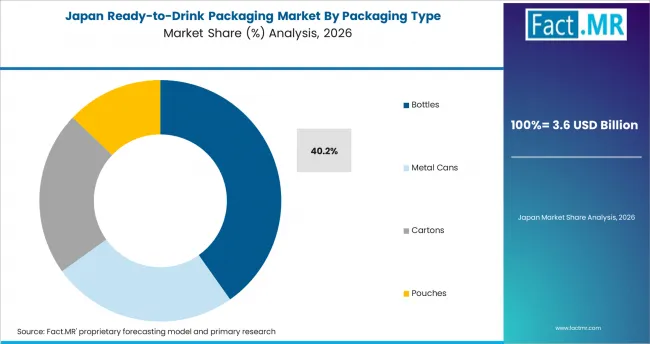
Ready To Drink Packaging Market Japan Market Share Analysis By Packaging Type | Source: Fact.MR
The Japan ready-to-drink packaging market is projected to grow at a CAGR of 6.5% through 2036. Demand is supported by expanding end-use activity and growing adoption of higher-specification products across key application segments.
- Expanding end-use demand supports procurement across primary applications.
- Infrastructure investment is broadening the installed equipment base.
- Growing performance requirements support mid-range and premium demand.
Market Growth Outlook for Ready-to-Drink Packagings in Brazil
The Brazil ready-to-drink packaging market is projected to grow at a CAGR of 6.3% through 2036. Demand is supported by expanding end-use activity and growing adoption of higher-specification products across key application segments.
- Expanding end-use demand supports procurement across primary applications.
- Infrastructure investment is broadening the installed equipment base.
- Growing performance requirements support mid-range and premium demand.
Market Opportunity Outlook for Ready-to-Drink Packagings in USA
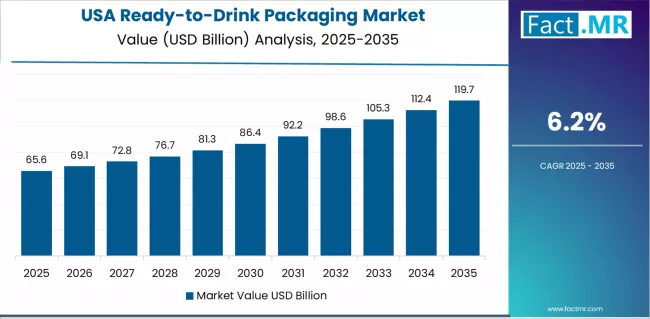
Ready To Drink Packaging Market Country Value Analysis | Source: Fact.MR
The USA ready-to-drink packaging market is projected to grow at a CAGR of 6.2% through 2036. Demand is supported by expanding end-use activity and growing adoption of higher-specification products across key application segments.
- Expanding end-use demand supports procurement across primary applications.
- Infrastructure investment is broadening the installed equipment base.
- Growing performance requirements support mid-range and premium demand.
Demand Analysis for Ready-to-Drink Packagings in UK
The UK ready-to-drink packaging market is projected to grow at a CAGR of 6% through 2036. Demand is supported by expanding end-use activity and growing adoption of higher-specification products across key application segments.
- Expanding end-use demand supports procurement across primary applications.
- Infrastructure investment is broadening the installed equipment base.
- Growing performance requirements support mid-range and premium demand.
Growth Forecast for Ready-to-Drink Packagings in Germany
The Germany ready-to-drink packaging market is projected to grow at a CAGR of 5.9% through 2036. Demand is supported by expanding end-use activity and growing adoption of higher-specification products across key application segments.
- Expanding end-use demand supports procurement across primary applications.
- Infrastructure investment is broadening the installed equipment base.
- Growing performance requirements support mid-range and premium demand.
Competitive Benchmarking and Company Positioning

Ready To Drink Packaging Market Analysis By Company | Source: Fact.MR
Ready-to-Drink Packaging Market Analysis By Company
- Amcor plc, Ball Corporation, Tetra Pak International S.A., Berry Global, Inc. hold strong positions in the global ready-to-drink packaging market through broad product portfolios, established brand recognition, and growing capabilities across core end-use applications.
- ALPLA Werke Alwin Lehner GmbH & Co KG, WestRock Company, Crown Holdings, Inc., SIG Group AG participate meaningfully across specific price tiers, user segments, and regional channels, with competition shaped by product quality, application fit, and distribution access.
- Technology integration and aftermarket service capability create differentiation, particularly in higher-specification product categories where buyer retention depends on performance reliability and ongoing support.
The competitive landscape is moderately fragmented, with established industrial players, specialized manufacturers, and value-oriented producers. Amcor plc, Ball Corporation, Tetra Pak International S.A., Berry Global, Inc. compete through product breadth, technical capability, and visibility across primary end-use applications.
Competition is shaped by differences between standard and premium product categories. Standard products attract price-sensitive buyers, while higher-specification systems create a premium layer of competition built around performance, durability, and service support.
Strategic priorities include expanding product portfolios, strengthening service networks, and widening reach across direct and e-commerce distribution channels. Companies combining reliable product performance with stronger technical support are positioned to improve retention and margin stability.
Key Companies in the Ready-to-Drink Packaging Market
- Amcor plc, Ball Corporation, Tetra Pak International S.A., Berry Global, Inc. are among the leading players in the ready-to-drink packaging market globally, supported by strong product portfolios, established market presence, and growing positions across primary end-use applications.
- ALPLA Werke Alwin Lehner GmbH & Co KG, WestRock Company, Crown Holdings, Inc., SIG Group AG hold established positions across specific application segments and regional markets, supported by durable products, distribution penetration, and category familiarity among end users.
- Silgan Plastics LLC, Ajanta Bottle Pvt. Ltd. and other specialist participants continue to compete through focused product offerings, price-point coverage, and niche application strength, reinforcing their relevance in a fragmented market.
Recent Industry Developments
- Amcor plc – Product Portfolio Expansion (2025)
- Amcor plc expanded its product portfolio with new models targeting higher-specification applications. The expansion strengthens the company's position in the growing premium segment.
- Ball Corporation – Technology Upgrade Launch (2026)
- Ball Corporation introduced upgraded technology capabilities across core product lines, improving operational efficiency and application versatility for end users.
- Tetra Pak International S.A. – Geographic Expansion (2025)
- Tetra Pak International S.A. expanded its distribution and service network into high-growth markets in Asia Pacific and Latin America, strengthening access to institutional procurement channels.
Leading Companies Shaping the Ready-to-Drink Packaging Market
- Amcor plc
- Ball Corporation
- Tetra Pak International S.A.
- Berry Global, Inc.
- ALPLA Werke Alwin Lehner GmbH & Co KG
- WestRock Company
- Crown Holdings, Inc.
- SIG Group AG
- Silgan Plastics LLC
- Ajanta Bottle Pvt. Ltd.
Sources and Research References
- Amcor plc. Product portfolio updates and corporate announcements.
- Ball Corporation. Product portfolio updates and corporate announcements.
- Tetra Pak International S.A.. Product portfolio updates and corporate announcements.
- Industry association publications, government regulatory databases, trade statistics, customs databases, and company product catalogs.
- Primary interviews with manufacturers, distributors, system integrators, end users, and industry consultants.
This bibliography is provided for reader reference and is not exhaustive. The full report contains the complete reference list and detailed citations.
Key Questions This Report Addresses
- What is the current and future size of the Ready-to-Drink Packaging Market?
- How fast is the Ready-to-Drink Packaging Market expected to grow between 2026 and 2036?
- Which packaging type is likely to lead the market by 2026?
- Which material type segment is expected to account for the highest demand by 2026?
- What factors are driving demand globally?
- How is technology evolution influencing market growth?
- Which countries are projected to show the fastest growth through 2036?
- What is driving market expansion in China and India?
- Who are the key companies active in the Ready-to-Drink Packaging Market?
- How does Fact.MR estimate and validate the market forecast?
Ready-to-Drink Packaging Market Definition
The ready-to-drink packaging market covers primary packaging formats used for beverages that require no consumer preparation before consumption. It includes bottles, cans, cartons, pouches, and cups made from plastic, glass, aluminum, and multi-layer laminates, used across carbonated and non-carbonated beverages, alcoholic drinks, dairy, and functional beverages distributed through retail, foodservice, and direct-to-consumer channels.
Ready-to-Drink Packaging Market Inclusions
- The scope covers global and regional market size and forecasts for 2026 to 2036 across packaging type, material type, closure type, application, and region.
- It includes regional demand analysis across major geographies, based on factors such as end-use activity levels, regulatory requirements, infrastructure investment, and technology adoption.
- The report includes pricing and cost analysis across entry-level, mid-range, and premium product categories, including hardware, consumables, and service components.
- It covers technology trends, market drivers and constraints, and the competitive landscape, including product portfolios, pricing strategy, geographic reach, and distribution positioning of leading players.
Ready-to-Drink Packaging Market Exclusions
- The scope excludes packaging for dry goods, powdered beverages, concentrates, and products that require consumer preparation before consumption.
- It excludes secondary and tertiary packaging such as corrugated boxes, shrink wraps, and palletizing materials not classified as primary beverage packaging.
- The report excludes packaging machinery, filling equipment, and labeling systems sold separately from packaging materials.
- It also excludes informal unbranded packaging with low market visibility and bulk industrial liquid containers not used in consumer beverage distribution.
Ready-to-Drink Packaging Market Research Methodology
- The methodology combines secondary research, primary interviews, and forecast modelling.
- It draws on 120+ secondary sources and benchmarks 65+ company product portfolios.
- Market sizing covers 30+ countries through a demand-side model, supported by top-down validation.
- Key inputs include end-use activity levels, regulatory requirements, procurement patterns, and technology adoption rates.
- The model cross-checks demand with shipments, pricing trends, channel mix, and product launches.
- Primary validation includes 25+ interviews across manufacturers, distributors, system integrators, and end users.
- Final estimates go through trade-flow checks, sales-pattern review, and sensitivity testing.
Segmentation
Scope of Analysis
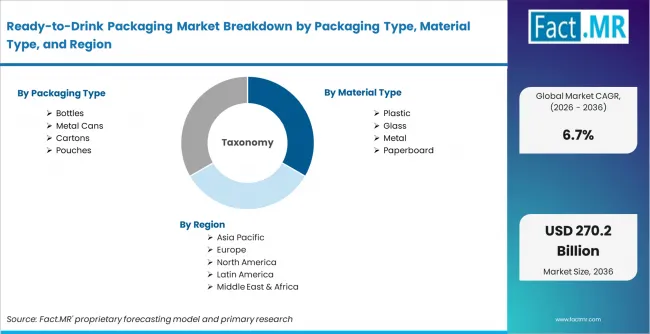
Ready To Drink Packaging Market Breakdown By Packaging Type, Material Type, And Region | Source: Fact.MR
| Parameter | Details |
|---|---|
| Quantitative Units | USD 141.3 billion to USD 270.2 billion, at a CAGR of 6.7% |
| Market Definition | Primary packaging formats for beverages requiring no consumer preparation, including bottles, cans, cartons, and pouches across retail and foodservice distribution. |
| Regions Covered | North America, Latin America, Europe, East Asia, South Asia and Pacific, Middle East and Africa |
| Countries Covered | China, India, Japan, Brazil, USA, UK, Germany, 30 plus countries |
| Key Companies | Amcor plc, Ball Corporation, Tetra Pak International S.A., Berry Global, Inc., ALPLA Werke Alwin Lehner GmbH & Co KG, WestRock Company, Crown Holdings, Inc., SIG Group AG, Silgan Plastics LLC, Ajanta Bottle Pvt. Ltd. |
| Forecast Period | 2026 to 2036 |
| Approach | Hybrid demand-side and top-down methodology built on country-level application demand, product benchmarking, pricing analysis, shipment validation, and primary interviews across manufacturers, distributors, and end users |
Source: Fact.MR analysis. Updated May 25, 2026
Ready-to-Drink Packaging Market Segmentation
-
Ready-to-Drink Packaging Market Segmented by Packaging Type:
- Bottles
- Plastic Bottles
- PET Bottles
- HDPE Bottles
- Glass Bottles
- Returnable Glass
- Non-returnable Glass
- Plastic Bottles
- Metal Cans
- Aluminum Cans
- Standard Cans
- Slim Cans
- Steel Cans
- Tinplate Cans
- Aerosol-style Cans
- Aluminum Cans
- Cartons
- Aseptic Cartons
- Long Shelf Life
- UHT Beverages
- Chilled Cartons
- Fresh Beverages
- Short Shelf Life
- Aseptic Cartons
- Pouches
- Stand-up Pouches
- Spouted Pouches
- Flexible Packaging
- Flat Pouches
- Single Serve
- Portable Packaging
- Stand-up Pouches
- Bottles
-
Ready-to-Drink Packaging Market Segmented by Material Type:
- Plastic
- PET
- Lightweight
- Recyclable
- HDPE
- Durable
- Chemical Resistance
- PET
- Glass
- Clear Glass
- Premium Beverages
- Alcoholic Drinks
- Colored Glass
- UV Protection
- Extended Shelf Life
- Clear Glass
- Metal
- Aluminum
- Lightweight
- Recyclable
- Steel
- Strength
- Durability
- Aluminum
- Paperboard
- Liquid Carton Board
- Aseptic Packaging
- UHT Products
- Coated Paperboard
- Barrier Properties
- Fresh Beverages
- Liquid Carton Board
- Plastic
-
Ready-to-Drink Packaging Market Segmented by Closure Type:
- Screw Caps
- Plastic Caps
- PET Bottles
- Reclosable
- Metal Caps
- Glass Bottles
- Tamper-proof
- Plastic Caps
- Pull Tabs and Easy Open Ends
- Stay-on Tabs
- Aluminum Cans
- Beverages
- Full Aperture Ends
- Wide Opening
- Convenience
- Stay-on Tabs
- Spouts and Fitments
- Spouted Closures
- Pouches
- Portable Use
- Flip-top Caps
- On-the-go Consumption
- Resealable
- Spouted Closures
- Screw Caps
-
Ready-to-Drink Packaging Market Segmented by Application:
- Non-alcoholic Beverages
- Soft Drinks
- Carbonated Drinks
- Energy Drinks
- Juices and Dairy
- Fruit Juices
- Milk-based Drinks
- Soft Drinks
- Alcoholic Beverages
- Beer
- Cans
- Glass Bottles
- Wine and Spirits
- Glass Bottles
- Premium Packaging
- Beer
- Functional Beverages
- Sports Drinks
- Electrolyte Drinks
- Hydration
- Health Drinks
- Protein Drinks
- Nutraceutical Beverages
- Sports Drinks
- Ready-to-Drink Tea and Coffee
- Iced Tea
- Bottled Tea
- Canned Tea
- Ready-to-Drink Coffee
- Cold Brew
- Canned Coffee
- Iced Tea
- Non-alcoholic Beverages
-
Ready-to-Drink Packaging Market Segmented by End Use Industry:
- Food and Beverage Industry
- Beverage Manufacturers
- Soft Drinks
- Alcoholic Drinks
- Dairy Industry
- Milk-based Beverages
- RTD Dairy Drinks
- Beverage Manufacturers
- Retail Industry
- Supermarkets
- Shelf Display
- Bulk Sales
- Convenience Stores
- On-the-go Sales
- Single Serve
- Supermarkets
- Hospitality Industry
- Restaurants
- Beverage Service
- Bulk Consumption
- Bars and Cafes
- Alcoholic Drinks
- RTD Coffee
- Restaurants
- E-commerce
- Online Grocery
- Home Delivery
- Bulk Orders
- Direct-to-consumer
- Subscription Models
- Specialty Drinks
- Online Grocery
- Food and Beverage Industry
-
Ready-to-Drink Packaging Market Segmented by Capacity:
- Medium Pack Size
- 500–1000 ml
- Family Pack
- Multi-serve
- 1–2 Liters
- Household Consumption
- Bulk Use
- 500–1000 ml
- Small Pack Size
- Below 250 ml
- Single Serve
- On-the-go
- 250–500 ml
- Convenience Packaging
- Individual Consumption
- Below 250 ml
- Large Pack Size
- Above 2 Liters
- Bulk Packaging
- Foodservice
- Ultra-large Packs
- Institutional Use
- Commercial Consumption
- Above 2 Liters
- Medium Pack Size
-
Ready-to-Drink Packaging Market Segmented by Distribution Channel:
- Direct Sales
- OEM Supply
- Beverage Manufacturers
- Bulk Contracts
- Project-based Sales
- Custom Packaging
- Large Orders
- OEM Supply
- Distributors
- Regional Distributors
- Local Supply
- Inventory Stockists
- Global Distributors
- Importers
- Exporters
- Regional Distributors
- Online Channel
- E-commerce Platforms
- Small Orders
- SMEs
- Direct Manufacturer Platforms
- Bulk Orders
- Customization
- E-commerce Platforms
- Direct Sales
-
Ready-to-Drink Packaging Market by Region:
- North America
- USA
- Canada
- Mexico
- Latin America
- Brazil
- Chile
- Rest of Latin America
- Western Europe
- Germany
- UK
- Italy
- Spain
- France
- Nordic
- BENELUX
- Rest of Western Europe
- Eastern Europe
- Russia
- Poland
- Hungary
- Balkan & Baltic
- Rest of Eastern Europe
- East Asia
- China
- Japan
- South Korea
- South Asia and Pacific
- India
- ASEAN
- Australia & New Zealand
- Rest of South Asia and Pacific
- Middle East & Africa
- Kingdom of Saudi Arabia
- Other GCC Countries
- Turkiye
- South Africa
- Other African Union
- Rest of Middle East & Africa
- North America
Frequently Asked Questions
How big is the ready-to-drink packaging market in 2025?
What will be the size of the ready-to-drink packaging market in 2036?
How much will the ready-to-drink packaging market grow between 2026 and 2036?
What are the key packaging types in the ready-to-drink packaging market?
Which segment will contribute the most share in the ready-to-drink packaging market in 2026?
Which countries are growing fastest in this market?
Who are the key companies in the ready-to-drink packaging market?
Who worked on this report


Preview the report firsthand - request a free sample
Free SampleGet the brochure for pricing and purchase details
Download PDF