Office-to-Residential Conversion Services Market Size, Share, Growth and Forecast (2026 - 2036)

The Office-to-Residential Conversion Services Market is segmented by Service Type, by Building Type, by Customer Type, by Delivery Model, by Conversion Outcome, by Project Stage and Region. Forecast for 2026 to 2036.

What is the office-to-residential conversion services market forecast to be worth by 2036?

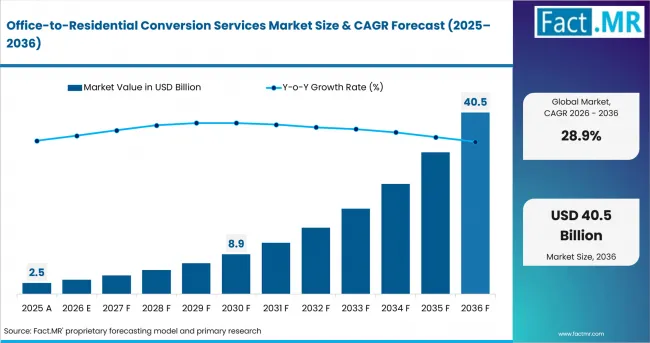
USD 3.2 billion in 2026 to USD 40.5 billion by 2036, at 28.9% CAGR.

  • The office-to-residential conversion services market crossed a valuation of USD 2.5 billion in 2025. Demand is expected to increase from USD 3.2 billion in 2026 to USD 40.5 billion by 2036.
  • The market is forecast to record 28.9% CAGR during 2026 to 2036 as office distress and housing shortages move more owners from asset review to funded conversion work.
  • Feasibility, design, financing structuring and execution services form the core of this market. The service layer begins with building screening and continues through code review, incentive applications, and project delivery.
  • This scope measures professional fees earned by advisors, architects, engineers and execution partners.
Office To Residential Conversion Services Market Value Analysis

What are the defining numbers behind office-to-residential conversion services growth?

USD 37.3 billion absolute opportunity by 2036, led by the United States and Canada.

  • Demand Drivers in the Market
    • Office owners need feasibility studies before they decide between conversion, sale or demolition.
    • City housing agencies are using tax relief and approval support to make older office stock usable again.
    • Developers need design teams that can solve light, air, plumbing and code limits inside deep office floorplates.
    • Lenders need conversion plans with cost clarity before they release construction capital for older commercial buildings.
  • Key Segments Analyzed
    • By Conversion Outcome: Market-Rate Rentals are anticipated to capture 44.0% share in 2026 as many viable projects need higher rents to offset retrofit cost.
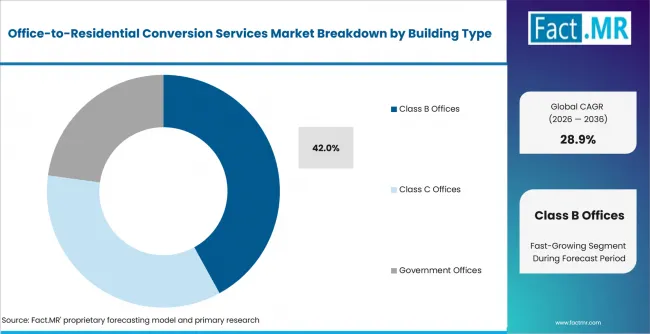
    • By Building Type: Class B Offices are expected to hold 42.0% share in 2026 since older mid-tier stock carries the clearest conversion pressure.
    • By Customer Type: Real Estate Developers are forecast to account for 38.0% share in 2026 as they manage acquisition and execution risk.
    • By Project Stage: Feasibility and Entitlement is expected to hold 36.0% share in 2026 as owners test zoning and building limits before full design spending.
    • By Delivery Model: Integrated Advisory is projected to hold 35.0% share in 2026 since owners prefer one team for feasibility, incentives and delivery coordination.
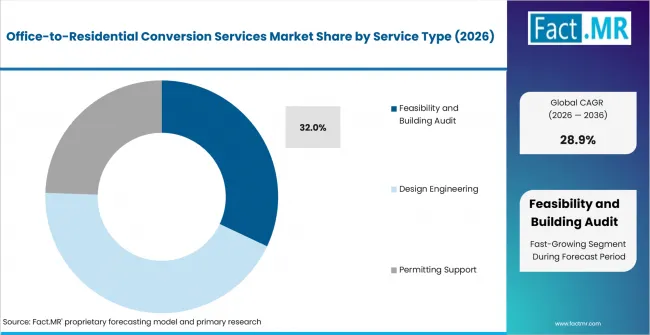
    • By Service Type: Feasibility and Building Audit is projected to account for 32.0% share in 2026 as most projects begin with a go or no-go test.
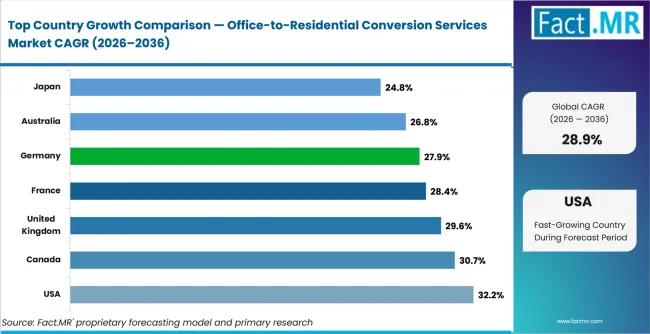
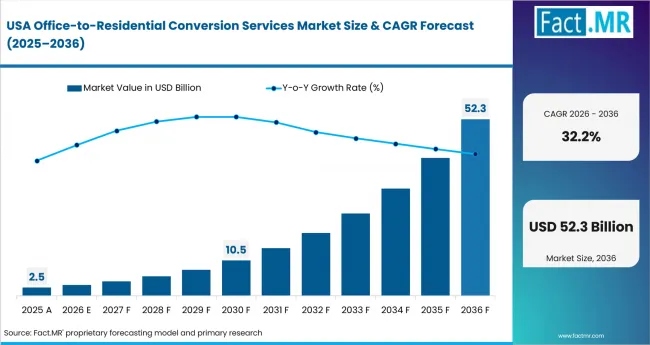
    • By Geography: The United States is projected to record 32.2% CAGR through 2036 as city-level incentives create the deepest service pipeline.
  • Analyst Opinion at Fact.MR
    • Shambhu Nath Jha, Senior Analyst at Fact.MR, states, “Office-to-residential conversion is not a design shortcut. I see it as a screening market first and a construction market second. The providers that win are the teams that can reject poor buildings early, price the code risk clearly and match incentives with a workable floorplate. Once lenders trust that package, conversion services move from single-building studies into portfolio programs.”
  • Strategic Implications
    • Developers should screen buildings before acquisition so that structural and light-well limits are priced into the bid.
    • City agencies should pair incentives with approval teams because tax relief alone does not solve code and design risk.
    • Architecture and engineering firms need repeatable due diligence tools that shorten early feasibility cycles.
    • Lenders should require conversion-specific cost and code reviews before underwriting older office assets.

The United States is projected to record 32.2% CAGR through 2036 as New York City and Washington DC convert larger pipelines. Canada is expected to expand at 30.7% CAGR through 2036 as Calgary proves the incentive model. The United Kingdom is forecast to grow at 29.6% CAGR through 2036 as permitted-development rules keep reuse work active. France is expected to advance at 28.4% CAGR through 2036 after its 2025 office-to-housing law created clearer approval tools.

How does the office-to-residential conversion services market break down by segment?

Market-Rate Rentals lead at 44.0%; Class B Offices lead building type at 42.0%.

Which service type leads?

Feasibility and Building Audit holds 32.0% share in 2026.
Office To Residential Conversion Services Market Analysis By Service Type

Feasibility and Building Audit is projected to account for 32.0% share in 2026. Owners buy this work first because conversion failure is costly when a building has poor light access or an inefficient core. Early due diligence also connects with building inspection services because technical review decides whether an office can support housing use.

Which building type leads service revenue?

Class B Offices hold 42.0% share in 2026.
Office To Residential Conversion Services Market Analysis By Building Type

Class B Offices are expected to hold 42.0% share in 2026. These assets often sit in transit-rich downtown areas but carry weaker leasing power than trophy towers. Their role connects with real estate brokerage because owners compare sale, lease and conversion routes before selecting a service team.

Which customer type buys the most services?

Real Estate Developers hold 38.0% share in 2026.
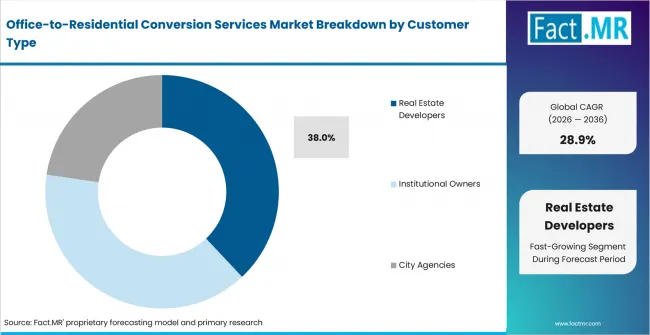
Office To Residential Conversion Services Market Analysis By Customer Type

Real Estate Developers are forecast to account for 38.0% share in 2026. Developers control the underwriting decision and usually hire the core consultant team. Institutional owners follow when they decide whether a distressed asset should be converted internally or sold to a specialist developer.

Which delivery model is most used?

Integrated Advisory holds 35.0% share in 2026.
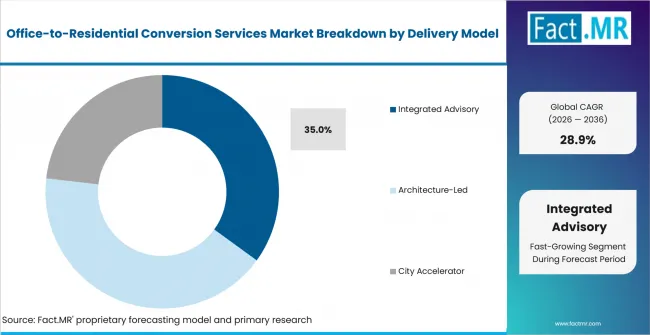
Office To Residential Conversion Services Market Analysis By Delivery Model

Integrated Advisory is projected to hold 35.0% share in 2026. Owners prefer one coordinated team when tax incentives, code review and design logic must be solved together. This makes conversion-service buying different from standard architecture procurement.

Which conversion outcome leads?

Market-Rate Rentals hold 44.0% share in 2026.
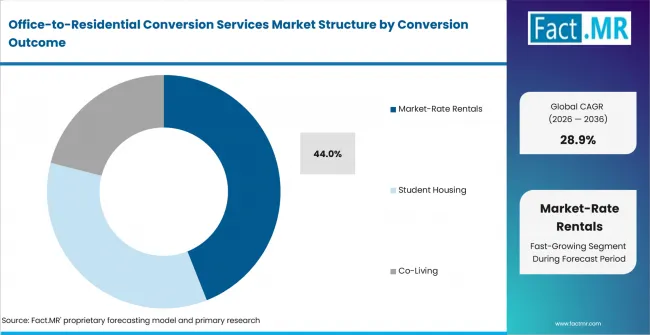
Office To Residential Conversion Services Market Analysis By Conversion Outcome

Market-Rate Rentals are anticipated to capture 44.0% share in 2026. Many projects need higher rents to absorb structural work, new mechanical systems and financing cost. Housing interiors also expand the role of interior design services as unit mix and amenity floors shape leasing value.

Which project stage holds the largest service share?

Feasibility and Entitlement holds 36.0% share in 2026.
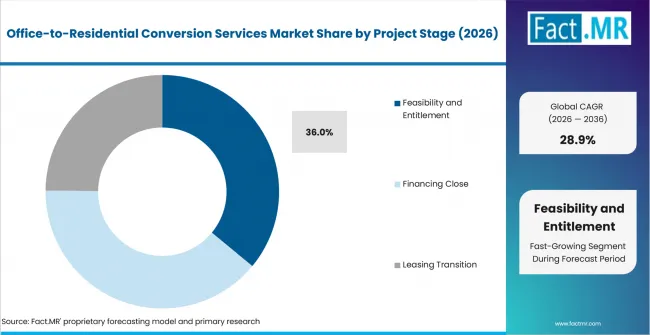
Office To Residential Conversion Services Market Analysis By Project Stage

Feasibility and Entitlement is expected to hold 36.0% share in 2026. Owners need clear entitlement and cost findings before they commission full design. Later execution work is larger per project, but early-stage study counts are higher.

What is accelerating office-to-residential conversion demand, and what is holding it back?

Office obsolescence and city incentives drive it; floorplate limits and retrofit cost restrain it.
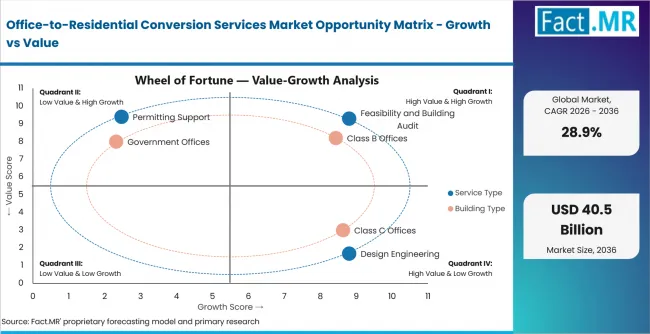
Office To Residential Conversion Services Market Opportunity Matrix Growth Vs Value

The main driver is obsolete office supply moving into reuse review. Urban Land Institute reported in December 2025 that apartment conversions reached 70,700 units in 2025. Some projects also require heavy site work when facade changes, light wells, or structural cuts move beyond planning.

Policy support is the second driver. The New York City Comptroller reported in July 2025 that conversions covered 15.2 million gross square feet in the first quarter of 2025. That pipeline creates demand for permitting, tax analysis and finance-structuring services before projects reach construction.

The main restraint is building physics. Deep floorplates can create dark interiors and expensive light-well cuts. Older towers often need new risers, fire systems and mechanical upgrades before residential use becomes workable.

Where do the biggest office-to-residential conversion service opportunities sit?

Incentive structuring, facade redesign and mechanical retrofit work.

  • Incentive Structuring: Advisors can help owners match tax tools with affordability requirements and project schedules.
  • Facade Redesign: Design firms can capture more fees where office skins need windows, insulation and resident-grade performance. This connects to facade systems where envelope choices shape cost and comfort.
  • Mechanical Retrofit: Engineering firms can win work by solving plumbing stacks, ventilation and fire protection for residential layouts. This overlaps with mechanical services when building systems must be rebuilt inside existing frames.

Which countries are scaling office-to-residential conversion services fastest?

United States 32.2%, Canada 30.7%, United Kingdom 29.6%, France 28.4%, Germany 27.9%, Australia 26.8%, Japan 24.8%.

Based on regional analysis, the office-to-residential conversion services market is segmented into North America, Europe, East Asia, South Asia and Pacific, Latin America, and Middle East and Africa.

Top Country Growth Comparison Office To Residential Conversion Services Market Cagr (2026 2036)

Country CAGR
United States 32.2%
Canada 30.7%
United Kingdom 29.6%
France 28.4%
Germany 27.9%
Australia 26.8%
Japan 24.8%

Office To Residential Conversion Services Market Cagr Analysis By Country

What is powering the United States lead?

32.2% CAGR, supported by New York City, Washington DC and large Class B office pipelines.
Office To Residential Conversion Services Market Country Value Analysis

The United States has the clearest mix of obsolete office stock and city-level incentives. The New York City Comptroller reported 15.2 million gross square feet of completed, ongoing and potential conversions in July 2025. Washington DC adds depth because its conversion pipeline is tied to the downtown comeback plan. Service demand favors providers that can combine zoning, tax analysis and technical feasibility. Larger projects also use construction elevators where vertical access affects build sequencing inside older towers.

Key companies include Gensler, Metro Loft Developers, Vanbarton Group, CetraRuddy and Post Brothers.

Why does Canada matter in this market?

30.7% CAGR, supported by Calgary’s incentive model and downtown vacancy reuse.

Canada is important because Calgary turned office vacancy into a funded conversion playbook. The City of Calgary states that its incentive program is transforming 2.68 million square feet of underused office space. That public record gives owners and advisors a tested model for feasibility, funding and approvals. Suppliers with downtown reuse experience can use Calgary as a proof point for other Canadian cities.

Key companies include NORR, Kasian, Zeidler Architecture, Dialog and Dream Unlimited.

How is the United Kingdom shaping conversion services?

29.6% CAGR, supported by Class MA rules and change-of-use housing output.

England’s Class MA route keeps office-to-residential work inside the planning workflow. The United Kingdom government reported 17,710 gains from change of use between non-domestic and residential uses in 2024 to 2025. The April 2024 permitted-development amendment removed the former floorspace cap. Service providers benefit when owners need prior approval, code review and building-quality fixes.

What supports the France outlook?

28.4% CAGR, backed by the 2025 office-to-housing law and vacant office supply.

France’s conversion outlook improved after Law No. 2025-541 created tools to facilitate conversion of offices and other buildings into housing. The French Ministry of Ecological Transition stated in September 2025 that France had more than 9 million square metres of unoccupied offices. Providers that understand local planning tools and social housing needs gain stronger access. This gives France a policy-led conversion route rather than a distress-only route.

What underpins Germany’s service demand?

27.9% CAGR, backed by housing pressure and selective reuse of commercial stock.

Germany’s opportunity is tied to housing need and unused commercial buildings in large cities. The Federal Statistical Office shows 251,937 dwellings completed in 2024 across residential and non-residential buildings. That production gap makes reuse more relevant, but conservative building standards keep feasibility work selective. Related energy retrofit systems also affect project economics because older buildings often need energy upgrades.

Why is Australia a slower but relevant market?

26.8% CAGR, supported by adaptive reuse guidance and constrained by strict feasibility economics.

Australia has visible policy interest in reuse, but fewer projects reach execution. Infrastructure Australia reported in November 2025 that building projects, including social housing, were projected at AUD 77.0 billion in the major public infrastructure pipeline. Melbourne also published adaptive reuse guidelines for office buildings. Service demand is strongest where reuse can meet housing standards without excessive structural cost.

How is Japan scaling conversion demand?

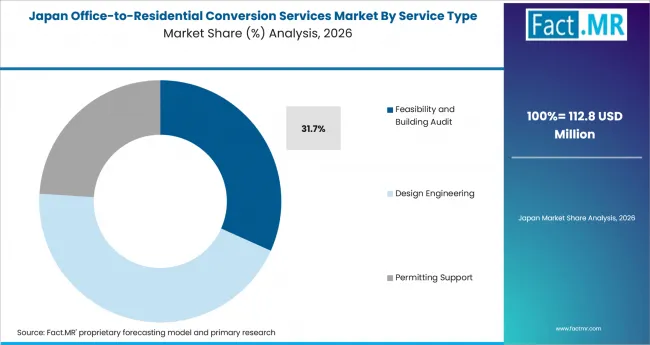
24.8% CAGR, supported by selective reuse needs and tight prime-office conditions.
Office To Residential Conversion Services Market Japan Market Share Analysis By Service Type

Japan’s market is selective because prime-office vacancy is lower than in many North American downtowns. The Ministry of Land, Infrastructure, Transport and Tourism reported in September 2025 that average land prices increased for the fourth consecutive year as of January 2025. This supports asset-by-asset screening, not a broad distressed-office wave. Providers need local code knowledge and compact-unit planning skills.

Who leads the office-to-residential conversion services landscape?

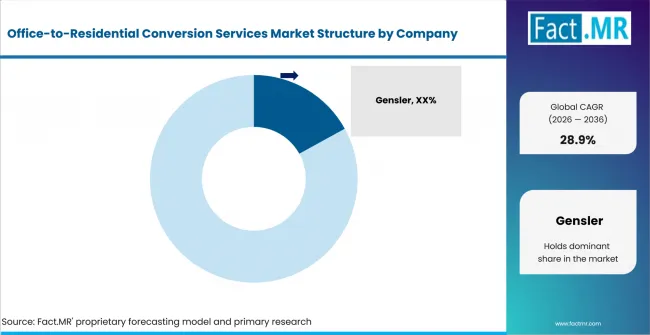
Gensler, Metro Loft Developers and Hines lead through conversion portfolios and applied project experience.
Office To Residential Conversion Services Market Analysis By Company

Office-to-residential conversion services are used by developers, owners and public agencies that need trusted feasibility evidence before committing capital. Gensler brings design research and conversion screening depth. Metro Loft Developers brings repeated execution in New York City. Hines gives institutional owners a benchmark through Seraph in Salt Lake City.

Execution capability is the main competitive divider. Teams that combine design, engineering, code review and finance support win more mandates than firms selling one narrow service. Off-site bathroom pods and repeatable interior assemblies connect conversion planning to prefabricated homes when owners seek faster fit-out routes.

Specialist advisors can compete when they know local permitting offices and can produce a fast feasibility answer. Global firms are better placed for multi-city portfolios because they standardize screening across assets. Some projects involve cutting light wells or adding structural openings, which makes 3D concrete printing less central today but relevant as construction methods change.

Which companies are the key players?

Gensler, Metro Loft Developers, Vanbarton Group, Hines, CetraRuddy, Arup and JLL.

  • Gensler
  • Metro Loft Developers
  • Vanbarton Group
  • Hines
  • CetraRuddy
  • Arup
  • JLL
  • CBRE
  • Savills
  • BDP
  • Woods Bagot
  • Drees & Sommer

Bibliography

  • [1] Nyren, R. (2025, December 1). UL10: Ten conversions to residential use. Urban Land Magazine.
  • [2] Office of the New York City Comptroller. (2025, July 17). Office-to-residential conversions in NYC: Economics and fiscal estimates.
  • [3] New York City Department of Housing Preservation and Development. (2024, December 16). Affordable Housing From Commercial Conversions Tax Incentive Benefits Program pursuant to Section 467-m of the Real Property Tax Law.
  • [4] Mayor of the District of Columbia. (2026, January 22). Mayor Bowser breaks ground on The Geneva, DC’s largest-ever office-to-residential conversion.
  • [5] City of Calgary. (n.d.). Downtown Office Conversion Program.
  • [6] City of Calgary. (n.d.). Downtown development incentive programs.
  • [7] Department for Levelling Up, Housing and Communities. (2024, April 4). The Town and Country Planning (General Permitted Development) (England) (Amendment) Order 2024.
  • [8] Ministry of Housing, Communities and Local Government. (2025, November 20). Housing supply: Net additional dwellings, England: 2024 to 2025.
  • [9] Directorate of Legal and Administrative Information. (2025, July 25). Relaxation of the rules for converting offices into housing.
  • [10] Ministère de l’Aménagement du territoire et de la Décentralisation. (2025, September 5). Transformation de bureaux en logements : deux rapports remis à la ministre du Logement.
  • [11] Federal Statistical Office. (n.d.). Construction work completed in Germany. Destatis.
  • [12] Infrastructure Australia. (2025, November 13). 2025 Infrastructure Market Capacity Report.
  • [13] City of Melbourne. (2024, September). Guidelines for the adaptive reuse of office buildings.
  • [14] Ministry of Land, Infrastructure, Transport and Tourism. (2025, September 2). Fiscal Year 2024 trends concerning land.
  • [15] Eckholm, C., Hadden Loh, T., Meyers, J., & Paynter, S. (2025, March 26). Understanding office-to-residential conversion: Lessons from six U.S. case studies. Brookings Institution.
  • [16] Gensler. (2024, June 12). Pearl House: Explore the transformation of New York’s largest office-to-residential conversion to date.
  • [17] Hines. (2024, April 23). Hines begins redevelopment on office-to-residential conversion in Salt Lake City.
  • [18] Hines. (2026, January 14). Hines announces completion of first office-to-residential conversion, Seraph, in Salt Lake City.
  • [19] CBRE. (2025, June 3). Conversions & demolitions reducing U.S. office supply.
  • [20] Office of the Mayor of New York City. (2025, May 22). Mayor Adams, Governor Hochul announce office-to-housing transformation at 5 Times Square to create up to 1,250 homes, including 313 affordable units.

This Report Addresses

  • Strategic intelligence on office-to-residential conversion services across service type, building type and customer type.
  • Segment analysis covering Market-Rate Rentals, Class B Offices, Real Estate Developers and Integrated Advisory.
  • Regional outlook covering the United States, Canada, the United Kingdom, France, Germany, Australia and Japan.
  • Competitive analysis of Gensler, Metro Loft Developers, Vanbarton Group, Hines, CetraRuddy, Arup and JLL.
  • Service assessment covering feasibility audits, design engineering, finance structuring and permitting support.
  • Policy assessment covering 467-m, Calgary incentive tools, Class MA changes and France’s 2025 office-to-housing law.
  • Primary interviews, provider checks, official source review and conversion pipeline validation support the forecast.

What does the office-to-residential conversion services market cover?

Feasibility, design, finance structuring and delivery support for converting obsolete office assets into housing.

The office-to-residential conversion services market covers project advisory and delivery work for office buildings that can be changed into residential use. It includes feasibility audits, architectural design, structural engineering, incentive planning and construction management. The market differs from real estate development because it measures the professional service layer rather than finished apartment asset value.

What is included in the scope?

Building feasibility screening, adaptive design, incentive support and conversion delivery review.

The scope includes zoning review, building feasibility studies and apartment layout planning. It covers structural checks, mechanical system redesign, fire-code review and financing support. It also includes entitlement help, tax-incentive applications and execution management for office buildings moving into rental housing, student housing or co-living use.

What is excluded from the scope?

Apartment sales, office leasing and ground-up residential construction without office reuse.

The scope excludes office leasing advisory unless it directly supports a conversion decision. It excludes completed apartment sales, property management and ground-up residential development. It also excludes demolition-only projects where no conversion service is purchased.

How was the analysis built?

100+ sources, 45+ company portfolios, 30+ countries, 25+ expert checks.

  • Primary Research:
    • Interviews covered developers, architecture practices, lenders and city housing officials. Respondents discussed fee ranges, feasibility failure points and buyer decision criteria.
  • Desk Research:
    • Desk research reviewed city incentive pages, planning rule changes, office vacancy signals and conversion case studies.
  • Market-Sizing and Forecasting:
    • Forecasting used candidate floor area, conversion pipeline units and service-fee intensity by project stage. Values were reconciled against company portfolios and city program volumes.
  • Data Validation and Update Cycle:
    • Forecasts were validated through provider checks and official housing conversion programs. Current development announcements confirmed the service revenue direction.

What is the report’s scope and coverage?
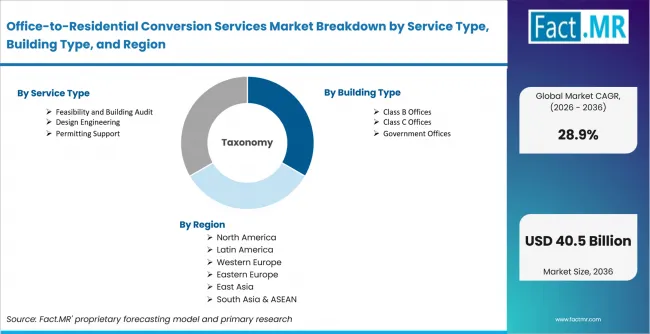
Office To Residential Conversion Services Market Breakdown By Service Type, Building Type, And Region

Attribute Details
Quantitative Units USD Billion in 2026 to USD Billion by 2036 at CAGR
Market Definition Professional services that convert obsolete office buildings into residential use
Service Type Feasibility Audit, Design and Engineering, Financing Structuring, Permitting Support, Construction Management
Building Type Class B Offices, Class C Offices, Government Offices, Mixed-Use Towers, Single-Tenant Offices
Customer Type Real Estate Developers, Institutional Owners, REITs and Funds, City Agencies, Lenders and Investors
Delivery Model Integrated Advisory, Architecture-Led Delivery, Engineering-Led Delivery, Developer-Led Delivery, City Accelerator Support
Conversion Outcome Market-Rate Rentals, Affordable Housing, Student Housing, Co-Living, Senior Housing
Project Stage Feasibility and Entitlement, Design Development, Financing Close, Construction Execution, Leasing Transition
Regions Covered North America, Latin America, Europe, East Asia, South Asia and Pacific, Middle East and Africa
Countries Covered United States, Canada, United Kingdom, France, Germany, Australia, Japan
Key Companies Profiled Gensler, Metro Loft Developers, Vanbarton Group, Hines, CetraRuddy, Arup and JLL
Forecast Period 2026 to 2036
Approach Hybrid bottom-up and top-down method using candidate office stock, conversion pipeline units, service-fee rates and provider validation

How is the market segmented?

  • By Service Type:

    • Feasibility Audit
    • Design Engineering
    • Financing Structuring
    • Permitting Support
    • Construction Management
  • By Building Type:

    • Class B Offices
    • Class C Offices
    • Government Offices
    • Mixed-Use Towers
    • Single-Tenant Offices
  • By Customer Type:

    • Real Estate Developers
    • Institutional Owners
    • REITs Funds
    • City Agencies
    • Lenders Investors
  • By Delivery Model:

    • Integrated Advisory
    • Architecture-Led
    • Engineering-Led
    • Developer-Led
    • City Accelerator
  • By Conversion Outcome:

    • Market-Rate Rentals
    • Affordable Housing
    • Student Housing
    • Co-Living
    • Senior Housing
  • By Project Stage:

    • Feasibility Entitlement
    • Design Development
    • Financing Close
    • Construction Execution
    • Leasing Transition
  • By Region:

    • North America
      • United States
      • Canada
      • Mexico
    • Latin America
      • Brazil
      • Chile
      • Rest of Latin America
    • Europe
      • Germany
      • United Kingdom
      • France
      • Italy
      • Spain
      • Rest of Europe
    • East Asia
      • China
      • Japan
      • South Korea
    • South Asia and Pacific
      • India
      • ASEAN
      • Australia and New Zealand
      • Rest of South Asia and Pacific
    • Middle East and Africa
      • Kingdom of Saudi Arabia
      • Other GCC Countries
      • Turkiye
      • South Africa
      • Rest of Middle East and Africa

- Frequently Asked Questions -

How should buyers understand the current position of the Office-to-Residential Conversion Services Market?

The office-to-residential conversion services market is estimated to be an active advisory category as owners test whether obsolete offices can become housing.

How is the Office-to-Residential Conversion Services Market expected to develop through the forecast period?

The market is projected to expand as cities, lenders and developers use conversion studies before committing capital.

What growth pattern is expected for office-to-residential conversion services?

The market is forecast to advance faster than conventional property advisory because office vacancy and housing shortages create direct reuse pressure.

Which service type has the clearest early lead?

Feasibility and Building Audit leads because every conversion starts with proof that structure, layout and systems can support residential use.

Which building type is most important in this market?

Class B Offices lead because many older buildings face weaker leasing prospects but still sit in locations suitable for housing.

Which country shows the strongest pull for conversion services?

The United States shows the strongest pull because city pipelines and downtown reuse programs are creating steady feasibility work.

How does Canada support demand in this market?

Canada supports demand through incentive-led downtown reuse programs that make conversion planning easier to finance.

How does the United Kingdom fit into the conversion services outlook?

The United Kingdom remains important because change-of-use rules keep planning and building-assessment work active.

What supports demand for office-to-residential conversion services?

Demand is supported by owners that need to confirm technical viability before lenders and public agencies approve projects.

What limits wider use of these services?

Wider use is constrained by deep floorplates, outdated systems and retrofit costs that can weaken project economics.

Why are Class B Offices important in this market?

Class B Offices are important because weaker leasing demand and central locations make them frequent candidates for housing reuse.

Table of Content

  1. Executive Summary
    • Global Market Outlook
    • Demand to side Trends
    • Supply to side Trends
    • Technology Roadmap Analysis
    • Analysis and Recommendations
  2. Market Overview
    • Market Coverage / Taxonomy
    • Market Definition / Scope / Limitations
  3. Research Methodology
    • Chapter Orientation
    • Analytical Lens and Working Hypotheses
      • Market Structure, Signals, and Trend Drivers
      • Benchmarking and Cross-market Comparability
      • Market Sizing, Forecasting, and Opportunity Mapping
    • Research Design and Evidence Framework
      • Desk Research Programme (Secondary Evidence)
        • Company Annual and Sustainability Reports
        • Peer-reviewed Journals and Academic Literature
        • Corporate Websites, Product Literature, and Technical Notes
        • Earnings Decks and Investor Briefings
        • Statutory Filings and Regulatory Disclosures
        • Technical White Papers and Standards Notes
        • Trade Journals, Industry Magazines, and Analyst Briefs
        • Conference Proceedings, Webinars, and Seminar Materials
        • Government Statistics Portals and Public Data Releases
        • Press Releases and Reputable Media Coverage
        • Specialist Newsletters and Curated Briefings
        • Sector Databases and Reference Repositories
        • Fact.MR Internal Proprietary Databases and Historical Market Datasets
        • Subscription Datasets and Paid Sources
        • Social Channels, Communities, and Digital Listening Inputs
        • Additional Desk Sources
      • Expert Input and Fieldwork (Primary Evidence)
        • Primary Modes
          • Qualitative Interviews and Expert Elicitation
          • Quantitative Surveys and Structured Data Capture
          • Blended Approach
        • Why Primary Evidence is Used
        • Field Techniques
          • Interviews
          • Surveys
          • Focus Groups
          • Observational and In-context Research
          • Social and Community Interactions
        • Stakeholder Universe Engaged
          • C-suite Leaders
          • Board Members
          • Presidents and Vice Presidents
          • R&D and Innovation Heads
          • Technical Specialists
          • Domain Subject-matter Experts
          • Scientists
          • Physicians and Other Healthcare Professionals
        • Governance, Ethics, and Data Stewardship
          • Research Ethics
          • Data Integrity and Handling
      • Tooling, Models, and Reference Databases
    • Data Engineering and Model Build
      • Data Acquisition and Ingestion
      • Cleaning, Normalisation, and Verification
      • Synthesis, Triangulation, and Analysis
    • Quality Assurance and Audit Trail
  4. Market Background
    • Market Dynamics
      • Drivers
      • Restraints
      • Opportunity
      • Trends
    • Scenario Forecast
      • Demand in Optimistic Scenario
      • Demand in Likely Scenario
      • Demand in Conservative Scenario
    • Opportunity Map Analysis
    • Product Life Cycle Analysis
    • Supply Chain Analysis
    • Investment Feasibility Matrix
    • Value Chain Analysis
    • PESTLE and Porter’s Analysis
    • Regulatory Landscape
    • Regional Parent Market Outlook
    • Production and Consumption Statistics
    • Import and Export Statistics
  5. Global Market Analysis 2021 to 2025 and Forecast, 2026 to 2036
    • Historical Market Size Value (USD Million) Analysis, 2021 to 2025
    • Current and Future Market Size Value (USD Million) Projections, 2026 to 2036
      • Y to o to Y Growth Trend Analysis
      • Absolute $ Opportunity Analysis
  6. Global Market Pricing Analysis 2021 to 2025 and Forecast 2026 to 2036
  7. Global Market Analysis 2021 to 2025 and Forecast 2026 to 2036, By Service Type
    • Introduction / Key Findings
    • Historical Market Size Value (USD Million) Analysis By Service Type , 2021 to 2025
    • Current and Future Market Size Value (USD Million) Analysis and Forecast By Service Type , 2026 to 2036
      • Feasibility and Building Audit
      • Design Engineering
      • Permitting Support
    • Y to o to Y Growth Trend Analysis By Service Type , 2021 to 2025
    • Absolute $ Opportunity Analysis By Service Type , 2026 to 2036
  8. Global Market Analysis 2021 to 2025 and Forecast 2026 to 2036, By Building Type
    • Introduction / Key Findings
    • Historical Market Size Value (USD Million) Analysis By Building Type, 2021 to 2025
    • Current and Future Market Size Value (USD Million) Analysis and Forecast By Building Type, 2026 to 2036
      • Class B Offices
      • Class C Offices
      • Government Offices
    • Y to o to Y Growth Trend Analysis By Building Type, 2021 to 2025
    • Absolute $ Opportunity Analysis By Building Type, 2026 to 2036
  9. Global Market Analysis 2021 to 2025 and Forecast 2026 to 2036, By Customer Type
    • Introduction / Key Findings
    • Historical Market Size Value (USD Million) Analysis By Customer Type, 2021 to 2025
    • Current and Future Market Size Value (USD Million) Analysis and Forecast By Customer Type, 2026 to 2036
      • Real Estate Developers
      • Institutional Owners
      • City Agencies
    • Y to o to Y Growth Trend Analysis By Customer Type, 2021 to 2025
    • Absolute $ Opportunity Analysis By Customer Type, 2026 to 2036
  10. Global Market Analysis 2021 to 2025 and Forecast 2026 to 2036, By Delivery Model
    • Introduction / Key Findings
    • Historical Market Size Value (USD Million) Analysis By Delivery Model, 2021 to 2025
    • Current and Future Market Size Value (USD Million) Analysis and Forecast By Delivery Model, 2026 to 2036
      • Integrated Advisory
      • Architecture-Led
      • City Accelerator
    • Y to o to Y Growth Trend Analysis By Delivery Model, 2021 to 2025
    • Absolute $ Opportunity Analysis By Delivery Model, 2026 to 2036
  11. Global Market Analysis 2021 to 2025 and Forecast 2026 to 2036, By Conversion Outcome
    • Introduction / Key Findings
    • Historical Market Size Value (USD Million) Analysis By Conversion Outcome, 2021 to 2025
    • Current and Future Market Size Value (USD Million) Analysis and Forecast By Conversion Outcome, 2026 to 2036
      • Market-Rate Rentals
      • Student Housing
      • Co-Living
    • Y to o to Y Growth Trend Analysis By Conversion Outcome, 2021 to 2025
    • Absolute $ Opportunity Analysis By Conversion Outcome, 2026 to 2036
  12. Global Market Analysis 2021 to 2025 and Forecast 2026 to 2036, By Project Stage
    • Introduction / Key Findings
    • Historical Market Size Value (USD Million) Analysis By Project Stage, 2021 to 2025
    • Current and Future Market Size Value (USD Million) Analysis and Forecast By Project Stage, 2026 to 2036
      • Feasibility and Entitlement
      • Financing Close
      • Leasing Transition
    • Y to o to Y Growth Trend Analysis By Project Stage, 2021 to 2025
    • Absolute $ Opportunity Analysis By Project Stage, 2026 to 2036
  13. Global Market Analysis 2021 to 2025 and Forecast 2026 to 2036, By Region
    • Introduction
    • Historical Market Size Value (USD Million) Analysis By Region, 2021 to 2025
    • Current Market Size Value (USD Million) Analysis and Forecast By Region, 2026 to 2036
      • North America
      • Latin America
      • Western Europe
      • Eastern Europe
      • East Asia
      • South Asia and Pacific
      • Middle East & Africa
    • Market Attractiveness Analysis By Region
  14. North America Market Analysis 2021 to 2025 and Forecast 2026 to 2036, By Country
    • Historical Market Size Value (USD Million) Trend Analysis By Market Taxonomy, 2021 to 2025
    • Market Size Value (USD Million) Forecast By Market Taxonomy, 2026 to 2036
      • By Country
        • USA
        • Canada
        • Mexico
      • By Service Type
      • By Building Type
      • By Customer Type
      • By Delivery Model
      • By Conversion Outcome
      • By Project Stage
    • Market Attractiveness Analysis
      • By Country
      • By Service Type
      • By Building Type
      • By Customer Type
      • By Delivery Model
      • By Conversion Outcome
      • By Project Stage
    • Key Takeaways
  15. Latin America Market Analysis 2021 to 2025 and Forecast 2026 to 2036, By Country
    • Historical Market Size Value (USD Million) Trend Analysis By Market Taxonomy, 2021 to 2025
    • Market Size Value (USD Million) Forecast By Market Taxonomy, 2026 to 2036
      • By Country
        • Brazil
        • Chile
        • Rest of Latin America
      • By Service Type
      • By Building Type
      • By Customer Type
      • By Delivery Model
      • By Conversion Outcome
      • By Project Stage
    • Market Attractiveness Analysis
      • By Country
      • By Service Type
      • By Building Type
      • By Customer Type
      • By Delivery Model
      • By Conversion Outcome
      • By Project Stage
    • Key Takeaways
  16. Western Europe Market Analysis 2021 to 2025 and Forecast 2026 to 2036, By Country
    • Historical Market Size Value (USD Million) Trend Analysis By Market Taxonomy, 2021 to 2025
    • Market Size Value (USD Million) Forecast By Market Taxonomy, 2026 to 2036
      • By Country
        • Germany
        • UK
        • Italy
        • Spain
        • France
        • Nordic
        • BENELUX
        • Rest of Western Europe
      • By Service Type
      • By Building Type
      • By Customer Type
      • By Delivery Model
      • By Conversion Outcome
      • By Project Stage
    • Market Attractiveness Analysis
      • By Country
      • By Service Type
      • By Building Type
      • By Customer Type
      • By Delivery Model
      • By Conversion Outcome
      • By Project Stage
    • Key Takeaways
  17. Eastern Europe Market Analysis 2021 to 2025 and Forecast 2026 to 2036, By Country
    • Historical Market Size Value (USD Million) Trend Analysis By Market Taxonomy, 2021 to 2025
    • Market Size Value (USD Million) Forecast By Market Taxonomy, 2026 to 2036
      • By Country
        • Russia
        • Poland
        • Hungary
        • Balkan & Baltic
        • Rest of Eastern Europe
      • By Service Type
      • By Building Type
      • By Customer Type
      • By Delivery Model
      • By Conversion Outcome
      • By Project Stage
    • Market Attractiveness Analysis
      • By Country
      • By Service Type
      • By Building Type
      • By Customer Type
      • By Delivery Model
      • By Conversion Outcome
      • By Project Stage
    • Key Takeaways
  18. East Asia Market Analysis 2021 to 2025 and Forecast 2026 to 2036, By Country
    • Historical Market Size Value (USD Million) Trend Analysis By Market Taxonomy, 2021 to 2025
    • Market Size Value (USD Million) Forecast By Market Taxonomy, 2026 to 2036
      • By Country
        • China
        • Japan
        • South Korea
      • By Service Type
      • By Building Type
      • By Customer Type
      • By Delivery Model
      • By Conversion Outcome
      • By Project Stage
    • Market Attractiveness Analysis
      • By Country
      • By Service Type
      • By Building Type
      • By Customer Type
      • By Delivery Model
      • By Conversion Outcome
      • By Project Stage
    • Key Takeaways
  19. South Asia and Pacific Market Analysis 2021 to 2025 and Forecast 2026 to 2036, By Country
    • Historical Market Size Value (USD Million) Trend Analysis By Market Taxonomy, 2021 to 2025
    • Market Size Value (USD Million) Forecast By Market Taxonomy, 2026 to 2036
      • By Country
        • India
        • ASEAN
        • Australia & New Zealand
        • Rest of South Asia and Pacific
      • By Service Type
      • By Building Type
      • By Customer Type
      • By Delivery Model
      • By Conversion Outcome
      • By Project Stage
    • Market Attractiveness Analysis
      • By Country
      • By Service Type
      • By Building Type
      • By Customer Type
      • By Delivery Model
      • By Conversion Outcome
      • By Project Stage
    • Key Takeaways
  20. Middle East & Africa Market Analysis 2021 to 2025 and Forecast 2026 to 2036, By Country
    • Historical Market Size Value (USD Million) Trend Analysis By Market Taxonomy, 2021 to 2025
    • Market Size Value (USD Million) Forecast By Market Taxonomy, 2026 to 2036
      • By Country
        • Kingdom of Saudi Arabia
        • Other GCC Countries
        • Turkiye
        • South Africa
        • Other African Union
        • Rest of Middle East & Africa
      • By Service Type
      • By Building Type
      • By Customer Type
      • By Delivery Model
      • By Conversion Outcome
      • By Project Stage
    • Market Attractiveness Analysis
      • By Country
      • By Service Type
      • By Building Type
      • By Customer Type
      • By Delivery Model
      • By Conversion Outcome
      • By Project Stage
    • Key Takeaways
  21. Key Countries Market Analysis
    • USA
      • Pricing Analysis
      • Market Share Analysis, 2025
        • By Service Type
        • By Building Type
        • By Customer Type
        • By Delivery Model
        • By Conversion Outcome
        • By Project Stage
    • Canada
      • Pricing Analysis
      • Market Share Analysis, 2025
        • By Service Type
        • By Building Type
        • By Customer Type
        • By Delivery Model
        • By Conversion Outcome
        • By Project Stage
    • Mexico
      • Pricing Analysis
      • Market Share Analysis, 2025
        • By Service Type
        • By Building Type
        • By Customer Type
        • By Delivery Model
        • By Conversion Outcome
        • By Project Stage
    • Brazil
      • Pricing Analysis
      • Market Share Analysis, 2025
        • By Service Type
        • By Building Type
        • By Customer Type
        • By Delivery Model
        • By Conversion Outcome
        • By Project Stage
    • Chile
      • Pricing Analysis
      • Market Share Analysis, 2025
        • By Service Type
        • By Building Type
        • By Customer Type
        • By Delivery Model
        • By Conversion Outcome
        • By Project Stage
    • Germany
      • Pricing Analysis
      • Market Share Analysis, 2025
        • By Service Type
        • By Building Type
        • By Customer Type
        • By Delivery Model
        • By Conversion Outcome
        • By Project Stage
    • UK
      • Pricing Analysis
      • Market Share Analysis, 2025
        • By Service Type
        • By Building Type
        • By Customer Type
        • By Delivery Model
        • By Conversion Outcome
        • By Project Stage
    • Italy
      • Pricing Analysis
      • Market Share Analysis, 2025
        • By Service Type
        • By Building Type
        • By Customer Type
        • By Delivery Model
        • By Conversion Outcome
        • By Project Stage
    • Spain
      • Pricing Analysis
      • Market Share Analysis, 2025
        • By Service Type
        • By Building Type
        • By Customer Type
        • By Delivery Model
        • By Conversion Outcome
        • By Project Stage
    • France
      • Pricing Analysis
      • Market Share Analysis, 2025
        • By Service Type
        • By Building Type
        • By Customer Type
        • By Delivery Model
        • By Conversion Outcome
        • By Project Stage
    • India
      • Pricing Analysis
      • Market Share Analysis, 2025
        • By Service Type
        • By Building Type
        • By Customer Type
        • By Delivery Model
        • By Conversion Outcome
        • By Project Stage
    • ASEAN
      • Pricing Analysis
      • Market Share Analysis, 2025
        • By Service Type
        • By Building Type
        • By Customer Type
        • By Delivery Model
        • By Conversion Outcome
        • By Project Stage
    • Australia & New Zealand
      • Pricing Analysis
      • Market Share Analysis, 2025
        • By Service Type
        • By Building Type
        • By Customer Type
        • By Delivery Model
        • By Conversion Outcome
        • By Project Stage
    • China
      • Pricing Analysis
      • Market Share Analysis, 2025
        • By Service Type
        • By Building Type
        • By Customer Type
        • By Delivery Model
        • By Conversion Outcome
        • By Project Stage
    • Japan
      • Pricing Analysis
      • Market Share Analysis, 2025
        • By Service Type
        • By Building Type
        • By Customer Type
        • By Delivery Model
        • By Conversion Outcome
        • By Project Stage
    • South Korea
      • Pricing Analysis
      • Market Share Analysis, 2025
        • By Service Type
        • By Building Type
        • By Customer Type
        • By Delivery Model
        • By Conversion Outcome
        • By Project Stage
    • Russia
      • Pricing Analysis
      • Market Share Analysis, 2025
        • By Service Type
        • By Building Type
        • By Customer Type
        • By Delivery Model
        • By Conversion Outcome
        • By Project Stage
    • Poland
      • Pricing Analysis
      • Market Share Analysis, 2025
        • By Service Type
        • By Building Type
        • By Customer Type
        • By Delivery Model
        • By Conversion Outcome
        • By Project Stage
    • Hungary
      • Pricing Analysis
      • Market Share Analysis, 2025
        • By Service Type
        • By Building Type
        • By Customer Type
        • By Delivery Model
        • By Conversion Outcome
        • By Project Stage
    • Kingdom of Saudi Arabia
      • Pricing Analysis
      • Market Share Analysis, 2025
        • By Service Type
        • By Building Type
        • By Customer Type
        • By Delivery Model
        • By Conversion Outcome
        • By Project Stage
    • Turkiye
      • Pricing Analysis
      • Market Share Analysis, 2025
        • By Service Type
        • By Building Type
        • By Customer Type
        • By Delivery Model
        • By Conversion Outcome
        • By Project Stage
    • South Africa
      • Pricing Analysis
      • Market Share Analysis, 2025
        • By Service Type
        • By Building Type
        • By Customer Type
        • By Delivery Model
        • By Conversion Outcome
        • By Project Stage
  22. Market Structure Analysis
    • Competition Dashboard
    • Competition Benchmarking
    • Market Share Analysis of Top Players
      • By Regional
      • By Service Type
      • By Building Type
      • By Customer Type
      • By Delivery Model
      • By Conversion Outcome
      • By Project Stage
  23. Competition Analysis
    • Competition Deep Dive
      • Gensler
        • Overview
        • Product Portfolio
        • Profitability by Market Segments (Product/Age /Sales Channel/Region)
        • Sales Footprint
        • Strategy Overview
          • Marketing Strategy
          • Product Strategy
          • Channel Strategy
      • Metro Loft Developers
      • Vanbarton Group
      • Hines
      • CetraRuddy
      • Arup
  24. Assumptions & Acronyms Used

List Of Table

  • Table 1: Global Market Value (USD Million) Forecast by Region, 2021 to 2036
  • Table 2: Global Market Value (USD Million) Forecast by Service Type , 2021 to 2036
  • Table 3: Global Market Value (USD Million) Forecast by Building Type, 2021 to 2036
  • Table 4: Global Market Value (USD Million) Forecast by Customer Type, 2021 to 2036
  • Table 5: Global Market Value (USD Million) Forecast by Delivery Model, 2021 to 2036
  • Table 6: Global Market Value (USD Million) Forecast by Conversion Outcome, 2021 to 2036
  • Table 7: Global Market Value (USD Million) Forecast by Project Stage, 2021 to 2036
  • Table 8: North America Market Value (USD Million) Forecast by Country, 2021 to 2036
  • Table 9: North America Market Value (USD Million) Forecast by Service Type , 2021 to 2036
  • Table 10: North America Market Value (USD Million) Forecast by Building Type, 2021 to 2036
  • Table 11: North America Market Value (USD Million) Forecast by Customer Type, 2021 to 2036
  • Table 12: North America Market Value (USD Million) Forecast by Delivery Model, 2021 to 2036
  • Table 13: North America Market Value (USD Million) Forecast by Conversion Outcome, 2021 to 2036
  • Table 14: North America Market Value (USD Million) Forecast by Project Stage, 2021 to 2036
  • Table 15: Latin America Market Value (USD Million) Forecast by Country, 2021 to 2036
  • Table 16: Latin America Market Value (USD Million) Forecast by Service Type , 2021 to 2036
  • Table 17: Latin America Market Value (USD Million) Forecast by Building Type, 2021 to 2036
  • Table 18: Latin America Market Value (USD Million) Forecast by Customer Type, 2021 to 2036
  • Table 19: Latin America Market Value (USD Million) Forecast by Delivery Model, 2021 to 2036
  • Table 20: Latin America Market Value (USD Million) Forecast by Conversion Outcome, 2021 to 2036
  • Table 21: Latin America Market Value (USD Million) Forecast by Project Stage, 2021 to 2036
  • Table 22: Western Europe Market Value (USD Million) Forecast by Country, 2021 to 2036
  • Table 23: Western Europe Market Value (USD Million) Forecast by Service Type , 2021 to 2036
  • Table 24: Western Europe Market Value (USD Million) Forecast by Building Type, 2021 to 2036
  • Table 25: Western Europe Market Value (USD Million) Forecast by Customer Type, 2021 to 2036
  • Table 26: Western Europe Market Value (USD Million) Forecast by Delivery Model, 2021 to 2036
  • Table 27: Western Europe Market Value (USD Million) Forecast by Conversion Outcome, 2021 to 2036
  • Table 28: Western Europe Market Value (USD Million) Forecast by Project Stage, 2021 to 2036
  • Table 29: Eastern Europe Market Value (USD Million) Forecast by Country, 2021 to 2036
  • Table 30: Eastern Europe Market Value (USD Million) Forecast by Service Type , 2021 to 2036
  • Table 31: Eastern Europe Market Value (USD Million) Forecast by Building Type, 2021 to 2036
  • Table 32: Eastern Europe Market Value (USD Million) Forecast by Customer Type, 2021 to 2036
  • Table 33: Eastern Europe Market Value (USD Million) Forecast by Delivery Model, 2021 to 2036
  • Table 34: Eastern Europe Market Value (USD Million) Forecast by Conversion Outcome, 2021 to 2036
  • Table 35: Eastern Europe Market Value (USD Million) Forecast by Project Stage, 2021 to 2036
  • Table 36: East Asia Market Value (USD Million) Forecast by Country, 2021 to 2036
  • Table 37: East Asia Market Value (USD Million) Forecast by Service Type , 2021 to 2036
  • Table 38: East Asia Market Value (USD Million) Forecast by Building Type, 2021 to 2036
  • Table 39: East Asia Market Value (USD Million) Forecast by Customer Type, 2021 to 2036
  • Table 40: East Asia Market Value (USD Million) Forecast by Delivery Model, 2021 to 2036
  • Table 41: East Asia Market Value (USD Million) Forecast by Conversion Outcome, 2021 to 2036
  • Table 42: East Asia Market Value (USD Million) Forecast by Project Stage, 2021 to 2036
  • Table 43: South Asia and Pacific Market Value (USD Million) Forecast by Country, 2021 to 2036
  • Table 44: South Asia and Pacific Market Value (USD Million) Forecast by Service Type , 2021 to 2036
  • Table 45: South Asia and Pacific Market Value (USD Million) Forecast by Building Type, 2021 to 2036
  • Table 46: South Asia and Pacific Market Value (USD Million) Forecast by Customer Type, 2021 to 2036
  • Table 47: South Asia and Pacific Market Value (USD Million) Forecast by Delivery Model, 2021 to 2036
  • Table 48: South Asia and Pacific Market Value (USD Million) Forecast by Conversion Outcome, 2021 to 2036
  • Table 49: South Asia and Pacific Market Value (USD Million) Forecast by Project Stage, 2021 to 2036
  • Table 50: Middle East & Africa Market Value (USD Million) Forecast by Country, 2021 to 2036
  • Table 51: Middle East & Africa Market Value (USD Million) Forecast by Service Type , 2021 to 2036
  • Table 52: Middle East & Africa Market Value (USD Million) Forecast by Building Type, 2021 to 2036
  • Table 53: Middle East & Africa Market Value (USD Million) Forecast by Customer Type, 2021 to 2036
  • Table 54: Middle East & Africa Market Value (USD Million) Forecast by Delivery Model, 2021 to 2036
  • Table 55: Middle East & Africa Market Value (USD Million) Forecast by Conversion Outcome, 2021 to 2036
  • Table 56: Middle East & Africa Market Value (USD Million) Forecast by Project Stage, 2021 to 2036

List Of Figures

  • Figure 1: Global Market Pricing Analysis
  • Figure 2: Global Market Value (USD Million) Forecast 2021-2036
  • Figure 3: Global Market Value Share and BPS Analysis by Service Type, 2026 and 2036
  • Figure 4: Global Market Y-o-Y Growth Comparison by Service Type,2026 to 2036
  • Figure 5: Global Market Attractiveness Analysis by Service Type
  • Figure 6: Global Market Value Share and BPS Analysis by Building Type, 2026 and 2036
  • Figure 7: Global Market Y-o-Y Growth Comparison by Building Type,2026 to 2036
  • Figure 8: Global Market Attractiveness Analysis by Building Type
  • Figure 9: Global Market Value Share and BPS Analysis by Customer Type, 2026 and 2036
  • Figure 10: Global Market Y-o-Y Growth Comparison by Customer Type,2026 to 2036
  • Figure 11: Global Market Attractiveness Analysis by Customer Type
  • Figure 12: Global Market Value Share and BPS Analysis by Delivery Model, 2026 and 2036
  • Figure 13: Global Market Y-o-Y Growth Comparison by Delivery Model,2026 to 2036
  • Figure 14: Global Market Attractiveness Analysis by Delivery Model
  • Figure 15: Global Market Value Share and BPS Analysis by Conversion Outcome, 2026 and 2036
  • Figure 16: Global Market Y-o-Y Growth Comparison by Conversion Outcome,2026 to 2036
  • Figure 17: Global Market Attractiveness Analysis by Conversion Outcome
  • Figure 18: Global Market Value Share and BPS Analysis by Project Stage, 2026 and 2036
  • Figure 19: Global Market Y-o-Y Growth Comparison by Project Stage,2026 to 2036
  • Figure 20: Global Market Attractiveness Analysis by Project Stage
  • Figure 21: Global Market Value (USD Million) Share and BPS Analysis by Region, 2026 and 2036
  • Figure 22: Global Market Y-o-Y Growth Comparison by Region,2026 to 2036
  • Figure 23: Global Market Attractiveness Analysis by Region
  • Figure 24: North America Market Incremental Dollar Opportunity,2026 to 2036
  • Figure 25: Latin America Market Incremental Dollar Opportunity,2026 to 2036
  • Figure 26: Western Europe Market Incremental Dollar Opportunity,2026 to 2036
  • Figure 27: Eastern Europe Market Incremental Dollar Opportunity,2026 to 2036
  • Figure 28: East Asia Market Incremental Dollar Opportunity,2026 to 2036
  • Figure 29: South Asia and Pacific Market Incremental Dollar Opportunity,2026 to 2036
  • Figure 30: Middle East & Africa Market Incremental Dollar Opportunity,2026 to 2036
  • Figure 31: North America Market Value Share and BPS Analysis by Country, 2026 and 2036
  • Figure 32: North America Market Value Share and BPS Analysis by Service Type, 2026 and 2036
  • Figure 33: North America Market Y-o-Y Growth Comparison by Service Type,2026 to 2036
  • Figure 34: North America Market Attractiveness Analysis by Service Type
  • Figure 35: North America Market Value Share and BPS Analysis by Building Type, 2026 and 2036
  • Figure 36: North America Market Y-o-Y Growth Comparison by Building Type,2026 to 2036
  • Figure 37: North America Market Attractiveness Analysis by Building Type
  • Figure 38: North America Market Value Share and BPS Analysis by Customer Type, 2026 and 2036
  • Figure 39: North America Market Y-o-Y Growth Comparison by Customer Type,2026 to 2036
  • Figure 40: North America Market Attractiveness Analysis by Customer Type
  • Figure 41: North America Market Value Share and BPS Analysis by Delivery Model, 2026 and 2036
  • Figure 42: North America Market Y-o-Y Growth Comparison by Delivery Model,2026 to 2036
  • Figure 43: North America Market Attractiveness Analysis by Delivery Model
  • Figure 44: North America Market Value Share and BPS Analysis by Conversion Outcome, 2026 and 2036
  • Figure 45: North America Market Y-o-Y Growth Comparison by Conversion Outcome,2026 to 2036
  • Figure 46: North America Market Attractiveness Analysis by Conversion Outcome
  • Figure 47: North America Market Value Share and BPS Analysis by Project Stage, 2026 and 2036
  • Figure 48: North America Market Y-o-Y Growth Comparison by Project Stage,2026 to 2036
  • Figure 49: North America Market Attractiveness Analysis by Project Stage
  • Figure 50: Latin America Market Value Share and BPS Analysis by Country, 2026 and 2036
  • Figure 51: Latin America Market Value Share and BPS Analysis by Service Type, 2026 and 2036
  • Figure 52: Latin America Market Y-o-Y Growth Comparison by Service Type,2026 to 2036
  • Figure 53: Latin America Market Attractiveness Analysis by Service Type
  • Figure 54: Latin America Market Value Share and BPS Analysis by Building Type, 2026 and 2036
  • Figure 55: Latin America Market Y-o-Y Growth Comparison by Building Type,2026 to 2036
  • Figure 56: Latin America Market Attractiveness Analysis by Building Type
  • Figure 57: Latin America Market Value Share and BPS Analysis by Customer Type, 2026 and 2036
  • Figure 58: Latin America Market Y-o-Y Growth Comparison by Customer Type,2026 to 2036
  • Figure 59: Latin America Market Attractiveness Analysis by Customer Type
  • Figure 60: Latin America Market Value Share and BPS Analysis by Delivery Model, 2026 and 2036
  • Figure 61: Latin America Market Y-o-Y Growth Comparison by Delivery Model,2026 to 2036
  • Figure 62: Latin America Market Attractiveness Analysis by Delivery Model
  • Figure 63: Latin America Market Value Share and BPS Analysis by Conversion Outcome, 2026 and 2036
  • Figure 64: Latin America Market Y-o-Y Growth Comparison by Conversion Outcome,2026 to 2036
  • Figure 65: Latin America Market Attractiveness Analysis by Conversion Outcome
  • Figure 66: Latin America Market Value Share and BPS Analysis by Project Stage, 2026 and 2036
  • Figure 67: Latin America Market Y-o-Y Growth Comparison by Project Stage,2026 to 2036
  • Figure 68: Latin America Market Attractiveness Analysis by Project Stage
  • Figure 69: Western Europe Market Value Share and BPS Analysis by Country, 2026 and 2036
  • Figure 70: Western Europe Market Value Share and BPS Analysis by Service Type, 2026 and 2036
  • Figure 71: Western Europe Market Y-o-Y Growth Comparison by Service Type,2026 to 2036
  • Figure 72: Western Europe Market Attractiveness Analysis by Service Type
  • Figure 73: Western Europe Market Value Share and BPS Analysis by Building Type, 2026 and 2036
  • Figure 74: Western Europe Market Y-o-Y Growth Comparison by Building Type,2026 to 2036
  • Figure 75: Western Europe Market Attractiveness Analysis by Building Type
  • Figure 76: Western Europe Market Value Share and BPS Analysis by Customer Type, 2026 and 2036
  • Figure 77: Western Europe Market Y-o-Y Growth Comparison by Customer Type,2026 to 2036
  • Figure 78: Western Europe Market Attractiveness Analysis by Customer Type
  • Figure 79: Western Europe Market Value Share and BPS Analysis by Delivery Model, 2026 and 2036
  • Figure 80: Western Europe Market Y-o-Y Growth Comparison by Delivery Model,2026 to 2036
  • Figure 81: Western Europe Market Attractiveness Analysis by Delivery Model
  • Figure 82: Western Europe Market Value Share and BPS Analysis by Conversion Outcome, 2026 and 2036
  • Figure 83: Western Europe Market Y-o-Y Growth Comparison by Conversion Outcome,2026 to 2036
  • Figure 84: Western Europe Market Attractiveness Analysis by Conversion Outcome
  • Figure 85: Western Europe Market Value Share and BPS Analysis by Project Stage, 2026 and 2036
  • Figure 86: Western Europe Market Y-o-Y Growth Comparison by Project Stage,2026 to 2036
  • Figure 87: Western Europe Market Attractiveness Analysis by Project Stage
  • Figure 88: Eastern Europe Market Value Share and BPS Analysis by Country, 2026 and 2036
  • Figure 89: Eastern Europe Market Value Share and BPS Analysis by Service Type, 2026 and 2036
  • Figure 90: Eastern Europe Market Y-o-Y Growth Comparison by Service Type,2026 to 2036
  • Figure 91: Eastern Europe Market Attractiveness Analysis by Service Type
  • Figure 92: Eastern Europe Market Value Share and BPS Analysis by Building Type, 2026 and 2036
  • Figure 93: Eastern Europe Market Y-o-Y Growth Comparison by Building Type,2026 to 2036
  • Figure 94: Eastern Europe Market Attractiveness Analysis by Building Type
  • Figure 95: Eastern Europe Market Value Share and BPS Analysis by Customer Type, 2026 and 2036
  • Figure 96: Eastern Europe Market Y-o-Y Growth Comparison by Customer Type,2026 to 2036
  • Figure 97: Eastern Europe Market Attractiveness Analysis by Customer Type
  • Figure 98: Eastern Europe Market Value Share and BPS Analysis by Delivery Model, 2026 and 2036
  • Figure 99: Eastern Europe Market Y-o-Y Growth Comparison by Delivery Model,2026 to 2036
  • Figure 100: Eastern Europe Market Attractiveness Analysis by Delivery Model
  • Figure 101: Eastern Europe Market Value Share and BPS Analysis by Conversion Outcome, 2026 and 2036
  • Figure 102: Eastern Europe Market Y-o-Y Growth Comparison by Conversion Outcome,2026 to 2036
  • Figure 103: Eastern Europe Market Attractiveness Analysis by Conversion Outcome
  • Figure 104: Eastern Europe Market Value Share and BPS Analysis by Project Stage, 2026 and 2036
  • Figure 105: Eastern Europe Market Y-o-Y Growth Comparison by Project Stage,2026 to 2036
  • Figure 106: Eastern Europe Market Attractiveness Analysis by Project Stage
  • Figure 107: East Asia Market Value Share and BPS Analysis by Country, 2026 and 2036
  • Figure 108: East Asia Market Value Share and BPS Analysis by Service Type, 2026 and 2036
  • Figure 109: East Asia Market Y-o-Y Growth Comparison by Service Type,2026 to 2036
  • Figure 110: East Asia Market Attractiveness Analysis by Service Type
  • Figure 111: East Asia Market Value Share and BPS Analysis by Building Type, 2026 and 2036
  • Figure 112: East Asia Market Y-o-Y Growth Comparison by Building Type,2026 to 2036
  • Figure 113: East Asia Market Attractiveness Analysis by Building Type
  • Figure 114: East Asia Market Value Share and BPS Analysis by Customer Type, 2026 and 2036
  • Figure 115: East Asia Market Y-o-Y Growth Comparison by Customer Type,2026 to 2036
  • Figure 116: East Asia Market Attractiveness Analysis by Customer Type
  • Figure 117: East Asia Market Value Share and BPS Analysis by Delivery Model, 2026 and 2036
  • Figure 118: East Asia Market Y-o-Y Growth Comparison by Delivery Model,2026 to 2036
  • Figure 119: East Asia Market Attractiveness Analysis by Delivery Model
  • Figure 120: East Asia Market Value Share and BPS Analysis by Conversion Outcome, 2026 and 2036
  • Figure 121: East Asia Market Y-o-Y Growth Comparison by Conversion Outcome,2026 to 2036
  • Figure 122: East Asia Market Attractiveness Analysis by Conversion Outcome
  • Figure 123: East Asia Market Value Share and BPS Analysis by Project Stage, 2026 and 2036
  • Figure 124: East Asia Market Y-o-Y Growth Comparison by Project Stage,2026 to 2036
  • Figure 125: East Asia Market Attractiveness Analysis by Project Stage
  • Figure 126: South Asia and Pacific Market Value Share and BPS Analysis by Country, 2026 and 2036
  • Figure 127: South Asia and Pacific Market Value Share and BPS Analysis by Service Type, 2026 and 2036
  • Figure 128: South Asia and Pacific Market Y-o-Y Growth Comparison by Service Type,2026 to 2036
  • Figure 129: South Asia and Pacific Market Attractiveness Analysis by Service Type
  • Figure 130: South Asia and Pacific Market Value Share and BPS Analysis by Building Type, 2026 and 2036
  • Figure 131: South Asia and Pacific Market Y-o-Y Growth Comparison by Building Type,2026 to 2036
  • Figure 132: South Asia and Pacific Market Attractiveness Analysis by Building Type
  • Figure 133: South Asia and Pacific Market Value Share and BPS Analysis by Customer Type, 2026 and 2036
  • Figure 134: South Asia and Pacific Market Y-o-Y Growth Comparison by Customer Type,2026 to 2036
  • Figure 135: South Asia and Pacific Market Attractiveness Analysis by Customer Type
  • Figure 136: South Asia and Pacific Market Value Share and BPS Analysis by Delivery Model, 2026 and 2036
  • Figure 137: South Asia and Pacific Market Y-o-Y Growth Comparison by Delivery Model,2026 to 2036
  • Figure 138: South Asia and Pacific Market Attractiveness Analysis by Delivery Model
  • Figure 139: South Asia and Pacific Market Value Share and BPS Analysis by Conversion Outcome, 2026 and 2036
  • Figure 140: South Asia and Pacific Market Y-o-Y Growth Comparison by Conversion Outcome,2026 to 2036
  • Figure 141: South Asia and Pacific Market Attractiveness Analysis by Conversion Outcome
  • Figure 142: South Asia and Pacific Market Value Share and BPS Analysis by Project Stage, 2026 and 2036
  • Figure 143: South Asia and Pacific Market Y-o-Y Growth Comparison by Project Stage,2026 to 2036
  • Figure 144: South Asia and Pacific Market Attractiveness Analysis by Project Stage
  • Figure 145: Middle East & Africa Market Value Share and BPS Analysis by Country, 2026 and 2036
  • Figure 146: Middle East & Africa Market Value Share and BPS Analysis by Service Type, 2026 and 2036
  • Figure 147: Middle East & Africa Market Y-o-Y Growth Comparison by Service Type,2026 to 2036
  • Figure 148: Middle East & Africa Market Attractiveness Analysis by Service Type
  • Figure 149: Middle East & Africa Market Value Share and BPS Analysis by Building Type, 2026 and 2036
  • Figure 150: Middle East & Africa Market Y-o-Y Growth Comparison by Building Type,2026 to 2036
  • Figure 151: Middle East & Africa Market Attractiveness Analysis by Building Type
  • Figure 152: Middle East & Africa Market Value Share and BPS Analysis by Customer Type, 2026 and 2036
  • Figure 153: Middle East & Africa Market Y-o-Y Growth Comparison by Customer Type,2026 to 2036
  • Figure 154: Middle East & Africa Market Attractiveness Analysis by Customer Type
  • Figure 155: Middle East & Africa Market Value Share and BPS Analysis by Delivery Model, 2026 and 2036
  • Figure 156: Middle East & Africa Market Y-o-Y Growth Comparison by Delivery Model,2026 to 2036
  • Figure 157: Middle East & Africa Market Attractiveness Analysis by Delivery Model
  • Figure 158: Middle East & Africa Market Value Share and BPS Analysis by Conversion Outcome, 2026 and 2036
  • Figure 159: Middle East & Africa Market Y-o-Y Growth Comparison by Conversion Outcome,2026 to 2036
  • Figure 160: Middle East & Africa Market Attractiveness Analysis by Conversion Outcome
  • Figure 161: Middle East & Africa Market Value Share and BPS Analysis by Project Stage, 2026 and 2036
  • Figure 162: Middle East & Africa Market Y-o-Y Growth Comparison by Project Stage,2026 to 2036
  • Figure 163: Middle East & Africa Market Attractiveness Analysis by Project Stage
  • Figure 164: Global Market - Tier Structure Analysis
  • Figure 165: Global Market - Company Share Analysis

Office-to-Residential Conversion Services Market

Buy Report Now