- Base Value(2025): 11.6 Bn
- Estimated Value(2026): 12.5 Bn
- Forecast Value (2036): 25.5 Bn
- CAGR (2026 - 2036): 7.4%
Building Inspection Services Market Forecast and Outlook (2026 to 2036)
- In 2025, the building inspection services market was valued at USD 11.6 billion.
- Based on Fact.MR analysis, demand for building inspection services is estimated to grow to USD 12.5 billion in 2026 and USD 25.5 billion by 2036.
- FACT.MR projects a CAGR of 7.4% during the forecast period.
- The market is expected to generate USD 13.0 billion in incremental revenue from 2026 and 2036.
- Growth is structurally supported across all end-use segments, though the pace varies.
- Real estate transaction volumes and tightening safety codes are the primary anchors.
- Technology adoption costs and inspector workforce constraints are the principal limiting forces in mature markets.
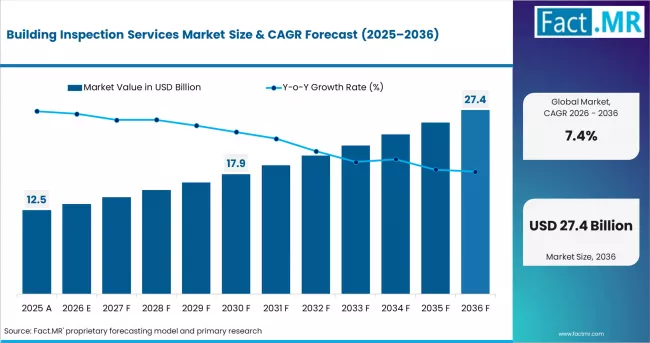
Building Inspection Services Market Market Value Analysis | Source: Fact.MR
Summary of Building Inspection Services Market
- Market Definition
- Market covers structural, electrical, HVAC, plumbing, fire safety, and environmental inspection services across residential, commercial, industrial, and institutional buildings globally.
- Demand Drivers
- Rising global real estate transaction volumes are increasing pre-purchase inspection demand as buyers require formal defect documentation before property acquisition.
- Governments in China, India, and Brazil are tightening building safety regulations, creating mandatory compliance inspection cycles for new and existing structures.
- Insurance companies are mandating periodic structural and systems assessments for property coverage renewal, expanding recurring inspection volume across commercial and institutional segments.
- Key Segments Analyzed
- By Service Type: Structural inspection leads at approximately 34% share in 2026, driven by mandatory safety compliance requirements across all building categories.
- By Inspection Type: Pre-purchase inspection leads at approximately 29% share, driven by rising real estate transactions and buyer due diligence requirements in residential markets.
- By End-use: Residential leads at approximately 46% share, supported by high housing unit volumes and frequent inspection cycles during buying and selling transactions.
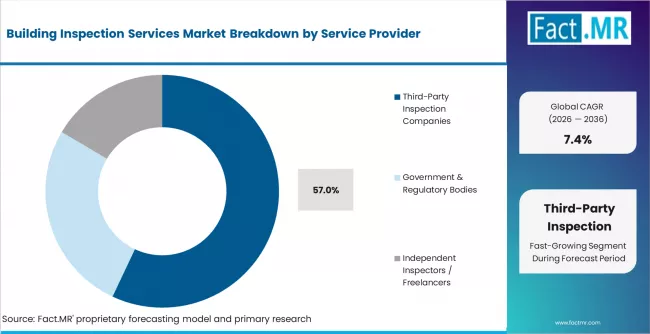
- By Service Provider: Third-party inspection companies lead at approximately 57% share, favoured for specialisation, regulatory certifications, and scalable service delivery.
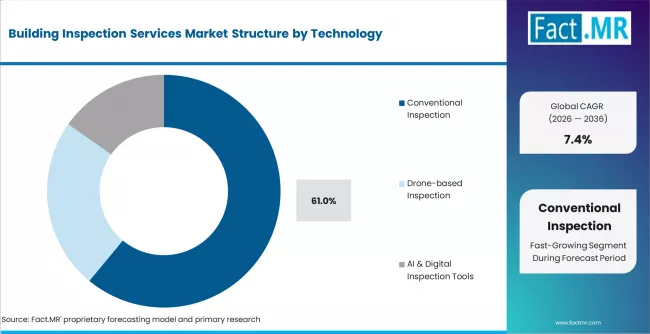
- By Technology: Conventional inspection leads at approximately 61% share in 2026, though AI and drone-based tools are capturing an increasing proportion of commercial and industrial project mandates.
- Analyst Opinion at FACT.MR
- Shambhu Nath Jha, Principal Consultant at Fact.MR, CXOs will observe a widening gap in the market. Technology-enabled inspection firms are moving ahead of traditional players. Conventional methods are struggling to keep pace. Digital reporting is becoming the baseline expectation. Drone-based verification is increasingly standard.
- Strategic Implications
- Invest in drone and AI inspection capabilities targeting commercial and industrial segments where technology-differentiated firms command higher fee rates.
- Develop compliance inspection service lines aligned with municipal building code update cycles in China, India, and Brazil to capture mandatory procurement from new construction.
- Build institutional client programmes for insurance-mandated periodic inspections, creating recurring revenue streams that reduce dependency on real estate transaction cycles.
- Methodology
- Market sizing based on inspection firm revenues and service volume benchmarks by end-use category, validated with 2024–2025 financial and permit data.
- Supported by building permit statistics, real estate transaction data, and regulatory enforcement records from national construction and safety authorities.
- Forecasts incorporate real estate volume trends, building code enforcement tightening, technology adoption curves, and expert inputs from inspection sector professionals.
| Metric | Value |
|---|---|
| Estimated Value in 2026 | USD 12.5 billion |
| Forecast Value in 2036 | USD 25.5 billion |
| Forecast CAGR (2026 to 2036) | 7.4% |
Source: Fact.MR analysis. Updated May 15, 2026
Procurement is shifting toward tech-integrated inspection firms capable of delivering digital reports, AI-annotated defect records, and IoT-based monitoring outputs. Major real estate developers and institutional property owners are increasingly requesting drone-verified structural assessments and software-linked compliance documentation. Firms without digital delivery capability are being displaced from high-value contract pipelines in North America and Western Europe.
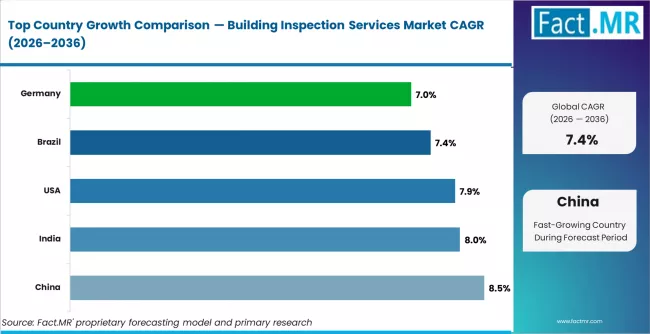
China leads at 8.5% CAGR through 2036, driven by smart city mandates and rapid urbanisation requiring certified safety documentation for new construction. India follows at 8.0%, supported by government housing programmes and expanding regulatory enforcement. The United States records 7.9%, anchored by real estate market depth and strict municipal building codes. Brazil grows at 7.4%, reflecting infrastructure modernisation and regulatory framework expansion. Germany records 7.0%, underpinned by energy efficiency certification requirements and a dense network of accredited inspection organisations. Mature markets in Western Europe face inspector shortage constraints that limit faster volume growth.
Segmental Analysis
Building Inspection Services Market Analysis by Service Type
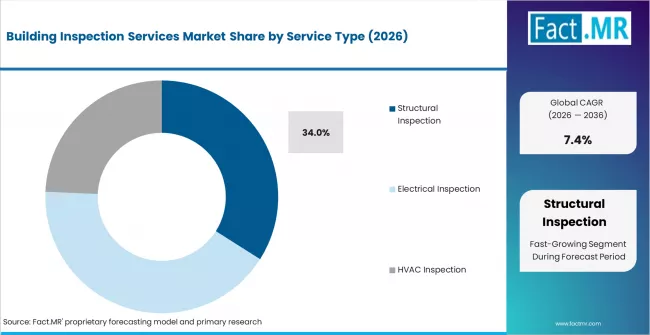
Building Inspection Services Market Analysis By Service Type | Source: Fact.MR
Based on FACT.MR analysis, structural inspection holds approximately 34% share in 2026. This service type leads because structural integrity assessment is a mandatory requirement across pre-purchase, compliance, and insurance inspection categories.
- SGS Capability Expansion: SGS S.A. expanded its building inspection service portfolio in Europe in Q3 2024, integrating structural and fire safety inspection into unified compliance audit packages targeting commercial real estate asset managers. The expansion is linked to growing demand for single-source documentation across multiple inspection categories [4].
- Drone Structural Assessment Launch: Bureau Veritas launched a drone-assisted structural inspection programme in France and Germany in early 2025, targeting tall commercial and industrial buildings where conventional access requires scaffolding. The programme reduces inspection time and cost while meeting insurer documentation standards [5].
- Fire Safety Inspection Growth Trend: Fire safety inspection demand in the UK increased following the Building Safety Act 2022 enforcement milestone in 2024, which extended mandatory fire risk assessment requirements to residential mid-rise buildings. DEKRA and TÜV SÜD both reported expanded UK fire safety inspection contract volumes in 2024 [6].
Building Inspection Services Market Analysis by Inspection Type
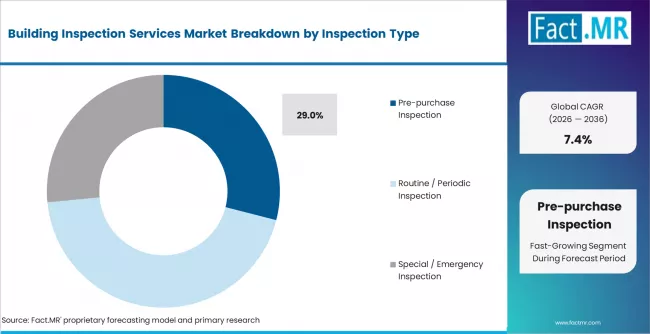
Building Inspection Services Market Analysis By Inspection Type | Source: Fact.MR
Based on FACT.MR analysis, pre-purchase inspection holds approximately 29% share in 2026. This type leads because property transaction volumes in residential markets generate the largest and most consistent inspection demand stream.
- Intertek Real Estate Partnership: Intertek Group Plc expanded residential pre-purchase inspection partnerships with major U.S. real estate platforms in 2024, integrating digital inspection reports into property listing portals. This distribution model reduces client acquisition cost and increases inspection volume per transaction cycle [7].
- Compliance Inspection Programme Growth: The U.S. Department of Housing and Urban Development expanded its housing habitability inspection requirements under federally assisted housing programmes in 2024, increasing compliance inspection mandates for multifamily properties receiving HUD funding [8].
- Periodic Inspection Volume Trend: Commercial property owners in Germany increased periodic inspection frequency in 2024 in response to updated DIN standards for building system maintenance documentation. TÜV SÜD and TÜV Rheinland both reported volume growth in periodic commercial building inspection contracts during 2024 [3].
Building Inspection Services Market Analysis by End-use
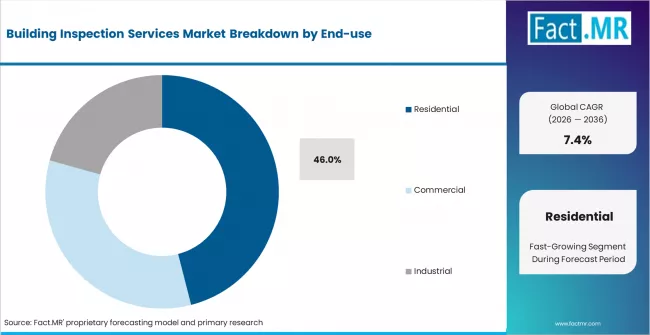
Building Inspection Services Market Analysis By End Use | Source: Fact.MR
Based on FACT.MR analysis, residential end-use holds approximately 46% share in 2026. High housing volume, frequent transactions, and mandatory pre-sale inspections sustain demand leadership.
- Pillar To Post Home Inspectors Expansion: Pillar To Post expanded its residential inspection franchise network across North America in 2025, driven by rising home resale activity and increasing demand for pre-purchase inspection services.
- International Code Council Compliance Update: The International Code Council reinforced residential inspection standards in 2024, increasing mandatory compliance checks for structural and safety parameters in housing transactions.
- SGS S.A. Commercial Inspection Growth: SGS reported increased commercial inspection contracts in 2025, particularly for office and retail properties requiring periodic safety and compliance audits.
Building Inspection Services Market Analysis by Service Provider
Building Inspection Services Market Analysis By Service Provider | Source: Fact.MR
Based on FACT.MR analysis, third-party inspection companies hold approximately 57% share in 2026. These firms dominate due to certification, scalability, and regulatory alignment.
- Bureau Veritas Contract Expansion: Bureau Veritas secured multi-year third-party inspection contracts for infrastructure and public buildings across Europe in 2025, reinforcing demand for accredited inspection providers.
- Intertek Group Plc Digital Inspection Integration: Intertek introduced integrated digital inspection services in 2024, combining on-site assessment with cloud-based reporting systems for institutional clients.
- TÜV SÜD AG Industrial Advisory Bundling: TÜV SÜD expanded bundled engineering and inspection services in Asia Pacific in 2025, targeting manufacturing and logistics facilities requiring compliance and technical advisory support.
Building Inspection Services Market Analysis by Technology
Building Inspection Services Market Analysis By Technology | Source: Fact.MR
Based on FACT.MR analysis, conventional inspection holds approximately 61% share in 2026. Manual inspection methods remain dominant in residential and routine commercial inspection due to established regulatory acceptance and lower per-assignment cost.
- DNV Digital Inspection Launch: DNV Group AS launched an AI-assisted building inspection reporting tool in early 2025 for industrial and infrastructure assets, integrating image recognition for defect classification with automated compliance cross-referencing against relevant national building codes.
- Applus+ Drone Programme: Applus+ expanded its drone-based inspection service offering across Spain and Latin America in mid-2024, targeting industrial facilities and large commercial structures. The programme is positioned as a cost reduction solution for clients with large multi-site property portfolios.
- IoT Monitoring Adoption Trend: UL Solutions Inc. reported growing demand for IoT-enabled structural health monitoring integration within building inspection contracts in North America through 2024, particularly for new commercial developments where clients seek continuous safety data between scheduled inspection cycles.
Drivers, Restraints, and Opportunities
Building Inspection Services Market Opportunity Matrix Growth Vs Value | Source: Fact.MR
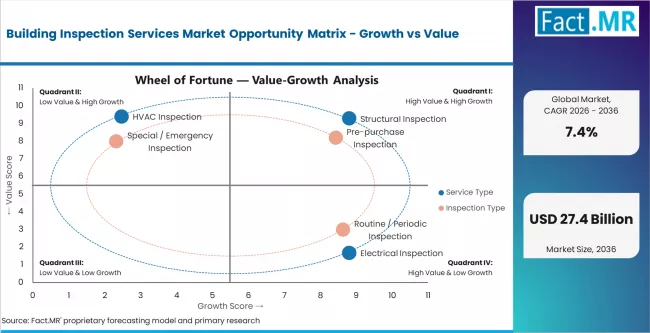
FACT.MR analysis indicates the building inspection services market has grown steadily on the foundation of real estate transaction volumes and municipal safety code enforcement. Demand is broadly distributed across residential, commercial, and industrial end uses.
Conventional inspection services still dominate volume but face margin pressure as technology-integrated firms enter high-value commercial segments. Drone-based and AI-assisted inspection tools are reducing time-on-site per assignment while generating more detailed defect documentation.
- Building Code Enforcement Tightening: The International Code Council released updated I-Codes in 2024 incorporating stricter structural and fire safety assessment requirements for residential and commercial buildings in jurisdictions across North America [1].
- Smart City and Green Building Certification: China's Ministry of Housing and Urban-Rural Development issued expanded green building inspection guidelines in 2024, requiring certified energy and environmental assessments for new commercial projects in pilot smart city zones [2].
- Insurance-Driven Periodic Inspection Demand: U.S. property and casualty insurers tightened structural inspection requirements for policy renewal in 2024, following significant weather event loss events.
Regional Analysis
.webp "Top Country Growth Comparison Building Inspection Services Market Cagr (2026 2036)")
Top Country Growth Comparison Building Inspection Services Market Cagr (2026 2036) | Source: Fact.MR
The building inspection services market is assessed across North America, Europe, Asia Pacific, Latin America, and Middle East and Africa, covering 40+ countries with distinct demand profiles shaped by real estate transaction volumes, building safety regulation intensity, technology adoption levels, and public infrastructure investment scale. The full report offers market attractiveness analysis by region and country.
| Country | CAGR (2026 to 2036) |
|---|---|
| China | 8.5% |
| India | 8.0% |
| United States | 7.9% |
| Brazil | 7.4% |
| Germany | 7.0% |
Source: Fact.MR analysis. Updated May 15, 2026
Source: Fact.MR (FACT.MR) analysis, based on proprietary forecasting model and primary research
Building Inspection Services Market Cagr Analysis By Country | Source: Fact.MR
Asia Pacific Building Inspection Services Market Analysis
- China: China is set to grow at 8.5% CAGR through 2036, leading among major markets. Regulatory tightening is accelerating inspection demand. Green building guidelines now mandate certified assessments in smart city zones. High-rise residential safety rules have become stricter. Developers and local authorities are increasing inspection procurement. SGS S.A. and Bureau Veritas are expanding through local partnerships. Urban renewal projects are adding demand for structural and environmental checks.
- India: India is projected to expand at 8.0% CAGR through 2036. Housing programmes are driving large-scale construction activity. Post-construction inspection demand is rising sharply. Updated NBC guidelines are strengthening compliance requirements. Commercial and institutional inspections are increasing in metro cities. TÜV SÜD AG and Intertek Group Plc are scaling local service capacity. RERA enforcement is adding mandatory inspection at project handover stages.
FACT.MR covers China, India, Japan, South Korea, ASEAN, and Australia and New Zealand. Readers can access regulatory trends, urbanisation data, and inspection benchmarks.
North America Building Inspection Services Market Analysis
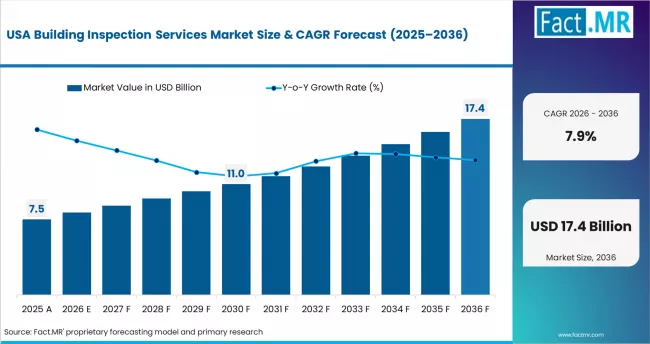
Building Inspection Services Market Country Value Analysis | Source: Fact.MR
North America leads in revenue and compliance maturity. Demand is driven by strict building codes and insurance-linked inspections. Technology adoption is increasing across inspection workflows. The U.S. remains the primary demand center.
- United States: The U.S. is forecast to grow at 7.9% CAGR through 2036. Updated building codes are expanding mandatory inspection scope. Federal housing programmes are increasing compliance checks. Insurance-driven inspections are also rising. UL Solutions Inc. is expanding service capacity through acquisitions. Commercial and residential inspection demand remains strong. Growth is supported by regulation and real estate activity.
FACT.MR covers the United States, Canada, and Mexico. Readers can find code enforcement data, insurance trends, and technology adoption insights.
Europe Building Inspection Services Market Analysis
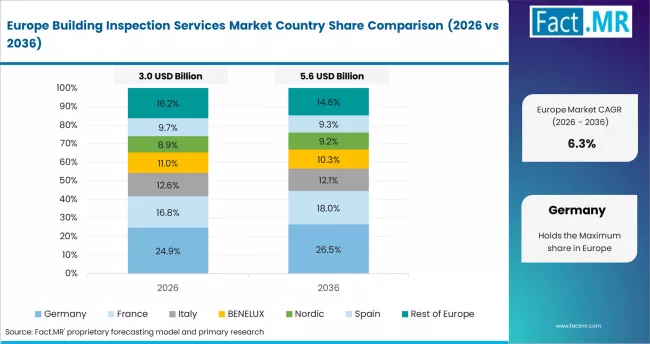
Building Inspection Services Market Europe Country Market Share Analysis, 2026 & 2036 | Source: Fact.MR
Europe is a compliance-intensive and certification-driven market where regulatory frameworks define service specifications and procurement standards. Energy efficiency directives and fire safety legislation are expanding mandatory inspection scope across the residential and commercial sectors.
- Germany: Demand for building inspection services in Germany is projected to rise at 7.0% CAGR through 2036. Energy efficiency laws are increasing inspection requirements for existing buildings. Subsidy-linked renovations are driving structural assessments. Commercial property owners face stricter maintenance documentation rules. TÜV SÜD AG and TÜV Rheinland AG report rising inspection demand. Growth is steady and regulation-led.
Fact.MR's analysis of the building inspection services market in Europe covers Germany, France, the UK, Italy, Spain, Nordic Countries, and BENELUX. Readers can find energy efficiency regulation impacts, fire safety mandate trends, and service provider competitive positioning.
Latin America Building Inspection Services Market Analysis
Latin America is an emerging growth region driven by urbanisation, infrastructure upgrades, and tightening safety regulations. Demand is expanding across residential, commercial, and public infrastructure projects. Governments are strengthening compliance frameworks to improve building safety and quality standards.
- Brazil: Brazil is projected to grow at 7.4% CAGR through 2036. Housing expansion programmes are driving large volumes of new construction. Updated ABNT standards are increasing mandatory periodic inspections for aging buildings. Urban redevelopment projects are creating demand for structural assessments. Bureau Veritas is expanding local inspection capacity. Infrastructure investment under federal programmes is sustaining long-term inspection demand.
FACT.MR covers Brazil, Mexico, Chile, Argentina, and Rest of Latin America. Readers can find urbanisation trends, infrastructure investment data, and regulatory inspection mandates across the region.
Competitive Aligners for Market Players
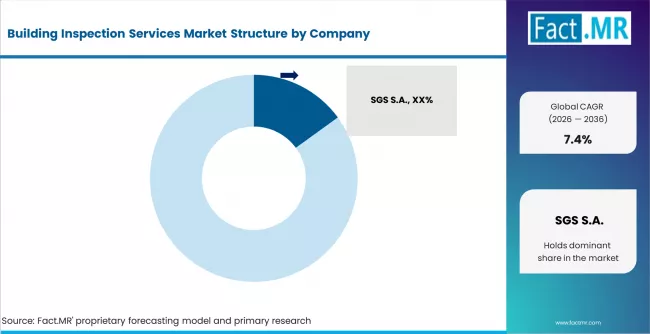
Building Inspection Services Market Analysis By Company | Source: Fact.MR
Competitive alignment in the building inspection services market is increasingly defined by technology adoption, regulatory positioning, and service integration depth. The market is moving away from purely manual inspection toward digitally enabled and data-driven service models. Companies that adapt early to this shift are gaining a clear advantage.
Large global players such as SGS S.A., Bureau Veritas, and Intertek Group Plc are focusing on digital inspection ecosystems. This includes drone-based inspections, AI-driven defect detection, and cloud-based reporting. These tools improve efficiency and accuracy. They also meet growing client expectations for faster and more detailed insights.
Mid-tier players are aligning through specialization and partnerships. TÜV SÜD AG and DEKRA SE are combining inspection with engineering and compliance advisory services. This helps increase contract value and reduce pricing pressure. Many firms are also partnering with technology providers to expand capabilities.
Procurement is shifting toward long-term and compliance-driven contracts. Institutional clients prefer certified vendors with standardized processes. This benefits companies with strong accreditation and global reach. Pricing is becoming divided. Technology-enabled services command higher value. Traditional inspection services face margin pressure. Companies are increasingly bundling inspection with monitoring and analytics. Competitive advantage now depends on digital capability, compliance strength, and integrated service delivery.
Key Players
- SGS S.A.
- Intertek Group Plc
- Bureau Veritas
- TÜV SÜD AG
- TÜV Rheinland AG
- DEKRA SE
- DNV Group AS
- UL Solutions Inc.
- Applus+
- Eurofins Scientific SE
Building Inspection Services Market by Segments
By Service Type:
- Structural Inspection
- Electrical Inspection
- HVAC Inspection
- Plumbing Inspection
- Fire Safety Inspection
- Environmental & Energy Inspection
By Inspection Type:
- Pre-purchase Inspection
- Routine / Periodic Inspection
- Special / Emergency Inspection
- Compliance Inspection
- Insurance Inspection
By End-use:
- Residential
- Commercial
- Industrial
- Institutional (schools, hospitals, government buildings)
By Service Provider:
- Third-party Inspection Companies
- Government & Regulatory Bodies
- Independent Inspectors / Freelancers
- Engineering & Consulting Firms
By Technology:
- Conventional Inspection
- Drone-based Inspection
- AI & Digital Inspection Tools
- IoT-enabled Monitoring
By Region:
- North America
- United States
- Canada
- Mexico
- Latin America
- Brazil
- Mexico
- Argentina
- Chile
- Rest of Latin America
- Western Europe
- Germany
- United Kingdom
- France
- Italy
- Spain
- Nordic Countries
- BENELUX
- Rest of Western Europe
- Eastern Europe
- Russia
- Poland
- Hungary
- Balkan and Baltic
- Rest of Eastern Europe
- East Asia
- China
- Japan
- South Korea
- South Asia and Pacific
- India
- ASEAN
- Australia and New Zealand
- Rest of South Asia and Pacific
- Middle East and Africa
- Kingdom of Saudi Arabia
- Other GCC Countries
- Turkey
- South Africa
- Rest of Middle East and Africa
Bibliography
- [1] International Code Council. (2024). 2024 I-Codes Update: Revised Structural and Fire Safety Assessment Requirements for Residential and Commercial Buildings Across Participating U.S. Jurisdictions. iccsafe.org/codes-tech-support/codes/2024-ibc-ifc
- [2] Ministry of Housing and Urban-Rural Development, China. (2024). Green Building Safety Inspection Guidelines Update: Certified Environmental and Structural Assessment Requirements for New Commercial Developments in Smart City Pilot Zones. mohurd.gov.cn/english
- [3] Bureau Veritas. (2024). Interim Results 2024: Building and Infrastructure Inspection Segment Revenue Including Insurance-Mandated Structural Assessment Volume Growth in North America and Periodic Commercial Inspection Expansion in Germany. bureauveritas.com/investors
- [4] SGS S.A. (Q3 2024). Service Expansion Announcement: Integrated Structural and Fire Safety Compliance Audit Package Launch for European Commercial Real Estate Asset Managers Combining Multiple Inspection Categories Under Unified Documentation. sgs.com/news
- [5] Bureau Veritas. (Early 2025). Programme Launch: Drone-Assisted Structural Inspection Service for Tall Commercial and Industrial Buildings in France and Germany Meeting Insurer Documentation Standards with AI-Annotated Defect Reports. bureauveritas.com/news
- [6] Building Safety Act 2022. (2024). Enforcement Milestone: Extension of Mandatory Fire Risk Assessment Requirements to Mid-Rise Residential Buildings in England Including Inspection Documentation Standards for Registered Building Inspectors. legislation.gov.uk/ukpga/2022/30
- [7] Intertek Group Plc. (2024). Annual Report 2024: Residential Pre-Purchase Inspection Partnership Expansion with U.S. Real Estate Platforms Including Digital Report Integration and Transaction-Linked Volume Growth. intertek.com/investors
- [8] U.S. Department of Housing and Urban Development. (2024). Housing Habitability Inspection Requirements Update: Strengthened Structural and Systems Assessment Mandates for Federally Assisted Multifamily Properties Under HUD Funding Programmes. hud.gov/building-inspection
This Report Addresses
- Strategic intelligence on building inspection services demand across structural, electrical, HVAC, plumbing, fire safety, and environmental inspection categories for residential, commercial, industrial, and institutional buildings globally.
- Market forecast from USD 12.5 billion in 2026 to USD 25.5 billion by 2036, at a CAGR of 7.4%.
- Growth opportunity mapping across China smart city mandates, India housing programme expansion, U.S. code enforcement updates, Germany energy efficiency certification, and Brazil infrastructure modernisation.
- Segment analysis by service type, inspection type, end-use, service provider, and technology across global and regional markets.
- Regional outlook covering Asia Pacific urbanisation-led compliance growth, North America real estate and insurance-driven demand, and Europe regulation-linked certification expansion.
- Competitive analysis of SGS, Bureau Veritas, Intertek, TÜV SÜD, TÜV Rheinland, DEKRA, DNV, UL Solutions, Applus+, and Eurofins covering accreditation depth, technology integration, and institutional contract positioning.
- Regulatory analysis covering U.S. ICC I-Codes 2024 updates, China MOHURD green building guidelines, Germany GEG energy performance requirements, UK Building Safety Act enforcement, and India NBC 2025 standards.
- Report delivered in PDF, Excel, and presentation formats supported by validated firm revenue data, building permit statistics, regulatory enforcement records, and primary industry expert interviews.
Segmentation
Scope of Report
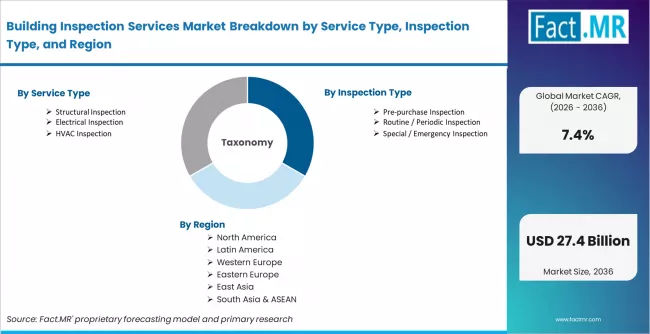
Building Inspection Services Market Breakdown By Service Type, Inspection Type, And Region | Source: Fact.MR
| Attribute | Details |
|---|---|
| Quantitative Units | USD 12.5 billion (2026) to USD 25.5 billion (2036), at a CAGR of 7.4% |
| Market Definition | Professional inspection services covering structural, electrical, HVAC, plumbing, fire safety, and environmental assessment of residential, commercial, industrial, and institutional buildings supplied by third-party firms, government bodies, and independent inspectors globally. |
| Service Type Segmentation | Structural Inspection, Electrical Inspection, HVAC Inspection, Plumbing Inspection, Fire Safety Inspection, Environmental & Energy Inspection |
| Inspection Type Segmentation | Pre-purchase Inspection, Routine / Periodic Inspection, Special / Emergency Inspection, Compliance Inspection, Insurance Inspection |
| End-use Segmentation | Residential, Commercial, Industrial, Institutional |
| Service Provider Segmentation | Third-party Inspection Companies, Government & Regulatory Bodies, Independent Inspectors / Freelancers, Engineering & Consulting Firms |
| Technology Segmentation | Conventional Inspection, Drone-based Inspection, AI & Digital Inspection Tools, IoT-enabled Monitoring |
| Application Coverage | Real estate pre-purchase due diligence, mandatory compliance checks, post-construction safety certification, insurance risk assessment, and periodic structural and systems maintenance inspections. |
| Regions Covered | North America, Europe, Asia Pacific, Latin America, Middle East and Africa |
| Countries Covered | USA, Canada, Mexico, Germany, UK, France, Italy, Spain, Nordic, BENELUX, China, Japan, South Korea, India, ASEAN, Australia and New Zealand, Brazil, Argentina, Chile, Saudi Arabia, GCC, Turkey, South Africa, Rest of MEA |
| Key Companies Profiled | SGS S.A., Intertek Group Plc, Bureau Veritas, TÜV SÜD AG, TÜV Rheinland AG, DEKRA SE, DNV Group AS, UL Solutions Inc., Applus+, Eurofins Scientific SE |
| Forecast Period | 2026 to 2036 |
| Approach | Hybrid top-down and bottom-up model using inspection firm revenues, service volume benchmarks by end-use type, average fee data by service and region, regulatory compliance data, and primary interviews with inspection professionals and procurement managers. |
Source: Fact.MR analysis. Updated May 15, 2026
Frequently Asked Questions
How big is the size of the building inspection services market in 2024?
What is the demand forecast for building inspection services for 2034?
At what CAGR is demand for building inspection services projected to accelerate?
What is the contribution of North America to global market revenue?
What is the evaluated growth rate of building inspection services in Japan?
How much share of the global market is projected to be held by building inspection services in the detection segment?
Who are some of the leading market players?
Who worked on this report


Preview the report firsthand - request a free sample
Free SampleGet the brochure for pricing and purchase details
Download PDF