- Estimated Value(2026): 932.6 Bn
- Forecast Value (2036): 1639.0 Bn
- CAGR (2026 - 2036): 5.8%
Real Estate Brokerage Market Size, Market Forecast and Outlook by Fact.MR
- The real estate brokerage market crossed a valuation of USD 883.2 billion in 2025.
- Demand is estimated to reach USD 932.6 billion in 2026 and is projected to rise to USD 1,639.0 billion by 2036.
- The market is forecast to record 5.8% CAGR from 2026 to 2036 as digital property search and agent-led transaction support expand.
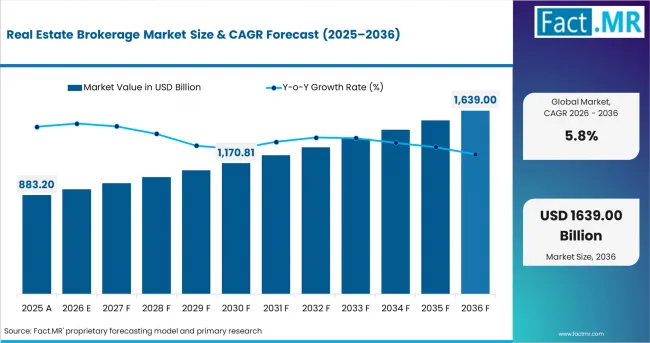
Real Estate Brokerage Market Value Analysis | Source: Fact.MR
| Metric | Details |
|---|---|
| Industry Size 2026 | USD 932.6 billion |
| Industry Value 2036 | USD 1,639.0 billion |
| CAGR 2026 to 2036 | 5.8% |
Source: Fact.MR analysis. Updated Jun 8, 2026
Summary of Real Estate Brokerage Market
- Demand Drivers in the Market
- Digital Property Search: Online listings help property seekers compare homes before contacting brokers for negotiation support.
- Transaction Complexity: Property owners need pricing guidance and documentation support during sale or leasing decisions.
- Commercial Leasing: Investors and occupiers use brokerage firms for location search and market insights.
- Key Segments Analyzed
- By Mode of Service: Online services are expected to hold 56.0% share in 2026 as digital listings support faster property discovery.
- By Property Type: Residential properties are likely to account for 64.0% share in 2026 because home sales and rentals create high transaction volume.
- By Service Provider: Organizations are projected to hold 58.0% share in 2026 as agencies and franchise networks offer wider local coverage.
- By Transaction Type: Sales brokerage is anticipated to capture 52.0% share in 2026 because property owners need support for pricing and negotiation.
- By Service User: Home seekers are expected to hold 45.0% share in 2026 since residential search remains the main brokerage use case.
- By Geography: China is projected to record 6.9% CAGR through 2036 as digital property platforms and urban housing activity support brokerage demand.
- Analyst Opinion at Fact.MR
- Shambhu Nath Jha, Principal Consultant at Fact.MR, states, “Real estate brokerage demand is moving from property matching to transaction confidence. Property seekers can find listings online but documentation still needs professional support. Firms that combine digital reach with local market knowledge will gain stronger transaction access.”
- Strategic Implications
- Digital Reach: Brokerage firms need listing tools and customer tracking systems that help agents respond faster during property search and negotiation.
- Local Expertise: Agencies should build neighborhood-level pricing knowledge because transaction confidence depends on accurate market comparison.
- Compliance Readiness: Broker networks need clearer representation agreements and fee communication as service transparency becomes more important.
Real estate brokerage demand is shifting from listing access to transaction support. Brokers help property seekers compare homes and negotiate terms. Commercial brokerage firms support leasing and investment sales with local market data.
China is projected to record 6.9% CAGR through 2036 as digital property platforms and urban housing activity support brokerage demand. India is likely to post 6.4% CAGR because affordable housing and urban migration support residential brokerage. The United States is expected to register 5.7% CAGR by 2036 as agent-assisted transactions and MLS changes reshape service models. The United Kingdom is set to grow at 5.4% CAGR as digital listings and registered transaction data support agency work. Germany is anticipated to record 5.2% CAGR since property price recovery supports advisory-led brokerage.
Segmental Analysis
Real Estate Brokerage Market Analysis by Mode of Service
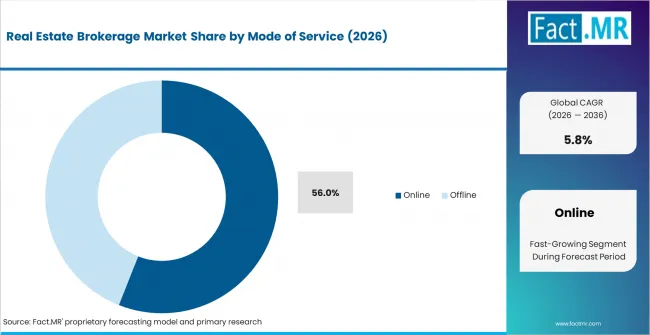
Real Estate Brokerage Market Analysis By Mode Of Service | Source: Fact.MR
Online services are expected to hold 56.0% share in 2026 as digital listings make property search faster. Property seekers often start on web portals and mobile apps before contacting agents. NAR’s 2025 profile found that most home seekers found their homes through online searches, followed by real estate agents. [1] Offline brokerage remains important for negotiation and closing support. Hybrid service models are gaining as brokers combine online leads with local field support. Mode choice depends on property type and transaction complexity.
- Online Discovery: Online brokerage platforms help property seekers compare homes faster before contacting agents for pricing and negotiation support.
- Offline Guidance: Offline brokers support property visits and local market advice during complex residential transactions.
- Hybrid Service: Hybrid models connect digital leads with agent support to improve conversion during property visits and closing steps.
Real Estate Brokerage Market Analysis by Property Type
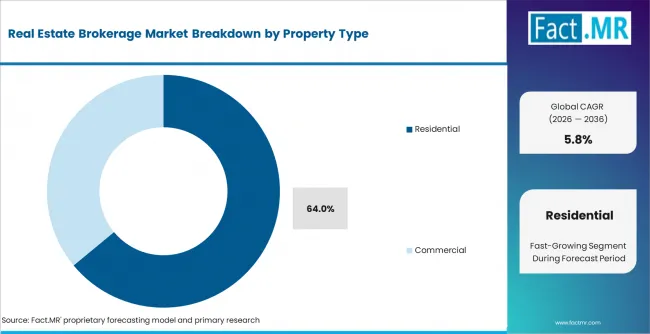
Real Estate Brokerage Market Analysis By Property Type | Source: Fact.MR
Residential brokerage continues to lead because home sales and rental searches create frequent transaction needs. Commercial brokerage has higher deal value because leasing and investment sales need deeper advisory work. Residential properties are likely to account for 64.0% share in 2026 because households need support for buying and leasing homes. The U.S. Bureau of Labor Statistics states that most real estate brokers and sales agents sell residential property, and others handle commercial property. [2] Commercial brokerage will gain from office and retail leasing mandates.
- Residential Search: Residential brokerage supports home search and closing coordination for households.
- Commercial Advisory: Commercial brokerage needs strong market data because leasing and investment deals depend on location and yield.
- Rental Support: Rental brokerage helps tenants compare availability and location suitability in competitive urban markets.
Real Estate Brokerage Market Analysis by Service Provider
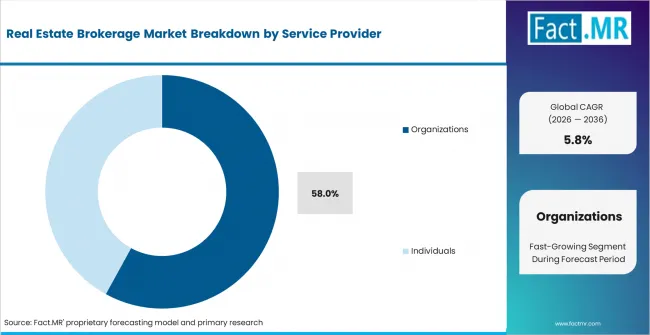
Real Estate Brokerage Market Analysis By Service Provider | Source: Fact.MR
Agency networks and organized brokerage companies are gaining because property transactions need brand trust and wider listing access. Organizations are projected to hold 58.0% share in 2026 as agencies and franchise networks offer wider local coverage. RE/MAX Holdings stated in its 2025 Form 10-K that the RE/MAX brand had over 145,000 agents in more than 8,500 offices across over 120 countries and territories. [3] Individual brokers remain important in neighborhood-focused residential markets. Organized firms use technology platforms and marketing support to attract transactions. Service provider choice depends on transaction value and location depth.
- Agency Scale: Brokerage organizations combine local agents and brand support to handle higher transaction volumes.
- Individual Brokers: Independent brokers remain useful in local residential markets through referrals and neighborhood knowledge.
- Commercial Firms: Large brokerage firms support corporate occupiers and investors through leasing and advisory services.
Real Estate Brokerage Market Analysis by Transaction Type
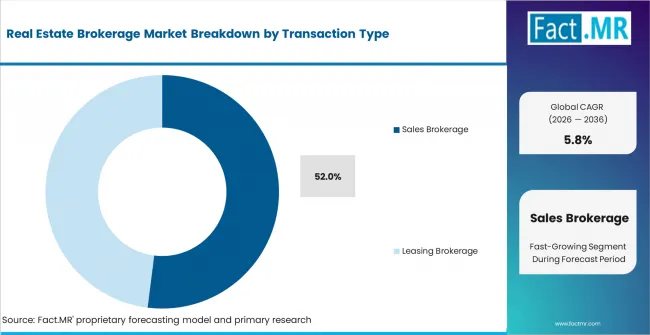
Real Estate Brokerage Market Analysis By Transaction Type | Source: Fact.MR
Sales brokerage is anticipated to capture 52.0% share in 2026 as property owners need help with pricing and negotiation. Sale transactions often need valuation guidance and listing support. Viewing coordination and offer management add to service demand. The U.S. Bureau of Labor Statistics states that real estate brokers and sales agents help clients buy and rent properties. [4] Leasing brokerage supports tenant search and occupancy decisions. Investment brokerage serves commercial assets and income-generating properties. Fee models change by transaction type because leasing and investment work need different service depth.
- Sales Support: Sales brokerage helps property owners price assets and complete negotiations with stronger market context.
- Leasing Activity: Leasing brokerage supports tenants and landlords during location search and lease term review.
- Investment Deals: Investment brokerage needs asset knowledge and financial analysis for commercial property transactions.
Real Estate Brokerage Market Analysis by Service User
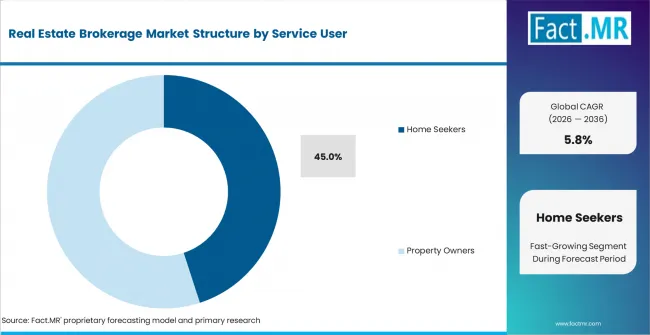
Real Estate Brokerage Market Analysis By Service User | Source: Fact.MR
Home seekers are expected to hold 45.0% share in 2026 as residential search remains the main brokerage use case. Property owners need brokers for pricing and listing support. Tenants use brokers to compare rental locations and lease terms. Compass stated in its 2025 Form 10-K that it generates revenue by helping home sellers and buyers through agents with listing and finding homes. [5] Investors need brokerage firms for acquisition and disposal mandates. Demand changes with affordability and transaction confidence. Brokers gain repeat access by reducing uncertainty around pricing and negotiation.
- Home Seekers: Home seekers use brokers to compare neighborhoods and negotiate property terms with better local context.
- Property Owners: Property owners need pricing guidance and listing support before placing homes or commercial assets on the market.
- Investor Use: Property investors rely on brokerage firms for asset sourcing and local market intelligence.
Real Estate Brokerage Market Drivers, Restraints, and Opportunities
Real Estate Brokerage Market Opportunity Matrix Growth Vs Value | Source: Fact.MR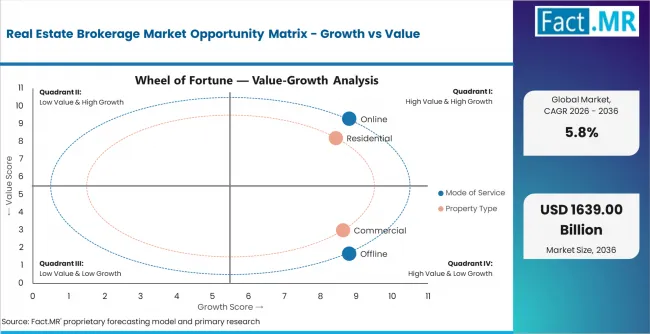
Fee pressure can restrain brokerage revenue. Clear fee communication may change how residential brokerage services are sold. Some clients may compare service costs more closely before choosing an agent.
Opportunities in the Real Estate Brokerage Market
- Digital Listing Tools: Brokerages can improve lead quality through better property data and faster agent response systems.
- Rental Brokerage: Agencies can serve urban tenants with verified listings and clearer lease comparison tools.
- Commercial Advisory: Brokerage firms can expand advisory services for investors seeking leasing support and capital markets guidance.
Regional Analysis
Based on regional analysis, the real estate brokerage market is segmented into North America, Latin America, Europe, East Asia, South Asia and Pacific, and Middle East and Africa.
.webp "Top Country Growth Comparison Real Estate Brokerage Market Cagr (2026 2036)")
Top Country Growth Comparison Real Estate Brokerage Market Cagr (2026 2036) | Source: Fact.MR
| Country | CAGR 2026 to 2036 |
|---|---|
| China | 6.9% |
| India | 6.4% |
| United States | 5.7% |
| United Kingdom | 5.4% |
| Germany | 5.2% |
Source: Fact.MR analysis. Updated Jun 8, 2026
Source: Fact.MR analysis, based on forecast approach and primary research.
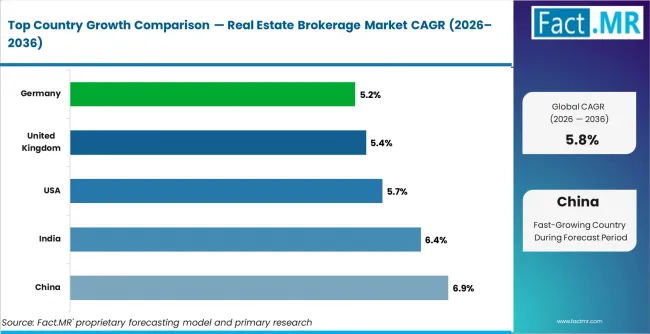
Real Estate Brokerage Market Cagr Analysis By Country | Source: Fact.MR
East Asia Real Estate Brokerage Market Analysis
East Asia demand comes from digital property search and housing market adjustment. China supports regional brokerage demand through large urban markets and active online listings. Brokers need strong local data and transaction support.
- China: China is projected to record 6.9% CAGR through 2036 as digital property platforms and urban housing activity support brokerage demand. Residential investment still forms an important part of the sector despite market correction. Brokers will need better pricing discipline as property seekers compare more listings online. Brokerage firms with verified listings and local market data can build stronger trust. Digital agencies will compete on speed and listing quality.
South Asia and Pacific Real Estate Brokerage Market Analysis
South Asia and Pacific demand is led by India. Urban migration and digital listing platforms support residential brokerage use. Brokers serve both home ownership and rental needs in growing cities.
- India: Affordable housing and city migration are widening brokerage demand in India. The country is likely to record 6.4% CAGR through 2036 as home search and rental activity expand. Brokers will support home seekers with location guidance and price comparison.
North America Real Estate Brokerage Market Analysis
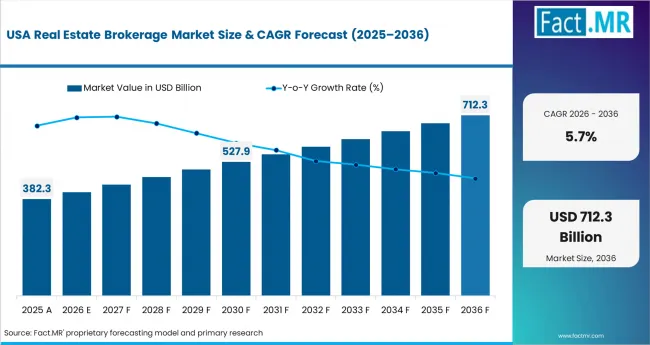
Real Estate Brokerage Market Country Value Analysis | Source: Fact.MR
North America demand is supported by the United States. Agent-assisted transactions remain important because home search and representation rules need clearer service communication. Digital tools are changing lead generation.
- United States: The United States is expected to grow at 5.7% CAGR from 2026 to 2036 as agent-assisted transactions and MLS changes reshape service models. Online search will continue to generate leads for agents. Residential brokers will compete on pricing advice and local negotiation skill. Commercial brokerage will gain from leasing and investment sales support in major metros. Clear service communication will decide client trust.
Europe Real Estate Brokerage Market Analysis
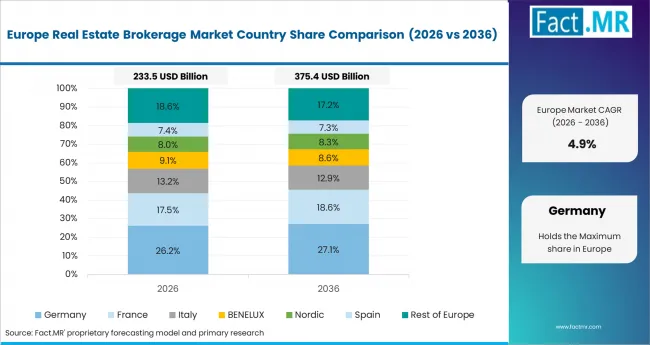
Real Estate Brokerage Market Europe Country Market Share Analysis, 2026 & 2036 | Source: Fact.MR
Europe demand is supported by digital property records and established agency networks. The United Kingdom and Germany need brokerage services for home transactions and commercial property advisory. Transparency and data access are becoming more important.
- United Kingdom: Digital listings and registered transaction data support agency work in the United Kingdom. The market is set to grow at 5.4% CAGR through 2036 as home seekers and property owners use agents for pricing and negotiation. Brokers will need lompare.ocal knowledge as digital tools make listings easier to c Estate agencies with verified data support will gain trust.
- Germany: Germany is anticipated to record 5.2% CAGR by 2036 as property price recovery supports advisory-led brokerage. Rising prices can improve seller confidence and transaction interest. Brokerage demand will come from residential sales and commercial advisory work. German agencies need accurate pricing because affordability remains sensitive. Commercial firms can gain through leasing and valuation support.
Competitive Aligners for Market Suppliers
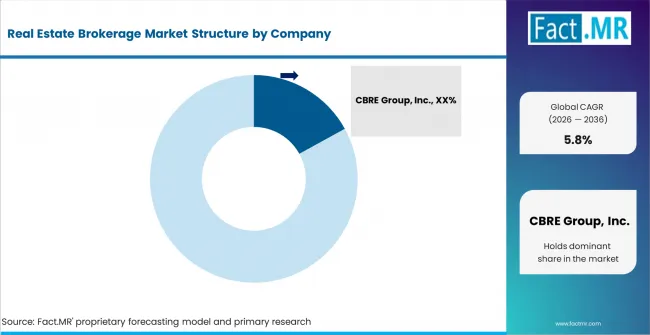
Real Estate Brokerage Market Analysis By Company | Source: Fact.MR
The real estate brokerage market includes residential agencies and commercial brokerage firms. CBRE Group Inc. and JLL are active in real estate brokerage and advisory services. Newmark Group Inc. and Cushman & Wakefield plc serve commercial property clients. Colliers International Group Inc. and Savills plc support brokerage through leasing and investment services.
By 2036, firms with digital platforms and stronger agent training will gain better transaction access. Residential brokerages must adapt to clearer service agreements. Commercial firms will gain from advisory-led work tied to leasing and investment sales.
Key Companies in Real Estate Brokerage Market
- CBRE Group, Inc.
- JLL
- Newmark Group, Inc.
- Cushman & Wakefield plc
- Colliers International Group Inc.
- Savills plc
Bibliography
- [1] National Association of Realtors. (2025, November). 2025 profile of home buyers and sellers: Highlights.
- [2] U.S. Bureau of Labor Statistics. (2025, August 28). Real estate brokers and sales agents. Occupational Outlook Handbook.
- [3] RE/MAX Holdings, Inc. (2026). Annual report 2025: Form 10-K. U.S. Securities and Exchange Commission.
- [4] U.S. Bureau of Labor Statistics. (2025). Real estate brokers and sales agents. Occupational Outlook Handbook.
- [5] Compass, Inc. (2025, February 25). Annual report 2024: Form 10-K. U.S. Securities and Exchange Commission.
This Report Addresses
- Strategic intelligence on real estate brokerage demand across residential and commercial transactions.
- Growth opportunity mapping across China, India, the United States, the United Kingdom, and Germany.
- Segment analysis by mode of service, property type, service provider, transaction type, and service user.
- Regional outlook covering digital property search, residential brokerage, commercial leasing, and transaction advisory.
- Competitive analysis of CBRE Group, Inc., JLL, Newmark Group, Inc., Cushman & Wakefield plc, Colliers International Group Inc., Savills plc.
- Service assessment covering online brokerage, offline agency support, sales brokerage, leasing brokerage, and investment brokerage.
- Primary interviews, broker checks, and official source review support validation.
Real Estate Brokerage Market Definition
The real estate brokerage market covers services that help property owners and investors complete property sales or leasing transactions. Brokers support property listings and transaction closing. The market includes residential and commercial brokerage delivered through online and offline service models.
Real Estate Brokerage Market Inclusions
The scope includes online and offline brokerage services. Residential and commercial property brokerage are included. Individual brokers and organized commercial advisory firms are covered. Sales brokerage and advisory-led brokerage are included.
Real Estate Brokerage Market Exclusions
The scope excludes real estate development and construction. It excludes property management services unless tied to brokerage mandates. Mortgage origination and title insurance are outside scope when sold as stand-alone services. Pure listing portals are excluded if no brokerage or agent support is offered.
Real Estate Brokerage Market Research Methodology
- Primary Research
- Primary research includes interviews with residential brokers and commercial agency heads. Franchise network managers were reviewed separately.
- Desk Research
- Desk research reviews housing transaction data and official real estate sources. Company filings support competitive validation.
- Market-Sizing and Forecasting
- Forecasting uses service mode demand and property type uptake. Service provider structure and transaction type support the forecast approach.
- Data Validation and Update Cycle
- Forecasts are validated through brokerage interviews and transaction activity checks. Regional assumptions are reviewed against housing sales data and digital brokerage adoption.
Segmentation
Scope of the Report
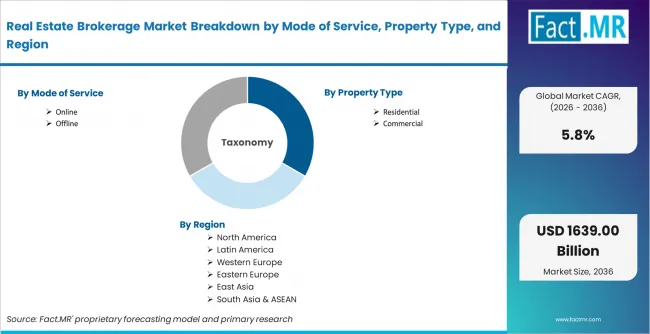
Real Estate Brokerage Market Breakdown By Mode Of Service, Property Type, And Region | Source: Fact.MR
| Attribute | Details |
|---|---|
| Quantitative Units | USD 932.6 billion in 2026 to USD 1,639.0 billion by 2036 at 5.8% CAGR |
| Market Definition | Brokerage services that support property sales, leasing, listing, negotiation, and transaction coordination |
| Mode of Service | Online, Offline |
| Property Type | Residential, Commercial |
| Service Provider | Individuals, Organizations |
| Transaction Type | Sales Brokerage, Leasing Brokerage, Investment Brokerage, Advisory-led Brokerage |
| Service User | Home Seekers, Property Owners, Tenants, Property Investors |
| Regions Covered | North America, Latin America, Europe, East Asia, South Asia and Pacific, Middle East and Africa |
| Countries Covered | China, India, United States, United Kingdom, Germany |
| Key Companies Profiled | CBRE Group, Inc., JLL, Newmark Group, Inc., Cushman & Wakefield plc, Colliers International Group Inc., Savills plc |
| Forecast Period | 2026 to 2036 |
| Approach | Hybrid top-down and bottom-up approach using service mode demand, property type, service provider structure, transaction type, and regional validation |
Source: Fact.MR analysis. Updated Jun 8, 2026
Real Estate Brokerage Market Analysis by Segments
-
By Mode of Service:
- Online
- Offline
-
By Property Type:
- Residential
- Commercial
-
By Service Provider:
- Individuals
- Organizations
-
By Transaction Type:
- Sales Brokerage
- Leasing Brokerage
- Investment Brokerage
- Advisory-led Brokerage
-
By Service User:
- Home Seekers
- Property Owners
- Tenants
- Property Investors
-
Region:
- North America
- United States
- Canada
- Europe
- United Kingdom
- Germany
- France
- Italy
- Spain
- East Asia
- China
- Japan
- South Korea
- South Asia and Pacific
- India
- ASEAN
- Australia and New Zealand
- Latin America
- Brazil
- Mexico
- Argentina
- Middle East and Africa
- GCC Countries
- South Africa
- Turkey
- North America
Frequently Asked Questions
What is the Real Estate Brokerage Market size in 2026?
What will the Real Estate Brokerage Market be worth by 2036?
What CAGR is projected for the Real Estate Brokerage Market?
Which mode of service leads the Real Estate Brokerage Market?
Which country expands fastest in the Real Estate Brokerage Market?
How does India perform in the Real Estate Brokerage Market?
How does the United States perform in the Real Estate Brokerage Market?
What is the main driver in the Real Estate Brokerage Market?
What is the main restraint in the Real Estate Brokerage Market?
Why are online brokerage services important in this market?
Why does residential property lead the market?
Why are organized brokerage firms gaining share?
Who worked on this report


Preview the report firsthand - request a free sample
Free SampleGet the brochure for pricing and purchase details
Download PDF