- Market Value (2025):USD 152.6 Mn
- Estimated Value (2026): USD 174.0 Mn
- Forecast Value (2036): USD 645.0 Mn
- CAGR (2026-2036): 14.0%
What is the Panel Warpage Metrology Market forecast to be worth by 2036?
USD 174.0 million in 2026 to USD 645.0 million by 2036, at a 14.0% CAGR.
- The Panel Warpage Metrology Market was valued at USD 152.6 million in 2025.
- Demand is projected to increase from USD 174.0 million in 2026 to USD 645.0 million by 2036.
- The market is forecast to record a 14.0% CAGR from 2026 to 2036.
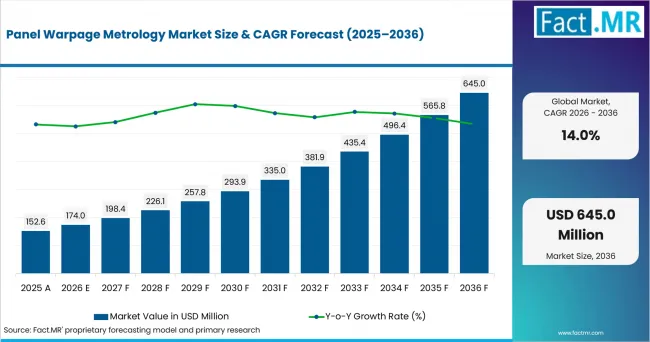
Panel Warpage Metrology Market Value Analysis | Source: Fact.MR
What are the defining numbers behind Panel Warpage Metrology Market growth?
USD 471.0 million absolute opportunity is expected by 2036.
- Demand Drivers in the Market
- Repeatable thermal-warpage measurement: Semiconductor packaging teams need comparable shape data before, during and after thermal exposure. Shadow moiré supports continuous surfaces, while digital fringe projection supports discontinuous surfaces and step-height measurements. Standardized measurement workflows help buyers qualify tools against package and substrate acceptance limits. [1][2]
- Larger panel formats: Panel-level packaging and glass-substrate production require metrology across areas approaching 600 × 600 mm or more. Full-field coverage allows process teams to distinguish global bow from local deformation without reducing the panel to package-scale samples. [1][3][4]
- Thermal-process control: Room-temperature flatness does not show how a package or panel deforms through heating and cooling. Thermal warpage systems capture shape changes across user-defined temperature profiles, supporting material, cure and assembly decisions. [1]
- Glass-panel process control: Glass-core buildup introduces inspection requirements for panel shape, cracks, through-glass vias, redistribution layers and bump structures. Multifunctional systems that combine warpage analysis with defect and dimensional metrology can reduce separate handling and measurement steps. [3]
- Key Segments Analyzed
- By Measurement Technique: Fringe projection is projected to hold 31.0% share in 2026. It provides full-field three-dimensional data on discontinuous surfaces and step-height features. Shadow moiré remains suited to continuous surfaces and temperature-dependent warpage measurement. [1][2]
- By Measurement Condition: Room temperature is projected to hold 44.6% share in 2026. It supports incoming, post-process and handling checks without a thermal chamber, while elevated-temperature and full-cycle measurements remain important for reflow and reliability qualification.
- By Substrate Format: Large panels (>500 mm) are projected to hold 43.4% share in 2026. Larger formats require wider measurement coverage to separate global bow from local topography. Mid-size panels and wafers can use smaller measurement fields and established handling formats.
- By Application: Fan-out packaging is projected to hold 40.9% share in 2026. Its combination of mold compound, redistribution layers and embedded dies creates deformation risks that affect lithography focus, carrier handling, die position and assembly.
- By End User: OSAT providers are projected to hold 31.7% share in 2026. Their molding, redistribution and assembly processes require warpage data that can guide carrier, cure and handling adjustments.
- Analyst Opinion at Fact.MR
- Shambhu Nath Jha, Sr. Consultant at Fact.MR, states, 'Panel warpage metrology should be selected around the surface, temperature profile and process decision being measured. Continuous and discontinuous surfaces may require different optical methods, while panel size changes field-of-view, resolution and handling requirements. Buyers should compare repeatability across the complete thermal profile rather than rely on one room-temperature accuracy figure.'
- Strategic Implications
- Fabs, substrate manufacturers and OSATs should match field of view, vertical resolution and surface compatibility to the actual panel and package geometry.
- Equipment suppliers should validate repeatability on production-representative panels and through the temperature profiles used in molding, cure, reflow and reliability testing.
- Procurement teams should compare measurement time, thermal-ramp control, automation, recipe transfer and correlation with existing process-control data.
Taiwan is projected to record a 15.3% CAGR; South Korea, 14.9%; Malaysia, 14.7%; Japan, 14.5%; and Austria, 13.3% from 2026 to 2036. Country demand conditions differ across advanced packaging, substrate production, outsourced assembly, semiconductor equipment and process-development activity.
How does the Panel Warpage Metrology Market break down by segment?
Fringe projection leads Measurement Technique with a 31.0% share, while Room temperature accounts for 44.6% of Measurement Condition in 2026.
Why does Fringe projection lead Measurement Technique?
Fringe projection is projected to account for 31.0% share in 2026.
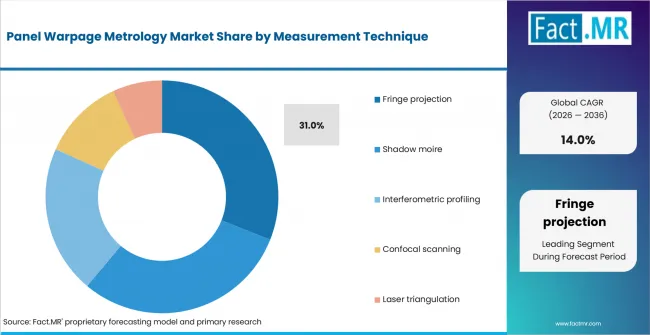
Panel Warpage Metrology Market Analysis By Measurement Technique | Source: Fact.MR
Fringe projection provides full-field three-dimensional measurements and can measure discontinuous surfaces and step-height features. Shadow moiré is better suited to smooth, continuous surfaces and temperature-dependent warpage. The choice depends on surface geometry, field of view, vertical resolution and the required thermal profile. [1][2]
Why does Room temperature lead Measurement Condition?
Room temperature is projected to account for 44.6% share in 2026.
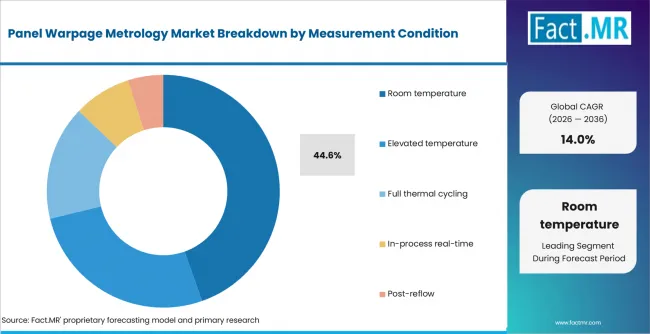
Panel Warpage Metrology Market Analysis By Measurement Condition | Source: Fact.MR
Room-temperature measurements support incoming, post-process and handling checks without a thermal chamber. Elevated-temperature and full-cycle measurements add time and equipment complexity but show deformation through reflow or reliability profiles. Buyers therefore use room-temperature systems for routine checks and thermal systems where temperature-dependent shape affects process decisions. [1]
Why does Large panels (>500 mm) lead Substrate Format?
Large panels (>500 mm) are projected to account for 43.4% share in 2026.
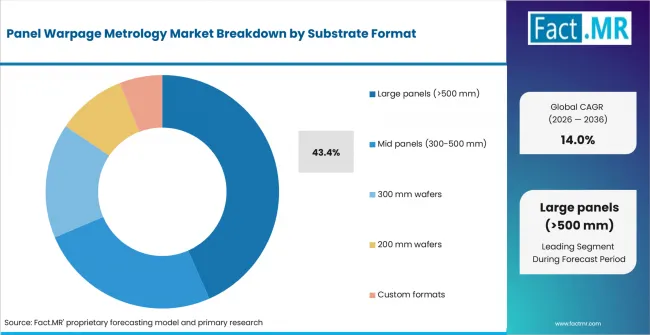
Panel Warpage Metrology Market Analysis By Substrate Format | Source: Fact.MR
Large panels require measurement systems with sufficient field of view, stable handling and repeatable full-area mapping. Akrometrix describes warpage measurement up to 600 × 600 mm, Onto Innovation reports panel coverage up to 650 × 650 mm, and Bruker supports 600 × 600 mm panel metrology. These formats increase demand for tools that can separate global bow from local surface variation without cutting the panel into smaller samples. [1][3][4]
Why does Fan-out packaging lead Application?
Fan-out packaging is projected to account for 40.9% share in 2026.
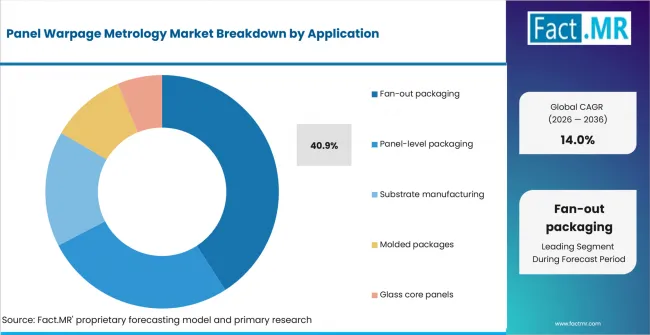
Panel Warpage Metrology Market Analysis By Application | Source: Fact.MR
Fan-out packaging combines mold compound, redistribution layers and embedded dies with different mechanical and thermal behavior. Warpage can affect lithography focus, carrier handling, die position and downstream assembly. Panel-scale fan-out therefore requires full-field measurements that can be correlated with molding, cure and redistribution processes.
Why do OSAT providers lead End User?
OSAT providers are projected to account for 31.7% share in 2026.
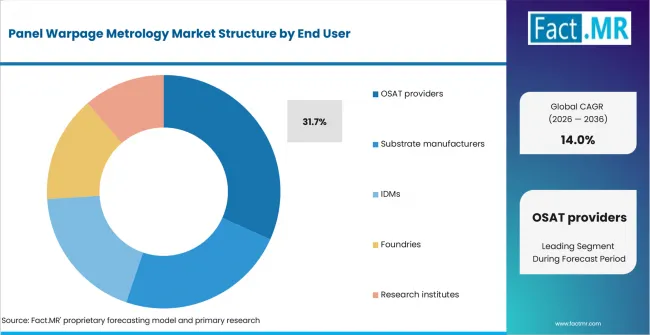
Panel Warpage Metrology Market Analysis By End User | Source: Fact.MR
OSAT providers perform molding, redistribution and assembly steps where panel or package deformation can disrupt handling and alignment. They need warpage measurements that translate into carrier, cure, reflow and process adjustments. Substrate manufacturers focus more heavily on bare-panel flatness, while OSATs must also control deformation introduced by dies, mold compound and assembly materials.
What is accelerating Panel Warpage Metrology Market adoption, and what is holding it back?
Demand increases as packaging teams require repeatable deformation data across larger panels and thermal profiles. Adoption remains constrained by trade-offs among field of view, vertical resolution, measurement time and surface compatibility. Impact estimates overlap across mechanisms and should not be added to the headline CAGR.
Drivers Impact Analysis
| DRIVER | (~) % IMPACT ON CAGR | GEOGRAPHIC RELEVANCE | IMPACT TIMELINE |
|---|---|---|---|
| Repeatable thermal-warpage measurement | +3.9% | Global leading-edge fabs | Medium term (2-4 years) |
| Panel-scale deformation control | +3.2% | Global leading-edge fabs | Medium term (2-4 years) |
| Technique selection by surface geometry | +2.7% | Global leading-edge fabs | Medium term (2-4 years) |
| Glass-panel process control | +2.1% | Global leading-edge fabs | Medium term (2-4 years) |
- Repeatable thermal-warpage measurement: Shadow moiré measures out-of-plane displacement on continuous surfaces, while digital fringe projection measures discontinuous surfaces and step heights. Repeatable workflows allow packaging teams to compare deformation across process and thermal conditions. [1][2]
- Panel-scale deformation control: Commercial systems now support panel dimensions around 600 × 600 mm or larger. Full-area measurements help manufacturers separate global bow from local topography before lithography, buildup, handling or assembly decisions. [1][3][4][5][6]
- Technique selection by surface geometry: Continuous surfaces, discontinuous features, field of view and thermal exposure require different measurement configurations. This creates demand for platforms that can combine or switch among complementary optical methods. [1][2]
- Glass-panel process control: Glass-core buildup requires panel-shape monitoring alongside through-glass-via, crack, redistribution-layer and bump inspection. Onto Innovation describes integrated panel warpage analysis across glass-substrate processing. [3]
Opportunity Impact Analysis
| OPPORTUNITY | (~) % IMPACT ON CAGR | GEOGRAPHIC RELEVANCE | IMPACT TIMELINE |
|---|---|---|---|
| Panel-scale FOV | +2.4% | Global leading-edge fabs | Medium term (2-4 years) |
| In-line dynamic warpage | +1.8% | Global leading-edge fabs | Medium term (2-4 years) |
| Metrology-to-process feedback | +1.4% | Global leading-edge fabs | Short term (<=2 years) |
- Panel-scale FOV: Panel-level packaging and glass-substrate workflows create opportunities for full-area metrology on formats around 600 × 600 mm. Tool value depends on combining coverage with usable vertical resolution, handling stability and measurement time. [1][3][4][5][6]
- In-line dynamic warpage: Thermal-profile measurements can show deformation that room-temperature checks miss. Faster acquisition, automated recipes and production handling can move this information closer to process-development and line-side decisions. [1]
- Metrology-to-process feedback: Warpage maps become more useful when they can be correlated with lithography, buildup, molding, cure and handling results. Integrated platforms can shorten the path from measurement to process adjustment. [3][6]
Restraints Impact Analysis
| RESTRAINT | (~) % IMPACT ON CAGR | GEOGRAPHIC RELEVANCE | IMPACT TIMELINE |
|---|---|---|---|
| Field-of-view and resolution trade-off | -2.1% | Global leading-edge fabs | Medium term (2-4 years) |
| Thermal-profile repeatability | -1.7% | Global leading-edge fabs | Medium term (2-4 years) |
| Technique-selection complexity | -1.3% | Global leading-edge fabs | Medium term (2-4 years) |
- Field-of-view and resolution trade-off: Wider measurement areas can reduce vertical resolution for some optical methods, while point or scanning methods may require more time to cover a large panel. [1][2][4]
- Thermal-profile repeatability: Chamber uniformity, sample support, heating rate and temperature measurement can affect dynamic warpage results, increasing qualification effort. [1]
- Technique-selection complexity: Shadow moiré, fringe projection, interferometry, confocal scanning and triangulation have different surface, range, resolution and throughput limits. Buyers may need more than one method or a multi-sensor platform. [1][2]
Which countries are scaling Panel Warpage Metrology Market fastest?
The Panel Warpage Metrology Market in Taiwan is projected to record a 15.3% CAGR from 2026 to 2036.
- Country outlooks differ according to the packaging, substrate and semiconductor processes that require deformation control.
- Taiwan combines foundry, advanced-packaging and substrate activity, creating requirements for panel-scale inspection and metrology.
- South Korea's memory, HBM and integrated semiconductor production requires deformation control across packaging and assembly steps.
- Malaysia's outsourced assembly and test base places emphasis on repeatable package and panel handling through production.
- Japan's equipment and materials base supports process development, while Austria's advanced-packaging equipment activity supports qualification and application engineering.
Country analysis positions the five profiled markets within North America, Latin America, Europe, East Asia, South Asia & Oceania, and the Middle East & Africa.
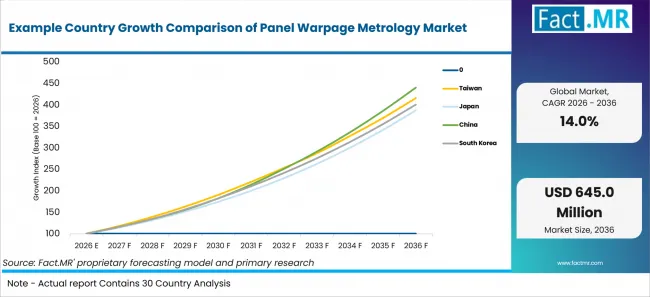
Example Country Growth Comparison Of Panel Warpage Metrology Market | Source: Fact.MR
| COUNTRY | CAGR 2026 to 2036 |
|---|---|
| Taiwan | 15.3% |
| South Korea | 14.9% |
| Malaysia | 14.7% |
| Japan | 14.5% |
| Austria | 13.3% |
What is driving Taiwan's growth through 2036?
The Taiwan market is projected to grow at a 15.3% CAGR from 2026 to 2036.
Advanced packaging, foundry and substrate production create requirements for full-field panel measurements, thermal-profile comparison and correlation with molding, buildup and handling results.
What is driving South Korea's growth through 2036?
The South Korea market is projected to grow at a 14.9% CAGR from 2026 to 2036.
Memory, HBM and integrated semiconductor production require warpage control across substrate, molding, bonding and assembly operations. Tool selection depends on the package format, thermal profile and production feedback required.
What is driving Malaysia's growth through 2036?
The Malaysia market is projected to grow at a 14.7% CAGR from 2026 to 2036.
Malaysia's outsourced assembly and test operations require repeatable deformation checks across package handling, molding, reflow and final assembly. Production use depends on measurement time, recipe stability and compatibility with multiple package formats.
What is driving Japan's growth through 2036?
The Japan market is projected to grow at a 14.5% CAGR from 2026 to 2036.
Japan's semiconductor equipment and materials base supports development work on substrates, packaging materials and deformation control. Demand centers on repeatable measurements that can be correlated with process and material changes.
What is driving Austria's growth through 2036?
The Austria market is projected to grow at a 13.3% CAGR from 2026 to 2036.
Austria's advanced-packaging equipment and application-engineering activity supports qualification work for bonding, substrate handling and process integration. Buyers require evidence that measurement results remain repeatable across panel formats and thermal conditions.
Who leads the Panel Warpage Metrology Market?
Companies participate through direct thermal-warpage systems, panel inspection and metrology platforms, or adjacent wafer-shape technologies.
Akrometrix directly supplies room-temperature and thermal warpage systems based on shadow moiré, with digital fringe projection available for discontinuous surfaces. Onto Innovation describes multifunctional glass-panel inspection and metrology with panel warpage analysis and coverage up to 650 × 650 mm. Camtek's MicroProf PT supports automated panel inspection and metrology across common panel formats, including glass. Bruker's ContourSP provides large-panel optical metrology for samples up to 600 × 600 mm. [1][2][3][4][5]
KLA's Zeta-6xx lists full-panel mapping and panel warpage among its PCB and IC-substrate applications. ZEISS participates more narrowly through wafer-shape control and integrated topography metrology: its DUNE 100 is positioned for wafer warpage, while ZEISS states that panel-type carrier applications are being explored. ZEISS therefore remains adjacent to established panel-warpage platforms, with its current positioning centered on wafer-shape control. [6][7]
Competition centers on measurable area, vertical resolution, thermal-profile capability, surface compatibility, automation, recipe transfer and correlation with process results. Buyers should distinguish direct thermal-warpage platforms from broader panel or wafer metrology systems when comparing suppliers.
Which companies are the key providers?
Key companies include Akrometrix; Onto Innovation; Camtek; Bruker; KLA; ZEISS.
- Akrometrix
- Onto Innovation
- Camtek
- Bruker
- KLA
- ZEISS
Bibliography
- [1] Akrometrix. Warpage Metrology Solutions.
- [2] Akrometrix. Comparing Shadow Moiré and Digital Fringe Projection Warpage Metrology Techniques.
- [3] Onto Innovation. Process Control Innovations for Glass in Advanced Packaging.
- [4] Bruker. ContourSP Large Panel Metrology System.
- [5] Camtek. MicroProf PT Panel Metrology and Inspection Tool.
- [6] KLA. Zeta-6xx Series Panel Metrology System.
- [7] ZEISS. DUNE 100 Wafer Shape Control.
This Report Addresses
- The report examines panel warpage metrology across the Measurement Technique and Measurement Condition segments.
- Segment analysis identifies Fringe projection as the leading Measurement Technique in the 2026 market structure.
- Regional analysis compares Taiwan, South Korea, Malaysia, Japan and Austria.
- Competitive analysis distinguishes direct thermal-warpage systems from broader panel and wafer metrology platforms supplied by Akrometrix, Onto Innovation, Camtek, Bruker, KLA and ZEISS.
- Use-case analysis covers fan-out packaging, panel-level packaging, substrate manufacturing, molded packages and glass-core panels.
What does the Panel Warpage Metrology Market cover?
The market covers equipment and process systems configured to address the challenge of measuring large-area, temperature-dependent deformation fast enough to guide panel process control.
Panel warpage metrology covers equipment used to measure out-of-plane deformation, surface shape and related topography on panel-level packages, IC substrates, wafers and glass-core panels. Systems may operate at room temperature or through controlled thermal profiles. Measurement methods include shadow moiré, digital fringe projection, interferometric profiling, confocal scanning and laser triangulation.
Market value includes configured metrology equipment, optical sensors, thermal chambers, panel or wafer handling, measurement software and service elements supplied with the system. Finished semiconductor devices, processed packages and unrelated inspection equipment are excluded.
What is included in the scope?
The scope includes systems used by OSAT providers, substrate manufacturers, IDMs, foundries and research institutes.
The market is segmented by Measurement Technique, including Fringe projection, Shadow moire, Interferometric profiling, Confocal scanning, Laser triangulation; Measurement Condition, including Room temperature, Elevated temperature, Full thermal cycling, In-process real-time, Post-reflow; Substrate Format, including Large panels (>500 mm), Mid panels (300-500 mm), 300 mm wafers, 200 mm wafers, Custom formats; Application, including Fan-out packaging, Panel-level packaging, Substrate manufacturing, Molded packages, Glass core panels; End User, including OSAT providers, Substrate manufacturers, IDMs, Foundries, Research institutes.
Thermal chambers, panel or wafer handling, optical sensors, automation, analysis software and process-control interfaces are included when supplied as part of the configured metrology system.
What is excluded from the scope?
The scope excludes unrelated semiconductor equipment, standalone materials and components sold independently of the configured system.
It also excludes facility construction, cleanroom infrastructure, the value of processed wafers or packages, and adjacent process steps that are not part of the defined equipment category.
How Was the Analysis Built?
Fact.MR is of the opinion that this assessment combines structured market analysis with a review of public information and industry evidence relevant to the market.
- Market Assessment: The analysis considers demand patterns, supply conditions, segment mix, country activity, company participation, and adoption trends.
- Evidence Review: Public company disclosures, government and regulatory publications, trade information, technical literature, and industry records inform the assessment.
- Validation and Updates: Findings are cross-checked against available market indicators and reviewed when material market developments emerge.
What is the report's scope and coverage?
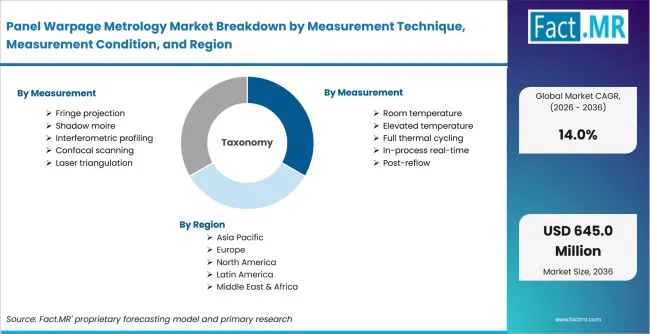
Panel Warpage Metrology Market Breakdown By Measurement Technique, Measurement Condition, And Region | Source: Fact.MR
| Attribute | Details |
|---|---|
| Quantitative Units | USD 174.0 million in 2026 to USD 645.0 million by 2036 at a 14.0% CAGR |
| Market Definition | Panel warpage metrology covers equipment used to measure out-of-plane deformation, surface shape and related topography on panel-level packages, IC substrates, wafers and glass-core panels. Systems may operate at room temperature or through controlled thermal profiles. Measurement methods include shadow moiré, digital fringe projection, interferometric profiling, confocal scanning and laser triangulation. |
| Measurement Technique | Fringe projection; Shadow moire; Interferometric profiling; Confocal scanning; Laser triangulation |
| Measurement Condition | Room temperature; Elevated temperature; Full thermal cycling; In-process real-time; Post-reflow |
| Substrate Format | Large panels (>500 mm); Mid panels (300-500 mm); 300 mm wafers; 200 mm wafers; Custom formats |
| Application | Fan-out packaging; Panel-level packaging; Substrate manufacturing; Molded packages; Glass core panels |
| End User | OSAT providers; Substrate manufacturers; IDMs; Foundries; Research institutes |
| Regions Covered | North America; Latin America; Europe; East Asia; South Asia & Oceania; Middle East & Africa |
| Countries Covered | Taiwan; Japan; South Korea; Austria; Malaysia |
| Key Companies Profiled | Akrometrix; Onto Innovation; Camtek; Bruker; KLA; ZEISS |
| Forecast Period | 2026 to 2036 |
| Approach | Hybrid top-down and bottom-up approach using demand indicators across Measurement Technique; Measurement Condition; Substrate Format; Application; End User; country-level growth; company participation and adoption trends |
How is the market segmented?
-
By Measurement Technique
- Fringe projection
- Shadow moire
- Interferometric profiling
- Confocal scanning
- Laser triangulation
-
By Measurement Condition
- Room temperature
- Elevated temperature
- Full thermal cycling
- In-process real-time
- Post-reflow
-
By Substrate Format
- Large panels (>500 mm)
- Mid panels (300-500 mm)
- 300 mm wafers
- 200 mm wafers
- Custom formats
-
By Application
- Fan-out packaging
- Panel-level packaging
- Substrate manufacturing
- Molded packages
- Glass core panels
-
By End User
- OSAT providers
- Substrate manufacturers
- IDMs
- Foundries
- Research institutes
-
By Region
- North America
- Other regional markets assessed at aggregate level
- Latin America
- Other regional markets assessed at aggregate level
- Europe
- Austria
- East Asia
- Taiwan
- Japan
- China
- South Korea
- South Asia & Oceania
- Malaysia
- Middle East & Africa
- Other regional markets assessed at aggregate level
- North America