- Base Value(2025): 168.2 Bn
- Estimated Value(2026): 168.4 Bn
- Forecast Value (2036): 244.5 Bn
- CAGR (2026 - 2036): 3.8%
Flat Panel Display Market Forecast and Outlook By Fact.MR
In 2025, the flat panel display market was valued at USD 168.2 billion. Based on Facr.MR analysis, demand for flat panel displays is estimated to grow to USD 168.4 billion in 2026 and USD 244.5 billion by 2036. FACT.MR projects a CAGR of 3.8% during the forecast period.
FACT.MR analysis indicates the flat panel display market is expected to generate an absolute dollar opportunity of USD 76.1 billion between 2026 and 2036. This steady expansion reflects consistent smartphone and television panel demand, accelerating OLED adoption in premium tiers, and the fast-growing automotive display segment. Structural constraints include commodity LCD panel price cycles that periodically compress revenue despite volume growth, capital intensity of new OLED fabrication lines, and geopolitical trade friction affecting display supply chains between China, South Korea, and major consumer electronics manufacturing markets.
Samsung Display and LG Display disclosed that demand for large OLED panels for premium televisions and high-refresh-rate OLED smartphone displays continued to drive revenue growth in their display businesses, with both companies citing automotive display as an emerging high-margin category receiving dedicated capital investment for next-generation curved and transparent OLED panel development programmes. [1]
Country growth reflects display panel manufacturing capacity investment, consumer electronics demand, and automotive display adoption. China leads at 7.8% CAGR, driven by BOE Technology Group and CSOT expanding Gen 8.6 and Gen 10.5 LCD and OLED fabrication lines serving domestic smartphone and television OEM demand. South Korea follows at 7.4%, supported by Samsung Display and LG Display investment in IT and automotive OLED panel capacity for premium global electronics brands. Germany posts 7.0% as automotive OEM integration of large-format OLED and LCD cockpit displays accelerates across BMW, Mercedes-Benz, and Volkswagen new model platforms. The United States grows at 6.8%, driven by Apple and major U.S. consumer electronics brands increasing premium OLED display procurement for iPhone and MacBook product lines. Japan posts 6.7% through Sharp and Japan Display Inc. sustaining precision panel manufacturing for automotive and industrial display applications. France grows at 6.5%, the most mature Western European market, generating consistent television and commercial display replacement demand with structural constraints from flat consumer electronics market volumes.
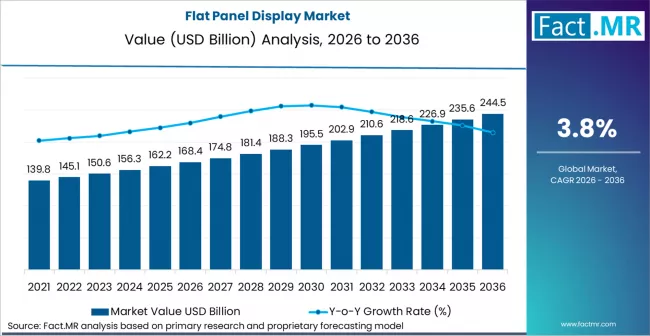
Flat Panel Display Market Market Value Analysis | Source: Fact.MR
| Metric | Value |
|---|---|
| Estimated Value in 2026 | USD 168.4 billion |
| Forecast Value in 2036 | USD 244.5 billion |
| Forecast CAGR (2026 to 2036) | 3.8% |
Source: Fact.MR analysis. Updated Mar 12, 2026
Market Definition
The flat panel display market includes thin display screens using LCD, OLED, and plasma technologies. These panels are used in televisions, smartphones, personal computers, and automotive displays. Panels are manufactured separately and supplied to electronics OEMs for device integration.
Market Inclusions
Includes global and regional forecasts from 2026 to 2036 by display technology and application. Covers LCD, OLED, and plasma panels used in consumer electronics, televisions, mobile devices, PCs, and automotive displays.
Market Exclusions
Excludes cathode ray tube displays, e-paper displays used only in e-readers, LED billboard displays, and components such as touch overlays or driver ICs sold separately from display panels.
Research Methodology
- Primary Research: Interviews with display engineers, OEM procurement managers, automotive display specialists, and technology analysts across Asia Pacific, Europe, and North America.
- Desk Research: Sources include OEM annual reports, DSCC display supply chain reports, panel shipment data, automotive display procurement announcements, and OLED patent filings.
- Market Sizing and Forecasting: Hybrid model using panel shipment volumes, average selling prices by technology, OEM procurement data, and fabrication capacity investment timelines.
- Data Validation and Update Cycle: Data validated using panel maker shipment statistics, OEM revenue disclosures, automotive integration announcements, and industry production data.
Summary
Market Definition
- Flat panel displays include LCD, OLED, and plasma screens used in televisions, smartphones, laptops, and automotive displays across global electronics supply chains.
Demand Drivers
- Apple’s expansion of OLED displays across iPhone, iPad, and MacBook lines is accelerating OLED fabrication investment by Samsung Display and LG Display.
- Automotive OEMs such as BMW, Mercedes-Benz, and Volkswagen are integrating curved OLED and high-resolution LCD panels in digital cockpit and infotainment systems.
- Chinese manufacturers including BOE and CSOT are expanding LCD and OLED fabrication capacity through government-supported display manufacturing investment programmes.
Key Segments Analyzed
- By Technology: LCD holds about 54% share in 2026 due to large manufacturing scale and cost competitiveness across televisions and smartphones.
- By Application: Consumer electronics lead with about 47% share in 2026 due to high demand from smartphones, tablets, laptops, and wearable devices.
- By Geography: Asia Pacific dominates production and demand, led by China and South Korea display manufacturing capacity.
Analyst Opinion at FACT.MR
- Shambhu Nath Jha, Principal Consultant at Fact.MR, opines that CXOs will find this report helpful for understanding how OLED technology adoption, automotive digital cockpit display integration, and fabrication capacity expansion in China and South Korea are shaping long-term growth and technology competition in the flat panel display market through 2036.
Strategic Implications
- Display manufacturers should invest in automotive OLED and high-brightness LCD panels with long-term supply agreements.
- Consumer electronics OEMs should diversify panel sourcing between Korean and Chinese suppliers.
- Companies should invest in micro-LED and advanced OLED technologies for future premium display markets.
Methodology
- Market sizing used panel shipment volumes and average selling prices validated with OEM revenue disclosures and industry shipment data.
- Automotive display integration programmes, OLED supply agreements, and manufacturing investments supported demand analysis.
- Forecasts included consumer electronics shipment projections, automotive cockpit adoption, and OLED fabrication expansion timelines.
Segmental Analysis
Flat Panel Display Market Analysis by Technology
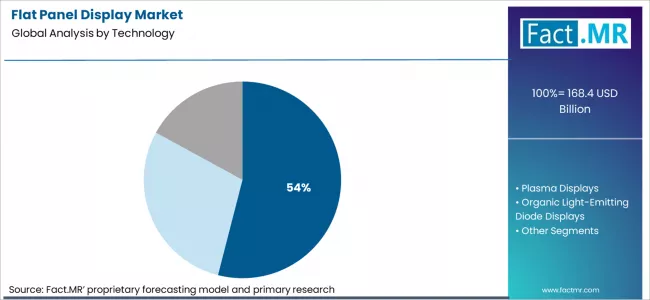
Flat Panel Display Market Analysis By Technology | Source: Fact.MR
Based on FACT.MR’s report, liquid crystal displays are expected to hold about 54% share in 2026. LCD technology remains dominant due to cost efficiency, high manufacturing yields, and wide application across smartphones, televisions, and large-format displays.
- BOE Technology LCD Capacity Investment: In 2025, BOE completed Phase 2 expansion of its Gen 10.5 LCD fabrication line in Wuhan. The facility adds capacity for 90,000 glass substrates per month targeting 65-inch and larger television panels.
- Samsung Display OLED Technology Development: In 2024, Samsung Display began pilot production of its Gen 3 QD-OLED panel. The design improves brightness by about 30% for premium 77-inch television displays used by Sony and Samsung Electronics.
- OLED Shipment Volume Trend: DSCC’s 2025 report showed OLED panels accounted for 42% of smartphone display shipments in Q4 2024, rising from 36% in 2022 as more mid-range smartphones adopted OLED screens.
Flat Panel Display Market Analysis by Application
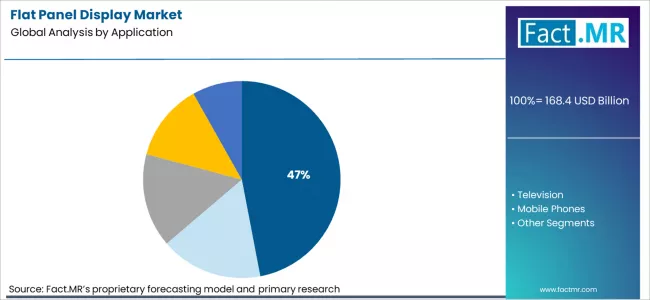
Flat Panel Display Market Analysis By Application | Source: Fact.MR
Based on FACT.MR’s report, consumer electronics is projected to hold about 47% share in 2026. Smartphones, tablets, laptops, and wearable devices generate the largest annual display panel demand globally.
- LG Display Automotive Application Investment: In 2025, LG Display expanded its Paju OLED automotive display line. The facility supplies curved OLED panels for automotive display systems used by BMW, Mercedes-Benz, and General Motors.
- Sharp Automotive Display Technology: In 2024, Sharp introduced its IGZO automotive LCD panel series with 2,000-nit brightness for vehicle infotainment and instrument clusters meeting AEC-Q100 automotive standards.
- Mobile OLED Adoption Trend: IDC reported that Samsung, Apple, and Xiaomi shipped over 180 million OLED smartphones in Q4 2024, marking the first quarter where OLED models exceeded LCD models among the top three vendors.
Drivers, Restraints, and Opportunities
FACT.MR analysts observe that the flat panel display market, valued at USD 168.2 billion in 2025, is shaped by mature LCD demand and fast-growing OLED and automotive display segments. Panel demand is largely driven by global smartphone, television, and PC replacement cycles that maintain steady shipment volumes across consumer electronics markets.
The industry shows a split between low-margin LCD panels and premium OLED displays. Chinese manufacturers compete aggressively in LCD segments, pushing prices down, while Samsung Display and LG Display maintain leadership in OLED technology. OLED panels command 2x to 5x higher prices than LCD formats and are gaining share in smartphones, IT devices, and automotive displays.
- China Display Investment Programme: China’s Ministry of Industry and Information Technology continued support for display manufacturing investment. BOE expanded its Gen 10.5 LCD facility in Wuhan and CSOT invested in its Gen 8.6 OLED line. BOE announced a CNY 46 billion OLED investment plan to expand panel supply for smartphone brands such as Huawei and Xiaomi.
- Automotive OLED Adoption Acceleration: BMW’s 2025 Neue Klasse platform will use panoramic curved OLED cockpit displays supplied by Samsung Display and LG Display. The programme is expected to exceed one million OLED automotive panels annually, confirming automotive displays as a major high-margin growth segment.
- Apple OLED IT Panel Expansion: Apple introduced OLED displays in the 2024 iPad Pro. The company sources panels from Samsung Display and LG Display. Apple’s OLED MacBook programme planned from 2026 will expand OLED demand into the laptop segment.
Regional Analysis
The flat panel display market is analysed across Asia Pacific, Europe, North America, Latin America, and Middle East and Africa, covering 40-plus countries with demand profiles shaped by consumer electronics shipment volumes, display panel manufacturing investment, automotive display integration programmes, and technology adoption rates across LCD, OLED, and plasma segments. The full report offers market attractiveness analysis based on fabrication capacity expansion timelines and technology adoption trajectories.
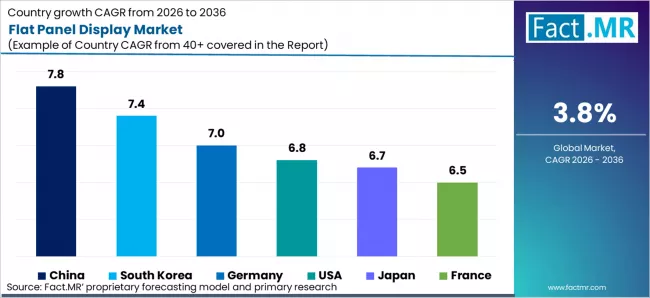
Flat Panel Display Market Cagr Analysis By Country | Source: Fact.MR
| Country | CAGR (2026-2036) |
|---|---|
| China | 7.8% |
| South Korea | 7.4% |
| Germany | 7.0% |
| United States | 6.8% |
| Japan | 6.7% |
| France | 6.5% |
Source: Fact.MR analysis. Updated Mar 12, 2026
Source: Fact.MR (FACT.MR) analysis, based on proprietary forecasting model and primary research
Asia Pacific Flat Panel Display Market Analysis
Asia Pacific dominates global flat panel display manufacturing. China and South Korea account for most LCD and OLED production capacity. BOE, CSOT, and Tianma drive China’s expansion, while Samsung Display and LG Display lead advanced OLED technology for premium electronics and automotive displays.
- China: China will record 7.8% CAGR through 2036. MIIT continues funding display manufacturing investment programmes. BOE announced a CNY 46 billion investment for OLED lines in Chengdu and Wuhan. CSOT’s Wuhan T9 Gen 8.6 OLED factory began operations in 2025, adding 45,000 substrates monthly. The facility supplies OLED panels to Huawei, Xiaomi, and OPPO.
- South Korea: South Korea is projected to grow at 7.4% CAGR through 2036. Samsung Display invested in the A5 OLED factory in Asan for Gen 8.7 IT OLED panels used in Apple MacBook and iPad Pro devices. LG Display expanded its Paju OLED automotive production line supplying BMW Neue Klasse and GM EV cockpit displays.
- Japan: Japan will expand at 6.7% CAGR through 2036. Japan Display restructured operations and shifted focus to automotive and medical displays at the Hakusan plant. Sharp increased IGZO automotive panel production at Kameyama Plant 2 for Tier 1 automotive suppliers in Europe and the United States.
FACT.MR’s Asia Pacific analysis of the flat panel display market covers China, Japan, South Korea, India, Australia and New Zealand, ASEAN, and Rest of South Asia and Pacific. Readers can find country CAGR forecasts, fabrication capacity investment timelines, government display manufacturing programme data, and OEM competitive positioning by technology segment.
Europe Flat Panel Display Market Analysis
Europe is a high-value demand region for flat panel displays. Automotive cockpit displays and premium electronics adoption drive panel demand. Most display panels are imported from Asian manufacturers.
- Germany: Germany will grow at 7.0% CAGR through 2036. BMW’s Neue Klasse platform integrates panoramic OLED cockpit displays supplied by Samsung Display and LG Display. Annual demand is expected to exceed one million panels by 2027. Mercedes-Benz also introduced hybrid LCD-OLED cockpit displays supplied through Continental using AU Optronics and Tianma panels.
- France: France is projected to grow at 6.5% CAGR through 2036. Stellantis adopted a 32-inch panoramic display for DS, Peugeot, and Opel models under the STLA Large platform. The system integrates LG Display OLED panels via Visteon. The government’s Plan France 2030 funds microLED and advanced display research at CEA-Leti.
FACT.MR’s European analysis of the flat panel display market covers Germany, France, the United Kingdom, Italy, Spain, Nordic countries, BENELUX, and Rest of Western Europe. Readers can find EU automotive display integration programme data, consumer electronics replacement demand trends, automotive OEM display specification benchmarks, and country-level revenue forecasts by technology and application.
North America Flat Panel Display Market Analysis
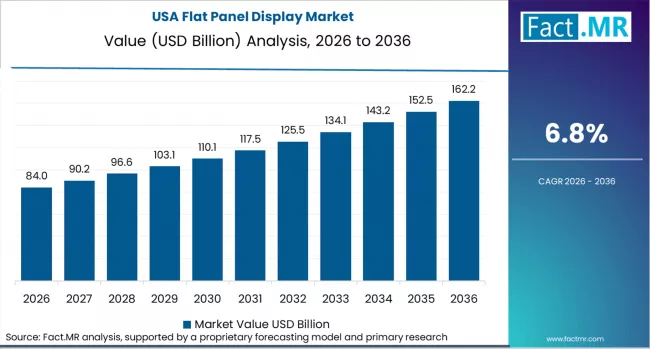
Flat Panel Display Market Country Value Analysis | Source: Fact.MR
North America is a major high-revenue demand market for flat panel displays. Premium electronics and automotive display adoption drive panel procurement across the region.
- United States: The U.S. will expand at 6.8% CAGR through 2036. Apple introduced OLED displays in the 2024 iPad Pro and plans OLED MacBook models starting in 2026. Samsung Display and LG Display supply these panels under long-term agreements. The CHIPS and Science Act also funds micro LED and advanced display research in U.S. laboratories.
FACT.MR’s North American analysis of the flat panel display market covers the United States, Canada, and Mexico. Readers can find CHIPS Act display technology programme data, Apple OLED supply chain investment timelines, automotive display integration benchmarks, and country-level revenue forecasts by technology and application.
Competitive Aligners for Market Players
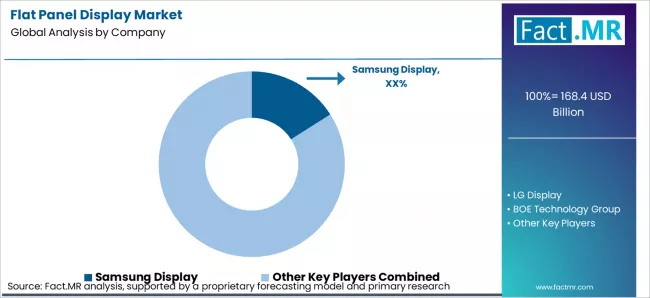
Flat Panel Display Market Analysis By Company | Source: Fact.MR
The global flat panel display market shows two different competitive dynamics. In premium OLED panels, the market is relatively concentrated, while LCD panels remain highly competitive with strong price pressure. Samsung Display and LG Display lead the OLED segment globally, competing through advanced technology such as improved colour performance, brightness, and longer panel lifespan. Meanwhile, BOE Technology Group, CSOT, AU Optronics, and Innolux compete mainly in the LCD segment, where success depends on large production capacity, cost efficiency, and reliable supply. Japanese companies such as Japan Display and Sharp focus on specialised segments like automotive and industrial displays, where strict quality standards allow them to maintain stronger pricing.
Technology and supply chain integration provide major advantages in this market. Samsung Display benefits from strong OLED material partnerships and its QD-OLED technology, which improves colour performance in premium televisions. LG Display, on the other hand, has developed tandem OLED technology designed for automotive displays, offering longer lifetime and higher brightness needed for vehicle use.
Large electronics brands such as Apple, Samsung Electronics, and Sony usually work with multiple display suppliers to avoid dependence on a single vendor. However, in premium OLED segments where only a few manufacturers can supply large volumes, panel makers still retain strong pricing power.
Key Players
- Samsung Display
- LG Display
- BOE Technology Group
- AU Optronics
- Sharp Corporation
- Japan Display Inc.
- Innolux Corporation
- Tianma Microelectronics
- CSOT (China Star Optoelectronics Technology)
- E Ink Holdings
Bibliography
- [1] Samsung Display Co., Ltd. and LG Display Co., Ltd. (2025). Q4 2024 Earnings Commentary: OLED Panel Revenue Growth in Television, IT, and Automotive Display Segments and Capital Investment Priorities. February 2025. news.samsung.
- [2] BOE Technology Group Co., Ltd. (2025). 2025 Capital Expenditure Plan Disclosure: CNY 46 Billion OLED Fabrication Investment at Chengdu and Wuhan Gen 8.6 OLED Lines Under MIIT Display Manufacturing Support Programme. March 2025.
- [3] BMW Group. (2025). Neue Klasse Vehicle Platform Specification: Panoramic OLED Curved Digital Cockpit Display System Sourcing from Samsung Display and LG Display for All Neue Klasse Models. January 2025.
- [4] Apple Inc. (2024). Product Launch and Supply Chain Disclosure: OLED iPad Pro Panel Supply Agreements with Samsung Display and LG Display and MacBook OLED Development Programme Timeline. May 2024.
- [5] BOE Technology Group Co., Ltd. (2025). Manufacturing Capacity Update: Gen 10.5 LCD Fabrication Line Phase 2 Commissioning at Wuhan Facility with 90,000 Monthly Glass Substrate Capacity for Large-Format Television Panel Production. February 2025.
- [6] Samsung Display Co., Ltd. (2024). Technology Launch: QD-OLED Generation 3 Panel with Updated Quantum Dot Colour Filter Architecture and 30% Higher Peak Brightness for Premium 77-Inch Television Applications. August 2024. news.
- [7] Display Supply Chain Consultants (DSCC). (2025). Q1 2025 Display Supply Chain Report: OLED Smartphone Panel Shipment Volume Share Reaching 42% of Total Smartphone Display Market in Q4 2024. January 2025.
- [8] LG Display Co., Ltd. (2025). Fabrication Capacity Expansion: P10 Paju Automotive OLED Line Expansion for Large-Format Curved Automotive Panel Supply to BMW, Mercedes-Benz, and GM Vehicle Programmes. February 2025.
- [9] Sharp Corporation. (2024). Product Launch: IGZO Automotive High-Brightness LCD Panel Series with 2,000 Nit Peak Brightness and AEC-Q100 Automotive Qualification for In-Vehicle Infotainment Applications. October 2024.
- [10] International Data Corporation (IDC). (2025). Smartphone Market Tracker Q4 2024: OLED Display Smartphone Unit Volume Surpassing LCD Among Top Three Global Vendors for First Time. January 2025.
This Report Addresses
- Strategic intelligence on China MIIT display investment supporting BOE and CSOT OLED expansion, South Korea funding Samsung Display IT OLED, automotive OLED adoption by BMW and Stellantis, and Apple MacBook OLED development shaping IT display demand.
- Market forecast from USD 168.4 billion in 2026 to USD 244.5 billion by 2036 at 3.8% CAGR, segmented by display technology, application, and region.
- Growth opportunities across China OLED fabrication expansion, South Korea IT OLED capacity for Apple, German automotive OLED cockpit displays, U.S. CHIPS Act display R&D, and France Plan 2030 micro LED research.
- Country CAGR outlook: China 7.8%, South Korea 7.4%, Germany 7.0%, United States 6.8%, Japan 6.7%, and France 6.5%, supported by fabrication investment and automotive display demand.
- Competitive analysis of Samsung Display, LG Display, BOE Technology Group, CSOT, AU Optronics, Sharp, and Japan Display covering technology portfolios and fabrication capacity.
- Technology tracking including QD-OLED Gen 3 panels, tandem OLED stacks for automotive displays, Gen 8.7 IT OLED capacity expansion, microLED research, and IGZO automotive LCD panels.
- Regulatory analysis covering China MIIT display investment policy, South Korea display subsidies, U.S. CHIPS Act technology programmes, EU electronics sustainability rules, and AEC-Q100 automotive display standards.
- Report delivered in PDF, Excel datasets, PowerPoint summary, and dashboard formats using OEM revenue data, DSCC shipment statistics, fabrication announcements, and primary research interviews.
Segmentation
Scope of Report
| Quantitative Units | USD 168.4 billion (2026) to USD 244.5 billion (2036), at a CAGR of 3.8% |
|---|---|
| Market Definition | Flat panel displays using LCD, OLED, and plasma technologies for consumer electronics, television, mobile, PC, and automotive screen applications. |
| Technology Segmentation | Liquid Crystal Displays (54%), Plasma Displays, Organic Light-Emitting Diode Displays |
| Application Segmentation | Consumer Electronics (47%), Television, Mobile Phones, Personal Computers, Automotive |
| Application Coverage | Smartphone screens, television panels, PC monitors, automotive instrument clusters and infotainment displays, tablets, and wearable displays. |
| Regions Covered | Asia Pacific, Europe, North America, Latin America, Middle East and Africa |
| Countries Covered | China, Japan, South Korea, India, Australia and New Zealand, ASEAN, Rest of South Asia and Pacific, Germany, UK, France, Italy, Spain, Nordic, BENELUX, Rest of Western Europe, Russia, Poland, Hungary, Balkan and Baltic, USA, Canada, Mexico, Brazil, Chile, Ecuador, Rest of Latin America, Saudi Arabia, GCC, Turkey, South Africa, Rest of MEA |
| Key Companies Profiled | Samsung Display, LG Display, BOE Technology, AU Optronics, Sharp, Japan Display, Innolux, Tianma, CSOT, E Ink Holdings |
| Forecast Period | 2026 to 2036 |
| Approach | Hybrid top-down and bottom-up model using display panel shipment volumes, average selling prices by technology and application, OEM procurement data, and primary interviews with display engineers and procurement managers. |
Source: Fact.MR analysis. Updated Mar 12, 2026
Flat Panel Display Market by Segments
-
By Technology:
- Liquid Crystal Displays
- Plasma Displays
- Organic Light-Emitting Diode Displays
-
By Application:
- Consumer Electronics
- Television
- Mobile Phones
- Personal Computers
- Automotive
-
By Region:
- North America
- United States
- Canada
- Mexico
- Latin America
- Brazil
- Chile
- Ecuador
- Rest of Latin America
- Western Europe
- Germany
- United Kingdom
- France
- Italy
- Spain
- Nordic
- BENELUX
- Rest of Western Europe
- Eastern Europe
- Russia
- Poland
- Hungary
- Balkan and Baltic
- Rest of Eastern Europe
- East Asia
- China
- Japan
- South Korea
- South Asia and Pacific
- India
- ASEAN
- Australia and New Zealand
- Rest of South Asia and Pacific
- Middle East and Africa
- Kingdom of Saudi Arabia
- Other GCC Countries
- Turkey
- South Africa
- Other African Union
- Rest of Middle East and Africa
- North America
Frequently Asked Questions
How large is the flat panel display market in 2025?
What will the market size be in 2026?
What is the projected market size by 2036?
What is the expected CAGR?
Which technology segment leads the market?
Which application segment dominates?
Which country shows the fastest growth?
What is the primary restraint?
Who worked on this report


Preview the report firsthand - request a free sample
Free SampleGet the brochure for pricing and purchase details
Download PDF