Paper Coating Materials Market (2026 - 2036)
Paper Coating Materials Market is segmented by Product Type (Ground Calcium Carbonate (GCC), Precipitated Calcium Carbonate (PCC), Kaolin Clay, SB Latex, Titanium Dioxide, Wax, Starch, Talc, and Others), End Use Industry (Packaging Industry, Binding Industry, Stationary Industry, Corrugated Boxes Industry, and Others), Application (Coated 1, Coated 2, Coated 3, Coated 4, and Others) and Region. Forecast for 2026 to 2036.
Core Findings
Paper Coating Materials Market Forecast and Outlook 2026 to 2036
In 2025, the paper coating materials market was valued at USD 2.7 billion. Based on Fact.MR analysis, demand is estimated to grow to USD 2.8 billion in 2026 and USD 4.5 billion by 2036. FACT.MR projects a CAGR of 4.8% during the forecast period.
The absolute dollar opportunity created between 2026 and 2036 is approximately USD 1.7 billion. This growth trajectory reflects structural reinforcement rather than speculative expansion. Demand growth is underpinned by three primary forces: first, substitution of plastic laminates with recyclable mineral-based coatings; second, continued expansion of corrugated packaging driven by e-commerce penetration; and third, premiumization of consumer-facing packaging requiring superior print fidelity and surface smoothness.
William Kuecker, Senior Director of Strategic Marketing at Solenis said, “"As consumer preferences shift and single-use plastic regulations increase, demand for paper-based packaging is growing fast. We're excited to share what's possible in paper-based packaging, using our eco-friendly chemistries and strategic supply chain partners to bring a greener, more sustainable future to the industry and the planet."
Country-level differentiation reflects industrial scale and regulatory enforcement intensity. China leads at 7.0% CAGR, India follows at 6.6%, Germany at 5.9%, France at 5.3%, the United Kingdom at 5.0%, and the United States at 4.7%. These growth rates illustrate a hierarchy where emerging packaging economies expand faster, while mature markets grow primarily through reformulation and value-added specialization.
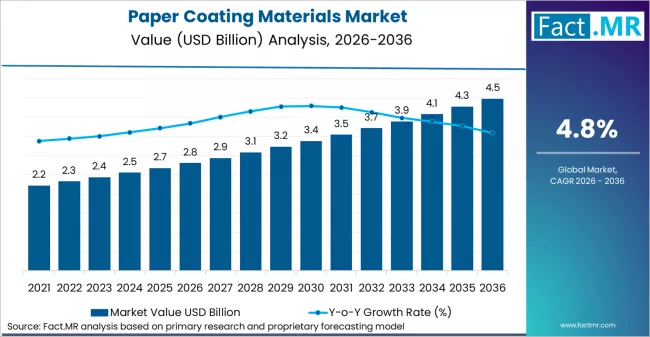
| Metric | Value |
|---|---|
| Estimated Value in 2026 | USD 2.8 billion |
| Forecast Value in 2036 | USD 4.5 billion |
| Forecast CAGR (2026 to 2036) | 4.8% |
Market Definition
The paper coating materials market comprises mineral pigments, polymer binders, and specialty additives applied to paper substrates to enhance brightness, opacity, smoothness, barrier resistance, durability, and print performance.
Market Inclusions
The report includes global and regional market sizing from 2026 to 2036, product-level segmentation analysis, end-use breakdown, application mapping, pricing assessment, trade dynamics, regulatory evaluation, and competitive landscape analysis.
Market Exclusions
Excluded from scope are finished paper products, downstream carton conversion economics, standalone plastic laminates not integrated within coating chemistry, and unrelated pulp production inputs.
Research Methodology
- Primary Research: Primary research involved structured interviews with mineral suppliers, coating formulators, packaging converters, and procurement executives.
- Desk Research: Desk research incorporated regulatory documentation, public filings, packaging production statistics, and sustainability disclosures.
- Market Sizing and Forecasting : A hybrid top-down and bottom-up methodology was employed to triangulate demand from coated paper output benchmarks and mineral consumption intensity ratios.
Summary
- Market Definition
- Paper coating materials are mineral and polymer-based additives such as calcium carbonates, kaolin clay, latex, and starch applied to paper surfaces to enhance printability, brightness, smoothness, barrier performance, and durability across packaging, publishing, and specialty paper applications.
- Demand Drivers
- Sustainable packaging growth is increasing demand for high-performance coated paper in food and consumer goods applications.
- Print quality enhancement in premium packaging and publishing supports calcium carbonate and kaolin clay consumption.
- Shift toward recyclable, fiber-based barrier solutions is driving innovation in latex, starch, and wax-based coatings.
- Key Segments Analyzed
- By Product Type: Ground Calcium Carbonate (GCC) holds about 25.4% share in 2026, driven by cost efficiency and brightness enhancement properties.
- By End Use Industry: Packaging Industry holds about 30% share in 2026 due to rising demand for coated paperboard and cartons.
- By Application: Coated 1 holds about 42% share in 2026, supported by widespread use in standard printing and packaging grades.
- By Geography: Asia Pacific represents the largest volume market, supported by expanding paper production capacity and packaging consumption.
- Analyst Opinion at FACT.MR
- Shambhu Nath Jha, Principal Consultant at FACT.MR, opines, ‘CXOs reviewing this report will observe that value creation in paper coating materials is shifting toward performance-driven formulations where brightness, barrier properties, and sustainability compliance define competitive advantage across packaging-led growth markets.’
- Strategic Implications
- Producers should invest in high-brightness GCC and PCC capacity to serve premium packaging demand.
- Manufacturers should develop bio-based and recyclable coating formulations to align with sustainability mandates.
- Suppliers should strengthen partnerships with paper mills in Asia Pacific to secure long-term volume contracts.
- Methodology
- Market sizing combined paper production data with coating material consumption ratios across grades and applications.
- Segment shares were validated through manufacturer disclosures, trade statistics, and mill-level consumption analysis.
- Country forecasts were built using packaging output trends, publishing demand outlook, and regulatory-driven sustainability targets.
- Segmental Analysis
Segmental Analysis
Paper Coating Materials Market Analysis by Product Type
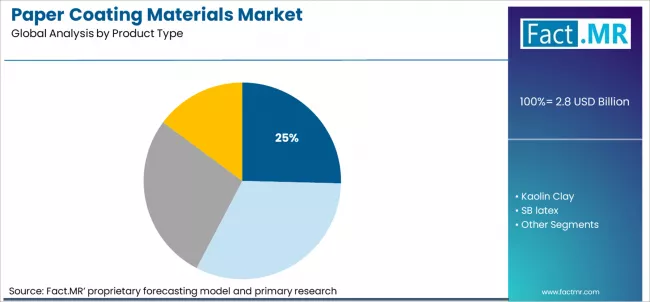
Ground Calcium Carbonate (GCC) holds about 25.4% share in 2026, supported by its cost efficiency, high brightness, and excellent opacity enhancement properties. GCC improves surface smoothness and print clarity, making it highly suitable for packaging boards and coated printing papers.
- Capacity Expansion Trend: In 2024, several global mineral suppliers expanded GCC production capacity in Asia to meet rising demand from packaging-grade coated paper manufacturers, reinforcing its leadership in cost-driven applications. [1]
- Omya Performance Minerals Update 2024: Omya reported continued investment in calcium carbonate solutions for sustainable packaging and lightweight paper applications in its 2024 corporate disclosures, highlighting GCC’s role in brightness and barrier enhancement. [2]
- Sustainability Shift: Paper mills increasingly favor GCC for its compatibility with recyclable fiber-based packaging solutions, aligning with circular economy mandates across Europe and Asia.
Paper Coating Materials Market Analysis by Application
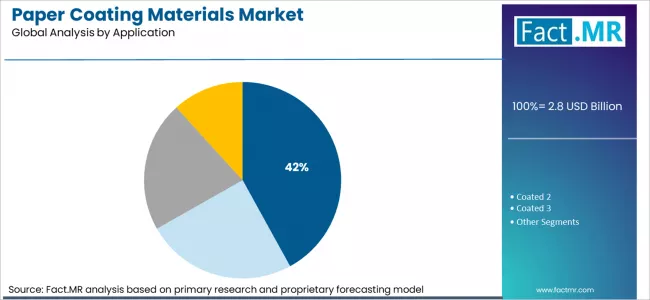
Coated 1 holds about 42% share in 2026, supported by its widespread use in standard coated printing and packaging grades. It provides enhanced brightness, ink absorption control, and surface smoothness without significantly increasing production cost, making it a preferred specification for mass-market paper applications.
- Print Quality Enhancement: Coated 1 applications remain dominant in magazines, catalogs, and mid-grade packaging where visual clarity is essential.
- Titanium Dioxide Optimization 2024: Producers adjusted titanium dioxide loading levels in coated grades to manage cost volatility while maintaining opacity and brightness performance.
- Sustainable Reformulation: Manufacturers are reformulating coated layers with bio-based starch and reduced synthetic latex content to meet sustainability targets without compromising print performance.
Drivers, Restraints, and Opportunities
FACT.MR analysts observe that paper coating materials have shifted from publishing-led demand toward packaging-driven growth. Market expansion reflects premium packaging requirements and the structural transition away from plastic laminates toward recyclable coated paper formats.
The market now balances cost optimization with performance enhancement. While raw material price volatility in pigments and latex moderates margin expansion, sustainability compliance and light weighting innovation support long-term consumption growth.
- Sustainable Packaging Regulations 2024-2025: Regulatory pressure to reduce single-use plastics across Europe and Asia is accelerating substitution with coated recyclable paperboard, boosting coating material demand. [3]
- E-commerce Expansion: Growth in global parcel shipments is increasing coated corrugated and carton board usage requiring improved surface finish and moisture resistance.
- Raw Material Volatility: Fluctuations in titanium dioxide and latex prices during 2024 created cost pressures for paper mills, encouraging formulation optimization and filler substitution strategies.
Regional Analysis
The paper coating materials market is analysed across Asia Pacific, Europe, North America, Latin America, and Middle East and Africa, spanning over 40+ countries.
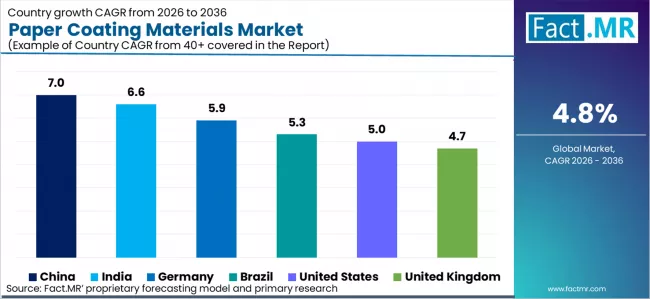
| Country | CAGR (2026-2036) |
|---|---|
| China | 7.0% |
| India | 6.6% |
| Germany | 5.9% |
| Brazil | 5.3% |
| United States | 5.0% |
| United Kingdom | 4.7% |
Asia Pacific Paper Coating Materials Market Analysis
Asia Pacific remains the volume and capacity expansion hub for the paper coating materials market, supported by integrated pulp-to-coating ecosystems, rapid packaging industrialization, and export-oriented barrier innovation. The region combines mineral resource availability with automated high-speed coating line investments, enabling scalable production for both domestic consumption and global packaging supply chains.
- China: China’s market is projected to expand at 7.0% CAGR through 2036. Industrial scale-up in calcium carbonate production and continued investment in automated coating lines are strengthening output efficiency, with capacity expansion estimated at over 7% in recent years. The country is aggressively developing low-cost, high-performance barrier coatings aligned with the global “Plastic-to-Paper” transition. Advanced coatings for tear-resistant and water-repellent e-commerce logistics packaging are further optimizing export-grade performance. [4]
- India: India is forecast to grow at 6.6% CAGR through 2036. Rapid expansion of FMCG and quick-commerce sectors is driving demand for oil- and grease-resistant (OGR) coated papers used in food delivery and organized retail. The country is scaling starch and bio-based coatings derived from agricultural by-products, supporting cost-efficient sustainability positioning. Tier-2 and Tier-3 city growth is boosting demand for premium-feel coated folding cartons in beauty and pharmaceutical packaging. [5]
FACT.MR's Asia Pacific analysis of the paper coating materials market covers China, India, Japan, South Korea, ASEAN, Australia and New Zealand, and Rest of Asia Pacific. Readers can find country-level CAGR projections, coating capacity benchmarks, export-grade barrier innovation trends, and bio-based formulation adoption metrics.
Europe Paper Coating Materials Market Analysis
Europe represents a circular-economy-driven innovation corridor, where regulatory leadership and mono-material recyclability standards are reshaping coating formulations across packaging applications.
- Germany: Germany is expected to grow at 5.9% CAGR through 2036. Under the VerpackG (Packaging Act), strong emphasis on 100% mono-material recyclability is accelerating demand for recyclable barrier coatings. High-barrier coated paper is increasingly replacing multi-layer metallized plastics in savory snack packaging. Germany also leads the EU in industrial biotechnology research, advancing seaweed- and protein-based smart coatings that enhance barrier functionality while maintaining recyclability. [6]
- United Kingdom: The UK is projected to expand at 4.7% CAGR through 2036. Major retailers such as Tesco and Waitrose are advancing plastic-free aisle commitments by 2026/27, driving demand for coated recyclable packaging. Home-compostable coating solutions are gaining traction, particularly in fresh food and takeaway segments. A growing R&D start-up ecosystem is piloting “active packaging” coatings that indicate food freshness, supporting premium functional paper applications. [7]
FACT.MR's European analysis of the paper coating materials market covers Germany, France, the United Kingdom, Italy, Spain, the Nordics, BENELUX, and Rest of Europe. Readers can find VerpackG compliance impacts, retailer sustainability mandate timelines, smart-coating innovation benchmarks, and country-level CAGR projections.
North America Paper Coating Materials Market Analysis
North America remains regulation-driven and innovation-led, supported by specialty coating development and circular infrastructure investments.
- United States: The U.S. market is projected to grow at 5.0% CAGR through 2036. The regulatory pivot away from PFAS-based “forever chemical” barriers is accelerating adoption of safer, water-based and recyclable coatings. Direct-to-consumer brands are investing in specialty tactile coatings to enhance premium “unboxing” experiences. Nano-cellulose innovation is gaining traction, with wood-derived nano-coatings offering high oxygen barrier properties for sensitive electronics and medical packaging.
FACT.MR's North American analysis of the paper coating materials market covers the United States and Canada. Readers can find PFAS transition timelines, nano-cellulose innovation trends, DTC packaging aesthetics benchmarks, and recycling compatibility metrics.
Latin America Paper Coating Materials Market Analysis
Latin America’s growth trajectory is anchored in bio-economy integration and pulp-based vertical manufacturing expansion.
- Brazil: Brazil is forecast to grow at 5.3% CAGR through 2036. Leveraging its large-scale pulp production base, Brazil is integrating on-machine coating capabilities at mill sites to reduce logistics costs. Bio-polymer vertical integration using ethanol and biomass derivatives is supporting localized water-based barrier dispersions.
FACT.MR's Latin American analysis of the paper coating materials market covers Brazil, Mexico, Chile, Colombia, and Rest of Latin America. Readers can find pulp integration benchmarks, bio-polymer coating innovation metrics, agricultural export packaging demand trends, and country-level CAGR projections.
Competitive Aligners for Market Players
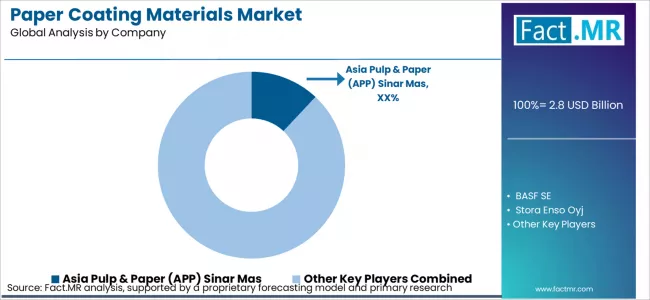
The paper coating materials market is becoming increasingly performance-driven, where competitive advantage depends on formulation expertise, sustainability alignment, and integration with paper mills. Leading mineral suppliers such as calcium carbonate producers benefit from upstream resource control, allowing cost stability and consistent quality in high-volume GCC and PCC applications. Meanwhile, specialty chemical companies are differentiating through advanced barrier technologies that replace plastic laminates while maintaining recyclability and repulpability.
Strategic positioning is shifting toward bio-based and PFAS-free coatings as regulatory pressure intensifies in Europe and North America. Companies investing in starch derivatives, bio-polymers, and nano-cellulose coatings are gaining traction with packaging converters seeking circular economy compliance. Integration at the mill level, particularly in pulp-rich regions like Brazil and China, enhances margin capture through on-machine coating capabilities and reduced logistics costs.
Customer relationships are increasingly collaborative, with coating suppliers working directly with FMCG brands and retailers to co-develop premium, print-enhancing, and moisture-resistant formulations. Overall, success in this market depends on balancing cost competitiveness in commodity coatings with innovation leadership in high-barrier, recyclable, and compostable specialty segments.
Recent Developments
- In 2025, Kemira announced a multi-million-euro investment to expand multiple production lines for strength and coating chemicals used in paper, board, and tissue at its Wellgrow site in Thailand, aiming to serve the growing Asia-Pacific paper and board markets, particularly in Southeast Asia and India.
- In 2025, Solenis showcased a full range of sustainable barrier coating solutions at FACHPACK 2025 and PACK EXPO Las Vegas 2025, designed to enable the shift from plastics to paper-based packaging by repelling liquids, oils, greases, and water vapor with eco-friendly chemistries.
Key Players
- Asia Pulp & Paper (APP) Sinar Mas
- BASF SE
- Stora Enso Oyj
- Dow
- Imerys
- Nippon Paper Industries Co. Ltd
- Eastman Chemical Company
- Minerals Technologies Inc.
- Ingredion
- Roquette
- Burgo Group SpA
- JK Paper
Scope of Report
| Items | Values |
|---|---|
| Quantitative Units | USD 2.8 billion (2026) to USD 4.3 billion (2036), at a CAGR of 4.8% |
| Market Definition | Paper coating materials are mineral- and polymer-based additives applied to paper and paperboard surfaces to enhance brightness, smoothness, opacity, printability, and barrier performance for packaging, publishing, and specialty applications. |
| Product Type | Ground Calcium Carbonate (GCC), Precipitated Calcium Carbonate (PCC), Kaolin Clay, SB Latex, Titanium Dioxide, Wax, Starch, Talc, Others |
| End Use Industry | Packaging Industry, Binding Industry, Stationary Industry, Corrugated Boxes Industry, Others |
| Application | Coated 1, Coated 2, Coated 3, Coated 4, Others |
| Application Coverage | Folding cartons, food-grade oil and grease resistant paper, coated printing paper, corrugated liner and medium coatings, barrier paper for plastic substitution, specialty graphics paper, and industrial packaging grades. |
| Regions Covered | Asia Pacific, Europe, North America, Latin America |
| Countries Covered | China, India, Germany, Brazil, United States, United Kingdom, Rest of Asia Pacific, Rest of Europe, Rest of North America, Rest of Latin America |
| Key Companies Profiled | Omya AG, Imerys S.A., Minerals Technologies Inc., BASF SE, Ashland Inc., Solenis LLC, Kemira Oyj, Clariant AG, Michelman Inc., Dow Inc. |
| Forecast Period | 2026 to 2036 |
| Approach | A hybrid top-down and bottom-up model was applied. Top-down inputs included global paper and packaging production forecasts, sustainability regulation timelines, and plastic substitution targets. Bottom-up inputs covered coating material consumption ratios per ton of paper, average pricing by product type, formulation mix trends, mill-level adoption rates, and primary interviews with coating formulators and paper manufacturers. |
Paper Coating Materials Market by Segments
-
By Product Type:
- Ground calcium carbonate (GCC)
- Precipitated calcium carbonate (PCC)
- Kaolin Clay
- SB latex
- Titanium Dioxide
- Wax
- Starch
- Talc
- Others
-
By End Use Industry:
- Packaging industry
- Binding industry
- Stationary industry
- Corrugated boxes industry
- Others
-
By Application:
- Coated 1
- Coated 2
- Coated 3
- Coated 4
- Others
-
By Region:
- North America
- USA
- Canada
- Mexico
- Latin America
- Brazil
- Chile
- Rest of Latin America
- Western Europe
- Germany
- UK
- Italy
- Spain
- France
- Nordic
- BENELUX
- Rest of Western Europe
- Eastern Europe
- Russia
- Poland
- Hungary
- Balkan & Baltic
- Rest of Eastern Europe
- East Asia
- China
- Japan
- South Korea
- South Asia and Pacific
- India
- ASEAN
- Australia & New Zealand
- Rest of South Asia and Pacific
- Middle East & Africa
- Kingdom of Saudi Arabia
- Other GCC Countries
- Turkiye
- South Africa
- Other African Union
- Rest of Middle East & Africa
- North America
Bibliography
- [1] Imerys. 2024. Imerys announces capacity expansion in calcium carbonate production for packaging applications. Imerys Group Press Release, 2024.
- [2] Omya AG. 2024. Annual Report 2024: Performance Minerals and Sustainable Packaging Solutions Update. Omya Corporate Disclosure, 2024.
- [3] European Commission. 2024. Directive on Reduction of Single-Use Plastics and Packaging Waste Amendments 2024-2025. Official Journal of the European Union, Brussels.
- [4] National Bureau of Statistics of China. 2024. Industrial Output and Paper Manufacturing Capacity Report 2024. Beijing: NBS Publications.
- [5] Ministry of Commerce and Industry, Government of India. 2024. Packaging Industry Development and Food-Grade Paper Demand Report. New Delhi.
- [6] Federal Ministry for the Environment, Germany. 2024. Packaging Act (VerpackG) Implementation Update and Circular Economy Strategy Brief. Berlin.
- [7] UK Department for Environment, Food & Rural Affairs (DEFRA). 2024. Retail Plastic Reduction Commitments and Sustainable Packaging Transition Framework 2024-2027. London.
This Report Addresses
- Strategic intelligence on calcium carbonate capacity scale-up in China, FMCG-driven coated paper demand in India, circular-economy compliance under Germany’s VerpackG, PFAS-free barrier transition in the United States, sustainable retail mandates in the United Kingdom, and pulp-integrated coating expansion in Brazil.
- Market size and forecast: valued at USD 2.8 billion in 2026, projected to reach USD 4.5 billion by 2036 at a 4.8% CAGR, segmented by product type, end use industry, application, and region.
- Growth opportunity mapping across high-brightness GCC and PCC expansion, bio-based starch and latex reformulation, plastic-to-paper barrier substitution, premium print-grade coating upgrades, and on-machine coating integration in pulp-rich economies.
- Country CAGR outlook: China (7.0%), India (6.6%), Germany (5.9%), Brazil (5.3%), United States (5.0%), and United Kingdom (4.7%) with detailed segment splits by product type and application intensity.
- Competitive analysis of Omya AG, Imerys S.A., BASF SE, Kemira Oyj, Solenis LLC, Minerals Technologies Inc., and other regional formulators covering mineral integration, barrier chemistry innovation, mill-level partnerships, and circular compliance capability.
- Product and technology tracking including PFAS-free barrier coatings, nano-cellulose oxygen barriers, bio-polymer dispersions, lightweight mineral formulations, and recyclable mono-material coating systems.
- Regulatory impact analysis covering EU Packaging and Packaging Waste Regulation updates, Germany’s VerpackG enforcement, UK plastic-free retail commitments, U.S. PFAS restrictions, and Asia Pacific sustainability compliance mandates.
- Report delivered in Excel datasets, PowerPoint summary, and detailed PDF supported by packaging production statistics, mineral trade data, sustainability disclosures, regulatory filings, and primary interviews with coating formulators and paper manufacturers.
Table of Content
- Executive Summary
- Global Market Outlook
- Demand to side Trends
- Supply to side Trends
- Technology Roadmap Analysis
- Analysis and Recommendations
- Market Overview
- Market Coverage / Taxonomy
- Market Definition / Scope / Limitations
- Research Methodology
- Chapter Orientation
- Analytical Lens and Working Hypotheses
- Market Structure, Signals, and Trend Drivers
- Benchmarking and Cross-market Comparability
- Market Sizing, Forecasting, and Opportunity Mapping
- Research Design and Evidence Framework
- Desk Research Programme (Secondary Evidence)
- Company Annual and Sustainability Reports
- Peer-reviewed Journals and Academic Literature
- Corporate Websites, Product Literature, and Technical Notes
- Earnings Decks and Investor Briefings
- Statutory Filings and Regulatory Disclosures
- Technical White Papers and Standards Notes
- Trade Journals, Industry Magazines, and Analyst Briefs
- Conference Proceedings, Webinars, and Seminar Materials
- Government Statistics Portals and Public Data Releases
- Press Releases and Reputable Media Coverage
- Specialist Newsletters and Curated Briefings
- Sector Databases and Reference Repositories
- FMR Internal Proprietary Databases and Historical Market Datasets
- Subscription Datasets and Paid Sources
- Social Channels, Communities, and Digital Listening Inputs
- Additional Desk Sources
- Expert Input and Fieldwork (Primary Evidence)
- Primary Modes
- Qualitative Interviews and Expert Elicitation
- Quantitative Surveys and Structured Data Capture
- Blended Approach
- Why Primary Evidence is Used
- Field Techniques
- Interviews
- Surveys
- Focus Groups
- Observational and In-context Research
- Social and Community Interactions
- Stakeholder Universe Engaged
- C-suite Leaders
- Board Members
- Presidents and Vice Presidents
- R&D and Innovation Heads
- Technical Specialists
- Domain Subject-matter Experts
- Scientists
- Physicians and Other Healthcare Professionals
- Governance, Ethics, and Data Stewardship
- Research Ethics
- Data Integrity and Handling
- Primary Modes
- Tooling, Models, and Reference Databases
- Desk Research Programme (Secondary Evidence)
- Data Engineering and Model Build
- Data Acquisition and Ingestion
- Cleaning, Normalisation, and Verification
- Synthesis, Triangulation, and Analysis
- Quality Assurance and Audit Trail
- Market Background
- Market Dynamics
- Drivers
- Restraints
- Opportunity
- Trends
- Scenario Forecast
- Demand in Optimistic Scenario
- Demand in Likely Scenario
- Demand in Conservative Scenario
- Opportunity Map Analysis
- Product Life Cycle Analysis
- Supply Chain Analysis
- Investment Feasibility Matrix
- Value Chain Analysis
- PESTLE and Porter’s Analysis
- Regulatory Landscape
- Regional Parent Market Outlook
- Production and Consumption Statistics
- Import and Export Statistics
- Market Dynamics
- Global Market Analysis 2021 to 2025 and Forecast, 2026 to 2036
- Historical Market Size Value (USD Million) Analysis, 2021 to 2025
- Current and Future Market Size Value (USD Million) Projections, 2026 to 2036
- Y to o to Y Growth Trend Analysis
- Absolute $ Opportunity Analysis
- Global Market Pricing Analysis 2021 to 2025 and Forecast 2026 to 2036
- Global Market Analysis 2021 to 2025 and Forecast 2026 to 2036, By Product Type
- Introduction / Key Findings
- Historical Market Size Value (USD Million) Analysis By Product Type , 2021 to 2025
- Current and Future Market Size Value (USD Million) Analysis and Forecast By Product Type , 2026 to 2036
- Ground Calcium Carbonate
- Kaolin Clay
- SB latex
- Titanium Dioxide
- Ground Calcium Carbonate
- Y to o to Y Growth Trend Analysis By Product Type , 2021 to 2025
- Absolute $ Opportunity Analysis By Product Type , 2026 to 2036
- Global Market Analysis 2021 to 2025 and Forecast 2026 to 2036, By End Use Industry
- Introduction / Key Findings
- Historical Market Size Value (USD Million) Analysis By End Use Industry, 2021 to 2025
- Current and Future Market Size Value (USD Million) Analysis and Forecast By End Use Industry, 2026 to 2036
- Packaging Industry
- Binding Industry
- Stationary Industry
- Corrugated boxes Industry
- Packaging Industry
- Y to o to Y Growth Trend Analysis By End Use Industry, 2021 to 2025
- Absolute $ Opportunity Analysis By End Use Industry, 2026 to 2036
- Global Market Analysis 2021 to 2025 and Forecast 2026 to 2036, By Application
- Introduction / Key Findings
- Historical Market Size Value (USD Million) Analysis By Application, 2021 to 2025
- Current and Future Market Size Value (USD Million) Analysis and Forecast By Application, 2026 to 2036
- Coated 1
- Coated 2
- Coated 3
- Coated 4
- Coated 1
- Y to o to Y Growth Trend Analysis By Application, 2021 to 2025
- Absolute $ Opportunity Analysis By Application, 2026 to 2036
- Global Market Analysis 2021 to 2025 and Forecast 2026 to 2036, By Region
- Introduction
- Historical Market Size Value (USD Million) Analysis By Region, 2021 to 2025
- Current Market Size Value (USD Million) Analysis and Forecast By Region, 2026 to 2036
- North America
- Latin America
- Western Europe
- Eastern Europe
- East Asia
- South Asia and Pacific
- Middle East & Africa
- Market Attractiveness Analysis By Region
- North America Market Analysis 2021 to 2025 and Forecast 2026 to 2036, By Country
- Historical Market Size Value (USD Million) Trend Analysis By Market Taxonomy, 2021 to 2025
- Market Size Value (USD Million) Forecast By Market Taxonomy, 2026 to 2036
- By Country
- USA
- Canada
- Mexico
- By Product Type
- By End Use Industry
- By Application
- By Country
- Market Attractiveness Analysis
- By Country
- By Product Type
- By End Use Industry
- By Application
- Key Takeaways
- Latin America Market Analysis 2021 to 2025 and Forecast 2026 to 2036, By Country
- Historical Market Size Value (USD Million) Trend Analysis By Market Taxonomy, 2021 to 2025
- Market Size Value (USD Million) Forecast By Market Taxonomy, 2026 to 2036
- By Country
- Brazil
- Chile
- Rest of Latin America
- By Product Type
- By End Use Industry
- By Application
- By Country
- Market Attractiveness Analysis
- By Country
- By Product Type
- By End Use Industry
- By Application
- Key Takeaways
- Western Europe Market Analysis 2021 to 2025 and Forecast 2026 to 2036, By Country
- Historical Market Size Value (USD Million) Trend Analysis By Market Taxonomy, 2021 to 2025
- Market Size Value (USD Million) Forecast By Market Taxonomy, 2026 to 2036
- By Country
- Germany
- UK
- Italy
- Spain
- France
- Nordic
- BENELUX
- Rest of Western Europe
- By Product Type
- By End Use Industry
- By Application
- By Country
- Market Attractiveness Analysis
- By Country
- By Product Type
- By End Use Industry
- By Application
- Key Takeaways
- Eastern Europe Market Analysis 2021 to 2025 and Forecast 2026 to 2036, By Country
- Historical Market Size Value (USD Million) Trend Analysis By Market Taxonomy, 2021 to 2025
- Market Size Value (USD Million) Forecast By Market Taxonomy, 2026 to 2036
- By Country
- Russia
- Poland
- Hungary
- Balkan & Baltic
- Rest of Eastern Europe
- By Product Type
- By End Use Industry
- By Application
- By Country
- Market Attractiveness Analysis
- By Country
- By Product Type
- By End Use Industry
- By Application
- Key Takeaways
- East Asia Market Analysis 2021 to 2025 and Forecast 2026 to 2036, By Country
- Historical Market Size Value (USD Million) Trend Analysis By Market Taxonomy, 2021 to 2025
- Market Size Value (USD Million) Forecast By Market Taxonomy, 2026 to 2036
- By Country
- China
- Japan
- South Korea
- By Product Type
- By End Use Industry
- By Application
- By Country
- Market Attractiveness Analysis
- By Country
- By Product Type
- By End Use Industry
- By Application
- Key Takeaways
- South Asia and Pacific Market Analysis 2021 to 2025 and Forecast 2026 to 2036, By Country
- Historical Market Size Value (USD Million) Trend Analysis By Market Taxonomy, 2021 to 2025
- Market Size Value (USD Million) Forecast By Market Taxonomy, 2026 to 2036
- By Country
- India
- ASEAN
- Australia & New Zealand
- Rest of South Asia and Pacific
- By Product Type
- By End Use Industry
- By Application
- By Country
- Market Attractiveness Analysis
- By Country
- By Product Type
- By End Use Industry
- By Application
- Key Takeaways
- Middle East & Africa Market Analysis 2021 to 2025 and Forecast 2026 to 2036, By Country
- Historical Market Size Value (USD Million) Trend Analysis By Market Taxonomy, 2021 to 2025
- Market Size Value (USD Million) Forecast By Market Taxonomy, 2026 to 2036
- By Country
- Kingdom of Saudi Arabia
- Other GCC Countries
- Turkiye
- South Africa
- Other African Union
- Rest of Middle East & Africa
- By Product Type
- By End Use Industry
- By Application
- By Country
- Market Attractiveness Analysis
- By Country
- By Product Type
- By End Use Industry
- By Application
- Key Takeaways
- Key Countries Market Analysis
- USA
- Pricing Analysis
- Market Share Analysis, 2025
- By Product Type
- By End Use Industry
- By Application
- Canada
- Pricing Analysis
- Market Share Analysis, 2025
- By Product Type
- By End Use Industry
- By Application
- Mexico
- Pricing Analysis
- Market Share Analysis, 2025
- By Product Type
- By End Use Industry
- By Application
- Brazil
- Pricing Analysis
- Market Share Analysis, 2025
- By Product Type
- By End Use Industry
- By Application
- Chile
- Pricing Analysis
- Market Share Analysis, 2025
- By Product Type
- By End Use Industry
- By Application
- Germany
- Pricing Analysis
- Market Share Analysis, 2025
- By Product Type
- By End Use Industry
- By Application
- UK
- Pricing Analysis
- Market Share Analysis, 2025
- By Product Type
- By End Use Industry
- By Application
- Italy
- Pricing Analysis
- Market Share Analysis, 2025
- By Product Type
- By End Use Industry
- By Application
- Spain
- Pricing Analysis
- Market Share Analysis, 2025
- By Product Type
- By End Use Industry
- By Application
- France
- Pricing Analysis
- Market Share Analysis, 2025
- By Product Type
- By End Use Industry
- By Application
- India
- Pricing Analysis
- Market Share Analysis, 2025
- By Product Type
- By End Use Industry
- By Application
- ASEAN
- Pricing Analysis
- Market Share Analysis, 2025
- By Product Type
- By End Use Industry
- By Application
- Australia & New Zealand
- Pricing Analysis
- Market Share Analysis, 2025
- By Product Type
- By End Use Industry
- By Application
- China
- Pricing Analysis
- Market Share Analysis, 2025
- By Product Type
- By End Use Industry
- By Application
- Japan
- Pricing Analysis
- Market Share Analysis, 2025
- By Product Type
- By End Use Industry
- By Application
- South Korea
- Pricing Analysis
- Market Share Analysis, 2025
- By Product Type
- By End Use Industry
- By Application
- Russia
- Pricing Analysis
- Market Share Analysis, 2025
- By Product Type
- By End Use Industry
- By Application
- Poland
- Pricing Analysis
- Market Share Analysis, 2025
- By Product Type
- By End Use Industry
- By Application
- Hungary
- Pricing Analysis
- Market Share Analysis, 2025
- By Product Type
- By End Use Industry
- By Application
- Kingdom of Saudi Arabia
- Pricing Analysis
- Market Share Analysis, 2025
- By Product Type
- By End Use Industry
- By Application
- Turkiye
- Pricing Analysis
- Market Share Analysis, 2025
- By Product Type
- By End Use Industry
- By Application
- South Africa
- Pricing Analysis
- Market Share Analysis, 2025
- By Product Type
- By End Use Industry
- By Application
- USA
- Market Structure Analysis
- Competition Dashboard
- Competition Benchmarking
- Market Share Analysis of Top Players
- By Regional
- By Product Type
- By End Use Industry
- By Application
- Competition Analysis
- Competition Deep Dive
- Asia Pulp & Paper (APP) Sinar Mas
- Overview
- Product Portfolio
- Profitability by Market Segments (Product/Age /Sales Channel/Region)
- Sales Footprint
- Strategy Overview
- Marketing Strategy
- Product Strategy
- Channel Strategy
- BASF SE
- Stora Enso Oyj
- Dow
- Imerys
- Nippon Paper Industries Co. Ltd
- Eastman Chemical Company
- Minerals Technologies Inc.
- Asia Pulp & Paper (APP) Sinar Mas
- Competition Deep Dive
- Assumptions & Acronyms Used
List Of Table
- Table 1: Global Market Value (USD Million) Forecast by Region, 2021 to 2036
- Table 2: Global Market Value (USD Million) Forecast by Product Type , 2021 to 2036
- Table 3: Global Market Value (USD Million) Forecast by End Use Industry, 2021 to 2036
- Table 4: Global Market Value (USD Million) Forecast by Application, 2021 to 2036
- Table 5: North America Market Value (USD Million) Forecast by Country, 2021 to 2036
- Table 6: North America Market Value (USD Million) Forecast by Product Type , 2021 to 2036
- Table 7: North America Market Value (USD Million) Forecast by End Use Industry, 2021 to 2036
- Table 8: North America Market Value (USD Million) Forecast by Application, 2021 to 2036
- Table 9: Latin America Market Value (USD Million) Forecast by Country, 2021 to 2036
- Table 10: Latin America Market Value (USD Million) Forecast by Product Type , 2021 to 2036
- Table 11: Latin America Market Value (USD Million) Forecast by End Use Industry, 2021 to 2036
- Table 12: Latin America Market Value (USD Million) Forecast by Application, 2021 to 2036
- Table 13: Western Europe Market Value (USD Million) Forecast by Country, 2021 to 2036
- Table 14: Western Europe Market Value (USD Million) Forecast by Product Type , 2021 to 2036
- Table 15: Western Europe Market Value (USD Million) Forecast by End Use Industry, 2021 to 2036
- Table 16: Western Europe Market Value (USD Million) Forecast by Application, 2021 to 2036
- Table 17: Eastern Europe Market Value (USD Million) Forecast by Country, 2021 to 2036
- Table 18: Eastern Europe Market Value (USD Million) Forecast by Product Type , 2021 to 2036
- Table 19: Eastern Europe Market Value (USD Million) Forecast by End Use Industry, 2021 to 2036
- Table 20: Eastern Europe Market Value (USD Million) Forecast by Application, 2021 to 2036
- Table 21: East Asia Market Value (USD Million) Forecast by Country, 2021 to 2036
- Table 22: East Asia Market Value (USD Million) Forecast by Product Type , 2021 to 2036
- Table 23: East Asia Market Value (USD Million) Forecast by End Use Industry, 2021 to 2036
- Table 24: East Asia Market Value (USD Million) Forecast by Application, 2021 to 2036
- Table 25: South Asia and Pacific Market Value (USD Million) Forecast by Country, 2021 to 2036
- Table 26: South Asia and Pacific Market Value (USD Million) Forecast by Product Type , 2021 to 2036
- Table 27: South Asia and Pacific Market Value (USD Million) Forecast by End Use Industry, 2021 to 2036
- Table 28: South Asia and Pacific Market Value (USD Million) Forecast by Application, 2021 to 2036
- Table 29: Middle East & Africa Market Value (USD Million) Forecast by Country, 2021 to 2036
- Table 30: Middle East & Africa Market Value (USD Million) Forecast by Product Type , 2021 to 2036
- Table 31: Middle East & Africa Market Value (USD Million) Forecast by End Use Industry, 2021 to 2036
- Table 32: Middle East & Africa Market Value (USD Million) Forecast by Application, 2021 to 2036
List Of Figures
- Figure 1: Global Market Pricing Analysis
- Figure 2: Global Market Value (USD Million) Forecast 2021 to 2036
- Figure 3: Global Market Value Share and BPS Analysis by Product Type , 2026 and 2036
- Figure 4: Global Market Y to o to Y Growth Comparison by Product Type , 2026 to 2036
- Figure 5: Global Market Attractiveness Analysis by Product Type
- Figure 6: Global Market Value Share and BPS Analysis by End Use Industry, 2026 and 2036
- Figure 7: Global Market Y to o to Y Growth Comparison by End Use Industry, 2026 to 2036
- Figure 8: Global Market Attractiveness Analysis by End Use Industry
- Figure 9: Global Market Value Share and BPS Analysis by Application, 2026 and 2036
- Figure 10: Global Market Y to o to Y Growth Comparison by Application, 2026 to 2036
- Figure 11: Global Market Attractiveness Analysis by Application
- Figure 12: Global Market Value (USD Million) Share and BPS Analysis by Region, 2026 and 2036
- Figure 13: Global Market Y to o to Y Growth Comparison by Region, 2026 to 2036
- Figure 14: Global Market Attractiveness Analysis by Region
- Figure 15: North America Market Incremental Dollar Opportunity, 2026 to 2036
- Figure 16: Latin America Market Incremental Dollar Opportunity, 2026 to 2036
- Figure 17: Western Europe Market Incremental Dollar Opportunity, 2026 to 2036
- Figure 18: Eastern Europe Market Incremental Dollar Opportunity, 2026 to 2036
- Figure 19: East Asia Market Incremental Dollar Opportunity, 2026 to 2036
- Figure 20: South Asia and Pacific Market Incremental Dollar Opportunity, 2026 to 2036
- Figure 21: Middle East & Africa Market Incremental Dollar Opportunity, 2026 to 2036
- Figure 22: North America Market Value Share and BPS Analysis by Country, 2026 and 2036
- Figure 23: North America Market Value Share and BPS Analysis by Product Type , 2026 and 2036
- Figure 24: North America Market Y to o to Y Growth Comparison by Product Type , 2026 to 2036
- Figure 25: North America Market Attractiveness Analysis by Product Type
- Figure 26: North America Market Value Share and BPS Analysis by End Use Industry, 2026 and 2036
- Figure 27: North America Market Y to o to Y Growth Comparison by End Use Industry, 2026 to 2036
- Figure 28: North America Market Attractiveness Analysis by End Use Industry
- Figure 29: North America Market Value Share and BPS Analysis by Application, 2026 and 2036
- Figure 30: North America Market Y to o to Y Growth Comparison by Application, 2026 to 2036
- Figure 31: North America Market Attractiveness Analysis by Application
- Figure 32: Latin America Market Value Share and BPS Analysis by Country, 2026 and 2036
- Figure 33: Latin America Market Value Share and BPS Analysis by Product Type , 2026 and 2036
- Figure 34: Latin America Market Y to o to Y Growth Comparison by Product Type , 2026 to 2036
- Figure 35: Latin America Market Attractiveness Analysis by Product Type
- Figure 36: Latin America Market Value Share and BPS Analysis by End Use Industry, 2026 and 2036
- Figure 37: Latin America Market Y to o to Y Growth Comparison by End Use Industry, 2026 to 2036
- Figure 38: Latin America Market Attractiveness Analysis by End Use Industry
- Figure 39: Latin America Market Value Share and BPS Analysis by Application, 2026 and 2036
- Figure 40: Latin America Market Y to o to Y Growth Comparison by Application, 2026 to 2036
- Figure 41: Latin America Market Attractiveness Analysis by Application
- Figure 42: Western Europe Market Value Share and BPS Analysis by Country, 2026 and 2036
- Figure 43: Western Europe Market Value Share and BPS Analysis by Product Type , 2026 and 2036
- Figure 44: Western Europe Market Y to o to Y Growth Comparison by Product Type , 2026 to 2036
- Figure 45: Western Europe Market Attractiveness Analysis by Product Type
- Figure 46: Western Europe Market Value Share and BPS Analysis by End Use Industry, 2026 and 2036
- Figure 47: Western Europe Market Y to o to Y Growth Comparison by End Use Industry, 2026 to 2036
- Figure 48: Western Europe Market Attractiveness Analysis by End Use Industry
- Figure 49: Western Europe Market Value Share and BPS Analysis by Application, 2026 and 2036
- Figure 50: Western Europe Market Y to o to Y Growth Comparison by Application, 2026 to 2036
- Figure 51: Western Europe Market Attractiveness Analysis by Application
- Figure 52: Eastern Europe Market Value Share and BPS Analysis by Country, 2026 and 2036
- Figure 53: Eastern Europe Market Value Share and BPS Analysis by Product Type , 2026 and 2036
- Figure 54: Eastern Europe Market Y to o to Y Growth Comparison by Product Type , 2026 to 2036
- Figure 55: Eastern Europe Market Attractiveness Analysis by Product Type
- Figure 56: Eastern Europe Market Value Share and BPS Analysis by End Use Industry, 2026 and 2036
- Figure 57: Eastern Europe Market Y to o to Y Growth Comparison by End Use Industry, 2026 to 2036
- Figure 58: Eastern Europe Market Attractiveness Analysis by End Use Industry
- Figure 59: Eastern Europe Market Value Share and BPS Analysis by Application, 2026 and 2036
- Figure 60: Eastern Europe Market Y to o to Y Growth Comparison by Application, 2026 to 2036
- Figure 61: Eastern Europe Market Attractiveness Analysis by Application
- Figure 62: East Asia Market Value Share and BPS Analysis by Country, 2026 and 2036
- Figure 63: East Asia Market Value Share and BPS Analysis by Product Type , 2026 and 2036
- Figure 64: East Asia Market Y to o to Y Growth Comparison by Product Type , 2026 to 2036
- Figure 65: East Asia Market Attractiveness Analysis by Product Type
- Figure 66: East Asia Market Value Share and BPS Analysis by End Use Industry, 2026 and 2036
- Figure 67: East Asia Market Y to o to Y Growth Comparison by End Use Industry, 2026 to 2036
- Figure 68: East Asia Market Attractiveness Analysis by End Use Industry
- Figure 69: East Asia Market Value Share and BPS Analysis by Application, 2026 and 2036
- Figure 70: East Asia Market Y to o to Y Growth Comparison by Application, 2026 to 2036
- Figure 71: East Asia Market Attractiveness Analysis by Application
- Figure 72: South Asia and Pacific Market Value Share and BPS Analysis by Country, 2026 and 2036
- Figure 73: South Asia and Pacific Market Value Share and BPS Analysis by Product Type , 2026 and 2036
- Figure 74: South Asia and Pacific Market Y to o to Y Growth Comparison by Product Type , 2026 to 2036
- Figure 75: South Asia and Pacific Market Attractiveness Analysis by Product Type
- Figure 76: South Asia and Pacific Market Value Share and BPS Analysis by End Use Industry, 2026 and 2036
- Figure 77: South Asia and Pacific Market Y to o to Y Growth Comparison by End Use Industry, 2026 to 2036
- Figure 78: South Asia and Pacific Market Attractiveness Analysis by End Use Industry
- Figure 79: South Asia and Pacific Market Value Share and BPS Analysis by Application, 2026 and 2036
- Figure 80: South Asia and Pacific Market Y to o to Y Growth Comparison by Application, 2026 to 2036
- Figure 81: South Asia and Pacific Market Attractiveness Analysis by Application
- Figure 82: Middle East & Africa Market Value Share and BPS Analysis by Country, 2026 and 2036
- Figure 83: Middle East & Africa Market Value Share and BPS Analysis by Product Type , 2026 and 2036
- Figure 84: Middle East & Africa Market Y to o to Y Growth Comparison by Product Type , 2026 to 2036
- Figure 85: Middle East & Africa Market Attractiveness Analysis by Product Type
- Figure 86: Middle East & Africa Market Value Share and BPS Analysis by End Use Industry, 2026 and 2036
- Figure 87: Middle East & Africa Market Y to o to Y Growth Comparison by End Use Industry, 2026 to 2036
- Figure 88: Middle East & Africa Market Attractiveness Analysis by End Use Industry
- Figure 89: Middle East & Africa Market Value Share and BPS Analysis by Application, 2026 and 2036
- Figure 90: Middle East & Africa Market Y to o to Y Growth Comparison by Application, 2026 to 2036
- Figure 91: Middle East & Africa Market Attractiveness Analysis by Application
- Figure 92: Global Market - Tier Structure Analysis
- Figure 93: Global Market - Company Share Analysis
- FAQs -
How large is the paper coating materials market in 2025?
The market was valued at approximately USD 2.6 billion in 2025.
What will the market size be in 2026?
The market is estimated to reach USD 2.7 billion in 2026.
What is the projected market size by 2036?
The market is projected to reach USD 4.3 billion by 2036.
What is the expected CAGR from 2026 to 2036?
The market is expected to grow at a CAGR of 4.8% during the forecast period.
Which product type holds the leading share?
Ground Calcium Carbonate (GCC) holds the leading share due to its cost efficiency and brightness enhancement properties.
Which end use industry dominates demand?
The packaging industry dominates demand driven by coated paperboard and carton applications.
Which application segment leads the market?
Coated 1 leads the market due to its widespread use in printing and standard packaging grades.
Which region represents the largest market?
Asia Pacific represents the largest market due to strong paper production capacity and packaging demand.
Why is sustainability influencing the market?
Sustainability mandates are accelerating the shift toward recyclable and bio-based coating formulations.
How is plastic substitution impacting growth?
The transition from plastic laminates to coated recyclable paper is driving barrier coating innovation.
What role does e-commerce play in market expansion?
Rising e-commerce shipments are increasing demand for coated corrugated and folding carton packaging.
Are bio-based coatings gaining traction?
Yes, starch- and biomass-derived coatings are gaining momentum due to environmental regulations and brand commitments.